4824
SYSTEM
DESIGN
OF
SYMPTOM
DETECTION
OF
MILD
COGNITIVE
IMPAIRMENT
WITH
OBSERVATIONAL
ROBOT
1GO-EUM CHA, 2DO-EUN KIM, 3KANG-HEE LEE
1Soongsil University, School of Computer Science & Engineering, Seoul, Korea 2Soongsil University, Global School of Media, Seoul, Korea
3Soongsil University, Global School of Media, Seoul, Korea
E-mail: 1[email protected], 2[email protected], 3*[email protected]
ABSTRACT
This paper proposes a robot observation system that enables users to recognize mild cognitive impairment and early dementia. The behavior of users will be recognized by a household robot to accumulate behavioral data which are forgetfulness, wandering and sleep disorder that is suspicious of dementia symptoms. DemTect, which is a sensitive examination tool of cognitive impairment for early dementia, can check symptoms of dementia immediately by data. This process proceeds continuously. If the user is evaluated to be below the normal range after the DemTect evaluation, this system notifies the caregiver that user should be needed professional inspection, which proceeds continuously. This system has the purpose not only to recognize signs but also to respond promptly to early dementia.
Keywords: Robot System Design, Mild Cognitive Impairment, Diagnostic System, Mobile Application, Web
Application
1. INTRODUCTION
1.1 Background
In 2017, there are an estimated 962 million people aged 60 or over in the world, comprising 13 percent of the global population. The population aged 60 or above is growing at a rate of about 3 percent per year. Rapid ageing will occur in other parts of the world as well so that by 2050 all regions of the world except Africa will have nearly a quarter or more of their populations at ages 60 and above [1].
According to the OECD survey in 2014, 17 of the 37 nations were an aged society with an elderly population of more than 17%[2]. This means that many countries have entered the aging society, and therefore there is an urgent need to study and care for the elderly and geriatric diseases. In addition, current people want a healthy old age life as their life expectancy. However, due to an increase in life expectancy, cerebral-related degenerative diseases such as vascular dementia and Alzheimer’s dementia have been increased and the cause has not been clarified yet. Therefore, the attention of these diseases will be needed [3].
Dementia is a major disease that occurs in the elderly, and it is a major disease that increases the burden on the national healthcare finances as the early detection and treatment of dementia are delayed. According to a report by Alzheimer’s Disease International (ADI) in 2015, the number of people with dementia is expected to double every 20 years [5]. The increase in the number of people with dementia is a global problem, and the World Health Organization recognized it as a major public health problem [6]. However, since the current dementia does not have the complete remedy through elimination of the causative factor, but it is at the level of alleviation of the symptom. Therefore, it is important to treat dementia in early stage to minimize the quality of life and loss of medical expenses [7].
4825 helps identify neuropsychological dysfunction, MCI, and dementia [9]. Moreover, individual and continuous observation based on understanding of disease as well as cognitive screening is important for the diagnosis of MCI [10]. However, due to the need for individual observations tailored to the characteristics of the patient, continuous observation by the experts has two drawbacks. First, it requires a tremendous amount of human resources. Second, the final judgment may not reflect the current state of patient [11]. Therefore, it is necessary to introduce an automated robot system in order to efficiently perform individualization and accurate observation of patients.
1.2 Goals
The system in this paper is a new diagnostic-social robotic system, driven by a growing number of attempts to integrate artificial intelligence into robots. Unlike a robot, a caregiver cannot keep eyes on a subject that they want to observe for every time, and it is difficult to notice the details. Therefore, the purpose of the system we develop is two points. One is to help the caregivers protect the target users through the observation robot. Another one is that, by implementing a structure for diagnosing mental disorder in the observed target, additionally gathered information enables continuous care of the potential patients. This system presents the possibility of the diagnostic-social robot system.
We propose a cognitive test system to identify the individual cognitive state of the patient and an early dementia recognition robot system that implements the behavior recognition algorithm based on the symptoms of mild cognitive impairment. The specific objectives are as follows.
● To build a cognitive screening test that is optimized for the diagnosis of mild cognitive impairment.
● To identify the behavioral characteristics of mild cognitive impairment and design a behavioral recognition algorithm.
● To design a system that reports the results of the above system to caregivers or experts.
1.3 Terminology
First of all, target user refers to the person who directly takes the test. The user can be observed by a robot in daily use to recognize their abnormal behavior. This user group is mainly in their 50s or older who are likely to suffer from dementia. The user may be living with the family, but the elderly living alone can be also be targeted. This user group
may refer to a patient already suffering from mild cognitive impairment.
The expert refers to those who have expertise in mild cognitive impairment and can make a medical diagnosis. They can monitor and diagnose the user’s symptoms through information in the diagnostic system, if necessary, by combining the patient’s information and the caregiver’s survey can contact the caregivers for professional treatment.
Caregivers can be referred to the guardians of target user group. They may live in the same residential environment with target user but may not be living together. They conduct surveys from experts about target user.
2. RELATEDRESEARCHES
2.1 Definition and Behavioral symptoms of
Mild Cognitive Impairment
2.1.1 Mild Cognitive Impairment (MCI)
Mild Cognitive Impairment (MCI) is defined as the symptoms of patients that have low scores of verbal recall, visuo-spatial recall, verbal fluency and naming, visual recognition, objective sorting and etc. without dementia symptoms. [11]
2.1.2 Behavioral symptoms of Mild Cognitive
Impairment
MCI is classified as a transitional phase between normal aging and Alzheimer’s disease, with heterogeneous and diverse symptoms. It is characterized by mild memory impairment and is thought to be a precursor to Alzheimer’s disease[12], Symptoms of Alzheimer’s disease includes forgetfulness, disorientation, wandering, and sleep disorder. MCI also accompanies these symptoms with memory decay[13].
2.2 Definition and Behavioral symptoms of Mild
Cognitive Impairment
2.2.1 DemTect
4826 15, 16, 17]. The interpretation of the DemTect score is shown in the following table 1.
Table 1: Interpretation of DemTect scores [14]
Total Score Diagnosis Recommendat ion 13-18 Cognitive
abilities appropriate for
target age
Retry DemTect after 12 months
or when symptoms get
worse 9-12 Mild cognitive
impairment Retest DemTect after 6 months - Observation
course 0-8 Suspected as
dementia
Additional diagnostic instructions, start treatment
2.2.2 Reasons for selecting DemTect
A variety of tools such as Mini-Mental State Examination (MMSE), Clock-drawing-test (CDT), PANDA [18], EASY [19], MUSIC [20] and DemTect. However, DemTect is currently recommended as an early screening tool for dementia in the tertiary consensus conference in Canada and The German neuroscience (destscheesellschaftfürneurologie; DGN) and has been translated into several languages, including German, English, French, and Polish [21]. In addition, what is important in cognitive testing tools is the reinforcement of testing according to age and education. The evaluation of DemTect is based on the 12-year-old basic education level, with one additional point on the total score [22]. DemTect was selected as a testing tool for the early diagnosis of dementia by an internationally recognized organization, because of its sensitivity to diagnose MCI.
2.3 Detection-Methods of Behavioral Symptoms
of Patient
2.3.1 Inquiry using B-ADL(Bayer Activities of
Daily Living)
Patients with dementia have a decline in IADL (Instrumental Activities of Daily Living) due to decreased cognitive function. The evaluation of IADL in dementia patients is important for the following reasons. First, the evaluation of IADL is necessary to diagnose dementia. In order to diagnose dementia, not only the cognitive disorder but also the significant disability of everyday life and social life
are required [26]. This suggests that dementia may not be present unless the cognitive decline of the patient has a meaningful impairment in daily life. Therefore, evaluation of daily living ability is necessary. Second, the evaluation of IADL is useful for early diagnosis of dementia [27]. IADL is susceptible to early diagnosis of dementia because it declines from the early stages [28]. Finally, through IADL evaluation, the medical practitioner can get detailed information about the degree of independence of the patient's daily life and refer to the treatment [27]. For IADL evaluation, it is preferable for the medical person to make an evaluation by interviewing the carer and the patient. Therefore, the carer's IADL evaluation paper will give priority to the medical person to evaluate the IADL. Bayer-ADL (B-ADL), which was developed to be used internationally as a collaborative work of the United States, Germany, the United Kingdom, Russia, Greece, will be used as the paperwork tool [29].
2.3.2 Observation of robot
Behavior recognition through the camera of the robot is carried out to recognize and identify the symptoms of dementia such as roaming and sleeping disorder. In addition, in the case of the elderly living alone, it is not easy to catch up with their anomalies because it is difficult for the caregiver’s IADL evaluation to be done.
2.4 Technical Approach in Related Studies
Various technical studies have been conducted to determine or alleviate dementia symptoms. There are researches such as a system that recognizes symptoms of dementia by making a communication module with a computer avatar, [23] and a cat robot that alleviates symptoms of dementia through interaction with dementia patients [24]. Studies by Nowak and Biocca (2003) show that images with low anthropomorphism increase coexistence [25], demonstrating that several studies use simplified characters or animal shapes for effective interaction.
4827 caregiver can learn the way of communication to patients.
The analysis of PARO [31], it verifies the patient’s positive reaction and intimacy to the robot through the real interaction experiment between dementia patients and PARO. Analyzing the behavior of participants, the average physical and verbal interaction grows linearly. It proves that dementia patients willingly interact with the robot.
Safety care system based on dementia assessment system is also proposed. Using RFID, a caregiver can follow up patients’ indoor and outdoor activities and prevent them from the hazardous area. To guide the appropriate safety monitoring system to the caregiver, it offers dementia assessment system by using eXtensible-Markup-Language(XML) technology. Caregiver design the questionnaire from the website so that they can produce assessment systems easily. [32] These two systems make caregivers can quickly identify the patient’s safety.
At last, a software-based on knowledge-base-system obtaining data from microphone or camera provides help to caregiver’s or robot’s patient care as forms of Graphic User Interface (GUI) or robot system.[33] The purpose is to provide appropriate care to the patient through observation.
3. DESIGN OF SYMPTOM DETECTION OF EARLY DEMENTIA WITH
OBSERVATIONAL ROBOT
3.1 Problem Definition
It mainly selects elderly people living with their families or seniors living alone. The robotic system first performs DemTect, which is the cognitive screening test mentioned in 2.2.1, and the expert directly judges whether the dementia is suspected based on the performance results. Based on the derived results, we can observe the daily life of the subject through the robot system so that the behavioral characteristics of the MCI described in 2.1.2 can be found. If behavioral characteristics of MCI or dementia are repeated more than a certain number of times on the basis of continuous behavioral observation, the presence of suspected dementia is confirmed by DemTect test again. IF the DemTect score is less than 12, a notice of suspicion will be sent to the caregiver.
3.2 Overall Architecture
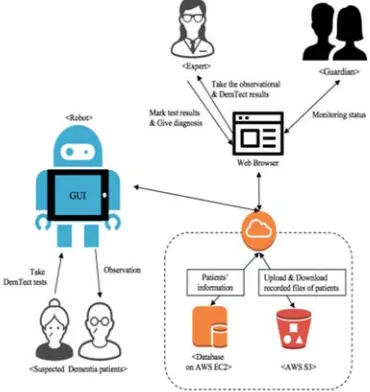
The person who is at risk of developing dementia symptoms is arranged in the interaction environment to transmit the instructions or conduct the test through the graphical interface. The patient’s
[image:4.612.323.508.216.412.2]behavior pattern is analyzed through a microphone and sensors around the robot and transmitted to the system. Experts analyze the test results information and behavior pattern information gathered through the system and make input the expected diagnosis results into the managing system. Based on the input diagnosis results, the robot continuously analyzes the behavior pattern, and the caregivers can acquire the condition of the subject based on the given information.
Figure 1: System Design of Interaction between System Users, Robot and Caregiver
3.3 LOCAL: Robot Graphical User Interface
4828
Figure 2: Experiment robot, Q.bo
3.4 REMOTE: Web Browser
For providing an easy way to manage users’ information and to analyze the results of testing and behavior observation, a managing system is presented in web application. This application is executed by Django framework (v1.8) uWSGI on Amazon AWS EC2 instance. The information that the database already has been gathered for this system will be presented by web browser.
3.5 Database
The database that possess every information of each user is created by Django ORM (Object-relational mapping) in MySQL. This database is managed exclusively to other process. If the data is requested by mobile application, it will be shared by calling handmade API which can access database by PHP. In another way, if the web pages request information to be shown, Django framework filters appropriate one.
4. SCENARIO DESIGN
4.1 Integrated Scenario
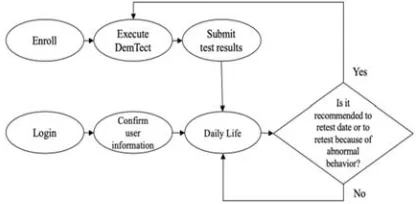
As shown in Figure 3, we start with the user's basic information registration and proceed with the cognitive impairment test (this) for the first time. The results of the cognitive test and the results observed by the robot are merged so that the expert can remotely check the presence or absence of the dementia of the subject.
Figure 3: Flowchart of Integrated Scenario
4.2 Target Scenario
[image:5.612.316.524.484.586.2]In the life of the general public, a robot that includes a camera and a microphone is placed, and DemTect, a cognitive screening test, is performed, and the result is used to detect a change in life pattern that may cause early cognitive dysfunction. Changes in life patterns include sleep habits change and wandering. In case of receiving the notification of retry of cognitive screening according to the recommendation in the table of 2.2.1, the test is performed through the graphical interface of the robot. A simple dialogue is provided through the dialogue screen provided in the GUI environment. Daily conversations will be done with robots and nurturing.
Figure 4: Flowchart of Target Scenario
4.3 Expert Scenario
4829 screening test, encourage the retest. If the target user has a potential to be a patient, the system will send a request for a request to visit doctor.
4.4 Caregiver Scenario
The robot will be installed outside the behavior radius of the patient or the subject to be observed. Patient registration and then cognitive screening will be progressed. However, it shall be possible for the test subject to carry out the test alone so as not to affect the test at all. They will observe the cognitive screening results of the patients entered by the specialist and follow the behavioral guidelines recommended to the caregiver. At last, caregivers receive alarms related to surveys and conduct surveys on whether or not they live together and observations. (B-ADL)
4.5 Detection System Scenario
Based on the results of cognitive screening conducted by the patient, the normal group and the risk group are classified. If the patient is in group of possible dementia patients, a notification is sent according to the recommended retest period according to the test score. If the retest results show that the patient has symptoms of dementia possibly, the result notification will be sent to the caregiver.
The dialogue with the patient with mild dementia is conducted so that the symptoms do not deteriorate. When conducting the retest, send a survey letter to the guardian. Before the survey is conducted, confirm whether or not you live together. At the time of cohabitation, the guardian will be allowed to conduct surveys. During non-cohabitation, guardians should not conduct surveys and experts should be able to determine the status of the target only as a result of DemTect. If it is not possible to check whether or not the system is alive for a certain period of time on the system, determine the status of the target by DemTect result.
For the possible developed scenario, continuous observation can prevent not only mild cognitive impairment but also other diseases. What’s more, when an elderly person is in an emergency, if the elderly person has no movement for a certain period of time (in case of loneliness), he or she can notify the specialist and the guardian so that the first aid or follow-up can be taken.
4.6 Recognition Patient Behavior Scenario
We use a robot to observe problem behaviors that may be associated with dementia in the subjects. If the robot continuously detects an abnormal behavior such as a sleeping disorder or roaming of the subject, it accumulates the number of times and checks DemTect information when it is
[image:6.612.316.522.149.336.2]detected more than 5 times in the system. This abnormal information is collected to help experts to judge whether the user has the possibility of disease.
Figure 5: System Design of symptom recognition of
patient behavior
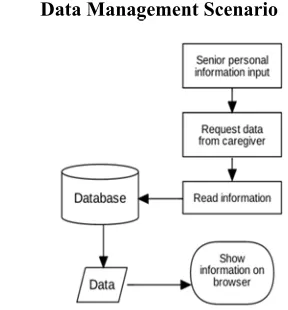
4.7 Data Management Scenario
Figure 6: System Design for caregiver to monitor senior
5. Experiments
5.1 Target Scenario
5.1.1 DemTect Test
5.1.1.1 10 words list repetition
[image:6.612.329.473.391.546.2]4830
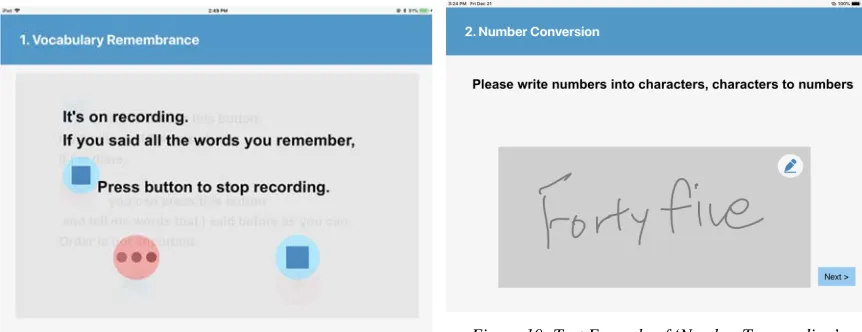
Figure 7: Test process of ‘Word List’
Figure 8: Recording process interacting with a target
To accomplish this with a mobile device, a set of 10-word lists is stored in the database. When a patient presses a speaker button to perform this test, one of the 10 sets will randomly speak 10 words through the speaker. Then the patient presses the microphone button to record the 10 memorable words. This will be used as a resource for professional scoring through web services.
5.1.1.2 Number transcoding
[image:7.612.91.532.62.253.2]Number transcoding is a test converting the format of numbers.
[image:7.612.90.521.291.457.2]Figure 9: Test example of ‘Number Transcoding’
Figure 10: Test Example of ‘Number Transcoding’
As shown in Figures 9 and 10, given that ordinary cognitive tests are provided to test takers in paper form, we used two methods to make input of correct answer writing on the screen or using the mobile keyboard. Each form of problem is given twice, randomly assigned by the server. This drawn or typed answer is sent to the server and used for each user’s DemTect scoring.
5.1.1.3 Semantic word fluency task (Supermarket task)
4831
Figure 11: Test example of ‘Supermarket Task’
5.1.1.4 Backward digit span
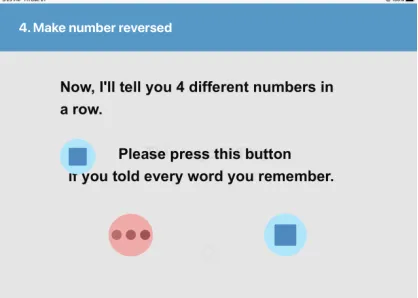
[image:8.612.310.523.295.451.2]This test consists of two parts, listening to the series of numbers and speaking number series reversely (refer to figure 12).
Figure 12: Test example of ‘Backward Digit Span’ of 4
numbers
A set of this test has random numbers from two random numbers up to six. There are two trials that are performed in this test.
5.1.1.5 Delayed word list recall
This test aims to recall the words mentioned in the 10 words list repetition performed in the previous step (refer to figures 13 and 14).
Figure 13: Test example of ‘Delayed Word List Recall’
Figure 14: Recording View of ‘Delayed Word List
Recall’
As shown in Figure 14, when user pressed microphone button, recording will be started, and user can put their answers in audio file after finishing recording.
5.1.2 Detection Sensors
[image:8.612.90.299.337.486.2]4832
Figure 15: Sensors for Human and Illuminance
Detection
5.2 Expert Scenario
5.2.1 Front Page
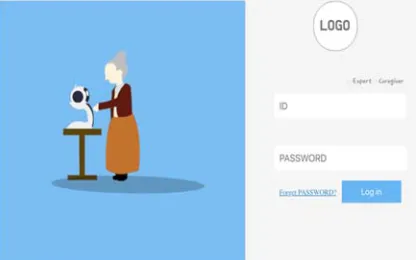
[image:9.612.313.527.299.442.2]After logging in on the first page, the expert can check his or her patient information.
Figure 16: Main Page- Initial screen
To distinguish from caregiver and other professionals for protecting patient’s and caregiver’s private information, they have to click radio button to verify their status. The radio buttons check ID and grant authority of accessing patient’s information (refer to figure 16).
5.2.2 List Page
Through this page, the experts are able to see a list of patients and their caregivers in charge. In this page, the experts can move to the monitoring page of each patient and caregiver. If the experts click the tab composed by HTML button tag and JavaScript code, an additional screen that has images linked to patient report and caregiver report is created.
Figure 17: Patient List - Initial screen
Figure 18: Patient List - additional screen
Clicking the patient report image, experts can move the result monitoring page which they can check the patient’s test result and behavior monitoring result. In caregiver report page, the expert can check the result of caregiver’s B-ADL inquiry. If there are new patient’s test result or caregiver’s inquiry result, the image of bulb changes to yellow to alarm the experts (refer to figures 17 and 18).
5.2.3 DemTect Test Checking Page
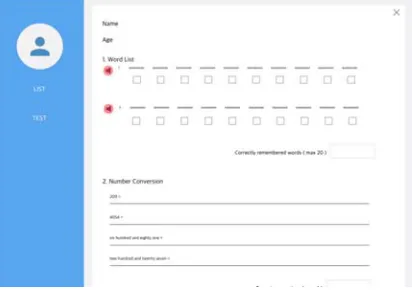
It is a page where a expert can mark the patient's DemTect Test (refer to figures 19, 20, and 21). The patient's voice and text image data from the test such as 10-word list repetition, number transcoding, semantic word fluency task, and backward digit span can be checked, and the patient can be scored.
[image:9.612.92.300.374.504.2]4833 list repetition, semantic word fluency task, and backward digit span. By using checkbox and text input, he can evaluate and record voice data.
[image:10.612.93.299.188.333.2]In ‘Number Transcoding’ section, the text image which is written by the patient is showed up, so the experts can check the patient’s cognitive status more accurately.
Figure 19: DemTect Checking Page 01
Figure20: DemTect Checking Page 02
Figure 21: DemTect Checking Page 03
5.2.4 Patient’s Result Monitoring Page
This is a page that monitors the DemTect test results and behavior recognition results of each patient. In the first table, you can see the score for each task and the transformed score for converting 18 points to the maximum score.The table below is a reference table and an outline of the score so that the patient can be immediately assessed.
The second table shows the number of sleep disturbances and the number of wandering detected by the robot's camera. The expert can judge these results comprehensively and ask for a visit to the caregiver or the patient himself or ask for a re-diagnosis.
5.2.5 Caregiver Inquiry Monitoring Webpage
[image:10.612.88.524.357.707.2]This is a page which monitors the results of the protector's survey. The result of the B-ADL survey entered by the caregiver can be confirmed in the same environment as the caregiver. The number and checkbox of the input tag are used to load the numeric data and the checkbox data entered by the protector through the server and display it on the screen. Based on the results of this survey and the DemTect Test performed in 5.1.1, the patient's condition can be evaluated comprehensively.
4834
Figure 23: Caregiver Inquiry Monitor Page 02
5.3 Caregiver Scenario
5.3.1 Front Page
[image:11.612.314.524.290.442.2]Not only expert but also caregivers should log in to check their patient’s cognitive status data. They have to click ‘caregiver’ radio button to verify their ID and password. After verifying their ID and password, they can access their test and inquiry data.
Figure24: Main Page- Initial screen
5.3.2 Patient Monitoring Webpage
This is a page where the caregiver can continuously track and confirm the patient's DemTect Test result and behavioral impairment recognition result. First, the graph shows the patient's DemTect Test results. I wanted to visualize the patient's results using a JavaScript open source based on a canvas tag named Chart.js in figure 25. In addition to this, it is designed to enable continuous observation and tracking by allowing the cumulative number of behavioral disorders to be identified by attaching a behavioral disorder recognition result sheet in figure 26.
Figure 25: Patient Monitoring Webpage 01
Figure 26: Patient Monitoring Webpage 02
5.3.3 Caregiver’s Inquiry of Bayer-Activities of Daily Living Webpage
[image:11.612.91.290.416.543.2]4835
Figure 27: Caregiver’s Inquiry of Bayer-Activities of Daily Living Webpage 01
Figure 28: Caregiver’s Inquiry of Bayer-Activities of Daily Living Webpage 02
6. Conclusion
We have designed and developed a system of mild cognitive impairment symptoms. We provide an environment using a robotso that can detect and diagnose cognitive impairment.A mobile application and web application are implemented to overcome limitation that robot cannot provide cognitive testing interface and to provide a managing system. In supporting this system, our motivation is to provide diagnosis environment with the advantages of convenient system and inexpensive price of diagnose mild cognitive impairment.
Our current work consists of many potentials for future work. The robot we have used to deliver the system has the potential to be extended into a social robot through the implementation of the chatbot conversation function. If we add the ability to talk to people using this robot, the system can have not only a diagnostic service but also an interactive robot. As a result, target users and their caregivers will continue to receive professional help, not only
to respond to their mental changes but also improving their cognitive abilities. Moreover, future research will be extended to a system for dementia patients. It is possible to develop into a patient protection system as well as an integrated residential environmental management system.
ACKNOWLEDGEMENT
THISRESEARCHWASSUPPORTEDBYBASIC
SCIENCE RESEARCH PROGRAM THROUGH
THENATIONALRESEARCHFOUNDATIONOF KOREA(NRF)FUNDEDBYTHEMINISTRYOF EDUCATION(NRF-2017R1D1A1B05036028).
REFERENCES:[1] Department of Economic and
Social Affairs, “World Population Prospects: The 2017 Revision, Key Findings and Advance Tables.” Population Division (2017). United Nations (New York)
[2] https://data.oecd.org/pop/elderly-population.htm 20 : 34, 11:34, 15/01/2018
[3] Kang, Mi-Ae; Baek, Yong-Mae. “The Neurocognitive Function Between the Patients Who had Subjective Memory Impairment and Mild Cognitive Impairment.” Korean Geriatric Society, Vol. 18, No. 1, 2014, pp.7-15.
[4] Wimo, A., Jonsson, L., Bond, J., Prince, M., Winblad, B. “The worldwide economic impact of dementia 2010”, Alzheimers Dement, Vol. 9, No. 1, 2013, pp.1-11.
[5] Prince, M., Wimo, A., Guerchet, M., Ali, G. C., Wu, Y. T., &Prina, M. (2015). “World Alzheimer Report 2015. The Global Impact of Dementia.” Alzheimer’s Disease International. (ADI), Alzheimer’s Disease International (London), 2015.
[6] World Health Organization. “Dementia: a public health priority.” World Health Organization, 2012.
[7] Sam-Yeon Lee, Jae-Min Kim, Joon-AnYoo and Il-Seon Shin, "Screening Instruments for Dementia," Journal of the Korean Society of Biological Therapies in Psychiatry, Vol. 12, No. 2, 2006, pp. 131~139.
4836 [9] Kalbe, E., Calabrese, P., Fengler, S., Kessier, J.
“DemTect, PANDA,EASY, and MUSIC: cognitive screening tools with age correction and weighting of subtests according to their sensitivity and specificity.”, Journal of Alzheimer's Disease, Vol. 34, No. 4, 2013, pp.813-834.
[10] Carlos Fernández-Llatas, Juan Miguel Garcia-Gomez, Javier Vicente, Juan Carlos Naranjo, Monserrat Robles, Jose Miguel Benedi, Vicente Traver, "Behaviour patterns detection for persuasive design in Nursing Homes to help dementia patients," 2011 Annual International Conference of the IEEE Engineering in Medicine and Biology Society, Boston 2011, pp. 6413-6417.
[11] Petersen, R. C., Doody, R., Kurz, A., Mohs, R. C., Morris, J. C., Rabins, P. V., et al, “Current concepts in mild cognitive impairment”, Archives of neurology, Vol. 58, No. 12, 2001, pp.1985-1992.
[12] Jellinger, K. A. "Mild cognitive impairment. Aging to Alzheimer's disease." European Journal of Neurology Vol. 10, No. 4, 2003, pp. 466-466. [13] Jong-Whan, Kim, Myoung-Keun, Kim, “A study on the architectural planning through the analysis between the Behavior character of Dementia patient”, Journal of the Korean Digital Architecture Interior Association Vol.6, No. 2, 2006, pp. 55-63.
[14] E. Kalbe, J. Kessler, et. al. “Demtect: a new, sensitive cognitive screening test to support the diagnosis of mild cognitive impairment and early dementia”, International Journal of Geriatric Psychiatry, Vol. 19, 2004, pp. 136-143.
[15] HowardChertkow MD, FadiMassoud MD, Ziad Nasreddine MD, Sylvie Belleville PhD, Yves Joanette PhD, Christian Bocti MD, ValérieDrolet BSc, John Kirk MD, Morris Freedman MD, Howard Bergman MD, “Diagnosis and treatment of dementia: 3. Mild cognitive impairment and cognitive impairment without dementia”, Vol. 178, No. 10, 2008, pp. 1273-1285.
[16] Jacova, C., Kertesz, A., Blair, M., Fisk, J. D., & Feldman, H. H. ,"Neuropsychological testing and assessment for dementia.", Alzheimer's & Dementia, Vol. 3, No.4, 2007, pp. 299-317. [17] Mitchell, A. J., and A. J. Larner. "Cognitive
Screening Instruments. A Practical Approach." ,2013.
[18] Kalbe E, Calabrese P, Kohn N, Hilker R, Riedel O, Wittchen H-U, Dodel R, Otto J, Ebersbach G, Kessler J, “Screening for cognitive deficits in
Parkinson’s disease with the Parkinson Neuropsychometric Dementia Assessment (PANDA) instrument, Parkinsonism RelatDisord, Vol. 14, 2008, pp. 93-101.
[19] Kessler J, Ozankan M, Baller G, Kaesberg S, Kalbe E, “A non-verbal dementia screening: EASY [German].”, DGPPN Conference 2010(Conference of the German Association for Psychiatry and Psychotherapy, DGPPN), 2010. [20] Calabrese P, Kalbe E, Kessler J, “The Multiple
Sclerosis Inventory Cognition(MUSIC): A neuropsychological screening tool for the detection of cognitive deficits for MS patient [German]”, NeuroPsycho, Vol. 30, 2004, pp. 317-321.
[21] Bo-Min, Lee, “Validity study on the Korean version of DemTect.”, Department of Occupational Therapy, Inje University, 2006. [22] Kessler J, Calabrese P, Kalbe E, et al.,
“DemTect: Ein neues Screening-VerfahrenzurUnterstützung der Demenzdiagnostik”, Psycho, Vol. 26, 2000, pp. 343-347.
[23] H. Tanaka, H. Adachi, et al, “Detecting Dementia Through Interactive Computer Avatars”, IEEE Journal of Transiational Engineering in Health and Medicine, Vol. 5, 2017, pp. 2200111.
[24] R. Picking, J. Pike, “Exploring the effects of interaction with a robot cat for dementia sufferers and their carers”, Internet Technologies and Applications, 2017, pp. 209-210.
[25] K. Nowak, F. Biocca, “The Effect of the Agency and Anthropomorphism on User’s Sense of Telepresence, Copresence, and Social Presence in Virtual Environments”, 2003, pp. 481-494. [26] American Psychiatric Association, “Diagnostic
and statistical Manual of Mental Disorders, Fourth Edition(DSM-IV)”, American Psychiatric Association(Washington D.C.), 1994 [27] Rubin EH, Morris C, Grant EA, VendegaT,
“Very Mild Senile Dementia of the Alzhimer’s Type. I: Clinical Assessment”, Archives of Neurology, Vol. 46, 1989, pp. 379-382.
[28] Juva K, Makela M, Erikinjuntti T, Sulkava R, Yilkoski R, Valvanne J, Tilvis R. “Functional Assessment Scales in Detecting Dementia” Age and Ageing, Vol.26, 1997, pp. 393-400.
4837 Caregivers a Patient’s Current Non-Critical Condition Indirectly.”, GECCO '18 Proceedings of the Genetic and Evolutionary Computation Conference Companion, GECCO, July 15-19, 2018, pp. 1841-1844.
[31]Wan-Ling Chang, Selma Šabanovié and Lesa Huber, “Use of Seal-like Robot PARO in Sensory Group Therapy for Older Adults with Dementia”, HRI '13 Proceedings of the 8th ACM/IEEE international conference on Human-robot interaction, HRI, March 03-06, 2013, pp. 101-102.
[32]C. Lin, P. Lin, P. Lu, G. Hsieh, W. Lee and R. Lee, "A Healthcare Integration System for Disease Assessment and Safety Monitoring of Dementia Patients," in IEEE Transactions on Information Technology in Biomedicine, vol. 12, no. 5, pp. 579-586, Sept. 2008.
![Table 1: Interpretation of DemTect scores [14]](https://thumb-us.123doks.com/thumbv2/123dok_us/8898399.953953/3.612.93.301.143.321/table-interpretation-of-demtect-scores.webp)