IJPSR (2016), Vol. 7, Issue 1 (Research Article)
Received on 22 July, 2015; received in revised form, 20 October, 2015; accepted, 04 December, 2015; published 01 January, 201 6
PHYTOCHEMICAL ANALYSIS OF LEAF EXTRACT OF ECLIPTA PROSTRATA (L.) BY GC- MS METHOD
John Wyson W. 1, M. Deventhiran 1, P. Saravanan 1, D. Anand * 1 and S. Rajarajan 2
P.G & Research Dept. of Botany 1, Ramakrishna Mission Vivekananda College (Autonomous), Mylapore,
Chennai – 600 004, Tamil Nadu, India.
Bioinformatics Facility Centre of DBT, P.G & Research Dept. of Microbiology and Biotechnology, Presidency College (Autonomous), Chennai – 600 005, Tamil Nadu, India.
ABSTRACT: Eclipta prostrata is a perennial herb, distributed in the tropical and sub- tropical regions of the world. The phytochemical investigation was carried out to determine the possible bioactive components from the methanol extract of Eclipta prostrata leaves by Gas Chromatography and Mass Spectroscopy (GC-MS).100 grams of the powdered sample was subjected to the soxhlet extraction followed by rotary evaporator and investigated using Perkin – Elmer GC-MS while the mass spectra of the compounds found in the leaf extract was matched with the National Institute of Standards and Technology library. The GC-MS analysis revealed the presence of various compounds with peak area like 10-Octadeconic acid, methyl ester (43.85), c-Sitosterol (36.45%), Pentadecanic acid,14methyl,methyl ester (15.09%), Diethyl Phthalate (13.96%), Glycine, N[(3a,5a,12a]-3,12-dihydroxy 24-oxocholan-24-yl]- (13.82%), Ethanol,2-(9,12-octadecadienyloxy),(ZZ) (13.73%), Oleic acid, eicosyl ester (6.92%). Extracts and metabolites from this plant have been known to possess pharmacological properties. Bioactive constituents exhibit antimicrobial activity and reported to have a commendable sense of purpose.
INTRODUCTION: Medicinal plants are the richest bio-resource of drugs of traditional systems of medicine, modern medicines, nutraceuticals, food supplements, folk medicines, pharmaceutical intermediates and chemical entities for synthetic drugs. Plants have great potential uses, especially as traditional medicine and pharmacological drugs. A large proportion of the world population depends
on traditional medicine 1.
QUICK RESPONSE CODE
DOI:
10.13040/IJPSR.0975-8232.7(1).272-78
Article can be accessed online on: www.ijpsr.com
DOI link: http://dx.doi.org/10.13040/IJPSR.0975-8232.7 (1).272-78
The medicinal plants are useful for healing as well as for curing of human diseases because of the
presence of phytochemical constituents.
Phytochemicals are naturally occurring in the medicinal plants, leaves, vegetables and roots that have defense mechanism and protect from various diseases Botanical medicines or phytomedicines refer to the use of seeds, berries, leaves, bark, root or flowers of any plant for medicinal purposes by
significant number of people 2.
Knowledge of the chemical constituents of plants is desirable because such information will be value for synthesis of complex chemical substances. Therefore, there is the need to look inwards to search for herbal medicinal plants with the aim of
validating the ethno-medicinal use and
Keywords:
Eclipta prostrata, GC-MS analysis, Methanolic, Bioactive components,
c-Sitosterol, Diethyl Phthalate
Correspondence to Author: Dr. D. Anand,
Assistant Professor,
Department of Botany, R.K.M Vivekananda College (Autonomous), Mylapore, Chennai – 600 005, India.
subsequently the isolation and characterization of compounds which will be added to the potential list of drugs 3.
Eclipta prostrata. L is a medicinal herb, belonging to family Asteraceae which is widely distributed throughout Asia. It is common in marshy lands,
hedges and roadsides 4. E. prostrata, an aromatic
plant, contains rich volatile components, which might be responsible for the pharmacological
properties 5. E. prostrata is traditionally used for
blackening, promoting hair growth and
strengthening the hair. It is used as anti venom against snake bite in China and Brazil. In India it is widely used as a cholagogue and deobstruent in
hepatic enlargement 6.
GC-MS method can serve as an interesting tool for testing the amount of some active principles of herbs. It combines two analytical techniques to a single method of analyzing mixtures of chemical compounds. Gas chromatography separates the components of the mixture and mass spectroscopy
analyzes each of the components separately 7.
Methanolic solvent is used to procure the
phytocomponents due to high polarity 8 (Molecules
with permanent dipoles). Hence, the present study was aimed to carry out the identification of bioactive compounds from the methanol extract of
Eclipta prostrata leaves by Gas chromatography and Mass spectroscopy (GC-MS).
MATERIALS AND METHODS: Collection of Plant Materials:
The leaves of E .prostrata were collected during
the month of December from the natural habitats of Thiruvalluvar district, Tamil nadu, India. The plant materials was identified and authenticated by Department of Botany, Ramakrishna Mission Vivekananda College, Chennai, India. The plant was washed with running tap water and finally washed with distilled water to remove the dirt and dried under shade for two weeks.
Preparation of Plant Extracts:
The dried leaf powder of E. prostrata (100gm) was
extracted in soxhlet apparatus using methanol for 6 hours. The methanolic extracts were dried under reduced pressure using rotary evaporator to get the crude and were stored below 4ºC until further used.
The extract contains polar components of the plant material, and 2 μl of the sample of the solutions was employed in GC-MS for analysis of different compounds.
GC-MS Analysis:
GC-MS analysis of the methanol extract of Eclipta
prostrata was performed using a Perkin–Elmer GC Clarus 500 system comprising an AOC-20i auto-sampler and a Gas Chromatograph interfaced to a Mass Spectrometer (GC-MS) equipped with a Elite-5MS (5% diphenyl/95% dimethyl poly siloxane) fused a capillary column (30 × 0.25 μm ID × 0.25 μm df). For GC-MS detection, an electron ionization system was operated in electron impact mode with ionization energy of 70 eV. Helium gas (99.999%) was used as a carrier gas at a constant flow rate of 1 ml/min, and an injection volume of 2 μl was employed (a split ratio of 10:1).
The injector temperature was maintained at 250 °C, the ion-source temperature was 200 °C, the oven temperature was programmed from 110 °C (isothermal for 2 min), with an increase of 10 °C/min to 200°C, then 5 °C/min to 280°C, ending with a 9 min isothermal at 280 °C. Mass spectra were taken at 70 eV; a scan interval of 0.5 s and fragments from 45 to 450 Da. The solvent delay was 0 to 2 min, and the total GC-MS running time was 36 min. The relative percentage amount of each component was calculated by comparing its average peak area to the total areas. . The mass-detector used in this analysis was Turbo-Mass Gold-Perkin-Elmer, and the software adopted to handle mass spectra and chromatograms was a Turbo-Mass ver-5.2.
Identification of compounds:
Interpretation on mass spectrum of GC-MS was conducted using the database of National Institute Standard and Technology (NIST) having more than 62,000 patterns. The spectrum of the unknown component was compared with the spectrum of the known components stored in the NIST library. The name, molecular weight and structure of the components of the test materials were ascertained.
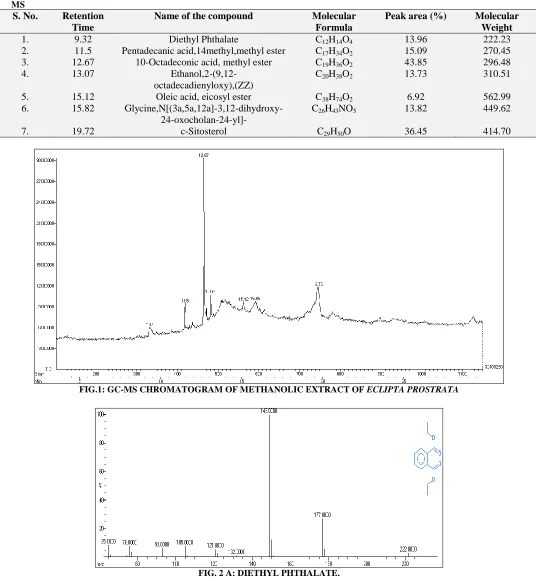
RESULTS: The active compounds with their peak number, concentration (peak area %), and retention
shows the presence of seven bioactive phytochemical compounds in the methanol extract of E. prostrata. The results revealed that, c-Sitosterol (RT 19.72), Glycine, N[(3a,5a,12a]-3,12-dihydroxy 24-oxocholan-24-yl]- (RT 15.82), Oleic acid, eicosyl ester (RT 15.12),
Ethanol,2-(9,12-octadecadienyloxy), (ZZ) (RT 13.07),
10-Octadeconic acid, methyl ester (RT 12.67), Pentadecanic acid,14methyl,methyl ester (RT
11.5), Diethyl Phthalate (RT 9.32) present in
E.prostrata. The individual fragmentations of the
components with molecular structure were
[image:3.612.37.573.174.755.2]illustrated in (Fig.2A-2G).
TABLE 1: PHYTOCOMPONENTS IDENTIFIED IN THE METHANOLIC LEAF EXTRACT OF ECLIPTA PROSTRATA BY GC-MS
S. No. Retention Time
Name of the compound Molecular
Formula
Peak area (%) Molecular
Weight
1. 9.32 Diethyl Phthalate C12H14O4 13.96 222.23
2. 11.5 Pentadecanic acid,14methyl,methyl ester C17H34O2 15.09 270.45 3. 12.67 10-Octadeconic acid, methyl ester C19H36O2 43.85 296.48
4. 13.07 Ethanol,2-(9,12-
octadecadienyloxy),(ZZ)
C20H38O2 13.73 310.51
5. 15.12 Oleic acid, eicosyl ester C38H74O2 6.92 562.99 6. 15.82
Glycine,N[(3a,5a,12a]-3,12-dihydroxy-24-oxocholan-24-yl]-
C26H43NO5 13.82 449.62
7. 19.72 c-Sitosterol C29H50O 36.45 414.70
FIG.1: GC-MS CHROMATOGRAM OF METHANOLIC EXTRACT OF ECLIPTA PROSTRATA
FIG.2 B: PENTADECANIC ACID,14METHYL,METHYL ESTER.
FIG.2 C: 10-OCTADECONIC ACID, METHYL ESTER
FIG. 2 D: ETHANOL,2-(9,12-OCTADECADIENYLOXY),(ZZ).
FIG.2 F: GLYCINE,N[(3A,5A,12A]-3,12-DIHYDROXY 24-OXOCHOLAN-24-YL]-
FIG.2 G: c-SITOSTEROL.
DISCUSSION: There is an increasing interest in the phytochemical compounds, which could be relevant to their nutritional incidence and their role
in health and disease 9. In recent years, the interest
for the study of the organic compounds from plants and their activity has increased. The aim of the present study was to develop a rapid method for the quantitative determination of organic compounds in plant and to confirm the phytochemicals present in the plant extracts. Diversity of medicinal plants and herbs containing various phytochemicals with biological activity can be of valuable therapeutic key 10.
The more precise in qualitative analysis can be obtained by gas chromatography coupled with mass
spectrometry (GC-MS). For quantitative
determination, gas chromatography with flame ionization detector (GC-FI) and GC-MS are preferred.
Previous studies reported that the GC-MS analysis of Eclipta alba using methanol divulged the
presence of eight possible bio active compounds Tridecanol, 2-ethyl-2-methyl, 1-Heptatriacotanol , c-Sitosterol, Oleic acid, eicosyl ester, 9,19- Cyclocholestan-3-ol-7-one,4a-dimethly-[20R],
10-Octadecenoic acid, methyl ester, 1,2
Benzenedicarboxylic acid, butyl octy ester,
Dodecanoic acid, 10 methyl, methyl ester.11,
whereas the current study showed seven
compounds c-Sitosterol, Glycine, N[(3a,5a,12a]-3,12-dihydroxy 24-oxocholan-24-yl]-, Oleic acid, eicosyl ester, Ethanol, 2-(9,12-octadecadienyloxy),
(ZZ), 10-Octadeconic acid, methyl ester,
Pentadecanic acid,14methyl,methyl ester, Diethyl
Phthalate which are divergent. The identified
phytochemical compounds have many biological properties. For instance, Oleic acid, eicosyl ester reported to contain anti-inflammatory, cancer preventive, dermatitigenic Hypocholesterolemic
and anemiagenic Insectifuge 12.
the ubiquitous steroid, stigmasterol were isolated from an n-hexane extract of the stem bark of the plant and earlier authors claimed that the water
extract of E. prostrata (whole plant) exhibited the
most potent inhibitory activity against antiviral
activity HIV-1 integrase (HIV-1 IN) 13.
Dasyscyphin-C (saponins) a newer isolated
compound from E. prostrata reported to have
anticancer-cytotoxic activity 14. It was tested under
in vitro conditions in HeLa (Human cervical carcinoma) & vero cell lines. At the concentration of 50g/ml it showed a good anticancer-cytotoxic
activity on HeLa cells 15. A rat hepatic stellate cell
line (HSCs) was used as in vitro assay system, the
methanolic extract of aerial parts of Eclipta
prostrata showed significant inhibitory activity on HSCs proliferation. It has been reported that the importance of free carboxylic acid at C-28 position
in echinocystic acid derivatives from the
methanolic extract Eclipta prostrata showed
antifibrotic activity. Ethanolic and ethyl acetate
fractions of Eclipta prostrata were tested for its
antibacterial activities against Escherichia coli,
Klebsiella pneumoniae, Shigella dysenteriae,
Salmonella typhi, Pseudomonas aeruginosa,
Bacillus subtilis, and Staphylococcus aureus 16.
Among the Phytocomponents, Diethyl Phthalate (DEP) is a diethyl ester of phthalic acid has been earlier reported that it is used as a solvent for fragrances, a surface lubricant in food and pharmaceutical packaging, and in tubing used for medical purposes. It is a colorless, oily liquid. Complexes derived from Diethyl Phthalate have
antifungal activity against Aspergillus niger,
Aspergillus flavus, Trichoderma harizanum,
Trichoderma viridae and Rhizotonia solani 17.
CONCLUSION: The presence of various bioactive compounds justifies the use of the plant leaves for various ailments by traditional practitioners. The present study, which reveals the
presence of components in Eclipta prostrata
suggest that the contribution of these compounds on the pharmacological activity would be
evaluated. The phytochemical analysis of the
medicinal plants are also important and have commercial interest in both research institutes and
pharmaceuticals companies for the manufacturing of the new drugs for treatment of various diseases.
ACKNOWLEDGEMENT: I am honoured to thank Secretary and Principal, Ramakrishna Mission Vivekananda College (Autonomous), Mylapore, Chennai, India for providing all facilities and I specially thank Sophisticated Analytical Instrument Facility (SAIF) Indian Institute of Technology, Chennai, India to carry out GC-MS studies.
REFERENCES:
1. M. Paul John Peter, J. Yesu Raj, V. P. Prabhu Sicis, V. Joy, J. Saravanan and Sakthivel. S. GC-MS Analysis of bioactive components on the Leaves extract of
Stylosanthes fruticosa- A potential folklore medicinal
plant. Asian Journal of Plant Science and Research, 2012; 2 (3):243-253.
2. Abdul Wadood, Mehreen Ghufran, Syed Babar Jamal, Muhammad Naeem, Ajmal Khan, Rukhsana Ghaffar and Asnad. Phytochemical Analysis of Medicinal Plants Occurring in Local Area of Mardan. Biochemistry & Analytical Biochemistry 2013; 2: 4.
3. Amin Mir M, Sawhney S.S, Jassal M.M.S: Qualitative and quantitative analysis of phytochemicals of Taraxacum
officinale. Wudpecker Journal of Pharmaceutical and
Pharmocology 2013; 2(1): 001 - 005.
4. Manik Sharma, Muhammad Yusuf, Showcat Hussain, Abrar Hussain: Phytochemical constituents and Pharmacological Activities of Eclipta alba Linn (Asteraceae): A Review, International Research Journal of Pharmacy 2012; 3(12):51-53.
5. Cardile V, Russo A, Formisano C, Rigano D , Senatore F, Arnold NA, Piozzi F: Essential oils of Salvia bracteata
and Salvia rubifolia from Lebanon: Chemical composition,
antimicrobial activity and inhibitory effect on human melanoma cells. Journal of Ethnopharmacology 2009; 126: 265–272.
6. Prakash. M.M.S. Kinthada, Naidu P.V.S, Muralidhar P. Biologically estimation of heavy / toxic metals present in traditional medicinal plant – Eclipta alba. International Journal of Pharmaceutical and Biomedical Science 2011; 2(4): 99-102.
7. Sheema Bai, Leena Seasotiya, Anupma Malik, Pooja Bharti and Sunita Dalal: GC-MS analysis of chloroform extract of Acacia nilotica L. leaves. Journal of Pharmacognosy and Phytochemistry 2014; 2 (6): 79-82. 8. Israelachvili, Jacob N. Intermolecular and surface forces.
Edn 3. San Diego, CA, Academic press/Elsevier, 2011 9. Steinmetz K, Potter J: Vegetables, fruit, and cancer, II.
Mechanisms Cancer Causes and Control 1991; 2: 427-442. 10. Liu RH. Health benefits of fruits and vegetables are from
additive and synergic combinations of phytochemicals: American Journal of Clinical Nutrition 2003; 78: 517S-520S.
11. Anand.D, John Wyson.W, Saravanan.P, Rajarajan.S. Phytochemical Analysis of Leaf Extract of Eclipta alba
12. Sheela D , Uthayakumari F. GC-MS Analysis of bioactive constituents from coastal sand dune taxon – Sesuvium
portulacastrum (L.), Bioscience Discovery 2013; 4(1):
47-53.
13. Tewtrakul S, Subhadhirasakul S, Cheenpracha S, Karalai C: HIV-1 protease and HIV-1 integrase inhibitory substances from Eclipta prostrata. Phytotherapy Research 2007; 21(11):1092-95.
14. Khanna, Venkatesan Gopiesh, kannabiran, Krishnan: Anticancer-cytotoxic activity of saponins isolated from the leaves of Gymnema sylvestre and Eclipta alba on HeLa cells. International Journal of green pharmacy 2008; 1: 227-29.
15. Mithun NM, Shashidhara S, Vivek kumar R: Eclipta alba
(L.) A Review on its Phytochemical and Pharmacological Profile. Pharmacology online 2011; 1: 345-357.
16. Karthikumar S, Vigneswari K, Jegatheesan K: Screening of antibacterial and antioxidant activities of leaves of
Eclipta prostrata (L). Scientific Research and Essays
2007; 2(4): 101-04.
17. Raman N, Parameswari S: Designing and Synthesis of Antifungal Active Macrocyclic Ligand and Its Complexes Derived from Diethylphthalate and Benzidine. Mycobiology 2007; 35(2): 65-68.
All © 2013 are reserved by International Journal of Pharmaceutical Sciences and Research. This Journal licensed under a Creative Commons Attribution-NonCommercial-ShareAlike 3.0 Unported License.
This article can be downloaded to ANDROID OS based mobile. Scan QR Code using Code/Bar Scanner from your mobile. (Scanners are available on Google Playstore)
How to cite this article: