5951
MODEL FOR DECISION-MAKING PROCESS WITH BIG
DATA
1BELKACEM ATHAMENA, 2ZINA HOUHAMDI
1Department of Management and MIS, Al Ain University of Science and Technology, Al Ain, UAE
2Department of Software Engineering, Al Ain University of Science and Technology, Al Ain, UAE
E-mail: 1[email protected], 2[email protected]
ABSTRACT
Currently, Big Data is an important concept due to the pervasive use of electronic devices, computerization, and information sharing worldwide. Despite the focus on Big Data, studies lack an explicit definition of the Big Data concept. Big Data is assumed to present natural solutions to government and private sectors, but the practical results of Big Data in other sectors are still unknown. This paper discusses Big Data concerning two perspectives: decision-making process and knowledge creation theory. The main finding of this investigation is that Big Data represents an exceptional source to generate new knowledge that supports the decision-making process in companies.
Keywords: Decision Support System, Business Intelligence, Big Data, Decision-Making
1. INTRODUCTION
In order to run a competing business, it is important to analyze the quality of data to improve the productivity and effectiveness of business systems [1]. Decision Support Systems (DSS) represent an important asset for analysts because it transforms input data into valuable information, and consecutively, this information is converted into knowledge to improve the decision-making process. Unfortunately, conventional DSS and Business Intelligence (BI) methods necessitate in excess the application of basic archival data and simple analysis techniques in order to foresee future decisions, to identify bias or to discover new opportunity [2]. The reduction of required time to respond to an injurious event is an important factor to maintain competitiveness. Fast and minimum delay in managing and analyzing business events is important, however challenging to attain [3]. The challenges are amplified by the processes that require the integration of internal data (from the company) and external data (outside the boundary of the company). Usually, the external data is collected from heterogeneous systems such as document management systems, ERP systems, business process execution language engines, etc. This diversity of external data makes the gathering, aggregation, and evaluation of a huge number of data excessively complex [4] and the existence of big data make these processes more difficult. Accordingly, the DSS’s landscape is changing from
its basis because of the availability of a large amount of information (with different formats) collected from different datasources.
Every Company improves its decision-making process by exploiting well-structured information. To obtain structured information, they need to gather, save, and analyze data and convert the results into relevant and usable information. The analysis and conversion activities require an appropriate context consisting of a user-friendly interface, a processor core with suitable intelligence and finally, an immense and general data repository. The repository contains data collected from various and distinct types of internal and external data sources. The repository can be a data mart, data warehouse, or Big Data.
5952 governmental context, Big Data is presented as a different type of internal database (for example online feedback and health care) and an external data source (for example data from a statistics center). Combining data collected from external and internal data sources allows the creation of new knowledge.
The current study is empirical and has two purposes. The first one clarifies and defines the Big Data concept and the second purpose is to investigate the possibility of integrating Big Data into the decision-making process to support decision-makers to earn worthy insights from Big Data by applying Big Data analytics with a view to apply Big Data techniques and tools in all decision-making stages. Accordingly, the present paper proposes the development of a model that integrates BI and Big Data in Simon’s decision model and describes the advantages and disadvantages of using the repository to discover new knowledge.
The remainder of this paper contains five sections: the literature review where the definition of Big Data and BI are described in section 2. A framework that integrates BI, DSS and Big Data in Simon’s model is detailed in section 3. Section 4 presents a deep discussion of the proposed model. Finally, to summarize, section 5 provides a concluding discussion.
2. LITERATURE REVIEW
The term “Big Data” is used to represent the set of data that grows hugely and becomes inconvenient to process by applying the usual database management methods. Furthermore, the big data size expands over the border of traditionally applied storage systems and software tools to gather, save, handle and the process the data in acceptable time [10]. The Big Data analytics express the application of complex analytic methods to Big Data. Big Data analytics assist in revealing new knowledge which may cause changes in business. But since Big Data contains huge data, then its management is a real challenge [11]. Advanced analytics help considerably the improvement of decision-making, risks reduction and relevant hidden insights discovery from datasets. Generally, the automation of decisions is not sufficient, but instead, it can be supported by the analysis of complete (rather than sample) datasets by applying big data methods and techniques [12]. Besides, the researchers have been interested to decision-making process and its management, and they were exhaustively discussed in the literature. The well-known proposed model
and used by almost all decision-makers is called Simon’s model which contains four stages: intelligence, design, choice, and implementation [13]. On the other side, Big Data pipe contains set of phases, and each phase has its own problems and needs decisions (such as data gathering, data analysis, data cleaning, data integration with another dataset, decision-making based on analysis outcomes). At the end, for the sake of producing significant value by analyzing Big Data, all these problems and decisions should be efficiently taken into consideration and adjusted for.
The decision-makers are consistently looking for any opportunity to improve the quality of their decision. Particularly they are interested in Big Data, and it used to improve the conventional decision-making process. Consequently, the integration of Big Data analytics methods and techniques in decision-making process should be investigated by researchers to provide relevant insights for decision-makers and improve the quality of their decisions.
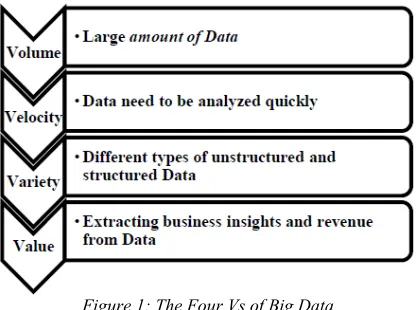
[image:2.612.314.522.530.685.2]Despite the focus on Big Data, insufficient information about what encompasses the Big Data concept is available [14]. Thus, the primary purpose of the current study is to clarify and define the Big Data concept. The concept of Big Data and its applications became apparent due to the growing quantity of data collected from different internal and external data sources that are characterized by four features (Figure 1): Volume, Variety, Value, and Velocity. Volume refers to data quantity; Variety considers the diversity in types and sources of data; Value describes relevant invisible information in huge data sets, and Velocity is the measure of how fast the data is analyzed and handled [5].
Figure 1: The Four Vs of Big Data
5953 using mining techniques. Accordingly, Big Data usage is associated with the utilization of BI algorithms to support the administrative processes with an intelligent assistance system. The needed data for business knowledge should be gathered, cleaned, saved, and analyzed. Since data cleaning and analysis phases are complex, the BI techniques and methods are required.
2.1. Big Data
The amount of data available to companies is increasing rapidly, not only in volume but also in the diversity of data gathered from multiple channels. These channels vary from information from social media to clicks on the Internet. Furthermore, companies gather, analyze, and respond to requests very quickly.
Big Data has several definitions, and many attempts have been made to describe Big Data [15]. Big Data is defined as digital information [8] collected from different sources such as videos and pictures, maps, health records, customer feedback, purchases in stores, web pages, social media accounts, geographic locations, etc. The definition of Big Data encompasses anything from numbers and figures to computing power and central properties [16]. Additionally, Big Data is defined as techniques, methods, and tools that can be used by a company to create, treat, and handle a huge amount of data and storage facilities [9]. Similarly, Jordan [17] defines Big Data as an analytical instrument.
Wren and Hoskisson [18] described Big Data as excessively large data sets that cannot be managed and analyzed with classical data processing methods and that accordingly need new technologies. Additionally, it is hard to derive any value from Big Data. Therefore, Big Data is defined as a data set that surpasses the enterprise’s aptitudes
to analyze and store for decision-making purposes. Big Data consists of three features:
1.Maximize algorithmic accuracy and computing power to collect, analyze, combine and interpret large datasets.
2.Draw on large data sets to determine patterns to make legal, technical and economic claims. 3.Generate insights that were previously
impossible, from knowledge and intelligence offered by the large data sets.
Big Data can be considered an evolution in data management. Big Data technology is defined as the creation of modern infrastructure, conceived to deduce value from an immense volume of different types of data with minimum cost, by capturing, discovering and/or analyzing high-velocity streams.
[image:3.612.337.498.400.527.2]Despite the variety and differences in Big Data definitions, there are some similarities related to the size and volume, variety and complexity [16], [19]. Complexity refers to the structure and behavior of data intricacy, the data correlation, and data sharing through objects [20]. Another similarity is related to techniques and methods used in data management. Figure 2 summarizes the different definitions of Big Data as presented in the literature.
Figure 2: Big Data Definitions
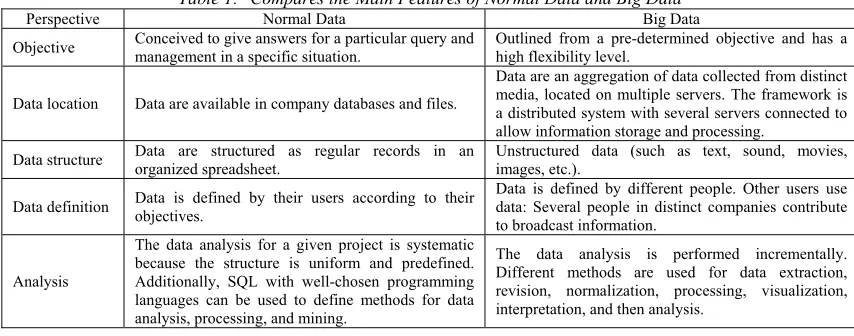
Table 1: Compares the Main Features of Normal Data and Big Data
Perspective Normal Data Big Data
Objective Conceived to give answers for a particular query and management in a specific situation. Outlined from a pre-determined objective and has a high flexibility level.
Data location Data are available in company databases and files.
Data are an aggregation of data collected from distinct media, located on multiple servers. The framework is a distributed system with several servers connected to allow information storage and processing.
Data structure Data are structured as regular records in an organized spreadsheet. Unstructured data (such as text, sound, movies, images, etc.).
Data definition Data is defined by their users according to their objectives.
Data is defined by different people. Other users use data: Several people in distinct companies contribute to broadcast information.
Analysis
The data analysis for a given project is systematic because the structure is uniform and predefined. Additionally, SQL with well-chosen programming languages can be used to define methods for data analysis, processing, and mining.
[image:3.612.91.518.549.717.2]5954 To summarize, Big Data is a familiar universal term, but basically, Big Data introduces two challenges for companies:
Company managers have to supply new equipment prepare for a possible complete transformation in information gathering and analysis.
More importantly, the entire company has to accommodate to the new process, particularly decision making, by perceiving the substantial significance of Big Data.
Companies need to consider Big Data in their decision-making process by focusing on the opportunities and values offered by Big Data because the preferences of consumers vary regularly (hourly) and everything in the world is constantly connected. Accordingly, analysts check various communication channels simultaneously and track decision behaviors or certain profiles.
2.2. Business Intelligence
According to Simon’s model, the decision-making process for a particular company always starts with the intelligence phase in which the problem is identified, and information about the problem is collected. In this phase, we apply problem structuring techniques. Additionally, BI tools can be used to assist the company in discovering possible solutions to the problem by performing detailed analysis and data integration [21]. In addition to problem-solving, BI provides decision opportunities that contribute to decision support. BI can be defined according to two perspectives: technical or organizational decision making [22]. Additionally, there are two types of BI concepts: one focuses on approaches for data storage and data mining to discover new knowledge, and the other focuses on data analysis to support decision making processes in business [23]. In the current paper, we will consider BI as a technology-driven process that combines technical and organizational perspectives to generate the required information to support decision opportunity generation, decision making, and learning processes. Thus, BI includes all methods concerned with relevant information extraction from large data sources that exist inside a company to support the decision-making process.
Data have two different aspects [20]:
1.Smart Data Processing is concerned with data analysis and assessment to provide decision support and to guarantee the alignment of company performance with the company strategy
and to provide information about used processes, which will be incorporated with existing knowledge.
2.Organizational Learning defines the process of discovering new knowledge that will be disseminated to people for use.
On the other hand, BI is defined according to three different perspectives [16]:
1.Product: BI is defined as an IT tool that includes all fundamental components and is considered the engine of DSS that provides analytics for the decision maker.
2.Process: BI is defined as the implementation of all fundamental components to reduce the needed time to make a decision by assisting the decision-making process.
3.Organization: BI is defined as a component of the decision process that includes human competencies and IT components to make strategic decisions to realize the company’s plan. BI supports system flexibility, integration with other systems, risk management and data quality [22].
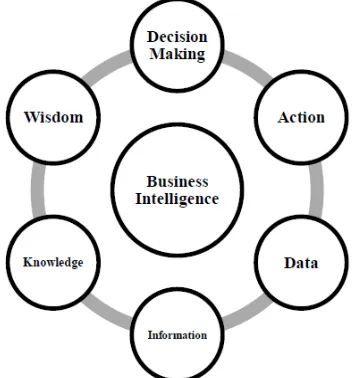
[image:4.612.329.506.489.678.2]Another perspective termed socio-technical [24], reinforces the relationship between BI organizational learning and knowledge management by considering features focusing on human interaction such as leadership, culture, and metrics for proper implementation. Figure 3 illustrates this perspective.
Figure 3: BI as Business Process Support
5955
Business process contains the decision-making processes and actions required to implement decisions.
Toolset makes the information evolve by supporting the necessary transformations from data to knowledge and by applying Artificial Intelligence techniques.
In Figure 2, the aggregation of business processes, BI, and toolsets, can be considered components of DSS because these components describe information transformations, their exploitation in the decision-making process, and finally feedback collection to start a new information transformation cycle.
A DSS is an interactive computerized information system that aids decision-makers in using data. A DSS uses artificial intelligence models and techniques to find the best solutions for unstructured or semi-structured problems [25]. A DSS processes, analyzes, shares, and visualizes essential information to support the process of information transformation and integration and thus improves company knowledge. Thus, a DSS is an information system developed to provide solutions for decision-making problems.
2.3 Decision support systems (DSS)
Usually, decision refers to a viewpoint, attitude or judgment obtained after investigation or evaluation. The decision is a cognitive phenomenon and the result of a complicated process of consideration that considers the appraisal of important outcomes and uncertainty. Decision-making is a process that implicates many activities such as understanding, assessment, and advise a particular action to allocate irrevocably set of resources in order to achieve a particular target. The main activities of a decision process are discover information, interpret information, apply decision criteria, and implement subsequent action. The economic theory is the root of decision theory because organizations make decisions in order to maximize benefits based on rationality and expediency. Nevertheless, the construction industry applied the utility theory and the experience was successful and was adopted as a leading model for standard decision-making. However, the model is considered as ideal because the theory is considered idealistic, however, because it concentrates on the description of steps that the manager should follow to make decisions instead of the actual steps of decision-making. Decision-making represents a significant part of management because decision-making is involved in all managers’ tasks including
planning, organizing, staffing, delegating or directing, coordinating, reporting, and budgeting (note the acronym POSDCORB). Accordingly, decision-making represents the most important management task. This section describes Simon model decision-making process which is considered as a standard rational model.
Information is considered as an important and relevant asset for the decision-making process and needs a mechanism to convert data into valuable and relevant information to be used by organizational processes. Usually, information systems are employed for this purpose. Particularly, the DSS process, analyze, share and visualize the relevant information to support the process of knowledge extraction, integration, and conversion, and thus improve the decision-making process. DSS are information systems developed to determine possible solutions for decision-making problems. Specifically, DSS are defined as an interactive computer-based information system that aid decision-makers to use information, methods, visualization techniques, and interfaces to work out unstructured or/and semi-structured problems. DSS are strongly related to the intelligence-design-choice model, with extra potentiality in the intelligence-design-choice phase. The principal purpose of DSS is to help decision maker by providing possible and suitable solutions for a particular problem. Although the decision-makers (human) make the decision, the DSS provides a friendly interface to assist the decision-makers in building scenarios and simulating and obtaining visualizations and reports [25].
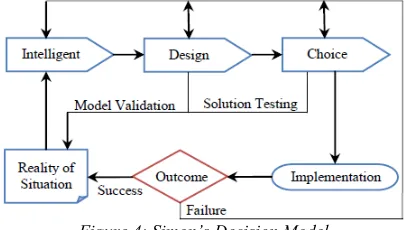
In Simon’s decision model (Figure 4), there are three phases in the decision-making process: intelligence phase, design phase, and choice phase [26]. Each phase uses techniques and methods from an organizational perspective (such as knowledge management, multi-criteria decision aids, and problem structuring methods) and a technical perspective (such as data marts and data warehouses). The organizational methods gather information about members involved in the decision-making process. However, technical tools are essential components used for information storage, access, analysis, knowledge discovery and sharing in databases. Technical tools also provide support for the application of methods and techniques from organizational perspective.
5956 itself (called problem cause root). This situation is known as “deciding what to decide”. The intelligence phase involves, for instance, a comparison between the actual project progress status and the project plan. The outcome of this phase is a decision statement.
Figure 4: Simon’s Decision Model
The term “intelligence” in this phase name is not clear because habitually, the term intelligence is used in decision-making context in an informal way to express what is used after knowing a decision must be taken. Simon adopted the word “intelligence” from its meaning in military context where the information is gathered without knowing why (i.e., what this information will serve to in reference of making). The decision-making in a business context, usually a huge quantity of information is collected before realizing that a decision is needed.
Design Phase: The main purpose of this phase is the identification of all available solutions. Consequently, an extensive effort is needed to investigate all possible alternatives. This phase consists of invention, development, and analysis of available option in order to find alternative solutions. In this phase, the chief executive consumes a large fraction of time, together or individually pursuing to create, develop and identify the majority of solutions for managing the problem context where a decision is required. This phase requires a lot of creativity and innovation to identify and develop design solutions.
Choice Phase: the main objective of this phase is the evaluation of the solutions that were developed in the design phase and select the best one according to the problem context. The result of this phase is a decision (selection of the best solution) to be implemented. Simon believes that the time spent by the chief executives in this phase is small than the time spent in design phase as the choice between alternative solutions already designed and
evaluated their impacts (advantages, disadvantages) to solve the current problem.
These three decision phases are not independent as they are described. Simon detected the mutual dependence between the three phases, and he cited cases of feedback between the phases. He also mentioned that each phase is treated recursively as a decision in itself. Accordingly, Simon’s model allows us to avoid the usual problem facing the decision-makers which is known as artificial reduction of decisions. This innovative idea brings the investigation of decision making from the management stories and links it strongly to the of Information Systems (IS) context [27].
This looks easy, but unfortunately, it is a little bit difficult as the problem may have different goals and each alternative illustrates a situation which makes the selection in choice phase a challenging task. Besides, the uncertainties related to outputs and situations make the assessment of a particular alternative hard.
3. INTEGRATION OF BI AND BIG DATA IN THE DECISION-MAKING PROCESS
This section proposes a model for integrating some of these tools in the decision-making process. The proposed model maps Big Data analytics and techniques to different phases of decision-making process. Therefore, if the data is big, then the analytics and the decisions are also big. The related literature was thoroughly analyzed and synthesized, and the state of the art of Big Data technologies (analytics and applications) was investigated to contribute to the elaboration of our model. Nevertheless, our model does not include all Big Data analytics, methods and technologies and sooner can be considered as an abstraction of some acceptable strategies to integrate Big Data analytics in decision-making process.
The decision-making process contains four phases:
Intelligence Phase: All required data to find out the problems and the opportunities is gathered from internal and/or external datasets. Consequently, the main objective of this phase is the identification of Big Data sources and then the collection of data from identified sources. This data is processed, saved in any Big Data storage (such as HDFS or NoSQL) and managed by any Big Data tool (such as conventional DBMS, EDW and MPP databases) and organized and displayed to decision-maker.
5957 and analyzing the model representing the problem. This phase contains three steps: planning (selection and planning of appropriate model for data analytics), data analytics (application of the selected model) and analysis (analyzing the model outputs).
Choice Phase: The main purpose of this phase is the evaluation of the effects of the selected model in the design phase. This phase contains two steps: evaluation (the solutions and their effects are evaluated and prioritized by applying Big Data visualization tools such as ADVISOR or Gephi) and decision (selection of the best solution).
Implementation Phase: The objective of this phase is the implementation of the selected solution in the previous phase. Therefore, Big Data methods and techniques will be used to monitor the decision outputs and to provide feedbacks (immediately or periodically) on the implementation results.
Figure 5 shows the proposed model, which applies the predictive approach to decision making. The predictive approach is recognized as an effective approach to develop and design DSS by using methods to structure problems, suggest a
solution and select the best alternative. The BI tools give information about the application domain to support the process phases.
[image:7.612.139.478.395.697.2]Note that some of our model components are encompassed within Simon’s model phases. In the intelligence phase, the company uses BI tools and techniques to identify pertinent information by exploiting Big Data, which is powered by local and external databases. The design phase develops a model that generates possible decision alternatives by using the identified information. The choice phase evaluates the possible opportunities based on problem structure defined in intelligence phase. The DSS is developed to make the proposed model workable via a user-friendly interface. The decision-makers conclude the decision-making process by implementing the selected alternative (or set of alternatives) generated by the DSS. The outcomes of these phases are considered new knowledge that should be integrated with existing knowledge. The new knowledge indirectly influences (via internal databases) the Big Data to be used when needed, consequently contributing to the learning process within the organization.
5958 In the following, we will describe each component of our proposed model:
Data Extraction Phase: Its main objective is collecting, storing, and integrating relevant information needed to generate a content item. For this purpose, information is combined from local data-sources (generally structured data) or external data-sources (generally unstructured data) for additional processing. Specifically, the objective of this step is extracting relevant information for decision-making from Big Data.
Intelligence Phase: Accumulated values from Big Data play vital roles in the opportunity and alternatives generation after analyzing the data. Furthermore, it is crucial to stress the importance of data representation. For instance, spreadsheets make data pattern identification difficult, but charts, which visualize data analysis, allow identification of data patterns quickly and thus facilitate the analyst’s job. In cases of negative patterns or deviation, we can perform corrective actions. Data representation methods are particularly essential for the production of the Big Data concept value. Basically, Big Data is not a concept concerning only data. It is used for new knowledge extraction (intelligence), and data representation is crucial for the decision-making process. Intelligence can be defined as the ability to create value from collected data to find pertinent information that can be used to solve the organization’s problems.
Decision Opportunities Generation Phase:
Possible solutions for the problem are created during this phase. It begins by analyzing a dataset to allow the decision-maker to perceive a general picture of the problem. After that, the decision maker identifies alternative solutions to the decision problem based on the analysis done by the application of BI techniques on Big Data content. This phase also defines the set of criteria that will be used by decision-makers to appraise each alternative.
Decision Support System Phase: Based on the
discovered alternatives and the evaluation criteria, a DSS is developed to identify the most appropriate solution(s) for the problem. DSS helps decision-makers by recommending the best alternative(s).
Decision Implementation Phase: The selected
alternatives are implemented in the company to solve the problem.
Organizational Learning Phase: The last step in our model generates valuable knowledge related to the decision problem. This knowledge is captured, recorded, and saved in the local data-sources to give an organizational history concerning the problem domain and can be used in the future.
4. DISCUSSION
5959 servers, they will start performing analysis in order to understand the real needs of their customers locally. Note that, diverse organizations with around 20 years in markets have inherent attitudes, strategies, models, procedures and, certainly, technologies that are not always useful to operate with a flexible approach. To enhance the impact more efficiently, the organization has to review its a decision-making process by streamlining it from top to bottom to be more responsive. Thus, this organization will survive with the continuous digital disturbance. We can achieve the real Big Data benefits by reducing the time gap between insight identification, decision-making, and implementation.
Knowledge generated from Big Data accumulates value, and it is used by decision-makers to identify opportunities. The proposed model provides theoretical evidence to enhance the reliability and power of the decision-making process by validating the idea of combining the decision-makers’ expertise and knowledge with historical data, decision methods and formal problem structuring methods. Usually, to make decisions, organizations apply a descriptive method that analyzes only historical data. Unfortunately, it is very hard to focus on recent approaches due to the exclusive concentration on history.
The proposed model also applies the same descriptive method; additionally, it uses predictive methods for the sake of providing guidance to solve a decision problem (supported by the decision maker’s expertise, knowledge, and decisions) and IT (DSS, Big Data, and BI). The Big Data concept analyzes the data’s impact on the decision-making process and ensures the generation of decision opportunities that will be used by decision-makers.
The contributions of the proposed model are as follows:
Development of a model that integrates Big Data, BI, DSS, decision-making processes, and learning.
Big Data acts as a data server where the BI methods and tools are used principally to support opportunity identification for a particular decision problem.
To make a decision, the decision-makers combine their expertise and skills as well as the company’s knowledge base created by the organizational learning process. The knowledge base contains knowledge generated through the process for future use. Accordingly, in addition to the methodologies, decision-making, and toolsets, the proposed model considers inherent properties
related to the decision-makers’ observations, knowledge, and personalities. The introduction of Big Data allows searches of both private (from internal databases) and public (from external databases) information, not only to identify the decision problem but also to improve the intelligence level in the decision-making process.
5. CONCLUSION
This study describes a model that integrates DSS, Business Intelligence, and Big Data within the decision-making context to assist decision-makers in new alternatives creation to solve a particular problem. The model focuses on the extensive search to obtain complete data and thus improves the quality of the decision. Moreover, Big Data modifies the management process and supports modifications in company culture and knowledge; Big Data is useful in the decision-making process if used appropriately. Big Data use does not provide guidance on the decision itself, opportunities generation or results prediction. Consequently, the presence and assistance of human decision-makers is imperative because their tacit knowledge and perception are essential to accumulate value from stored information and knowledge.
Big Data enables organizations to improve decision-making and to be closer to their customer. Accordingly, to Laney and Jain [28], by 2018, around 5 million jobs will be created about Big Data. The challenge is that managers have to make profound decisions. For example, the organization shall spend more on marketing or redesign its products; the organization is more efficient with the current structure or shall reorganize its sales team. The organization must invest in new technologies or issue new equity and use proceeds to retire outstanding debts. Thus, the market environments have changed, and the organizations have to adapt decision-making to decide fast, to react earlier and more efficiently, act not only for the present but also predictive, make bulletproof decisions, make decisions on high-quality data basis, and make decisions collaboratively and outside the box. The result shows that Big Data improve decision-making throughout the organization by integrating Big Data analytics into the decision-making process.
5960 and contain important information and patterns that is invisible and should be discovered to be used in decision-making. Therefore, Big Data could be exploited to improve decision making by using the sophisticated analytics methods on Big Data and discovering relevant information and invisible insights.
The extraction and exploitation of relevant knowledge by application of Big Data improve the decision-making process. Thus, the design science methods are applied to achieve our research objective which is the integration of Big Data in decision-making process. Accordingly, our research contribution is the proposition of model that assist the decision-makers in their tasks by applying Big Data technologies, tools and analytics.
Our work contributes to the knowledge base, Big Data, and decision-making process theories by inspecting state of the art and summarizing models, techniques, theories and Big Data analytics methods by reading the literature related to prior researches with the view to developing our model. Thus, we aggregate diverse aspects and incorporate them in a single model. T is true that our model is empirical and theoretical, but it contributes to the environment since it can be used in the companies and enterprises.
As we know that the continuous target of decision-makers is to acquire complete and relevant information in order to take the best decisions. So, this work supplies decision-makers and companies with a model that explains the integration of Big Data and application of Big Data analytics through decision-making process phases with the sake of improving the decision making.
The advantages of Big Data analytics in decision-making are well known since it reveals invisible and valuable information. So, the proper exploitation and application of Big Data analytics will lead to potential human, technological and scientific progress. However, this task is challenging. The difficulties are related to resources, time constraints and particularly the access to external sources composing Big Data.
The main contribution of the study is the use of Big Data to support and improve decision-making in the organization, by integrating Big Data into the decision-making process. This work can be considered an initial attempt to integrate BI, DSS and Big Data in the decision-making process. Some elements need further investigation such as an explicit model to integrate Big Data with BI techniques to fulfill the company repositories to support information systems by providing complete data.
REFERENCES
[1] Z. Houhamdi and B. Athamena, “Impact of information quality on decision making,” Glob. Bus. Econ. Rev. J., 2018.
[2] A. Vera-Baquero and O. Molloy, “A Framework to Support Business Process Analytics,” in International Conference on Knowledge Management and Information Sharing, 2012, pp. 321–332.
[3] A. Vera-Baquero, R. Colomo-Palacios, and O. Molloy, “Business Process Analytics Using a Big Data Approach,” IT Prof., vol. 15, no. 6, pp. 29–35, Nov. 2013.
[4] A. Vera-Baquero and O. Molloy, “Integration of Event Data from Heterogeneous Systems to Support Business Process Analysis,” in International Joint Conference on Knowledge Discovery, Knowledge
Engineering, and Knowledge Management,
2012, pp. 440–454.
[5] M. Chen, S. Mao, and Y. Liu, “Big Data: A Survey,” Mob. Networks Appl., vol. 19, no. 2, pp. 171–209, Apr. 2014.
[6] Y. Demchenko, C. Ngo, C. de Laat, P. Membrey, and D. Gordijenko, “Big Security for Big Data: Addressing Security Challenges for the Big Data Infrastructure,”
in Workshop on Secure Data Management,
Springer, Cham, 2013, pp. 76–94.
[7] V. Mayer-Schönberger and K. Cukier, Big data : a revolution that will transform how we live, work, and think, Reprint ed. Eamon Dolan/Mariner Books, 2014.
[8] M. Michael and D. Lupton, “Toward a manifesto for the ‘public understanding of big data,’” Public Underst. Sci., vol. 25, no. 1, pp. 104–116, Jan. 2016.
[9] M. Knapp, “Big Data,” J. Electron. Resour. Med. Libr., vol. 10, no. 4, pp. 215–222, 2013.
[10] W. R. Kubick, “Big Data, Information and Meaning,” Clin. Trial Insights, vol. 21, no. 2, pp. 26–28, 2012.
[11] H. J. Watson, “Tutorial: Big Data Analytics: Concepts, Technologies, and Applications,” Commun. Assoc. Inf. Syst., vol. 34, pp. 1247–1268, 2014.
[12] J. Manyika et al., “Big data: The next frontier for innovation, competition, and productivity,” 2011.
5961 and T. P. Liang, Business intelligence and
analytics : systems for decision support.
London: Prentice Hall, 2014.
[14] S. Fosso Wamba, S. Akter, A. Edwards, G. Chopin, and D. Gnanzou, “How ‘big data’ can make big impact: Findings from a systematic review and a longitudinal case study,” Int. J. Prod. Econ., vol. 165, pp. 234–246, Jul. 2015.
[15] R. Kitchin, “Big Data, new epistemologies and paradigm shifts,” Big Data Soc., vol. 1, no. 1, Jul. 2014.
[16] J. S. Ward and A. Barker, “Undefined By Data: A Survey of Big Data Definitions,” arXiv Prepr. arXiv1309.5821, Sep. 2013. [17] S. R. Jordan, “Beneficence and the Expert
Bureaucracy,” Public Integr., vol. 16, no. 4, pp. 375–394, Oct. 2014.
[18] G. Phillips-Wren and A. Hoskisson, “An analytical journey towards big data,” J. Decis. Syst., vol. 24, no. 1, pp. 87–102, Jan. 2015.
[19] N. Kshetri and Nir, “Big data
׳
s impact on privacy, security and consumer welfare,” Telecomm. Policy, vol. 38, no. 11, pp. 1134–1145, Dec. 2014.[20] M. Troester, “Big Data Meets Big Data Analytics Three Key Technologies for Extracting Real-Time Business Value from the Big Data That Threatens to Overwhelm Traditional Computing Architectures,” 2012.
[21] A. Popovič, R. Hackney, P. S. Coelho, and J. Jaklič, “Towards business intelligence systems success: Effects of maturity and culture on analytical decision making,” Decis. Support Syst., vol. 54, no. 1, pp. 729–739, Dec. 2012.
[22] Ö. Işık, M. C. Jones, and A. Sidorova, “Business intelligence success: The roles of BI capabilities and decision environments,” Inf. Manag., vol. 50, no. 1, pp. 13–23, Jan. 2013.
[23] M. Handzic, “Integrated socio-technical knowledge management model: an empirical evaluation,” J. Knowl. Manag., vol. 15, no. 2, pp. 198–211, Apr. 2011. [24] M. Handzic, K. Ozlen, and N. Durmic,
“Improving Customer Relationship
Management Through Business
Intelligence,” J. Inf. Knowl. Manag., vol. 13, no. 02, p. 1450015, Jun. 2014.
[25] D. Daas, T. Hurkmans, S. Overbeek, and H. Bouwman, “Developing a decision support system for business model design,” Electron. Mark., vol. 23, no. 3, pp. 251– 265, Sep. 2013.
[26] A. D. Haidar, “Decision-Making Principles,” in Construction Program Management – Decision Making and
Optimization Techniques, Cham: Springer
International Publishing, 2016, pp. 25–55. [27] F. C. Lunenburg, “The Decision-Making
Process,” Natl. Forum Educ. Adm. Superv. J., vol. 27, no. 4, 2010.