Mathematics Education
CoSMEd 2011 Penang, Malaysia
15 – 17 November 2011
1
A Study on Learning Pre-Algebra using Interactive Multimedia
Courseware within Collaborative Learning Set-Up and e-mail Interactions
Mohd Sazali Khalid Sulaiman Yamin
Universiti Tun Hussein Onn Malaysia
Abstract
Many students at diploma level are weak in mathematics even after spending eleven years in Malaysian education system. However, throughout the world there are research studies been done with mixed results using technology and collaborative learning. The objective of this paper is to analyze the effect of learning pre-algebra using interactive courseware with collaborative learning by using STAD set ups with interactive courseware using e-mail facilities during team discussion only. Quasi experimental type research was used. The gain score (differences between post and pre test) between the two equivalent groups. of Diploma Information Technology first year students in two different intake years 2009 and 2010 in UTHM were employed. „t-test‟ results revealed the second group using e-mail is statistically significantly inferior to the group using purely interactive multimedia courseware CDiCL only with STAD team discussion. On average participants experienced higher gain scores in the first group (Mean = 3.28, SE=0.433), than participants in the second group (M=0.77, SE=0.354). This difference was statistically significant (t (74) = 4.51, p<0.05); however, it did show a medium effect size of r = 0.45. Some clinical interviews and video recordings were taken to support that teams prefer using traditional collaborative learning method with more face to face interactions rather than e-mails in solving problem.
Keywords: mathematics information technology, algebra, CDiCL, facebook
Introduction
2 JTMM under Faculty Engineering Technology, in KUiTTHO (Kolej Universiti Teknologi Tun Hussein Onn). As a result Diploma Mathematics IT 1 adopted UTM‟s Diploma Computer Science syllabus and curriculum. Discrete Mathematics topics and tutorial (pen and paper) was the order since most of the mathematics lecturers graduated from UTM. In 2004 KUiTTHO was officially upgraded into the 17th full fledged public university in Malaysia called UTHM and JTMM became a faculty called FTMM which introduced Mathematics IT 1 and Mathematics IT 2 for the first year diploma students with all the mathematics topics still intact plus the introduction of laboratory activities (Mohd Sazali et al, 2006). The objective was to let the students see mathematics applications in information technology. License packages like SPSS and Matlab were incorporated into the syllabus since it took more rigorous statistical approach with probability distributions, permutations and hypothesis testing. Problem Based Learning (PBL) was tried in UTHM using Republic Polytechnic Singapore experience as the yardstick. This paper has five sections. Current issues, methodology, research procedure, results and discussions.
Current Issues
At diploma level many lecturers from the local universities found that mathematics was not rigorously understood even though the students who successfully entered the university programs with high grade score in SPM (equivalent to GCSE „O‟ levels). For example statistics from Kelantan State Education Department (2003 – 2006) revealed the average rate of passes SPM Mathematics was 75% only. This means that 25% failed mathematics at SPM level. In spite of 75% passes, some of them were found to be struggling in mathematics, statistics and quantitative methods once they entered Diploma and degree studies especially on topics involving algebra (Mohd Salleh, 1990). Something must be done some how quickly since e-learning has become the in-things of today. More over algebra is the gate to many advance mathematical topics in the universities.
Many researches were done about the above problem with mixed results (Healy, 1998; Heid, 2002 and Zain et al 2006). In Malaysia, many young teachers complained that they could not deliver mathematics concepts very well in English which started 2003 during PPSMI. (Tan, 2007). PPSMI was introduced at Primary Year 1, Form 1 and Lower 6 at the public schools. It was found that many senior teachers who were trained in English medium schools took administrative duties while the young teachers (aged 45 below) who had learnt and fully trained in mathematics in Malaysian language beginning 1979. Razali Hassan (2008) studied on learners and teachers style using computers. He correctly pinpointed one thing - both parties have different strength and weaknesses as far as learning and teaching styles which did not match for the optimum benefit for the students‟ side.
3 recruitment and other incentives. One of them is they can hire their own set of teachers (PTA Talk in KISAS) and the school enjoyed better treatment. Unknowingly, sometimes creative teachers are temporarily sidelined. A creative teacher is defined as someone who is braved enough to teach differently from the syllabus (Schifter and Fosnot , 1993). Once the school is very focused to excel only in the public examination it was found the standard of questions posed by the teachers were steroetyped. What is asked are mostly public examination questions and nothing else. Without critical and challenging questions it is hard to produce holistic learning that produce first class engineers, scientists and professionals (Noraini Idris, 2006). Noraini claimed that students taught mathematics in visual mode understood mathematics better. But Healy (1998) disagreed when many visual aided students understood mathematics from the surface level only and this was insufficient for higher college mathematics.
One of the main features of cluster and smart schools is the employment of ICT in teaching mathematics and sciences. Advantages of computer-aided-instruction are increased student engagement and motivation, providing students with a greater level of individualized instruction (Barrow et al., 2008). Since mathematics is synonym to drilling and practice, ICT is looked as the rescue to teaching problems especially in remedial work. According to MOE INTEL 2007 report, USA experienced 20 – 30 percent remedial classes at high colleges and first year degree programs. When Malaysia is facing with remedial classes in polytechnics and colleges communities MOHE, it seems that USA, a developed country, is experiencing that too (Barrow et al, 2008).
Drilling and practicing is taken quite well at schools because item analysis by Chai Mun and Tiong (2005) found that 50% of the PMR and UPSR questions set 2003 – 2006 was categorically put as simple, 30% are medium difficulty and 20% are challenging. Many „naughty‟ teachers know that by drilling their students at easy and middle type of questions this would suffice their students to pass in any public exam. As a result many students are not exposed at all to harder critical thinking skills since many teachers rushed with the syllabus. Once they are at the university the students look so lost. They cannot help themselves with internet to find important facts regarding mathematics learning. What was seen they used ICT not for studying related subjects.
4 in society (Shane and Von Glinov, 2008). Here Shane and Von Glinov did not encourage any team to appoint a leader who has limited ability in a specified skill. Now Facebook is getting more popular not only among youngsters in social networking but also among teachers. They shared messages, pictures, video clips and they can use it for studying purposes. e -mails are popular too. Now how can we implement mathematics education using ICT in Malaysia. Thus a curriculum and syllabus for Mathematics IT came into UTHM. The objectives of this study is to analyze the effect of learning pre-algebra using interactive courseware with collaborative learning set up against a group that use mainly e-mails and facebook and determine whether e-mails and facebook help mathematics learning.
Methodology
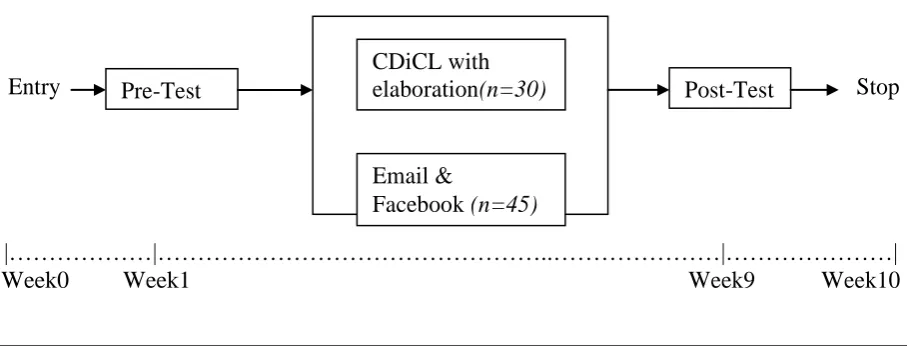
The structure of the experiment is shown in Figure 1 below.
[image:4.595.72.526.257.430.2]Entry Stop
|………|………..………|………| Week0 Week1 Week9 Week10
Figure 1. Basic Structure of the experimentation
This structure was agreed since calculus came during Week 7 and Week 8 of 1DIT Mathematics I.T. syllabus. Between Week 3 to Week 6 they were exposed to more algebra, Discrete Mathematics and Series. CDiCL used ADDIE methodology under multimedia interactive courseware development. It was tested in Polytechnic Kota Bharu, Kelantan and a secondary school in Pasir Mas, Kelantan in 2006. (Mohd Sazali Khalid, 2010). The content of the cd has more than 10 topics under pre-algebra, factorization and simplification. It was recommended that CDiCL would be more effective if it was used with lower size team of 3 as compared to bigger size team of five.
Research Procedure
Quasi-experimental design was employed where it was not possible to randomize any student to participate. Group I (Control using CDiCL and CL only) n=30; 22 girls 8 boys. The students were academically equivalent as their entry was controlled by MOHE.
Learning Processes
First week, they were explained about the study to compare effectiveness studying mathematics IT using CD-ROM and CL against another group learning mathematics using e -mail only). They were asked to sit for PRE-TEST and after ninth week the POST TEST was conducted. Both tests had similar questions. Marks from pre and post test are taken as coursework marks in their diploma program. They are divided into two different groups size
Pre-Test
CDiCL with elaboration(n=30)
Email &
Facebook (n=45)
5 18 and 12 of them. The first group came at 0800 am and the second group came at 0900am. They were required to learn pre-algebra skills using CD-ROM called CDiCL which has 20 different modules. Each session they must cover at least 2 – 3 modules while solving word problem in between. This was to maintain focus all along the session. The instructor selected the team using math results from SPM. Each team has 5 members and they solved it collaboratively using STAD (student team assessment division) set up which has a leader, assistant leader, reporter, manager and time keeper. At the end of each session they must submit a report. Computing time is about 20 – 40 minutes *only. The rest of the session is used by the instructor (the first author) to explain recommended solution during the CL work. Example of word problem is shown in Appendix A.
Group II (using e-mails and facebook) - Experimented group (n=45) 30 girls 15 boys.First week, they were explained about the study to compare effectiveness studying Diploma Mathematics IT using e-mails and facebook against learning mathematics using CDiCL. They were asked to sit for PRE-TEST and after ninth week POST TEST was conducted. Marks from pre and post test were taken as coursework marks in their diploma program. Both tests have identical questions. They were divided into two different groups size 25 and 20 of them. The first group came at 0800 am and the second group came at 0900 am beginning 2nd week to the 9th week. They were required to learn pre-algebra skills using CDiCL that was already uploaded on the server. Each session they must cover at least 2 – 3 modules while solving word problem in between. This was to maintain their focus. During the learning process they were allowed e-mail facilities and facebook within 20 – 40 minutes only. To enhance e-mailing work half of each team sat in different room. The team members was selected using results from SPM. Each team has 5 members. However to reduce face to face discussion between peers in any team, few members of any team must come at 0900 am session but the team leader must come at 0800 am session. To prove their work, each team must submit a report to the lecturer. This was easily done by looking at the lecturers‟ weekly e-mail activities. Computing time is about 20 – 40 minutes * per session. The rest of the time was used by the lecturer (the first author) to explain mathematics solutions during their e-mail and Facebook encounters. Similar word problem was given to both group as shown in Appendix A.
(Note : * as done in MOE INTEL 2007 group among selected schools throughout the country)
Learning Outcome
The students obtained all their marked pre and post test after the 9th week with full elaboration by the first author. The recommended answers were put on paper for students‟ notes.
Results
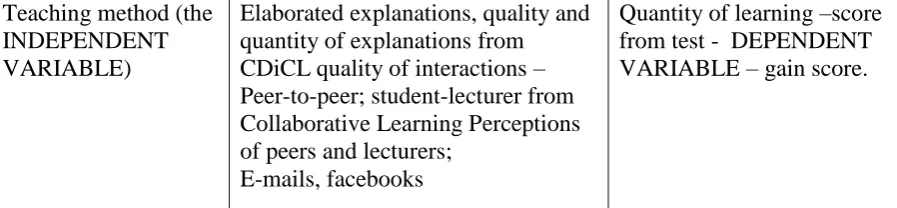
The result was analysed using SPSS version 16.0. Descriptive and some basic statistics t-test was used in analyzing the effectiveness of these two groups. The first author was teaching both sets of students 2008 and 2009. This is to reduce biasness and any discrepancies (extraneous variables) in the teaching values. The first author has more than 20 years experience teaching mathematics at diploma level (Kota Bharu Polytechnic and UTHM). In order to explain the result, we are going to use Table 1 as a guide.
Table 1
Framework for explaining the outcomes
6 Teaching method (the
INDEPENDENT VARIABLE)
Elaborated explanations, quality and quantity of explanations from CDiCL quality of interactions – Peer-to-peer; student-lecturer from Collaborative Learning Perceptions of peers and lecturers;
E-mails, facebooks
Quantity of learning –score from test - DEPENDENT VARIABLE – gain score.
In this section two types of results are shown.
Quantitative and Qualitative Results. Quantitative Results
[image:6.595.75.524.73.177.2]Descriptive statistics in terms of the Gain score (difference between post and pre test score) is shown in Figure 2.
Figure 2.
Descriptive statistics of the two different participating groups
` Here the control group mean is three times than the experimental group even though standard deviation between them is almost equal. This implies that they are equivalent in ability since all entries into UTHM were processed by MOHE in Kuala Lumpur. Since two groups of students were tested, an independent „t-test‟ statistics was employed. Table 2 has the details.
Table 2
Results of Independent Equal Variance t-test
Levene‟s Test for
equality of variance t-test for equality of Means
Gain Score
F Sig. t df
Sig.(2-tailed)
Mean Difference
Std. Error Difference Equal
variances assumed
Group1 1.078 0.303 4.51 74 .0031 2.51 0.554
Equal variances not assumed
Group2 4.67 68.27 .002 2.51 0.554
Method Mean St. Standard
Error Dev Group 1(control) CDiCL
n=30
3.28 2.372 0.433
Group 2( Facebook and e-mails) n=45
7 From Table 2 , Levene‟s test produced non-significant (i.e. p >0.05) then the null hypothesis was accepted that the difference between the variance is zero - which implies the variance are roughly the same and the assumption is tenable. For these data, Levene‟s test is non-significant so we read the test statistics in the row labeled Equal Variance assumed. This again implies of homogeneity of variances is met. Looking at the mean difference of 2.51 and the standard error difference of 0.554. In the case of 2-tailed test of p equals to 0.0031 which is smaller than 0.05, we could conclude there was a significant difference between these two groups of 1DIT students in UTHM. In terms of the experiment we can infer that students are not equally excited to use a courseware CDiCL delivered through the server with some collaborative learning against another group of DIT students using e-mails and Facebook. Calculating the effect size, a score of 0.45 was obtained which is substantial. (Fields,2000).
Qualitative Results
While doing the experiments, the following data were obtained through audio recording (handsets).
Items and characteristics Advantages Disadvantages CD-ROM known as CDiCL Easy to understand and
control
Boring / not the state of the art
Collaborative learning for they are sitting in pairs
Peer to peer discussion on word problem. More members talking in Malay. The mathematics concepts are relayed in BM by the instructor too.
The worthiness of their discussion depends on the readiness of the members in each team. If they are all ready, the discussion is more fruitful.
e-mails only; FB; they sit by themselves alone
It looked more conducive, the state of the art.
Interesting but lonely. The student cannot walk all over the places to discuss many things. They just e-mail their problems and suggested solution (if any).
e-mail They can write anything they
like but Bahasa Malaysia was used in their e-mails and more relax.
They cannot talk as freely as what they used to do all this time. They can only emails or Facebook.
Facebook They looked happier. They can see their friends faces.
8 What could be gained from this qualitative data was firstly many students enjoyed using e-mails and facebook since this was the trend among youngsters. But their mood would slightly change if they faced difficulties getting feedback from peers and what more if they were e-mailing some ideas and solution by himself alone in the laboratory.
Discussion
In this study 75 Diploma Information Technology from UTHM students took part and they were put into two different groups. One studied in 2008/09 session and the other one 2009/10 session. The first group used CDiCL courseware with collaborative learning set up while the second group practiced electronic mails and Facebook to learn algebra topics. The first author was the only mathematics instructor among the two groups. From the result section, e-mail group did not do so well as compared to CDiCL and collaborative learning group. The average gain score obtained from the e-mail group and Facebook is lower than the old collaborative learning group using CDiCL. This implies that stability among group members of 3 is important to be achieved as face to face discussion is more fruitful than e-mails and facebook during mathematics learning. And this concurs with Zain et al (2006), Tan, (2007), Razali (2008), Shane and Glinov (2008). May be the members lost their focus once they got facebook as the facility to learn since the students suddenly changed their mood to study through computers and this concurs with MOE INTEL 2007 report. Word problem solving exercises could be more effective in Malaysian language ( Mohd Sazali, 2010b) and this was so not well demonstrated by the second group using e-mails and facebook.
The contribution of this paper is that students would do better if they were trained to think more outside their box. This came with some creativity and innovative from lecturers‟ sides i.e., collaborative learning method besides some use teaching aids likes CDiCL. Their work in the computer laboratory must be guided with some sort of „word problem‟ solving tasks within specified time length in order for them to focus what would the outcome of each of their computer session. The experiment in FTMM UTHM DIT Year 1 was differently done than schools that participated in MOE INTEL 2007 program where in FTMM more „solid question„ was prepared as the main guide to the computer laboratory work. In MOE Intel report 2007 some students complained they were more advanced than the teachers in getting correct web sites for learning purposes. The limitation was the students were still so new to this style of learning since they were the first semester students in UTHM. Another obstacle was understanding algebra, English and Malay when mathematics has its own language and concepts as well. Word problem solving exercises was roped in into their work to glue things up (technology, languages and mathematics) and it was effective only if the teams collaborated well as proven in 1DIT 2008/09 batch of students. From interview, few students complained they understood a lot even though their marks was low and this contrasted to their peers who gained high marks but they understood less Mathematics IT. In sum, 1DIT students had gained new learning and teachings skills.
Conclusion
9 New learning and teaching experience was obtained among the participants and the result can help UTHM to decide employing future technology.
Acknowledgement
UTHM and FTMM/FSKTM for allowing in conducting this study. Special thanks goes to 1DIT students batch 2008/09 and 2009/10 for participating in this study. Technicians like Mr Razzaly Yussoff and Mr Azaddin were very instrumental in carrying out their task in producing successful environment for this study. Madame Siti Mahfuzoh Wasikon and Miss Nurul Nadzirah Hairani 3BIT was also acknowledged in preparing this paper.
References
Barrow, L., Debraggio, E., and Elena Rouse, C. (2008). Failing in mathematics.(url address: http://www.voxeu.org/index.php?q=node/2722 ) accessed on 26 July 2011
Chai Mun, O.C. Tiong. (2005). “Siri Teks Referens SPM 4&5”. Petaling Jaya: Pearson Longman .Field, A.(2000). Discovering Statistics Using SPSS for Windows (2nd Edition). London: Sage. Healy, J.M. (1998). Failure to Connect : How computers affect our children‟s minds – for better and worse. USA: Simon and Schuster.
Healy, J.M.(1998). Failure to connect: How computers affect our children‟s minds – for better and worse. USA : Simon and Schuster.
Heid, M.K. (2002). “Computer Algebra Systems in Secondary Mathematics Classes: The Time To Act is Now!”. Mathematics Teacher. 95(9). pp 662-667
Pusat Perkembangan Kurikulum (2001). “Kemahiran Berfikir dalam Pengajaran dan Pembelajaran.” Kuala Lumpur: Kementerian Pendidikan Malaysia.
Marzita Puteh (2003). Factors associated with mathematics anxiety. Tanjung Malim: UPSI Mays, H.(2005). Using the results of diagnostically testing to promote mathematical
pedagogical knowkedge. Teacher Education: local and global. Australian Teacher Education Association 33rd Annual Conference proceedings., pp 310-316, ATEA, Australia [E1]
Mohd Salleh Abu. (1990). “An Exploratory Study of Mathematical Difficulties Experienced by the Pre-University Students at University Teknology Malaysia and the Relation to the Structure of Mathematical Ability”. Brunel University, England: PhD Thesis. MOE Intel Project Report (2007) School Adoption Project Phase 1 . Ministry of Education
Malaysia and Intel Malaysia. 1st edition. Kuala Lumpur: Educational Technology Division, MOE , and Intel Malaysia. ISBN 978-983-3244-87-4
Mohd Sazali Khalid, Norlida Hassan, Nureizi Arbaiy, Zehan Afizah Afip and Nurul Azma Abdullah. (2006). Statistical Mathematics – Laboratory Activities. Teaching module. Parit Raja: UTHMPublication.
Mohd Sazali Khalid, Maizam Alias, Wahid Razally, Sulaiman Yamin, Tutut Herawan. (2010a). The effect of using an interactive multimedia courseware within a collaborative learning environment on learning pre-algebra concepts. Procedia Social & Behavioural Sciences Vol 8, 2010 pp 571-579 ICMER 2010.
10 Noraini Idris. (2006). Teaching and Learning of Mathematics. Making sense and Developing
Cognitive Abilities. Kuala Lumpur: Utusan Publications and Distributors Sdn Bhd. Parents Teachers Association (2011). Kolej Islam Sultan Alam Shah KISAS. 1st July 2011. Razali Hassan. (2008). How do learners respond to Computer Based Learning Material
which has been designed to suit their particular learning style. Unpublished Ph.D thesis. Warwick University,UK.
Shane, Mc. and Glinov, Von. (2008). Organization Behavior. 4th Ed. Boston: Mc Graw Schifter, D. and Fosnot, C. T. (1993) “Reconstructing Mathematics Education: Stories of
Teachers Meeting The Challenge of Reform”. New York: Teachers College Press. Star Paper, “Dilemma faced by PPSMI/EmTMS”. Kuala Lumpur: Star Publication Sdn Bhd.
14 December 2008.
Tan, M.(2007). Teaching Mathematics and Science in English in Malaysian Schools: Profiles of Teacher Learning within the context of educational reform. Proceedings of COSMED 2nd International Conference Math and Science Education. Penang: Nov 2007. pp 142 - 151
Tracer Study (2006). Projek Kajian Graduan Politeknik Kementerian Pendidikan Malaysia
bagi tahun 2003 – 2005 Accessed
http://www.politeknik.edu.my/WebSept07/PENERBITAN/TRACER_STUDY_2006/ laporan_final_2006.pdf on 5 May 2009
Wei Xin-li and Cao Jian-wen (2011). “Study on roles of various medias in college course teaching based on modern Information Technology”. International Application and Technology. 978-1-4244- 7255-0/11/$26.00 c 2011 IEEE Zain, M.Z.M., Majid, O., Luan, W.S., Fong, S.F., Atan, H. & Idrus, R.M. (2006). Computers
in Malaysian Smart School: The changing of technologies and mindsets. Malaysian Journal of Educational Technology. 6(2). (pp. 61-70).
Authors:
Mohd Sazali Khalid, Universiti Tun Hussein Onn Malaysia [email protected]
Sulaiman Yamin, Universiti Tun Hussein Onn Malaysia [email protected]
APPENDIX A.