Ring Opening in Epoxy, Propoxy Carbazole with Various
Amines Using Ionic Liquid as Green Solvent
G V R Sharma
1,*, M. Veerraghava Reddy
1,2, G. Omprakash
2, K. Tatendra Reddy
21 Department of Chemistry, GIT, GITAM University, Visakhapatnam-530 045, India 2Pharma Zell R&D (India) Private Limited, Visakhapatnam- 531 162, India
*Corresponding author: [email protected]
Copyright © 2014 Horizon Research Publishing All rights reserved.
Abstract
The epoxides undergo ring-opening reaction smoothly with various amines in an ionic liquid namely 1-butyl-3-methylimidazolium tetrafluoroborate (bmim BF4) under mild reaction conditions. All the reactions were carried out at ambient temperature to afford the corresponding β–aminoalcohols in excellent yields. The ionic liquid was recovered and reused in further reactions with very good efficiency.Keywords
Epoxides, Amines, Bmim BF4, β-Amino Alcohols1. Introduction
β-Adrenergic blocking agents (β-blockers)1, 3-11 mostly
comprising of β-amino alcohols are of pharmaceutical significance and have received major attention due to their utility in the management of cardiovascular disorders including hypertension, anginapectoris, cardiac arrhythmias, and other disorders related to the sympathetic nervous system. Aryloxy β-amino alcohol functionality is the key pharmacophore in β-blockers. Propranolol is the prototype agent for this class of compounds, which affects β1 and β2 receptors. The classical approach and the most straight forward synthetic route for the preparation of β-amino alcohols, involve the heating of epoxide with an excess of amine at elevated temperature. Since some functional groups are sensitive to high temperature, a variety of activators such as alkali metal halides, metal perchlorates, metal tetrafluoroborates and metaltriflates have been reported to carry out this reaction. However, many of these methods involve the use of expensive and stoichiometric amounts of reagents, suffer from poor regioselectivity and also require extended reaction times. Therefore, the development of a new and efficient protocol for this transformation under mild and more convenient conditions is still needed. On the other hand, use of ionic liquids as alternatives to conventional organic solvents is increasing at a rapid rate in many areas of
chemistry, in particular in the area of organic synthesis. It is due to the fact that the ionic liquids provide green chemistry and ecofriendly technologies as they can be recycled many times without loss of efficiency2. Ionic liquids have higher boiling points compared to organic solvents which have lower boiling points and this property makes ionic liquids as best alternatives to organic solvents. The bmim BF4 belongs to the class of Ionic liquids which we have used in the current study and found it to be an effective reagent and solvent. By using ionic liquid, high product yields can be obtained, and a reduced amount of waste can be produced in a given reaction. Often the ionic liquid can be recycled and was reused for five runs without any loss of activity. Therefore it leads to a reduction of the costs of the processes. It must be emphasized that reactions in ionic liquids are not difficult to perform and usually require no special apparatus or methodologies. The reactions are often quicker and easier to carry out than in conventional organic solvents.
2. Results and Discussions
In this communication, we wish to report the exploition of Ionic liquids, in particular bmim BF4 as an efficient reaction medium for the ring opening of various epoxides with nitrogen nucleophiles under mild and moderate reaction conditions as shown in the schemes 1.
N H O O + HN R2 R1 OH N H O N R2 R1
1 (2a-2e), (3a-3e),
(3a) (3f)
bmim BF4
Scheme 1
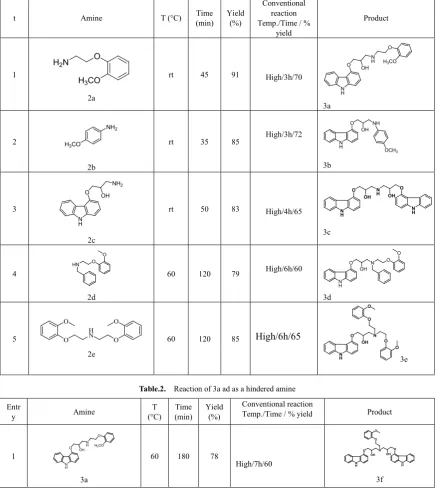
of bmim BF4 was added. First, epoxy, propoxy carbazole (1) was subjected to the opening with various amines (2a-e and 3a) in the presence of bmim BF4. The reaction between compound 1 and compound 2a was rather fast in the presence of bmim BF4 and the corresponding β-amino alcohol 3a, was obtained nearly in aquantitative yield (91% ) within 45 minutes at room temperature ( Table 1, entry 1). A somewhat milder reaction between compound 1 and compound 2b took place employing bmim BF4 and compound 3b was isolated in quantitative yield (85% ) after 35 minutes at room temperature (Table 1, entry 2). In the
2c, in the presence of bmim BF4 at room temperature obtained compound 3c in quantitative yield (83%) after 50 minutes (Table 1, entry 3). On the other hand, the ring opening reactions of compound 1 with the secondary amines
2d and 2e were sluggish and had to be heated at 60° C for 120 minutes in the presence of bmim BF4 (Table 1,entry 4 and 5). Compounds 3d, 3e were obtained in 85% and 79% respectively. Reaction of compound 1 and compound 3a was performed at 60°C for 180 minutes in the presence of bmim BF4 compound 3f was isolated in 78% yield (Table 2, entry 1).
Table 1. Reaction of Compound with various amines
t Amine T (°C) Time (min) Yield (%)
Conventional reaction Temp./Time / %
yield
Product
1
H2N O
H3CO 2a
rt 45 91 High/3h/70
N H O N H OH O
H3CO
3a
2 H3CO
NH2
2b
rt 35 85 High/3h/72
OH N H O NH OCH3 3b 3 N H O NH2 OH 2c
rt 50 83 High/4h/65 N
H O OH N H O N H OH 3c
4 HN
O O
2d
60 120 79 High/6h/60 OH
N H
O N O
O 3d 5 O O H N O O 2e
60 120 85 High/6h/65 O
[image:2.595.87.526.246.737.2]OH N O O N H O O 3e
Table.2. Reaction of 3a ad as a hindered amine
Entr
y Amine (°C) T (min) Time Yield (%)
Conventional reaction
Temp./Time / % yield Product
1 N H O N H OH O
H3CO
3a
60 180 78
High/7h/60 O OH N O O O N H N H OH 3f
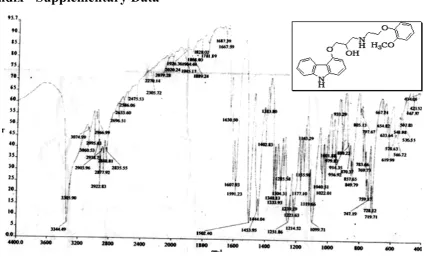
given in the enclosed supplementary data (Figures 1-14). IR spectrum of 3c
Mass spectrum of 3c
3. Experimental Section
FT-IR spectra were recorded as KBr pellet on Nicolet 380 FT-IR instrument (Model Thermo Electron Corporation-Spectrum One). 1H spectra were recorded on Varian 300 and 400 MHz spectrometers using CDCl
3, DMSO-d6 as solvents, and tetra methyl silane (TMS) as internal standard. Mass spectra were recorded on Agilent triple quadrupole mass spectrometer equipped with turbo ion spray interface at 375°C. All the organic extracts were dried over sodium sulfate after work-up. The dry reactions were carried out under nitrogen atmosphere with magnetic/mechanical stirring. Unless otherwise mentioned, all the solvents and reagents used were of LR grade. TLC was performed on precoated silica-gel plates, which were visualized using UV light and sulphuric acid/ethanol (5:95) charring.
3.1. General Procedure
To a mixture of epoxide (1 mol) and amine (1 mol) was added the bmim BF4 (10 mol%).The resulting reaction mixture was stirred at ambient temperature for a specified period (Table1). The progress of the reaction was monitored by TLC. After complete conversion of the starting material, as indicated by TLC, the product was extracted with di ethyl ether, followed by drying at 80°C under reduced pressure to afford the corresponding pure β-amino alcohol derivatives in excellent yields. All the products were confirmed by their 1HNMR, IR and Mass spectrometry and compared with literature data.
3.2. Spectral Data for 3a
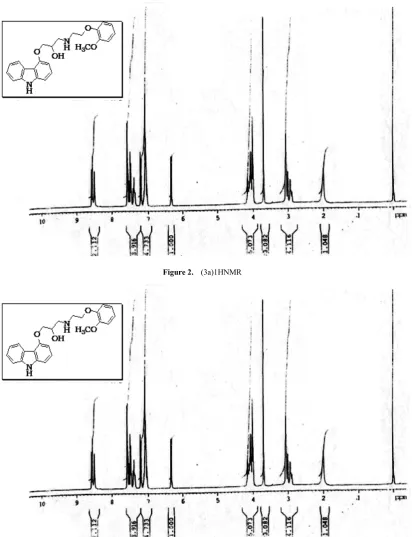
Compound 3a: IR (Kbr): 3344 cm-1 (-OH); 1H NMR (CDCl3; 400 MHz ): δ 8.5 (m, 2H, -carbazole), 7.4 (m, 4H,
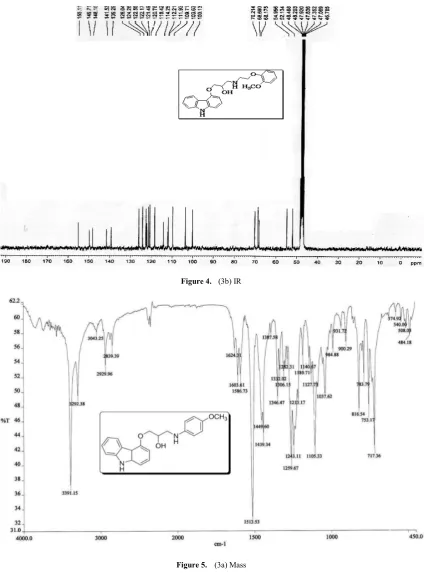
-Aromatic), 7.1 (m, 5H, -Carbazole), 6.4 (d, 1H, J=6.8 -carbazole), 4.1 (m, 5H, -CH2-CH-CH2), 3.85 (s, 3H, -OCH3), 2.92 (m, 2H, -CH2), 2.9 (m, 2H, -CH2), 2.1 (bs, -NH); 13C NMR (100 MHz, DMSO) (Fig.2.6): δ 48.48, 52.13, 54.95, 68.17, 68.69, 70.21, 100.13,103.63, 109.71, 111.93, 112.21, 114.25, 118.42, 120.76, 121.49, 122.17, 124.26, 126.04, 139.29, 141.53, 148.15, 149.71, 155.11; MS: m/z (M+1) 407. HRMS: m/z calculated for C24H26N2O4, 406.19 Found: C24H26N2O4, 406.168
1H), 8.25 (d, J ═ 7.6 Hz, 1H), 7.46 (d, J ═ 7.6 Hz, 1H), 7.37–7.27 (m, 2H), 7.16 (t, J ═ 7.0 Hz, 1H), 7.08 (d, J ═ 8.0 Hz,
1H), 6.72–6.66 (m, 5H), 5.28 (s, 1H), 5.20 (t, J ═ 4.0 Hz, 1H), 4.27–4.16 (m, 3H), 3.61 (s, 3H), 3.43–3.35 (m, 1H),
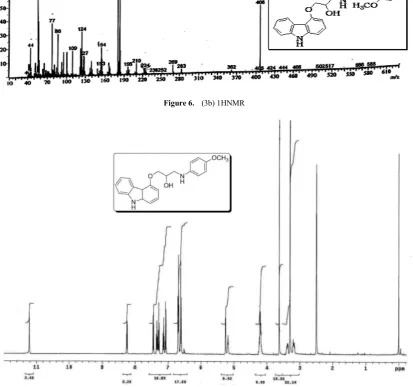
3.24–3.16 (m, 1H). 13C NMR (100 MHz, DMSO–d6): 154.9, 150.7, 143.0, 141.0, 138.9, 126.4, 124.5, 122.4, 121.7, 118.5,
114.6, 113.2, 110.9, 110.3, 103.8, 100.4, 70.2, 67.8, 55.3, 47.4. MS (m/z): 363 (M+1). HRMS. m/z Calculated for
C22H22N2O3 362.16 Found C22H22N2O3 362.1459
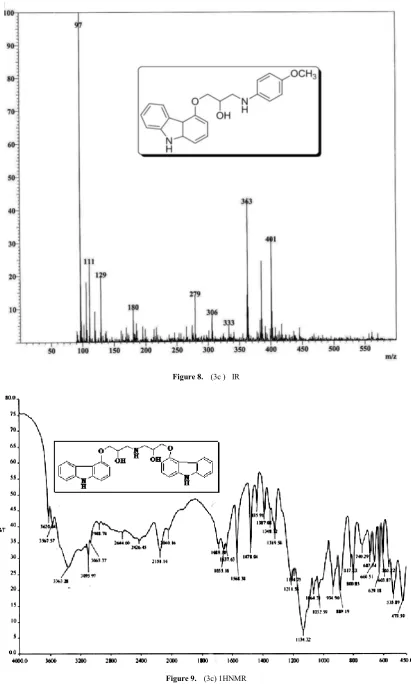
Compound 3c:IR (Kbr): 3620, 3567 and 3363 cm-1(-NH), 3095 and 3063 cm-1(-OH);
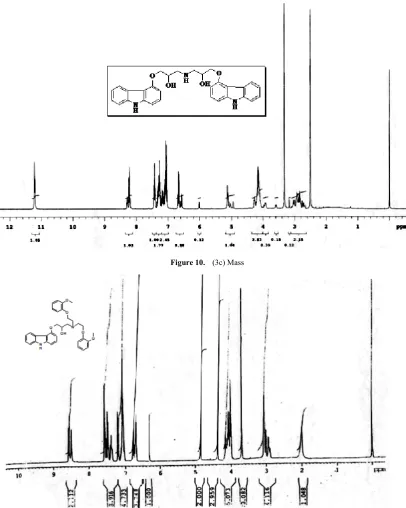
1H NMR(300 MHz, dmso): δ 11.2 (s, 2H, -NH), 8.2 (m, 2H, -Aromatic), 7.5 (m, 2H, -Aromatic), 7.3 (m, 4H, -Aromatic), 7.2 (m, 4H, -Aromatic), 6.6 (m, 2H, -Aromatic), 5.2 (m, 2H, -OH), 4.2 (m, 4H, -OCH3), 4.0 (m, 2H, -CH), 2.8 (m, 4H, -CH2); MS: m/z (M-1) 494 and (M+1) 496. HRMS m/z calculated: for C30H29N3O4 495.58 Found:C30H29N3O4 495.5689
Compound 3d:IR (Kbr): 3401 cm-1 (-OH), 3059 cm-1 (-CH aromatic);
1H NMR (300 MHz, CdCl3) : δ8.2 (d, 1H, J=7.8, -Aromatic), 8.0 (s, 1H, -NH), 7.5-7.2 (m, 9H, -Aromatic), 6.8 (m, 5H, -Aromatic), 6.6 (d, 1H, J=8.0, -Aromatic), 4.2 (m, 4H, -OCH2), 4.1 (m, 1H, -CH), 3.9 (m, 6H, -NCH2), 3.0 (m, 3H, -OCH2), 1.5 (s, 1H, -OH); MS: m/z (M+1) 497. HRMS m/z C31H32N2O4 for 496.61 Found C31H32N2O4 496.5891
Compound 3e:IR (Kbr): 3064 cm-1(-CH Aromatic), 2838 cm-1 (-OCH3);
H1NMR (400 MHz, DMSO-d6/TMS ): δ 7.8 (m, 2H, -tosyl); 7.5 (m, 2H, -tosyl), 6.9 (m, 4H, -Aromatic), 4.3 (m, 2H, -OCH2), 4.1 (m, 2H, -CH2), 3.7 (s, 3H, -OCH3), 2.4 (s, 3H, -CH3); MS: m/z (M+1) 323. HRMS m/z calculated for C33H36N2O6: 556.66 Found C33H36N2O6 : 556.6495
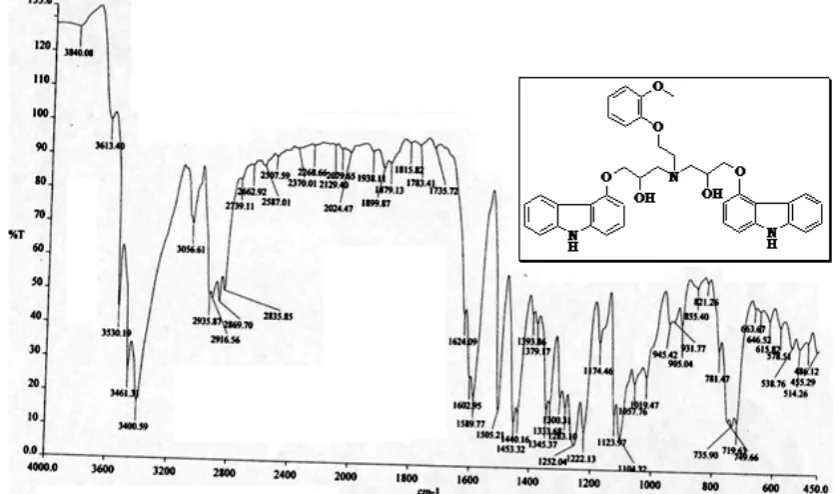
Compound 3f:IR (Kbr): 3613 cm-1 and 3530 cm-1 (-NH), 3461 cm-1 and 3400 cm-1 (-OH);
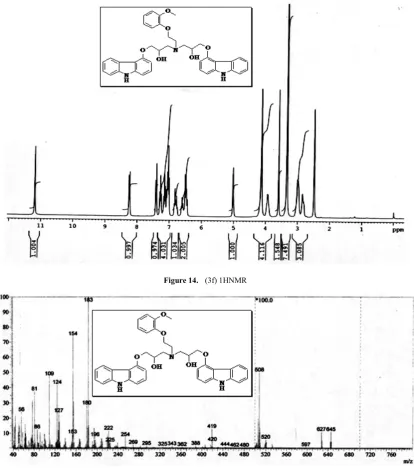
1H NMR(300 MHz, dmso): δ 11.2 (s, 2H, -NH), 8.2 (m, 2H, -Aromatic), 7.5 (m, 2H, -Aromatic), 7.3 (m, 8H, -Aromatic), 6.8 (m, 2H, -Aromatic), 6.6 (m, 4H, -Aromatic), 5.1(s, 2H, -OH), 4.2(m, 8H, -CH2), 3.9(m, 2H, -CH), 3.6(s, 3H, -OCH3); MS: m/z (M) 645.HRMS m/z calculated for C39H39N3O6 645.76 Found C39H39N3O6 645.7496
4. Conclusions
In conclusion it has been demonstrated that ionic liquids can be used for the ring opening of epoxides with amines. Ionic liquid can be recycled several times. The details of experimental and spectral data for other compounds are available in the supplementary data.
[image:5.595.91.518.444.701.2]Appendix - Supplementary Data
Figure 2. (3a)1HNMR
Figure 4. (3b) IR
Figure 6. (3b) 1HNMR
Figure 8. (3c ) IR
[image:9.595.98.510.75.760.2]Figure 10. (3c) Mass
Figure 12. (3e) Mass
[image:11.595.101.505.75.253.2] [image:11.595.92.512.295.542.2]Figure 14. (3f) 1HNMR
Figure 15. (3f) Mass
REFERENCES
[1] Main B G & Tucker H, In Medicinal Chemistry: the role of Organic chemistry in Drug Research of β-blockers: Roberts S M & Price B J, Eds, Academic Press: London, 1985. [2] Khupse N D & Anil Kumar, Ind J of Chem., 49A, 2010,
635-48
[3] Howe R, Crowther A F, Stephenson J S, Rao B S & Smith L H, J Med Chem, 11, 1968, 1000.
[4] Crowther A F & Smith L H, J Med Chem, 11, 1968, 1009. [5] Howe R & Rao B S, J Med Chem, 11, 1968, 1118 and
references cited therein.
[6] (a) Powell J R, Wainer I W & Drayer D E, Drug Stereochemistry Analytical Methods and Pharmocology, Dekker M, USA, 1988; (b) Connolly M E, Kersting F & Bollery C T, Prog Cardiovas Dis, 19, 1976, 203.
[7] (a) Rabkin R, Stables D P, Levin N W &Suzman M M, Am J Cardiol, 18, 1966, 370; (b) Bestermann E M M & Friedlander D H, Postgrad Med J, 41, 1965, 526; (c) Ross E J, Prichard B N C, Kaufmann L, Robertson A I G & Harries B J, Br Med J, 1967, 191; (d) Prichard B N C &Gillam P M S, Br Med J, 1964, 725; (e) Geroge C F, Prescriber’s Journal 14, 1974, 93; (f) Sandler G & Pistevos A C, Br Med J, b, 254.
[image:12.595.99.514.74.544.2]D A, Shanks R G & Weaver J A, Lancet, 1968, 852; (e) Morelli H F, Ann Inter Med, 78, 1973, 913; (f) Owen D A L & Marsden C D, Lancet, 1965, 1259; (g) Weber R B & Reinmuth O M, Neurology, 22, 1972, 366; (h) Young R R, Gowen J H & Shahani B T, N Engl J Med, 293, 1975, 950. [9] Fritz W, Wolfgang K, Max T, Gisbert S, Egon R & Karl D,
DE 2,815,926 A1, Oct 18, 1979, Chem Abstr, 92, 1979, P128716e.
[10] Zoltan R, Jozsef B, Gyula S, Tamas G, Donáth V G, Norbert N, Kalman N, Judit C, Tibor S, Laszlo B, Imre D, Zoltan G, Kotay N P & Peter S, EP 0,918,055 A1, May 26, 1999, ChemAbstr, 130, 1999, P352184r.