The Firefly Optimization Algorithm:
Convergence Analysis and Parameter Selection
Sankalap Arora
Computer Science DepartmentSUSCET,Mohali Punjab,India.
Satvir Singh
Electronics Department SBS State technical CampusFerozpur, Punjab, India
ABSTRACT
The bio-inspired optimization techniques have obtained great attention in recent years due to its robustness, simplicity and efficiency to solve complex optimization problems. The firefly Optimization (FA or FFA) algorithm is an optimization method with these features. The algorithm is inspired by the flashing behavior of fireflies. In the algorithm, randomly generated solutions will be considered as fireflies, and brightness is assigned depending on their performance on the objective function. The algorithm is analyzed on basis of performance and success rate using five standard benchmark functions by which guidelines of parameter selection are derived. The tradeoff between exploration and exploitation is illustrated and discussed.
General Terms
Optimization, metaheuristic, firefly algorithm, analysis, convergence, parameter selection, performance.
Keywords
Optimization; firefly algorithm; convergence; parameter selection;
1.
INTRODUCTION
The basic meaning of optimization in our daily lives is to do better in a field and in area of computational intelligence, optimization can be basically described as finding a parameter in a function which can make the solution better among all the possible solutions and the best value is known as optimum solution. [1]. In order to solve optimization problems, optimization algorithms are used which can be classified in a simple way into deterministic algorithms and stochastic algorithms. Deterministic algorithms are those whose behavior can be completely predicted as they are presented with same set of input and algorithm does same computations and produce same set results every time [2], [3].
Generally stochastic algorithms are divided into heuristic and metaheuristic algorithms. Heuristic algorithms find solutions in a reasonable amount of time but there is no guarantee that optimal solutions are reached [4], [5]. On the other hand metaheuristic uses certain tradeoff a randomization and local search, as randomization provides a good way to move away from local search to the search on global scale which means metaheuristic algorithms intend to be suitable for global optimization. Most stochastic algorithms can be considered as metaheuristic and good examples are Genetic Algorithm (GA) [6], [7]. Many modern metaheuristic algorithms were developed based on swarm intelligence in nature like PSO and AFSA. Firefly algorithm is a metaheuristic algorithm developed by Dr. Xin-Shi Yang[3]. This algorithm is based on the natural behavior of fireflies which is based on the phenon-
-menon of bioluminescence. Fireflies in nature are capable of producing light thanks to special photogenic organs situated very close to the body surface behind a window of translucent cuticle [3]. This light helps them to communicate with each other and attract prey or other fireflies.
2.
Basic Concepts
2.1
Optimization Problem
An optimization problem has basically three components: a function to optimize, possible solution set to choose a value for the variable from, and the optimization rule, which will be either maximized or minimized[8], [9]. Since one can switch between minimization and maximization problems by multiplying the objective function by negative one, analyzing either minimization or maximization problem is enough[10]. A typical maximization problem can be given as follows:
Max f(x)
s.t. x ϵ S ⊆
(1) A solution for this problem is a member of set S which gives the maximum value of f(x)compared to all elements in S. Mathematically, x* is a solution if and only if x*ϵ S and f(x*)≥ f(x), for all x ϵ S. The aim of all solution methods and algorithms is to find such x*[11], [12], [13].
2.2
Firefly algorithm
2.2.1
Behavior of flies
The bioluminescence processes is responsible for flashing light of fireflies. There are many theories regarding reason and importance of flashing light in firefly’s life cycle but many of them converge to mating phase [14]. The basic objective of flashing light is to attract mating partner The pattern of these rhythmic flashes is unique based upon rhythm of flashes, rate of flashing and amount of time for which flashes are observed [15]. This pattern attract both the males and females to each other and female of a species respond to individual pattern of male of same species . According to the inverse square law, intensity of the light I, keeps on decreasing as the distance r increases in terms of I α 1/r2. Air also acts as absorbent and light gets weaker with increasing distance [16]. Combining these two factors reduce the visibility of fireflies to a limited distance normally few hundred meters at night which is sufficient for fireflies to communicate with each other.
2.2.2
Concept
• All fireflies are considered as unisex and irrespective of the sex one firefly is attracted to other fireflies
•The Attractiveness is proportional to their brightness, which means for any two flashing fireflies, the movement of firefly is from less bright towards the brighter one and if no one is brighter than other it will move randomly. Furthermore they both decrease as their distance increases.
• The landscape of the objective function directly affects the brightness of the firefly [3] [17].
For a maximization problem, the brightness is proportional to the objective function’s value. Other forms of the brightness could be defined in same way to the fitness function as in genetic algorithms.
2.2.3
Light intensity and attractiveness
Firefly algorithm is based on two important things, first is the variation in light intensity and second is formulation of attractiveness. For simplicity it is assumed that attractiveness of firefly is determined by its brightness which is connected with objective function [18].
At particular location x, the brightness I of a firefly can be chosen as I(x) ∝ f(x) for a maximization problem.
The attractiveness β is relative, which means it should be judged by other fireflies, so it will differ with distance rij
between firefly i and firefly j. As already stated, the light intensity decreases with distance from its source and light is also absorbed by air, so attractiveness should be allowed to vary with varying degree of absorption[3], [17]. So in simplest form, light intensity I(r) varies according to inverse square law.
(2)
Is is the intensity at the source. The light intensity I varies
with the distance r having a fixed light absorption coefficient γ i.e.
(3) where Io is the initial light intensity, In order to avoid the singularity at r = 0 in the expression Is/r2 the combined effect of both the inverse square law and absorption can be approximated as the following Gaussian form[17], [19]:
(4) Firefly’s attractiveness β is proportional to the light intensity seen by adjacent fireflies which can be defined as:
(5)
where β0 is the attractiveness at r = 0. Since it is often faster to calculate1/(1 + r2) than an exponential function, the above function, if necessary, can be approximated as shown in (6).
(6)
Both (5) and (6) define a characteristic distance Г 1/γ over which the attractiveness is changing significantly from βo to
βoe-1 for equation (5) or βo/2 for equation (6)[3], [16]. In the
real time implementation, β(r) is the attractiveness function which can be can any monotonically decreasing function like the following.
(7)
For a fixed, the characteristic length becomes
(8)
Conversely, γ can be used as typical initial value for a specific length scale Г in an optimization problem. That is
(9)
The distance between any two fireflies is calculated using Cartesian distance method.
(10)
In (10) xi,k is the kth component of spatial coordinate xi of ith
firefly. In 2-D case, we have
(11)
Firefly i is attracted to brighter firefly j and its movement is determined by
(12)
Firefly algorithm( )
1. Objective function f(x), x=(x1,x2,…,xd)T 2. Initialize a population of fireflies xi(i= 1,2, . . , n) 3. Define light absorption coefficient γ
4. While (t<MaximumGenerations) 5. For i=1:n (all n fireflies) 6. For j=1:i
7. Light intensity Ii at xi is determined by f(xi) 8. If (Ii > Ij)
9. Move firefly i towards j in all d dimensions 10. Else
11. Move firefly i randomly 12. End If
13. Attractiveness changes with distance r via exp[-γr2] 14. Determine new solutions and revise light intensity 15. End for j
16. End for i
17. Rank the fireflies according to light intensity and find the current best
18. End while
3.
PARAMETER SELECTION
GUIDELINES
3.1
Effect of random numbers
The rigorous analysis of optimization algorithm with random numbers is beyond the scope of this paper. By including
random numbers, state space exploration is improved but it slows down the convergence i.e. it prevents premature convergence to non-optimal points.
3.2
Parameter tuning heuristic
In addition to parameters to α and γ and to effect of random numbers discussed above, the convergence of algorithm is indirectly proportional to number of fireflies i.e. more the number of fireflies, more iterations are needed to converge [22]. The best rate of convergence i.e. best tradeoff between exploration and exploitation strongly depends upon many things like number of local optima, function being optimized, distance from global solution, position of global solution in search domain, size of domain etc. It is nearly impossible to find set of unique parameters for algorithm which would work in all cases but the following empirical procedure, based on the above considerations, was found to work in practice [19], [21].
3.3
Convergence
The algorithm is run several times until convergence with convergent parameter set like mentioned in “Optimization experiments” section. If different results are obtained in most runs, the convergence rate is too high; the algorithm converges prematurely to non-optimal points. Slow convergent parameter set should be used i.e. larger number of fireflies, greater domain size [22]. If same result is obtained again and again, but during a large fraction of the algorithm
Name Formula Range Goal
for f
Sphere [-100,100]
n
0.01
Ackley
[-30,30]n 1
Rosenbrock
[-30,30]n 100
Rastrigin
[image:3.595.75.523.418.753.2]
[-5.12,5.12]n 100
Griewank
[-600,600]n 0.1
iterations no better points are found, the convergence rate is too low, fireflies do not focus the search around promising candidate solutions quickly enough. A more quickly convergent parameter set should be selected, smaller number of fireflies, smaller dimension. If consistent results are obtained, convergence rate is good and the same parameter set, domain size should be used to solve similar problems.
4.
OPTIMIZATION EXPERIMENTS
4.1
Test conditions
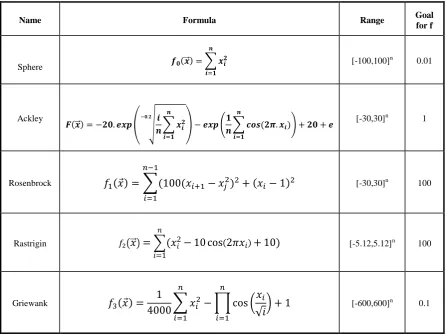
The firefly optimization algorithm was used for the optimization of four benchmark functions. Three sets of parameters were used. Parameter set 1 (α=0.1, γ = 0.01), set 2 (α=0.25, γ = 0.1) and set 3(α=0.5, γ = 1) were selected by the author in the algorithm convergence domain after a large number of simulation experiments. The functions, the number of dimensions (n), the admissible range of the variable (x), the optimum and the goal values are summarized in Table 1. The number of iterations required to reach the goal was recorded. Each optimization experiment was run 25 times with random
initial values of x and v in range [xmin, xmax.] indicated in table
1. During the optimization process the fireflies were not allowed to fly outside the region defined by [xmin, xmax].
4.2
Optimization results and discussion
4.2.1
Effect of number of fireflies in domain(N)
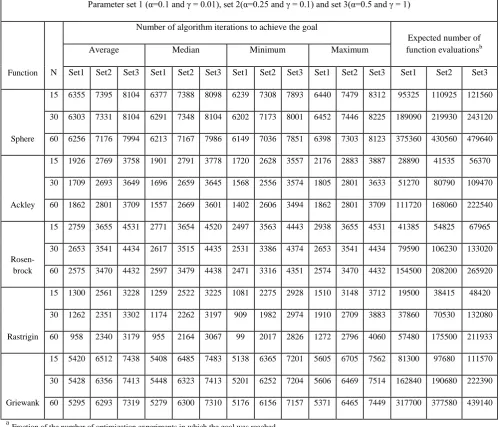
In most cases, increasing the number of fireflies increased the number of required algorithm iterations as indicated by average, median, minimum and maximum values reported in Table 2. The success rate of algorithm (fraction of number of runs it reached the goal) was constant in all cases except for Rastrigin function. Since in real life applications the optimization cost is usually dominated by evaluations of objective function, the expected number of function evaluations was retained as main algorithm performance criterion. It takes into account success rate, number of fireflies and number of algorithm iterations. Best results are obtained with minimum number of fireflies. Usually few numbers of fireflies gave good success rate except in case of Rastrigin function.
Parameter set 1 (α=0.1 and γ = 0.01), set 2(α=0.25 and γ = 0.1) and set 3(α=0.5 and γ = 1)
Function N
Number of algorithm iterations to achieve the goal
Expected number of function evaluationsb
Average Median Minimum Maximum
Set1 Set2 Set3 Set1 Set2 Set3 Set1 Set2 Set3 Set1 Set2 Set3 Set1 Set2 Set3
Sphere
15 6355 7395 8104 6377 7388 8098 6239 7308 7893 6440 7479 8312 95325 110925 121560
30 6303 7331 8104 6291 7348 8104 6202 7173 8001 6452 7446 8225 189090 219930 243120
60 6256 7176 7994 6213 7167 7986 6149 7036 7851 6398 7303 8123 375360 430560 479640
Ackley
15 1926 2769 3758 1901 2791 3778 1720 2628 3557 2176 2883 3887 28890 41535 56370
30 1709 2693 3649 1696 2659 3645 1568 2556 3574 1805 2801 3633 51270 80790 109470
60 1862 2801 3709 1557 2669 3601 1402 2606 3494 1862 2801 3709 111720 168060 222540
Rosen-brock
15 2759 3655 4531 2771 3654 4520 2497 3563 4443 2938 3655 4531 41385 54825 67965
30 2653 3541 4434 2617 3515 4435 2531 3386 4374 2653 3541 4434 79590 106230 133020
60 2575 3470 4432 2597 3479 4438 2471 3316 4351 2574 3470 4432 154500 208200 265920
Rastrigin
15 1300 2561 3228 1259 2522 3225 1081 2275 2928 1510 3148 3712 19500 38415 48420
30 1262 2351 3302 1174 2262 3197 909 1982 2974 1910 2709 3883 37860 70530 132080
60 958 2340 3179 955 2164 3067 99 2017 2826 1272 2796 4060 57480 175500 211933
Griewank
15 5420 6512 7438 5408 6485 7483 5138 6365 7201 5605 6705 7562 81300 97680 111570
30 5428 6356 7413 5448 6323 7413 5201 6252 7204 5606 6469 7514 162840 190680 222390
60 5295 6293 7319 5279 6300 7310 5176 6156 7157 5371 6465 7449 317700 377580 439140
a
Fraction of the number of optimization experiments in which the goal was reached
b
[image:4.595.48.549.308.735.2](Number of particles in the swarm) × (Average number of iterations)/(Success rate)
4.2.2
Effect of objective function
Sphere and rosenbrock have single minimum while other functions have multiple local minima. Rastrigin and griewank have large scale curvature which guides the search towards global minimum. Only in case of rastrigin function, some time there was failure to achieve goal due to premature convergence to local minimum.
4.2.3
Effect of parameter γ and α
Parameter set 1 has the highest convergence rate than set 2 and set 3. Exploitation is favored compared to exploration of state space. The number of algorithm iterations for set 1 was generally smaller. Smallest number of function evaluations was achieved for parameter set 1. Convergence parameter is not the only important factor, convergence trajectory is also important because equal convergence rate doesn’t yield good results. For n=15 with α=0.1 and γ = 0.01, the author obtained good results as shown in Table 2.
5.
Summary
An analysis is made on Firefly algorithm considering its dynamic behavior and convergence as important aspects. Algorithm is analyzed using tools from discrete-time dynamic system and this analysis provides qualitative guidelines for general (random) algorithm parameter selection. Simulation experiments are conducted with three parameter sets, three parameter set of fireflies in domain and five benchmark functions. The speed of convergence-robustness tradeoff was discussed. Better results are achieved in small number of fireflies in domain and smaller value of α and γ. Further research is needed to clarify effect of randomness and their effect on convergence. Better parameter sets probably await discovery in the outlined algorithm convergence domain.
6.
REFERENCES
[1] Y. Liu and K. M. Passino, “Swarm Intelligence: A Survey”, International Conference of Swarm Intelligence, 2005.
[2] X.S Yang, ”Engineering Optimization: An introduction with metaheuristic Applications”, Wiley & Sons, New Jersey, 2010.
[3] X. S. Yang, “Nature-Inspired Metaheuristic Algorithms”, Luniver Press, 2008
[4] X. S. Yang, “Engineering Optimization: An Introduction with Metaheuristic Applications”. Wiley & Sons, New Jersey, 2010.
[5] D. Yazdani, and M. R. Meybodi , “AFSA-LA: A New Model for Optimization”, Proceedings of the 15th Annual CSI Computer Conference (CSICC'10), Feb. 20-22, 2010.
[6] D. E. Goldberg, “Genetic Algorithms in Search, Optimization and Machine Learning, Reading, Mass”, Addison Wesley, 1989
[7] I. H. Holland, “Adaptation in natural and Artificial Systems”, University of Michigan, Press, Ann Abor, 1975.
[8] J. Kennedy, R. C. Eberhart, “Particle swarm optimization”, IEEE International Conference on Neural Networks, Piscataway, NJ., pp. 942-1948, 1995.
[9] T. Baeck, D. B. Fogel and Z. Michalewicz, “Handbook of Evolutionary Computation”, Taylor & Francis, 1997. [10]J. Kennedy J., R. Eberhart and Y. Shi, “Swarm
intelligence”, Academic Press, 2001
[11]F. Tangour and P. Borne,(2008) "Presentation of some Meta-heuristic for the Optimization of complex system", in: Studies in Informatics and Control, Vol. 17, No. 2,pp.169-180
[12]L. X. Li, Z. J. Shao and J. X. Qian, “An optimizing Method based on Autonomous Animals: Fish Swarm Algoritm”, System Engineering Theory & Practice, 2002.
[13]Wright JA, Farmani R (2001) Genetic algorithm: A fitness formulation for constrained minimization in Proc. of Genetic and Evolutionary Computation Conf., San Francisco, CA, pp 725–732, 2011.
[14]S. L. ukasik and AK. SÃlawomirZ, “Firefly algorithm for Continuous Constrained Optimization Tasks”, 1st International Confernce on Computational Collective Intelligence, Semantic Web, Social Networks and Multiagent Systems, Springer-Verlag Berlin, Heidelberg, pp.169-178, 2009.
[15]K. Krishnand, K, Ghose, and D, “Glowworms swarm based optimization algorithm for multimodal functions with collective robotics applications”, Int. J. of Multiagent and Grid Systems, Vol. 2, No. 3, pp. 209-222, 2006.
[16]X.-S Yang,(2009)"Firefly algorithms for multimodal optimization" in:Stochastic algorithms: Foundations and Applications,SAGA 2009, Lecture notes in computer sciences,Vol 5792,pp.169-178
[17]X.-S Yang,(2010)"Firefly algorithm, L'evy flights and global optimization", in :Research and development in Intelligent Systems XXVI(Eds M.Bramer, R.Ellis, M.Petridis), Springer London,pp.209-218
[18]T.Apostolopoulos and A.Vlachos, "Application of the firefly algorithm for solving the economic emissions load dispatch problem", in: International Journal of Coimbinatorics, Vol. 2011,pp. 1-23.
[19]H.banati and M. Bajaj, (2011),"Firefly based feature selection approach", IJCSI International Journal of Computer Science Issues, vol. 8,Issue 4, no. 2,pp. 473-480
[20]N. Chai-ead, P. Aungkulanon*, and P. Luangpaiboon, 2011, "Bees and firefly algorithms for noisy non-linear optimization problems", International Multiconference of engineers and scientists (IMECS), Vol. II, Hong Kong. [21]B. G. Babu and M. Kannan, “ Lightning bugs”,
Resonance, Vol. 7, No. 9, pp. 49-55, 2002.