http://dx.doi.org/10.4236/ojic.2015.54010
How to cite this paper: Abdulghani, A.J. and Hussain, R.K. (2015) Synthesis and Characterization of Schiff Base Metal Com-plexes Derived from Cefotaxime with 1H-indole-2,3-dione (Isatin) and 4-N,N-dimethyl-aminobenzaldehyde. Open Journal of Inorganic Chemistry, 5, 83-101. http://dx.doi.org/10.4236/ojic.2015.54010
Synthesis and Characterization of Schiff Base
Metal Complexes Derived from Cefotaxime
with 1
H
-indole-2,3-dione (Isatin) and
4-N,N-dimethyl-aminobenzaldehyde
Ahlam Jameel Abdulghani
*, Rasha Khuder Hussain
Department of Chemistry, College of Science, University of Baghdad, Baghdad, Iraq Email: *[email protected]
Received 10 July 2015; accepted 28 August 2015; published 31 August 2015
Copyright © 2015 by authors and Scientific Research Publishing Inc.
This work is licensed under the Creative Commons Attribution International License (CC BY).
http://creativecommons.org/licenses/by/4.0/
Abstract
This work involved the synthesis of two Schiff base derivatives of cefotaxime antibiotic (CFX) namely: [sodium3-(acetoxymethyl)-7-((Z)-2-(methoxyimino)-2-(2-((E)-2–oxoindolin-3-ylide-neamino) thiazol-4-yl)acetamido)-8-oxo-5-thia-1-azabicyclo[4.2.0]oct-2-ene-2-carboxylate]. (0.5) Methanol (LI) and [sodium3-(acetoxymethyl)-7-((2Z)-2-(2-(4-dimethylamino) benzylideneamino) thiazol-4- yl)-2-(methoxyimino)acetamido)-8-oxo-5-thia-1-azabicyclo [4.2.0] oct-2-ene-2-carboxylate]. (0.5) Methanol (LII) from the condensation reaction of the antibiotic with 1H-Indole-2,3-dione(isatin) and -N, N-dimethyl amino benzaldehyde respectively. Metal complexes of the two Schiff base gands with Co(II), Ni(II), Cu(II), Cd(II), Pd(II) and Pt(IV) ions were prepared by reacting each li-gand with the metal salts in refluxing ethanol. The chemical structures of the two lili-gands as well as the stereo-chemical structures and geometries of the studied metal complexes were suggested depending the results obtained from CHN and TG analysis, NMR, FTIR, and atomic absorption spectrophotometry, electronic spectra, magnetic moments and conductivity measurements. The mole ratio of the ligands to the metal ion was 1:1 with tridentate bonding behaviors of the coordi-nating ligands with the metal ions.
Keywords
Cefotaxime, Schiff Bases, Metal Complexes, Antibacterial Activity
1. Introduction
Research work on the synthesis of Schiff base derivatives of cephalosporins antibiotics is still limited compared
with other organic compounds. This is attributed to the presence of a variety of interacting groups in the skeleton of these molecules which results in low yields [1]-[5]. Complexation of these Schiff base derivatives with sever-al metsever-al ions showed the capability of forming mono-, di- and polynuclear metsever-al complexes in which they be-haved as monodentate, bidentate or tridentate ligands depending on the positions and number of electron donat-ing groups [1] [2] [4] [5]. Cefotaxime sodium (sodium(6R,7R)-3-(acetoxymethyl)-7-(2-(2-aminothiazol-4-yl)- 2-(methoxyimino)acetamido)-8-oxo-5-thia-1-azabicyclo [4.2.0]oct-2-ene-2-carboxylate) is a third generation ce-phalosporin antibiotic having a broad activity against gram positive cocci (not enterococcus), gram negative bacteria (not Pseudomonas), and high resistance against the action of β-lactamases, as well as low index of side effects [6]. Isatin (1H-Indole-2,3-dione) is one of the most promising class of aromatic heterocyclic organic compounds having many interesting activity profiles and well-tolerated in human subjects [7]. Isatin and its Schiff base derivatives showed a variety of biological and pharmacological activities as antimicrobial, antide-pressant, anti-HIV, cytotoxicity, anlagesic, antileshmanial, anticonvulsant, insecticides, fungicides, anticancer, tuberculostatic, and anti-inflammatory [7]-[12]. This work studies the synthesis and characterization of new metal complexes of two Schiff base ligands derived from the condensation reaction of cefotaxime with 1H-Indole-2, 3-dione (isatin) (LI) and p-dimethylaminobenzaldehyde (N,N-DMAB) (LII) (Scheme 1) and studies the coordi-nation behavior of the two ligands with Co(II), Ni(II), Cu(II), Cd(II), Pd(II) and Pt(IV) ions.
2. Experimental
2.1. Materials and Methods
All chemicals were of analytical grades and were used as received from suppliers without further purification. Because of limited solubility of palladium (II) chloride, the salt was converted first to the complex dichlorobis (benzonitrile) palladium (II) [PdCl2(PhCN)2] prior to use following the method reported by Rochow [13]. Purity of products was detected by TLC techniques using a mixture of acetone: chloroform (1:1 and 1:2 v/v), ether: chloroform (1:1 v/v), ethanol: chloroform (1:2) v/v) and chloroform only as eluents, and iodine chamber for spot location.
2.2. Instruments
Melting points (uncorrected) were determined on a Gallenkamp M.F.B 600 - 010f melting point apparatus. Fourier Transform Infrared (FTIR) spectra were obtained using a SHIMADZUE FT-IR 8400S Fourier transforms,
H N
C
S
O S
N O
O N
N O
O NaO
HN
C
S
O S
N O N O
N O
O NaO
Methanol
ref lux glacial acetic acid
CHO
N CH3 H3C
4-DMAB
N CH3
H3C H2N
N HC O
O
+ H2O
cef otaxime sodium(CFX)
LII N
H O O
isatin
Methanol
ref lux glacial acetic acid
O H N C
S
O S
N O N O
N O
O NaO
N
O HN
LI + H2O
within the wavenumber region between 4000 and 400 cm−1 using KBr disc and 4000 and 200 cm−1 using CsI disc. Electronic spectra for compounds in the (UV-Visible) region (200 - 1100) nm were recorded using a SHIMADZUE 1800 Double Beam UV-Visible spectrophotometer. Elemental microanalysis was performed on Eurovector EA 3000A. 1H-NMR and 13C-NMR spectra were performed by using a Bruker Ultra Sheild 300 MHz NMR, Al al-Bayt University (Jordan) and Delta A2 NMR JMN-ECS 400 MHz Manchester Metropolitan University. Thermal analyses (TG and DTG) of samples were performed under helium and nitrogen atmos-pheres at heating range of (25˚C - 900˚C) and (25˚C - 800˚C) respectively and heating rate of 20˚C/min. by us-ing Perkin Elmer TGA 4000. Molar conductivity measurements (S∙mol−1∙cm2) for metal complexes (10 - 3 M) in DMF, DMSO at room temperature were carried out by using LASSCO Digital Conductivity Meter. Magnetic moments (eff. B.M) for the prepared complexes in the solid state at room temperature were measured according to Faraday’s method by using Bruker Magnet B.M-6, Atomic Absorption measurements were performed using BUCK Scientific model 210 VGP USA Atomic Absorption Spectrophotometer.
2.3. Synthesis of Ligands
Synthesis of [sodium 3-(acetoxymethyl)-7-((Z)-2-(methoxyimino)-2-(2-((E)-2-oxoindolin-3-ylideneamino) thia-zol-4-yl) acetamido)-8-oxo-5-thia-1-azabicyclo [4.2.0]oct-2-ene-2-carboxylate]. (0.5) Methanol (LI):
To a stirred solution of isatin (0.308 g, 2 m∙mole) in hot methanol (10 ml) was added (1 g, 2 m∙mole) of cefo-taxime sodium salt in hot methanol (15 ml) followed by 2 ml of glacial acetic acid. The reaction mixture was heated under reflux for 6 h with continuous stirring. The color of solution was changed from orange to brown followed by the formation of a brown precipitate. The product was filtered, washed with hot mixture methanol: water (v: v) (80:20) % followed by cold methanol and ether and vacuum dried.
Synthesis of [sodium 3-(acetoxymethyl)-7-((2Z)-2-(2-(4-dimethylamino) benzylideneamino) thiazol-4-yl)-2 -(methoxyimino) acetamido)-8-oxo-5-thia-1-azabicyclo[4.2.0]oct-2-ene-2-carbo-xylate]. (0.5) Methanol (LII):
This ligand was previously prepared by A. H. kshash in ethanol at pH 4 [4]. In this work we prepared the li-gand adopting a different procedure. A hot solution of 4-dimethylamino benzaldehyde (DMAB) (0.312 g, 2 mmol) in methanol (3 ml) was added to a hot stirred solution of cefotaxime sodium salt (1 g, 2 m∙mol) in the same solvent (15 ml). Then glacial acetic acid was added (1.5 ml) and the mixture was heated under reflux for 3 h to achieve complete precipitation. An olive green precipitate was formed. The product was filtered, washed several times with a hot mixture of methanol-water followed by cold methanol and ether and vacuum dried.
2.4. Synthesis of Metal Complexes
To a stirred solution of each ligand (0.2 g, 0.33 m∙mol) in a mixture of ethanol-water (80:20)% (3 ml) heated to boiling point was added an alcoholic solution of the metal salts: CoCl2∙6H2O, NiCl2∙6H2O, CuCl2∙2H2O, CdCl2∙2H2O, [PdCl2(PhCN)2] and K2PtCl6 (0.039 g, 0.039 g, 0.028 g, 0.036 g, 0.029 g and 0.0804 g respectively, 0.16 m∙mol) with continuous stirring. Immediate precipitation of metal complexes (C1 - C6 respectively for LI complexes and C7 - C12 for LII complexes) was observed. Reflux was continued for 1 h for complete precipita-tion. The products were filtered off, washed with hot EtOH: H2O followed by ether and vacuum dried.
3. Results and Discussion
3.1. Physical Properties and Elemental Analyses
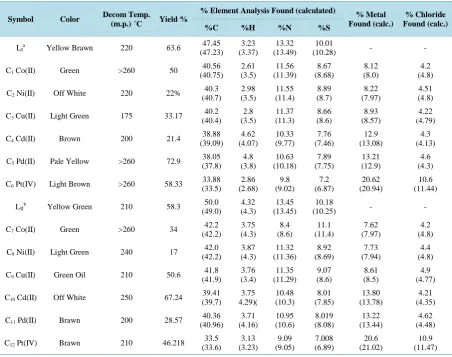
The physical properties and results obtained from C.H.N. analyses and metal contents of the prepared com-pounds are described inTable 1. The analytical data were almost agreeable with calculated values with some deviations attributed to incomplete combustion or technical errors. The molecular formula of the ligands and their metal complexes were suggested according to these data together with those obtained from spectral and thermal analyses as well as conductivity and magnetic susceptibility of metal complexes.
3.2.
1H-NMR Spectra
Table 1.Physical properties and analytical data for LI, LII ligands and their metal complexes.
Symbol Color Decom Temp.
(m.p.)˚C Yield %
% Element Analysis Found (calculated) % Metal
Found (calc.)
% Chloride Found (calc.)
%C %H %N %S
LIa Yellow Brawn 220 63.6 47.45 (47.23) 3.23 (3.37) 13.32 (13.49) 10.01
(10.28) - -
C1 Co(II) Green >260 50 40.56 (40.75) 2.61 (3.5) 11.56 (11.39) 8.67 (8.68) 8.12 (8.0) 4.2 (4.8)
C2 Ni(II) Off White 220 22% 40.3 (40.7) 2.98 (3.5) 11.55 (11.4) 8.89 (8.7) 8.22 (7.97) 4.51 (4.8)
C3 Cu(II) Light Green 175 33.17 40.2 (40.4) 2.8 (3.5) 11.37 (11.3) 8.66 (8.6) 8.93 (8.57) 4.22 (4.79)
C4 Cd(II) Brown 200 21.4 (39.09) 38.88 (4.07) 4.62 (9.77) 10.33 (7.46) 7.76 (13.08) 12.9 (4.13) 4.3
C5 Pd(II) Pale Yellow >260 72.9 (37.8) 38.05 (3.8) 4.8 (10.18) 10.63 (7.75) 7.89 (12.9) 13.21 (4.3) 4.6
C6 Pt(IV) Light Brown >260 58.33 (33.5) 33.88 (2.68) 2.86 (9.02) 9.8 (6.87) 7.2 (20.94) 20.62 (11.44) 10.6
LIIb Yellow Green 210 58.3 (49.0) 50.0 (4.3) 4.32 (13.45) 13.45 (10.25) 10.18 - -
C7 Co(II) Green >260 34 42.2 (42.2) 3.75 (4.3) 8.4 (8.6) 11.1 (11.4) 7.62 (7.97) 4.2 (4.8)
C8 Ni(II) Light Green 240 17 42.0 (42.2) 3.87 (4.3) 11.32 (11.36) 8.92 (8.69) 7.73 (7.94) 4.4 (4.8)
C9 Cu(II) Green Oil 210 50.6 41.8 (41.9) 3.76 (3.4) 11.35 (11.29) 9.07 (8.6) 8.61 (8.5) 4.9 (4.77)
C10 Cd(II) Off White 250 67.24 39.41 (39.7) 3.75 4.29)( 10.48 (10.3) 8.01 (7.85) 13.80 (13.78) 4.21 (4.35)
C11 Pd(II) Brawn 200 28.57 40.36 (40.96) 3.71 (4.16) 10.95 (10.6) 8.019 (8.08) 13.22 (13.44) 4.62 (4.48)
C12 Pt(IV) Brawn 210 46.218 33.5 (33.6) 3.13 (3.23) 9.09 (9.05) 7.008 (6.89) 20.6 (21.02) 10.9 (11.47)
The Na%, found (cal.) of LIa = 3.88 (3.7) %, LIIb = 3.8 (3.7)%.
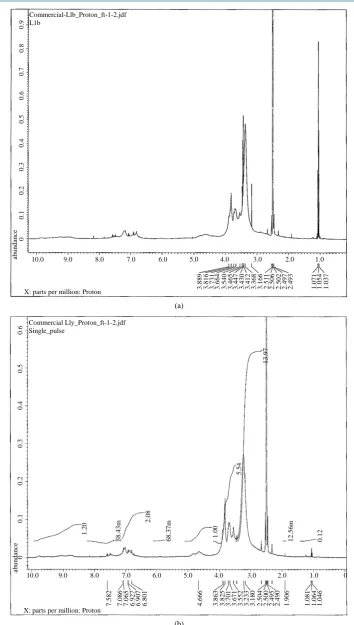
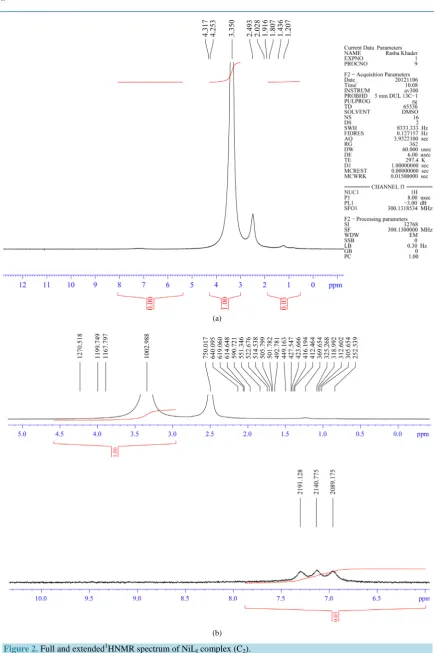
protons on the beta-lactam ring [17] and of amide NH proton [3] [18] respectively. The peak appeared at δ (3.7) ppm was attributed to the chemical shift of S-CH2 protons on the dihydrothiazine ring [18]. The signals related to methyl protons were observed at the range (2.3 - 3.233) ppm [19] [20]. The signal related to the thiazole ring proton appeared at δ 8.79 ppm [3][16] [19]. No signal was observed in the spectrum related to the free amino group of cefotaxime which support the formation of the Schiff base ligand. The 1H NMR spectrum of the Ni(II) complex (C2) in DMSO (Figure 2), displayed signals located at δ (7.3 - 6.90), 4.253, 4.317 and (3.35 - 1.2) ppm
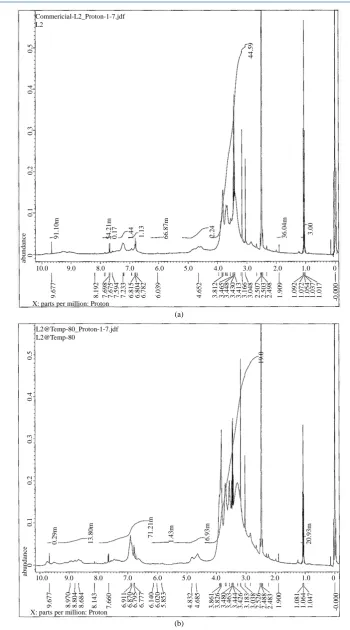
and were attributed to chemical shifts of aromatic protons of indole ring moiety [14]-[16], CO-CH and N-CH protons on the beta-lactam ring [17][18] and methyl protons [17][19] [20] respectively. The 1HNMR spectrum of LII (Figure 3) exhibited the signals related to the NH proton of amide group [3][15][18], azomethine proton [3][16][21], thiazole ring proton [3][16][18] and aromatic protons [16][21] appeared at δ 9.667, δ 9.05 (s), 8.2 ppm and 7.841 - 6.782 (m) respectively. The doublet signal observed at δ (4.87) and (4.625) ppm were as-signed to N-CH [16][17], and CO-CH [15][18] protons in the β-lactam ring. Chemical shifts of S-CH2 protons, aliphatic CH2, and methyl protons were observed at δ (3.048, 3.813 [16][18] and (1.072 - 3.166) [16][19][22] ppm respectively. No signal related to chemical shift of NH2 group was observed, which confirms the formation of the Schiff base ligand [20]. The 1H-NMR spectrum of the Co (II) complex of LII(C7) in DMSO (Figure 4(a),
Figure 4(b)) exhibited the signals assignable to the proton of amide group, azomethine group and aromatic pro-tons which appeared at δ 10.45 [15][17], 8.036 [3] [23] and 6.0 - 7.016) [15] ppm respectively. The spectrum
also showed two peaks at δ (5.264) and 5.166 ppm which were attributed to N-CH and CO-CH protons in the
10.0
ab
und
an
ce
9.0 8.0 7.0 6.0 5.0 4.0 3.0 2.0 1.0
X: parts per million: Proton
0 0. 1 0. 2 0. 3 0. 4 0. 5 Commercial-Llb_Proton_ft-1-2.jdf L1b 0. 6 1. 037 1. 054 1. 071 2. 493 2. 497 2. 502 2. 506 2. 51 1 3. 166 3. 368 3. 412 3. 430 3. 447 3. 465 3. 540 3. 664 3. 731 3. 816 3. 889 0. 7 0. 8 0. 9 (a) 10.0 ab und an ce
9.0 8.0 7.0 6.0 5.0 4.0 3.0 2.0 1.0 0
X: parts per million: Proton
[image:5.595.133.488.77.703.2]38. 43m 0 0. 1 0. 2 0. 3 0. 4 0. 5 1. 046 Commercial Lly_Proton_ft-1-2.jdf Single_pulse 0. 6 1. 064 1. 081 1. 906 2. 490 2. 495 2. 500 2. 504 3. 180 3. 233 3. 552 3. 671 3. 701 3. 825 3. 863 4. 666 6. 801 6. 907 6. 927 7. 065 7. 086 7. 582 68. 37m 12. 56m 1. 20 2. 08 1. 00 0. 12 5. 54 13. 97 (b)
(a)
[image:6.595.95.530.66.720.2](b)
10.0
ab
und
an
ce
9.0 8.0 7.0 6.0 5.0 4.0 3.0 2.0 1.0 0
X: parts per million: Proton
91. 10m 0 0. 1 0. 2 0. 3 0. 4 0. 5 9. 677 -0. 000 Commericial-L2_Proton-1-7.jdf L2 54. 21m 0. 17 1. 44 1. 13 66. 87m 2.
24 3.00
36. 04m 44. 59 8. 192 7. 698 7. 675 7. 594 7. 233 6. 815 6
.804 6.782 6.039 4.652 3.812 4653. 4483. 4303. 4133. 1663. 3.048 5072. 2.503 2.498 9091. 0921. 0721. 0541. 0371. 0171.
(a) 10.0 ab und an ce
9.0 8.0 7.0 6.0 5.0 4.0 3.0 2.0 1.0 0
X: parts per million: Proton
0.
29m
13.
80m 71.21m
[image:7.595.133.484.76.707.2]1. 43m 16. 93m 20. 93m 0 0. 1 0. 2 0. 3 0. 4 0. 5 9. 677 8. 970 8. 804 8. 684 8. 143 7. 660 6. 91 1 6. 870 6. 795 6. 777 6. 140 6. 020 5. 853 4. 832 4. 685 3. 861 3. 826 3. 480 3. 463 3. 444 3. 426 3. 183 3. 038 2. 526 2. 488 2. 483 1. 900 1. 081 1. 064 1. 047 -0. 000 L2@Temp-80_Proton-1-7.jdf L2@Temp-80 19. 0 (b)
(a)
(c)
[image:9.595.88.535.76.707.2](d)
[22] ppm respectively. The 1HNMR spectrum of the Cu (II) complex (C9) (Figure 4(c),Figure 4(d)) displayed signals appeared at δ 9.65, 7.833 - 6.598, 4.77, 4.208 and 0.845 - 3.361 ppm which were attributed to the protons of amide group [3] [15] [18], aromatic protons [17] [24], NCH and COCH protons of β-lactam ring [16]-[18] and methyl protons [17] [19] [20] respectively. The new peaks observed at δ 2.086, 2.046 ppm may be assigned to coordinated water molecules [15].
[image:10.595.88.541.320.506.2]3.3. Infrared Spectra
[image:10.595.89.540.532.719.2]Table 2 and Table 3 describe respectively the important vibrational modes of LI, LII and their metal complexes. Both LI and LII have several potential donor atoms but, due to steric constraints, the ligands can provide a max-imum of three donor atoms to any one metal center [18]. The infrared spectra of the two ligands exhibited the absence of absorption bands at (3348, 3252 cm−1) corresponding to stretching modes of NH2 group of cefotax-ime and at 1728, and 1664 cm−1 assigned to (C-3) carbonyl of isatin [25] [26] and C=O group of N, N-DMAB[5] which refers to the formation of the Schiff base ligands by condensation reaction between both isatin and N, N-DMAB with the antibiotic to form the azomethine CH=N linkage. This was confirmed by the appearance of new bands at υ 1636 and 1643 cm−1 respectively assignable to υ (C=N-) of azomethine group [1]-[5]. A broad band was observed around 3565 cm−1 and 3418 cm−1 of the two ligands respectively attributed to vibrational modes of hydrogen bonded O-H group of methanol solvent embedded in the crystal lattice structure of the
Table 2.Characteristic IR stretching vibrations (cm−1) of LI and its metal complexes.
Symbol NH of amide
(isatin)
C=O of C2-isatin
C=O B-lactam (Amide + ester) C=N
-COO Asym. (sym)
H2O Lattice (coordinate)
M-O-COO (H2O)
M-N (M-Cl)
LI 3255
(3192) 1692
1740
(1659) 1636
1568
(1367) - - -
C2 Ni(II) 3252
(3194) 1694
1726
(1658) 1626
1611 (1385)
3525 (3370, 806, 768)
493 (462)
424 (336)
C1 Co(II) 3253
(3194) 1695
1728
(1659) 1625
1625 (1385) overlap
3525 (3370, 806, 752)
509 (486)
420 (370)
C3 Cu(II) 3253
(3193) 1693
1725
(1661) 1624
1624 overlap (1377)
3525 (3375, 806, 768)
486 (455)
424 (370)
C4 Cd(II) 3257
(3194) 1695
1729
(1655) 1624
1578 (1377)
3520 (3400, 802, 768)
579 (556)
440 (348)
C5 Pd(II) 3255
(3190) 1695
1730
(1658) 1628
1557
(1356) 3525
553 (536)
417 (336)
C6 Pt(IV) 3258
(3194) 1693
1725
(1659) 1626
1626
overlap (1404) 3464
556 (517)
451 (374)
Table 3.Characteristic IR stretching vibrations (cm−1) of LII and its metal complexes.
Symbol NH of
amide
C=O B-lactam
(Amide + ester) C=N
COO Asym. (Sym)
H2O Lattice (coordinate)
M-O COO (H2O)
M-N (M-Cl)
LII 3248 1744
(1656) 1643
1621
(1377) - - -
C7 Co(II) 3250 1731
(1658) 1633
1610 (1388)
3526 (3325, 863, 760)
552 (513)
435 (378)
C8 Ni(II) 3246 1733
(1654) 1633
1614 (1387)
3557 (3406, 864, 760)
552 (513)
482 (363)
C9 Cu(II) 3250 1732
(1658) 1633
1627 (1388)
3526 (3337, 865, 760)
579 (536)
435 (363)
C10 Cd(II) 3246 1730
(1658) 1650
1641 (1389)
3553 (3314, 863, 762)
580 (556)
439 (363)
C11 Pd(II) 3246 1730
(1658) 1650
1639
(1387) 3490
580 (552)
439 (363)
C12 Pt(IV) 3250 1731
(1658) 1652
1640
(1393) 3470
540 (513)
ligands [26]-[28]. The two tables describe also the positions of the bands assigned to vibrational modes of amide NH groups [15] [28]-[30], υ C=O of lactam ring of the antibiotic moiety [3] [31] [32], overlapped amide and es-ter carbonyls [18], the asymmetric and symmetric stretching vibrations respectively of carboxylate anion [3] for both ligands. The -NH- vibrations of the indole ring system [25] and υ C=O at C-2 [26] [33] of isatin moiety of LI (Table 2) are in agreement with those reported in the litrature. The band assigned to υ (C-S) stretching vibra-tion was located at (580) cm−1[1] [5]. The C-N-C and the N-H stretching vibrations of the lactam amide residue in the two ligands were observed at (1180, 1177) cm−1[34] and 3255 cm−1 respectively [3] [17] [29]. The spec-trum of the Schiff base ligand LII (Table 3) exhibited an additional band observed at (1335) cm−1 assigned to υ (C-N) stretching vibration of benzylic moiety [5] [15].
All complexes exhibited shifts in the position of the bands related to the β-lactam carbonyl (ν C=O), azome-thine groups, υ (-C=N) and carboxylate anion which refers to the coordination of these groups with the metal ions [33][34]. This was confirmed by the appearance of new low intensity bands at lower wavenumbers corres-ponding to stretching vibrations of M-N and M-O bonds respectively [33] [35]. The values of frequency differ-ence (∆υ) between the two bands of (COO−) asymmetric and (COO−) symmetric stretching vibration (˃200 cm−1) refers to monodentate coordination behavior of carboxylate group with the metal atoms [29] [34][35]. These observations suggest that the two Schiff base ligands behaved as tridentate ligands in the coordination with the metal ions [16] [36]. The bands observed at frequency ranges 363 - 370 cm−1 were assigned to stretching vibra-tions of (M-Cl) bonds [32][35]. Bands assigned to vibrational modes of lattice and coordinated waterbonds [35] were also detected and are described in Table 2 and Table 3.
3.4. Electronic Spectra, Magnetic Moments, and Conductivity Measurements
The electronic spectrum of Schiff base LI in DMSO (Figure 5(a)) exhibited a high intensity band appeared as a doublet with two maximum absorptions at υmax 37,736 and 33,223 cm−1 (εmax 33,525 and 40,525 L∙mol−1∙cm−1, respectively) attributed to π → π* transition [5] [15] [37] and a broad low intensity band at υ
max 24,155 cm−1 (εmax275 L∙mol−1∙cm−1) which was attributed to n→ π* transition [5] [15] [37]. The spectrum of LII in DMSO (Figure 5(b)) exhibited a high intensity band appeared with two absorption maxima at υmax 33,333 and 38,168 cm−1 (εmax 43,225 and 42,550 L∙mol−1∙cm−1 respectively) with a shoulder at υmax 28,986 cm−1attributed to the π → π* transition and a low intensity band at υ
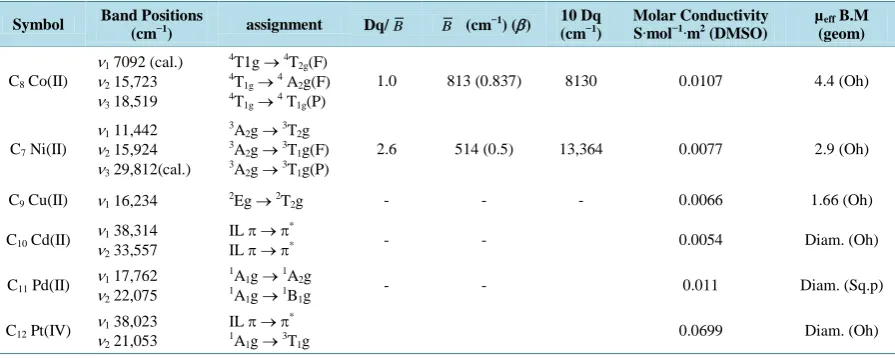
max 24,570 cm−1 attributed to the n → π* transition [5] [37]. The spectral data together with molar conductivity and magnetic moments of all metal complexes of LI and LII in DMSO are described in Table 4 and Table 5 respectively.
The spectra of the metal complexes exhibited bathochromic or hypsochromic shifts of ligand bands. The bands assigned to intraligand π → π* for the Co(II), Ni(II), Cu(II), Cd(II), Pd(II) and Pt(IV) complexes (C1 - C6) were observed at υmax (38,320, 34,483), (38,168, 34,722), (38,462, 34,483), (38,314, 34,247), (38,314, 34,483) and 21,231 cm−1 respectively, while those of LII complexes for the same metal ions (C7 - C12) were observed at (38,023, 33,784), (38,314, 33,784), (38,320, 34,247), (38,314, 33,557), (36,765, 30,395) and 21,053 cm−1 re-spectively. The spectra of transition metal complexes showed additional low intensity bands in the visible and near IR regions related to ligand field d-d transitions [38]-[40]. The spectra of the two Co(II) complexes (C1 and C7) exhibited two additional bands in the visible region attributed respectively to 4T1g → 4A2g(F) (υ2) and 4T1g(F)→
(b) (a)
190.00 400.00 600.00 190.00 400.00 600.00
Wavelength λ (nm) Wavelength λ (nm) 0.00
0.500 1.000 1.500 1.902 1.753
1.500
0.00 0.500 1.000
A
b
so
rb
an
ce
A
b
so
rb
an
[image:11.595.147.472.561.706.2]ce
4T
1g(P) (υ3) transitions of octahedral Co(II) complexes [20] [41]. By applying the observed band energies and band ratio υ3/υ2 (1.4 and 1.17 respectively) for the two complexes on Tanabe-Saugano diagram of d7 configura-tion, the values of Dq B B, and 10 Dq were obtained (Table 4 and Table 5) and the energy of υ1 assigned to the transition 4T1g → 4T2g for each complex was calculated. The spectra of the two Ni(II) complexes (C2 and C8) showed two additional bands appeared in the near IR attributed to the spin allowed transitions 3A2g → 3T2g(υ1) and 3A2g → 3T1g(F)(υ2) of octahedral Ni(II) complexes [20][37]. By applying the two observed band energies and band ratio υ2/υ1 (1.45 and 1.39 respectively) for the two complexes on Tanabe-Saugano diagram of d8 con-figuration, the values Dq B B, and 10 Dq were obtained and the energies of υ3 assigned to the transition 3A2g → 3T
1g(P) were also calculated. The values of β for the cobalt and nickel complexes indicated some covalent cha-racter [41]. The values of magnetic moments for the two complexes support the paramagnetic high spin octahe-dral structures [20][27][41]. The spectra of the two Cu(II) complexes (C3, C9) showed one broad band in the visible region assigned to the 2Eg → 2T2g transition of tetragonally distorted octahedral Cu(II) complexes [38]-[40]. The magnetic moment of the two Cu (II) complexes is within the expected values for one unpaired electron [38]-[40]. No d-d transition bands were observed the spectra of the Cd (II) complexes (C4 and C10) which were quite common with the d10 complexes [38]-[40].
[image:12.595.89.542.328.511.2]The spectra of the two diamagnetic Pd(II) complexes (C5 and C11) exhibited two additional bands attributed to the transitions 1A1g → 1A2gand 1A1g → 1B1g respectively of square planar geometry [20] [42]. The Pt(IV) com-plexes (C6, C12) were diamagnetic and their spectra exhibited the appearance of one additional band attributed to
Table 4.Electronic spectra, spectral parameters, and molar conductivity of LI metal complexes.
Symbol Band Positions (cm−1) Assignment Dq/B B (cm−1) (β) (cm10 Dq −1) SMolar conductivity ∙mol−1∙cm2 (DMSO) µ(geom) eff B.M.
C1 Co(II)
ν1 6471 (cal.) ν2 14,620 ν3 20,620
4
T1g →4T2g(F) 4T1g →4A2g (F) 4T1g →4T1g (P)
0.8 895 (0.922) 7160 0.0085 4.36 (Oh)
C2 Ni(II)
ν1 12,285 ν2 17,857 ν3 28,800(cal.)
3A2g →3T2g 3A2g →3T1g(F) 3A2g →3T1g(P)
2.2 576 (0.56) 12670 0.01595 3.86 (Oh)
C3 Cu(II) ν1 16,667 ν2 34,483
2Eg →2T2g - - - 0.0453 1.66 (Oh)
C4 Cd(II) ν1 38,314 ν2 34,247
IL π→π*
Il π→π* - - - 0.0065 Diam. (Oh)
C5 Pd(II) νν1 17,668 2 22,272
1A1g →1A2g
1A1g →1B1g - - - 0.012 Diam. (Sq.p)
C6 Pt(IV) νν1 38,023 2 21,231
IL π→π*
[image:12.595.90.538.539.718.2]1A1g →3T2g - - - 0.0589 Diam. (Oh)
Table 5.Electronic spectra, spectral parameters, and molar conductivity of LII metal complexes.
Symbol Band Positions
(cm−1) assignment Dq/B B (cm
−1) (β) 10 Dq (cm−1)
Molar Conductivity
S∙mol−1∙m2(DMSO) µ(geom) eff B.M
C8 Co(II)
ν1 7092 (cal.) ν2 15,723 ν3 18,519
4
T1g →4T2g(F) 4T1g →4 A2g(F) 4T1g →4 T1g(P)
1.0 813 (0.837) 8130 0.0107 4.4 (Oh)
C7 Ni(II)
ν1 11,442 ν2 15,924 ν3 29,812(cal.)
3A2g →3T2g 3A2g →3T1g(F) 3A2g →3T1g(P)
2.6 514 (0.5) 13,364 0.0077 2.9 (Oh)
C9 Cu(II) ν1 16,234 2Eg →2T2g - - - 0.0066 1.66 (Oh)
C10 Cd(II) νν1 38,314 2 33,557
IL π→π*
IL π→π* - - 0.0054 Diam. (Oh)
C11 Pd(II) νν1 17,762 2 22,075
1A1g →1A2g
1A1g →1B1g - - 0.011 Diam. (Sq.p)
C12 Pt(IV) νν1 38,023 2 21,053
IL π→π*
1A
1g → 3T2g transitions of octahedral Pt(IV) complexes [42]. The molar conductivity measurements of all metal complexes in DMSO (10−3 M) suggested that the complexes were nonelectrolyte [43]. According to these data, together with elemental analyses and I.R. spectra, the structures of metal complexes were suggested as illu-strated inScheme 2.
3.5. Thermo Gravimetric Analysis
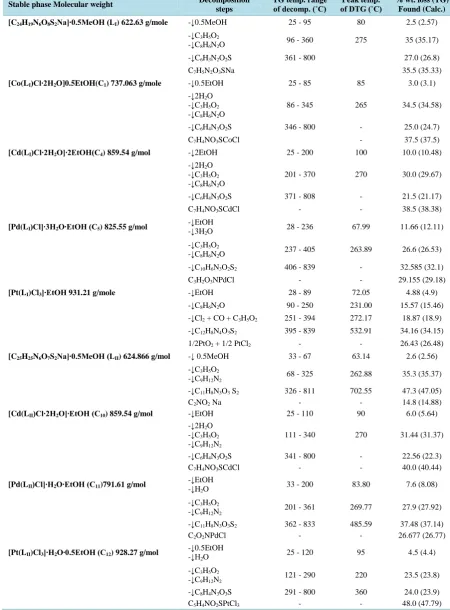
The TGA analyses of the two ligands and some selected metal complexes described in (Table 6). The TG curves of the two ligands refer to three decomposition steps. In the first step the weight loss corresponds to the elimina-tion of solvent molecules (alcohol and water molecules) embedded in the crystal lattice at peak temperature 65 −100˚C as is demonstrated by DTG curves data, which agrees with the elemental and IR analysis of the studied samples. The second and third steps involved the thermal decomposition of the ligands. The thermal decomposition
C11: [Pd(LII)Cl]∙H2O∙EtOH C12: [Pt(LII)Cl3]∙H2O∙0.5EtOH
H N C Pd S C O S N N Cl O CH2 O N O O C N OCH3 O
.H2O .EtOH
HC
N CH3 H3C
H N C Pt S C O S N N Cl O CH2 O N O O C N OCH3 O
.H2O .0.5EtOH
HC
N CH3 H3C
Cl
Cl
C6: [Pt(LI)Cl3]∙EtOH
H N C M S C O S N N Cl O CH2 O N O O C N OCH3 O .nEtOH HC N CH3
H3C
H2O
H2O
M= Co(II), Ni(II),Cu(II) C7-C9, n= 0.5; Cd(II) (C10), n =1 H N C Pt S C O S N N C N H O Cl O CH2 O N O O C N OCH3 O Cl Cl .EtOH
[M(LII)Cl∙(H2O)2]∙nEtOH H N C Co S C O S N N C N H O Cl OH2 O CH2 O N O O C N OCH3
H2O
n EtOH
O
M= Co(II), Ni(II),Cu(II) (C1-C3), n= 0.5; M= Cd(II)(C4), n=2
H N C Pd S C O S N N C N H O Cl O CH2 O N O O C N OCH3 O
.3H2O .EtOH
[M(LI)Cl∙(H2O)2]∙nEtOH) C5: [Pd(LI)Cl∙3H2O∙EtOH
Table 6. Thermal decomposition of LI, LII and some selected metal complexes.
Stable phase Molecular weight Decomposition
steps
TG temp. range
of decomp. (˚C) of DTG (˚C)Peak temp. % wt. loss (TG) Found (Calc.)
[C24H19N6O8S2Na]∙0.5MeOH (LI) 622.63 g/mole -↓0.5MeOH 25 - 95 80 2.5 (2.57)
-↓C3H5O2
-↓C8H6N2O 96 - 360 275 35 (35.17)
-↓C6H3N2O2S 361 - 800 27.0 (26.8)
C7H5N2O3SNa 35.5 (35.33)
[Co(LI)Cl∙2H2O]0.5EtOH(C1) 737.063 g/mole -↓0.5EtOH 25 - 85 85 3.0 (3.1)
-↓2H2O -↓C3H5O2
-↓C8H6N2O 86 - 345 265 34.5 (34.58) -↓C6H4N3O2S 346 - 800 - 25.0 (24.7)
C7H4NO3SCoCl - 37.5 (37.5)
[Cd(LI)Cl∙2H2O]∙2EtOH(C4) 859.54 g/mol -↓2EtOH 25 - 200 100 10.0 (10.48)
-↓2H2O -↓C3H5O2
-↓C8H6N2O 201 - 370 270 30.0 (29.67) -↓C6H4N3O2S 371 - 808 - 21.5 (21.17)
C7H4NO3SCdCl - - 38.5 (38.38)
[Pd(LI)Cl]∙3H2O∙EtOH (C5) 825.55 g/mol -↓EtOH -↓3H2O 28 - 236 67.99 11.66 (12.11)
-↓C3H5O2
-↓C8H6N2O 237 - 405 263.89 26.6 (26.53) -↓C10H6N3O2S2 406 - 839 - 32.585 (32.1)
C3H2O3NPdCl - - 29.155 (29.18)
[Pt(LI)Cl3]∙EtOH 931.21 g/mole -↓EtOH 28 - 89 72.05 4.88 (4.9)
-↓C8H6N2O 90 - 250 231.00 15.57 (15.46) -↓Cl2 + CO + C3H5O2 251 - 394 272.17 18.87 (18.9) -↓C12H8N4O3S2 395 - 839 532.91 34.16 (34.15) 1/2PtO2 + 1/2 PtCl2 - - 26.43 (26.48)
[C25H25N6O7S2Na]∙0.5MeOH (LII) 624.866 g/mol -↓ 0.5MeOH 33 - 67 63.14 2.6 (2.56)
-↓C3H5O2
-↓C9H12N2 68 - 325 262.88 35.3 (35.37) -↓C11H8N3O3 S2 326 - 811 702.55 47.3 (47.05)
C2NO2 Na - - 14.8 (14.88)
[Cd(LII)Cl∙2H2O]∙EtOH (C10) 859.54 g/mol -↓EtOH 25 - 110 90 6.0 (5.64)
-↓2H2O -↓C3H5O2
-↓C9H12N2 111 - 340 270 31.44 (31.37) -↓C6H4N3O2S 341 - 800 - 22.56 (22.3)
C7H4NO3SCdCl - - 40.0 (40.44)
[Pd(LII)Cl]∙H2O∙EtOH (C11)791.61 g/mol -↓EtOH -↓H2O 33 - 200 83.80 7.6 (8.08)
-↓C3H5O2
-↓C9H12N2 201 - 361 269.77 27.9 (27.92) -↓C11H8N3O3S2 362 - 833 485.59 37.48 (37.14)
C2O2NPdCl - - 26.677 (26.77)
[Pt(LII)Cl3]∙H2O∙0.5EtOH (C12) 928.27 g/mol -↓0.5EtOH -↓H2O 25 - 120 95 4.5 (4.4)
-↓C3H5O2
-↓C9H12N2 121 - 290 220 23.5 (23.8) -↓C8H4N3O3S 291 - 800 360 24.0 (23.9)
of LI showed similar behavior to other isatin Schiff bases mentioned in the literature [21] [22] [44]. In the second step, the weight losses were mainly attributed to the removal of the isatinazomethinic moiety [22] [44] [45], as well as the methyl ester substituent at the fused six membered thiazin ring. The third step was attributed to the removal of the substituted thiazole ring and its side chain moiety by amide bond breaking, leaving the fused ring β-lactam sodium salt as the residual part of the ligand. The weight losses demonstrated by TG curves of the Co(II) and Cd(II) complexes (C1, C4) were attributed to the loss of coordinated water together with coor-dinated isatinazomethinic moiety and methyl ester substituent. The third stage is similar to that of the original ligand.
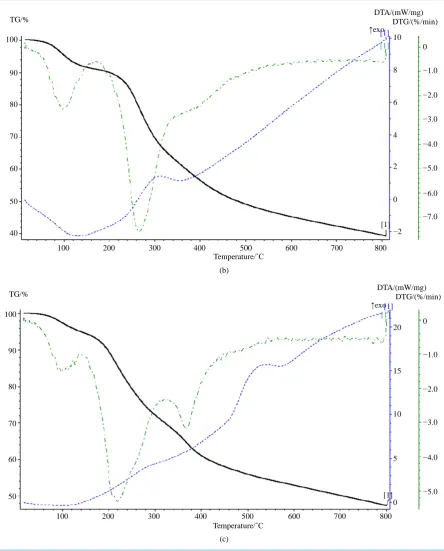
The DTA curve of the Cd(C4) complex (Figure 6(a)) shows a broad endothermic peak in the range (301˚C -
500˚C) which corresponds to the partial removal of the coordinated part of the complexes and an exothermic
broad peak at temperature range (501 - 808). The final residue of the complex corresponds to the metal ion bonded to the chloride and carboxylate anion at the fused β-lactam rings fragments. The total weight losses ex-hibited by the Pd(II)LI and Pt(II)LI complexes (C5 and C6) were (71% - 73%) up to 839˚C are summarized in three steps for the former and four steps for the latter. The mass losses displayed by the thermal decomposition of LII and its selected Cd(II), Pd(II) and Pt(IV) complexes (C10, C11 and C12) in the first and second steps cor-respond to the departure of lattice solvent and to methyl ester + N, N-dimethyl benzyl imino moieties respec-tively in addition to coordinated water molecules in the case of Cd (II) LII complex. The maximum weight loss in the third step was due to the loss of thiazole ring and its side chain up to the remaining part of the β-lactam moiety. The DTA curve of the Cd(II) complex (C10) (Figure 6(b)) showed two endothermic peaks at the tem-perature ranges (25˚C - 310˚C) and (311˚C - 420˚C) corresponding to the mass loss of the first and second steps.
The exothermic peak at the temperature range (421˚C - 800˚C) is attributable to the third step. The maximum
weight loss of the Pd(II) complex observed in the third step refers to almost complete degradation of the ligand. The DTA curve of the Pt(IV) complex (C12) (Figure 6(c)) indicated three steps. The first is an endothermic step in the range (25˚C - 270˚C) corresponding to the loss of solvents together with the methyl ester and the coordi-nated N, N-dimethylaminobenzylimino moieties. The second step shows endothermic and exothermic decompo-sition reactions in the range (271˚C - 600˚C) which corresponds to further decomposition of the uncoordinated parts of the ligand. In the third step an exothermic peak was observed at temperature range (600˚C - 800˚C) cor-responding to the formation of the final product.
100 200 300 400 500 600 700 800
Temperature/˚C
0 0
−1.0
−4.0
−5.0
−6.0
−7.0 50
60 70 80 90 100
TG/%
DTA/(mW/mg) DTG/(%/min)
40
2.0
−3.0 −2.0 1.0
−1.0
−2.0
−3.0 −8.0 Rasidual Mass: 36.51% (808.3˚C)
[1]
[1]
[1]
↑exo
100 200 300 400 500 600 700 800 Temperature/˚C
0 0
−1.0
−4.0
−5.0
−6.0
−7.0 50
60 70 80 90 100
TG/% DTA/(mW/mg) DTG/(%/min)
↑exo
40
2 4 6 8 10
−2
−3.0 −2.0
[1]
[1]
[1]
(b)
100 200 300 400 500 600 700 800
Temperature/˚C
20
10
0 5 15
0
−1.0
−2.0
−3.0
−4.0
−5.0 50
60 70 80 90 100
TG/% DTA/(mW/mg) DTG/(%/min)
↑exo
[1]
[1]
[1]
[image:16.595.88.533.78.630.2](c)
Figure 6. Thermo grams of a-Cd (II) LI (C4), b-Cd (II) LII (C10) and c-Pt (IV) LII (C12) complexes.
3.6. Antibacterial Activity
inhi-bition against Staphylococcusaureus and a high growth inhibition against E. coli. The two Schiff base ligands were completely inactive against all the studied cultures at the selected concentration, which indicates that the amino group of the original antibiotic plays an important role in growth inhibition activity. All metal com- plexes showed selective activity against one or two bacteria except the complex [Pt(LII)Cl3]H2O∙0.5EtOH which was active against all cultures and exhibited higher activities against Streptococcuspneumonia and Pseudomo-nas aeroginosacompared with the free antibiotic (Cefotaxim). The complexes [Co(LI)Cl∙(H2O)2]∙0.5(EtOH), [Cu(LI)Cl∙(H2O)2]∙0.5(EtOH), [Ni(LII)Cl∙(H2O)2]∙0.5(EtOH) and; [Pd(LII)Cl]∙H2O∙EtOH were found moderately active against Staphylococcusaureus especially the copper complex which showed comparable bactericidal ac-tivity with the original drug. The other metal complexes showed selective acac-tivity against one type of bacteria at a range starting from highest activity of [Co(LI)Cl∙(H2O)2]∙0.5EtOH against E. coli, [Pt(LI)Cl3]∙EtOH against Staphylococcusaureus, [Ni(LII)Cl∙(H2O)2]∙0.5(EtOH), against E. coli to the lowest activity of [Cd(LII)(H2O)2Cl]. EtO H against Pseudomonasaeroginosa. These results imply that the type of metal ions and type microorganism are the main controlling factors on antibacterial action.
4. Conclusion
Two Schiff base derivatives of cefotaxime were successfully synthesized from the condensation reaction of the antibiotic with isatin (LI) and 4-N, N-dimethylaminobenzaldehyde (LII) and their structures were characterized by elemental and thermal analysis, NMR and FTIR spectra. The coordination of the two ligands with Co(II), Cd(II), Ni(II), Cu(II), Pd(II), and Pt(IV) ions showed tridentate behavior with M:L mole ratio of 1:1. All com-plexes were of octahedral geometries except the Pd(II) comcom-plexes which had square planar structures. The bio-logical activity of the prepared compounds was controlled by type of bacteria, functional groups of ligands and type of metal ion.
References
[1] Naz, N. and Iqbal, M.Z. (2011) Synthesis, Spectroscopic and Biological Studies of Transition Metal Complexes of Novel Schiff Bases Derived from Cephradine and Sugars. ScienceInternational (Lahore), 23, 27-31.
[2] Bukhari, I.H., Arif, M., Akbar, J. and Khan, A.H. (2005) Preparation, Characterization and Biological Evaluation of Schiff Base Transition Metal Complexes with Cephradine. PakistanJournalof BiologicalSciences, 8, 614-617. [3] Anacona, J.R., Calvo, J. and Almanza, O.A. (2013) Synthesis, Spectroscopic and Magnetic Studies of Mono- and
Po-lynuclear Schiff Base Metal Complexes Containing Salicilydene-Cefotaxime Ligand (H2L). International Journalof
InorganicChemistry, 2013, Article ID: 108740, 7 p. http://dx.doi.org/10.1155/2013/108740
[4] Kshash, A.H. (2010) Synthesis of Some Schiff Bases by Direct Condensation for Cefotaxime (Claforan) and Benzal-dehyde or Its Substitutions and Study of Their Antibacterial Activity. JournalofAnbarVeterinaryScience, 3, 125-132. [5] Al-Noor, T.H., Al-Jeboori, A.T. and Aziz, M.R. (2013) Preparation, Characterization and Antimicrobial Activities of Fe(II), Co(II), Ni(II), Cu(II), and Zn(II) Mixed Ligand Complexes Schiff Base Derived from Cephalexin Drug and 4(Dimethylamino) Benzaldehyde with Nicotinamide. AdvancesinPhysicsTheoriesandApplications, 18, 1-8.
[6] Nigam, P., Mohan, S.W., Kundu, S. and Prakash, R. (2009) Trace Analysis of Cefotaxime at Carbon Paste Electrode Modified with Novel Schiff Base Zn(II) Complex. Talanta, 77, 1426-1431.
http://dx.doi.org/10.1016/j.talanta.2008.09.026
[7] Bhrigu, B., Pathak, D., Siddiqui, N., Alam, M.S. and Ashen, W. (2010) Search for Biologically Active Isatins: A Short Review. InternationalJournal ofPharmaceuticalScience andDrugResearch (IJPSDR), 2, 229-235.
[8] Pal, M., Sharma, N.K. and Jha, P.K.K. (2011) Synthetic and Biological Multiplicity of Isatin: A Review. Journalof AdvancedScientificResearch, 2, 35-44.
[9] Aditya, J., Patidar, A., Manocha N. and Gupta, D. (2012) Synthesis, Characterization and Antimicrobial Activity of Novel Schiff Base of Isatin Derivatives. InternationalJournal ofPharmaceuticalScienceandDrugResearch (IJPSDR), 4, 260-266.
[10] Verma, M., Pandeya, S.N., Singh, K.N. and Stables, J.P. (2004) Anticonvulsant Activity of Schiff Bases of Isatin De-rivatives. Acta Pharmaceutica, 54, 49-56.
[11] Silva, J.F.M., Garden, S.J. and Pinto, A.C. (2001) The Chemistry of Isatins a Review from 1975 to 1999. Journalof Brazilian ChemicalSociety, 12, 273-324. http://dx.doi.org/10.1590/s0103-50532001000300002
Mycobiology, 40, 20-26. http://dx.doi.org/10.5941/MYCO.2012.40.1.020
[13] Rochow, E.G. (1960) Inorganic Synthesis. McGraw-Hill, New York, 6, 218.
[14] Venkateshwarlu, E., Venkateshwar, J.R., Umasankar, K. and Dheeraj, G. (2012) Study of Anti-Inflamatory, Analgesic and Anti-Pyretic Activity of Novel Isatin Derivatives. AsianJournalofPharmaceutical andClinicalResearch, 5, 187- 190.
[15] Silverstien, R.M., Webster, F.X. and Kiemle, D.J. (2005) Spectrophotometric Identification of Organic Compounds. 7th Edition, John Wiley and Sons, Inc., New York.
[16] Ikotun, A.A., Egharevba, G.O., Obafemi, C.A. and Owoseni, A.O. (2012) Ring Deactivating Effect on Antimicrobial Activities of Metal Complexes of the Schiff Base of p-Nitroaniline and Isatin. JournalofChemicaland Pharmaceuti-calResearch, 4, 416-422.
[17] Chohan, Z.H. and Jaffery, M.F. (2000) Synthesis, Characterization and Biological Evaluation of Co(II), with Cu(II), Ni(II) and Zn(II) Complexes Cephradine. MetalBasedDrugs, 7, 265-269. http://dx.doi.org/10.1155/MBD.2000.265
[18] Anacona, J.R. and Silva, G.D. (2005) Synthesis and Antibacterial Activity of Cefotaxime Metal Complexes. Journalof theChileanChemicalSociety, 50, 447-450. http://dx.doi.org/10.4067/s0717-97072005000200001
[19] Al-Resayes, S.I., Shakir, M., Abbasi, A., Amin, K.M.Y. and Lateef, A. (2012) Synthesis, Spectroscopic Characteriza-tion and Biological Activities of N4O2 Schiff Base Ligand and Its Metal Complexes of Co(II), Ni(II), Cu(II) and Zn(II).
Spectrochimica ActaPartA, MolecularandBiomolecularSpectroscopy, 93, 86-94.
http://dx.doi.org/10.1016/j.saa.2012.02.099
[20] Kumar, A. and Singh, D. (2009) Metal Complexes with the Fluoroquinolone Antibacterial Agent Norfloxacin, Synthe-sis, Structure and Bioactivity. InternationalJournalofChemicalSciences, 7, 19-27.
[21] Joshi, S. (2011) Synthesis, Characterization and Biological Studies of Schiff Base Metal Complexes of Co (II), Zn (II), Ni (II), and Mn (II) Derived from Amoxicillin Trihydrate with Various Aldehydes. InternationalJournalofPharma andBioSciences, 2, 240-250.
[22] Nagajothi, A., Kiruthika, A., Chitra, S. and Parameswari, K. (2012) Synthesis and Characterization of Tetradentate Co(II) Schiff Base Complexes: Antimicrobial and DNA Cleavage Studies. InternationalJournalofResearchin Phar-maceuticalandBiomedicalSciences, 3, 1768-1778.
[23] Chaluvaraju, K.C. (2011) Synthesis and Biological Evaluation of Some Isatin Derivatives for Antimicrobial Properties.
ResearchJournalofPharmaceutical, BiologicalandChemicalSciences, 2, 541-546.
[24] Prakash, C.R., Raja, S., Selvam, T.P., Saravanan, G., Karthick, V. and Kumar, P.D. (2009) Synthesis and Antimicrobi-al Activities of Some Novel Schiff Bases of 5-Substituted Isatin Derivatives. RasayanJournalofChemistry, 2, 960- 968.
[25] Khalil, M.M.H. and Al-Seif, F.A. (2008) Molybdenum and Tungsten Tricarbonyl Complexes of Isatin with Triphenyl-phosphine. ResearchLettersinInorganicChemistry, 2008, Article ID: 746058, 4 p.
[26] Pârnău, C., Kriza, A., Popa, N. and Udrea, S. (2005) Controlled Synthesis III. Reaction of Sn(IV) and Zr(IV) with Isa-tins. Analele UniversităŃiidinBucuresti-Chimie, AnulXIV (Serienouă), I-II, 141-146.
[27] Sharma, A. and Shah, M. (2013) Synthesis and Characterization of Some Transition Metal Complexes Derived from Bidentate Schiff Base Ligand. JournalofAppliedChemistry, 3, 62-66. http://dx.doi.org/10.9790/5736-0356266
[28] Sultana, N., Arayna, M.S. and Afzal, M. (2003) Synthesis and Antibacterial Activity of Cepharadine Metal Complexes: Part I: Complexes with Magnesium, Calcium, Chromium and Manganese. PakistanJournalofPharmaceuticalScien- ces, 16, 59-72.
[29] Sultana, N., Arayna, M.S. and Afzal, M. (2005) Synthesis and Antibacterial Activity of Cephradine Metal Complexes: part II Complexes with Cobalt, Copper, Zinc and Cadmium. PakistanJournalofPharmaceuticalSciences, 18, 36-42. [30] Imran, M., Iqbal, J., Iqbal, S. and Ijaz, N. (2007) In Vitro Antibacterial Studies of Ciprofloxacin-Imines and Their
Complexes with Cu(II),Ni(II),Co(II), and Zn(II). Turkjsh Journal ofBiology, 31, 67-72.
[31] Anacona, J.R. and Lopez, M. (2012) Mixed-Ligand Nickel(II) Complexes Containing Sulfathiazole and Cephalosporin Antibiotics: Synthesis, Characterization, and Antibacterial Activity. International Journal of Inorganic Chemistry,
2012, Article ID: 106187.
[32] El-Said, A.I., Aly, A.A.M., El-Meligy, M.S. and Ibrahim, M.A. (2009) Mixed Ligand Zinc (II) and Cadmium(II) Com-plexes Containing Ceftriaxone or Cephradine Antibiotics and Different Donors. JournaloftheArgentineChemical So-ciety, 97, 149-165.
[34] Anacona, J.R. and Osorio, I. (2008) Synthesis and Antibacterial Activity of Copper(II) Complexes with Sulphathiazole and Cephalosporin Ligands. TransitionMetalChemistry, 33, 517-521.
http://dx.doi.org/10.1007/s11243-008-9074-y
[35] Nakamoto, K. (1997) Infrared and Raman Spectra of Inorganic and Coordination Compounds. 5th Edition, John Wiley and Sons, Inc., New York.
[36] Sultana, N. and Arayne, M.S. (2007) In Vitro Activity of Cefadroxil, Cephalexin, Cefatrizine and Cefpirome in Pres-ence of Essential and Trace Elements. PakistanJournalofPharmaceuticalSciences, 20, 305-310.
[37] Khalifa, M.A. and Hussaan, A.M. (1996) Complexes of Some Metal Ions of Schiff Base Ligand Derived from Isatin with 2-Aminothiophenol. JournaloftheChemicalSocietyofPakistan, 18, 115-118.
[38] Sutton, D. (1968) Electronic Spectra of Transition Metal Complexes. McGraw-Hill Publ. Co. Ltd., New York.
[39] Lever, A.B.P. (1968) Inorganic Electronic Spectroscopy. Elsevier Publishing Company, Amsterdam, London.
[40] Figgis, B.N. (1966) Introduction to Ligand Fields. Inter-Science Publishers, a Division of John Wiley and Sons, New York, London, Sydney.
[41] Sinthuja, S.A. and Kumari, S.S. (2013) Synthesis, Spectroscopic Investigation and Antimicrobial Studies on Some Schiff Base Complexes of Cu(II) and Ni(II). JournalofChemicalandPharmaceuticalResearch, 5, 303-309.
[42] Hegazy, W.H. and Gaafa, A.E.D.M. (2012) Synthesis, Characterization and Antibacterial Activities of New Pd(II) and Pt(IV) Complexes of Some Unsymmetrical Tetradentate Schiff Bases. AmericanChemicalScienceJournal, 2, 86-99.
http://dx.doi.org/10.9734/ACSJ/2012/1584
[43] Geary, W.J. (1971) The Use of Conductivity Measurements in Organic Solvents for the Characterisation of Coordina-tion Compounds. CoordinationChemistryReviews, 7, 81-122. http://dx.doi.org/10.1016/S0010-8545(00)80009-0
[44] Ignat, I., Oprea, O., Stanica, N. and Kriza, A. (2012) Synthesis, Characterization and Thermal Behavior of Complexes of Cu(II), Co(II), Ni(II), Zn(II) and Cd(II) with Schiff Base Derived from 1-H-Indole-2,3-Dione and o-Aminobenzylic Alcohol. RevistaDeChimie, 63, 1001-1007.