ScholarWorks @ Georgia State University
ScholarWorks @ Georgia State University
Anthropology Theses Department of Anthropology
11-28-2007
"I am Not my Hair! Or am I?": Black Women's Transformative
"I am Not my Hair! Or am I?": Black Women's Transformative
Experience in their Self Perceptions of Abroad and at Home
Experience in their Self Perceptions of Abroad and at Home
Yolanda Michele Chapman
Follow this and additional works at: https://scholarworks.gsu.edu/anthro_theses
Recommended Citation Recommended Citation
Chapman, Yolanda Michele, ""I am Not my Hair! Or am I?": Black Women's Transformative Experience in their Self Perceptions of Abroad and at Home." Thesis, Georgia State University, 2007.
https://scholarworks.gsu.edu/anthro_theses/23
EXPERIENCE IN THEIR SELF PERCEPTIONS OF ABROAD AND AT HOME.
by
YOLANDA CHAPMAN
Under the Direction of Cassandra White
ABSTRACT
The Black female body has been subject to cultural scripting in which Black
women are deemed as the “other”. This representation of the Black female is played out
in many ways such as through the racial and racist marking of her hair and skin color. In
investigating Black women who have participated in a study abroad program, I found that
this is one vehicle in which they have been exposed to other’s perspectives of the
Eurocentric standards of beauty. In this paper, I have examined ways in which Black
women are active agents in their own social scripting of their bodies. Through interviews,
focus groups and participant observation, with 20 self identified Black women, the
investigation began with a look at the African and European cultural influences on
African American ideas about beauty, hair and identity. Initial discussions of
participants’ experiences with hair at home and abroad led to broader dialogues about
transformations in their concepts of gender, race, and identity.
EXPERIENCE IN THEIR SELF PERCEPTIONS OF ABROAD AND AT HOME.
by
YOLANDA CHAPMAN
A Thesis Submitted in Partial Fulfillment of the Requirements for the Degree of
Master’s of Arts
In the College of Arts and Sciences
Georgia State University
Copyright by
EXPERIENCE IN THEIR SELF PERCEPTIONS OF ABROAD AND AT HOME.
by
YOLANDA CHAPMAN
Committee Chair: Cassandra White
Committee: Emanuela Guano Megan Sinnott
Electronic Version Approved:
DEDICATION
ACKNOWLEDGEMENTS
This endeavor could not have been accomplished without the support, encouragement
and love of so many individuals. First, I’d like to acknowledge my guiding force, God. Thank
you for blessing me with the opportunity to understand your creation and granting me with the
skills to apply that understanding. To Dr. Cassandra White, I cannot thank you enough. My time
in Atlanta and at Georgia State has been such a life changing experience due to your support and
friendship. You have truly become a close friend. I want to also thank my committee members,
Dr.Emanuela Guano and Dr.Megan Sinnott for their words of wisdom and advice. To my
participants, thank you for using your beautiful wings and allowing the wind of the oceans blow
through your hair. Without your ambition to travel abroad and share your experiences with me,
this project would not exist. To my sister: Thank you for making me want to be my best by
viewing me worthy of admiration. Lastly and most importantly, to my mother: Thank you for
instilling in me at a young age that anything is possible because “I am the head and not the tail.”
Your love and appreciation for life has caused me to be the woman I am today. Thank you for
having faith in me. And thank you to all Black women who are not afraid of their beauty and
TABLE OF CONTENTS
PAGES
ACKNOWLEDGEMENTS V
CHAPTER ONE: INTRODUCTION 1
Introduction 1
Definition of broad terms /concepts 4
CHAPTER TWO: LITERATURE REVIEW AND THEORY 5
Race in America 5
Creation of the category Black 6
Construction of the Black Female Body 7
Othering and double Consciousness 10
The Global Media and Study Abroad 11
Creation of the Black Beauty Culture 14
Africa and hair 14
400 Years without a comb 15
The “Black is Beautiful” Movement 17
The Black beauty market 18
African Americans and Hairstyles 20
Straightening 21
Natural 23
The Standard of Beauty 24
The beauty myths 25
Good and bad hair 27
Racial markers 29
Social and Cultural Capital 31
Resistance to the Beauty Myth 33
CHAPTER THREE: METHODS, METHODOLOGIES AND ETHICS 36
Participants 36
Racial and ethnic background 37
Educational background 37
Age 38
Hair type and skin color 38
Study abroad location 39
Truth Claims 39
Self-reflexivity 42
Intersectionality 44
Methods 45
Interviews 47
Focus Groups 51
Participant Observation 53
Ethics 54
Minimal harm 54
Issues with studying friends 55
I am not a native anthropologist! 56
The Black Female Identity 60
Checking the box: negotiating racial identity in the U.S. 61
Standard of Beauty 65
The standard of beauty is a myth! 65
Hair is important to women! 66
Hair othered: I can’t be myself at work? 68
Redefining Good and Bad Hair 71
Definitions 71
I am not my hair!: resistance to the standard of beauty in the U.S. 76
CHAPTER FIVE: FINDINGS: TRANSFORMATIVE MOMENTS ABROAD 83
Global Worldview: Creation of “worldmindedness” 83
I have always wanted to go abroad! 84
It’s something the rich and white do! 85
I wanted to connect with my ethnicity! 89
Negotiating Blackness Abroad 90
Combating negative views of self:views of perceived racial identity 90
My hair gave me away!: hair as a racial marker abroad 92
American Status 95
My accent gave me away!: I am American? 95
I am privileged to be American. 97
Wait…I am still Black!?: Experiences with local racisms 98
I am Not My Hair or am I?: Reflections on Hair Identity Abroad 100
CHAPTER SIX: CONCLUSION AND RECOMMENDATIONS 103
Conclusion 103
Future Research 105
REFERENCES 107
APPENDIX A: Interview Questions 104
APPENDIX B: Informed Consent Form 116
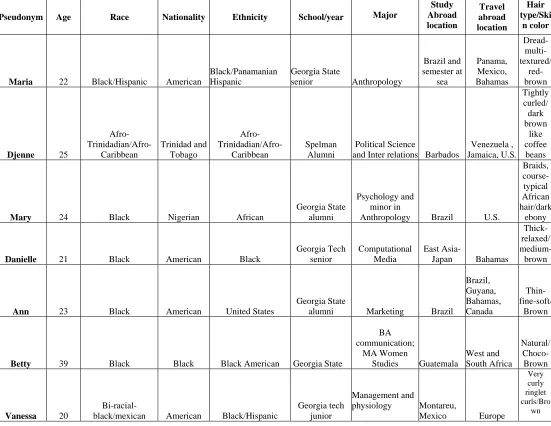
APPENDIX C: Demographics of Characteristics of Respondents 119
CHAPTER ONE INTRODUCTION INTRODUCTION
This paper is about Black women that have studied abroad and their experiences with
cultural concepts of beauty as it relates to their hair. The discussion is focused on the pretravel
perceptions, being different in the United States, and transformative moments while abroad.
In this paper, I have used the discourse used by Black women who live in Atlanta to
investigate Black female identity and body politics. In order to complete this task I conducted
20 interviews, 2 sets of 3 focus groups and participant observation with self identifying Black
women that have participated in a study abroad program at Clark Atlanta University, Spelman
College, Emory University, The Georgia Institute of Technology (Georgia Tech) and Georgia
State University. I was able to uncover their perceptions of their racial identity and worldview
which was one factor that prompted them to study abroad, challenging and strengthening their
identity as Black women by confronting their ideas about Black beauty.
Hair has served as a marker of their “womanness” and/or “gender” and racial identity
(Black American) abroad and at home. The history of the U.S. can be understood through an
analysis of the value placed on Black people’s hair. The statement, “everything I know about
American history, I learned from looking at Black people’s hair” (Jones 1981:12) explains the
value that American society has placed on hair. Since race has a strong socially constructed
meaning and hair serves as a racial marker, power relations can be investigated through the
travel as a transformative experience that changed their awareness of race, national identity
and gender in the US context.
I was inspired to study Black women’s hair identity through two personal experiences.
The first was a popular song titled “I am not my hair” written by the artist India.Arie. The
song, by this powerful Black soultress, has helped to change and challenge the view of Black
women in the beauty and music industry in the U.S. India.Arie is a acoustic artist that is in the
same genre as popular female artists, Lauren Hill and Erykah Badu. Through her positive
lyrics her music inspires Black beauty, Black female empowerment and natural beauty. With
songs like “I am not my hair” (2006) and “Brown skin” (2001), India.Arie’s music helped
inspire and support Black women who were embracing or wanted to embrace their skin and
hair as an affirmation of their Blackness. I call this the “I love my hair, however it may look
and my brown skin” movement.
Through her personal testimony in her song about her struggles with her hair, she
furthered supported the “Black is Beautiful” movement by promoting self love and
confidence for many Black women all over the United States. Through her song “I am not my
hair”, she encouraged Black women in the United States to not let their physical features such
as their hair define who they are but yet let their character and soul define them. In her song
she states, “its time for us to redefine who we be” by not letting it be our “crown and glory”
or “ determine our “integrity” but better yet be an expression of our creativity through
embracing different styles like they did in Africa. This is one of Delia’s favorite songs. In
discussing the meaning of song with her, she states that the lyrics
American vernacular in her use of the verb to be is splendid! It is very correct, especially when used by our redefined standards. India be doing it!
She was a descending voice from the mainstream that used this generally oppressive
tool as vehicle to speak out a positive message about Black beauty. As a dark skinned woman
with natural (chemical free) hair, she redefined and represented a successful resister of the
Eurocentric standard of beauty that dominated Hollywood. On April 16, 2007, Arie was
invited to be on an episode of The Oprah Winfrey Show entitled "After Imus: Now What?"
where she was praised for her work. This neo soul singer and artist is admired by Oprah and
Black women all over the world for creating songs that celebrate their beauty and speak out
against self hatred and assimilation.
My second inspiration was a study abroad panel I had participated on about minority
experiences abroad. In questioning how physical features such as skin color and hair texture
define a woman, I found it necessary to investigate how the myth of an ideal beauty standard
affects Black women’s identity. I specifically chose to investigate the perceptions of Black
women who live and studied abroad in a college/university in Atlanta, Georgia. These Black
women have been exposed to and have confronted the negative views of themselves through
in the U.S. and abroad which in turn created a new way for them to conceptualize the world
and their identity within it.
I have studied abroad three times to different locations and learned more about myself
as a Black woman due to the different perceptions of my perceived identity and interaction with
people that have been influenced by the White hegemonic structures which is spread through
U.S. media. After studying in Brazil in 2006, I began working with the Georgia State study
asked to participate on a panel discussion on minority student’s experiences abroad. This panel
was very important and differed from other study abroad sessions, in that it served as a
platform in which perceptions of our racial identity as it relates to our experiences with local
racisms were expressed, and benefits of going abroad. More interestingly, the subject of hair
was of particular concern and interest. Audience members wanted to know how the Black
female panelists would care for their hair abroad and panelists discussed their concerns and
issues with hair maintenance abroad and their host families’ othering of them through their
hair. This discussion strengthened my understanding of the importance of hair to Black women
in the U.S. who have gone abroad and how it serves as a racial marker abroad and a marker of
difference in the United States.
DEFINITION OF BROAD TERMS/CONCEPTS The following terms are defined as used in this study:
Study Abroad: Study abroad is defined as a program outside the United States that students in a university participate in for academic credit hours. Studying abroad is the act of a student
pursuing educational opportunities in a foreign country.
Woman: a biologically adult female human (sex); a person that socially identifies as a woman (gender).
CHAPTER TWO
LITERATURE REVIEW AND THEORY RACE IN AMERICA
Anthropologists have long worked to dispel the idea that race has a biological premise. In
1962, Frank Livingstone from the University of Michigan stated that “there are no races, there
are only clines” (Brace 2005:4). Clines is a term that describes slow changes that result in the
phenotypic similarities among people of a particular geographic region. Brace argues in his
book, Race is a Four Letter Word, that race is a problematic category; he states “since selective
pressures influence traits separately, human adaptive traits have distributions that are completely
unrelated to each other…and in turn cannot be studied by “racial” distributions” (Brace
2005:6,7). The term “probable mutation effect” describes the process by which certain traits over
time are weeded out due to various factors involving environment and lifestyle. With the birth of
new evolutionary developments, such as human variation and probable mutation theories, the
idea of race as a biological fact cannot be accepted. Brace delves further into why the idea of
“race” as a biological construct is problematic. One reason is that the use of “race” to explain
human variation implies there are different species. He asserts that “when it is finally realized
that there is no coherent biological entity that corresponds with what people generally assume is
meant by ‘race’, all those claims extolling or denigrating various aspects of racial worth will be
deprived of any validity” (Brace 2005:9).
The American Anthropological Association (AAA) discusses the concept of race in a
similar manner. In the anthropological statement on race, they claim to approach race as a
enslavement of culturally and phenotypically different people. Thus among anthropologists the
term “race” is described as a “cultural category, not a biological reality”. Despite the fact that
there is no biological proof for race, the socio-political aspects continues to play a major role in
society. Considering its cultural relevance, it is essential that I discuss the perceived and
internalized ‘race’ of Black women in the United States as an aspect of their identity.
Creation of the category Black
The act of placing people into categories according to socially constructed categories, or
so-called “races,” has its origins in European colonialism. The categorization of the worlds’
peoples into racial groups and the subsequent designation (using pseudoscience as a base) of
certain races as “superior” or “inferior” to others provided a justification for colonialism,
exploitation, and slavery of non-Westerners. The two main racial categories that are widely used
to describe people of African descent and people of European ancestry in the United States are
“Black” and “White.” These code words have been utilized in the United States as descriptive
terms of these two groups of people. It is also important to note that this is a discussion about the
United States, with is not interchangeable with America. The problem arises when these groups
are considered to be concrete and culturally and biologically distinct. The idea of “Black” and
“White” as being opposites was constructed during slavery in the United States. In order to
create a distinction between those with power and the slaves, the power holders described
themselves in terms of distinct physical traits using skin color as a determinant- “light v. dark”
and “black v. white.” Although the racial category Black was created as an inferior opposite of
White, Black has come to represent a major group in the United States with cultural influences
from Africa. By the time North America outlawed the transatlantic slave trade in 1808, a distinct
These slaves that were forcefully taken from Africa, have come to be defined and define
themselves in many ways. Bryd and Tharp argue that between 1964 and 1966, colored people
and negroes “became” Black people (2001:51). Prior to the 1960’s, the word Black only had
negative connotations, but has since been embraced by many people of African ancestry in the
United States. Wright argues that the Black race is not only socially constructed but legally
enforced. Blacks in the United States are a legally created group through the 13th, 14th and 15th
amendments (1985:11). Structurally, being Black in American society means occupying a
racially defined status which indicated that Black group identity is clearly multidimensional
(Demo and Hughes 1990:365). Blackness can never be permanently fixed in a place as a
complete or static “thing” (Guerrero 1993:2).
CONSTRUCTION OF THE BLACK FEMALE BODY
The Black body is a social construct in which cultural and racial markers such as hair has
served to affect the social identity of Black women the world over. Black western feminist
scholars have viewed the Black female body as a foundation for discussing gender, race and
power, but also as being both biologically and socially constructed (Banks 2000:13). Western
literature supports this model as a valid way to investigate power relations and racial markers
that are related to the Black female body (Hill Collins 2000, Roberts 1997). The Black female
body is the site where power struggles are fought and discourses on race and gender continue to
be played out (Caldwell 2004:18). Since the Black body has been culturally constructed by a
racist and sexist society in the United States, “Black bodies, intellect, character, and culture are
all [viewed as] inherently vulgar” (Roberts 1997:11).
In my research, the body of my participants was represented as a physical place where
conflicting representations that have been placed on Blackness, it is a site of perpetual
contestation, struggle, and change (Guerrero 1993:3). As such, society’s perceptions of these
women’s identity have affected how their bodies have been positioned in the modern world. As
Black women, they were deemed the other and marked by their race and gender by the dominant
society in the United States and local perceptions abroad.
Women’s bodies have always been a site for public discourse, especially in relation to the
standard of beauty. The reason for this focus stems from hegemonic perceptions of the ease with
which the female body can be controlled and dominated. In American society, women have a
second class status that has allowed their bodies to be subject to public display. Since women
have been viewed as “docile bodies”, the body serves as a site for power struggles (Foucault
1979, 1980 cited in Weitz 2001:668). These perceived power struggles are best exemplified
when looking at the daily bodily disciplines for women (Weitz 2001:668). For example, the daily
beauty regimens that go into doing their hair. For many Black women in the United States, going
to the hair salon is a weekly ritual in which the body has been trained to follow. Since the social
construction of femininity is stifling, women are disciplining their bodies to conform or resist to
the standard of beauty.
It is not surprising that this body discipline is more common amongst women then men.
In most patriarchal societies, women have been constructed in relation to men, as a biological
opposite. Western women are perceived as polar opposites to men because of the physiological
body being related to nature which is deemed by the dominant society as weakness. Feminist
scholars argue that the rise of reason and science gave a new legitimacy to gender subordination
(Ramazananoglu 2006:28). Dualistic thinking (men/women, culture/nature and black/white) has
2001:668). This view has treated the “body as matter to be studied like a machine” where women
are objectified by men (Ramazananoglu 2006:28). This dualistic thinking that still exists today
can explain why women’s bodies and brains are and have been viewed as inferior.
These social and cultural ideas about women and inferiority are transmitted through the
female body (Banks 2000:4). Dorothy Roberts has created a great framework for thinking about
and discussing the construction and destruction of the Black female body. Roberts explains how
the body of Black females has been controlled by racist ideologies of eugenicists. She uses the
Margaret Sanger birth control movement as an example in which Black women were
disproportionately sterilized because they were stereotyped as “jezebels” and “immoral Black
women” in need of control (Roberts 1997:11).
Patricia Hill Collins argues that the creation of four socially and culturally constructed
images of Black womanhood- mammies, matriarchs, welfare mothers and jezebels were created
in the United States during slavery (Collins 2000:70). The label of the jezebel stemmed from the
view of the African woman slave’s body as fair game to inflict pain, ascribe negative opinions
and indulge in sexual fantasies. They were raped by white slave owners because they were
viewed as uncovered and unprotected property (Byrd and Solomon 2005: xii). Since the
post-emancipation, Black women entered a society with bodies wrecked by captivity and disease, and
sustained by poverty (Phillips 2004:4). During slavery, Black women were already deemed
animalistic and today, the Black body is still viewed as a site of filth that has been subject to
social/cultural scripting. Jezebel is still one of the controlling images that restricts and endangers
the body of Black women in the United States. These negative images of the Black woman
classism. Regardless, the bodies of Black women have written a “history” and a “herstory” in the
United States (Byrd 2005:xii). Othering and double consciousness
These stereotypical images of Black women were predicated on the 19th century ideology “the
cult of true womanhood” in which White females in the United States defined their identity on
the basis of who they were not rather than who they were (Collins 2000:71). Additionally,
“Gender norms continue to buttress and perpetuate colonial hierarchies of gender, race, and class
by constructing the social identities of White women as the standard of womanhood and female
beauty, and the social” (Caldwell 2004:21). In labeling White women ‘real’ women, this was
another racist form of identifying Black women as non human. As a result of the stereotypical
images of the Black female body created during slavery, “Black women’s parts--- particularly
our butts, hips, thighs, breasts, lips, skin and hair—are continuously overemphasized, fetishized,
derided, “improved”, trend-spotted and otherwise objectified” (Byrd and Solomon 2005:1). This
racist view of the Black body has affected the identity of Black women.
The dual othering, being othered as Black and as a female, has placed Black women in a
subordinating positioning in both gender and racial hierarchies. Black women’s bodies have been
‘othered’ through their hair and have been a highly visible marker of their dual ‘otherness’ ”
(Collins 2000:79, Caldwell 2004:18). Although men are othered as Black, they are not subject to
dual otherness. Gender-based double standards of beauty have allowed Black men to have more
options in terms of hair than their Black female counterparts (Jackson 2001:136). Though norms
of masculinity can work as a barrier to allowing men to artistically style their hair in the United
W.E.B DuBois referred to the feature of incorporating dual identities into African
American cultural life as “double consciousness: a disjointed identity, partially imposed by
racism, the “two-ness” of living between whiteness and Blackness, Africanness and
Americanness, always seeing oneself through another’s vision, never feeling quite whole” (Du
Bois 1990 cited in Copeland-Carson 2006:60). Black women have been faced with this
intersectionality of oppression and have had to navigate a life of “in-between” status.
Copeland-Carson says it best when she states that women have had to create a “kind of double vision: for
our own survival we had to both see how the world might view us as “the Other,” while also
seeing our own reality, self-worth and potential” (2006:59).
Black women have struggled to define themselves in positive terms as both Black and
female. “Dealing with issues of beauty- particularly skin color, facial features, and hair texture-
is one concrete example of how controlling images denigrate African American women” (Collins
2000:79). Hair then is a key site for investigating how “Black women’s identities are
circumscribed by dominant discourses on race and gender” (Caldwell 2004:18). Since Black
women have had to learn how to adapt to their sexist and racist environments, one survival
strategy they created was “shifting”. Shifting is a mechanism in which these women deal with
the social construction of their body. Black women “shift to accommodate differences in class, as
well as gender and ethnicity” (Jones 2004:7). Shifting is the change of outward behavior, to
adopt an alternate pose or voice or embellish a certain identity in order to satisfy others such as
Whites or Black men (Jones 2004:7). Although the Black female identity can shift, it is still
THE GLOBAL MEDIA AND STUDY ABROAD
The Association of International Education Administrators (AIEA) states that
globalization has led to the “internationally integrated production and consumption of goods,
cultural products, and services in which local and national identities are challenged. More
individuals are transnationally mobile and even larger numbers of people are globally-linked
even without leaving their own localities” (AIEA 2007).
Globalization has made it so that ideas can flow more easily and quickly (Appadurai 1996:32). The flows of ideas and images created by the United States accounts for the
“Americanization” of many locations such as Brazil, Spain, Kenya, and Mexico. Ideas such as
the American beauty standard are all over the world and are conflicting with other cultural
groups ideas of beauty such as those of Black women in the United States. These ideas are
perpetuated through television, cinema and video technology and created by the intricate and
overlapping set of Eurocolonial worlds (first Spanish and Portuguese, later English, French,
and Dutch) that have set the basis for the traffic of ideas and images throughout the world,
blurring the lines between realistic and fictional realities (Appadurai 1996).
This global reality is also caused by the increased intercultural exposure as a result of
the increased popularity and number of study abroad and exchange programs in high schools
and colleges (Thomlison 1991). Universities and organizations such as the Association of
International Education Administrators (AIEA) and the Council on International Educational
Exchange (CIEE) are encouraging people especially college students to travel, work and study
abroad.
Study abroad offices are selling their programs to students by promising that the cross
2004:150). Since globalization heightens the demand for international competence,
international exposure is a necessity for students that desire to enter into the professional field
after college. In order to create this global perspective, one will need to broaden their world
scope which can be accomplished through studying abroad. Traditional experiences such as
study abroad, are growing rapidly, while at the same time being re-evaluated (AIEA 2007).
As more people travel and students study abroad, they are being exposed to other worldviews and cultures. As many Black women go abroad, they will be exposed to how others
view their racial identity. Attitudes towards Black women's hair, Black women's hair-styling
practices, and their own complex and often ambiguous attitudes reveal the cultural scripting of
Black female bodies, as well as efforts to transcend or defy this cultural scripting. The act of
participating in a study abroad program for Black women situates them in place where their
perception of self may differ from others’ perceptions of Black women provided by the
American media. As a result of the global flows of ideas, “more persons throughout the world
see their lives through the prisms of the possible lives offered by mass media in all their forms”
(Appadurai 1996:32). These mass media images from the U.S. have impacted how people in
other countries view Black women from the U.S.
The experiences of Black women who have studied abroad are important because of the
ways in which place and situation create particular responses to hair – both of these are directed
at women in different cultural contexts, and as their responses to being “marked” in distinctive
ways. Study abroad leads to the crossing of boundaries and the transformation of cultural
scripts about hair as a signifier of black female bodies; it is therefore important to an
exploration of how identities shift and transform in relation to shifting social contexts.
CREATION OF THE BLACK BEAUTY CULTURE
Africa and hair
Although hair is important to women in many cultures in different contexts it has been
particularly meaningful to women of African descent because it has been “displayed as beautiful
and decadent and used to display culture, beauty and spirituality” (Rosado 2004: 60). Hair has
always been an important site of symbolic meaning. In the African Diaspora, “hair is even more
important than skin color and language” (Rosado 2004: 60). Hair has always been important to
African women because it has been used as a vehicle to express their creativity, personalities and
social status.
Hair has been a determinant of a person’s personality and lifestyle. Many scholars have
agreed that hair can be a reflection of a person’s political affiliation, social status, and sexuality
(Rosado 2004: 61). Others such as Morrow, state that hairstyles are symbolic of age, occupation,
clan and status (Banks 2000:7). In Africa, hair styles have been used to communicate marital
status, age, religion, ethnicity, wealth and geographical origins (Rosado 2004: 60; Byrd and
Tharps 2001:2).
In the early fifteenth century, hair functioned as a carrier of symbolic messages in most
West African societies. Hair was an integral part of the language system in which different styles
had strong social significances. For example in some cultures, a person’s surname could be
indicated through their specific hairstyles such as the Kuroma people of Nigeria who shaved
their head with a single “tuft” left on top (Bryd and Tharps 2001:3). The hairstyles were often
“elaborate works of art, showcasing braids, plaits, patterns shaved into the scalp, any
combination of shells, flowers, beads, or strips of material woven into the hair” (Bryd and Tharps
400 years without a comb
Willie Morrow illustrated how people from Africa were forced to leave their homeland
and stripped of their culture by being made to leave behind their belongings, including hair
utensils (Morrow 1973). By the beginning of the sixteenth century, the Spanish, Dutch, and
Portuguese began trading human cargo in North America, South America and the Caribbean.
The Europeans began to exploit the West African city-states and for nearly four hundred years
and an estimated twenty million Africans were captured and sold to European and Arabian
slave traders (Bryd and Tharps 2001:10). The Africans endured foul, disgusting and inhumane
conditions aboard ships during the Middle Passage which affected their mind and bodies
(Peterson-Lewis 1993 cited in Wade 2006:2). Given the importance of hair to Africans, they
were shocked by the treatment of their body and hair.
The Africans, partaking of traditions steeped in the art and science of highly specialized
hair care, arrived in the western world with a scalp that was often infested with sores and hair
that was matted and soiled with perspiration, blood, feces, urine and dirt (Peterson-Lewis 1993
cited in Wade 2006:2). Bryd and Tharps argue that slave traders would shave the Africans
heads for what they claimed to be sanitary reasons, but really to erase the African’s culture and
alter the relationship between the African and his or her hair (2001:11). Given the inhumane
conditions and inability to transport any of the necessary tools, the slaves had to be creative in
order to upkeep their appearance (Wade 2006:2; Bryd and Tharps 2001:12, Morrow 1973).
When Africans first came to the New World, their hair grooming practices changed due
to the different environment. Without the combs, herbal ointments, and palm oil used in Africa
for hairdressing, those enslaved were forced to use common Western household products and
used for scalp cleaners, coffee as a natural dye and butter used to condition the hair (Bryd and
Tharps 2001:16). They not only had to find new ways to clean and groom their hair, but styling
practices changed as a result of the hostile racist environment. Bryd and Tharp argue that the
field slaves were not encouraged nor were given time to style their hair so they wore scarves to
protect their heads from the sun; but for aesthetic and comfort purposes, Africans that worked
in the house wore their hair similar to the White owners (2001:14). In the 1700’s, the hair of
slaves was undervalued and misunderstood. Their hair was described as like “wool” and
compared to that of animals (Bryd and Tharps 2001:14). “White slave owners sought to
pathologize African features like dark skin and kinky hair to further demoralize the slaves,
especially the women” (Bryd and Tharps 2001:14).
In order to combat this, some slaves consciously refused to hide their hair, and would
make “flamboyant hairstyles that beli[ed] any sense of shame or inferiority” (Bryd and Tharps
2001:16). Although Africans had difficulty maintaining their hair traditions, the meaning and
significance of traditional hairstyles were not easily forgotten (Bryds and Tharp 2001:15). Thus
similarities can be seen in the West African styles found today in African American
communities (Wade 2006:1).
Today people of African descent in the United States identify as either African American
and/or Black, still place great value on hair maintenance. Hair care rituals were a part of the
complex survival strategies that Africans created during slavery and that Blacks continue to
utilize today (Rodriguez 2004:64). Although all Black women in the United States do not have
the same conceptions about beauty nor have the same texture of hair, hair has been a bonding
experience of Black women due to its importance in the African culture. Regular hair care rituals
today (Rodriguez 2004: 64). Hair can be viewed in terms of a rite of passage…signaling an entry
into womanhood” (Wade 2006:1). Banks argues that hair is the basic, “natural symbol of the
things people want to be…and it’s social-cultural significance should not be underestimated”
(2000:7). Although I agree that Hair is a natural feature, it is the cultural connotation that is
associated to it, that makes it a symbol. These definitions of hair reveal the complex and global
meaning of hair.
THE “BLACK IS BEAUTIFUL” MOVEMENT
In the mid-sixties, Black hair in the United States underwent its biggest change since
Africans arrived in America (Bryd and Tharps 2001:51). Hair came to symbolize either a
continued move toward integration in the American political system or a growing cry for Black
power and nationalism. The “Black is Beautiful” movement taught Blacks that they needed a
true sense of self and “Africaness” to counter “Whiteness”. The “Black is Beautiful” movement
was a cultural and social movement that started in late 1960’s to promote pride in Blackness-
features and culture (Goering 1972:231). The movement was founded upon the importance of
truth, knowledge, beauty and accentuating positive connotations of the label “Black”.
Some of the most prominent leaders of this movement, the Black Panthers, realized that
Blacks were a minority living in a White society who needed a positive uplift. They started this
“Black Power” movement to create a massive shift in the collective conscience which challenged
the definition of African Americans, physically, politically, socially and stylistically (Rodriguez
2004: 64). The Black Power movement brought articulated and focused leadership to America.
“It critiqued Black popular culture and demonstrated how our lives in the West had been marked
by the slave trade and the dehumanizing effect of racism (Dash 2006:31). The Black liberation
solidarity and the accumulation of wealth after the Emancipation” (Phillips 2004:6). This
movement is an essential part of the “Black is beautiful” movement in that it promoted a
positive “Black” identity and self love and pride in African features (Bryd and Tharps 2001:51).
As Phillips notes, the Black consciousness movement wanted to create a positive Black identity
in a deeply racist society, turning the pejorative designation of race into a source of dignity and
self-affirmation through the ideology of class differentiation, self-help and interdependence
(Phillips 2004 cited in Gaines, 1996:3). Since many Whites considered the phrase “a beautiful
Black woman” to be an oxymoron, Black Panthers promoted the idea that Black women are
beautiful (Phillips 2004:6).
In the “Black is Beautiful” movement in the 1960’s, hair became a key determinant in
visually declaring Black Pride through embracing natural styles such as the afro and various
braiding styles (Bryd and Tharp 2001:53). Although many Black women did not feel
comfortable wearing their hair in these natural styles due to the racial stigma of Black hair in its
natural state, the Black power/pride movement promoted the idea that Black hair in its natural
state is beautiful (Phillips 2004:8; Bryd and Tharps 2001:53). Given the Eurocentric aesthetic
standards that prevailed in the societies in the United States and societies of the African
Diasporia, Iin order to combat these negative images and care for their Black hair, Blacks in the
United States created a Black beauty culture in the early 1900’s.
The Black beauty market
After two centuries in bondage, a self created system of Black hair care was created in
the late 1800’s with the birth of the Black hair-care boom (Bryd and Tharps 2001:16). During
this time, the Black consumer market was created as a direct result of the disposable income that
Negro.” “Black beauty culture in the United States emerged not only from Black women’s desire
to beautify their bodies but also from a need to address the socioeconomic and racial vagaries of
Whiteness against their bodies” (Phillips 2004:4).
In the early 1900’s, Black female community leaders and business women, Madame C.J.
Walker and Ms. Anne Malone, created hair grooming practices to help with the maintenance of a
healthy Black consciousness (Rodriguez 2004: 64). Unsatisfied with the products and methods
available to care for and straighten Black people’s hair, Anne Malone and Madame C.J. Walker
created supplies and creams to help “beautify” Black hair. Malone wanted to “solve the hair
problems, such as baldness and breakage, that many Black women of the time faced as a result of
high-stress lifestyle, a nutritionally deficient diet, and inadequate hygiene” (Byrd and Tharps
2001:31). In order to do so, Malone created a product that she claimed would make Blacks hair
grow and Walker fashioned a straightening method “shampoo-press-and-curl”.
In the 1930’s, when popular advertisements promoted beauty through skin bleaching,
Malone encouraged women to “see themselves as African first” (Phillips 2004:8) Malone
patented, manufactured and distributed beauty products under the name of “PORO” (Phillips
2004:4). Which is Mende a West African word meaning “devotional society” (Byrd and Tharps
2001:32). Byrd and Tharps find it interesting that Malone would name her products an African
term when at the time Blacks in the United States were not looking for connections to Africa.
Although Malone was trying to produce a company that was pro-Black, Bryd and Tharps argue
that it was a contradiction that plays throughout the modern history of Black hair in which Black
people would consider beautifying Black hair through making their hair appear “whiter” (Byrd
Regardless of what the critics say, Malone helped herself and other Black women to
socially and financially move up through creating a manufacturing hair-product firm and a
beauty college specifically for Black women in which they sold products (Phillips 2004:4, Byrd
and Tharps 2001:31). Although she reached her goal of enhancing the status of Black women
and uplifting the Black community through her financial contributions, she only partially
responded to the stigmatization and racism that was placed on hair associated with African
descent. Malone endeavored to counteract white hegemony by encouraging Black women to
view themselves as beautiful. Although hair straightening is a style choice for Black women in
the United States, self hatred and assimilation are still very much a part of the reason that many
Black people straightened their hair in the early 1900’s and continue to do so today.
This is only one example of the many ways that Black people in the 1900’s created a health
and beauty consciousness through their hair. Today there are many different hair and beauty
salons that tailor to the beauty needs and desires of Black people all over the United States.
Atlanta along with other major cities including Detroit and Chicago are amongst the leaders in
the Black hair care movement. In August of 2007, Atlanta hosted the Bronner Brother hair show,
one of the most popular and largest public sessions on Black hair maintenance and displays of
hairstyles. Black women spend over thousands of dollars and many hours on beautifying their
hair in order to achieve social acceptance (Byrd and Solomon 2005:39).
AFRICAN AMERICANS AND HAIRSTYLES
Different hair styles were popular during different times. In the 1800’s cornrows and
plaits were very popular and in the late 1960’s and early 70’s, the afro and natural styles became
popular with the “Black is Beautiful” and Black Power movements. The aesthetics of these
meanings that African American women in the United States attached to their hair as a signifier
of personhood (Jackson 2001: 135). The many ways that Black people wear their hair is a
reflection of the personality and often a political statement. There were various choices of
hairstyles for African Americans such as: dreadlocked, natural, curled, faded, braided, twisted,
straightened, permed, crimped and cornrowed (Lester 2000:202). Although these styles are
popular amongst Black women in the United States, the practice of ‘straightening’ the hair is
highly contested in the Black community as an appropriate style option.
Straightening
The matter of straightened versus natural hair may have been an ideological or political
issue for Black civic and political leaders and a symbol of success and opportunity for the elite
(Byrd and Tharps 2001:44). Although Black leaders were in favor of the increased attention to
grooming and appearance in the fight for social acceptance, many denounced hair straightening
as an acceptable choice. They found it to be a pitiful attempt to emulate Whites and attributed
their hair straightening to self-hatred and shame of their Black features (Byrd and Tharps
2001:37; Dash 2006:31). Even today, hair straightening practices have been thought to be an
indication of racial self-hatred contradictory to Blackness (Jackson 2001:135).
“Conking” as a trend style from the early to mid-20th century was bitterly opposed by
some members of the Black community for the message it conveyed about internalized diasporic
inferiority. Conking was a chemical means of straightening African hair that became fashionable
among Black entertainers such as Malcolm X, Nat King Cole, Fats Domino, and Josephine
Baker (Dash 2006:30). The issue that many Black people had with chemical straightening was
that the process was painful. The lye used in the treatment burns and even blisters the scalp
ritual of humiliation because of the painful acts of applying the chemicals to the hair and scalp
(Badillo 2001:36).
In 1992, Spike Lee directed and Denzel Washington starred in the movie Malcolm X,
which was a portrayal of the Black Nationalist. In his early life, Malcolm X was a pimp and
Harlem hustler who was sentenced to prison for burglary. In one scene, Malcolm was “conking”
his hair in the bathroom and was approached by a jail mate about the dangers and negative
implications of chemicals for Black people. Although hair straightening was thought to be an act
of self-hatred, many social scientists have found different interpretation of the straightening
ritual. For example, Byrd and Tharps stated that anthropologists, Shane and Graham White,
contend that hair straightening is just one of a long list of styling options for Black people and
should not be viewed as an unconscious attempt to assimilate, but rather as a creative styling
option (2001:40). Others also disagree that “conking” was an attempt to try to look “White.”
Craig argues, “straightening the hair rarely mirrored the looks of white counterparts… the
self-hatred or the ‘desire to be white’ interpretation misses the various meaning that black people
assign to straightened hair” (Banks 2000:10).
The many issues that some Black scholars and people have is not with the act of
straightening but the way the hair is straightened. Black people have straightened their hair
through chemicals such as relaxers, perms and texturizers and utensils such as hot/pressing
combs and flat/straigteining irons. According to Goering “Blacks were never strongly in favor of
being white” (1972: 235). The fact that they wear different hair styles such as straightened “does
not mean that they want White hair. Straightened hair is just another hair style not an emulation
straightening it with a pressing comb are two popular hair styling options today amongst Black
women in the United States.
Natural
Another popular hair styling option is called ‘natural’. ‘Natural’ hair was considered
“unstraightened Black hair that was not cut close. It was a less sculpted, less maintained version
of the rounded, perfectly actualized Afro” (Dash 2006:30). In the 1960’s, hair became a key
determinant in visually declaring Black Pride and many Black women in the United States begun
embracing their “Blackness” through natural styles such as the afro and various braiding styles
(Bryd and Tharp 2001:53). Although many Black women did not feel comfortable wearing their
hair in these natural styles due to the racial stigma of Black hair in its natural state, the Black
power/pride movement promoted the idea that Black hair in its natural state is beautiful (Phillips
2004:8; Bryd and Tharp 2001:53).
The natural state of Black hair is defined in many ways in the United States. An Atlantan
hairdresser described natural hair as “hair that is in its natural condition in which texture not
form should be naturali.” Natural hair and styles are very popular in Atlanta, therefore there are
many natural hair salons. The stylist described natural hair as “no chemical that alters natural
curl pattern” She said that, women can have “physical changes” such as color and use
straightening techniques such as pressing and flat ironing and still be natural. Women who do not
have natural hairstyles use chemicals that alter their natural curl pattern through perms,
texturizers and jerri curls. Although most Black women do not wear their hair in the original
state, they still wear natural hairstyles, meaning that they create cultural hairstyles that do not
require heat and therefore do not alter the natural curl pattern. These styles include the afro and
The Afro hairstyle was adopted by Afro-Americans as an outward affirmation of an
empowering sense of black pride. Afros were one of the ways that unstraightened/“nappy” hair
was celebrated and worn. The Afro is a style that draws on qualities intrinsic to curly African
hair such as the coil of the hair and its capacity to grow in a thick mass (Dash 2006:30). Another
popular natural style was dredlocks. This type of Rastafarian hairstyling came to prominence
with the success of Bob Marley, a Rastafarian and wearer of dredlocks. The Rastafarian style of
locking Black hair is a signifier of their view of the natural state of African physical and cultural
attributesas beautiful. The word dredlocks signifies unholy people’s fear of the dreadful power
of the holy (Byrd & Tharps 2001:125 cited in Dash 2006:30). This meaning has come to be
embraced by many Blacks in the United States as a unique styling technique that can only be
properly utilized by African people. Although this style is pridefully embraced by many people
of African ancestry, many Whites in the United States view dredlocks as unprofessional or
undesirable (Lester 2000:201).
THE STANDARD OF BEAUTY
Thru media images perpetuated through magazines and the cosmetic industry, Black
women have traditionally been defined as sexual, rather than beautiful (Caldwell 2004:21). This
view was created during slavery when White slave owners sought to demean African features
like dark skin and kinky hair to further demoralize the slaves, especially women (Bryd and
Tharp 2001:14).This culture of White beauty attacked Blackness and the Black sense of beauty
(Phillips 2004:4). In the 1700’s, Black hair was described as “wool” and compared to animals
(Bryd and Tharp 2001:14). Blacks have felt like outcasts because of the way the media has
portrayed them. In the 1920’s, newspaper advertisements constantly condemned the
their sense of beauty, Blackness and self esteem by the cosmetic companies and White standard
of beauty.
The White western view of beauty is known throughout the world. The blue-eyed,
blonde, thin White women could not be considered beautiful without being compared to the
Black women with classical African features of dark skin, broad noses, full lips, and kinky hair
(Collins 2000:79). This view is exclusionary and racist, but provides insight into the
intersection of race, gender, class and power through the standard of beauty (Caldwell
2004:18). The beauty standard has created dichotomies as binary opposites to distinguish
African features from European features such as kinky and straight, long and short, dark and
light , good and bad (Johnson 2004:65).
The beauty myths
Naomi Wolf, the author of the popular book, The Beauty Myth, states that the “beauty
myth is a political weapon used to exert control over western women and that the value of what
is and is not beautiful is an instrument of control and of disqualification” (Wolf 2002, cited in
Badillo 2001:37). Consequently, western women are made to internalize ideas about beauty and
aspire to unrealistic standards of beauty. Beauty has been constructed to favor those in
power-Whites and has created an industry that is tailored around their physical features. Hair plays
such an important role in our society because it is a valued physical characteristic and this value
is portrayed through teen magazines, television shows and music videos that have made hair an
important part of fashion and beauty (Wolf 2002:25).
Since most of the beautifying products and ideas about beauty are sold to young
women, physical beauty has been an important goal for them. Women have been socialized to
In this sense, physical beauty denotes European features such as long, straight hair, a porcelain
skin tone and a thin frame (Goering 1972:235). The Eurocentric notions of beauty are highly
displayed as the ideal beauty that even Whites cannot attain. Although the media in the United
States has created a notion that the body frames and hair textures of “Black” and “’White”
women are completely different, there is no specific racialized physical features. Although
women of African descent in the United States do tend to have a more curvaceous frame and
curlier hair than White women in the United States, Black features cannot be essentualized. The
goal of physical beauty can be reached by women through beautifying their hair. Although hair
is important to men and women, physical beauty is more desired by and demanded of women
in the West. The women in the United States are socialized to believe socio-cultural myths that
place great importance on hair that adheres to gender and racial norms.
Marker of femininity
For women in the United States, hair is a marker of femininity. According to Banks,
hair has always been an important physical attribute for women because it is very visible and
public (2000:12). Hair has meaning everywhere but the values placed on it are different. As for
western women, hair has become a part of their identity. Its importance has created a space in
the world that women mostly occupy. Jones argues that the world of hair is a female domain
that many men do not understand (1981:276). The amount of importance that the American
society places on beauty for women, can affect their life chances such as job opportunities and
marriage. Johnson has noted that hair carries serious weight in relationships with the opposite
sex which causes women to believe their external features are more important than internal
qualities (2004:66). As a result, women in the United States begin to invest in beauty products
which they spend $300-1,200 on their hair monthly (Rosado 2004: 60). It has also been duly
noted that a woman’s worth and beauty often comes from her hair (Badillo 2001:36) with
Black women in America buying into the myth that they have to consume in order to attain the
standard of beauty.
This unattainable Eurocentric standard of beauty is used by the cosmetic industry and
fashion magazines to encourage all women influenced by westernized ideas of beauty that they
need to indulge in consumer capitalism in order to feel good about themselves. Visual images
are powerful in their promotion of an ideal female beauty through the material realm of
consumer culture. Over one million copies of magazines such as Vogue, Cosmopolitan, and
Glamour, are circulated by advertising which targets western women as the primary consumer
in both modern and postmodern society (Barthel 1988 cited in Blair 1994:6).The companies
capitalize on making women feel that they never look good enough. In doing this, the female is
both an object and commodity of the male and female gaze in which women are the sexual
fantasy of men and subject of critique and criticism of women. The female gaze can also be
empowering through film and printing industry in that women can define and refine themselves
as more women are becoming produces of the image of the “woman” (Blair1994:4). Although
the pressures on black and white women are different due to cultural/racial differences, they are
similar in that they are socialized to believe that they can never consume enough and that they
will never be pretty enough. Even within the Black community in the United States the idea of
beauty is subjective due to socialized local cultural/social beliefs.
Good and bad hair
The idea that there is such a thing as “good” and “bad” hair is a beauty myth. This beauty
the hair aspect, straight hair has been promoted as the standard. In the fashion world, straight hair
is assigned the highest value (Jones 1981: 30, 280). Some women feel pressured to purchase
weaves/extensions in order to get long and straight hair and the most expensive hair to buy is the
“French refined” or “European” hair (Jones 1981: 30, 274).
The idea of “good” and “bad” hair was created during the colonial era, therefore the
concept of “good” and “bad” hair can be found throughout the African Diaspora. What is
considered “good” and “bad” hair is determined by texture, length, and curl pattern and
associated with race (Rosado 2004: 61). “Good” hair is perceived as the hair closest to white
people’s hair—long, straight, silky, bouncy, manageable, healthy, and shiny; while “bad” hair is
short, matted, kinky, nappy, coarse, brittle and wooly” (Lester 2000:202; Rosado 2004: 61). The
definitions of “good” and “bad” hair are a result of the favoring of lighter skinned slaves due to
their physical resemblance to Whites (Bryd and Tharps 2001:16). As a result of racial mixing in
America, those with lighter, whiter skin were considered to have “good” hair because their
complexion and features resembled the slave masters (Lester 2000:202). “As the lighter-skinned,
straighter-haired slaves- men and women- continued to carry favor with the Whites in power, a
skin-shade, hair-texture hierarchy developed within the social structure of the slave community”
(Bryd and Tharps 2001:19). Therefore, lighter skin and finer hair meant free status for slaves or a
lighter labor load. The color complex within the African American community began with the
favor of light skinned over dark skinned slaves (Russell 1992:11). The politics of hair parallels
the politics of skin color.
“Black hair” and “White hair” are not types of hair but rather the texture of hair that has
been racially contextualized. There are cultural associations to certain textures about ideas of
have different textures of hair regardless of race. The association of bad hair with “Blacks” and
good hair with “Whites” is a Eurocentric ideal stemming from slavery that placed social status
on hair in the United States. In the United States as well as many countries such as Brazil, the
concept of bad hair is associated with individuals who have Black or African ancestry (Caldwell
2004:18). ‘Bad’ hair was considered as something that should not be touched, lacking of and
skimpy (Banks 2000:31).
In the two Black films, 400 year without a Comb and School Daze, Willie Morrow and
Spike Lee respectively discuss the internalization of self hatred of black features and the creation
of the division in the Black community. Morrow shows how the favoring of the mixed children
of slave women and masters created jealousy and envy between the light and dark skinned slaves
(house and field slave). Spike Lee shows how this internalized self hatred created during slavery
still exists in the mindsets of African American communities today. In the movie, Lee created
two groups, the light skinned sorority called Gamma Rays and the Afrocentric dark skinned
freedom fighter women. In order to bring light to the negative connotations of terms “good” and
“bad” hair, he had these two groups sing a song called “Straight and Nappy”. The dark skinned
women were called “jig a boo” and the light skinned “wanna-be’s.” In this artistic, comedic
satire, Lee was able to articulate how hair has been used as a racial marker in the Black
community in the United States.
Racial markers
Racial characteristics including hair type came to be associated with the arbitrary
categories that were put forth during colonialism. “Biological evidence shows that the
(Badillo 2006:35). There is more diversity within a ‘race’ than between them. The Black
community alone has a wide variety of skin complexions, hair textures and facial differences.
Lewis R. Gordon's (1997) work on anti-Blackness provides significant insights into these
processes. Gordon argues,
In an anti-black world, race is only designated by those who signify racial identification. A clue to that identification is the notion of being colored. Not being colored signifies being white, and, as a consequence, being raceless, whereas being colored signifies being a race. Thus, although the human race is normatively white, racialized human beings, in other words, a subspecies of humanity, are nonwhite.... In effect, then, in the antiblack world there is but one race, and that race is black. Thus to be racialized is to be pushed "down" toward blackness, and to be deracialized is to be pushed "up" toward whiteness.
(Gordon 1997:76 cited in Caldwell 2004:22)
Black identity was created in order to normalize Whiteness and ‘other’ Blackness. The body
was used as a marker of ‘racial’ difference and a concrete sign of ‘racial’ superiority or
inferiority (Nuttall 2000). Body parts such as hair were marked with racial inferiority as well.
The hair of Black subjects was used as a symbol of their supposed degenerate, simple or savage
presence (Dash 2006:28). Since hair was used as a justification of the subordination of Africans,
curly and kinky hair immediately became a badge of racial inferiority (Banks 2000:7). The
wooly hair of African slaves was deemed to represent a symbol of rebelliousness and therefore
regarded them as inferior and dangerous (Jackson 2001:135). Curly hair has then become a
symbolic weight and a social stigma for Blacks in the United States.
People all over the world have used hair as a way to racially categorize people and hair
has served as “evidence” of a person’s race. For example Jones was often judged as being Black
because her hair was curly (Jones 1981:29). Another woman recalled being called ‘bad’ by her
family because she had ‘bad hair’ (Badillo 2001:35). Women’s bodies reflect popular attitudes
Practices of racialization center on categorizing individuals into bipolar categories of
“Whiteness” and “Blackness”. “These practices of racialization reflect a decidedly anti-Black
bias, which privileges Whiteness as an unmarked and universal identity” (Caldwell 2004:22).
Dalton argues that most White people do not see themselves in racial terms, therefore Whiteness
has little meaning itself but only in relation to other races such as Black (Dalton,15 cited in
Rothenberg 2005:15). Shone defines Whiteness as “the everyday, invisible, subtle, cultural and
social practices, ideas and codes that discursively secure the power and privilege of European
Americans, but that strategically remain unmarked, unnamed, and unmapped in contemporary
society (1994:503). Some Whites in the United States have used the lens of Whiteness to
privilege themselves enough to not see race, nor see themselves as racial or view racial incidents
and the experiences of people of color as important, sensitive, rational or validated.
Whites in the United States believe in their ability to be colorblind and not see color or
race in itself is a privilege that can only be held and attributed by their Whiteness. Many scholars
such as, McIntosh, define white privilege as unearned privileges that people with white skin or
those that can visibly identify as white have that puts them at an advantage. She also describes
white privilege as “an invisible weightless knapsack of special provisions, maps, passports,
codebooks, visas, clothes, tools and blankchecks.” (McIntosh 1988)
SOCIAL AND CULTURAL CAPITAL
Beauty functions as a particularly dense transfer point for relations of power (Nuttall
2000: 342). Beauty has been socially constructed to favor White features such as straight hair;
thus this social preference for White hair has given power to those with straight hair. Those with
straight hair or “White” hair are given access to certain valuable societies and social groups that
Caucasian or straight…. [H]aving good hair meant” having “more social capital… Bad hair is…
a code word for African or kinky hair… which meant you had less social capital (Rosado 2004:
61). In this way, social capital is a key resource in which privilege is conferred. Women in the
United States have been able to access social capital through their hair. Hair styles or hair that is
associated with those of African descent is considered less desirable. Perms, weaves/extension
and braids are consistently ranked as conservative and professional while natural styles such as
dreadlocks, twists and knots were viewed as liberal. Deeming straight hair as good and course
hair as bad, creates a racial hierarchy amongst different kinds of hair (Rosado 2004: 62). The
privilege awarded to Blacks with “good” hair disempowers the multitextured and different hair
textures of Black women. They are then at a distinct disadvantage because of its inequality.
Black women with straight hair can change their racial and class identity. The ideology
of the aesthetic is a discourse of power, one that has played a far from negligible part in the
consolidation of the bourgeoisie and its accrual of cultural capitol (Nuttall 2000:346). Hair serves
as cultural capitol in which people with “good” hair have access to certain knowledge and skills.
Cultural Gatekeepers are persons who define and create rules of inclusion and exclusion of
certain groups of persons (Laureu and Horvat 1999:37). Gatekeepers such as employers for
example, use criteria such as hair styles, to judge potential employees as capable, and
“acceptable” for employment. As such, hair has the power to create and limit social and cultural
mobility for Black women because it affects their perceived racial identity.
Beautifying hair according to the western standards of beauty, has benefits for women in
the United States. Although the concept of beauty is relative and what is considered ‘beautiful’ in
one community may not be considered elsewhere, even in the United States; the western