Psychology Dissertations Department of Psychology
5-3-2007
Trajectories of Pure and Co-Occurring
Internalizing and Externalizing Problems from Age
2 to Age 12: Findings from the NICHD Study of
Early Child Care
Kostas Andrea Fanti Georgia State University
Follow this and additional works at:https://scholarworks.gsu.edu/psych_diss Part of thePsychology Commons
This Dissertation is brought to you for free and open access by the Department of Psychology at ScholarWorks @ Georgia State University. It has been accepted for inclusion in Psychology Dissertations by an authorized administrator of ScholarWorks @ Georgia State University. For more information, please [email protected].
Recommended Citation
Fanti, Kostas Andrea, "Trajectories of Pure and Co-Occurring Internalizing and Externalizing Problems from Age 2 to Age 12: Findings from the NICHD Study of Early Child Care." Dissertation, Georgia State University, 2007.
TRAJECTORIES OF PURE AND CO-OCCURRING INTERNALIZING AND
EXTERNALIZING PROBLEMS FROM AGE 2 TO AGE 12: FINDINGS
FROM THE NICHD STUDY OF EARLY CHILD CARE
by
KOSTAS ANDREA FANTI
Under the Direction of Christopher C. Henrich
ABSTRACT
According to previous research, internalizing and externalizing problems tend to be
comorbid or co-occur at different ages in development (Angold, Costello, & Erkanli, 1999). The
question that this dissertation addresses is how and why internalizing and externalizing
problems, two disorders that represent separate forms of psychopathology, co-occur in children.
This is an important question for the developmental psychopathology perspective because an
appreciation of the concept of co-occurrence is essential for explaining the development and
taxonomy of internalizing and externalizing psychopathology, and for understanding the etiology
and course of these symptoms (Achenbach, 1990). Attempts to explain co-occurrence have
proposed that co-occurring psychopathology might represent distinct, meaningful syndromes
(Angold & Costello, 1992; O’Connor et al., 1998), and in support of this idea, evidence of the
existence of pure and co-occurring internalizing and externalizing problems has been found
(Keiley et al., 2003). However, no previous study has identified heterogeneous developmental
patterns of pure or combined internalizing and externalizing problems within a dynamic
This dissertation uses data from the NICHD study of Early Child Care to explore the
co-occurrence between internalizing and externalizing problems from age 2 to 12 with the use of
Latent Class Growth Analysis. The sample included 1232 children (52% male). Different groups
of children exhibiting low/normative, pure internalizing, pure externalizing, and co-occurring
internalizing and externalizing problems across the 10 year period were identified. The higher
risk groups deviated from the low/normative group in terms of antecedents, SES risk, medical
risk, difficult temperament, and home environment. Moreover, children who exhibited pure
moderate externalizing problems, and children who exhibited chronic externalizing problems,
with and without co-occurring internalizing problems, engaged in more risky behaviors and were
more likely to have friends who also engaged in risky behaviors. Furthermore, the pure chronic
externalizing group and the groups scoring high on internalizing problems, with and without
co-occurring externalizing problems, were more asocial with peers. Finally, children exhibiting
chronic co-occurring externalizing and internalizing problems were more excluded by peers in
comparison to the rest of the sample’s population.
INDEX WORDS: Internalizing problems, Externalizing problems, Co-occurrence,
Comorbidity, Latent Class Growth Curve Analysis,
Socio-economic-status, Early medical problems, Difficult temperament, Home
TRAJECTORIES OF PURE AND CO-OCCURRING INTERNALIZING AND
EXTERNALIZING PROBLEMS FROM AGE 2 TO AGE 12: FINDINGS
FROM THE NICHD STUDY OF EARLY CHILD CARE
by
KOSTAS ANDREA FANTI
A Dissertation Submitted in Partial Fulfillment of the Requirements for the Degree of
Doctor of Philosophy
In the College of Arts and Sciences
Georgia State University
Copyright by Kostas Andrea Fanti
TRAJECTORIES OF PURE AND CO-OCCURRING INTERNALIZING AND
EXTERNALIZING PROBLEMS FROM AGE 2 TO AGE 12: FINDINGS
FROM THE NICHD STUDY OF EARLY CHILD CARE
by
KOSTAS ANDREA FANTI
Major Professor: Christopher C. Henrich
Committee: Gabriel P. Kuperminc
Roger Bakeman
Gregory Jurkovic
Electronic Version Approved:
Office of Graduate Studies
College of Arts and Sciences
Georgia State Univeristy
iv
Acknowledgements
Thanks to my primary advisor, Christopher Henrich, and to the remainder of my 4-person
committee, Gabriel Kuperminc, Roger Bakeman, and Gregory Jurkovic, for their mentorship.
Thanks to Christopher Henrich and Roger Bakeman for their teachings on statistics.
Thanks to Christopher Henrich, Gabriel Kuperminc, Paul Frick, and Eric Vanman for helping me
with my research ideas.
Thanks to my lab partner, Kathryn Brookmeyer for her perspective.
v
TABLE OF CONTENTS
AKNOWLEDGMENTS……… iv
LIST OF TABLES………. vii
LIST OF FIGURES……… viii
CHAPTER 1 INTRODUCTION……… 1
Theoretical and methodological approach……….. 3
Development of externalizing problems………... 6
Development of internalizing problems………..………... 10
Co-occurrence between externalizing and internalizing problems …... 12
2 CURRENT STUDY.……… 15
Antecedents………. 18
Early adolescence outcomes.……….………. 20
3 METHOD…………..……… 21
Participants………..……… 21
Procedures..………. 23
Measures………. 23
4 ANALYSES AND RESULTS……….………. 29
Analyses……….. 29
Results………... 38
Descriptive statistics……… 39
Internalizing Problems Trajectories………….………..
vi
45
Joint occurrence…….………... 49
Antecedents………….……….... 53
Outcomes………….……… 60
5 DISCUSSION……….……….. 64
Development of externalizing problems………...………….. 64
Development of Internalizing problems………...………….. 67
Developmental pathways of pure and co-occurring problems...……… 68
Demographic differences……… 70
Antecedents related to co-occurrence or their pure counterparts…..….. 71
Outcomes related to pure and co-occurring problems….……… 73
Informing taxonomy...………... 75
Strengths, Limitations, and Future directions..……… 79
Implications………….………... 84
Implications for developmental psychopathology………... 88
vii
List of Tables
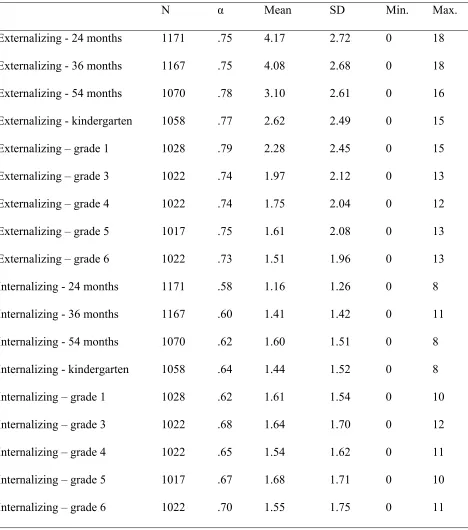
Table 1. Means, Standard Deviations (SD), Ranges, and Internal Reliabilities for
Externalizing and Internalizing Problems……...………... 40
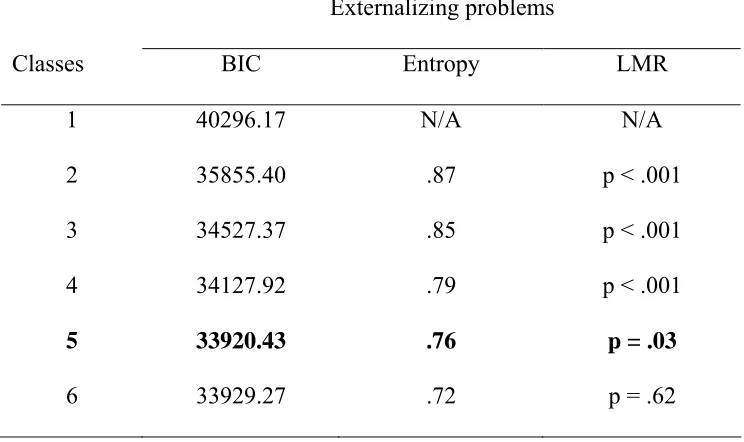
Table 2. Model Fit Statistics for Externalizing Problems……… 42
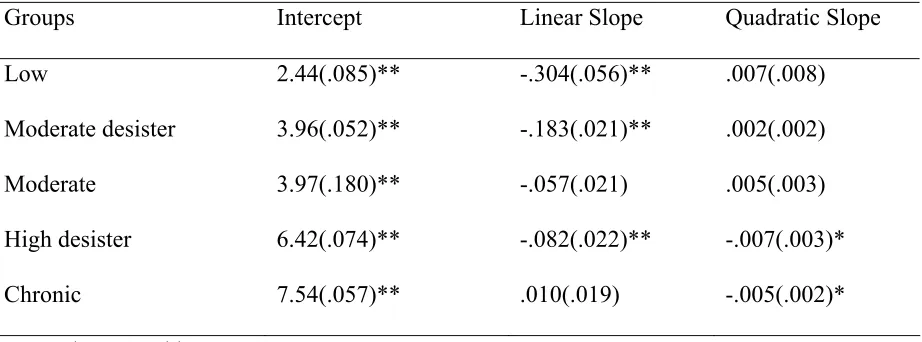
Table 3. Unstandardized Growth Factor Parameter Estimates and Standard Errors
(SE) for Externalizing Problems……… 44
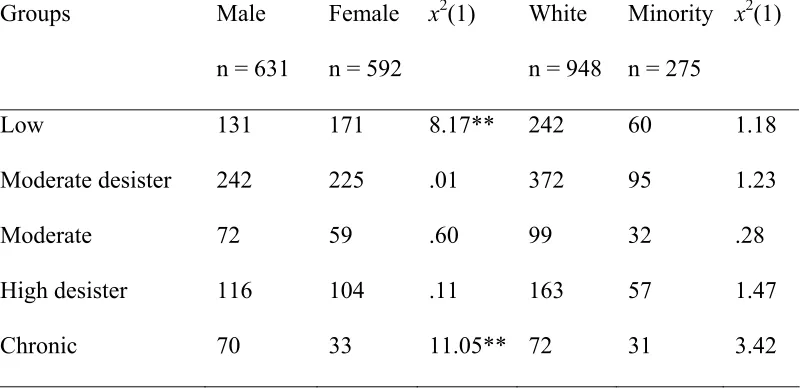
Table 4. Group break down by Gender and Ethnicity for Externalizing Problems …… 45
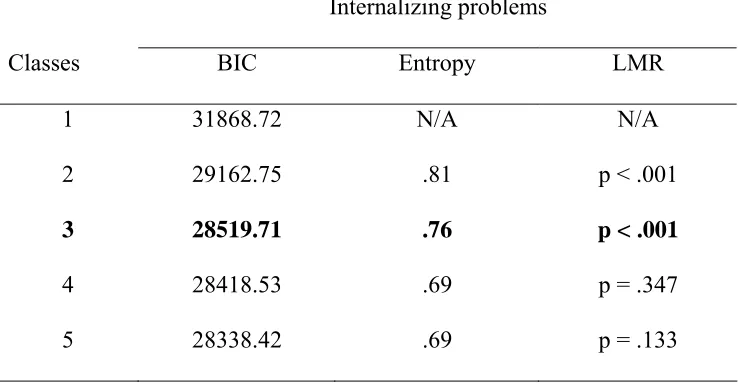
Table 5. Model Fit Statistics for Internalizing Problems………. 47
Table 6. Unstandardized Growth Factor Parameter Estimates and Standard Errors
(SE) for Internalizing Problems………. 48
Table 7. Group Break Down by Gender and Ethnicity for Internalizing Problems…… 49
Table 8. Initial group Probabilities of Pure and Co-occurring Problems (N = 1223)... 51
Table 9. Final Probabilities of Pure and Co-occurring Problems (N = 1223)…..……... 51
Table 10. Group Break Down by Gender and Ethnicity for the Final Groups...……… 54
Table 11. Means and Standard Deviations (SD) of the Study’s Variables……… 55
Table 12. Means and 95% Confidence Intervals (CI) for Antecedents Based on the
Final Groups (N=1223)...……… 56
Table 13. Multinomial Logistic Regression Analyses Comparing the Higher Risk
Groups to the Low-normative Group in terms of Antecedents (N=1223).…… 57
Table 14. Means (CI) for Outcomes Based on the Final Groups (N=1223)…………..… 61
Table 15. ANCOVA analyses Comparing the Higher Risk Groups to the
viii
List of Figures
Figure 1. LCGA analysis………...………... 32
Figure 2. Joint occurrence analysis………...……… 37
Figure 3. Quadratic growth model for externalizing problems ……… 41
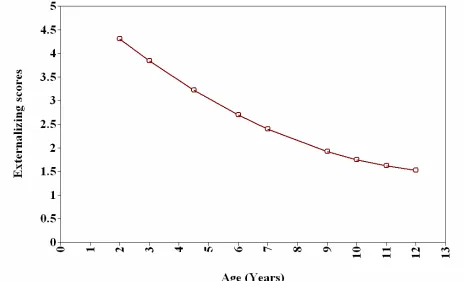
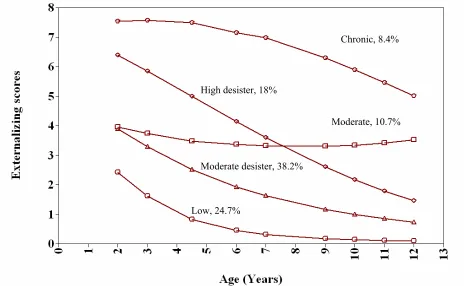
Figure 4. Final LCGA model for externalizing problems……….…… 43
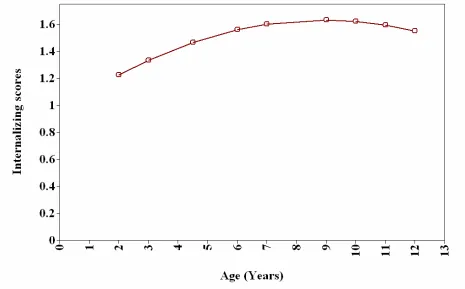
Figure 5. Quadratic growth model for internalizing problems.………. 46
Chapter 1 - Introduction
The development of internalizing and externalizing problems is of key interest to
psychologists and psychiatrists because these symptoms detrimentally affect a considerable
number of children, adolescents, and adults (Anderson, Williams, McGee, & Silva 1987; Caspi,
Moffitt, Newman & Silva, 1998; Gilliom & Shaw, 2004). Internalizing problems are
intrapersonal in nature and appear in the form of withdrawal, anxiety, fearfulness, and
depression, whereas externalizing problems are interpersonal in nature and take the form of
hyperactivity, aggression, defiance, and destructive behavior (Achenbach, 1991-1992; Campbell,
1995). Internalizing and externalizing symptoms may develop as early as the second year of life
(Gilliom & Shaw, 2004). Once established, as early as childhood, these symptoms tend to be
stable across development placing the individual in a developmental pathway of academic
difficulties, peer problems, negative interactions with parents, delinquency and other negative
outcomes (Coie & Dodge, 1998; Fergusson, Lynksey, & Horwood, 1996; Keiley, Lofthouse,
Bates, Dodge, & Pettit, 2003; Kovacs & Devline, 1998; Parker & Asher, 1987; Youngstrom,
Findling, & Calabrese, 2003). Furthermore, early emotional and behavioral problems have been
found to precede child, adolescent, and adult psychopathology, and therefore it is of great
importance to identify children at risk for high and continuous internalizing and externalizing
problems early in development (Caspi et al., 1998; Gilliom & Shaw, 2004; Moffitt, 1993).
A question that remains unanswered in the literature is how and why internalizing and
externalizing problems, two disorders from different diagnostic classes representing separate
forms of psychopathology, co-occur in children (Oland & Shaw, 2005). According to previous
research, internalizing and externalizing problems tend to be comorbid at different ages in
behaviors and emotions (Achenbach, 1993; Angold, Costello, & Erkanli, 1999; Caron & Rutter,
1991; Gilliom & Shaw, 2004; Keiley et al., 2000; Lilienfeld, 2003; Youngstrom, Findling, &
Calabrese, 2003). Thus, an appreciation of the concept of co-occurrence is essential for
explaining the development and taxonomy of internalizing and externalizing psychopathology,
and for understanding the etiology and course of these symptoms (Achenbach, 1990; Angold &
Costello, 1993; Caron & Rutter, 1991; Hinshaw, 2002; Lilienfeld, 2003; Loeber & Keenan,
1994; Rutter, 1997).
The present study addresses the co-occurrence question by investigating how individual
children deviate from normal development and follow trajectories of pure or co-occurring
internalizing and externalizing problems. Furthermore, to understand the expression of pure or
co-occurring internalizing and externalizing problems during adolescence, this study examines
how the differential trajectories of behavioral and emotional problems are related to early
adolescent outcomes, such as delinquency and behaviors with peers. In addition, to understand
the processes associated with the different subgroups of individuals, the current study examines
how antecedents, including child, family, and environmental and medical risk factors, forecast
the development of pure or co-occurring trajectories of behavioral and emotional problems.
The theoretical and methodological approach used by the current study to examine
co-occurrence will be discussed first. Information will then be provided on the development of
internalizing and externalizing problems because it is essential to understand the development of
these symptoms separately in order to better understand their development. Finally, the
Theoretical and methodological approach
The present study investigates the development of internalizing and externalizing
problems from infancy to early adolescence using developmental psychopathology as a
conceptual framework (Cicchetti, 1984; Kuperminc, & Brookmeyer, 2006; Moffitt, 1993; Rutter
& Sroufe, 2000; Sroufe & Rutter, 1984). This approach combines questions about developmental
change and psychopathology, and therefore integrates research and theories from developmental
psychology, such as the methods and approaches used by developmental psychologists to
investigate longitudinal change, and research and theories from psychiatry or clinical
psychology, such as the classification system used by psychiatrists to identify individual
differences in psychopathology (Rutter & Sroufe, 2000; Sroufe & Rutter, 1984). In addition,
central to the developmental psychopathology approach is the belief that the study of
psychopathology can inform our understanding of normal development and, conversely, that the
study of normative development may shed light on the etiology and course of psychopathology
(Cicchetti, 1984).
According to Rutter and Sroufe (2000) there are three key issues in developmental
psychopathology. The first key issue is the understanding of causal processes and the realization
that most mental disorders arenot due to single linear causes, but to thecomplex interplay of
multiple genetic and environmental risk and protective factors. Furthermore, based on the same
key issue, it is important to take into account individual differences when investigating how
causal processes affect the course of disordered behavior. The second key issue is the
investigation of processes and mechanisms of development, taking into account that the
mechanisms of causation may involve dynamic processes over time,with several routes to the
and psychopathological development, taking into account variations and individual differences in
normative and psychopathological outcomes. Therefore, developmental psychopathology is
concerned with individual differences in the origins, course, and outcomes of normative and
psychopathological developmental processes (Cicchetti, 1984; Hinshaw, 2002; Kuperminc, &
Brookmeyer, 2006; Sroufe, 1997; Sroufe & Rutter, 1984).
Even though the developmental psychopathology approach has advanced the
understanding of the development of maladaptive and adaptive behaviors, one of the remaining
major research challenges is the idea of occurrence (Rutter & Sroufe, 2000). Findings on
co-occurrence are important for developmental psychopathology because these findings can have
implications for the validity of classification systems and treatment (Angold & Costello, 1993;
Keiley et al., 2003; Rutter & Sroufe, 2000). Furthermore, findings on factors related to
co-occurrence can have implications for etiological theories, since risk factors associated with one
disorder might in fact be risk factors for another disorder (Angold & Costello, 1993; Rutter &
Sroufe, 2000).
One of the main reasons behind the limited understanding of co-occurrence is the
unavailability of appropriate analytic methods. Based on the previous key issues (Rutter &
Sroufe, 2000), to investigate co-occurrence within the developmental psychopathology tradition,
analytic methods need to be able to (1) take into account individual differences and possibly
identify different classes of children exhibiting either pure or co-occurring psychopathology, (2)
investigate both normative and pathological development to understand the link between them,
(3) investigate the course of co-occurrence within a dynamic framework by taking trajectories of
change into account, and (4) consider the origins and outcomes of co-occurrence. A new analytic
known by some researchers as Latent Class Growth Analysis (Muthén, 2000; Muthén & Muthén,
2006), and by others as the semiparametric group based trajectory approach (Nagin, 1999; Nagin
& Tremblay, 2001). Because this approach investigates heterogeneity in terms of latent classes, it
will be referred to as Latent Class Growth Analysis (LCGA).
LCGA can identify heterogeneous trajectories representing latent classes of children by
modeling a mixture of distinct multivariate normal distributions. Children within each class have
similar growth curve patterns. Therefore, this statistical model allows for the identification of
different subgroups of individuals who show homogeneous developmental trajectories of the
target behavior (Muthén & Muthén, 2006; Nagin, & Land, 1993). Furthermore, this approach can
relate the entire longitudinal course of two behaviors, and therefore provides the capacity for the
joint estimation of trajectory models across the entire period of observation (Muthén, 2000;
Nagin & Tremblay, 2001).
Hence, LCGA first identifies heterogeneous classes within each behavior of interest
based on their distinct developmental courses and then joins these differential trajectories to
investigate co-occurrence. Therefore, the first step is the identification of different latent classes
for externalizing and internalizing problems, and the second step is to determine which groups of
individuals follow trajectories of normative, pure, or co-occurring internalizing and externalizing
problems. In addition, identifying heterogeneous classes of individuals is important for the
investigation of antecedents and outcomes (Muthén, 2007). Therefore, after the identification of
the different latent classes, individual, familial, medical, and environmental antecedents during
the first two years of life will be investigated to identify possible factors that might place
problems. In addition, delinquent and peer behavior outcomes at age 12 will be included in the
analyses to identify the higher risk groups in terms of early adolescent negative outcomes.
Development of externalizing problems
Before investigating the joint occurrence of internalizing and externalizing problems, it is
important to understand the development of the two separately. Externalizing problems appear
early in development in the form of physical aggression, temper tantrums, defiant, irritable, and
argumentative behaviors, and these behaviors increase in intensity during the second year of life
(Campbell, 1995; Caplan, Vespo, Pedersen, & Hay, 1991; Tremblay, 2000). Physical aggression
and other externalizing behaviors are often used by toddlers to solve conflicts with peers or
playmates, and with the development of cognitive abilities and the skills to regulate emotions,
externalizing problems decrease and diminish over the course of development (Bakeman &
Brownlee, 1982; Cote, Tremblay, Nagin, Zoccolillo, & Vitaro, 2002; Loeber, Tremblay, Gargon,
& Charlebois, 1989; Tremblay, 2000). According to the normative development of externalizing
problems, by school entry most children are prosocial and cooperative (Tremblay, 2000).
During the first years of life there are very few gender differences in the rates of
behavioral problems (Keenan & Shaw, 1997; Prior, Smart, Sanson, & Oberklaid, 1993). Hitting,
biting, and temper tantrums during toddlerhood decrease in frequency after the second year of
life for both boys and girls (Park & Slabby, 1983). Furthermore, girls outgrow their tendency to
exhibit oppositional and aggressive behavior earlier than boys (Richman, Stevenson, & Graham,
1982), and by about 4 to 5 years of age, gender differences in externalizing problems emerge
with boys engaging in more aggressive acts and being more impulsive and proactive (Maccoby
& Jacklin, 1980; Smith & Green, 1974). This change in externalizing problems severity has been
During school entry, boys externalizing problems are 10 times higher for those of girls (Offord,
Boyle, & Racine, 1991).
Even though the majority of children follow the normative development of externalizing
problems, there is a subgroup of individuals who do not outgrow the temper tantrums and the
defiant, irritable and argumentative behavior that characterizes the second year of life, and
exhibit chronic externalizing problems (Lahey, Waldman, & McBurnett, 1999; Loeber,
Tremblay, Gargon, & Charlebois, 1989; Moffitt, 1993; Patterson, 1995). This group of
individuals was identified using samples of boys and has been called the life-course persistent
group (Moffitt, 1993; Patterson, 1982). Boys who follow a life-course persistent trajectory of
externalizing problems account for only 5 to 7% of the population, but they might be responsible
for the majority of crimes committed (Moffitt, 1993; Patterson, 1982).
In addition, studies using the LCGA method to investigate heterogeneity in the course of
externalizing problems identified more than two groups of individuals exhibiting chronic,
moderate desisting, high desisting, and low externalizing problem trajectories, and those
differences have been found as early as the second year of life for both boys and girls (Broidy et
al., 2003; Loeber & Hay, 1997; Nagin, Farrington, & Moffitt, 1995; Nagin & Tremblay, 1999;
NICHD Early Child Care Research Network, 2004; Tremblay et al., 1999; Shaw et al., 2003).
The majority of these studies suggest that there is a group of individuals exhibiting low levels of
externalizing problems early in development that declines over time, which is consistent with the
normative development of externalizing problems. These studies further suggest that most of the
children with moderate or high scores early in development exhibit decreases in externalizing
problems after the preschool years. Moreover, a small group of individuals who exhibit chronic
1993; Nagin & Tremblay, 1999). The chronic externalizing problem group represents a minority
of the population and follows a high and consistent trajectory of aggression and conduct
problems (Broidy et al., 2003; NICHD Early Child Care Research Network, 2004; Shaw et al.,
2003). Therefore, the chronic group identified by studies with the use of LCGA might be the
same group as the life course persistent group identified by Moffitt (1993) and Patterson (1982).
In terms of gender, research suggests that the developmental course of externalizing
problems is similar for boys and girls (NICHD Early Child Care Research Network, 2004).
However, girls have been found to exhibit lower mean levels of physical aggression, and girls in
the chronic aggression group scored lower than boys in the chronic aggression group (Broidy et
al., 2003).
Antecedents influencing the development of externalizing problems
Researchers are increasingly focusing on the development of chronically aggressive
individuals and trying to understand why some people become more violent compared to the
majority of the population (Coie & Dodge, 1998). The life course persistent group was found to
be affected by prenatal and perinatal medical risks, and those problems were found to be related
to infant neuropsychological risk (Brennan, Hall, Bor, Najman, & Williams, 2003; Day,
Richardson, Goldschmidt, & Cornelius, 2000; Moffitt, 1993; Overpeck & Moss 1991).
Neuropsychological deficits can then impair the child’s cognitive abilities and can also result in a
difficult temperament, and early deficiencies in cognitive functioning and difficult temperament
can set an individual to a pathway of exhibiting chronic externalizing problems (Bates, Pettit,
Dodge, & Ridge, 1998; Fergusson, Lynksey, & Horwood, 1996; Lynam, Moffitt, &
In addition, the familial context into which a child is born is just as important as the
child’s temperamental and cognitive characteristics. Socioeconomic status, parental education,
and parental marital status at birth were found to be amongst the strongest predictors of later
externalizing problems (Ackerman, D’Eramo, Umylny, Schultz, & Izard, 2001; Bradley &
Corwyn, 2002). Furthermore, longitudinal studies provided evidence that children at risk for
developing early chronic externalizing problems are at higher risk for being born into family
adversity, such as negative, low warmth, and hostile parenting (Belsky, Hsieh, & Crnic, 1998;
Campbell, Pierce, Belsky, Woodworth, & Crnic, 1996; Moffitt, 1993; Shaw, Owens, Vondra,
Keenan, & Winslow, 1996; Spieker, Larson, Lewis, Keller, & Gilchrist, 1999). Moreover, the
additive effects of both negative temperamental characteristics and negative parenting were
found to maintain and exacerbate externalizing problems (Dodge & Pettit, 2003; Lahey et al.,
1999; Moffitt, 1993; Patterson, Capaldi, & Bank, 1991; Patterson, Reid, & Dishion, 1992).
Outcomes associated with the development of externalizing problems
As mentioned, chronically aggressive individuals are highly delinquent and commit the
majority of crimes in society (Moffitt, 1993; Patterson, 1982). Studies using the LCGA method
have linked the severity of aggression to higher levels of delinquency during adolescence with
the chronic group being the more delinquent (Broidy et al., 2003; Nagin & Tremblay, 1999).
Individuals exhibiting high rates of externalizing problems also tend to affiliate with delinquent
peers during adolescence, which might contribute to their risky behaviors (Cairns, Cairns,
Neckerman, Gest, & Gariepy, 1988; Dishion, Andrews, & Crosby, 1995; Fergusson, Lynksey, &
Horwood, 1996). In addition, highly aggressive children cannot establish positive relationships
exhibiting high externalizing problems are usually rejected by their peers (Moffitt, 1993;
Patterson, 1982; Coie, Lochman, Teery, & Hyman, 1992).
Development of internalizing problems
Between ages 1 and 2 internalizing problems appear in the form of withdrawal, anxiety,
and sad affect (Campbell, 1995). Internalizing problems gradually increase after the age of two
and remain relatively common across the life span (Cantwell & Baker, 1989; Kaslow, Brown, &
Mee, 1994; Vasey, Crnic, & Carter, 1994). Improvements in cognitive abilities enable the child
to self-reflect and to remember and anticipate negative or depressive events. Because of this,
cognitive maturation has been related to normative increases in internalizing problems (Kaslow,
Brown, & Mee, 1994; Kovacs & Devline, 1998; Vasey, Crnic, & Carter, 1994). During the first
years of life there are few gender differences in the rates of emotional problems (Keenan &
Shaw, 1997; Offord et al., 1991; Prior, Smart, Sanson, & Oberklaid, 1993). However, during the
transition to adolescence, girls show more severe and increase rates of internalizing problems
compared to boys (Angold & Rutter, 1992; Angold, Erkanli, Silberg, Eaves, & Costello, 2002;
Keiley et al., 2003). Furthermore, girls are twice as likely to exhibit anxiety and depression
during adolescence (Youngstrom et al., 2003).
Similar to the chronic externalizing group, a high risk group that exhibits internalizing
problems early in development has been identified, and epidemiological studies suggest
prevalence rates of 4 to 5% for this group during childhood (Harrington, 1994; Rutter, 1986) and
5 to 22% during adolescence (Brooks-Gunn & Petersen, 1991; Verhulst, 1995). Moreover,
evidence suggests that there is a group of children exhibiting high internalizing problems
continuously from childhood to adolescence (Duggal, Carlson, Sroufe, & Egeland, 2001).
development of internalizing problems early in life (Keiley et al., 2000), and no previous study
has used the LCGA method to investigate the development of internalizing problems.
Antecedents influencing the development of internalizing problems
Environmental risk factors, such as low familial socio-economic status, have been shown
to be associated with increased levels of internalizing symptoms (McLeod & Shanahan, 1996).
Furthermore, exposure to a negative familial context has been associated to a higher risk for
exhibiting continuing internalizing problems across development (Duggal, Carlson, Sroufe, &
Egeland, 2001). Additionally, as with the development of externalizing problems, negative
cognitive processes, irritability and difficult temperament have been found to be related to the
development of internalizing problems (Bates et al., 1998; Cicchetti & Toth, 1998; McCauley,
Mitchell, Burke, & Moss, 1988; Rothbart & Bates, 1998; Rubin & Mills, 1991; Turner & Cole,
1994), and the additive effects of temperamental difficulties and unsupportive caregiver
environment were found to be the most influential for high rates of internalizing problems
(Cicchetti & Toth, 1998; Rubin & Mills, 1991).
Outcomes associated with the development of internalizing problems
Individuals exhibiting internalizing problems are often unable to form good peer
relationships and they usually act negatively with peers (Hogue & Steinberg, 1995; Oland &
Shaw, 2005). Furthermore, children and adolescents exhibiting high internalizing problems
remain distant from peers and are more likely to engage in isolative behaviors and social
withdrawal (Coie & Dodge, 1998). Because of these isolated behaviors, children who exhibit
internalizing problems do not affiliate with delinquent peers, and therefore they are at lower risk
for exhibiting risky behaviors (Oland & Shaw, 2005). This finding lead researchers to suggest
factor against later externalizing problems, for being affiliated with delinquent peers, and for
engaging in risky behaviors (Fite, Colder, & O’ Connor, 2006; Ialongo et al., 1996).
Co-occurrence between externalizing and internalizing problems
It has been noted that different psychopathological syndromes tend to be positively
correlated with one another, and individuals who are high in one syndrome tend to score at
average or high levels in other symptoms as well (e.g. Achenbach, Conners, Quay, Verhulst, &
Howell, 1989). These findings suggest that comorbidity between different syndromes is highly
probable. Furthermore, epidemiological studies provided evidence that internalizing and
externalizing problems tend to co-occur at different ages in development (Achenbach, 1993;
Angold, Costello, & Erkanli, 1999; Caron & Rutter, 1991; Gilliom & Shaw, 2004; Keiley et al.,
2000; Lilienfeld, 2003; Youngstrom, Findling, & Calabrese, 2003). In addition, studies using
latent growth modeling suggest that individuals who score continually high or increase over time
in either internalizing or externalizing problems also tend to remain elevated or to increase in the
other domain (Gilliom & Shaw, 2004; Keiley et al., 2000). This finding indicates that there is
possibly a group of individuals who score continually high on both internalizing and
externalizing problems.
Furthermore, in trying to explain co-occurrence, it has been proposed that co-occurring
psychopathology might represent distinct, meaningful syndromes, and that co-occurrence can be
regarded as a single diagnostic entity (Angold & Costello, 1992; Lilienfeld, 2003; O’Connor et
al., 1998). In support of this idea, evidence of the existence of pure internalizing and
externalizing problems and co-occurring internalizing and externalizing problems has been
provided by previous research using confirmatory factor analysis (Keiley et al., 2003; Reitz,
Youngstrom, Findling, & Calabrese, 2003). Based on these findings, the present study expects to
identify children at risk for pure externalizing problems, pure internalizing problems, and
co-occurring internalizing and externalizing problems.
Additionally, it is possible that one disorder increases the risk for the other, and therefore
internalizing disorders might play a causal role in the development of externalizing disorders,
and externalizing disorders in the development of internalizing disorders (Lilienfeld, 2003). For
example, externalizing problems might result in social failures, such as peer rejection, which
might result in the expression of co-occurring internalizing problems (Frick, Lilienfeld, Ellis,
Loney, & Silverthorn, 1999; Keiley et al., 2003; Patterson & Stoolmiller, 1991). Furthermore,
feelings of personal distress, which are related to internalizing problems, may result in the
expression of co-occurring externalizing problems (Lemerise & Arsenio, 2000). Therefore, the
co-occurrence between internalizing and externalizing problems may result from a cycle of
reciprocal causation between these problems (Lilienfeld, 2003; Oland & Shaw, 2005).
Antecedents and co-occurrence
Even though co-occurrence can be thought of as a distinct syndrome, shared
environmental, individual, and genetic risk factors have been proposed to account for the
presence of co-occurring disorders (Angold & Costello, 1993; Klein & Riso, 1993; Lilienfeld,
2003; O’Connor et al., 1998). Therefore, internalizing and externalizing disorders may be due to
the same underlying causal factors, and these common features can distinguish children
exhibiting internalizing and externalizing disorders from children exhibiting normative levels of
these disorders (Klein & Riso, 1993; Lilienfeld, 2003; Rutter, 1997). Furthermore, these
common features could also account for co-occurring internalizing and externalizing problems
factors compared to pure internalizing or externalizing problems (Ge, Best, Conger, & Simons,
1996; Keiley et al., 2003; Klein & Riso, 1993; Lilienfeld, 2003; Rutter, 1997).
As shown in the previous sections, both internalizing and externalizing problems are
affected by the family’s socio-economic status, difficult temperament, negative parenting, and
cognitive deficiencies, and therefore these factors represent common features characterizing both
internalizing and externalizing problems. These common variables could account for the
co-occurrence between the two symptoms, with the co-co-occurrence between internalizing and
externalizing problems being represented by these overlapping risk factors and causal processes
(Klein & Riso, 1993; Rutter, 1997). Research that tested this claim found that pure and
co-occurring internalizing and externalizing problems are affected by similar developmental
processes, although children with co-occurring internalizing and externalizing problems were
found to differ from pure internalizing and externalizing problems in that they experienced the
highest level of risk factors (Epkins, 2000; Ge, Best, Conger, & Simons, 1996; Keiley et al.,
2003; Lilienfeld, 2003; Milan, Pinderhughes, & The Conduct Problems Prevention Research
Group, 2006; Renouf, Kovacs, & Mukerji, 1997). More specifically, longitudinal studies suggest
that children with co-occurring compared to pure internalizing and externalizing problems
experience more disadvantaged familial environment in terms of socio-economic-status (SES),
have higher levels of difficult temperament, and experience higher levels of negative parenting,
such as harsh discipline, hostility, and low warmth and nurturing parenting (Keiley et al., 2003;
Ge et al., 1996).
Outcomes and co-occurrence
In terms of outcomes, previous research has suggested that co-occurrence may be related
more functionally impaired and have more maladaptive developmental outcomes compared to
cases with pure internalizing or externalizing problems (Kovacs, 1997; Nottleman & Jensen,
1995; Oland & Shaw, 2005). More specifically, children with co-occurring internalizing and
externalizing problems were found to face more negative developmental outcomes,in terms of
peer relationships and delinquency, when compared to children with pure externalizing or
internalizing problems (Loeber & Keenan, 1994; Miller-Johnson, Lochman, Coie, Terry, &
Hyman, 1998; Newman, Moffitt, Caspi, & Silva, 1998; Oland & Shaw, 2005; Rudolph,
Hammen, & Burge, 1994). Furthermore, adolescents with co-occurring internalizing and
externalizing symptoms are more likely to affiliate with friends who are involved with
delinquent acts and risky behaviors (Talbott & Flemming, 2003). Therefore, children exhibiting
co-occurring internalizing and externalizing problems are expected to be at higher risk for acting
negatively with peers, engaging in risky behaviors, and having friends who engage in risky
behaviors.
Chapter 2 - Current study
The developmental psychopathology framework has been incorporated to investigate the
development of emotional and behavioral problems. This framework conceives of development
as an active dynamic process and is concerned with the time course of psychopathology for
different groups of individuals (Cicchetti, 1984; Cicchetti & Rogosch, 1996; Kuperminc &
Brookmeyer, 2006; Rutter & Sroufe, 2000; Sroufe & Rutter, 1984). Following the developmental
psychopathology perspective, the current study investigates how individual children deviate from
normal development and follow trajectories of pure internalizing problems, pure externalizing
person centered framework (Bergman & Magnusson, 1997; Hinshaw, 2002; Nagin & Tremblay,
1999, 2001; Richters, 1997).
It is imperative to initiate the investigation of the development of behavioral and
emotional problems during infancy because the identification of children at risk for high and
continuous internalizing and externalizing problems early in development is important for
determining the onset and course of psychopathology (Gilliom & Shaw, 2004; Hill, 2002;
Hinshaw, 2002; Moffitt, 1993). Additionally, the use of a person centered methodology to
investigate the differential trajectories of internalizing and externalizing problems is important
because these methods enable researchers to identify subgroups of individuals exhibiting
psychopathology (Bergman & Magnusson, 1997; Hinshaw, 2002; Nagin & Tremblay, 1999,
2001; Richters, 1997). The LCGA method estimates growth curves for each individual, and then
assigns each individual into a trajectory group (Muthen & Muthen, 2006; Nagin, 1999). In
addition, because an individual’s problem behaviors and emotions might increase or decrease
over time in a non-linear fashion and because nine data points are available in the data used for
this study, a quadratic growth curve was included (e.g. Broidy et al., 2003; Shaw et al., 2003).
Moreover, the focus is on both pure and co-occurring internalizing and externalizing
problems because the ability to identify subgroups of individuals in different trajectories of
distinct or combined internalizing and externalizing problems may lead to changes in how
childhood psychological problems are classified (Achenbach, 1993; Keiley et al., 2003; Oland &
Shaw, 2005; Sroufe, 1997). Within these groups, children exhibiting normative, pure
externalizing problems, pure internalizing problems, and chronic co-occurring problems are
expected to be identified. The identification of these groups might suggest that children in the
externalizing problems who can be differentiated based on the levels of internalizing problems
they exhibit. The same is true for the chronic internalizing problem group (Duggal, Carlson,
Sroufe, & Egeland, 2001) because findings are expected to suggest that individuals exhibiting
chronic internalizing problems can be differentiated based on the levels of externalizing
problems they exhibit. The following paragraphs present the hypotheses for the development of
internalizing and externalizing problems separately, and for the development of distinct and
combined internalizing and externalizing problems.
Hypothesis: Developmental trajectories of externalizing and internalizing problems
For both externalizing and internalizing problems, groups of children who exhibit
normative growth as well as non-normative growth are expected to be identified. The groups of
children representing the majority of the sample’s population and who also follow a course
similar to the normative growth described by previous research will be considered to belong in
low or normative risk groups (Krol, De Bruyn, & Van Den Bercken, 1995). The groups scoring
higher than the rest of the sample’s population and who also represent a minority of the sample
will be considered to be at risk groups. For both internalizing and externalizing problems the
higher risk group is expected to be the group scoring continually high on each of these
symptoms. These groups are expected to account for a minority of the sample’s population as
indicated by previous research (Duggal, Carlson, Sroufe, & Egeland, 2001; Moffitt, 1993).
Furthermore, groups exhibiting moderate levels of externalizing and internalizing problems are
expected to be identified.
Hypothesis: Co-occurring trajectories of internalizing and externalizing problems
After testing the individual trajectories of externalizing and internalizing problems, the
co-occur. A high risk group exhibiting chronic co-occurring internalizing and externalizing
problems, and high risk groups exhibiting pure externalizing and pure internalizing problems are
hypothesized to be identified. The majority of children are expected to be identified in the
low-normative internalizing and externalizing problems groups forming alow risk group. In
comparison to the higher risk groups, the low-normative group is expected to display relatively
low levels of problem behaviors and emotions across time. Additionally, groups exhibiting
moderate co-occurring problems, and pure moderate externalizing and internalizing problems are
expected to be identified.
Antecedents
Another main focus of the developmental psychopathology perspective has to do with the
origins of psychopathology (Cicchetti, 1984; Kuperminc & Brookmeyer, 2006; Rutter & Sroufe,
2000). The antecedent environmental and individual factors may help to differentiate between
normative, pure, and co-occurring internalizing and externalizing problems (Angold & Costello,
1993). Furthermore, linking antecedents to psychopathology is very important because it has the
power to inform early interventions (Keiley et al., 2000; Gilliom & Shaw, 2004).
Initially, all the high risk groups will be compared to the low-normative group
(Achenbach, Conners, Quay, Verhulst, & Howell, 1989) and specific comparisons between the
chronic co-occurring group and the pure problem groups will be conduced. Of specific interest
are the children exhibiting co-occurring chronic externalizing and internalizing problems because
these children are at higher risk for being affected by environmental and individual risk factors in
comparison to the pure problem groups (Keiley et al., 2003; Ge et al., 1996).
Previous research has suggested the importance of investigating how child characteristics
present study investigates how early difficult temperament, positive home environment, and
cognitive functioning, controlling for demographics, familial SES and prenatal and perinatal
medical problems, influence the developmental trajectories of pure and co-occurring
internalizing and externalizing problems. The early medical problems risk index and the family’s
SES risk are included as control variables. Those variables are seen as general stressors that
might place an individual in a trajectory of behavioral and emotional problems, with the more
risks being related to the chronic co-occurring problems group (Keiley et al., 2003). In addition,
gender is included as a control variable because males and females differ in the continuity and
change of behavioral and emotional problems (Broidy et al., 2003; Keenan & Shaw, 1997).
Finally, ethnicity is included as a control variable because youth from minority and majority
cultures have been found to differ in the levels of internalizing and externalizing problems they
exhibit (e.g. Dodge, Pettit & Bates, 1994; Garisson et al., 1990; Kuperminc, Blatt, Shahar,
Henrich, and Leadbeater, 2004; Nottleman & Jensen, 1995).
Hypotheses:
Studies have linked early temperament, cognitive abilities, and the familial environment
created by caregivers to pure and co-occurring internalizing and externalizing problems (Epkins,
2000; Ge, Best, Conger, & Simons, 1996; Keiley et al., 2003; Lilienfeld, 2003; Milan et al.,
2006; Renouf, Kovacs, & Mukerji, 1997). Early severe deficiencies in cognitive functioning,
difficult temperament, and negative familial environment are expected to set a child on the
course of a pathway exhibiting chronic externalizing and internalizing problems from infancy up
to early adolescence. Children in the pure internalizing and externalizing groups are expected to
experience milder forms of negative familial environment, cognitive dysfunction, and difficult
membership in the pure externalizing group compared to the pure internalizing group (Rothbard
& Bates, 1998). In addition, it is hypothesized that children who score low on difficult
temperament, who come from a positive family environment, and who have normal cognitive
functioning will belong in the low-normative trajectory group.
Early adolescence outcomes
Finally, the investigation proceeded to analyze how the differential trajectory groups are
related to children’s behaviors with peers and delinquency during early adolescence. According
to the developmental psychopathology approach, following a course of negative developmental
pathways, such as chronic internalizing and externalizing problems, can be associated with an
increased likelihood of later failures (Sroufe, 1997). Of specific interest are the individuals
exhibiting co-occurring chronic externalizing and chronic internalizing problems because these
children are more prone to maladjustment, such as delinquency and negative behaviors with
peers (Oland & Shaw, 2005).
Hypotheses:
Membership in the different pure or co-occurring classes is expected to have different
early adolescent consequences. Children in the chronic co-occurring group compared to children
in the pure behavioral and emotional problem groups are expected to show more negative peer
behaviors, to be more delinquent during early adolescence, and to socialize with more deviant
peers (Kovacs, 1997; Nottleman & Jensen, 1995; Oland & Shaw, 2005). Therefore, the severity
of early adolescence outcomes can also distinguish between children who follow trajectories of
co-occurring internalizing and externalizing problems from those who follow trajectories of pure
externalizing and internalizing problems. Furthermore, if the hypotheses are supported, the
precursor of the most serious delinquency during adolescence and of exhibiting the worse
problem behaviors with peers. In addition, children in the pure externalizing problems group are
expected to be more at risk to exhibit early adolescence delinquency and to be associated with
deviant peers compared to the pure internalizing problems group. Finally, the normative groups
are expected to be the least delinquent and to engage in positive behaviors with peers.
In sum, children representing the minority of the sample are expected to be identified in
the high risk groups, including the co-occurring problems group, the pure internalizing group,
and the pure externalizing group. Children representing the majority of the sample are expected
to be identified in the low-normative problem groups. The identification of these subgroups of
individuals in different trajectories of distinct or combined internalizing and externalizing
problems may have important implications for the taxonomy of problem behaviors and emotions
(Achenbach, 1993; Keiley et al., 2003; Oland & Shaw, 2005; Rutter, 1997; Sroufe, 1997).
Furthermore, the findings may relate the severity of individual and familial antecedent factors to
individuals who are at higher or lower risk for exhibiting pure or co-occurring problem behaviors
and emotions. Finally, the investigation expects to identify outcomes that might characterize
individuals who follow chronic or moderate levels of problem behaviors and emotions.
Chapter 3 - Methods
Participants
The present study used data from the NICHD Study of Early Child-Care. Participants
were recruited from different hospitals across10 locations in the United States. A total of 8,986
women gave birth during the sampling period (January of 1991 and November of 1991) across
the different locations, and 60% (5,416) of those women agreed to be conducted for a telephone
conditional random sampling. The conditional random sampling procedure was used to assure
that the sample was representative of single mothers, ethnic minority, and low maternal
education. From this sample participants were excluded if (a) mothers were younger than 18 at
the time of the child’s birth, (b) families were planning to move before the completion of the
study, (c) children were born with disabilities or remained in the hospital more than seven days
postpartum, and (d) mothers could not communicate sufficiently in English (http://secc.rti.org).
Because of these criteria the NICHD sample might represent a lower risk group. However,
participants were recruited to ensure demographic diversity in terms of financial status, ethnicity,
maternal education, and maternal marital status. 1,525 families were selected as eligible, but only
1,364 completed the home interview when the infant was 1 month old, and these families
comprised the final sample of the study. Therefore, 161 families from the original sample did not
participate in the study. The study’s final sample was diverse in terms of gender (53% male),
minorities (24% were minorities), maternal education (11% of the mothers had not completed
high school), and marital status (14% were single). The average family income was 3.6 times the
poverty threshold. The final sample was similar to the original sample (1,525) in terms of
maternal education, percentage in different ethnic groups, and presence of a husband/partner in
the household (NICHD Early Child Care Research Network, 2004).
The trajectory analyses for the current study were based on 1232 children (52% male)
whose mothers completed the Child Behavior Check List (CBCL) at least two times out of nine.
The sample used for the current study was diverse in terms of ethnicity, 77.5% were White, 6%
were of Hispanic descent, 11.7% were African American, 1.3% were Asian, and 3.5%
represented other minority groups. A dichotomous variable representing the majority group
variable. Moreover, 70% of the sample’s population reported that their income was above the
poverty threshold with a mean annual income of $67,310; 20.4% scored below the poverty
threshold at some point during data collection but not continuously with a mean annual income
of $25,362; 9.6% scored below the poverty threshold continuously during data collection with a
mean annual income of $12,641. Furthermore, 10% of the mothers had not completed high
school and 21% were single.
Procedures
Data were collected from birth to age 12. The NICHD study used multiple informants,
including mothers, fathers, other caregivers, teachers, the study’s children, and the children’s
peers. Furthermore, the NICHD study used multiple methods, including observations, interviews,
and surveys. In the present study interviews with the mothers which took place during home
visits were used for information in terms of the child’s gender, ethnicity, the family’s
socio-economic-status (SES) risk index, and the medical risk index. Mother reports were used to
construct the trajectories of externalizing and internalizing problems. Antecedents were based on
interviews, assessments, self-reports, and observations. Early adolescent outcomes were based
on questionnaires completed by teachers, mothers, the study’s children, and friends of the study’s
children. Additional details on the procedures for data collection and instruments used are
documented in the NICHD Study of Early Child-Care Manuals of Operation (http://secc.rti.org).
Measures
Mother’s ratings of externalizing and internalizing problems. Mothers rated participants’
externalizing and internalizing problems at 2, 3, 4.5, 6, 7, 9, 10, 11, and 12 years of age with the
Child Behavior Checklist (CBCL; Achenbach, 1991a, 1992). The child’s age was chosen as the
example, the CBCL data were collected from all children when the children were exactly 24
months of age. There are two versions of the CBCL: the preschool version for children ages 2-3
which includes 99 items and the school-age version for children ages 4-18 which includes 113
items. Both versions measure internalizing and externalizing problems, although some items
vary to capture developmental changes. For the present study items that appear on both versions
of the CBCL were used to maximize comparability over time, following previous research
(Gilliom & Shaw, 2004). Nine items were used to measure externalizing problems (“Can’t sit
still, restless, or hyperactive,” “Cruel to animals,” “Destroys his own things,” “Destroys things
belonging to his family or others,” “Disobedient,” “Doesn’t seem to feel guilty after
misbehaving,” “Gets in many fights,” “Physically attacks people,” and “Temper tantrums or hot
tempered”). Six items were used to measure internalizing problems (“Too fearful or anxious,”
“Self-conscious or easily embarrassed,” “Shy or timid,” “Unhappy, sad, or depressed,”
“Withdrawn, doesn’t get involved with others,” and “Worries”). Mothers rated how descriptive
each item was of the child’s usual behavior now or within the past 6 months on a three-point
scale (0 = not true, 1 = somewhat or sometimes true, 2 = very true or often true), and raw sum
scores were used in the study’s analysis. The CBCL has been used extensively for research with
children and adolescents, and both externalizing and internalizing subscales have shown
adequate internal consistency and reliability. The Cronbach’s alphas for externalizing problems
ranged from .73 to .79, and for internalizing problems from .58 to .70 for the current study.
Risk indexes
Items indicating early familial SES and medical risk were dichotomized into 0 (no risk)
items were collected before 24 months of age, and therefore they predated the measures of
externalizing and internalizing problems used in the trajectory analyses.
Prenatal and postnatal medical risks index. Interviews with the mother during the first
and sixth month after birth were used to establish any health problems the mother had during
pregnancy and any perinatal infant health problems during the first and sixth month of age.
Infant health problems included: ear infection, number of medical visits, injuries, and serious
illnesses or disabilities that can possibly affect the study child’s development. Furthermore,
mothers reported whether they smoked during and after pregnancy and whether they or the
infants were exposed to smoking by others (passive smoking). Smoking by the mother or others
was included as a risk factor because the respiratory health of young children is affected
adversely by exposure to environmental tobacco smoke, especially during pregnancy and the
first year of life (Overpeck & Moss 1991). A score of one was given if any perinatal or birth
complications were reported by the mother, and those scores were added to the medical risk
index. The lowest score was zero and the highest possible score was 6.
Familial SES Risk index. A socioeconomic risk index was created reflecting mothers’
reports of family finances, maternal marital status, and maternal education (Henrich,
Schwab-Stone, Fanti, Jones, & Ruchkin, 2004). According to research, these variables are each risk
factors for both internalizing and externalizing problems (e.g. Anderson et al., 1989). Mothers
reported the family’s income from the first month to 24 months, and an income-to-needs ratio
was calculated from the U.S. Census Bureau tables as the ratio of family income to the
appropriate poverty threshold for each household size and number of children under 18. The
scores were averaged from 1 to 24 months, and families below the poverty threshold received a
asked whether they were married and if/or the father was living with them in the same
household. During the same interview, mothers also reported their educational level. A score of
one was given if the mother reported a low educational level (lower than high school) or if the
mother was a single parent. The scores on the SES index ranged from 0 to 4.
Antecedents
Three antecedents were included in the present study - child temperament, child cognitive
functioning, and familial environment. All antecedents were collected before 24 months and
therefore predated the measures of externalizing and internalizing problems used in the trajectory
analyses.
Early difficult temperament. Temperamentwas assessed during the first and sixth month
of age with the Early Infant Temperament Questionnaire (EITQ; Care & McDevitt, 1978;
Medoff-Cooper, Carey & McDevitt, 1993).At the one- and six-month home visit mothers were
asked to respond to 38 items (rated on a one- to six-point scale from “almost never” to “almost
always”). All items were developmentally appropriate for young infants. The items provide
scores on five subscales: activity, adaptability, approach, mood, and intensity. Furthermore, the
combination of the items in each scale is a good representation of an overall temperament scale.
The stability from 1 to 6 months was good, r = .77, p < .001, and therefore an average difficult
temperament factor based on both assessment periods was created. The difficult temperament
scale used for the current study was the average score of all the items from the first and sixth
month collection. Internal consistency coefficients for the final difficult temperament scale was
.69.
Cognitive developmental status. The revised Bayley (BSID-II; Bayley, 1993) was
Mental Development Index (MDI) is the most widely used measure of cognitive developmental
status for children in the first two years of life. It assesses memory, learning, and problem
solving; sensory perceptual acuity and discriminations; early verbal communication; and the
ability to form generalizations and classifications. Correlation of this instrument with the
Stanford-Binet IQ at 24, 27, and 30 months is reported at .57. The overall standardized score was
based on the average of the 15 month assessment and the 24 month assessment. This variable
was used as an indicator for the child’s early cognitive functioning. The stability from 15 to 24
months was good, r = .80, p < .001.
Family environment. The quality and quantity of the social and physical resources and of
support and stimulation in the child’s home environment was assessed using the HOME
Inventory Infant/Toddler version (Bradley, Mundfrom, Whiteside, Casey, & Barrett, 1994;
Caldwell & Bradley, 1984) during 6 and 15 months. The Infant/Toddler version of the Inventory
is aimed for use during infancy (birth to age three). The HOME is a semistructured interview and
observational procedure designed to describe the stimulation and responsiveness of mothers,
their involvement with and acceptance of their children, the availability of play and learning
materials, and the organization and variety of the physical environment (Caldwell & Bradley,
1984). An example of an interview item is: the family has a fairly regular and predictable daily
schedule for the child, and an example of an observational item is: the house has at least one full
shelf of books. Each item is scored in a binary fashion (yes/no), and the information used to
score those items is obtained during the course of the home visit by means of observation and
parent semi-structured interview. The HOME provides an appraisal of the child’s overall “home
life” and higher HOME scores indicate more enriched and positive home environments. For the
period and an overall variable for the fifteenth month period. The stability from 6 to 15 months
was good, r = .72, p < .001, and therefore the 6 and 15 month overall variables were averaged to
reflect a positive home environment. The internal consistency coefficient for the final composite
scale was α = .77.
Outcome measures at Sixth grade:
Risky behavior. The Risky Behavior Protocol (Conger & Elder, 1994) questionnaire has
three sections completed by the mother, the study child, and a friend of the study’s child.
Mothers completed a 30-item questionnaire. The study’s children and their friends each
completed 38 identical items that measure: “things your friends do” (19 items), and “things you
do” (19 items). The questions ask whether the child or friend experiments with weapons,
cigarettes, alcohol, or drugs. One total risk taking score for the children was created based on the
mother reports. The child self reports and the friend reports resulted in a variable for delinquency
committed by friends and another variable for delinquency committed by the child. The
Cronbach’s alpha for the mother reported overall risk taking score was .71, for the overall risk
taking score committed by the child was .73, and for the overall risk taking score committed by
friends was .82.
Child Behavior with Peers at grade 6. The Child Behavior Scale (Ladd & Profilet, 1996;
Kochenderfer & Ladd, 1996) was used to measure the children’s peer-related behaviors and was
completed by mothers and teachers. It consists of 37 items measuring aggression, prosocial
behavior with peers, asocial behavior with peers, exclusion by peers, bullying, and victimization.
Children’s behaviors with peers were rated on a 3-point scale (0 = not true, 1 = sometimes true, 2
= often true). The two scales, used in this study based on the combined score between the mother
or rejected by peers, e.g. peers’ attempts to exclude children from participation in classroom
social activities (8 items, α = .91).
Chapter 4 – Analyses and Results
Analyses
Analyses proceeded in five stages. In the first stage, a quadratic growth curve analysis in
Mplus 4.2 (Muthén & Muthén, 2006) was conducted to investigate the average trajectories for
externalizing and internalizing problems. In the second stage, Latent Class Growth Analysis
(LCGA) in Mplus was used to identify distinct groups of individual trajectories separately for
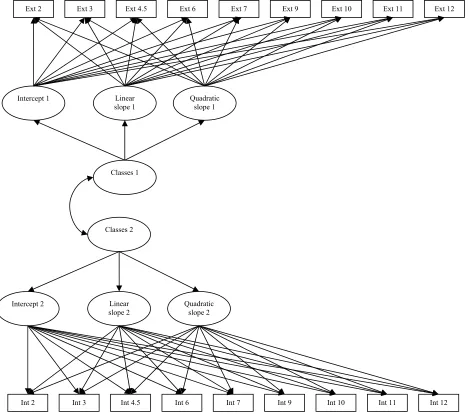
externalizing and internalizing problems. In the third stage, the joint probabilities were derived
from a mixture model including the individual trajectories derived from the LCGA analysis and
multivariate groups were identified. In the fourth stage, multinomial logistic regressions in SPSS
were performed to identify early child and family characteristics that distinguished membership
in the identified groups. In the fifth stage, Analysis of Covariance (ANCOVA) was used to
compare the different trajectory groups in terms of 6th grade outcomes.
Average trajectory of externalizing and internalizing problems over time
Single-class latent quadratic growth curve modeling was used to investigate the
normative development of internalizing and externalizing problems, and identify the average
intercept and average linear and quadratic slope for externalizing and internalizing problems.
This type of growth model uses a polynomial function to model the relationship between the
behavior under investigation and age (McArdle & Bell, 2000; Muthén, 2001; Singer & Willett,
2003). The function takes the form (Singer & Willett, 2003)
where yιtis a latent variable which characterizes the level of externalizing or internalizing
problems for participant ι at time t. As seen from the equation, the analysis is based on a
quadratic growth curve. For the present study the unit of time was years of age, following
previous studies which conducted growth analyses based on the same data (NICHD Early Child
Care Research Network, 2004). Ageιt is participant ι’s age at time t, Age2ιt is the square of
participant ι’s age at time t, and ε is a disturbance assumed to be normally distributed. The
model’s coefficients, β1, and β2, determine the average shape of the trajectory, and αo is the
intercept. For this type of analysis the intercept, linear and quadratic slope are assumed to take on
a normal distribution (Hedeker & Gibbons, 1994). The residual intercept, linear, and quadratic
slopes were also used to suggest whether there is variability in terms of the initial levels of the
variables and in terms of change over time.
Patterns of externalizing and internalizing problems over time
The development of different groups of externalizing and internalizing problems was
investigated using LCGA, which identifies heterogeneous groups by modeling a mixture of
distinct multivariate normal distributions. This approach is useful in identifying how different
groups of people who share some common characteristic develop over time. Heterogeneity of
trajectory groups is data-driven based on estimation of individual growth curves for each child.
Children within each group are assumed to be homogeneous in respect to their developmental
patterns, and within group differences are thought of as less informative than between group
differences.
Similarly to hierarchical and latent growth curve modeling, LCGA uses a polynomial
problems, and age (Nagin, 1999; Nagin & Tremblay, 1999; Kreuter & Muthén, 2006; Muthén,
2001; Roeder et al., 1999). The function takes the form (Nagin, 1999):
yιtj = βjo + βj1Ageιt + βj2Age2ιt + ε
where yιtj is a latent variable which characterizes the level of externalizing or internalizing
problems for participant ι at time t given membership in group j. Ageιt is participant ι’s age at
time t, Age2ιt is the square of participant ι’s age at time t, and ε is a disturbance assumed to be
normally distributed with zero mean and constant variance. The model’s coefficients, βjo, βj1, and
βj2, determine the shape of the trajectory. The coefficients are superscripted by j to denote that
they are not constrained to be the same across j groups and are free to vary, which allows for
cross-group differences in the shape of developmental trajectories. Therefore, the absence of
constraints captures mixtures of developmental trajectories in the population and also allows
each group’s trajectory to have a distinct shape. Furthermore, the model does not permit
individual variability in the intercepts or slopes within classes, and children within a class share a
single trajectory of change over time. Therefore, the random effects for intercept slope and
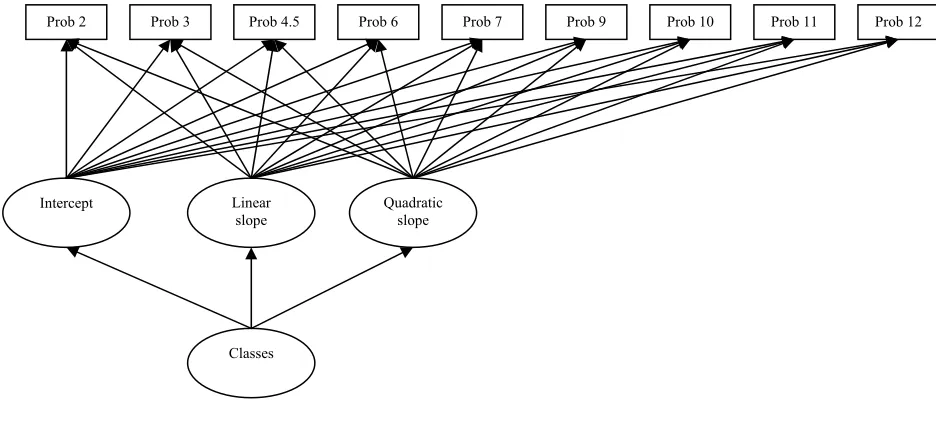
quadratic term are set to zero within class. Figure 1 is another way to demonstrate the LCGA
approach (Muthén & Muthén, 2006). The intercept, linear slope, and quadratic term are based on
the different time points of internalizing or externalizing problems. The intercept indicates the
average of the problem behavior at age 2. Furthermore, as shown in the figure the intercept,