The Impact of the Implementation of CLT On Students’
Speaking Skills
Surajwaran Mangaleswaran1, Azlina Abdul Aziz2,
1 SMK (LKTP) Jengka 2, Maran, Malaysia
2 Faculty of Education, Universiti Kebangsaan Malaysia, Bangi, Malaysia
DOI: 10.29322/IJSRP.9.04.2019.p8814
http://dx.doi.org/10.29322/IJSRP.9.04.2019.p8814
Abstract- One of the most influential theoretical developments in language teaching and learning especially among ESL students is the idea of communicative competence as it is believed to help in redefining the target of second language (L2) instruction in the classroom. Although most teachers recognise the importance of CLT, many of them do not have much confidence in practicing it effectively in the classroom. Thus, this paper attempts to identify the teachers' and students’ perceptions on the implementation of CLT in the SBELC as an effective approach to enhance students speaking skills and looking into teachers’ challenging in using CLT in the classroom. Next, this paper also aims to identify the impacts of implementation of CLT in the SBELC to enhance speaking skills among students as well as to recognise the ways of implementation of CLT to enhance students speaking skills. The role of CLT approach in enhancing the speaking skills among students was examined through quasi-experimental by collecting data using methods like interview sessions with teachers, an observation, the pre-test and post-test methods etc. The analysis and interpretations were based on learners’ pre-post English speaking test scores, speaking observation comments and feedback as well as the teachers’ and students’ opinion. The findings show a slight increase in the students overall speaking skills after CLT implementation. Teachers’ and students’ interviews find that despite vast knowledge on CLT, its implementation is disrupted due to the lack of facilities and focus on exams. Moreover, it was found that students still lack of appropriate words and grammar during the speaking practices, and the teachers’ role as the facilitator, the guide and the corrector of their weaknesses in speaking were highly recommended. The implication of these factors are implementation of CLT would be disrupted in schools to enhance speaking skills. The study recommends authorities and schools to provide enough facilities and reduce the focus on exams to elevate speaking skills.
Index Terms- Speaking Skill, CLT, Implementation, Classroom
I. INTRODUCTION
n the world, teachers’ role and responsibilities in educating students are crucially important in any schools regardless their subjects to teach. In term of teaching English as a Second Language (ESL), the roles of teachers are primarily to focus on the development and the practise of the language to improve various skills of the language. The skills are including reading and comprehension, writing, grammar, listening and speaking. The aim of the education within 21st century era is comprehensively excellent, not only in academic,
but also in other fields such as entrepreneurship, volunteer works, and fluent in communicative practice. English is one of the most important language in the world. It is considered as a universal language (BB. Bohdanska, 2012) which can be used and understood by all people around the world. The importance of English language which is being promoted by most countries in the world to bridge the gap in terms of economic and political interest has increased the awareness in educators and students. Amizura H. Mohd. Radzi et al., (2007) also stated the same view, English is an important and crucial medium of communication among people whether intra-national or international levels. It demands the related parties to master the language as soon as possible. It cannot be denied that English has become equally important in many fields apart from the education and language studies as the science, technology and business fields have started to fully utilise the medium which could increase their capacity respectively.
knew they will be fail or nearly fail to speak English well such as in remote area of Kenya (Mwamba, 2005). Similarly, Alharbi (2015) in Saudi Arabia, students there also show low oral skills of English language as it is related to the absence of authentic situation of language learning whether outside or inside the classroom. This shows that most of non-native speakers are comfortable in using their first language in the classroom rather than the second language. Thus, the objectives of the study are; to recognise the ways of implementation of CLT to enhance students speaking skills, to identify the effectiveness of implementation of CLT in the SBELC to enhance speaking skills among students, and to identify the teachers' and students’ perceptions on the implementation of CLT in the SBELC as an effective approach to enhance students speaking skills.
II. LITERATURE REVIEW 2.1 Communicative Language Teaching (CLT)
Littlewood (2007) considered Communicative Language Teaching (CLT) which has been introduced in ESL settings can reimburse the limitations of traditional language teaching. In Malaysia, the introduction of KSSM in 2012 to replace the formerly placed KBSM is a change that aims to improve the growth of students’ thinking skills up to the higher level as well as focus on acquiring the expected competencies to established standards in the curriculum, including the approach of student-centred learning such CLT (MoE 2015). It is parallel to the concept of the KSSM as cited in Saadiyah Darus (2010) that present on the stages since year 2017 and based on six main principles; communication, physical development and aesthetics, humanity, self-esteem, science and technology as well as spirituality, attitudes and values. The principles of CLT is a combination of various techniques and goals to improve students’ communicative competence. The characteristics of CLT as identified by Brown (2000) includes classroom goals which focuses on all of the components (grammatical, discourse, functional, sociolinguistic, and strategy) of communicative competence. Another principle of CLT is the fluency and accuracy which are seen as complementary principles underlying communicative techniques. And, the introduction of CLT in English language subject is believed can enhance speaking skills among students. In a TESL environment in Malaysia, it focuses on the four skills, and Communicative Language Teaching (CLT) is seen to be applicable in which students are learning to speak using English language from informal to formal context (Saadiyah Darus, 2010). All the tasks and activities in the classroom therefore have to equip students with the important and relevant skills of communication. In the classroom, the activities plus the interactions between teachers and students make the teaching and learning alive (Khoa Anh Viet, 2008).
2.2 Why Malaysian students weak in their communicative practice?
Michael Swan (2008) argued that there is no need for the mother tongue to support the foreign language, and it even can block the learning of the new language. David & Naji (2000) and David & Nambiar (2001) claims that rural students show no interest in mastering English language, so they lazy to practice it. Sarwar et al, (2014) has proven that even smart students who always achieve high scores in written examinations also were fail or nearly fail to express themselves orally in English language. Another problem is, Malaysian teachers have implemented teacher-centred educational model for decades, and some of them refuse to change the method of teaching. So, the holistic professional reform has to be applied (Don et al. 2015). English language curriculum inventors and teachers to ensure that all students achieve high level of skills and knowledge parallel to the international standards and benchmark against the Common European Framework of Reference or CEFR ((MEB, 2013) in Majdah Mahamud, 2018). Another, limited period of the lesson plus crowded classroom make students cannot practice using language effectively in the classroom (Al-Hosni 2014; Alharbi, 2015).
2.3 Ways of implementation of CLT to enhance students speaking skills.
First, pair work or group work practices. Paulston & Bruder (1976) revealed few classifications of activities which may bring the maximum benefits in students’ effort to master the communicative competence, and these categories are social formulas and dialogs, community-oriented tasks, problem-solving activities and role plays. All of them have to be done in a group or pair work. Doan Linh Chi (2011) suggested that the activities and role-plays from course books and the Internet can be used by students too. Second, there are many fun-game learning tools also, such contributed by Kayi (2006) who had listed several prevalent speaking activities and debated about their advantages, and the activities are discussions, role-play simulations, information gap, brainstorming, storytelling, interviews, story completion, reporting, playing cards, picture narrating and picture describing. Third, students also can practice speaking by formal conversation, such structured interview, for example can teach students to sitting in a question-answer experience, sharing the fact around certain topics, and exchanging tangible information. Another way, as in Tuan and Mai (2015), several activities are highlighted where to improve students’ speaking skills, such as speaking by using the target language in the classroom or outside, speak English with the classmates at home too, join speaking club activities such as drama or debate, and practice to speak in front of a mirror. Moreover, the information-gap activities, jigsaw activities, discussion and debates, communication games, and prepared talks and oral presentations are also another type of activities that are typically implemented in a CLT classroom.
This chapter present the methodology and procedures ranging from research design, the setting, population, sample and sampling procedure, instrument, procedure for data collection method and strategies, and finally techniques for the quantitative and qualitative analysis of the mix-method of collecting data.
3.2 Research Type and Approach
[image:3.612.73.542.404.503.2]This research was carried out based on quantitative and qualitative method by using a set of instruments including the quasi-experimental design of study for the students. This experiment consists of the pre-test and the post-test is used to analyse the impacts of Communicative Language Teaching. The research uses both qualitative and quantitative data analysis technique, as the “One group quasi experimental design” consist of pre and post-test is a quantitative method of the study. The research also integrates it with the qualitative approach as the students and teachers will be interviewed and observed throughout the research period when the method is being applied. The reflection of teachers after each lesson was analysed.
Table 1. The schedule for one group experimental design
“One group quasi experimental design”
Pre-Test Post-Test
- A speaking test
- Before the CLT method is applied - Time (15 minutes)
- A speaking test
- After the treatment based on CLT is carried out (after 6 weeks)
- Time (15 minutes)
3.3 Study Population
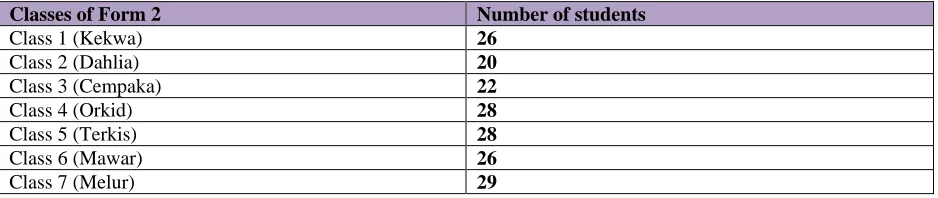
In this study, the population includes all Form 2 students of SMK Jengka 2 in academic year 2018. The form 2 students of SMK Jengka 2 in academic year 2018 consist of 7 classes. Which comprises of 865 students. The quantity of students in each class of the population is as follow:
Table 2. The quantity of students in each form 2 classes
Classes of Form 2 Number of students
Class 1 (Kekwa) 26
Class 2 (Dahlia) 20
Class 3 (Cempaka) 22
Class 4 (Orkid) 28
Class 5 (Terkis) 28
Class 6 (Mawar) 26
Class 7 (Melur) 29
3.4 Sample Size
The sample of this research includes both students and teachers. The target sample of this research study includes form 2 students from 2 Orkid and 2 Terkis in Sekolah Menengah Kebangsaan Jengka 2 which consist of a total of 56 students. The form 2 students are considered as an appropriate group to be sampled for the study because they are more motivated to speak and use the language that they are learning and they do not have any major examination which focuses more on writing skills. The sample of students are also chosen on the basis that they are the first batch students under the CEFR. Hence, teachers should be able to implement CLT approach and discover its impact on students to improve their oral performance considering the lack pressure of public exams.
English teachers at Sekolah Menengah Kebangsaan Jengka 2 were the selected sample. The study dealt with the sample of 2 teachers. They were selected on the basis that they taught the classes of the form 2 students in the school. The teachers also carried out CLT activities in classroom in relation to the KSSM curriculum. All the teachers who became the participants were chosen to collect different views about communicative language teaching if they regard it as the best method to develop students’ speaking skill. The teachers provided reflections and will be interviewed at the end of the study.
3.5 Data Collection Method
were interviewed on their opinion on Communicative Language Teaching and the learning process using the CLT method. The students were taught and the lessons were conducted by the two respective English teachers for 6 weeks with a total of 30 periods with each period lasting 30 minutes. The teachers and students were interviewed on their opinion towards Communicative Language Teaching at the end of the course. In this study, a descriptive text in the form voice recording is used. For pre-test, students were given 10 questions for the first part (part 1), and one task based on the communicative activity in the second part (part 2). Students’ answers were written and also recorded for further validation of the transcription process. The post-test consisted of exact questions and tasks as in the pre-test for students to show their improvement. The observation checklist contains ‘yes’ or ‘no’ options, followed by a feedback or comments from teachers on the activities being carried out in the classroom. The interview was carried out on both the teachers and the six students who are selected randomly. There is no specific time limit for the interview and the interview for the students was in dual language (Malay) to ensure they understand the questions. The interview process was voice recorded and the answers were then translated and transcribed for further analysis.
3.6 Data Analysis
The data is analysed to fulfil the three objectives of this study. The first objective was to examine the implementation of CLT in the SBELC in enhancing students’ speaking skills. The objective was examined using the observation checklist designed for the teachers. The checklist consists of yes or no scales with a feedback column for the observer to give comments on the roles carried out by the teachers. Lesson plans are used by the teacher during the lessons. It was designed based on the current Form 2 Scheme of Work approved by the Ministry of Education. The lesson plans were used as a reference to evaluate the teachers to carry out their responsibilities in implementing CLT lessons. Teachers’ reflection in the lesson plan and the observation results were analysed qualitatively. Lesson plans of the teachers and the reflections on the lessons were collected and revised on to ensure that the activity was carried out based on the standard guidelines recommended by the Ministry of Education through the Curriculum Specification. The second objective of the study is to identify the effectiveness of the implementation of CLT in the SBELC to enhance students’ speaking skills It was analysed based on language used in speaking English effectively through communication. The score from both the pre-test and post-test on speaking skills were converted into mean scores and standard deviations. Then the mean scores and standard deviations from the tests were calculated by using a paired t-test to compare the student’s speaking ability before and after learning with communicative activities. The data was calculated by using the SPSS. Implementation of HOTS activity in the lesson anticipates the production of sentences spoken by students relating to the HOTS criteria. These sentences were analysed and categorised qualitatively into the respective HOTS elements. The HOTS elements include applying, analysing, evaluating and creating. HOTS criteria will be identified in each sentence that are spoken by the students. The speaking test which also includes HOTS elements will be analysed to see if students’ speech consists of words and phrases that elicit elements of HOTS. The elements in the speeches will be identified and classified based on the characteristics that are outlined by the SBELC. The third objective of the study is to identify the teachers’ and students’ perception on the implementation of CLT in the KSSM/SBELC as an effective approach to enhance speaking skills. An interview was carried out on the teachers and students.
IV. FINDINGS
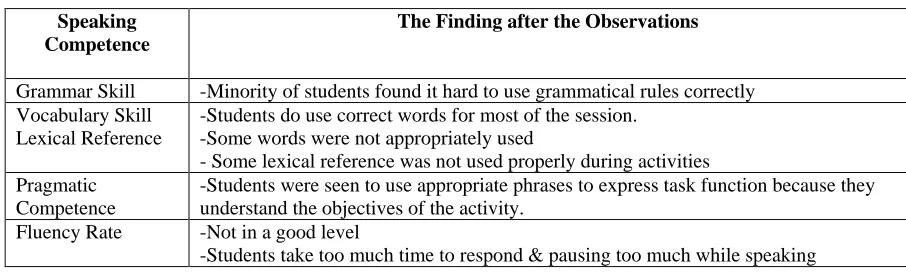
[image:4.612.78.531.587.723.2]The findings of the observation show that the teachers have provided learners with activities whether to be carried out in pair or groups, teachers provide artificial forms of sentences to assist students understand the meaning of the sentences better. Teachers were seen to not use the first language at all and strictly restricting their students from using languages other than English language. The usage of English in the classroom was carefully corrected and guided by the teacher at all time. The teacher also ensured all students participate in the activities from the minor to the major tasks. Students’ competence was showed after the observation as in Table 2 below;
Table 3. Speaking competence Observation
Speaking Competence
The Finding after the Observations
Grammar Skill -Minority of students found it hard to use grammatical rules correctly Vocabulary Skill
Lexical Reference
-Students do use correct words for most of the session. -Some words were not appropriately used
- Some lexical reference was not used properly during activities Pragmatic
Competence
-Students were seen to use appropriate phrases to express task function because they understand the objectives of the activity.
Fluency Rate -Not in a good level
The teacher gave basic inputs regarding the topic or errors along the lesson, while the errors in speech are usually tolerated when the vocabulary or grammatical elements are pronounced wrongly. The errors were being noted and written down for reference at the end of the lesson. Implementation of HOTS in the lesson is visible through the contents and activities that the students are required to do. The teachers try to include at least two level of HOTS elements to ensure students could expand their way of thinking in a particular topic. The findings from the teachers’ lesson plan was based on the teachers’ reflection and the construction of the activities that includes all the necessary elements in a CLT lesson. The reflection from the teachers on their lesson objectives and students’ performances shows progress in terms of interest in speaking and also ability to finish the required tasks. Teachers’ reflection showed that most of the students could not carry out task at the production stage, students still use their first language and asked for teachers’ help to translate their ideas in English. The students were also very passive in speaking practices; however, it was an improvement when students’ practice the application of HOTS in their presentation unlike the previous lessons when it was direct and simple answers. Lesson plans show clear positive sign when the objectives set by the teachers are all achieved.
[image:5.612.68.519.251.319.2]Second objective is to identify the effectiveness of CLT implementation on learners’ English speaking ability.
Table 4. A Comparison of the Overall Mean Scores on Pre-test and Post-test.
_________________________________________________________________________________________
English Speaking Ability N Mean Score S.D
_________________________________________________________________________________________
Pre-Test 56 14.59 2.833
Post-Test 56 15.57 2.696
__________________________________________________________________________________________
[image:5.612.85.528.448.517.2]As illustrated in table 4, it was found that the English-speaking ability of learners from 2 Orkid and 2 Terkis was significantly higher after CLT activities were implemented, significant at the .05 level. The participants had significantly higher mean scores on the post-test (M = 15.23, SD = 2.67) than the pre-post-test (M= 14.59, SD = 2.83). It is found that students have improved significantly based on the overall mean scores which was evaluated based on five other components in speaking. Students speaking test results also proves that CLT activities have a positive impact on the students’ communicative competence.
Table 5. The mean score of the pre-test and post-test of Grammatical Competence
________________________________________________________________________________________
Grammatical Competence N Mean Score S.D
________________________________________________________________________________________
Pre-Test 56 6.66 1.69
Post-Test 56 7.11 1.66
_________________________________________________________________________________________
[image:5.612.89.526.630.701.2]Table 5 shows that the participants’ ability in the grammatical competence on English speaking were higher on post task-based learning (M = 6.66, S.D. =1.69) than pre task-based learning (M = 7.11, S.D. =1.66). It is a slight increase from the pre-test mean scores and it shows a development of students’ grammatical competence although the level of proficiency in this section is largely weak. The result is statistically significant as the P-value obtained is lower than the significant level at 0.05. The participants responded that they could communicate more effectively after experiencing communicative activities and group works. They were not only speaking English in longer sentences and more fluently, but also were using more appropriate vocabulary and grammar structures in each situation.
Table 6. The mean score of the Pre-test and Post-test of Pragmatic Competence
_______________________________________________________________________________________
Pragmatic Competence N Mean Score S.D
_______________________________________________________________________________________
Pre-Test 56 2.11 0.45
Post-Test 56 2.23 0.50
________________________________________________________________________________________
For example, the mean score rose from (M=2.11, SD =0.45) to (M=2.23,SD =0.50) which explains that the students have barely improved their ability to express a range of functions effectively and appropriately. The result is statistically significant as the P-value is below 0.05. The students have improved in responding to roles and setting given to them although their response might cause social misunderstanding. However, the result does not show any large difference in terms of the improvement of the students in this section. The result has not been very encouraging as it did not meet the expected level. The functional competence of students remained the same for most of the students as more students still did not improve in fulfilling required functions effectively compared to the pre-test carried out.
Table 7. The mean score of the Pre-test and Post-test of Discourse Competence
_________________________________________________________________________________________
Discourse Competence N Mean Score S.D
________________________________________________________________________________________
Pre-Test 56 3.82 0.72
Post-Test 56 4.07 0.85
__________________________________________________________________________________________
The data in table 6 refer to the score of Discourse competence which evaluates students’ ability to organise a discourse coherently and cohesively. The score also measures students’ contribution in interaction and managing conversation to keep the conversation going. The results of the post-test show that the mean score increased from (M= 3.82, SD= 0.72) to (M=4.07, SD= 0.85). The data proves that students can structure the discourse according to a topic or genre and they can also take turn occasionally and develop topics effectively. Although the level of proficiency among students has increased, its difference between both set of mean scores is very small. The margin of improvement has not been up to the expected levels. This proves that improvement does not match the time frame.
Table 8. The mean score of the Pre-test and Post-test of Fluency
________________________________________________________________________________________
Fluency N Mean Score S.D
________________________________________________________________________________________
Pre-Test 56 2.00 0.43
Post-Test 56 2.20 0.52
__________________________________________________________________________________________
As shown in table 7, the data refers to the fluency scores that are evaluated on the students. Students’ fluency refers to the ability to speak fluently demonstrating a reasonable rate of speech. The mean score of the component increased from (M=2.00, SD=0.43) to (M=2.20, SD= 0.52) which indicates that the students have barely improved in terms of delivering ideas smoothly with less hesitation and pauses. Although, there is a very small increase in the mean scores, the students’ level of fluency is still the same.
The findings for the pre-test and post-test overall mean scores has shown improvement in students’ speaking proficiency. Despite increased number in terms of the mean scores, the difference of the scores from both test have not been encouraging. The paired t-test found that there is a statistically significant difference between the means of each component despite the low number of differences. This is a reason why it is important to refer to the 95% confidence interval. This gives an impression that if the experiment is done 100 times, 95 times of the true value for the difference would lie on that particular percentage. In this results, the P-value has always been lower than 0.05. It further confirms that the differences in the marks are statistically significant although the scores appear to be relatively small. Despite a statistically significant result, the small difference of means scores has to be taken seriously
[image:6.612.86.528.389.469.2]activities could elicit their creative thinking and provide a platform for the teachers to adopt and adapt many of the activities to include communicative activities. The types of activities that were encouraged by teachers are taken from the syllabus that is recommended by the Ministry of Education, added by their own adopt and adapt activities that suit students’ ability as well as to elicit the Higher Order Thinking skills. The study found that one of the ways to implement CLT was thinking skills, as they need students to analyse and create conversations based on a topic. Moreover, students were found to participate in group work and pair work most of the time in a week. They were very exciting to have a chance to do and act specific roles with their friends in front of the classroom. However, the main obstacle for students was the focus on other main skills such writing, reading, and grammar which are important for the examination may reduce the focus on the communicative activities.
V. DISCUSSION
According to the Oxford pocket dictionary (2009), speaking is “the action of covering information or express ones thought and feeling in spoken language” Another definition of speaking skill is “using language for purpose” (Baker, Watsrup, 2003). While CLT is a various set of principles that reflect a communicative view of language and its learning which is used to support a wide variety of the classroom procedures (Richards & Rodgers, 2001). Communicative Language Teaching or CLT emphasises the language usage rather than its structure. Thus, CLT concentrates attentively more to the spoken form of English which is speaking skills compared to writing and reading skills. In the academic world, CLT is one of the most influential theoretical developments in language teaching and learning especially among ESL students, and it is related to the idea of communicative competence that is believed to help in redefining the target of second language (L2) instruction in the classroom.
Students speaking skills and competence is emphasised and is one of the main components in the SBELC which is aligned with CEFR curriculum for the form 2 students. There are several ways of implementation of CLT to enhance students speaking skills, especially in the target language (Tanveer, 2007) which is English language. CLT implementation can make students willing to practice speaking in classroom for readiness in authentic situations. It is comfortable to apply in student-centred classrooms (Le, 2010) where the discovery learning approach become the base of their learning tasks or activities.
The encouragement from teachers can give a chance to the students to express and exchange their ideas in their English language classroom and the CLT activities, such as open discussion and asking questions to the teacher in the classroom. The teachers expressed that they prefer students to participate in pair work but the group work is the students’ preference as it gives them freedom and more time to engage with their classmates. This is agreeable with Doan Linh Chi (2011) and Friya Islam (2016) that work in a group or group activities which is necessary for the practice of speaking skills. Activities such as role play exhibits their ability to consider opinion of others while debating activities which primarily involves discussions shows that students can make decisions using their knowledge and experience. Students are confident in the application of HOTS, where after presenting and speaking about a specific topic, students are seen to be designing or developing new ideas based on the current topic. Construction of new ideas and ways leads to many inventions and innovations with the guidance of the teachers.
Besides, in the school, the communicative English was being regarded as a confidence booster and also a tool that could promote students to speak outside classrooms. Even though most teachers recognise the importance of CLT, many of them do not have much confidence in practicing it effectively in the classroom. So, teachers have to be alerted with all the change and transformation of idea in the communicative ideas in the classroom. This is because the teachers’ role is also a contributing factor to the responses that the students give coherently to their interlocutor's turns.
This suits Barbara Šteh et al., (2014) study that there are two important aspects to be served as the central concepts of the pedagogy and andragogy subject-matter in education system, which are the origins of learning process and the roles of students and teachers. This is supported by Doan Linh Chi (2011) who claims that teachers’ role to help students improving their grammar, enhance their vocabulary, and manage the interactions with its perfect rules. The teacher encourages students to ask questions to keep a conversation going. Teacher guides the students who work in groups to break the information in their intended scripts or notes so that they can easily understand it when they are presenting. Yanik (2007) added by arguing that the implementation process of English language curriculum varies and this depends on the facilities of different schools and classrooms, as well as teachers’ and students’ characteristics. The CEFR is associated with Standards-Based English Language Curriculum (SBELC) and they are built on the basics of communicative competence with the cognitive progression in its learning standards through supply in order to increase the expectations of the ability of students to grasp concepts since their kindergarten schooling up to secondary levels. This is implemented to show that speaking skills are vital for students to be polished since their small ages, especially among non-native speakers.
VI. CONCLUSION
implementation of the CLT in classroom and its impact on the students’ speaking. The review of current literature has questioned the position and effectiveness of CLT in classrooms especially after the newly integration of CEFR. The challenges faced by teachers and students have been summarised in this final chapter. The CLT still proves to be a very effective approach if it is carried out according to its criteria along with the support of both teachers and students respectively. Hence, an approach which is still relevant must be supported to be able to obtain maximum impact on the students. The study also has shown clear implications and recommendations that have been made for the school administration and also the Ministry of Education. This qualitative study which also includes quantitative data provides to be a platform for further studies to be carried out on CLT in Malaysia. The areas related to this teaching approach is seen to be more important in the upcoming future due to the CEFR that is integrated into SBELC. Further research should be done on the impact of CEFR on the speaking skills of students as it also adopts the CLT as its main method. Further research should also look into the implementation HOTS in CLT as students’ cognitive skills in rural schools can be compared to the schools in urban areas. This is due to the lack of literature on HOTS in rural areas in Malaysia. A comprehensive study on the newly implemented CEFR on student speaking skills can provide interesting findings to identify its effectiveness and weakness.
REFERENCES
[1] Alharbi, A. Heba, (2015). Improving Students’ English Speaking Proficiency in Saudi Public Schools. International Journal of Instruction Vol. 8, No. 1 Jan 2015. [2] Al Hosni, Samira, (2014). Speaking Difficulties Encountered by Young EFL Learners. International Journal on Studies in English Language and Literature (IJSELL)
Volume 2, Issue 6, June 2014, pp. 22-30.
[3] Amizura Hanadi Mohd. Radzi, Ani Mardiah Azmin, Nur Hidyati Zolhani & Suzana Abdul Latif (2007). Adopting Communicative Language Teaching (CLT) Approach to Enhance Oral Competencies Among Students: Teachers’ Attitudes and Belief. Faculty of Communication and Modern Languages. Universiti Utara Malaysia.
[4] Anca SIRBU (2015). THE SIGNIFICANCE OF LANGUAGE AS A TOOL OF COMMUNICATION. “Mircea cel Batran” Naval Academy Scientific Bulletin, Volume XVIII – 2015 – Issue 2. Retrieved from https://www.anmb.ro/buletinstiintific/buletine/2015_Issue2/FCS/405-406.pdf
[5] Bc. BARBORA BOHDANSKÁ (2012). The level of knowledge of the cultural background of English-speaking countries among students of English language at a secondary school. UNIVERZITA PALACKÉHO V OLOMOUCI. Retrieved from https://theses.cz/id/9zhwj8/b_bohdanska.pdf
[6] Barbara Šteh, Jana Kalin and Jasna Mažgon (2014). THE ROLE AND RESPONSIBILITY OF TEACHERS AND STUDENTS IN UNIVERSITY STUDIES: A COMPARATIVE ANALYSIS OF THE VIEWS EXPRESSED BY PEDAGOGY STUDENTS. University of Ljubljana, Slovenia. Retrieved from
http://www.doiserbia.nb.rs/img/doi/0579-6431/2014/0579-64311401050S.pdf
[7] David, M.K. and Naji, I. (2000). Do minorities have to abandon their languages? A case study of the Malaysian Tamils. The International Scope Review, 2(3), 1-15.
[8] David, M.K. and Nambiar, M. (2001). Exogamous marriages and out-migration: Language shift of the Malyalees in Malaysia. In M.K. David (ed.) Methodological issues in language maintenance and language shift studies. pp:136-145. Berlin: Peter Lang.
[9] Dr. Majdah binti Mahamud (2018). THE CEFR LEVELS OF ENGLISH AMONG STUDENT REPRESENTATIVES IN A POLYTECHNIC IN MALAYSIA. National Innovation and Invention Competition Through Exhibition (iCompEx’18). https://upikpolimas.edu.my/conference/index .php/icompex/icompex_2018/paper/viewFile/382/247.
[10] Doan Linh Chi (2011). Guidance for Learnersʼ Improvement of Speaking Skills. Nha Trang Teachers Training College, Vietnam. Language Education in Asia, Volume 2, Issue 2, 2011.
[11] Fariya Islam (2016). “Effectiveness of Communicative Language Teaching at Primary Level in Bangladesh”. BRAC University, Dhaka, Bangladesh.
[12] HAZITA AZMAN (2016). Implementation and Challenges of English Language Education Reform in Malaysian Primary Schools. Universiti Kebangsaan Malaysia. 3L: The Southeast Asian Journal of English Language Studies – Vol 22(3): 65 – 78.
[13] Kayi, H. (2006). Teaching speaking: Activities to promote speaking in a second language. The Internet TESL Journal, 7(11). Retireved from
http://iteslj.org/Techniques/Kayi-Teaching Speaking.html
[14] Khoa Anh Viet (2008). Imperialism of communicative language teaching and possible resistance against it from teachers in Vietnam as an English foreign languages context. VNU Journal of Science, Foreign Languages 24 (2008) 167-174.
[15] Le, T. B. T. (2010). An action research on the application of cooperative learning to teaching speaking. Paper presented at the International Conference on TESOL, Ho Chi Minh City, Vietnam.
[16] Littlewood, W. (2007). Communicative and task-based language teaching in East Asianclassrooms. Language Teaching 40 (3), 243-249.
[17] Matthew J. Davies (2011). Increasing students’ L2 usage: An analysis of teacher talk time and student talk time. University of Birmingham. Retrieved from
https://www.birmingham.ac.uk/Documents/college-artslaw/cels/essays/languageteaching/Daviesessay1TTTessaybank.pdf
[18] Mwamba, Richard, (2005). An investigation into factors that hinder the instruction of oral communication skills in English Kenyan secondary schools: A case of Kisii district’’. Eldoret Moi University; (Unpublished M.Phil thesis)
[19] Saadiyah Darus (2010). The Current Situation and Issues of the Teaching of English in Malaysia. Universiti Kebangsaan Malaysia. Retrieved from
https://www.researchgate.net/publication/2656 31688_The_Current_ Situation_and_Issues_of_the_Teaching_of_English_in_Malaysia
[20] Sarwar, M., Alam, M., Hussain, A., Shah, A.A., & Jabeen, M. (2014). Assessing English Speaking skills of Perspective teachers at entry and graduation level in teacher education program. Language Testing in Asia a Springer Open Journal.
[21] Tuan, N.H., & Mai, T.N. (2015). Factors Affecting Students’ Speaking Performance at LE Thanh High School. Asian Journal of Educational Research Vol. 3 No.2.
AUTHORS
First Author – Surajwaran Mangaleswaran, B.Ed (TESL), [email protected].