EVALUATING THE PERFORMANCE OF ERGONOMIC WORKING
ENVIRONMENT IN ASSEMBLY LINE
Nurul Hanna Mas’aud
1and Bulan Abdullah
21Faculty of Mechanical Engineering, Universiti Teknologi MARA, Bukit Besi, Dungun, Terengganu, Malaysia 2
Faculty of Mechanical Engineering, Universiti Teknologi MARA, Shah Alam, Selangor, Malaysia E-Mail: [email protected]
ABSTRACT
Most of the workers in manufacturing industry, especially under assembly department have to perform their job in standing position due to the effectiveness. The research scope and objectives are to obtain the satisfaction of workers standing position to the workers. Besides that, the ergonomically design ergonomic working environment was implemented to reduce the aching feet, low back pain, swollen ankles and calves as well as leg and hip pain at the selected manufacturing plant. The data on the Musculoskeletal Disorders (MSDs) symptoms of pain and the workers’ risks of exposure to vibration were collected via questionnaire and Rapid Upper Limb Assessment (RULA). After implementing the ergonomic working environment, direct interview was conducted to get the feedback from the workers as well as to verify the working environment. The research found that the workers are having pain in the right heels and left heel with percentage 33.9% and 32.1% respectively. RULA result found that 50% of the workers score 3 or 4, about 29% score 5 or 6 and 21% score 7. Therefore, after implementing the ergonomic working environment, the percentage of painful body part was decreased, RULA score was reduced and muscle is not in fatigue. Most of the workers are satisfied, they felt happy and comfortable. Overall, it raised the awareness of ergonomic among the workers and the organization as well.
Keywords: job rotation, anti-fatigue mat, vibration exposure, industrial workers, manufacturing.
1. INTRODUCTION
The majority of the industrial workers have usually undergone some health problems due to the environment of working and pressure regarding the workload which is then will cause stress. Other than that, when the workers are not giving full attention to their job, it will lead to an injury [1]. Besides that, there are various factors that also can contribute to the health problems.
In general, to obtain the best performance in assembly processes, most of the workers should perform their job in standing position. The workers are most probably much easier to reach the parts to be assembled when performing their job in standing position. It is because it will be more effective when the workers perform their job in standing position, as compared with sitting positions. According to a study, the significant rationales to perform this job in standing positions are: 1) the workers are requiring a large degree of freedom of working orientation and 2) the design of workstation does not allow the workers to perform the jobs in sitting position [2]. As a result, this position encourages workers to be more efficient and productive.
However, standing in a long duration can affect the workers in term of muscle fatigue, occupational injuries, as well as it will also can cause discomfort to the workers. It is then finally will cause the workers felt tired. The workers will have a problem such as aching feet, low back pain, swollen ankles and calves, as well as leg and hip pain [3].
Many industries have successfully executed ergonomic solutions in their organizations, as a method to concentrate on their workers' MSD injury risks [4]. The industries that already implemented ergonomic in their organization were agriculture industry [5, 6, 7],
construction industry [8, 9], healthcare industry [10], manufacturing industry [11] and shipyard industry [12].
All the data published are from the overseas company such as in the United States and Europe. The specific data or activity in Malaysia industry is less published. Therefore, no data or activity regarding ergonomic area is similar in term of physical aspects of Malaysian workers.
2. METHODOLOGY
Direct observation
Direct observation was conducted in order to get the general information regarding the workers, hand tools and working environments. The information is obtained from the unstructured interview among 15 workers in the assembly lines.
Questionnaire and Rapid Upper Limb Assessment (RULA)
In the qualitative assessment, this study involves the use of a questionnaire and RULA to survey the issues regarding vibration exposure to the workers. The questionnaire includes 3 sections; (i) demographic information, (ii) health information and (iii) work information with total 31 questions. For RULA, it includes 2 sections; (i) arm and wrist analysis and (ii) back, trunk and leg analysis. This assessment was attached with the questionnaire. There are 56 respondents involved in the survey.
Design
ergonomic environment, the comment and feedback from the workers and organization were obtained from the questionnaire, RULA, direct interview, muscle activity measurement and satisfaction survey (off-line and in-line). For off-line survey, it involved 30 workers. While in-line survey, it involved all workers at door mirror assembly line.
3. RESULTS AND DISCUSSIONS
Results and discussion of data collected are from the questionnaire study, RULA, direct muscle activity measurement by using electromyography and the design of the new ergonomic working environment.
Questionnaire and RULA
A questionnaire study was used in this research to identify the effects of vibration exposure to the assembly workers. This section begins with the explanation on the pilot study and reliability of the questionnaire. The following section focuses on the presentation of result, finding and analysis of the worker’s demographic which are found in section A. The result is then followed by the analysis of result findings from section B, which is regarding the health information of the workers. Finally, the findings of section C will establish the effects of vibration exposure to the workers.
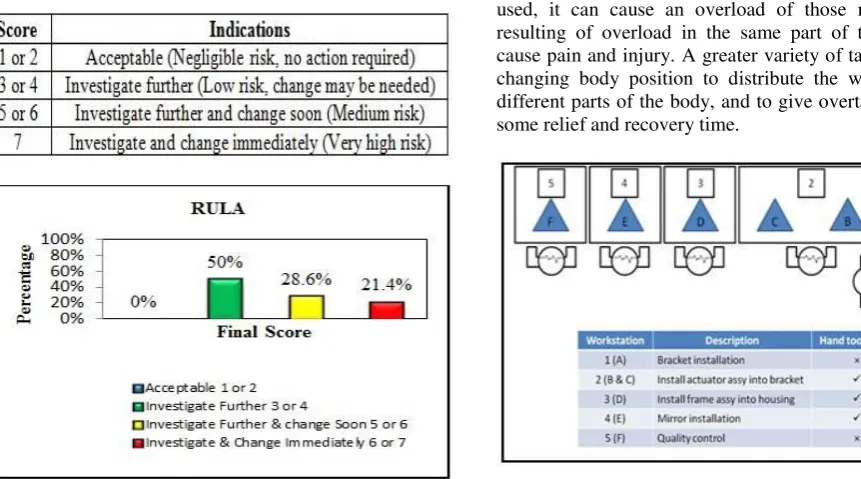
[image:2.595.60.491.524.763.2]RULA was attached with the questionnaire. There are 56 respondents involved in this assessment. RULA was carried out to analyze the worker’s posture. The RULA score was given based on the posture of the worker itself with the grand score of its coding system. There are 4 action levels as shown in the Table-1 which indicate the level of intervention required to reduce the risk of injury due to physical loading on the worker.
Table -1. Score and indications of RULA.
Figure-1. Percentage of RULA result.
The result of the measurement in the Figure-1 shows that half of the workers are under score 3 or 4 which is needed to investigate further. But, it is still under the low risk and need changes. Next, about 28.6% (n = 16) under score 5 or 6 which is needed to be investigated and change soon because it was under medium risk. While the lowest percentage is 21.4% (n = 12) under score 7, which has to be investigated and change immediately because it is under very high risk. Lastly, no one of the workers are under the score 1 or 2 which is under acceptable conditions. According to the results, it might be due to the posture of the workers. Most of the workers are working in an uncomfortable environment. The task involves with the movement of the upper and lower arm, wrist, neck, trunk and leg. In addition, it also includes the muscle usage (holding the vibrating hand tool) as well as additional force or load that is applied by the workers to perform their job. All of these factors contribute to higher RULA score.
Design
Based on the discussion with the engineers, there are several working environments that are possible to be applied. According to previous research, the design of ergonomic working environment is not necessarily complicated and costly. It can be very simple, easy and can be implemented by the workers without any further training program to be attended.
Job rotation
[image:2.595.309.546.605.754.2]Basically, based on the layout of assembly workers (refer Figure-2), each worker are performing the same task every day. In one line, there are 5 workers involves, but only three of them are using vibrating hand tool. When the workers involve in using tools for one or a few tasks that do not vary in the movements and muscles used, it can cause an overload of those muscles. The resulting of overload in the same part of the body can cause pain and injury. A greater variety of tasks allow for changing body position to distribute the workload over different parts of the body, and to give overtaxed muscles some relief and recovery time.
Generally, total working hour for each worker is 12 hours per day. They start at 8.00am and finish at 8.00pm. According to the workers, the extra 2 hours which is from 6.00pm until 8.00pm is considered overtime. They are requested to work overtime every day. Assembly department workers have different break time as compared with another department.
Table-2 shows the distribution of duration of working in standing position. The duration of standing depends on the task given where 62.5% (n = 35) of the workers are standing for 8-12 hours, about 23.2% (n = 13) are standing for less than 4 hours, almost 7.1% (n = 4) are standing for 6-8 hours, with 5.4% (n = 3) are standing for more than 12 hours and 1.8% (n = 1) is standing for 4-6 hours. These showed that most of the assembly workers are performing their job in standing position. This may lead to MSDs problem since they have to stand in a prolonged position. The distribution of duration of working in standing position is shown in Figure-3.
Table-2. Distribution of duration of working in standing position.
Figure-3. Distribution of duration of working in standing position.
For ergonomic intervention in the company, researcher proposed to the supervisor to apply the job rotation. This will help to reduce the muscle fatigue among the workers. It is suggested to rotate after each break so that the workers are not doing the repetitive movement (refer Table-3). Provisionally, the line leaders are following the schedule that has been done so that the workers can directly refer to it easily.
Table-3. Job Rotation timetable.
After applying job rotation direct interview is done by the worker involved. All the workers are happy with it. Most of them comment that they not even feel any pain during working. They also did not feel bored as they did not do the same thing for the whole day. They a most likely start with new task after each break and this job rotation encourage them to do their task with enthusiasm. Based on the interview, the quantity of product is increasing, while the duration of vibration exposure to the workers is decreased (refer Figure-4 to Figure-8)
About 90% of the workers agree that they exposed to the vibration in very short time per day (refer Figure-5). According to the new job rotation timetable, the workers are most probably will not do the job at the same workstation in a day.
Figure-5. Analysis of direct interview: Duration exposed to vibration.
As a result, the risk of injuries can be reduced and the workers feel happy with the new timetable since they are not bored when doing same task every day. In other side, the workers basically can do more than one work (refer Figure-6).
Figure-6. Analysis of direct interview: Risk of injuries.
All the workers feel very happy with the new job rotation timetable. They really enjoy working. It is due to the new working task (refer Figure-7).
Figure-7. Analysis of direct interview: Employee motivation.
Last but not least, more than half of the workers have the same opinion that they have become very versatile since they can perform several tasks in assembly line (refer Figure-8). This is an advantage for the workers.
Figure-8. Analysis of direct interview: Employee learning.
Unfortunately, the management is not agreeing to implement this job rotation program permanently. It is due to some reasons. One of the reasons is for traceability purpose. According to ISO 8402, traceability is “the ability to trace the history, application or location of an entity by means of recorded identifications.” This means, if any of the product having defect or problem, they can simply trace and track each worker involved and components that comprises with the product.
Anti-Fatigue mat
In general, standing is a natural human posture and there are no particular health hazard poses due to standing. However, standing in long period can cause sore feet (refer Figure-9).
Figure-9. Heel pain [13].
In order to increase the awareness on ergonomic matters among the organization, it was suggested to use the anti-fatigue mat. It is because; standing on concrete or other hard surface is tiring. But with the anti-fatigue mat is much gentler on the worker’s feet as compared to concrete floor since the mat is made of various materials includes rubber and carpeting materials.
Figure-10. Body part that having pain due to standing position.
The organization is agreed to provide the anti-fatigue mat to the workers. Figure-11 shows the condition of the workers before and after using the anti-fatigue mat.
Figure-11. Anti-fatigue mat.
Unfortunately, the anti-fatigue mat is provided phase by phase due to high cost. Each line needs one mat which cost about RM380. Therefore, the management decided to provide to the higher productivity line. Up until now, almost 70% of the assembly line has been used the anti-fatigue mat. After 3 months of implementation, direct interview was conducted to get the feedback from the workers. All the workers are really satisfied with this anti-fatigue mat. It is because, it can reduce the anti-fatigue. Even though the cost of this anti-fatigue mat is quite high, but the management is willing to provide the mat. It is because, the mat is durable. According to the assembly manager, they found that the number of medical leaves is reduced and the number of productivity is increasing after using the anti-fatigue mat.
4. CONCLUSIONS
On the whole, the workers felt very happy and enjoy with the new environment as they are less fatigue, and not stress. For RULA, basically, the working postures of all workers are similar. The minimum score that can be achieved is 4 since the natural posture of assembly workers that are in standing position cannot be changed. At least, with the implementation of new ergonomic environment, none of the workers are under the medium and high level of MSD risk.
REFERENCES
[1] Shafie M. R. N. H., Tan C. F. and Raihani M. K. 2005. A Study of the relation between engineering curriculums and industrial accidents. Kolej Universiti Teknikal Kebangsaan Malaysia.
International Journal of Research and Review in Applied Science. 8(1): 14-21.
[3] Falck A., Örtengren R. and Högberg D. 2002. The influence of assembly ergonomics on product quality and productivity in car manufacturing-A cost-benefit approach. In: Nordic Ergonomic Society Conference. pp. 1-7.
[4] U.S. Department of Labor, Occupational Safety and Health Administration (OSHA). 2014. OSHA’s
alliance program.
https://www.osha.gov/pls/oshaweb/owadisp.show_do cument?p_table=NEWS_RELEASES&p_id=25869.
[5] D. L. Parker, D. Merchant and K. Munshi. 2002. Adolescent work patterns and work‐related injury incidence in rural Minnesota. American Journal of Industrial Medicine. 42(2): 134-141.
[6] Baron S., Estill C., Steege A. and Lalich N. 2001. Simple solutions: Ergonomics for farm workers. http://www.cdc.gov/niosh/docs/2001-111/pdfs/2001-111.pdf.
[7] Bernard B. P. 1997. Musculoskeletal disorders and workplace factors: A critical review of epidemiologic evidence for work-related musculoskeletal disorders of the neck, upper extremity, and low back. http://www.cdc.gov/niosh/docs/97-141/pdfs/97-141.pdf.
[8] J. T. Albers and C. F. Estill. 2007. Simple solutions: Ergonomics for construction workers. Journal of Immunology. 179: 1864-1871.
[9] U.S. Department of Labor, Occupational Safety and Health Administration (OSHA). 2005. OSHA’s
alliance program.
https://www.osha.gov/dcsp/alliances/regional/reg2/gu atemala_ny_final.html.
[10]Chao E. L. and Henshaw J. L. 2009. Guidelines for nursing homes: Ergonomics for the prevention of
musculoskeletal disorders.
https://www.osha.gov/ergonomics/guidelines/nursing home/final_nh_guidelines.pdf.
[11]Centers for Disease Control and Prevention, National Institute for Occupational Safety and Health (NIOSH). 1994. A strategy for industrial power hand tool ergonomic research-Design selection, installation, and use in automotive manufacturing. http://www.cdc.gov/niosh/pdfs/95-114.pdf.
[12]U.S. Department of Labor, Occupational Safety and Health Administration (OSHA). 2008. Guidelines for shipyards: Ergonomics for the prevention of
musculoskeletal disorders.
https://www.osha.gov/Publications/OSHA3341shipya rd.pdf.
[13]Heel.Pain.1919.