Constructing MICDS Algorithm for Data Transmission
using Maximal Independent Set in Network Graph
G.N. Purohit
Depatment of Mathematics and
Statistics Banasthali University, Banasthali, Rajasthan-304022,
India
Seema Verma
Depatment of Electronics Banasthali University, Banasthali, Rajasthan-304022,
India
Usha Sharma
Depatment of Mathematics and
Statistics Banasthali University, Banasthali, Rajasthan-304022,
India
Gargi Chauhan
Depatment of Computer Science
Banasthali University, Banasthali, Rajasthan-304022,
India
ABSTRACT
Wireless Sensor Networks (WSNs) is a distributed wireless network which consists of a large number of small (sensor) nodes with sensing, computation and wireless communication capabilities. These sensor nodes work together to monitor various applications and they communicate with each other in multiple hops or directly, with the objective of handing over the processed data to the sink node or access point (AP). WSNs have many issues like self-configuration, fault-tolerance, adaptation, flexibility, energy efficiency, security, scalability, interference, architectural issues, mobility and delay tolerance but the most critical and important issue is to reduce energy wastage and interference and increasing network lifetime [1,2, 3]. In order to manage these issues, WSNs require some virtual backbone. A Connected Dominating Set (CDS) can be used to create a virtual backbone in WSNs [5,6,7,8, 9,10]. The CDS is a dominating set which induces a connected subgraph. A maximal independent set is an independent set that is not a subset of any other independent set [7,8]. In this paper, proposed a MICDS (Maximal Independent Connected Dominating Set) algorithm for the WSNs, which are based on the construction of the maximal independent set (MIS) of the representing network graph. There are two different steps in the implementation of MICDS algorithm. In the first phase, the maximal independent set of the network is constructed. In second phase, the dominating set and connectors for the dominating set are constructed using MIS. Using the dominating set and connectors, all the data is transmitted to the sink node or access point (AP). The simulation results indicate that the MICDS algorithm reduce the interference and energy wastage in the network graph, further it also increases the lifetime of the network.
Keywords
MICDS (Maximal Independent Connected Dominating Set), Maximal Independent Set (MIS), Dominating set (DS), Connected Dominating Set (CDS), etc.
1.
INTRODUCTION
Wireless Sensor Networks (WSNs) consist of large number of small nodes with sensing, computation and wireless communications capabilities that work together to monitor various phenomena [1,2]. It can be used in many applications such as environmental and habitat monitoring, traffic control, health monitoring, battlefield, disaster forecasting, etc. It has no fixed or pre-determined infrastructure [1,2,3,11].
In WSNs, nodes are communicated using a shared medium, either through a single hop or multiple hops. And these sensor nodes are tightly inhibited in processing ability, storage capacity and energy, routing and data aggregations are very challenging. There are many issues in WSNs such as self-configuration, fault-tolerance, adaptation, flexibility, energy efficiency, security, scalability, interference, architectural issues, network lifetime, mobility and delay tolerance but the network lifetime, energy consumption and interference are most important issues [1]. WSNs have limited energy due to which the data transmitted by a source can only reach the nodes that are within its transmission range. If two nodes are within the transmission range of each other then they can exchange data directly but if they are not within the transmission range of each other then they communicated through other intermediate nodes [1,7]. Due to this problem we construct a virtual backbone in WSNs through which each node of the network can transmit data to the sink node effectively.
Connected Dominating Set (CDS) plays an important role in the creation of virtual backbone in WSNs [5, 6, 7, 8, 9, 10]. A dominating set of a network is a set of nodes such that each node is either in that set or adjacent to some node in that set. A dominating set is called a connected dominating set (CDS) when the dominating set nodes can form connected graph. The nodes in the CDS are called dominators and the other nodes are called dominatees [7, 8, 11, 12].
The main objective of this paper is to have a network which has minimum interference and energy wastage and to increase the lifetime of the network. In this paper MICDS algorithm in a directed graph are constructed that reduce energy wastage and interference in the network and also extend the network lifetime.
Network as a graph are considered where the vertices correspond to the nodes and the edges correspond to the links between these vertices or nodes. One node is considered as the access point (AP) or data collector. All the data transferred from each node should reach the access point or data collector.
set of the network graph such that each node is either in that set or adjacent to some node in that set [9]. A Connected Dominating Set (CDS) „C‟ of G is a dominating set of G which make a connected subgraph of G. The nodes in the CDS are called dominators and the other nodes are called dominatees. The nodes which are not in the dominating set and have maximum degree get the first preference to become a connector of the network graph.
The connectors of the network graph are found according to the degree and through these connectors the data is transmitted to the access point (AP) or sink node. For implementing this process, an algorithm has been developed which is based on the above approach. There are two phases in this algorithm. In first phase, an algorithm for finding the maximal independent set of the network graph has been created. In second phase, an algorithm for constructing dominating set and connectors of the network graph. Thus, the proposed algorithm creates the CDS that performs well and reduce energy wastage and interference which extend network lifetime.
The rest of the paper is organized as follows. Section 2 reviews the related works. Section 3 describes the system model. Section 4 presents problem statement. Section 5 presents MICDS algorithm. Section 6 describes and analyzes the simulation results for the proposed algorithm. Section 7 concludes the paper.
2.
RELATED WORK
Li, Zhu, Thai and Du (2004) study the problem of constructing a CDS in wireless networks and also propose a localized one-phase distributed algorithm which is r-CDS with constant performance ratio. This algorithm is better at maintenance since there is no need to build a tree or select a leader which is the common methods used in most of the distributed but serialized algorithms. They also compare their algorithm with other localized algorithms. They also show that the algorithm has a better performance ratio and constructs a CDS with smaller size in most cases [14].
Hussain, Shafique and Yang (2010) extended an existing CDS algorithm (r-CDS) to meet real life sensor network requirements and also tried to extend network lifetime by delaying First Node Death. This delay can help data-critical WSNs like an industrial WSN to continue network traffic for longer period of time. For performance evaluation they are using realistic scenarios in their design. They compare the proposed algorithm with a traditional CDS algorithm. The results prove the efficiency of the proposed algorithm in terms of network lifetime and packet loss. And they also prove that mr-CDS algorithm outperforms original r-CDS algorithm and significantly prolongs network lifetime [10].
Kui, Sheng, Du, and Liang (2013) construct an energy-balanced connected dominating set (DGAEBCDS) for data collection in wireless sensor network. DGAEBCDS can effectively increase the number of rounds before the first node failure by reducing the energy consumption per round and only choosing the nodes with a relatively higher weight to construct the CDS. Theoretical analyses show that the total message complexity of the algorithm is (𝑛 log 𝑛), and also show that DGA-EBCDS can reduce energy consumption in the formation of CDS as well as effectively prolong the lifetime of the network. Furthermore, the routing decision in DGA-EBCDS considers both the path length and the remaining energy of nodes in the path [13].
Li, Thai, Wang, Yi, Wan and Du proposed a new greedy algorithm, called S-MIS with the help of Steiner tree that can construct a CDS in wireless networks with performance ratio of (4.8+ln5)opt+1.2. They also introduce the distributed version of this algorithm. They prove that the proposed algorithm is better than the current best performance ratio which is 6.8. They also compare S-MIS with its variation which is rS-MIS and the result of this comparison shows that the sizes of the CDSs generated by S-MIS and rS-MIS are almost the same [4].
Sampoornamand Rameshwaran combine the features of Connected Dominating Set (CDS) with Conjugative Sleep Schedule Algorithm and also update the connected dominating set with two different topological conditions which are considered. An example of changing re-computation period dynamically in a centralized solution can be found in the area size and the maximum transmission range is usually set by the application itself. By the application of distributed sleep scheduling algorithm, performance improved on high density networks. Based on the topologies and by variation of the sensor nodes to different densities (i.e., 20, 40, 60 and 80) the performance of conjugative power efficient scheduling scheme with and without CDS is evaluated. As a result of better lifetime, better energy savings achieved in wireless sensor networks [15].
Wu and Li investigate the problem of constructing a k-connected m-dominating set in wireless sensor networks for general k and m. They propose one distributed algorithm LDA with low message complexity to construct a kmCDS whose size is guaranteed to be within a small constant factor of the minimum one when
is a constant. They also propose a centralized algorithm ICGA which has a constant performance ratio to improve the existing best centralized kmCDS construction algorithm CGA. Furthermore, they show the tight bound of the performance ratio of another existing distributed kmCDS construction algorithm DDA [11].Nabhan, Zhang, Rodhaan, and Dhelaan propose two novel algorithms for constructing connected dominating set (CDS) in wireless sensor networks (WSNs). Both algorithms are intended to minimize CDS size. The first algorithm has a performance factor of 5 from the optimal solution. The second algorithm is an improved version of the first one. They studied the impact of proposed algorithms compared to the S-MIS algorithm. Results showed an improved performance of both proposed algorithms over S-MIS for large scale networks [12].
3.
SYSTEM MODEL AND NETWORK
MODEL
The WSN is represented by a graph G= (V, E), where V= {v1, v2, v3,……vn } denotes the set of all nodes in the graph
including the access point (AP) and E
V×V denotes the set of all edges referred to all the communication links through which the data packets can be transmitted from one node to another. All the communication links are destined to AP. Every data packet from a node is forwarded to its parent node so that the entire data packet finally reached the AP.with a subset N(v)
V of nodes , where each node u
N(v) is called the neighbor of „v‟ [1].An independent set of a network graph G= (V, E) is a subset of the vertices, such that no two vertices are adjacent to each other. It is a maximal independent set (MIS) if no more vertices can be added to it to maintain the independence property. A dominating set „D‟ of a network graph „G‟ is a subset of the vertices „V‟ such that each node is either in that subset or adjacent to some node in that subset. Thus, MIS is a dominating set. A connected dominating set (CDS) „C‟ is a dominating set of G that makes a connected subgraph of G. The nodes in the C are called dominators and the other nodes are called dominatees.
4.
PROBLEM STATEMENT
In WSNs, a virtual backbone is a connected dominating set (CDS). The CDS is a dominating set which create a connected subgraph. It is used to reduce the energy consumption and interference in network graph and also used to prolong the lifetime of the network.
MICDS algorithm are constructed which is used to solve the energy consumption and interference problem in the directed network graph. MICDS algorithm is based on the maximal independent set. Initially maximal independent set (MIS) are created then by using the MIS, the dominating set and connectors is find out which creates the connected dominating set (CDS). The nodes in the CDS are dominators and the other nodes are dominatees. During the transmission, the dominators are in active mode and the dominatees which involve in transmission are in active mode and other dominates are in sleep mode. Therefore, MICDS algorithm provides the network with less energy consumption and interference and also extends the lifetime of the network.
5.
MICDS ALGORITHM
The algorithm has two phases. In first phase, the maximal independent sets of the network graph are constructed. In second phase, the dominating set and connectors for the dominating set are constructed. It will provide the transmission of the data to the access point or sink node with less energy wastage and interference because of which the lifetime of the network is extended.
Phase1: Construction of Maximal Independent sets of the graph
In this phase, an algorithm is based on the construction of maximal independent set of the given network graph. To create the maximal independent set with the following condition:
Vertices in the maximal independent set are not the subset of any other independent sets.
No more vertices can be added in MIS to preserve the independence property.
Maximal Independent Set Algorithm:
Step 1: Arrange all the vertices of the network graph „G‟ in some order
V=v1, v2, v3, ……….vn.
Step 2: Select a vertex v1 from V and create a set S1= { v1}. Step 3: Select vertex v2.
If v2 is not adjacent to v1, then put it in set S1.
S1 S1
{v2}.Else create a new set S2 = {v2}.
Let v1, v2, v3, ……vi-1 vertices in „V‟ have been selected and included in the sets S1, S2, S3,……Sm.
Step 4: Select the vertex vi and find N(vi). If N(vi)
Sj =
for j
{1,2,3,…..m},Then Sj Sj
{vi}. (If there is tie, then select j arbitrarily)Else if N(vi) Sj
j
{1,2,3,…..m},Then Sj+1 = {vi}.
Step 5: Repeat Step 4 for all vertices Vi‟suntill the i is finished.
Hence, independent sets S1, S2, S3,………Sm are obtained.
Step 6: Find an access point (AP) or sink node „A‟ from the network graph „G‟.
Step 7: Remove an access point or sink node „A‟ from the independent sets of the network graph.
Step 8: Find the independent sets „Smax‟ which include maximum number of vertices from the vertex set of the network graph.
Therefore „Smax‟ is the maximal independent set of the network graph „G‟
MIS= Smax
Thus, maximal independent set „MIS‟ are obtained.
Phase2: Construction of Dominating Set and Connectors for the dominating set in the graph
In this phase, the dominating set and connectors for the dominating set is created which is based on the maximal independent set of the given network graph that were created in phase1, therefore all the data is transmitted to the access point or sink node using these dominating set and connectors.
Step 1: In Phase 1 the maximal independent sets of the network graph „G‟ are find out.
By the definition of dominating set, the maximal independent set is considered as the dominating set.
Therefore, DS= MIS.
Step 2: Remove an access point and the dominating set vertices (DS) from the vertex set „V‟ of the network graph „G‟.
V`= (G-A-DS)
Step 3: Find the connectors (Ci) for the dominating set (DS). Calculate
Vi(in_deg) + Vi(out_deg) = Vi(total).
We check
If Vi(total) ≥ Vj(total) then
Ci = Vi
Step 4: Repeat Step 3 until all the connectors is find out. Step 5: After finding all the connectors of the network graph „G‟. The user selects the connectors (Ci) according to its requirement for the transmission.
Thus, dominating set (DS) and connectors (Ci) are obtained.
6.
SIMULATION RESULTS
In this section, the performance of MICDS algorithm has been analyzed by simulation in MATLAB version R2007a. Evaluations are based on the finding of maximal independent set of the network graph. Using maximal independent sets, the dominating set and connectors for the dominating set in the network graph is find out. Through these dominating set and connectors the connected dominating set (CDS) are created and with the help of CDS all the data to the sink node or access point are transmitted. And this can also reduce the energy wastage and collisions or interference between the nodes of the graph and extend the lifetime of the network.
The following procedures have been simulated on MATLAB for finding the maximal independent set „M‟ and dominating set „DS‟ and connectors for the dominating set „C‟ in the network graph:
6.1
Procedure Maximal_Independent_Set
Input: Graph G= (V, E)„n‟ is the total number of vertices in the graph „I‟ is the vertex number
„S‟ is the independent sets which is represented in matrix form „sn‟ is the set number
„MI‟ is the maximal independent set which is represented in matrix form
„in_deg‟ is the indegree of the vertex „out_deg‟ is the outdegree of the vertex
For all the vertices „V‟ of the graph stored at „i‟ do
Enter the adjacent vertices of „i‟ stored at „data‟
For all the set number „sn‟ stored at „k‟ do
Check the intersection of the adjacent vertices with the independent sets „S‟ then
if intersection is empty then
For all the vertices „n‟ of the graph stored at „j‟ do
If S(k,j)==0 then
S(k,j)=i Union with „S‟
K=i+1
End
End
End
End
Else if intersection is not empty then
For all the vertices „n‟ of the graph stored at „j‟ and creating different set „S‟ do
If S(j,1)==0
S(j,1)=i
Sn=sn+1
End
End
End
End
S is the independent sets of the graph which is in the matrix form
For all the vertices „V‟ of the graph stored at „i‟ do
Enter the indegree of vertices of „i‟ stored at „in_deg‟
Enter the outdegree of vertices of „i‟ stored at „out_deg‟
Check if out_degree is zero then
Sink node is „i‟ whose outdegree is zero
Replace the sink node vertex by zero in „S‟
End
End
Stored that „S‟ after modification in M
M=S
Put all first row elements of „M‟ in „f‟
Find the total length of the first row of „M‟ and stored that value in „p‟
For all the vertices „V‟ of the graph stored at „i‟ do
Find the total length of the ith row of „M‟ and stored that value in „q‟
Compare „p‟ and „q‟ value
If p<q then
p=q
Store the total elements of the ith row of „M‟ in „f‟
End
End
Store „p‟ value in „‟max‟
Store „f‟ value in „MI‟
Therefore, in the above procedure „MI‟ matrix is the answer. The maximal independent set is represented in the form of matrix.
6.2
Procedure
Dominating_Connectors_Set
Input: Graph G= (V, E)„n‟ is the total number of vertices in the graph
„I‟ is the vertex number
„S‟ is the independent sets which is represented in matrix form
„MI‟ is the maximal independent set which is represented in matrix form
„out_deg‟ is the outdegree of the vertex
„DS‟ is the dominating set which is represented in matrix form „CC‟ is the connectors which is represented in matrix form
Store „MI‟ value in „DS‟
For all the elements in „MI‟ stored at „i‟ do
For all the elements in „M‟ stored at „j‟ do
For all the elements in „M‟ stored at „k‟ do
If M(j,k)==MI(1,i)
Make M(j,k) to zero
End
End
End
End
Store „M‟ modify value in „dc‟
For all the elements in „dc‟ stored at „i‟ do
For all the elements in „dc‟ stored at „j‟ do
Check if dc(i,j) value is not equal to zero then
Enter the indegree of vertices of „i‟ stored at „in_deg‟
Enter the outdegree of vertices of „i‟ stored at „out_deg‟
total=in_deg+out_deg
End
End
End
Store total value in „a‟
Find the total number of elements in „a‟ and store that value in „tt‟
rs=reshape(a,1,yy)
Sort the „rs‟ value in descending order and store that value in „CC‟
Therefore, in the above procedure „DS‟ and „CC‟ is the answer. The dominating set and connectors are represented in the form of matrix.
6.3
Analysis
[image:5.595.308.556.462.755.2]The transmission of the data in the network graph using the Connected Dominating Set (CDS) depends on the maximum degree, independent sets, number of nodes in maximal independent set and hierarchy of the network graph have been analyzed.
Table 1.
Node Maximum
Degree
Independent set
Number of nodes in Maximal Independent
Set
11 6 3 4
20 5 3 9
25 5 4 10
30 6 3 12
35 5 3 14
40 6 4 14
Fig 1.
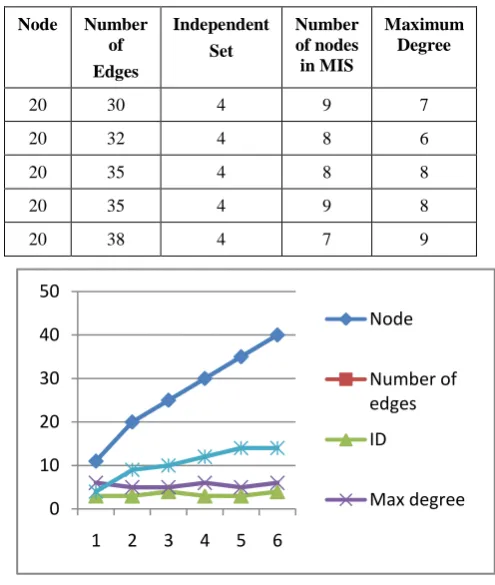
From Table.1 and Fig.1, we have analyzed four cases:
Case1: When maximum degree decreased and independent sets are constant then the number of nodes in MIS increased.
Case2: When maximum degree increased and independent sets decreased then the number of nodes in MIS increased.
Case3: When maximum degree and independent sets increased then the number of nodes in MIS are constant.
Case4: When maximum degree is constant and independent sets increased or decreased then the number of nodes in MIS increased.
Table 2.
Node Number
of Edges
Independent Set
Number of nodes in MIS
Maximum Degree
20 30 4 9 7
20 32 4 8 6
20 35 4 8 8
20 35 4 9 8
20 38 4 7 9
0 5 10 15 20 25 30 35 40 45
1 2 3 4 5 6
Node
Max degree
ID
0 10 20 30 40 50
1 2 3 4 5 6
Node
Number of edges
ID
[image:5.595.47.285.651.770.2]From Table.2 and Fig.2, we have analyzed three cases:
Case1: When maximum degree decreased and independent sets are constant then the number of nodes in MIS differed by 1 or decreased.
Case2: When maximum degree increased and independent sets are constant then the number of nodes in MIS differed by 2 or decreased or may be constant.
Case3: When maximum degreeand independent sets are constant then the number of nodes in MIS differed by 1 or increased.
7.
CONCLUSION
In this paper, a new virtual backbone MICDS algorithm for WSNs is proposed. The algorithm uses maximal independent set in the network graph to find the dominating set and connectors for dominating set that creates connected dominating set (CDS). Therefore, CDS are used for the transmission of the data packets to another node or sink node. The resulting assignment can guarantee that there is no interference between the nodes means the network graph is collision free and the CDS used for the transmission implies less energy consumption and interference that extend the network lifetime. In the future, constructing the load balancing connected dominating set (CDS) for the wireless sensor networks (WSNs).
8.
ACKNOWLEDGMENTS
One of the authors of this paper, Gargi Chauhan acknowledges UGC, New Delhi for the financial assistance for carrying out this research.
9.
REFERENCES
[1] Gargi Chauhan, Usha Sharma, Seema Verma and G. N. Purohit, “TDMA Scheduling Algorithm Using Independent Sets in Network Graph”, Internatonal Journal of Computer and Technology,vol.10,No.10.
[2] Yiwei Wu and Yingshu Li, ``Connected Dominating Sets", to appear in Ad Hoc and Sensor Wireless Networks: Architectures, Algorithms and Protocols, Bentham Science, 2009.
[3] Pathan, A.S.K.; Hyung-Woo Lee; Choong Seon Hong, “Security in wireless sensor networks: issues and challenges” Advanced Communication Technology (ICACT), Page(s):6, year 2006.
[4] Li Y.S, Thai M.T, Wang .F, Yi C.W, Wan P.J and Du D.Z, “On Greedy Construction Of Connected Dominating Sets in Wireless Networks”, Journal of Wireless Communications and Mobile Computing, vol. 5, no.8, pp. 927-932, 2005.
[5] Yaqian LI, Rongrong YIN, Haoran LIU, Xiaochen HAO,” A Reliable Connected Dominating Set Algorithm in Wireless Sensor Networks”, Journal of Computational Information Systems 8: 6 (2012) 2583-2592.
[6] Kamrul Islam, Selim G. Akl, and Henk Meijer, “Distributed Generation of a Family of Connected Dominating Sets in Wireless Sensor Networks”, Distributed Computing in Sensor Systems - DCOSS , pp. 343-355, 2009.
[7] My T. Thai, Feng Wang, Dan Liu, Shiwei Zhu, Ding-Zhu Du, "Connected Dominating Sets in Wireless Networks with Different Transmission Ranges," IEEE Transactions on Mobile Computing, vol. 6, no. 7, pp. 721-730, July 2007, doi:10.1109/TMC.2007.1034.
[8] Weili Wu, Hongwei Du, Xiaohua Jia, Yingshu Li, Scott C.-H. Huang,” Minimum connected dominating sets and maximal independent sets in unit disk graphs”, Theoretical Computer Science 352 (2006) 1 – 7.
[9] Kamrul Islam, Selim G Akl, and Henk Meijer, A Constant Factor Localized Algorithm for Computing Connected Dominating Sets inWireless Sensor Networks, Proc of 14th IEEE International Conference on Parallel and Distributed Systems, ICPADS.2008.
[10]Sajid Hussain, Mubashsharul I.Shafique, Laurance T.Yang: Construction a CDS based network backbone for energy efficiency in industrial WSN,IEEE 2010.
[11]Yiwei Wu and Yingshu Li, "Construction Algorithms for k-Connected m-Dominating Sets in Wireless Sensor Networks," 9th ACM International Symposium on Mobile Ad Hoc Networking and Computing (MobiHoc 2008), Hong Kong, China, May 26-30, 2008.
[12]Najla Al-Nabhan, Bowu Zhang, Mznah Al-Rodhaan, Abdullah Al-Dhelaan: Two Connected Dominating Set Algorithms for Wireless Sensor Networks. WASA 2012: 705-713.
[13]Xiaoyan Kui, Yu Sheng, Huakun Du, and Junbin Liang, “Constructing a CDS-Based Network Backbone for Data Collection in Wireless Sensor Networks”, International Journal of Distributed Sensor Networks Volume 2013.
[14]Li, Y., Zhu, S., Thai, M.T., Du, D.-Z.: Localized Construction of Connected Dominating Set in Wireless Networks. In: NSF International Workshop on Thoretical Aspects of Wireless Ad Hoc, Sensor and Peer-to-Peer Networks (2004).