International Journal of Emerging Technology and Advanced Engineering
Website: www.ijetae.com (ISSN 2250-2459,ISO 9001:2008 Certified Journal, Volume 3, Issue 3, March 2013)
983
Purification of Frog Oil Using Animal Bone-Base Activated
Carbon
EGWIM, C .EVANS.
1, HALIMA, A.MAHMUD
2, IBRAHIM, H.OLABISI.
3 1,2Biochemistry Department, Federal University of Technology, PMB 65, Minna, Niger State, Nigeria
3Biochemistry units, Department of Science Lab Tech, Federal Polytechnic, PMB 420, Offa, Kwara State, Nigeria.
Abstract--Animal bones were carbonized at a temperatures of 800-900OC .The carbonized sample was reduced to particle size of 75µm and then chemically activated at 500OC using orthophosphoric acid as activating agent. The mixture was separated by centrifugation. The activated carbon was then added (1:8 v/w) to the frog oil for purification. Physicochemical properties and individual fatty acid profiles were monitored hourly. Melting point, odour and colour were determined for crude and purified samples. The result showed that peroxide value (PV) decreased from 3.50-1.80, while pH decreased from 11.8-9.0 after purification. Refractive index melting point reduced from 1.4876-1.4616 and 27.4-24.5OC respectively. With odour and colour improved after 4 hrs. The same trend was observed in the iodine values, oleic, linolic, stearic,and palmitic acids, for frog oil after purification. The Freundlich isotherm model for the purification of frog oil using animal - bone - based activated carbon showed n and k values of 1.10 and 4.745 respectively with an R2 of 99%. The present result has shown that animal - bone - based activated carbon is quite suitable for the purification of frog oil.
Keywords-- Animal bone, carbonized, oil, crude, orthophosphoric acid
I. INTRODUCTION
Activated carbon also called activated charcoal, activated coal or carbon activatus, is a form of carbon that has been processed to make it extremely porous and thus to have a large surface area available for absorption or chemical reaction (Hubner and Moser 2002). Activated carbon is produced from carbonaceous source material such as nutshell, corn cob, wood fiber, sawdust, lignite coal, petroleum pitch (Sabio et al. 2004). Activated carbons or adsorbents can be used once and discarded, or as is more common, it can be employed on a regenerative basis and reused for a number of cycles. Commercial adsorbents are divided into five major classes: Molecular-sieve zeolites, activated alumina, silica gel, synthetic polymers or resins and activated carbons (Geankoplis 1995). The general process to prepare activated carbon is based on carbonizing and activating the natural carbonaceous biomass (Tay et al. 2009). Activation step of activated carbon process may be achieved either physically or chemically.
The chemical activation has been shown as a more efficient method to obtain activated carbon with high surface area and narrow micropore distribution (Adinata et al. 2007). Of the activation agents, H3PO4 is widely considered better in the preparation of activated carbons because it offers some advantages such as non-polluting character and ease of elimination by washing with water (Sun et al. 2007). Moreover, H3PO4 introduces physical and chemical modifications on the biomass by penetration, particle swelling, and partial dissolution of biomass, bond cleavage and reformation of new polymeric structures resistant to thermal decomposition
(Alhamed, 2008, Nakagawa et al. 2007). Typically, surface areas ranging from 500 - 1400 m2/g are obtained for the activated material (Dibinin et al. 1994). The activated carbon particle has two types of pores existing in it by which adsorption takes place. These are the
macropores (> 10-1 m) and the micropores (10-3 - 10-1
m).
The macropores provides passageway to the particles interior and to the micropores but do not contribute substantially to the particle surface area. The micropores, on the other hand, are responsible for the large surface area of activated carbon particles and are created during the activation process (CAH 1978). It is in the micropores that adsorption largely takes place. As a result, two main parameters are relevant to the performance of the activated carbon namely the surface area and the pore volume.
Activated carbon has several important uses such as in clean up of industrial effluents (Madukasi et al. 2001, Okafor et al. 2005), removal of taste and odour from domestic and industrial water supplies, vegetable and animal fats and oil, alcoholic beverages, chemicals and pharmaceuticals and in waste water treatment (Geankoplis 1995).It is further reason that activated animal bone base is employed to purify frog oil.
International Journal of Emerging Technology and Advanced Engineering
Website: www.ijetae.com (ISSN 2250-2459,ISO 9001:2008 Certified Journal, Volume 3, Issue 3, March 2013)
984
Information on the domestic and/or industrial uses of frog oil is scarce. However, an earlier study has shown that dietary frog oil improves the quality of circulating plasma lipids and lipoproteins (Egwim 2003). Developing a purification technology for frog oil will be a worthy venture. Therefore; the aim of this study is to determine the optimum method of purification of frog oil on a large scale using activated charcoal and to determine the nutritional values of the oils.
Materials and methods
Source of Materials and chemicals
Animal bones were bought from the abattoir in Bida, Niger State Nigeria, while most of the chemicals used were of the analytical grade from BDH, London. Frog oil was purchased from local producers, in Badeggi Niger State Nigeria.
Carbonization
The animal bones were cleaned, sun dried and charged into an automated muffle furnace (Gallenkamp FSE - 624 - 0100). The bones were heated for 2 - 3hrs at 800 – 900OC, the charred products were allowed to cool in a desiccators and then ground to a workable size of 75µm. HC1(0.5M) was used to wash and purify the carbon. The product was rinsed several times with distilled water. The sample was then dried in an oven at 100OC for I hour, and then stored in air tight polythene bags.
Chemical activation of charred bones
Chemical activation of animal bones using
orthophosphoric acid (H3PO4) was done following the method described by Okafor and Aneke (2005), samples of charred bone were mixed with 0.5M solution of orthophosphoric acid (l:2w/v) and heated to form a paste. The paste was transferred into a crucible and heated at 500OC for 2 to 3 hrs in a furnace, allowed to cool to room temperature, washed with distilled water and dried at 100OC. The final product was stored in an air tight polythene bag ready for use.
Purification of Frog oil
Activated carbon prepared as stated above was added to oil sample at a ratio of 1:8 (v/w), stirred and maintained at 80-100OC. Sample (20 ml) was withdrawn at 1 hour interval, centrifuged at 1500xg and the clear supernatant (oil) collected and stored for physicochemical analysis.
Determination of physical and physiochemical properties of purified frog oil
Melting point was determined using Gallenkamp melting point apparatus (MFB-600-010f),Colour was determined using Lovibond tinctometer and recorded as Hezen point, while odour was determined by a 30member panelist. Samples were scored for 5 points were 1 is for least odour and 5 for the highest odour.
Saponification values, unsaponifiable matter, iodine value, peroxide value, free fatty acid were determined in crude and purified oil samples according by the method of ISO. Refractive index was determined using Abbe refractometer while pH was determined using a standard laboratory bench pH meter (EIL model 7020).
Fatty acid profile
Fatty acid composition of crude and purified oil samples were determined using gas-liquid-chromatography method (Varian Chromatography Model 3400cx).
II. RESULTS AND DISCUSSION
The process technology of frog oil as well as other less popular oil can be improved for domestic and industrial usefulness. The melting point, odour and colour parameters of frog oil before and after purification with activated carbon using animal bone is shown in Table1.
Table 1
Physical Properties of frog oil before and after purification with activated carbon.
Frog oil
Parameters Crude Purified
Melting point(OC) 27.4 23.6
Odour 5.0 + 0.01 2.6 + 0.09
Colour Brown pale
yellow
Golden yellow
Hezen point(hz) 250.4 120.9
International Journal of Emerging Technology and Advanced Engineering
Website: www.ijetae.com (ISSN 2250-2459,ISO 9001:2008 Certified Journal, Volume 3, Issue 3, March 2013)
985
The present study has shown that activated carbon eliminates frog oil from objectanable 5.0 to acceptable 2.6.
Moma et al. (2003) has reported that objectionable odour
and rancidity are quality attributes of adulterated vegetable oil. In the present study therefore, the treatment of frog oil with chemically activated animal-bone based carbon (CAAC) may not only remove the impurities but also make the oil samples more acceptable and more industrially useful.
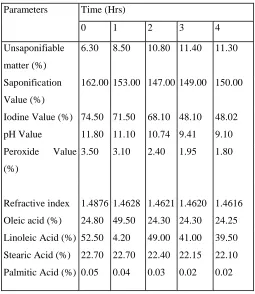
The physiochemical properties of frog oil after treatment with CAAC. The result showed that percentage unsaponifiable matter increased with purification time as shown in Table 2. This result suggests that the crude oil samples contain impurities. Which were by removing the
impurities, the unsaponifiable matter becomes
concentrated. Saponification value decreased with
purification time in the frog oil. This observation suggests that the bulk of impurities in frog oil contain low saponification value per unit volume of oil as impurities, and when the impurity is removed, the unit saponification value decreased. This observation is supported by the report of (Moma et al. 2003), who have shown that impurities can increase or decrease saponification value depending on the nature of the impurity. The result further shows that refractive index reduced with time which further confirmed that the removal impurities by CAAC treatment. The result (Table 2) also shows that the parameters like unsaponifiable matter (%), saponifiable value (%), iodine value etc tended to equilibrium within 3 - 4hrs. This observation is an indication of favourable adsorption system. Absorption systems that tend to equilibrium are judged effective'
[image:3.612.309.564.166.460.2](Ahmed et al. 2003, Ahmed et al. 2004). However the ease of attaining equilibrium is a function of the mesh size and surface area (Smith et al. 1996).
Table 2
Physiochemical properties and fatty acid profile of frog oil purified with animal- bone-based activated charcoal.
Parameters Time (Hrs)
0 1 2 3 4
Unsaponifiable
matter (%)
6.30 8.50 10.80 11.40 11.30
Saponification
Value (%)
162.00 153.00 147.00 149.00 150.00
Iodine Value (%) 74.50 71.50 68.10 48.10 48.02
pH Value 11.80 11.10 10.74 9.41 9.10
Peroxide Value
(%)
3.50 3.10 2.40 1.95 1.80
Refractive index 1.4876 1.4628 1.4621 1.4620 1.4616
Oleic acid (%) 24.80 49.50 24.30 24.30 24.25
Linoleic Acid (%) 52.50 4.20 49.00 41.00 39.50
Stearic Acid (%) 22.70 22.70 22.40 22.15 22.10
Palmitic Acid (%) 0.05 0.04 0.03 0.02 0.02
It is interesting to note that the frog oil have high saponification values, which makes it a useful raw material for the cosmetic industries and since the results of the present study tends to suggest that equilibration could be attained in a short reasonable time (≈4hrs), a model for large scale purification of frog oil could be formulated. It was also found that, the fatty acids oleic acid, linoleic acid, stearic acid, palmitic acid meets of frog oil meets up with the WHO/FAO recommendations.
n=1.10
k=4.745
International Journal of Emerging Technology and Advanced Engineering
Website: www.ijetae.com (ISSN 2250-2459,ISO 9001:2008 Certified Journal, Volume 3, Issue 3, March 2013)
986
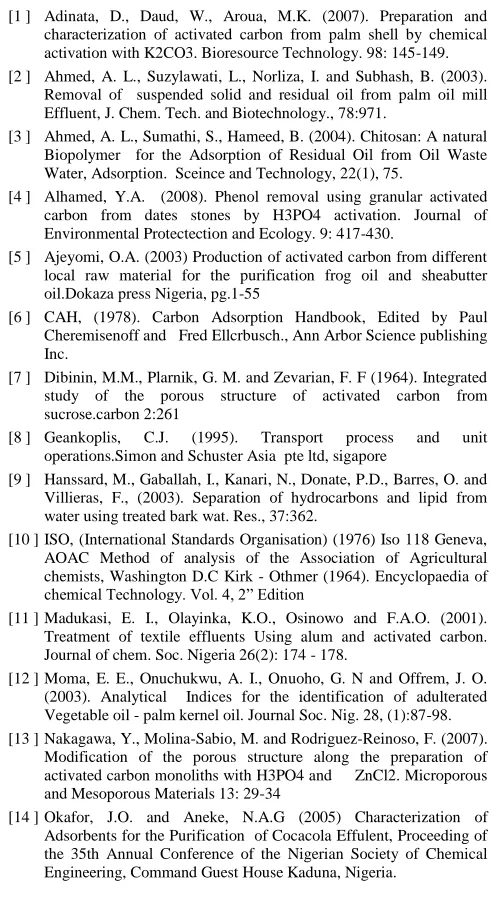
[image:4.612.320.568.262.712.2]This is demonstrated by the adsorption isotherm (Figures i). The heterogenicity factor (n) calculated from Freundlich isotherm plot of 1.10 frog oil sample, while the equilibrium adsorption coefficient (k) was 4.745 for frog oil sample purified by CAAC. The Freundlich model assumes that the uptake of any adsorbate occurs on a heterogeneous surface by multilayer adsorption and that the amount of adsorbate increases infinitely with an increase in concentration. From these assumptions it can be concluded that the purification of frog oil occur on a heterogeneous surface by multilayer adsorption. The present observation indicates that chemically activated animal -bone - based charcoal (CAAC) used for this study is suitable for the purification of frog oil.
Figure i:Freundich plot for frog oil purification using activated bone charcoal at 800OC and 150µm particle size
It is also known that when a value is greater than 1.0, the conditions are favourable for in frog oil adsorptions (Ajeyomi 2003). Hence it is clearly proved that the purification of frog oil by animal - bone - based activated charcoal agrees well with the Freundlich adsorption model.
Figures 1 clearly shows that the Freundlich isotherm model fits the analyzed data well with its correlation
coefficient (R2) values of 0.9999.
III. CONCLUSION
The work concludes that animal-bone-based activated with ortho-phosphoric acid is valuable absorbent suitable for the purification of frog oil.Rancidity can be prevented or reduce by passing the oil through activated charcoal.
RERERENCE
[1 ] Adinata, D., Daud, W., Aroua, M.K. (2007). Preparation and characterization of activated carbon from palm shell by chemical activation with K2CO3. Bioresource Technology. 98: 145-149. [2 ] Ahmed, A. L., Suzylawati, L., Norliza, I. and Subhash, B. (2003).
Removal of suspended solid and residual oil from palm oil mill Effluent, J. Chem. Tech. and Biotechnology., 78:971.
[3 ] Ahmed, A. L., Sumathi, S., Hameed, B. (2004). Chitosan: A natural Biopolymer for the Adsorption of Residual Oil from Oil Waste Water, Adsorption. Sceince and Technology, 22(1), 75.
[4 ] Alhamed, Y.A. (2008). Phenol removal using granular activated carbon from dates stones by H3PO4 activation. Journal of Environmental Protectection and Ecology. 9: 417-430.
[5 ] Ajeyomi, O.A. (2003) Production of activated carbon from different local raw material for the purification frog oil and sheabutter oil.Dokaza press Nigeria, pg.1-55
[6 ] CAH, (1978). Carbon Adsorption Handbook, Edited by Paul Cheremisenoff and Fred Ellcrbusch., Ann Arbor Science publishing Inc.
[7 ] Dibinin, M.M., Plarnik, G. M. and Zevarian, F. F (1964). Integrated study of the porous structure of activated carbon from sucrose.carbon 2:261
[8 ] Geankoplis, C.J. (1995). Transport process and unit operations.Simon and Schuster Asia pte ltd, sigapore [9 ] Hanssard, M., Gaballah, I., Kanari, N., Donate, P.D., Barres, O. and
Villieras, F., (2003). Separation of hydrocarbons and lipid from water using treated bark wat. Res., 37:362.
[10 ]ISO, (International Standards Organisation) (1976) Iso 118 Geneva, AOAC Method of analysis of the Association of Agricultural chemists, Washington D.C Kirk - Othmer (1964). Encyclopaedia of chemical Technology. Vol. 4, 2” Edition
[11 ]Madukasi, E. I., Olayinka, K.O., Osinowo and F.A.O. (2001). Treatment of textile effluents Using alum and activated carbon. Journal of chem. Soc. Nigeria 26(2): 174 - 178.
[12 ]Moma, E. E., Onuchukwu, A. I., Onuoho, G. N and Offrem, J. O. (2003). Analytical Indices for the identification of adulterated Vegetable oil - palm kernel oil. Journal Soc. Nig. 28, (1):87-98. [13 ]Nakagawa, Y., Molina-Sabio, M. and Rodriguez-Reinoso, F. (2007).
Modification of the porous structure along the preparation of activated carbon monoliths with H3PO4 and ZnCl2. Microporous and Mesoporous Materials 13: 29-34
[14 ]Okafor, J.O. and Aneke, N.A.G (2005) Characterization of Adsorbents for the Purification of Cocacola Effulent, Proceeding of the 35th Annual Conference of the Nigerian Society of Chemical Engineering, Command Guest House Kaduna, Nigeria.
n=1.10
k=4.745
International Journal of Emerging Technology and Advanced Engineering
Website: www.ijetae.com (ISSN 2250-2459,ISO 9001:2008 Certified Journal, Volume 3, Issue 3, March 2013)
987
[15 ]Shukla, A, Zhang, Y.H., Dubey, P., Margrave, J.L and Shukla, S.S., (2002). The role of sawdust in the removal of unwanted materials from water. J. of Hazardous mat.B95,
[16 ]Smith, J.M., Van Ness, H.C and Abbot, M.M. (1996) Introduction to ChemicalEngineering Thermodynamics, 5th Ed., The Mcgraw Hill Companies Inc., New York.137
[17 ]Sun, Y., Zhang J.P., Yang, G. and Li, Z.H. (2007). Production of activated carbon by H3PO4 activation treatment of corncob and its performance in removing nitrobenzene from water. Environ. Progress 26: 78-85
[18 ]Tay, T., Ucar, S., and Karagoz, S. (2009). Preparation and characterization of activated carbon from waste biomass.J. Hazardus Materials 165: 481-485.