ISSN: 1992-8645 www.jatit.org E-ISSN: 1817-3195
373
AN EMPIRICAL STUDY ON SUCCESS FACTORS TO
ENHANCE CUSTOMER TRUST FOR MOBILE COMMERCE
IN SMALL AND MEDIUM-SIZED TOURISM ENTERPRISES
(SMTES) IN JORDAN
1SALEH ALQATAN, 2NOOR MAIZURA MOHAMAD NOOR, 3MUSTAFA MAN, 4ROSMAYATI MOHEMAD
1,2,3,4
School of Informatics and Applied Mathematics, Universiti Malaysia Terengganu
Kuala Terengganu, Malaysia
E-mail: [email protected] , [email protected] , [email protected],
4
ABSTRACT
Even though mobile technologies and wireless communication are growing at a very rapid phase all over the world, still the development of mobile commerce is hindered by a lot of aspects. Researchers all over the world are actively studying on this domain to understand the factors that affect the acceptance of commerce. A lot of studies have recognized that 'trust' is an crucial factor that impacts the acceptance of M-commerce in a lot of domains, including the Small and Medium-sized Tourism Enterprises (SMTEs). Nevertheless it is not an easy task to make the customers to trust M-commerce for various reasons. Furthermore, trust has been identified as a major obstacle of mobile commerce applications. Drawn from previous literatures on trust in the information system and M-commerce, this study proposed a new model for investigating trust in M-commerce acceptance by SMTEs in developing countries, which focused on Jordan. The study distributed the questionnaire to 361 respondents employed in Jordanian SMTEs. The trust factors were investigated to assess their influence on user’s trust in M-commerce applications for SMTEs via descriptive and inferential statistical analysis. Results of the analysis revealed that all factors, except for ‘structural assurance’ and ‘calculative-based trust’, affect the user’s trust in such applications. The study provides a clear understanding of decision maker’s perception about M-commerce acceptance in their businesses. This study is important in a global context, as SMTEs in Jordan are going for exporting their product in the global marketplace.
Keywords: Customer Trust, M-Commerce, Smtes, Jordan, Trust Model
1. INTRODUCTION
Generally trust or trustworthiness is a vital aspect in a lot of financial activities, which could engage unwanted partiality activities. Even though the idea of trust has been studied in fields, their viewpoints on it will vary; however some general prospects can be found. Trust includes two participants: trustor and trustee. The process of building trust might involve some risks, which are inevitable. The trustors believe that the trustee will not deceive their risk-assuming behavior [102]. In an earlier research, trust has been perceived or defined in different ways, therefore the literatures on trust are reasonably widespread; nevertheless, frequently
there is a lack of accord and focus of effort, even within a specific field, but scholars from all the discipline have acknowledged the value of trust [97,141]. Based on cross-disciplinary collection of scholarly articles, [123] study has defined trust as “a psychological state comprising the intention to
accept vulnerability based upon positive
expectations of the intentions or behavior of another.”
ISSN: 1992-8645 www.jatit.org E-ISSN: 1817-3195
374 system is a very significant element in the context of contemporary business, particularly in
e-business, where value is created through
impersonal, arms-length transactions [94]. The trust is a significant aspect affecting the behavior of consumer and it determines the accomplishment of technologies adoption such as E-commerce. [135] study has defined trust in electronic commerce as the prejudiced prospect with which the customers consider that an online transaction with a web retailer will fulfill their needs and desires. Researchers have found that the lack of trust as one of the fundamental reasons for consumers’ skepticism in terms of electronic commerce [11].
It is noteworthy that E-commerce seems to be remote ad more automated as against the brick and mortar business. Furthermore the E-commerce offers less direct sensory indications, gives little instant indulgence, involves additional legal qualms and more vulnerable. Consequently is harder to build trust in online environment. As E-commerce is associated with apparent risk therefore trust of public is the most significant concern on line transactions [108].Nevertheless, trust of the accessible services and ease of use are the obstacles to comprehensive use of E-commerce by tourists. The trust of vendors and transactions is a very imperative subject in E-commerce and e-service backgrounds [161].
In E-commerce and M-commerce, Trust has been an important factor in affecting consumers’ behavior to accept and adopt a specific technology, especially when it comes to situation of uncertain environments. A lot of studies have pragmatically trust investigated as important motivating factor for the adoption of E-commerce [121]. The purpose of trust in Internet and mobile commerce is more complicated than brick and mortar, as the relationships of trust is present among: the clients, the sellers and Internet provider. As the clients, the sellers will not have personal interactions they only will interact only through the Internet or mobile site. Good and well organized sites can offer valid credit about the seller. Therefore, the triumph of mobile commerce pivots on the readiness of customers to accept a novel technology and involve in activities using systems and devices that are different from what they were using before [20]. Therefore trust is considered as significant aspect in the adoption of M-commerce technology in SMTEs.
2. TRUST IN M-COMMERCE
In an implicit background, it is very hard to build trust in E-commerce and as well as M-commerce even though it is a crucial factor for the adoption. There are strong recommendations to examine a trust as driving factor in the area of mobile commerce [103,159]. According to [114], trust minimizes behavioral ambiguity associated with the activities of the Web vendor. Trust also makes the consumers to perceive some control over the probable vague operations; this perception makes them to engage in on-line transactions. Compared with E-commerce, M-commerce is more exposed to risk of insecurity. So, the factor of trust is relatively more important in M-commerce. The growth of mobile commerce technology in generally and particularly, in Small and Medium-sized Tourism Enterprises (SMTEs) is related with understanding how trust can be built on a mobile commerce [81].
As the mobile commerce is still in the budding stage only very limited choice of products is available. As discussed earlier Trust is a significant factor that affects the proposed use of mobile commerce more than e-commerce [20]. Despite the potentiality of mobile commerce technology in SMTEs, trust is considered as a major obstacle in the adoption of this technology and its development. For tourists, the devices of mobile phone are more convenient and efficient for "anytime online shopping", it has other properties and characteristics that prevent the improvement of trust. In the near future the M-commerce is expected to be an alternative technology for the desktop computers such as laptop and Personal computer (PC). Moreover, the development of mobile technologies and innovative mobile phones make new kinds of M-commerce service possible. Nevertheless, the adoption of these services is not happening in a greater pace, rather it is sluggish; the lack of trust in M-commerce might be a significant factor for this slowness [63].
ISSN: 1992-8645 www.jatit.org E-ISSN: 1817-3195
375 studied. It is very much evident that trust is major factor to accept and adopt the M-commerce. The importance of trust and its vital role of technology adoption are continuously increasing. In spite of a lot of the existing studies that have explained the impact of trust in the adoption of Mobile commerce (M-commerce) [20,102,104,165,83,133,141,155,37-47] the studies that have investigated the impact of trust in the adoption of M-commerce in tourism enterprises are still very few. Furthermore, the number of studies investigating the impact of mobile commerce on the performance of SMTEs is very limited, particularly in developing countries [35,117]. Consequently, trust is also at the heart of the growth of M-commerce in SMTEs [103]. This study aims to help fill this gap.
2.1 Factors Analysis That Influence Of Trust In Mobile Commerce
The trust as a concept is taken from various fields, it is considered as a phenomenon associated with a particular understanding of risks areas on individual level. In spite of that the process of building the trust of the individual is a dynamic where it involves various and multiple steps, some scientists believe that trust is a concept of multi-level variables and influenced by some factors as well as the kind of relationships between these factors whether some of internal relationships that are static and some of external relationships that will change over the time [1]. So, trust is complex phenomenon in adoption of M-commerce in small and medium-sized tourism enterprises. Due to researches on trust in mobile commerce is relatively a new topic, especially SMTEs.
Trust has been positively recognized to influence the behavioral intentions of individuals to purchase the services and products as well as do
their business by using mobile devices.
Consequently, understanding the factors that influence the trusting beliefs in an M-commerce environment in SMTEs is of considerable necessary and important to researchers. A lot of factors have effect on trust [43, 20,131] divide antecedent trust factors into the following categories:
• Knowledge-based trust is the confidence that
acquire the individuals through experience and expertise over time.
• Institutional-based trust indicates to
relationships with formal societal structures, based on standards and rules of enterprises that
surrounding individual's behavior and trusting beliefs.
• The calculative –based trust assumes that
individuals build their trust based on rational Evaluation of the results of the actions of other parties.
• Cognitive-based trust examines how
information collected through interaction is used to adjust an individual’s trusting beliefs.
• Personality-based trust relates to personal
attributes and the trust that develops during infancy when individual seeks and receives assistance from one’s Organizers.
This study focused on main four factors which affect customers’ trust in M-commerce in SMTEs:
A. Familiarity with M-commerce
The link between Familiarity and trust is a well-accepted topic in psychology, sociology and
computer science [82]. Familiarity is an
understanding, which is often based on previous interactions, experiences, and learning of what, why, where and when others do what they do [89]. It is noteworthy that trust is significant factor, which induces customers involve in commercial transactions [48]. Increased Familiarity means a better understanding of the transaction process with the M-commerce; this augments the trust of clients. In case of tourism industries the mobile commerce applications enable users to buy and sell products on the move. The familiarity of using mobile devices also acts as a catalyst to induce trust for using mobile commerce [20].
It is significant to understand the factors that motivate the customers to employ mobile commerce, especially in case of developing countries, because the increasing demand of mobile devices has created potential market for mobile commerce. As mentioned above, the familiarity of using mobile phones has created a positive ambience for mobile commerce [134]. Nonetheless, not much focus has been given in the literature in terms of studying how familiarity influences trust in M-commerce in specific industry such as tourism of
developing countries in technological and
ISSN: 1992-8645 www.jatit.org E-ISSN: 1817-3195
376 using mobile devices gives green light for mobile commerce. Therefore, familiarity of tourists with mobile commerce services will influence tourists trust in the adoption of this technology in SMTEs of Developing countries.
B. Calculative-based trust
According to [10], the calculative-based trust is the basic motivation for the participation of online transaction, where two strangers meet randomly. Calculative-based trust is a phase, where all the prospective interactions between two individuals are evaluated as an autonomous value-based transaction. If the communication is assessed as advantageous to the trustors, they will involve in the interaction with the trustee. All the interactions are calculated to establish its prospective value and if a constructive result is forecasted, the trust level incrementally raises depending on the on the apparent enormity of the transaction. However if the interaction is negative, the trust relationship
proportionally weakens with the level of
infringement.
Comprehending the calculative-based trust can help instituting and upholding trust relationship among buyers and sellers in the commercial process. The concept of calculative-based is getting very popular due to its impact [78]. However, the theoretical foundation has received little attention. In M-commerce shopping, especially in developing countries, customers can be made to trust enterprises such as tourism sectors, by making them to believe that, these enterprises will never breach their promises, the services and products offered will be in line with the expectations of customers, the enterprises will never give any misleading or false information, the information provided are authentic and up-to-date and the services are more reliable [138]. Therefore, Calculative-based trust will influence tourist’s trust in the adoption of this technology in SMTEs of Developing countries.
C. Structural assurance
Structural assurance means consumer projections of success, due to safety nets as legal recourse, guarantees, and regulations that exist in the context. It indicates that structures such as guarantees and regulations are intact to encourage success in M-commerce in SMTEs of developing countries. An effectual means to enhance institution-based trust is providing structural assurance. The measures play a very significant role in influencing the trust of an individual, when information about the counterpart
is not whole [61, 47].Structural assurances might also improve trust viewpoints and readiness to trust. Providing systems, more than the needs and promoting security and guarantees will advocate reliability and goodwill [109].
Even though, structural assurance is considered as the most imperative feature in the acceptance of mobile technology, the trust of individuals is believed to be the foremost feature for enhancing mobile commerce in developing countries [87]. However, there is a lack of literature in terms of investigating the relationship between the psychological process of structural assurance and the purchasing intentions of consumers [116]. There are proofs for the existence of association between the positive awareness of privacy and security in Internet and the trust of customers in purchasing the services and products provided by SMEs via Internet. Therefore, structural assurance will influence tourists trust in the adoption of M-commerce in SMTEs of Developing countries.
D. Compatibility
Compatibility is defined as “the degree to which an innovation is perceived as consistent with the existing values, past experiences and needs of
potential adopters” [120]. The perceived
compatibility of an innovation has an encouraging impact on the adoption of the innovation [142]. High compatibility will lead to preferable adoption. Furthermore, Internet users, who believe that using Mobile commerce is well-matched with their principles and jobs, tend to adopt these kinds of services.
ISSN: 1992-8645 www.jatit.org E-ISSN: 1817-3195
377
E. Propensity to trust
An individual’s propensity to trust influences the impact of the trust antecedents: “the propensity to trust is a personality trait that moderates the effect of trustworthiness attributes on the formation of trust” [77]. The individuals who have a high propensity to trust, they will be less likely to fear and anxiety in the exchange of personal information because they believe that others are inherently trustworthy and good intentions [73]. Propensity to trust represents the willingness of individuals to grant their trust to specific firm [96]. It is one of the important factors that directly influence on consumers trust and thus their behavior to purchase [2]. However, when a consumer has had experience, propensity to trust will not be an important factor [150].
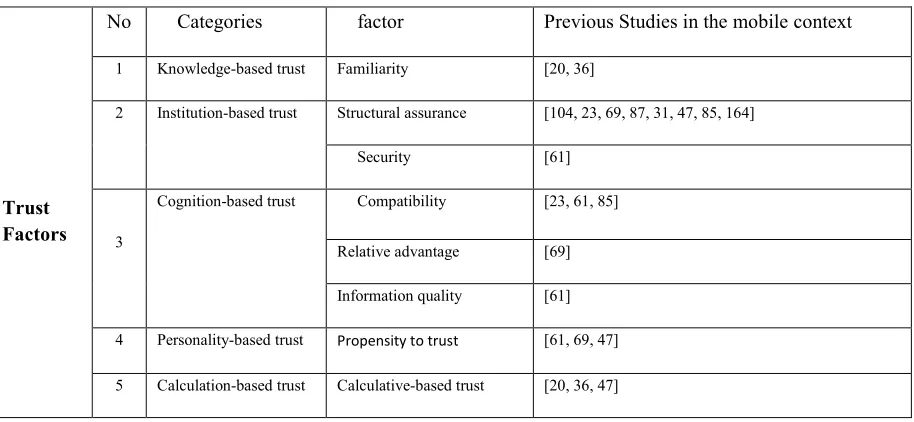
[image:5.612.89.546.336.547.2]The propensity of individuals to use their mobile phones and then to use them for mobile commerce gives some basic evidences, which could be produced as part of society profiles to which service venders could respond. However, it is crucial to gain the customers trust for making them to adopt mobile commerce in developing countries [47]. Nevertheless, people diverge in their inclination towards trust [61]. A lot studies have identified that inclination towards trust has direct influence on the formation of trust on M-commerce as shown in table 1. In SMEs, the customer’s with strong inclination towards trust more probably trust a service after evaluating that service. Therefore, inclination to trust will influence tourists trust in the adoption of M-commerce in SMTEs in Developing countries.
Table 1:Explains The Most Important Factors That Played A Vital Role Of Trust In The Customer Intention And That Supported In Previous Studies In The Mobile Context.
Trust Factors
No Categories factor Previous Studies in the mobile context
1 Knowledge-based trust Familiarity [20, 36]
2 Institution-based trust Structural assurance [104, 23, 69, 87, 31, 47, 85, 164]
Security [61]
3
Cognition-based trust Compatibility [23, 61, 85]
Relative advantage [69]
Information quality [61]
4 Personality-based trust Propensity to trust [61, 69, 47]
5 Calculation-based trust Calculative-based trust [20, 36, 47]
The table above shows the factors that have a significant impact on the trust and had been supported in a lot of previous studies in the mobile environment such as: Familiarity with M-commerce, Calculation-based, Structural assurance, Compatibility and Propensity to trust. However, no study has been conducted to investigate the impact of these factors in the adoption of M-commerce technology in Small and medium-sized Tourism Enterprises (SMTEs), especially in developing countries. Nevertheless this study aims to full this gap.
Security is a crucial factor that affects individuals to buy online. Generally most of the
consumers are reluctant to involve in online financial operations such as selling and buying as they fear that their personal and financial details might be stolen by hackers and other cyber criminals [128]. From a consumer’s perspective, the perceived security may be defined as “the subjective probability with which consumers believe that their personal information (private and monetary) will not be viewed, stored and manipulated during transit and storage by inappropriate parties in a manner consistent with their confident expectations” [113].
ISSN: 1992-8645 www.jatit.org E-ISSN: 1817-3195
378 selling and buying products and services and is built on the basis of a multitude of factors such as, the individual’s perception of the security of the payment system via mobile phones. Studies show that users’ perception of control is an important element of gaining trust in the transaction [28]. In spite of the security concerns, the trust factor very much influences the adoption of technology in various fields such as, E-commerce. However, there is a lack of studies that have examined the impact of
security in the adoption of M-commerce,
particularly in SMTEs [7].
A lot of previous researches highlighted trust to be an important and vital factor in the acceptance and usage of E- commerce. However, insofar this factor has not been addressed as a key issue in the development and success of
M-commerce in generally, particularly SMTEs [133].
Previous studies have identified many factors that have influenced trust in online transaction. Most of them have focused on the perceived security [74, 54, 68, 153,32]. It is worth mentioning that the security is seemingly important in mobile
commerce rather than the E-commerce
environment, because due to the weak links it becomes easy for the intruders to snoop into
financial information in mobile commerce
environment. Of late most of the portable devices such as note books, PDAs do not have the similar facilities as the mobile phones such as: smart cards to enhance security, roaming to stay connected on the move, therefore the mobile devices are limited in their use in wireless environments. The possibility of merging these technologies for a specific setting depends on the security protocols. It is very imperative that the lack of security is one
of the biggest obstacles, which stops consumers from adopting mobile commerce. However a lot studies have focused on the security factor in ‘wired’ environments, but only few have dealt with wireless environment [48].
3. RESEARCH MODEL AND HYPOTHESES
A model refers to an estimation of, and a simple version of some real life feature [71]. In the present research, a trust model for acceptance of M-commerce in SMTEs of developing countries is developed in an attempt to get better insights of the factors that impact trust in M-commerce. This model can be deemed as an elemental framework for acceptance because SMTEs in developing countries first need to work on the variables if they are desirous of accepting M-commerce in their business operations.
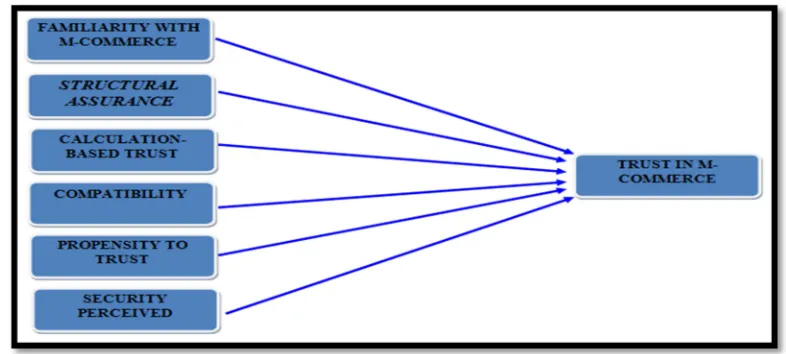
The six variables included in the model are presented in Figure 1. They are familiarity with M-commerce, structural assurance, calculation-based trust, compatibility, propensity to trust, and
perceived security. A simpler model is
[image:6.612.107.500.522.699.2]recommended for SMTEs in developing countries, to make it easy for them to employ in their businesses as opposed to complex models that are created based on the conditions present in the developed countries. The justification behind the choice of constructs is because based on the literature review, these constructs are significant in understanding and explaining the decisions of SMTEs in developing countries when it comes to M-commerce acceptance.
ISSN: 1992-8645 www.jatit.org E-ISSN: 1817-3195
379 The purpose of this study main focus is to examine the critical factors that influence on user trust for the acceptance of M-commerce by SMTEs in developing countries. The research hypotheses that are proposed to accomplish these research goals as described as the following:
3.1 Familiarity With M-Commerce
Trust is considered as a main element in the sustainable development of IS [152]. In the field of technology, sociology and computer science, researchers acknowledge the relation between familiarity and trust. Familiarity also has a hand in influencing trust by firstly, building trust when the vendor displays behavior worthy of trust or when the vendor does the opposite; secondly, familiarity creates a framework in which specific positive expectations from the trusted party exists [42]. When it comes to a novel and strange system, consumers care more about privacy and are hence slow to trust. On the contrary, increased familiarity with a system could mean a higher understanding of the transaction process with the e-service providers in SMEs and this translates to increase in consumer trust [149].
The growth of B2C electronic commerce is slowed down by factors and among the main ones is lack of trust. With insufficient rules and customs, consumers depend on the familiarity and the reputation of a system to minimize the uncertainty in their transactions [154]. M-commerce applications have showed significant evolvement in developing countries [51]. Many studies in the developing countries have noted that trust is a significant factor that affects the employment of M-commerce applications in various domains. Additionally, the role of familiarity in trust has been examined in the context of commerce [60]. In other words, familiarity is required to pursue and obtain trust [110, 9, 144] and trust only arises in a familiar situation. The situation may be modified to be conducive to trust and this may affect the potential of creating trust in human interactions [89].
In the context of SMEs, the impact of the change ability of familiarity upon trust is critical in
understanding M-commerce trust as the
environment in M-commerce provision of
application is distinct from the conventional commerce environment. Hence, citizens are mostly unfamiliar with the environment particularly in its earlier stages where it is critical to reinforce citizen’s trust. According to [156], trust is influenced by the familiarity of the consumer with
the E-commerce experience. In developing countries, not much focus has been given in the literature in terms of studying how familiarity influences trust in M-commerce environment in specific industry such as tourism from technological and hypothetical perspectives [88, 7]. In E-commerce environment, trust was reported to significantly predict purchase intention of potential as well as repeat customers where familiarity and disposition to trust were significant for both [114]. In another study conducted about online firms, the trust impacted the willingness of the consumers to transact online and that familiarity influenced trust. In other words, familiarity was found to be significantly related to the transaction willingness of consumers. In Kuwait, [122] study found that the familiarity had a direct effect on customer’s trust, which in turn affects behavioral intention to adopt online payment. Hence, M-commerce familiarity is considered an important factor affecting customer trust in M-commerce application use in SMTES of developing countries. So, this study hypothesizes that:
H1: Familiarity with M-commerce services will positively influence consumer trust to use M-commerce application for SMTEs.
3.2 Structural Assurance
The perceived structural assurance is viewed as an integral element of trust [93]. It is defined as the belief that it is probable to succeed due to the existence of appropriate contextual conditions such as: promises, contracts, regulations, and guarantees [87].The development of trust is categorized by [97] study into antecedents, trust and behavioral intentions. Trust antecedents are those elements determining its formation. In the context of developing countries, structural assurance indicates the important trust antecedent in the alternative evaluation phase and is important in the SMEs purchase state in Internet marketing [129]. Structures provide an appropriate environment, which gives users a sense of security. Additionally, previous empirical research reveals that structural assurance encourages the development of online trust [22, 108].
ISSN: 1992-8645 www.jatit.org E-ISSN: 1817-3195
380 that actual knowledge transfer is occurring [105]. [101, 55] studies contended that structural assurance impacts the trust belief of users and their trust intention. This in turn, results in affecting their behavioral intention towards system use. Hence, SMEs in developing countries are confident in the institutional structures role in encouraging taking
the opportunity to employ M-commerce
applications. However, this does not mean SMEs will always be ready to employ M-commerce as they may reject its adoption even with structural assurance owing to their values and internal process or their analysis of the relative strengths and weaknesses [64].
SMEs use of information systems has been addressed in many studies. Several studies of SMEs adoption in developing countries were done in light of E-commerce [119, 65, 21,124-95]. Nevertheless, there is a gap in literature concerning the relationship between psychological process of structural assurance and the purchasing intentions of consumers [127]. In E-commerce relationship trust, [98] revealed that institution-based structural assurance is a factor that influences trust related Internet behavior. Even though, structural assurance is considered as the most imperative feature in the acceptance of mobile technology, the trust of individuals is believed to be the foremost feature for enhancing mobile commerce applications [87]. However, there is a lack of literature in terms of
investigating the relationship between the
psychological process of structural assurance and the purchasing intentions of consumers in developing countries [7]. [151] reported that one of the most significant factors that affect mobile payment trust was the structural assurance of mobile technology. In mobile businesses, [165] reported that structural assurance is considered as one of the primary factors that affect initial trust – a factor that eventually affects usage intention. Thus, structural assurance is considered as an important factor affecting customer trust to use M-commerce application in SMTES of developing countries. So, this study hypothesizes that:
H2: Structural assurance will positively influence consumer trust to use M-commerce application for SMTEs.
3.3 Calculation-Based Trust
The calculation based trust can be employed to forecast the level of trust between users in the network [62]. Comprehending the calculative-based trust can help institute and uphold trust relationship among buyers and sellers in the commercial
process. The concept of calculative-based is getting very popular due to its impact [78]. However, the theoretical foundation has received little attention [7]. In SMEs, calculative-based notion stemming from cost-benefit analysis is considered as a salient antecedent of customer’s trust on the vendor in the stage of purchasing stage [18, 129]. It represents the most general type of trust that exists in the beginning of the business interaction. The parties to the interaction analysis the level of their dependency on the other, the expected profit and the potential risks to decide if they are ready to develop trust with one another. In other words, this kind of trust stems from an accurate calculation on the basis of financial criteria [136].
Consumers using the calculation-based trust will try their hand at predicting the intention of the seller through the latter’s trustworthiness and by confirming his history of fulfilling orders at the right time and his reputation. The benefits and the potential disadvantages of trusting such a seller is then considered and a decision is made whether to trust him on the basis of gains and losses. This type of trust commonly resides in most relationships among unfamiliar parties and is violated in an instant with a minor breach of expectations [12]. This cost-benefit analysis of opportunities consequently results in calculation-based trust where it is ill-advised for the other party to exhibit opportunistic behavior [43]. In the context of M-commerce shopping in developing countries, such as Jordan, customers trust are obtained by enterprises like tourism sector by convincing them that the enterprises will hold their part of the bargain, offer services and products that are aligned with the customers’ expectations, and refrain from providing misleading information; the information provided are accurate, up-to-date with reliable services [138, 7]. In this context, the customer can be expected to lay his trust on an e-vendor more if the former is convinced that the e-vendor has more to lose by misleading him or by breaking customer trust. In mobile environment, Calculative-based trust will positively affect trust [46]. There are various external determinants that may shed a light
on trust formation in a more complex,
ISSN: 1992-8645 www.jatit.org E-ISSN: 1817-3195
381 trust to use M-commerce application in SMTES of developing countries. So, this study hypothesizes that:
H3: Calculation-based trust will positively
influence consumer trust to use M-commerce application for SMTEs.
3.4 Compatibility
Compatibility is described as an important innovation characteristic of the innovation diffusion theory [120]. Compatibility is considered as the level to which innovation is believed to be aligned with the prior performance and the needs of potential adoption with the current working environment, working processes, values, and beliefs of the SMEs [17]. The innovation’s perceived compatibility impacts the innovation adoption [142] and high compatibility will result in preferable adoption. Moreover, Internet users who are convinced of the mobile commerce alignment with their principles and jobs are more susceptible to adopting this type of services [7]. According to [56], the issues concerning compatibility with trust in IT systems should be kept in mind. Also, compatibility predicts the adoption of various mobile services [61]. It is revealed to develop trust in information system like E-commerce and may be an important factor in developing or destroying trust of both potential and current customers [16].
Moreover, [57] revealed a positive association between innovation adoption and compatibility. This is also evidenced in [86] who noted that a considerable correlation exists between the degree of trust and partners’ compatibility with one another. Parties to the contract were more inclined to trust each other when they have common values in light of normative, cultural, procedural and technological orientation. Higher compatibility would therefore result in stronger bonds in the parties’ relationship [125] which improves trust. As for the mobile communication system, according to
[29], the innovation attributes including
compatibility significantly impacts customer’s trust.
In the developing countries’ SMEs, such as Jordan, a sector that is experienced in mobile internet or E-commerce, they must already be aligned with M-commerce application. In other
words, a business having strong positive
inclinations towards M-commerce may easier to put their trust on M-commerce applications and use it [23] indicating that great levels of technology compatibility has a high probability of resulting in
the enterprise acquisition of a deeper understanding of a system, which in turn, enhances its trust in the technology and encourages its acceptance. On the other hand, a business that does not feel compatible with E-commerce applications will refuse to trust it, has less intentions of using it and will not facilitate its diffusion [52]. However, in terms of tourism sector the mobile commerce is more probably compatible with the precedent mind-set of customers, especially when they have some experience in using Internet through their mobile devices. However, customers with pessimistic thoughts towards the mobile technology might feel intricate to trust and use the mobile commerce
applications provided by SMEs developing
countries, such as Jordan [7]. As for technology acceptance (where the Internet facilitates online betting), [70] reported compatibility to be the top significant factor. Hence, it is crucial for marketers to create their marketing literature on the basis of this factor and for online betting services to
continue offering a compatible service. Therefore,
calculation-based trust is an important factor affecting customer trust to use M-commerce application in SMTEs of developing countries. So, this study hypothesizes that:
H4: Compatibility will positively influence
consumer trust to use M-commerce application for SMTEs.
3.5 Propensity To Trust
ISSN: 1992-8645 www.jatit.org E-ISSN: 1817-3195
382 In online environment, individuals who easily trust have a higher probability to purchase in comparison to those who are reluctant to trust. In other words, the lack of clear acknowledgement to specific online transactions, a person characterized by a high trust propensity or innovators easily ascribe trust intention to the transactions despite other contexts [162]. Despite of the importance of trust propensity in trust building in E-business [132], little research has been done to examine the query whether an individual’s propensity to trust other people significantly impacts his/her trust in system [45].
Along the same line, [79] discovered that the individual’s trust propensity significantly impacts his/her trust indicating that an organization should consider it their long-term commitment to develop and enhance the level of system trust among their employees. In order to obtain consumer trust in developing countries like Jordan, SMEs need to use various security methods. Currently, there are several unresolved issues concerning the various modes efficacy in increasing consumer confidence. According to [13], a trust disposition influences online vendor trust as well as individual’s intention to commit in trust-related behaviors through inference, intentions to interact in online purchase behavior. Furthermore, In SMEs in Jordan as developing country, the customer’s with strong inclination towards trust more probably trust a service after evaluating that service [7]. In Kuwait as developing country, [122] found that the propensity to trust has a direct effect on customer’s trust beliefs which in turn affects behavioral intention to adopt online payment. Propensity to trust was revealed to influence perceived site quality as individuals with low propensity to trust have a tendency to be more critical of an object in terms of trust whereas those having high levels have a more positive tendency [99, 76]. They found that consumer trust is positively affected by propensity to trust in the web business. Hence, trust propensity is an important factor affecting customer trust to use M-commerce application in SMTEs of developing countries. So, this study hypothesizes that:
H5: Propensity to trust will positively influence consumer trust to use M-commerce application for SMTEs.
3.6 Perceived Security
The increasing technological developments have made considerable contributions in the security of the Internet for e-business. Nevertheless, the
challenges are still rampant in this area, and security is still the top issue in the development of e-businesses [157]. Perceived security is described as the subjective probability with which the consumers are convinced that their personal information will remain private and secure during its transit and storage by parties in a manner that is aligned with the expectations [39].
Transacting through the internet while disregarding the security risks involved could translate into a grievous mistake. Prior study has addressed the security control in E-commerce environment and found in invaluable in trust development processes. Perceived security control is described as the perception of security related to the transactions with a web site [74]. When carrying out business transactions online, it is important to keep in mind that consumers should be made to feel secure upon providing their personal information including address and credit card details. Security, an element mandatory for trust, is prevalent in more advanced E-commerce economies and is therefore assumed by many consumers while conducting online transactions with SMEs [25]. In addition, security is considered among the main barriers to developing E-commerce applications in SMEs in majority of developing countries [84, 91, 58, 158]. In other words, information safety is critical for the company for the integrity of the entire application when it comes to E-commerce applications implementation.
Studies in psychology reveals that
individuals who perceive themselves to be in control are more inclined to feel and behave in a positive manner and those who feel that they are more in control over the purchase process perceive great level of trust in interacting with online environment [153]. In the context of developing countries, the perceived security is found to positively impact customer trust in various SMEs. With secure technology, the customer is more likely to lay their trust. In other words consumer trust positively relates to the his/her behavioral intention to adopt a technology – when he/she trust the technology, he/she will likely use it [145]. In spite of the security concerns, the trust factor very much influences the adoption of application in various fields such as, E-commerce. However, there is a lack of studies that have examined the impact of security on customer trust in the adoption of
M-commerce applications for enterprises in
ISSN: 1992-8645 www.jatit.org E-ISSN: 1817-3195
383 trust (Website Trust) indicating that transaction security may be the top most significant factor that influences consumer trust in websites. Moreover security is positively associated with trust in online shopping as it influences the willingness of the people to voluntarily provide their personal information including their address, credit card number etc. when transacting [26]. [15] Showed that web site security directly and significantly impacts consumer trust in financial service web site. In a developing country like China, perceived security was shown to positively relate to initial trust in mobile brokerage service [61]. Hence, perceived security is an important factor affecting customer trust to use M-commerce application in SMTES of developing countries. So, this study hypothesizes that:
H6: perceived Security will positively influence consumer trust to use M-commerce application for SMTEs.
4. RESEARCH METHODOLOGY
An empirical study was designed to test the research framework and the above mentioned hypotheses. We will briefly address here some methodological issues related to the subject (section 4.1) data collection (section 4.2) and the measurement of variables (sections 4.3).
4.1 Subjects
When we conducted our research in developing country, we chose to target SMEs in tourism sector, because, tourism industry is one of the largest industries in the world and its association with the Internet has made it the largest online industry [30]. Moreover, majority of the tourism enterprises all over world comprise of small and medium-sized tourism enterprise [66]. Due to economic diversification, the tourism industry suffers more in developing countries than the developed countries [143]. SMEs play a more important role in the economic development than the large-sized enterprises. However, in the context of developing countries, the contribution of SMEs in employment and GDP is relatively low (30% and 17%, respectively) compared to developed countries where it significantly contributes to employment (60%) and GDP (50%). Even though the SMEs need to employ the role of IT effectively and with more efficiency, their role in competitiveness has been primarily focused on large-sized enterprises. This in turn leads to the very slow adoption of IT [3]. In Jordan as example of developing counties,
the Jordanian Ministry of Industry and Trade has classified the SMEs depending on the number of staff and money invested for accomplishing their business objectives. In the context of Jordanian economy, unemployment rate is quite high at 12.5% and SMEs evidently have a significant role in economic development as it reflects 98% of total employer and 52% of the workforce. On top of this, they provide all the new jobs and 51% private sector output along with 96% of total exports. Thus, Jordan is highly dependent on SMEs to be the force behind its economy [59, 8]. Approximately 98% of all Jordanian businesses employing less than 50 workers are categorized as SMEs – this depends on the number of workers for every establishment, as two third of these establishments have no more than 19 employees [106].
Jordan has relatively limited natural resources to support its economic development, leading it to search for other sources of income, of which tourism has become an essential player. Jordan has managed to capitalize on its strategic central location in the area, its relative stability and security, along with pleasant climate, to establish a reputation for being tourist destination [6]. In addition to the above, the Jordanian government has confirmed its commitment to construct the
country’s information and communication
technology infrastructure as contended by [137, 4]. According to [3], both public and private sector, including tourism must launch a comprehensive information systems strategy toward expanding Jordanian business to reach the international market; in order to exploit its opportunities [38] such as M-commerce. Nevertheless, various significant factors are expected to impact these innovations acceptance and adoption. To focus our research, we selected Small and Medium-sized Tourism enterprises (SMTEs) in Jordan.
4.2 Data Collection
ISSN: 1992-8645 www.jatit.org E-ISSN: 1817-3195
384 The sampling frame of this study comprises of updated lists of employees from the selected SMEs in the tourism industry. Data were collected based on stratified sampling only from the SMEs in the tourism industry. The stratified random sampling of tourism industry might efficiently demonstrate the differences in willingness of the
SMEs in terms of adopting M-commerce
applications. Furthermore stratified random
sampling is suitable for selecting samples from different groups. In this study, we use stratified sampling based on locations. Hence the survey was carried out in 2012 with a random sample of SMTEs selected from the South, Central and North of Jordan. In this study, stratified sampling by geographic area is used
Sampling entails selecting a specific subset of individuals from a given statistical population in order to study its characteristics [146]. Selection of SMEs in the tourism industry that participated in the present study is based on the information on the population obtained from Ministry of Tourism. The sample size of the present study is drawn from a total population of 4601 employees. Therefore, the sample size of this research is 357 [75]. However, the researcher decided to collect 397 data. The reasons behind the collection of extra 40 data lie in the preference to achieve high of response rate. Secondly, the researcher follows the central limit theorem which states that the large sample size, the more probable the sample mean is close to normal distribution. The achievement of larger sample size indicates closer to normal distribution. If just target exactly 357 sample sizes, it is risky facing insufficient sample size in data collection process. Out of 600 questionnaires distributed to tourism SMEs, 397 questionnaires were returned. Out of these 397 questionnaires, 36 were returned incomplete. Thus, 361 questionnaires or 60.2 percent were coded in data key in process and used for further analyses.
4.3 Measuring Instrument
The measurement methods used in this study were drawn from literature on IS and M-commerce. For all concepts, we asked respondents to rate their level of agreement with statements using 6-point scales (1 = strongly agree and 6 = strongly disagree). Familiarity with M-commerce was measured using four-items adapted from [9], structural assurance was measured using five-item scale developed by [100, 31], calculation-based
trust was constructed using three-items of [43] as well as one-item of [34, 31]. Moreover, compatibility with mobile commerce was measured using three-items adapted from [107, 23] as well as two-items from [92]. Propensity to trust was measured using five-items adapted from the study of [97, 148] in addition to two-items of the study of
[42] while perceived security was measured
using
four-items adapted from [19, 74].
4.4 Test Of Reliability, Validity And Identification Of Factors
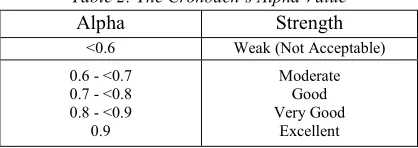
[image:12.612.313.522.538.612.2]Once the data collection had been completed. In order to ensure that the measures improved in the instrument were reasonable and suitable, its reliability and validity must be examined. Reliability refers to the stability of indicators available to measure the concepts that help in assessing the quality of the measurements and leading to consistent results [126]. Reliability tests items used in the questionnaire as instrument to collect data. It finds the consistency of respondents’ answers to all the questions in the study. It tests the degree to which the questions independently measures the same concept in the sense of their correlation with one another. The Cronbach’s alpha was used to measure the reliability of questions for each variable. The Cronbach’s alpha above or equal to 0.70 is considered reliable as suggested by [111] and to measure the strength of reliability [70]. Rule of Thumb for Cronbach’s Alpha is followed as depicted in Table 2 below:
Table 2: The Cronbach’s Alpha Value
Alpha Strength
<0.6 Weak (Not Acceptable)
0.6 - <0.7 0.7 - <0.8 0.8 - <0.9
0.9
Moderate Good Very Good
Excellent
ISSN: 1992-8645 www.jatit.org E-ISSN: 1817-3195
[image:13.612.83.526.92.209.2]385
Table 3: Cronbach’s Alpha (Α) Reliability Coefficients For The Main Constructs
Variable No.of
item
Cronbach's Alpha
Strength
Trust in M-commerce 6 0.797 Good
Familiarity With M-commerce 4 0.892 Very Good
Calculative Based Trust 4 0.763 Good
Structural Assurance 5 0.772 Good
Compatibility with mobile commerce 5 0.748 Good
Propensity to trust 7 0.820 Very Good
Perceived Security 4 0.812 Very Good
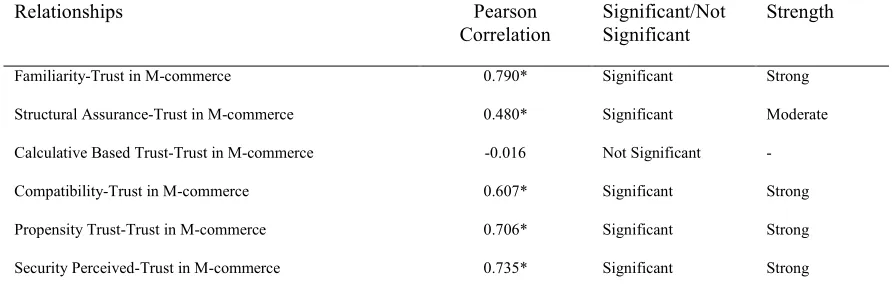
In this study, researcher conducted Pearson Correlation analysis with the correlation coefficient used to explore the strength of relationship for each variable. Correlation analysis is a statistical method used to describe the strength and direction of the linear relationship between two variables [112]. The degree of correlation is concerned with measuring the strength and importance of a relationship between the variables. To achieve this, the bivariate
association was conducted. The procedure
computes Pearson’s correlation coefficient with
[image:13.612.84.306.375.435.2]significant levels. Pearson correlation coefficients can only take one value which ranges from - 1 to +1. The magnitude of the absolute value, while ignoring the sign provides an indication of the strength of the relationship between two variables. The perfect correlation of 1 or -1 indicates that the value of one variable can be determined exactly by knowing the value of other variable. [24] method explored such relationship and gave the following guideline as shown in table 4:
Table 4: The Strength of Relationship
No. Correlation Coefficient Type of Strength
1.
2.
3.
0.1 to 0.29 OR -0.1 to -0.29
0.30 to 0.49 OR -0.30 to -0.49
0.50 to 1.0 OR -0.50 to -1.0
Weak
Moderate
Strong
The summarized results for correlation analysis between independent and dependent variable for this research are as shown in table 5:
Table 5: Pearson Correlation Result For Relationship Between Independent And Dependent Variables
Relationships Pearson
Correlation
Significant/Not Significant
Strength
Familiarity-Trust in M-commerce 0.790* Significant Strong
Structural Assurance-Trust in M-commerce 0.480* Significant Moderate
Calculative Based Trust-Trust in M-commerce -0.016 Not Significant -
Compatibility-Trust in M-commerce 0.607* Significant Strong
Propensity Trust-Trust in M-commerce 0.706* Significant Strong
Security Perceived-Trust in M-commerce 0.735* Significant Strong
Factor analysis method confirms the items or dimensions used accurate in each variable as measurements. Basically, factor analysis is a multivariate analysis procedure that attempts to identify any underlying “factors” that are responsible for the covariant among a group independent variables. The goals of a factor analysis are typically to reduce the number of
[image:13.612.83.529.461.606.2]ISSN: 1992-8645 www.jatit.org E-ISSN: 1817-3195
386 examining the validity is through the EFA and there are several guidelines established:
1) Correlation matrix – most pairs between
constructs are significance.
2) The Kaiser-Meyer- Olkin Measure should be
equal or more than 0.50.
3) Bartlett test of Sphericity (Approximate Chi-Square) – Large and Sig. (p-value) – should be less than 0.05.
[image:14.612.88.553.206.332.2]The purpose of the factor analysis rule above is to achieve data reduction or retain the nature and character of the original items, and to delete those items which had lower factor loadings and cross loading [49]. Table 6 reports the summary of factor analysis for all variables.
Table 6: The Exploratory Factor Analysis Result
Construct/Variable KMO BTS P-value
(Sig.)
Familiarity With M-commerce 0.700 176.276 0.0000
Calculative Based Trust 0.566 30.334 0.0000
Structural Assurance 0.686 249.504 0.0000
Compatibility with mobile commerce 0.737 390.995 0.0000
Propensity to trust 0.718 450.879 0.0000
Perceived Security 0.602 146.944 0.0000
On the basis of the overall factor analysis result, the researcher found that all variables met the rules and all items in the variables were retained for the next analysis.
5. RESULTS
5.1 Data Analysis
[139] described regression analysis as a statistical tool that investigates the variables relationship. It also used to as a predictive analysis method where one or more variables are utilized to predict the degree of another through the straight line formula including two way regressions. Multiple Regression analysis is an appropriate analytical technique for the research question of this study that seeks to find out the relationship between trust in M-commerce (dependent variable) and a set of factors such as familiarity with M-commerce, structural assurance,
calculation-based trust, compatibility, propensity to trust, perceived security (independent variables).
Normality test and multicollinearity test were first tested. A normality test was run in order to confirm the suitability of empirical data for statistical analysis. The normality assumption of data was assessed by Skewness and Kurtosis values. [49] advocated the use of Skewness and Kurtosis values as this analyses provide more accurate measurement of normality. The Skewness and Kurtosis values between ±2 are usually acceptable [44] which means that the Skewness and Kurtosis value and critical ratio should be less than or equal to -2 and not more than or equal to 2. The result revealed that the highest Skewness and Kurtosis for each items in the variables are below or equal to ±2. Therefore, the data is declared as normally distributed.
Table 7: Skewness and Kurtosis Result for Trust Perceived Descriptive Statistics
Variable(s) Skewness Kurtosis
Trust Perceived -0.071 -0.934
The result of normality data as presented in Table 7 proved that normality distribution for dependent variables; Trust Perceived is acceptable.
[image:14.612.83.516.611.672.2]ISSN: 1992-8645 www.jatit.org E-ISSN: 1817-3195
387 multicollinearity occurs when a high degree of correlation is found between the variables. The challenge in clarifying the impact of any single variable owing to their relationship is explained by multicollinearity. There are several ways to
measure collinerity existing between the
independent variables and they include, Pearson correlations, Tolerance Value and Variance Inflation Factors (VIF). For the examination of the multicollinerity among the study variables, Pearson correlations, VIF and tolerance tests were conducted. Based on the previous research conducted by [50], the researcher stated that the multicollinearity appears when the variables occurring separately actually measure the same
[image:15.612.83.549.273.370.2]thing. The collinearity can be detected by correlation of variable used, tolerance and variance inflation factors (VIF) test. This research follows [112], multi-collinearity explanation that its appearance occurs when the dependent variable is highly correlated with others variables that have coefficient above 0.90. The correlation analysis of the variables exposed to Pearson Correlation analysis indicated that all significant relationships were less than 0.90 indicating no multicollinearity problem. With that, the researcher took support from VIF and Tolerance values to confirm absence of multicollinearity as referred to table 8.
Table 8: Tolerance and VIF result
Independent Variable Dependent Variable
Collinearity Statistics
Tolerance VIF
Familiarity with M-commerce --> Trust in M-commerce 0.336 2.974
Calculative-based trust --> Trust in M-commerce 0.978 1.023
Structural assurance --> Trust in M-commerce 0.550 1.817
Compatibility with M-commerce --> Trust in M-commerce 0.266 3.764
Propensity to trust --> Trust in M-commerce 0.269 3.714
Security Perceived --> Trust in M-commerce 0.383 2.612
The result in table 8 shows that the values of tolerance ranged from 0.266 to 0.978 and the VIF values ranged from 1.023 to 3.764. Tolerance result for each independent variable was below 1.0 and VIF value was below the threshold point which is 10 [112]. The multicollinearity test above indicates that all the variables in this research were correlated and no multicollinearity problem appeared.
In this study, there are six major hypotheses which cover; the direct effect of familiarity with M-commerce on perceived trust,
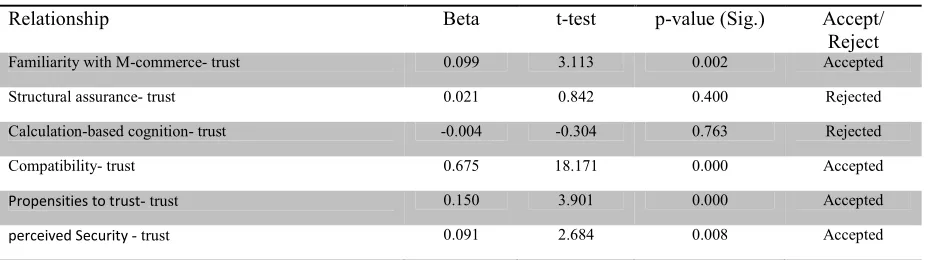
the direct effect of calculative-based trust towards trust, the direct effect of structural assurance on trust, the direct effect of compatibility with M-commerce on trust, the direct effect of propensity to trust on trust and direct effect of perceived security on trust. To examine the direct effects, multiple regression analysis is used and based on t-values (critical ratio). In Table 9 the results of the hypotheses that were being tested are presented. Four hypotheses were accepted (H1, H4, H5, H6) and two hypotheses were rejected (H2, H3).
Table 9: Regression Analysis Results
Relationship Beta t-test p-value (Sig.) Accept/
Reject
Familiarity with M-commerce- trust 0.099 3.113 0.002 Accepted
Structural assurance- trust 0.021 0.842 0.400 Rejected
Calculation-based cognition- trust -0.004 -0.304 0.763 Rejected
Compatibility- trust 0.675 18.171 0.000 Accepted
Propensities to trust- trust 0.150 3.901 0.000 Accepted
perceived Security - trust 0.091 2.684 0.008 Accepted
[image:15.612.86.550.562.692.2]ISSN: 1992-8645 www.jatit.org E-ISSN: 1817-3195
388
6. DISCUSSION
The purpose of this study is to identify the major factors influencing trust in M-commerce acceptance by SMTEs in developing countries. As mentioned
earlier, Familiarity with M-commerce,
compatibility, Propensities to trust and perceived security were found to be significant. We discuss the results in this section with implications for practitioners with respect to what can be done to improve SMTEs perceptions to accept M-commerce.
I. FAMILIARITY WITH M-COMMERCE
Familiarity was one of those factors where we hypothesized the existence of a relationship of familiarity towards the user trust in M-commerce application in our model. This study focused on Jordan, as an example of developing country, to address the impact of familiarity towards the user trust in M-commerce in SMTEs. On the basis of the results (table 9), the hypothesis concerning this variable is accepted as t-test is 3.113 and p-value less than 0.05. Hypothesis was accepted and indicated that an increase of 1% in familiarity with M-commerce will result in a 9.9% increase in trust of SMTEs to use M-commerce.
The result was consistent with the results of other previous research. For example, [36] showed that user’s familiarity positively contributes to the establishment of a communication IS by the end user. The research focused on the importance of trust in information systems adoption. Similarly, another researcher by [154] revealed that perceived familiarity is significant antecedent to online consumer trust. Moreover, with the use of statistical analysis, [160] revealed that the familiarity of consumers positively impacts consumer’s trust in mobile commerce applications.
II. STRUCTURAL ASSURANCE
In this research, we hypothesized the existence of a relationship of structural assurance towards the user trust in M-commerce application in SMTEs of developing countries. This study focused on Jordan, as an example of developing country, to address the impact of structural assurance towards the user trust in M-commerce application in SMTEs. This relationship was not accepted in our model. The result of this research, Table 9 in section 5.1 presents the t-statistics of 0.842 with p-value of 0.400. This p-value of over 0.05 indicates no significant influences of structural assurance upon trust in M-commerce.
This result is confirmed by some prior research. For instance, [147] revealed that the linkage between structural assurance and trust is not significant in purchase tasks and future purchase tasks. In a similar research, structural assurance that is vendor-specific was revealed to be insignificant for trust in the context of new customers. A possible justification is that new customers often overlook the structural assurance of the vendor if they are not serious buyers [72]. In addition,[55], they hypothesized that structural assurance promises that the web transaction can be carried out in an environment that is secure and safe and provide consumer protection against losses or privacy exposure by creating protective and technological structures. Superior degrees of structural guarantee may ensure consumers in conquering their doubts of online shopping and maximize their level of trust in the website. [55] revealed insignificant association between structural assurance and trust. In this study, the link from institution-based trust (structural assurance) to trust in M-commerce was not significant. This is an unexpected result as the respondents had considerable experience when it comes to the Internet. This may be explained by the fact that such experience was obtained via simple-information-based and shopping sites, as opposed to advice-providing sites used in this study. Hence, the respondents may feel that the structural assurance context, upon which they built their experience, is dissimilar to the study’s structural assurance context. The same argument was proposed by [98]. This result implies that in the context of M-commerce, structural assurance may be significant to trust, but the structural assurance context requires defining in specific terms to differentiate it from the
general beliefs concerning mobile internet,
specifically as mobile internet is increasingly being used for more particular application. The researcher calls for further research in this field.
III. CALCULATION-BASED TRUST