MULTI-ATTRIBUTE REVERSE AUCTION-BASED
PROTOCOL FOR RESOURCE ALLOCATION IN GRIDS
1,2LI-LI DING, 3WANG-LIN KANG, 4ZHENG-WEI WANG
1Assoc. Prof., College of Economics and Management, Shandong University of Science and Technology,
Qingdao, China
2Postdoctor, College of Physical and Environmental Oceanography, Ocean University of
China,Qingdao, China
3 Lecturer,College of Economics and Management, Shandong University of Science and Technology,
Qingdao, China
4 Mast. Stud.,College of Economics and Management, Shandong University of Science and Technology,
Qingdao, China
E-mail: [email protected]
ABSTRACT
Auction models are found efficient in managing resources allocation, which is a key technology in grid computing system. In this paper, a new reverse auction approach is proposed, and its mechanism and related auction algorithm are designed. In our approach, the grid trading service, i.e., an intelligent entity, uses this auction algorithm to estimate the resource user’s satisfaction degree and help the resource providers to update their multi-attribute bidding strategies in the next round. Numerical simulating experiments show that our model can satisfy a resource user’s quality demand on multiple attributes, and have better performance in user utility. The results also illustrate that revealing the resource user's preferences increases allocated efficiency.
Keywords: Grid, Auction, Multi-attribute, Algorithm,Grid Resource Provider
1. INTRODUCTION
Grid computing has emerged as a new paradigm for solving computationally large-scale problems in computer science, engineering, and commerce [1]. The participating resources in a grid may be computational resources, data storage or computer networks, which are located worldwide. Thus, it is difficult to design optimal grid resource allocation mechanisms which meet different objectives of both users and resource providers at the same time. In order to match these different requirements, several economic-based resource allocation mechanisms have been proposed to solve this complex problem. These economic models are suitable for grids because of their decentralized structure and the use of incentives for resource providers to contribute resources. Also, the objectives of both users and resource providers are considered when making allocation decisions. The most commonly studied economic models in the context of resource management in distributed systems are auction protocols, e.g., first price auction[2], double auction[3] and Vickrey auction[4].
Different from the original literature, we
auction-based approach has good behavior in grid environment. It has better performance on user satisfaction level and market information efficiency. We organize the paper as follows. Section 2 gives the related literature. In section 3, we present the reverse auction allocation model. In section 4, the iterative multi-attribute reverse auction protocol is designed and an iterative algorithm is presented to help the grid trading service (GTS) efficiently discover the user’s true value preference. Section 5 designs the bidding strategy for grid resource providers. The simulating experiment results are presented in section 6. In section 7 we draw conclusions and present future research directions.
2. RELATED LITERATURE
For the grid allocation problem, we represent related literature as follows.
2.1 Economic-Based Grid Resource Allocation Problem
Economic-based resource management in grid has been investigated by several researchers. The two main economic models often used are commodities markets and auctions. Most commodities market models introduce money and pricing as the technique for coordinating the selfish behavior of the grid trading service. Each user is endowed with money to purchase required grid resources. Each grid resource provider owns a set of grid resources and charges users for the use of his grid resources. Market plays a basic role in the allocation of grid resources.
In the auction model, users and grid resource providers act dependently and they can negotiate on the trading price. Auction models have advantage over commodities market models for grid resource allocation because they require little global information, have decentralized structure and are easy to implement. Most previous work considers only one type of auctions and compares it with other economic and conventional models. In [5], three types of auction allocation protocols are evaluated: First Price Auction, Vickrey Auction, and Double Auction. From users' and grid resources' perspective, they wanted to find the most suitable resource allocation mechanisms for the grid environment. The double auction models have received more attention. Three most popular double auctions are: Preston-McAfee Double Auction Protocol (PMDA), Threshold Price Double Auction Protocol (TPDA), and Continuous Double Auction Protocol. Huang et al. [6] investigated that a periodic double auction mechanism with uniform price suited for resource allocation on Grid. In their work, the double auction took place in rounds and
all exchanges were performed with the same price. Zakian et al. [7] also used a continuous double auction method for grid resource allocation. They used market-like techniques to provide an incentive for providers, and motivated the users to trade-off between deadline, budget, and the required level of quality of service. In [8-9], the computational auction mechanism for allocating and scheduling computer resources such as processors or storage space that had multiple quality attributes was proposed. The mechanism was evaluated according to its economic and computational performance.
2.2 The Multi-Attribute Reverse Auction
on evaluation of their multiple conflicting attributes. Singh and Benyoucef [14] presented a methodology for solving the sealed bid, multi-attribute reverse auction problem. They provided a fuzzy TOPSIS based methodology along with a mechanism for determination of fuzzy linguistic value of each attribute.
3. REVERSE AUCTION ALLOCATION MODEL
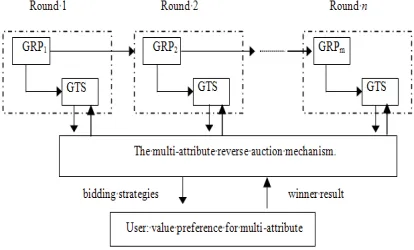
[image:3.612.92.299.303.428.2]In this paper, we consider the problem of reverse auction allocation problem with available grid resources of multiple attributes. The main participants in the reverse auction allocation model (see Figure 1) are: a resource user, grid resource providers (GRPs) and grid trading service (GTS). In the following we present each participant and describe their roles and characteristics.
Figure 1: Reverse Auction Allocation Model
Resource User: He bargains with the grid resource providers in a global grid, and announces his resource requirements * * * *
1 2
( , , , j, , k)
J z z z z ,
where z*j is the reserved value of attribute j,
{1, 2, , }
j∈ k . Each user is characterized by a utility function that describes his preference. The multi-attribute utility functions in the above literature are always based on the simple additive weighting (SAW) method [10, 11]. A utility or a score in the SAW method is obtained by adding the contributions of each attribute. There are other methods for multi-attribute utility functions, e.g., multiplying the contributions of the various attributes. In this paper, we refer to the latter one, since the user often reveals his utility function information to discover the maximal provider’s surplus. For the grid allocation problem, the satisfaction degree often represents the user’s utility. This satisfaction degree function gives a value, which is the sum of the user’s levels of satisfaction level from various attributes’ values, comparing with each attribute’s reserved value. For example, the less price, the more satisfaction. Thus, we
design a true satisfaction degree function u GRP( i)
with the bid of GRPi based on k attributes, e.g.,
computational speed, workload and working time, for the user as follows.
1 *
* 1
( )
k
j ij
i j
j j
z a
u GRP w
z
β β
=
−
=
∑
(1)
where aij∈A indicates the attribute j in round i,
j
w (w≤wj ≤ w ) indicates the weight of attribute
j, * j
z indicates the reserved value of attribute j, β is
a parameter of Lβ metric. Different from the
literature of [15], we consider * j
z as the reserved value rather than the ideal value of attribute j.
Grid Resource Provider (GRP): They contribute their resources to the grid and charge user for resource. In the reverse auction mechanisms, after user notifies all available computing resource with k attributes, GRPs arrive dynamically with unlimited supply ability. Namely, it assumes that there are n rounds during the whole auction and in each round only one grid resource provider arrives. We represent the bid of GRPi,
(1, 2, , )
i= m as b a ai( i1, i2,,aik) , where
ij
a stands for the value of the jth attribute offered by
GRPi. Each GRPi has a valuation v a ai( i1, i2,,aik) for the computing resource, which is known only to him. In this paper, we allow GRPs to declare untruthful types. For simplicity, we also assume that GRPs neglect their providing cost because of the massive market trades. Thus, there is a novel approach designed to help GRPs discover the private information of user, which also reduces the cost of information exchange and improve information efficiency.
Grid Trading Service (GTS) is an intelligent entity or an auctioneer to enable users to find the right resources that match their requirements. It provides support for GRPs to deploy auction mechanisms. For instance, it designs a method to estimate the satisfaction degree of user and help GRPs to decide their bidding strategies. It approximates this function with a weighted Lβ. In
each round, it updates the estimation of the parameters β and wjof the Lβ in order to provide
4. MULTI-ATTRIBUTE REVERSE AUCTION PROTOCOL
In our implementation of the multi-attribute reverse auction protocol, the user firstly notifies all available GRPs of his resource request. At each round t, the grid resource provider bids according to his price policy, and the auctioneer (GTS) estimates the utility function based on the past preferences of GRPs. Moreover, the auctioneer improves the estimated satisfaction degree function and informs GRPs about his estimations in the coming round. According to these estimations and their cost functions, GRPs update their bids for the next round. Finally the user decides who wins the auction according to the reverse auction protocol. We use a small positive constant threshold, denoted by Δ, to represent a minimum preference percentage difference by which the user can distinguish between bids. For example, if the user prefers A to B, then we requireu A( )≥u B( )(1+ ∆). In each round, let SP and NSP denote the sets of preferred and not preferred bids, respectively. Let
t
X denote the set of constraints derived from the past preferences of GRPs in current round. SetX0 = Φ. We design the following the auction algorithm to help the grid resource providers to discover the user’s preference and update their bids.
Auction Algorithm:
Step 1.The user announces the request with k
attributes. Set t=1 and SP=NSP= Φ. Step 2. In round t, a grid resource provider comes
and presents his bid together with other attributes.
Step 3.The user decides whether to accept the bid. If the current grid resource provider improves the user's estimated value by ∆, then this bid is the temporary winner and placed in set SP and go to Step 4. Otherwise, consider this bid as refused and place it in set NSP and go to Step 6.
Step 4. GTS updates the preference constraint set.
1 { ( ) ( )(1 )
}
i j
t t
X X u GRP u
i SP and j NSP GRP − = ∪ ≥ + ∈ ∀ ∈ ∆ (2)
Fit a satisfaction degree function that satisfies the constraint set Xt for the
smallest positive integer β . Let the estimated satisfaction degree function value of the accepted bid of the current round t be
* u .
Step 5.Move to an improved contour with an estimated satisfaction degree of ut in round t, i.e.,
*(1 ) t
u =u + ∆ (3)
GTS recommends the coming GRPs to move onto this contour by providing them with the current β , wj and ut . Let the
coming grid resource provider update his bid and set t= +t 1. Go to Step 2. If t=n, then go to step 6.
Step 6. Stop. Choose the winner in set SP. If there are more than one winning GSPs, the user selects by additional information, e.g., cooperation relationship.
5. BIDDING STRATEGIES FOR GRPS
In each round, the GTS starts the auction and receives one bid before this round expires. The GRPs determine their bids based on their cost structures and the current improved contour. In this paper, we assume that all GRPs neglect cost. In each round they update their bids according to the estimated satisfaction degree function provided by the GTS. After obtaining all the past information about GRPs’ multi-attribute bids in current round, we solve the following problem to estimate user’s preference satisfaction degree function.
1 1 * * 1 max
. . 1
( ( ) ( )( ) ) 1 k j j j k j ij i j j j i i j j
s t w
w w w j
z a
u GRP w i
z
GRP GRP
GRP preferred to GRP
u u β β ε ε = = = ≤ ≤ ∀ − = ∀ ∀ ≥ +
∑
∑
in current round
ε
≥ ∆
(4)
where w is the lower bound for estimated weights
of attributes, w is the upper bound for estimated weights of attributes and ε is the minimum difference between the satisfaction degree function of the preferred bid and the other bids.
past preferences of user are reflected by (2). A threshold preference level of Δ is enforced by constraint of ε ≥ ∆ .This indicates that the minimum difference between the satisfaction degree function values of the preferred bid and the other bids should be at least Δ, since the user has distinguished between these bids.
6. SIMULATING EXPERIMENTS
In this section, the simulating experiments are given to describe two attributes about price and memory, which are important for the user to make decision. In our simulation, a user submits resources or jobs to the GTS, which in turn initiates an auction for each request. We use the iterative algorithm here. Here, GRPs are the bidders and they bid for executing jobs. We simulate configurations of 20 resources with 1000 MIPS (million instructions per second) processing capacity. Let p denote the price with the weight
of wp =0.6 and mdenote the memory with the
weight of wm =0.4. Suppose that the reserved
value of price is * 10 p
z = $, reserved value of
memory is z*c=1G and β =3. Then, the user's underlying satisfaction degree function is that
* *
1
* *
{( ( p )) ( ( c) )}
p m
p c
z p m z
u w w
z z
β β β
− −
= +
(5)
Here, there are two attributes, i.e., price and memory, where price is to be minimized and memory is to maximized. They must be standardized to achieve the consistency. According to the rule of [10], for the profit type, the score denoted by lij is lij =aij maxaij and for the
cost type the score is lij =minaij aij . Since
satisfaction degree about the various attributes’ values in (1) has normalized the original data, we use the original data of p and m to calculate the user’s satisfaction degree. In Table 1, we give bidding strategies of eleven GRPs.
[image:5.612.290.527.52.499.2]In round 1, the first grid resource provider presents price and memory for the resource or the job in Tab. 2. The user computes the value by his true value function. Since 0.213459 is larger than the user’s reserved value, the user accepts this bid, which is the temporary winner.
Table 1: Bidding Strategies of GRPs
Table 2: Estimated Satisfaction Degree by GTS
In the coming round, the multi-attribute bid is refused for the smaller value. In the third round, the new multi-attribute bid is accepted since
0.224144>0.213459(1 0.05)+ . By this time, there are two temporary winners in set SP. The GTS begins to estimate the satisfaction degree of the user. It starts with β=1 and computes the weights of these two attributes by solving (4), i.e.,
0.2751 p
w = and wm =0.7249 . The estimated
satisfaction degree in round 3 is u* =0.4119424. These estimated parameters satisfy the condition of
0.4326941
0.4119424>1.0503 . Based on these estimated satisfaction degree functions, the following grid resource providers present the fourth and fifth multi-attribute bids. Although the estimated satisfaction degrees are increasing, i.e.,
0.4545045>0.4400155, the user refuses these bids
Round p m
*
* p
p
z p
z
− *
* c
c m z
z
−
1 8.9790 2.1250 0.10210 0.52941 2 7.9000 1.9990 0.21000 0.49975 3 7.5970 2.0220 0.24030 0.50544 4 7.5456 2.0567 0.24544 0.51378 5 7.5350 2.1430 0.24650 0.53336 6 7.5389 2.1520 0.24611 0.53531 7 7.4560 2.2120 0.25440 0.54792 8 7.3310 2.2516 0.26690 0.55587 9 7.1890 2.3316 0.28110 0.57111 10 7.1560 2.2316 0.28440 0.55189 11 6.9760 2.3216 0.30240 0.56926
R. A.
True Satisfaction
degree
Estimated satisfaction degree t
u
1 √ 0.213459 0.4326941
2 0.215359 0.4200967
3 √ 0.224144 0.4119424
4 0.228136 0.4400155
5 0.234807 0.4545045
6 √ 0.235360 0.31768796
7 0.241495 0.32554832
8 √ 0.247164 0.2470630
9 0.255705 0.2556059
10 0.250542 0.2564760
according to his true satisfaction degree function. Thus, the GTS begins to update the estimated preference satisfaction degree function, i.e., it increases β from 1 to 2 in round 6. The estimated
parameter values are wp =0.4425 and
0.5575 m
w = . The seventh multi-attribute bid is invalid, since it does not exceed
0.247128(0.247128=0.235360 (1 0.05)× + ). In the same way, the GTS updates the parameter estimations in round 8 from 2 to 3. Therefore, the estimated parameter values are β =3 ,
0.6003 p
w = and wm =0.3997. For the ninth and
tenth multi-attribute bids, GTS also can use the estimated parameters to compute the satisfaction degrees and achieve the same results comparing with the user. Thus, GTS considers the estimated satisfaction degree function as the true function of the user.
7. CONCLUSIONS
Resources management and allocation are a key and challenging technology in grid system. We propose a reverse auction-based grid resources allocation mechanism. We develop an auction approach to estimate the parameter values of the underlying preference satisfaction degree function of user using his/her past preferences. This decision support tools have important potential benefits for all parties participating in reverse auctions, i.e., the user, GRPs and GTS. The further work is to consider the providing cost, e.g., fixed cost or variable cost, to design the algorithm. The others are to put some artificial intelligence into the auction protocol, present the winner determination problem to improve the allocation result and performance, and apply this mechanism to a real grid system.
ACKNOWLEDGMENTS
This work is supported by the Fundamental Research Funds for the Central Universities of China, partially supported by the National Science Foundation of China (No. 71001057), HSSRP of the Ministry of Education(No. 11YJC630209);
SDMYSAF (No. 2010BSE06034); SDUST
Research Fund (No. 2011KYTD104 and No. 2011KYJQ103).
REFRENCES:
[1] W.F. Sun, Q.F.Xia, Z.C. Xu, M.C. Li, Z.q Qin “A Game Theoretic Resource Allocation Model Based on Extended Second Price Sealed Auction in Grid Computing”, Journal
of Computers, Vol. 7, No. 1, 2012, pp. 65-75. [2] F. Gorbanzadeh, A. A. P. Kazem, “Genetic
Algorithms for Solving Winner Determination Problem in Combinatorial Double Auction in Grid”, International Journal of Artificial Intelligence. Vol. 1, No. 2, 2012, pp. 54-62. [3] H. Izakian, A. Abraham, B.T. Ladani, “An
Auction Method for Resource Allocation in Computational Grids”, Future Generation Computer Systems, Vol. 26, 2010, pp. 228-235. [4] A. Attanasio, G. Ghiani, L. Grandinetti, F. Guerriero, “Auction Algorithms for Decentralized Parallel Machine Scheduling”, Parallel Computing, Vol. 32, No.9,2006, pp. 701-709.
[5] S.Sangwan., “A New Model Using Auction Oriented Approach in Grid Computing”, International Journal of Computer Science and Management Studies. Vol. 12, 2012, pp. 151-153.
[6] P. Huang, H. Peng, P. Lin, X. Li, “Macroeconomics Based Grid Resource Allocation”, Future Generation Computer Systems, Vol. 24, No.7, 2008, pp. 694-700. [7] H.Izakian, A. Abraham, B.T.Ladani, “An
Auction Method for Resource Allocation in Computational Grids”, Future Generation Computer Systems, Vol. 26, No. 2, 2010, pp. 228-235.
[8] U. Kant, D. Grosu, “Auction-based Resource Allocation Protocols in Grids”, Proceedings of International Conference on Parallel and Distributed Computing and Systems, 2004, pp. 20-27.
[9] B.Schnizler, D.Neumann, D. Veit, C.Weinhardt, “ Trading Grid Services-A Multi-attribute Combinatorial Approach”, European Journal of Operational Research. Vol. 187, No. 3, 2008, pp. 943-961.
[10] Y.K. Che, “Design Competition through Multi-dimensional Auctions”, Rand Journal of Economics. Vol. 24, No.4,1992, pp. 668-679. [11] F. Branco, “The Design of Multi-dimensional
Auctions”, Rand Journal of Economics. Vol.28, No.1,1997, pp. 63-81.
[13] T.C.Wang, H.D.Lee, “Developing a Fuzzy TOPSIS Approach Based on Subjective Weights and Objective Weights”, Expert Systems with Applications. Vol. 36, No.5,2009, pp. 8980-8985.
[14] R.K. Singh, L.Benyoucef, “A Fuzzy TOPSIS Based Approach for E-sourcing”, Engineering Applications of Artificial Intelligence. Vol. 24, No.3,2011, pp. 437-448.