443
AN EFFICIENT PROTOCOL FOR RESTRICTED ADAPTIVE
OBLIVIOUS TRANSFER
RUAN OU1,2, ZHOU JING2,*,FU CAI1, WANG CHUNZHI2 1
College of Computer Science & Technology,
Huazhong University of Science & Technology, Wuhan, China, 430074
2
College of Computer Science & Technology,
Hubei University of Technology, Wuhan, China, 430068
*Corresponding author: Zhou Jing, [email protected]
ABSTRACT
Restricted adaptive oblivious transfer was introduced by Herranz in 2011, which is the main approach to protect user privacy in e-transactions involving operations on digital confidential data or sensitive infor-mation. There are many practical applications for restricted adaptive oblivious transfer, such as medical or financial data access, pay-per-view TV, and so on. However, so far as we know, there are only two proto-cols for restricted adaptive oblivious transfers which were both proposed by Herranz [8]. Furthermore, the-se two protocols are very expensive. In this paper, we propothe-se a new protocol for restricted adaptive oblivi-ous transfer by using fully homomorphic encryption. Compared with Herranz’s constructions, our protocol is more efficient in the cost of communication and computation.
Keywords: Oblivious Transfer, Restricted Adaptive Oblivious Transfer, Fully Homomorphic Encryption
1. INTRODUCTION
With the growth of modern Internet and mobile communication networks,more and more transac-tions in our daily life are performed electronically. Many of these e-transactions involve operations on digital confidential data or sensitive information. Thus, the demand for providing privacy to users is growing. The cryptographic primitive of standard oblivious transfer [1, 2] provides an approach to protect user privacy, which is an interactive proto-col between a server and a client: the client
re-trieves an itemdbi, and nothing else, from a
data-base DB={db1,,dbN}of secret items maintained
by the server, who does not obtain any information
about the index i (chosen by the client) of the
re-trieved item. So far, plenty of OT protocols have been proposed to provide user privacy, such as [3-7]. As we know, in traditional OT, a client can arbi-trarily retrieve messages of his choices from a serv-er without any restrictions, while this rules out many practical applications, such as medical or financial data access, pay-per-view TV. In these cases, on the one hand, the database server wants to enforce access control policies on the database, and prohibit the clients from retrieving messages of their choices without any restrictions. On the other
hand, the clients do not want to reveal which mes-sages they are retrieving. Summing up, there are situations which both the server and the clients want to preserve some kind of privacy. The server wants to restrict the access of each client to his da-ta, by means of some policy; these restrictions can be defined by (decreasingly) monotone families, containing the subsets of items that are allowed to be retrieved. The clients can ask for retrieval of
different items, in a sequential and adaptive (i.e.,
possibly depending on the previously retrieved items) way, and should obtain these items, as long as they form a subset of allowed items, without letting the server know which items have been re-trieved. This problem was called restricted adaptive oblivious transfer by Herranz [8]. There are many applications for restricted adaptive oblivious trans-fer. One real-life example where such a protocol is important is pay-per-view TV system: a TV chan-nel over the Internet broadcasts different programs (films, sport events, MVs) which can be watched only by those clients who have paid for them. For example, a client may pay a registration fee which gives him the right of watching five films or ten football matches or twenty MVs.
ISSN: 1992-8645 www.jatit.org E-ISSN: 1817-3195
444 index of the currently queried item, he cannot de-cide if the client has (still) the right to obtain this item. So far as we know, there are only two proto-cols for restricted adaptive oblivious transfers that were both proposed by Herranz [8]. Furthermore, these two protocols are very expensive. In this pa-per, we propose a new protocol for restricted adap-tive oblivious transfer by using fully homomorphic encryption. Compared whith Herranz’s construc-tions, our protocol is more efficient in the cost of communication and computation.
The rest of the paper is arranged as follows. In Section 2, the related works are introduced. Then, fully homomorphic encryption is recalled in Section 3. Section 4 proposes our new protocol for restrict-ed adaptive oblivious transfer and analyzes its effi-ciency. Finally, conclusions are drawn and future work is presented in Section 5.
2. RELATED WORKS
Oblivious transfer (OT) is a two-party computa-tion protocol between a sender and a receiver where the sender transfers some information to the receiv-er while remaining oblivious as to which infor-mation the receiver obtains [1]. This scheme was
first introduced by Rabin [3]. In 1985, Even et al.
[4] presented a more generalized form of OT,
nam-ing 1-out-of-2 OT which can let a sender send two
encrypted messages to a receiver, whereas the re-ceiver can decrypt only one of them that he had chosen in advance. In 1986, Brassard et al. [2]
fur-ther extended 1-out-of-2 to 1-out-of-n OT, the case
of sending n messages to a receiver with only one
of them can be obtained by the receiver. Here, k
-out-of-n scheme is the final form of OT scheme
[5-7].
In its basic form, oblivious transfer puts no re-strictions on which records a particular user can
access, i.e., all users can access all records. In many
practical applications, such as medical or financial data access, pay-per-view TV, the server wants to enforce access control policies on messages, and prohibit users retrieving messages of their choices
without any restrictions. In 2001, Aiello et al. [9]
present priced oblivious transfer, in which each record has attached a (possibly different) price, the client holds a (homomorphically) encrypted balance which is reduced with each transfer and her can only retrieve records as long as her balance is posi-tive. In 2011, Herranz [8] proposes a more general scheme called restricted oblivious transfer, which protects each record with an access control policy. In his case the policy consists of several different lists, the client can access to items if and only if the
serial accessing items form a subset of one of the lists. In his paper, he also showed that priced obliv-ious transfer is a particular case of restricted adap-tive oblivious transfer.
Other works [10-14] focused on providing access control policy with user anonymity for OT proto-cols, where each item of the database is associated with a policy, and only clients whose attributes sat-isfy this policy are allowed to obtain this item in a private and anonymous way. In their schemes, in order to guarantee user anonymity they introduced a trusted third party, called the issuer external which is assigning attributes to users for the server data-base.
3. PRELIMINARIES
In this section we recall fully homomorphic en-cryption which will appear in the construction of our new restricted adaptive oblivious transfer pro-tocol.
3.1 Fully Homomorphic Encryption
Fully homomorphic encryption is one of the holy grails of modern cryptography. Such scheme is well known to be useful for constructing privacy-preserving protocols, for example as required in 'cloud computing' applications: a user can store encrypted data on a server, and allow the server to process the encrypted data without revealing the data to the server. At a high-level, the essence of fully homomorphic encryption is simple: given
ci-phertexts that encryptπ π1, 2,,πt, fully
homomor-phic encryption should allow anyone to output a
ciphertext that encrypts f(π π1, 2,,πt) for any
desired function f, as long as that function can be
efficiently computed. No information about
1, 2, , t
π π π or f(π π1, 2,,πt), or any
intermedi-ate plaintext values, should leak; the inputs, output
and intermediate values are always encrypted. The
problem was suggested by Rivest, Adleman and Dertouzos [15] back in 1978, yet the first plausible candidate came thirty years later with Gentry’s breakthrough work in 2009 [16,17].
Dijk et al. [18] and Brakerski et al. [19]
intro-duced the somewhat homomorphic scheme, which
can achieve homomorphism under addition and
multiplication. Brakerski et al. [20] show that
somewhat homomorphic encryption can be based on standard, well-studied cryptographic
assump-tions, and constructed a very efficient somewhat
homomorphic encryption protocol.
In the construction of our restricted adaptive
homo-445
morphic scheme will be used. A public key cryp-tosystem is additively homomorphic if there exists
an operation ⊕defined on the set of ciphertexts,
such message that encrypted in c1⊕c2 is m1+m2,
where mi is the message encrypted in ci ,
for i=1, 2 . Formally, this property is written
asDsk(εpk(m1)⊕εpk(m2))=m1+m2. Analogously, a
cryptosystem is multiplicatively homomorphic if
there exists an operation ⊗which is defined on the
set of ciphertexts, such thatDsk(εpk(m1)⊗εpk(m2))
1 2
m m
= ⋅ , for any pair of plaintexts (m1, m2).
4. AN EFFICIENT PROTOCOL FOR RE-STRICTED ADAPTIVE OBLIVIOUS TRANS-FER
In this section, we will propose our protocol for restricted adaptive oblivious transfer, and ana-lyze its efficiency by comparing it with Herranz’s construction [8].
4.1 The General Functionality of Restricted Adaptive Oblivious Transfer
In this section we review definitions related to the general functionality of restricted adaptive oblivious transfer, where a server S maintains a
secret database DB={db1,,dbN} with N items
and a policy defining which subsets of entries of the database can be available to the different clients, and wants to be sure that a client C will not obtain any information about items of the database which are not allowed to C; and a client ask for retrieval of different items in a sequential and adaptive way without letting the server know which items have been retrieved. In general, a protocol fulfilling this functionality will consist of two phases: the setup phase - defining rights and the request & retrieval phase.
The setup phase: defining rights. This phase
should be run offline. Let ρ ={1,, }N denote the
set of indices of the items in the database. For a particular client C, the server S specifies the family
1
{ , , } 2
C B Bs
ρ
B = ⊂ of subsets of items that client
C is allowed to obtain. Of course, BC must be a
decreasingly monotone family: if B1∈BC is
al-lowed, and '
1
B ⊂B , then '
C
B ∈B is allowed, as
well. The family BC is known by both S and C. The
server S stores an information infoC related to C,
which initially contains BC. Possibly, the client C
receives some additional information αc from S, to
be used in the future requests.
Request & retrieval phase. The input for the
client C includes αc and the index it corresponding
to the item t
i
db he wants to retrieve from the
base. The input for the server consists of the
data-base DB and infoC. At the end of the protocol, C
obtains a value t
i
out . Assume that this is the t-th
time that C executes this protocol with S, and that
previous executions had inputsi1,,it−1 . Let us
define the subset of indicesB={ ,i1,it−1, }it . Then
C obtains the desired value, i.e.
t t
i i
out =db , if and
only if B∈BC.
A protocol for this functionality of restricted adaptive oblivious transfer will be considered se-cure if it satisfies the following three properties.
• Correctness. Assume that the t-th execution of
the protocol has input ( it ,αc ) for C, where
{1, , }
t
i ∈ N . The first requirement is a typical
correct one: if the client and the server behave
hon-estly during the t-th execution and if
1
{ ,i , }it ∈BC, then
t t
i i
out =db is the secret output
of C.
• Privacy for the client. In any execution of the protocol for request & retrieval of an item, the serv-er S does not obtain any information about the
in-dex it.
• Privacy for the server. In the t-th execution of
the ‘request & retrieval’ phase, with input (it,αc),
the client C does not obtain any information about
itemsdb, for ≠it; and does not obtain any
in-formation about item t
i
db , if { ,i1 , }it ∉BC.
Just as we can see, a malicious server can always refuse to execute his part of the protocol or run the
request & retrieval phase with entries db'j different
than the correct ones dbj . The first case almost
exists in all protocols, which we can’t do anything about it. The second case, to avoid this problem, the server can be required to publish a cryptographic commitment of each entry in the database, in the setup phase of the system. Later, in case of dispute, a judge can forge the server to open the correspond-ing commitments and take a decision.
In the construction of our protocol for restricted adaptive oblivious transfer, for simplicity, we will
assume that the server behaves honestly, i.e. he
ISSN: 1992-8645 www.jatit.org E-ISSN: 1817-3195
446
the correct values dbjof the items as the inputs of
the corresponding protocols.
4.2 The New Protocol for Restricted Adaptive Oblivious Transfer
We now describe our protocol in details. The two phases of the protocol that we propose work as fol-lows.
1. The setup phase: defining rights
Let ρ ={1,, }N denote the set of indices of the
items in the server’s database
and C { ,B1 ,Bs} 2
ρ
B = ⊂ be the family of subsets
of indices expressing the collections of items that client C is allowed to query. In general, we will
have Bj ={ij,1,,ij n, j}⊂ρ.
The client generates a pair of keys
( , ) (1 )k
pk sk ←Kg for the homomorphic cryptosys-tem PKE, and publishes pk. The server computes an
encryption of BC , i.e., he computes
pk ,1 pk ,
c ( ( ), , ( ))
j
j = ε ij ε ij n
, for j=1,,s. He also
chooses a random value u0 and encrypts it
pk( 0) u
c =ε u . Initially, he sets infoC=
1, ,
(pk c, u,{ c }j j=s)
and sends additional
infor-mation cu to the client, which will be used in the
future requests.
2. Request & retrieval phase
The t-th execution of the “request and retrieval”
protocol works as follows, for t≥1.
(1) To retrieve item
t
i
db , the client decrypts
u
c to get ut−1 , and computes cit =εpk( )it and
,t pk( 1)
u i t
c =ε u− , then sends ( , , )
t t
i u i
c c to the server.
(2) After receiving (c cit, u i,t)from the client,
the server does:
(i) He computes cs t j, , =(cs t j, , ,1, ,cs t j N, , , )
,
forj=1,,s,
wherecs t j k, , , =
, ,0
, ,
, ,1 , ,2
'
pk 1 1
,1 ,2 ,
( ( )
( ) ( ) ( ) )
j k
j k n
j k j k j
j
t
k t t k t
t
t t
j t j t j n t
db u u i i
i i i i i i
ε + − − − + − +
− ⋅ − ⋅ ⋅ − ,
for k=1,,N, '
1 t
u− is the plaintext of cu i,t,.
The server can compute cs t j k, , , as follows.
(a)cdbk =εpk(dbk)
(b)cik =εpk( )ik
(c)cs t j k, , , =
, ,0 , ,1
, , , ,2 , ,1 ,2 , ( ) ( ) ( ) ( )
j k j k
k t k t t
j k n
j k j
t j t
t t
db u i u i i j i
t t
j i j n i
c c c c c c c
c c c c
⊕ − + − ⊕ −
⊗ − ⊗ ⊗ −
(ii) Her chooses a random value ut and encrypts
it, i.e., cut =εpk( )ut .
(iii) He sends ( ,{ c, , } 1, , )
t s t j
u j s
c =
to the client.
(3) The server updates the values { c }j j=1,,s
.
First, he computes
' , j i
c =
,1
, ,2
pk , ,1
,2 , ( ( ) ( ) ( ) ) j j n j j j t j i j t
t t
j t j n t
i i i
i i i i
ε + − ⋅
− ⋅ ⋅ − = ,1 , ,2 , ,1 ,2 , ( ) ( ) ( ) j t j n j j
t j t
t j i j i
t t
j i j n i
c c c
c c c c
⊕ − ⊗
− ⊗ ⊗ −
for j=1,,sand i=1,,nj.
Then, he replaces the old values { c }j j=1,,s
of
with the new ones, in infoC, where he also replaces
u
c with t
u
c . From the above updating, we can see
that cj
become encryptions of a list of random val-ues if the client has asked for an item which was not
in Bj, which means the subset Bj must not be
con-sidered any more.
(4) After receiving ( ,{ c, , } 1, , )
t s t j
u j s
c =
from the
server, the client can decrypt the ciphertext cs t m i, , ,t
with sk, obtaining the desired item
t
i
db , if
1
{ ,i , }it ⊆Bm∧Bm∈ BC.
Theorem 1: The above protocol securely realizes the general functionality of restricted adaptive oblivious transfer.
Proof: We will show that the above protocol sat-isfies the following 3 properties.
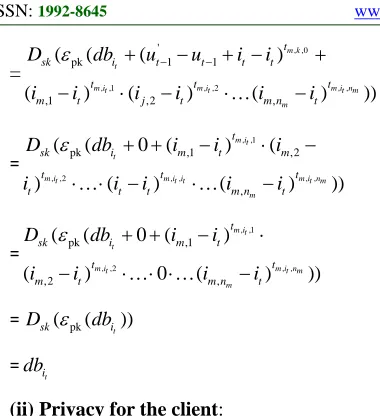
(i) Correctness:
, , ,
( )
t
sk s t m i
447 =
, ,0
, ,1 , ,2 , ,
'
pk 1 1
,1 ,2 ,
( ( ( )
( ) ( ) ( ) ))
m k
t
m it m it m i nt m
m
t
sk i t t t t
t t t
m t j t m n t
D db u u i i i i i i i i
ε + − − − + − +
− ⋅ − ⋅ −
=
, ,1
, ,2 , , , ,
pk ,1 ,2
,
( ( 0 ( ) (
) ( ) ( ) ))
m it t
m it m i it t m i nt m
m
t
sk i m t m
t t t
t t t m n t
D db i i i
i i i i i
ε + + − ⋅ −
⋅ ⋅ − ⋅ −
=
, ,1
, ,2 , ,
pk ,1
,2 ,
( ( 0 ( )
( ) 0 ( ) ))
m it
t
m it m i nt m
m
t
sk i m t
t t
m t m n t
D db i i
i i i i
ε + + − ⋅
− ⋅ ⋅ ⋅ −
=Dsk(εpk(dbit))
=dbit
(ii) Privacy for the client:
In the protocol, the client only sends the
cipher-texts(c cit, u i,t)to the server, which disclosed nothing
to the server from the security of the encryption scheme.
(ii) Privacy for the server:
In the protocol, the server sends message
, , 1, ,
( ,{ cut s t j}j=s)
to the client.
(1)If { ,i1, }it ⊆Bm ( Bm∈ BC ), from the
cor-rectness of the protocol, the client can get the de-sired item
t
i
db , however, he learns nothing about
the other item db(≠it), because the ciphertext
, , , s t m
c is an encryption of some random value.
, , , s t m
c =
, ,0
, ,1 , ,2 , ,
'
pk 1 1
,1 ,2 ,
( ( )
( ) ( ) ( ) )
m k
m it m it m i nt m
m
t
t t t
t t t
m t m t m n t
db u u i i
i i i i i i
ε + − − − + − +
− ⋅ − ⋅ −
= , ,0
pk( ( ) )
m k
t t
db i i
ε + −
(2)If { ,i1, }it ⊄Bm ( Bm∈ BC ), there exists
some index i∉Bm.
(i)If i=it,
, , , s t m k
c =
, ,0
, ,1 , ,2 , ,
'
pk 1 1
,1 ,2 ,
( ( )
( ) ( ) ( ) )
j k
m it m it m i nt m
m
t
k t t k t
t t t
m t m t m n t
db u u i i
i i i i i i
ε + − − − + − +
− ⋅ − ⋅ −
is an encryption of some random value, because
, ,1 , ,2 , ,
,1 ,2 ,
( )m it ( )m it ( )m i nt m
m
t t t
m t m t m n t
i −i ⋅ i −i ⋅i −i is a
random value.
(ii)If i<it, in the -th execution of the “request
& retrieval” phase, the server updates { c }j j=1,,s
, in
whichcm i, =
,
,1 ,2
pk( , ( ,1 ) ( ,2 ) ( , ) )
m n
m m m
m
t
t t
m i m m m n
i i i i i i i
ε + − ⋅ − ⋅ −
fori=1,,nm is an encryption of some random
value because ,1 ,2
,1 ,2
( )tm ( )tm
m m
i −i ⋅ i −i ⋅ ,
,
( )m nm
m
t m n
i −i is a random value. Thus, from the
1 +
-th execution the cm
is the encryptions of some random values instead of the encryptions of
m
B .
4.3 Efficiency Analyze
So far there are only two protocols for restricted adaptive oblivious transfer, which were both pro-posed by Herranz [8] and we denote as JH11-1 and JH11-2. Just as Herranz pointing out in [8], JH11-2 is less efficient than JH11-1. Thus, we only need to compare our protocol with JH11-1. In the construc-tion of JH11-1, a complicated condiconstruc-tional disclo-sure of secrets protocol was used, which needs
2
2N +2s+2 encryptions and 2N2+2s+2 group
element exchange, where N is the size of the
serv-er’s DB, s is the number of the client’s subsets of
items that he is allowed to obtain. However, we avoid using the conditional disclosure of secrets protocol. The efficiency results of the protocols
JH11-1 and ours are shown in the table 1, where N,
s are just the same as above, n n1, 2,,ns are the
number of each subset’s items that the client is
al-lowed to obtain, and s N, ni Nfor i=1,,s
[image:5.612.99.289.76.284.2]in the vast majority of practical applications. From table 1 we can see obviously that our protocol is more efficient than JH11-1, especially for band-width.
Table 1. Efficiency results of the protocols JH11-1 and Ours
Scheme JH11-1 Ours
Defining
rights Encryptions s N⋅
1 2 ( ) s n n n + + + Request & re-trieval Client’s Encryptions 2 2 2 4 N N s +
+ + 6
Server’s
ISSN: 1992-8645 www.jatit.org E-ISSN: 1817-3195
448
Group ele-ment
Ex-changes
2
4
4 5
N N s
+
+ + s N⋅ +4
5. CONCLUSION AND FUTURE WORK
In the paper, we propose a new protocol for re-stricted adaptive oblivious transfer by using public key cryptosystems which are additive at the same time and multiplicatively homomorphic, called ful-ly homomorphic encryption. Our protocol avoids using the conditional disclosure of secrets protocol, and is more efficient in the cost of communication and computation than Herranz’s constructions.
As future research related to this work, Herranz mentioned two possibilities: improving the efficien-cy of the solutions and providing anonymity for the clients. There has a third possibility: constructing secure protocols for restricted adaptive oblivious transfer according to the standard ideal/real simula-tion paradigm [21] and within UC framework [22].
ACKNOWLEDGEMENT
This work was partially funded by the National Natural Science Funds of China under Grant No.60903175 and 61170135.
REFRENCES:
[1] M. Rabin, “How to exchange secrets by
oblivi-ous transfer”, Technical report TR-81, Harvard
Aiken Computation Laboratory, 1981.
[2] G. Brassard, C. Crépeau and J.M. Robert,
“All-or-nothing disclosure of secrets”, Proceedings
of Crypto’86, Santa Barbara, CA, Aug 11-
15,1986, pp. 234–238.
[3] M. Naor and B. Pinkas, “Computationally
se-cure oblivious transfer”, Journal of
Cryptolo-gy.Vol. 18, No.1, 2005, pp.1-35.
[4] S. Even and O. Goldreich, “A. Lempel. A
ran-domized protocol for signing contracts”,
Com-munications of the ACM, Vol. 28, No. 6, 1985, pp. 637-647.
[5] W. Ogata and K. Kurosawa, “Oblivious
key-word search”, Journal of Complexity, Vol. 20,
No. 2-3, 2004, pp. 356-371.
[6] J. Zhang and Y. Wang, “Two provably secure
k-out-of-n oblivious transfer schemes”, Applied
Mathematics and Computation, Vol. 169, No. 2, 2005, pp.1211-1220.
[7] Zeng B. , Tartary C. , Xu P. , Jing, J. and
Tang X, “A Practical Framework for t-Out-of-n Oblivious Trat-Out-of-nsfer With Security Agait-Out-of-nst
Covert Adversaries”, IEEE Transactions on
In-formation Forensics and Security, Vol. 7, No. 2, 2012, pp.465-479.
[8] Javier Herranz, “Restricted adaptive oblivious
transfer”, Journal Theoretical Computer
Sci-ence, Vol. 412, No. 46, October, 2011, pp.6498-6506.
[9] B. Aiello, Y. Ishai and O. Reingold, “Priced
oblivious transfer: How to sell digital goods”,
Proceedings of Eurocrypt 2001, Innsbruck
(Ty-rol), Austria, May 6 -- 10, 2001, pp. 119–135.
[10] J. Camenisch, M. Dubovitskaya and G. Neven,
“Oblivious transfer with access control”,
Pro-ceedings of CCS’09, August 12 -- 17, 2009,
pp. 131–140.
[11] J. Camenisch, M. Dubovitskaya, G. Neven and
G.M. Zaverucha, “Oblivious transfer with
hid-den access control policies”, Proceedings of
PKC’11, Taormina, Italy, March 6-9, , 2011,
pp. 192–209.
[12] A. Rial and B. Preneel, “Blind Attribute-Based
Encryption and Oblivious Transfer with
Fine-Gramed Access Control”, 2010th Benelux
Workshop on Information and System Security (WISSec 2010), Nijmegen, the Netherlands, November 29-30, 2010.
[13] Jan Camenisch, Maria Dubovitskaya, Robert R.
Enderlein and Gregory Neven, “Oblivious Transfer with Hidden Access Control from
At-tribute-Based Encryption”, Security and
Cryp-tography for Networks, Lecture Notes in Com-puter Science Vol. 7485, 2012, pp. 559-579
[14] L. Xu and F. Zhang, “Oblivious Transfer with
Threshold Access Control”, Journal of
Infor-mation Science and Engineering, Vol. 28, No. 3, May 2012, pp.555-570.
[15] R. Rivest, L. Adleman, and M. Dertouzos, “On
data banks and privacy homomorphisms”,
Foundations of Secure Computation, Academic
Press, 1978, pp. 169–177.
[16] Craig Gentry, “Fully homomorphic encryption
using ideal lattices”, STOC 2009, Maryland, USA, May 31 - June 2 2009, pp.169-178.
[18] Craig Gentry, “Toward basing fully
homomor-phic encryption on worst-case hardness”,
CRYPTO 2010, Santa Barbara, California,
USA. August 15-19, 2010, pp. 116–137.
[19] M. Dijk, C. Gentry, S. Halevi, and V.
Vaikun-tanathan,"Fully homomorphic encryption over
the integers”, EUROCRYPT 2010, French
449
[20] Z. Brakerski and V. Vaikuntanathan, “Fully
homomorphic encryption from ring-LWE and
security for key dependent messages”,
CRYP-TO 2011, Santa Barbara, August 14-18 2011, p.501-520
[21] Zvika Brakerski and Vinod Vaikuntanathan.
“Efficient Fully Homomorphic Encryption
from (Standard) LWE”, Ost11, Ostrovsky,
2011, pp.97-106.
[22] O. Goldreich, Foundations of Cryptography:
Volume II—Basic Applications, 2004, Cam-bridge, U.K.: Cambridge Univ. Press.
[23] R. Canetti, “Universally composable security:
A new paradigm for cryptographic protocols”,