C O R R E S P O N D E N C E
Open Access
Data normalization considerations for
digital tumor dissection
Aaron M. Newman
1,2*, Andrew J. Gentles
3,4, Chih Long Liu
1,2, Maximilian Diehn
1,5,6and Ash A. Alizadeh
1,2,3,6,7*Please see related Li et al correspondence: www.dx.doi.org/10.1186/s13059-017-1256-5 and Zheng correspondence: www.dx.doi.org/10.1186/s13059-017-1258-3
Abstract
In a recently published article inGenome Biology, Li and colleagues introduced TIMER, a gene expression deconvolution approach for studying tumor-infiltrating leukocytes (TILs) in 23 cancer types profiled by The Cancer Genome Atlas. Methods to characterize TIL biology are increasingly important, and the authors offer several arguments in favor of their strategy. Several of these claims warrant further discussion and highlight the critical importance of data normalization in gene expression deconvolution applications.
Computational approaches for enumerating cell subsets from bulk tissue expression profiles have significant potential for studying tumor cellular ecosystems,
includ-ing tumor-infiltratinclud-ing leukocytes (TILs) [1–3]. We
there-fore read with interest the recentGenome Biologyarticle
by Li and colleagues in which they introduce TIMER, an in silico method for TIL deconvolution [4]. TIMER relies on prior knowledge of immune signature genes as input and consists of three major steps: (1) gene expression normalization across platforms and sample types; (2) selection of immune signature genes that are negatively correlated with tumor purity; and (3) deconvolution of RNA admixtures using a previously described technique for iterative linear least squares regression (LLSR) [5]. They apply TIMER to the inference of six distinct immune subsets (B cells, CD4 T cells, CD8 T cells, neutrophils, macrophages, and dendritic cells) in The Cancer Genome Atlas (TCGA) bulk tumor expression profiles and investigate links between TIL heterogeneity, tumor genomic features, and survival in 23 cancer types.
Several groups, including ours, have also proposed methods for gene expression deconvolution [1, 3, 5, 6]. We recently described CIBERSORT, an in silico tissue dis-section approach that is robust to noise, unknown mixture content, and closely related cell types (collinearity) [6].
Notably, in benchmarking experiments CIBERSORT out-performed other deconvolution methods, including LLSR, and revealed complex associations between 22 distinct im-mune subsets and outcomes in a pan-cancer meta-analysis [6, 7]. We were therefore surprised by several claims in relation to CIBERSORT.
First, the authors assert that CIBERSORT succumbs to statistical collinearity (i.e., cell subsets with highly corre-lated expression profiles), leading to biased estimations. Evidence for this argument is primarily based on a sim-ple experiment in which inferred levels of each immune subset were compared by Pearson correlation. After aggregating CIBERSORT results from 22 phenotypes into the same six subsets, the authors compared cross-correlation matrices between TIMER and CIBERSORT on four cancer types. Leukocyte levels estimated by TIMER were almost always positively correlated. According to the authors, positive correlations make intuitive sense because
“immune cells work in synergy.” In contrast, the
correla-tions among the six phenotypes estimated by CIBERSORT were largely negative. The authors also observed negative correlations when analyzing more than six cell types with TIMER (i.e., LLSR), stating that negative correlations indi-cate a technical artifact due to collinearity.
In fact, CIBERSORT mitigates such bias through regularization, as was rigorously demonstrated through a battery of validation experiments [6, 7]. These analyses
in-cluded an assessment of“deep deconvolution”in which in
silico predictions of closely related leukocyte subsets were
* Correspondence:[email protected];[email protected]
1Institute for Stem Cell Biology and Regenerative Medicine, Stanford University, Stanford, California 94305, USA
Full list of author information is available at the end of the article
directly compared against flow cytometry [6]. Moreover, an independent study confirmed that regularization improves the performance of gene expression deconvolution [8].
We were also surprised by the authors’ claim that
hematopoietic cell types should generally track together, especially in light of their diverse functions (innate or adaptive, stimulatory or suppressive, etc.) and migration patterns (circulating, tissue-infiltrating, or tissue-resident) [9, 10]. For instance, while specific hematopoietic subsets infiltrating tumors can be positively correlated in a given tumor type [11], the expectation of universally positive correlations does not extend to all tumor types, or to all infiltrating immune cells [12]. Separately, age-related lymphomyeloid lineage skewing of hematopoiesis [13] would be expected to further confound this assumption. Finally, while acute and chronic inflammation can be substrates for tumor initiation, a number of distinct tumor-infiltrating immune cells are known to have either tumor-promoting or anti-tumor properties, and are associated with inverse prognostic correlations with cancer outcomes [9, 14].
We therefore reanalyzed previously published flow cytometry data of leukocyte subsets directly enumerated in peripheral blood mononuclear cells (PBMCs) from healthy donors and in tumor biopsies obtained from patients with lung squamous cell carcinoma (LUSC) [6, 7]. When we quantified each immune subset as a fraction of total leukocyte content, many of the
pairwise correlations were negative, as were the mean correlation coefficients (Fig. 1a and b), consistent with CIBERSORT. However, when we instead considered absolute TIL levels in the same lung tumors, most of the correlations were positive (Fig. 1c), likely reflecting dif-ferences in tumor purity. Thus, data normalization in solid tumors significantly impacts the assessment of TIL heterogeneity and composition.
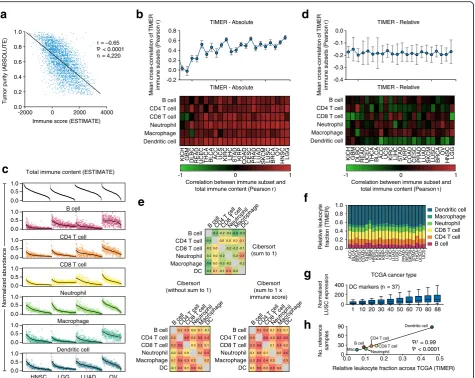
Given these results, we suspected that tumor purity would explain the discrepancy between TIMER and CIBERSORT. Indeed, after examining the TIMER source code, we found that, unlike most previous deconvolution methods including CIBERSORT, TIMER solves the regression problem without normalizing inferred cell subset frequencies to 1. TIMER results are therefore directly influenced by total leukocyte content, which is inversely correlated with tumor purity across TCGA (Fig. 2a). As a result, all six cell types strongly correlate with total leukocyte abundance in nearly every analyzed tumor type (Fig. 2b), making it difficult to discern the intercellular heterogeneity among the leukocyte subsets that variably infiltrate these tumors (Fig. 2c). When TIMER results were instead normalized in relative space (i.e., summing to 1) for each sample, all mean cross-correlation coefficients were negative (Fig. 2d). The inverse held true for CIBERSORT: mean cross-correlation coefficients became positive when we either (1) omitted the sum-to-1 normalization step, or (2) multiplied the
a
b
c
Fig. 1Variable correlation of directly enumerated leukocyte frequencies in lung tumors and blood.aAll-versus-all Pearson correlation matrix
of nine distinct leukocyte subsets profiled by flow cytometry in peripheral blood mononuclear cells (PBMCs) from 20 healthy donors [6].bSame
as panela, but for five immune subsets profiled by flow cytometry in 13 lung squamous cell carcinoma tumor biopsies [7].a,bLeukocyte
frequencies were normalized to sum to 1 prior to correlation analysis.cSame as panelb, except the frequency of each leukocyte subset was
[image:2.595.58.542.448.680.2]normalized results by a separate estimate of overall immune content (Fig. 2e). While we acknowledge that TIMER estimates were not intended to be analyzed in relative space (as described below), the same reasoning
should have been applied by Li et al. to CIBERSORT; that is, CIBERSORT relative abundance estimates should not have been directly compared with absolute leukocyte abundance (as in Table S6 from [4]). Collectively, these
ACC
BLCA BRCA CESC COAD DLBCGBM HNSC KICH KIRCKIRP LGG LIHC LUAD LUSC
OV
PRAD READ SKCM ST
AD
THCA UCECUCS
0.0 0.2 0.4 0.6 0.8 1.0
TCGA cancer type
Relative leukocyte fraction (TIMER ) Normalised LUSC expression B cell CD4 T cell CD8 T cell Neutrophil Macrophage Dendritic cell -2000 0 2000 4000
0.0 0.2 0.4 0.6 0.8 1.0
Immune score (ESTIMATE)
T
u
mor purity (ABSOLUTE)
r = –0.65 P < 0.0001 n = 4,220
-0.2 0.0 0.2 0.4 0.6 0.8 Mean cross-correlation of TIMER immune subsets (Pear s on r ) Mean c ro ss-correlation o f TI M ER immune subsets (Pearson r )
TIMER - Absolute
TIMER - Absolute
KICH GBM DLBC READ UCEC THCA BLCA ACC UCS KIRC LIHC STAD KIRP COAD CESC PRAD LUAD SKCM LUSC BRCA OV HNSC LGG
B cell CD4 T cell CD8 T cell Neutrophil Macrophage Dendritic cell
-1
Correlation between immune subset and total immune content (Pearsonr)
0 1 -1
Correlation between immune subset and total immune content (Pearson r)
0 1 -0.4 -0.3 -0.2 -0.1 0.0
TIMER - Relative
TIMER - Relative
KICH GBM DLBC READ UCEC THCA BLCA ACC UCS KIRC LIHC STAD KIRP COAD CESC PRAD LUAD SKCM LUSC BRCA OV HNSC LGG
B cell CD4 T cell CD8 T cell Neutrophil Macrophage Dendritic cell
b
a
d
e
f
g
h
B cellCD4 T cellCD8 T cellNeutrophilMacrophageDC-0.4 -0.2 -0.2 -0.6 -0.3 -0.4 0.0 0.0 0.0 0.1 -0.2 0.0 -0.2 -0.2 -0.1 -0.2 0.0 -0.2 -0.2 0.3 -0.6 0.0 -0.2 -0.2 -0.2 -0.3 0.1 -0.1 0.3 -0.2
B cellCD4 T cellCD8 T cellNeutrophilMacrophageDC B cell 0.2 0.3 0.0 0.1 -0.1 CD4 T cell0.2 0.5 0.2 0.5 0.4 CD8 T cell0.3 0.5 0.0 0.3 0.1 Neutrophil0.0 0.2 0.0 0.2 0.4 Macrophage0.1 0.5 0.3 0.2 0.2
DC
B cell CD4 T cell CD8 T cell Neutrophil Macrophage DC B cell
CD4 T cell CD8 T cell Neutrophil Macrophage DC
-0.1 0.4 0.1 0.4 0.2
B cellCD4 T cellCD8 T cellNeutrophilMacrophageDC 0.3 0.3 0.1 0.3 0.1 0.3 0.6 0.3 0.5 0.5 0.3 0.6 0.1 0.4 0.2 0.1 0.3 0.1 0.2 0.5 0.3 0.5 0.4 0.2 0.3 0.1 0.5 0.2 0.5 0.3 0.0
1.0
Total immune content (ESTIMATE)
0.0
1.0 B cell
0.0
1.0 CD4 T cell
0.0
1.0 CD8 T cell
0.0
1.0 Neutrophil
0.0
1.0 Macrophage
0.0
1.0 Dendritic cell 0.5 0.5 0.5 0.5 0.5 0.5 0.5
HNSC LGG LUAD OV
c
Normalized abundanc
e
1 10 20 30 40 50 60 70 80 88 0
200
400 DC markers (n = 37)
0.0 0.1 0.2 0.3 0.4 0.5 0
30 60 90
Relative leukocyte fraction across TCGA (TIMER)
No. reference
samples
B cell CD4 T cell
CD8 T cell Neutrophil Mac
Dendritic cell
R2 = 0.99
P < 0.0001 Cibersort
(sum to 1)
Cibersort (without sum to 1)
Cibersort (sum to 1 x immune score)
Fig. 2Impact of data normalization on in silico tumor-infiltrating leukocyte profiling.aTumor purity inferred by ABSOLUTE [29] versus immune content inferred by ESTIMATE [30], compared across 11 TCGA (The Cancer Genome Atlas) cancer types (ABSOLUTE data were obtained from [26]).
bBottomheat map showing Pearson correlations comparing overall leukocyte content, inferred by ESTIMATE, with immune subset abundance,
inferred by TIMER, across 23 TCGA tumor types. Cancers are ordered fromlefttorightby the mean correlation coefficient calculated across the six
immune cell types.Topmean cross-correlation coefficient of the six immune subsets compared with each other, omitting self-comparisons.
Cancer types are vertically aligned, and correlation coefficients are expressed as mean ± SEM.cTIMER results are shown for four representative TCGA
cancer types, along with immune content inferred by ESTIMATE. Overall leukocyte content and estimates of individual tumor-infiltrating leukocyte (TIL)
subsets are normalized from 0 to 1 within each cancer type, and ordered fromlefttorightby decreasing immune content.Regression lines
(shown inblack) were calculated by cubic splines.dSame as panelb, but after normalizing inferred levels of the six leukocyte subsets to one
in each patient.eCross-correlation matrix of CIBERSORT results before and after adjustment by total leukocyte content. Results are shown for
lung squamous cell carcinoma (LUSC) microarrays profiled by TCGA (n= 130 tumor samples). ESTIMATE was used to infer total leukocyte content,
denotedimmune score.fAverage representation of the six immune subsets inferred by TIMER across 23 TCGA cancer types.gImpact of
source datasets on tumor gene expression levels following batch correction. Li et al. applied ComBat [17] to merge expression profiles of
bulk tumors with a reference database containing six immune cell types with variable representation. Here, the number of dendritic cell (DC) samples
in the authors’reference database (n= 88) was randomly sampled from 1 to 88 while the remaining immune subsets were left unchanged. For each
iteration, ComBat was applied to merge the reference immune profiles with RNA-Seq data from LUSC, which we used as a representative TCGA cancer
type (n= 555 tumors). The median expression level of each DC marker gene (used in Li et al. and originally obtained from [31]) was determined across
the LUSC cohort; markers are represented as medians, quartiles, and 10th and 90th percentiles.hAnalysis of the number of immune reference samples
[image:3.595.64.540.87.465.2]data highlight the importance of data normalization in comparing gene expression deconvolution methods.
We and others have previously shown that regression-based gene expression deconvolution can robustly
quan-tify cell-type proportions [5–7, 15, 16]. Therefore, we
were surprised by the claim that“levels of different cell
types are not comparable” in the output of TIMER [4].
Upon further examination of this output, we found dis-proportionately high levels of rare dendritic cells (DCs) across all 23 cancer types (approximately 50% by inferred fractional abundance; Fig. 2f), suggesting problems with marker gene selection and/or data normalization. We
hypothesized that this result might be due to the authors’
use of ComBat [17] to purge batch effects between two highly distinct sample types: bulk tumors profiled by TCGA and a knowledgebase of purified leukocytes used for signature genes. In support of this hypothesis, we found that the number of DC reference profiles in the knowledge base was strongly correlated with the expres-sion of DC marker genes in normalized tumors (Fig. 2g). Further analysis revealed a strong association between predicted abundance in TCGA (Fig. 2f) and representa-tion in the knowledge base for all six leukocyte subsets (Fig. 2h). Thus, misapplication of ComBat distorted im-portant biological signals that correlate with experimental batches [18], preventing TIMER from estimating cell type proportions.
Separately, we wish to address the claim that CIBER-SORT is only applicable to microarray data [2, 4]. While microarray datasets were indeed the focus of our previ-ous studies, this is not an inherent restriction of the de-convolution algorithm itself, which is platform agnostic. In fact, the analytical assumptions made by CIBERSORT are likely to hold for any mixture that can be modeled as a linear sum of its parts and for which an appropriate signature matrix exists. Such mixtures include RNA-Seq datasets, as others have already shown for bulk tumor
profiling [19–21], and for single-cell RNA-Seq profiling
[22], as well as other genomic features associated with cell lineage [23]. For example, CIBERSORT was recently used to enumerate hematopoietic subsets in bone mar-row biopsies from healthy and diseased patients based on genomic patterns of nucleosome accessibility profiled by ATAC-Seq [23], demonstrating its broad applicability. Finally, in response to this correspondence, Li et al. [24] have made a number of new claims that warrant clarifica-tion. In order to comprehensively address these claims, we have included a detailed point-by-point response, includ-ing new analyses, in Additional file 1: Figures S1 and S2). We summarize three key points:
1. The authors continue to ignore the significant impact of data normalization on deconvolution results, stating that CIBERSORT produces
nonbiological negative correlations mainly due to collinearity. They dismiss the notion that regularization can help combat collinearity (despite significant literature on the topic [25], e.g. ridge regression, and [8]), and offer a flawed analysis to support their claim consisting of synthetic mixture datasets that are improperly defined since the mixed populations do not sum to 100% and are therefore unsuitable for addressing this topic (Additional file 1: Figure S1a and b).
2. Furthermore, Li et al. use a single flow cytometry experiment (Fig.1a) to argue that closely related immune cell types should be positively correlated in abundance, whether in blood or in tumors. Since the default version of CIBERSORT produced negative correlations for the same cell types when
enumerated in solid tumor biopsies, Li et al. claim these results contradict our own experimental data in Fig.1aand are likely due to collinearity. In making these arguments, Li et al. disregard some fundamental immunological principles governing leukocyte migration patterns (see above and Additional file 1), relevant prior literature (e.g., Fig. 3a in [6]), and the main point of this correspondence (e.g., Fig. 2e). To further illustrate the impact of data normalization on deconvolution results, we extended our CIBERSORT analysis in Fig.2eto 22 immune subsets (i.e., LM22 [6]) in TCGA LUSC tumors. As expected, the majority of pairwise correlations were positive when relative abundance estimates were scaled by total immune content, including correlations between closely related cell types (e.g., naïve versus memory B cells;
Additional file1: Figure S2). Moreover, we observed no significant association between pairwise
correlations of leukocyte estimates in tumors and pairwise correlations of corresponding expression profiles in LM22 (Additional file1: Figure S2). Therefore, leukocyte behavior is highly complex and unlikely to be distilled into simplistic comigration patterns without significant further investigation, especially without consideration of data normalization.
on CIBERSORT results. When considering these variables, most of the significant positive correlations are of modest magnitude (e.g., 70% withr< 0.2) and only a small minority of LM22 genes are significantly positively correlated with tumor purity (3% withr> 0.2, approximately 0% withr> 0.4; Additional file1: Figure S1c). Furthermore, since exclusion of all significantly positively correlated genes from LM22 had virtually no impact on tumor deconvolution performance (Additional file1), we observed no empirical evidence consistent with the above claim.
In summary, our results address key conclusions in Li et al. [4, 24] and emphasize the importance of data normalization in deconvolution analyses. In particular, deconvolution methods cannot be meaningfully com-pared without taking normalization differences into account. By focusing on relative measures of TIL con-tent in previous work [7], we avoided the confound-ing impact of tumor purity [26]. This approach has precedence in prior literature, particularly since many prognostic associations are more robust when defined as ratios of functionally distinct TILs (e.g., CD8 T cells versus Tregs, lymphocytes versus neutrophils, etc.) [7, 27, 28]. Whether absolute or relative measures of TIL abundance better capture tumor immunology in clinical settings remains an important consideration for future studies.
Additional file
Additional file 1:Detailed response to Li et al., [24]. (DOCX 561 kb)
Abbreviations
DC:Dendritic cell; LLSR: Linear least squares regression; LUSC: Lung
squamous cell carcinoma; PBMC: Peripheral blood mononuclear cell; TCGA: The Cancer Genome Atlas; TIL: Tumor-infiltrating leukocyte
Authors’contributions
AMN and AAA wrote the manuscript with input and edits from all authors. All authors read and approved the final manuscript.
Competing interests
The authors declare that they have no competing interests.
Publisher’s Note
Springer Nature remains neutral with regard to jurisdictional claims in published maps and institutional affiliations.
Author details
1Institute for Stem Cell Biology and Regenerative Medicine, Stanford University, Stanford, California 94305, USA.2Division of Oncology, Department of Medicine, Stanford Cancer Institute, Stanford University, Stanford, California 94305, USA.3Center for Cancer Systems Biology, Stanford University, Stanford, California 94305, USA.4Department of Radiology, Stanford University, Stanford, California 94305, USA.5Department of Radiation Oncology, Stanford University, Stanford, California 94305, USA.6Stanford Cancer Institute, Stanford University, Stanford, California 94305, USA.7Division of Hematology, Department of Medicine, Stanford Cancer Institute, Stanford University, Stanford, California 94305, USA.
Received: 31 May 2017 Accepted: 12 June 2017
References
1. Newman AM, Alizadeh AA. High-throughput genomic profiling of
tumor-infiltrating leukocytes. Curr Opin Immunol. 2016;41:77–84. 2. Aran D, Butte AJ. Digitally deconvolving the tumor microenvironment.
Genome Biol. 2016;17:175.
3. Shen-Orr SS, Gaujoux R. Computational deconvolution: extracting cell
type-specific information from heterogeneous samples. Curr Opin Immunol. 2013;25:571–8.
4. Li B, Severson E, Pignon JC, Zhao H, Li T, Novak J, et al. Comprehensive analyses of tumor immunity: implications for cancer immunotherapy. Genome Biol. 2016;17:174.
5. Abbas AR, Wolslegel K, Seshasayee D, Modrusan Z, Clark HF. Deconvolution
of blood microarray data identifies cellular activation patterns in systemic lupus erythematosus. PLoS One. 2009;4, e6098.
6. Newman AM, Liu CL, Green MR, Gentles AJ, Feng W, Xu Y, Hoang CD,
Diehn M, Alizadeh AA. Robust enumeration of cell subsets from tissue expression profiles. Nat Methods. 2015;12:453–7.
7. Gentles AJ, Newman AM, Liu CL, Bratman SV, Feng W, Kim D, et al. The
prognostic landscape of genes and infiltrating immune cells across human cancers. Nat Med. 2015;21:938–45.
8. Mohammadi S, Zuckerman N, Goldsmith A, Grama A. A critical survey of
deconvolution methods for separating cell-types in complex tissues. arXiv. 2015: 1510.04583. https://arxiv.org/abs/1510.04583.
9. Fridman WH, Pages F, Sautes-Fridman C, Galon J. The immune
contexture in human tumours: impact on clinical outcome. Nat Rev Cancer. 2012;12:298–306.
10. Shiao SL, Ganesan AP, Rugo HS, Coussens LM. Immune microenvironments
in solid tumors: new targets for therapy. Genes Dev. 2011;25:2559–72. 11. Gao Q, Qiu SJ, Fan J, Zhou J, Wang XY, Xiao YS, et al. Intratumoral balance
of regulatory and cytotoxic T cells is associated with prognosis of hepatocellular carcinoma after resection. J Clin Oncol. 2007;25:2586–93. 12. Stoll G, Bindea G, Mlecnik B, Galon J, Zitvogel L, Kroemer G. Meta-analysis of
organ-specific differences in the structure of the immune infiltrate in major malignancies. Oncotarget. 2015;6:11894–909.
13. Rossi DJ, Bryder D, Zahn JM, Ahlenius H, Sonu R, Wagers AJ, Weissman IL. Cell intrinsic alterations underlie hematopoietic stem cell aging. Proc Natl Acad Sci U S A. 2005;102:9194–9.
14. TerzićJ, Grivennikov S, Karin E, Karin M. Inflammation and colon cancer. Gastroenterology. 2010;138:2101–14.e2105.
15. Gong T, Hartmann N, Kohane IS, Brinkmann V, Staedtler F, Letzkus M, et al. Optimal deconvolution of transcriptional profiling data using quadratic programming with application to complex clinical blood samples. PLoS One. 2011;6, e27156.
16. Zhong Y, Wan YW, Pang K, Chow LM, Liu Z. Digital sorting of complex
tissues for cell type-specific gene expression profiles. BMC Bioinformatics. 2013;14:89.
17. Johnson WE, Li C, Rabinovic A. Adjusting batch effects in microarray expression data using empirical Bayes methods. Biostatistics. 2007;8:118–27.
18. Jaffe AE, Hyde T, Kleinman J, Weinbergern DR, Chenoweth JG, McKay RD,
et al. Practical impacts of genomic data "cleaning" on biological discovery using surrogate variable analysis. BMC Bioinformatics. 2015;16:372. 19. Tuong ZK, Fitzsimmons R, Wang SM, Oh TG, Lau P, Steyn F, et al. Transgenic
adipose-specific expression of the nuclear receptor RORαdrives a striking shift in fat distribution and impairs glycemic control. EBioMedicine. 2016;11: 101–17.
20. Mehnert JM, Panda A, Zhong H, Hirshfield K, Damare S, Lane K, et al. Immune activation and response to pembrolizumab in POLE-mutant endometrial cancer. J Clin Invest. 2016;126:2334–40.
21. Srinivasan S, Su M, Ravishankar S, Moore J, Head PE, Dixon JB, et al. TLR-exosomes exhibit distinct kinetics and effector function. arXiv. 2016 :1608. 08565v1. https://arxiv.org/abs/1608.08565.
22. Baron M, Veres A, Wolock SL, Faust AL, Gaujoux R, Vetere A, et al. A
single-cell transcriptomic map of the human and mouse pancreas reveals inter- and intra-cell population structure. Cell Syst. 2016;3:346–60.e4. 23. Corces MR, Buenrostro JD, Wu B, Greenside PG, Chan SM, Koenig JL, et al.
24. Li B, Liu JS, Liu XS. Revisit linear regression based deconvolution methods for tumor gene expression data. Genome Biol. 2017. doi:10.1186/s13059-017-1256-5.
25. Hastie T, Tibshirani R, Friedman J. The elements of statistical learning: data mining, inference and prediction. 2nd ed. New York: Springer; 2009. 26. Aran D, Sirota M, Butte AJ. Systematic pan-cancer analysis of tumour purity.
Nat Commun. 2015;6:8971.
27. Sato E, Olson SH, Ahn J, Bundy B, Nishikawa H, Qian F, et al. Intraepithelial CD8+ tumor-infiltrating lymphocytes and a high CD8+/regulatory T cell ratio are associated with favorable prognosis in ovarian cancer. Proc Natl Acad Sci U S A. 2005;102:18538–43.
28. Templeton AJ, McNamara MG, Seruga B, Vera-Badillo FE, Aneja P, Ocaña A, et al. Prognostic role of neutrophil-to-lymphocyte ratio in solid tumors: a systematic review and meta-analysis. J Natl Cancer Inst. 2014;106:dju124. 29. Carter SL, Cibulskis K, Helman E, McKenna A, Shen H, Zack T, et al. Absolute
quantification of somatic DNA alterations in human cancer. Nat Biotechnol. 2012;30:413–21.
30. Yoshihara K, Shahmoradgoli M, Martinez E, Vegesna R, Kim H, Torres-Garcia W, et al. Inferring tumour purity and stromal and immune cell admixture from expression data. Nat Commun. 2013;4:2612.
31. Abbas AR, Baldwin D, Ma Y, Ouyang W, Gurney A, Martin F, et al. Immune
response in silico (IRIS): immune-specific genes identified from a compendium of microarray expression data. Genes Immun. 2005;6:319–3.
• We accept pre-submission inquiries
• Our selector tool helps you to find the most relevant journal • We provide round the clock customer support
• Convenient online submission • Thorough peer review
• Inclusion in PubMed and all major indexing services • Maximum visibility for your research
Submit your manuscript at www.biomedcentral.com/submit