5
III
March 2017
Technology (IJRASET)
Design of Security Framework for Ads-B Based
Systems
Ms. Devyani Patre1 , Ms. Ashwini Meshram2, Ms. Neha Pilare3 , Prof. Shilpa Tuteja4
1
Final Year BE Dept. of CSE, SRMCEW, RTMNU, Nagpur, India.
4
Professor BE Dept. of CSE, SRMCEW, RTMNU, Nagpur, India.
Abstract: The requirement for increased surveillance due to increase in flight volume in the distanced area or oceanic regions outside the range of traditional radar coverage has been fulfilled by the advent of space-based automatic dependent surveillance – broadcast (ads-b) systems. Ads-b systems fulfills the need of air traffic controllers with highly accurate real-time flight data. Ads-b is dependent on communications between aircraft and ground stations of the air route traffic control center (artcc). Ads-b signals are public over a known frequency; however these communications are not secured. In order to increase airspace throughput and efficiency, there is a need for a system that prevents attacks on ads-b signals sent from aircraft to artcc and between aircrafts. Hashing is simulated by attempting and detecting the attacked signals and notifying the aircraft about the attacks. Attacks are implemented by decreasing the capacity of air cells.
The goal of this project is to design a secure transmission that prevents ads-b signals from being attacked. The ultimate goal of the project is to show that if ads-b signals can be secured, the situational awareness can improve and the air route traffic control center (artcc) can use information from this surveillance system to decrease the separation between aircraft and ultimately maximize the use of the airspace. Economic goal of ads-b system include this simulation is to determine how attacks impact time spent in flight, additional fuel burn, real time broadcast of information, increased situational awareness for both the pilot and the air traffic controller, and the potential to decrease the distance separation.
Keywords: automatic dependent surveillance – broadcast (ads-b) systems, simulation, radar comparison, minimizing separation, situational awareness.
I. INTRODUCTION
Since the year 1978, there has been a high increase in the demand for air transportation each year. Right now, there are around 190 million people flying in the United States both domestically and internationally. The service of carrying configured statistics by the year 2032, around 250 million tourist will be flying in the United States. With the increasing growth in the number of people flying each year, there is involvement for more airplanes to meet the demand of flying tourist. Presently, there are a total of over 6050 aircrafts that design the formation of all United States air carriers. It is determined that by the year 2033, there will be maximum 7000 aircrafts that will design the United States air carrier fleet.
The perception of air route traffic controllers(ARTC) highly depends on tracking system provided by the ground radar systems, that specifies the present location of the aircraft in the airspace. Flyers of compact aircraft have gamble on his data passed to them whereas main aircraft may have their own radar systems. The difficulty with radar systems is that they are costly and even after the beginning of installation maintenance is very high. The leading idea of Automatic Dependent Surveillance – Broadcast(ADS-B) system is to pass on this work to the aircraft themselves. The aim of GPS and internal avionics based systems in the aircraft is to broadcast the surveillance and observed data, the location and more systematically to the ground stations and to other overall aircraft.
The main objective of establishing this system is to make the air traffic more beneficial and systematic by reducing the separation and to make more optimal flight paths. This is gain by having more and more accurate and validate information about the ongoing situation of the aircraft in the airspace.
Technology (IJRASET)
II. EXISTING SYSTEM
Primary and Secondary Surveillance Radar: Surveillance is defined as the close observation, monitoring and bugging of updating information and it is required in air transportation systems to track and auditor flights in order to maximize safety, accuracy and efficiency in the airspace. There are various types of surveillance used for air traffic control, Primary surveillance radar provides information about a target’s distance to the Air Traffic Controller, but not the target’s identity. Secondary surveillance radar is linked to primary surveillance radar and is able to interrogate a transponder of an aircraft, determining and verifying its altitude, latitude/longitude, and flight number. Both primary and secondary surveillance radar are expensive to maintain and have finite coverage radius.
III. PROPOSED SYSTEM
Automatic Dependent Surveillance Broadcast (ADS-B)/NextGen: For more precise aircraft track the FAA has proposed a new framework that will eventually substitute the current national airspace system. This advanced framework is called Next Generation, or NextGen. The main component in NextGen is ADS-B. ADS-B consists of two major components: ADS-B IN and ADS-B OUT. In ADS-B IN it permits aircraft to accept information transferred from ground stations and other aircraft, while in ADS-B OUT this permits aircraft to transmit configured messages to ground stations and other aircraft .ADS-B is a satellite-based technology that uses the worldwide station system also called as Global Positioning System (GPS) to decide the present location of aircraft. As the position of the aircraft is traced and updated information about position and is pass on to both the air route traffic controller and the flyer in the cockpit. This information is forwarded at a rate of once per second, which is an improvement to the 12 second delay of the existing system. Further to make available more frequent and precise information, the implementation and maintenance of ADS-B will be affordable than that of the primary and secondary radar systems. The benefits of ADS-B include surveillance region beyond primary or secondary radar coverage, real-time broadcast of information, increased situational awareness for both the pilot and the air traffic controller, and the capability to decrease the scattered distance between aircraft.
IV. PROBLEM DEFINITION
Threats to ADS-B: With the survey of ADS-B, the aviation industry has entered into the computer world. With the rapid exchange of time sensitive data and limited precautions to protect it, the worldwide aviation system is “a potential target for large-scale cyber-attack”. ADS-B signals are public over a known frequency. As a result the signals are vulnerable to spoofing and jamming. Jamming is the forceful disruption of a signal. . If we accept that jamming attack exists, we will not be able to find out the solutions for these type of attacks because unlike spoofing attacks cannot be prevented, only detected. Spoofing attacks also very difficult to detect. The goal of spoofing is to change the data transmitted in a message. Two important types of spoofing attacks are “false source” and “false content.” A “false source” attack creates signal that is exactly same to a real signal, but looks like it is coming from a different location. This creates a fake plane or planes on ARTCC or aircraft screen. A “false content” attack “captures” the message, changes and retransmits it. In this type of attack, the aircrafts position or altitude are shown incorrectly on aircraft displayor ARTCC. In our project, we will be focusing only on spoof attacks.
V. OBJECTIVE
The target of this project is to design a secure transmission framework that hold back Air Traffic Surveillance System (ATSS) signals from being spoofed & develop situational awareness, recover the gap between aircraft and conclusively maximize the need of the airspace. Automatic Dependent Surveillance–Broadcast (ADS-B) is actually a satellite-based surveillance system. ADS-B Out uses GPS technology to decide an aircraft's location, air speed and other information, and send that data to a network of ground stations, which carry the information to air traffic control displays and to nearby aircraft equipped to receive the information via ADS-B In. Operators of aircraft appointed with ADS-B In can receive weather and traffic position information delivered directly to the cockpit.
VI. MISSION REQUIREMENT
The system will minimize separation distance to 5 NM. The system shall not expand fuel burn by more than A.
ADS-B messages shall be resistant and protecting to spoofing attacks B% of times.
Technology (IJRASET)
VII. DESIGN ALTERNATIVES
In order to observe and prevent spoofing attacks on ADS-B based info communication signals, the following techniques are being renewed: symmetric, asymmetric encryption and hashing.
Hashing algorithm:- The very first goal of hashing is to sure the identity of the source of a message. This is gain by creating a hash that is attached at the end of the message. A hash is a message which gives the summary created by compiling a hashing algorithm by the sender. This summary is verified at the receiver’s station by executing the same algorithm and deriving the hash independently. The systems at the receiver’s station then compares the summary when received to the independently derived summary If both of them are unique, then it is considered that message is true . Hashing algorithms run very quickly and only need a software upgrade. However, it will require usage of add on bits in ADS-B message that are fully used right now. A possible deal would be to free any 8 bits that are currently being used.
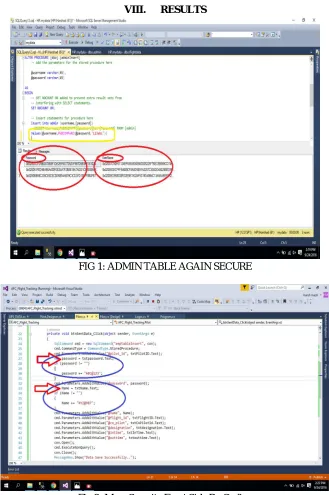
VIII. RESULTS
[image:4.612.141.470.215.710.2]FIG 1: ADMIN TABLE AGAIN SECURE
Technology (IJRASET)
Fig 3: Name Password Secure
IX. FUTURE SCOPE
ADS-B ground stations are in working order now across nation, broadcasting flight data, traffic, weather to all appropriately equipped aircraft.
Air traffic control facilities at speed being updated for ADS-B, all aircraft flying in allocated airspace will be need to have avionics that transmit their ADS-B location information.
Research could be done on the basis of data set accumulated from the online survey for regional differences in benefits. Operating position and home base was not taken into account when observing the application benefits, but these features could be used to check the differences within the areas. The information can be made into pieces so that each type of operator in each area can be observed separately.
Further research could be done to find out the price at which holders are willing to equip with a more sensible set of “ADS-B Out” and “ADS-B in” applications, against a price for all ADS-B applications as done in the online survey for this research.
X. CONCLUSION
Depend on the determination of data and the various simulations, it is advised that hashing encryption, and in particular symmetric encryption, should be executed on ADS-B signals the reason it has a balanced security strength, low probable chances of collision, feasibility acceptable, and less economic implications .To avoid new and unendurable challenges in the foreseeable realistic future, this should include a thorough vast wide analysis of the predicted traffic density on today’s wireless navigation channels as well as the possible influence of communication.
REFERENCE
[1] Bureau of Transportation Statistics, 2012
[2] FAA. "FAA Aerospace Forecast: Fiscal Years 2012-2032." FAA Aerospace forecast: Fiscal Years 2012-2032 (2012): 1- 115. Print
[3] McCallie, Donald. Department of the Air Force University. Air Force. Exploring Potential ADS-B Vulnerabilities in the FAA’s NextGen Air Transportation System Print. http://apps.fcc.gov/ecfs/document/view.action?id=70216945 23
[4] Jerry T. Chiang and Yih-Chun Hu. Cross-Layer Jamming Detection and Mitigation in Wireless Broadcast Networks. IEEE/ACM Transactions on Networks. [5] AIAA Decision Paper. "A Framework for Aviation Cybersecurity." The Connectivity Challenge: Protecting Critical Assets in a Networked World (2013):
[5] "Air Traffic." - NextGen Briefing. Federal Aviation Administration, 21 Sept. 2009. Web. 9 Sept. 201
[6] Skalski-Pay, Jennifer, Applied Encryption: Ensuring Integrity of Tactical Data,SANS Institute InfoSec Reading Room [7] Aireon and FlightAware Partner to Launch Glob
[8] alBeacon Airline Solution for ICAO Airline Flight Tracking compliance. Retrieved 21 september 2016Update on GADSS-Related Global Aircraft Tracking Initiatives.Retrieved 21 september 2016
[9] H. Li, B. Yang, C. Chen, and X. Guan,
[10] “Connectivity of Aeronautical Ad hoc Networks,” in 2010 IEEE Globecom Workshops. IEEE, Dec. 2010R. Kaune, C. Steffes, S. Rau, W. Konle, and J. Pagel, “Wide area multilateration using ADS-B transponder signals,” in Information Fusion (FUSION), 2012 15th International Conference on, 2012, [11] P. Thomas, “North sea helicopter ADS-B/MLat pilot project findings,” in Digital Communications-Enhanced Surveillance of Aircraft and Vehicles
(TIWDC/ESAV), 2011 Tyrrhenian International Workshop on, 2011’