Method & Implementation of Relocalisation and
Management for Smart System in WSN
Simran1, Er. Sonam Khattar2
1Research Scholar, 2Asst. Professor
Computer Science & Engineering. Deptt. Galaxy Global Group of Institutes, Dinarpur, Ambala
Abstract: during the development of a WSN, it is unknown which influences the nodes might experience, which nodes might crash and how long exactly the sensor nodes will last with available energy. Also nodes might experience high interference, resulting in many retransmissions from that node and require higher energy consumption can cause the battery run out and sometimes the node aggregates sensor information and transmits it to the base station crashes, the complete WSN will be rendered useless. For this, the problems solved by maintain the configuration even when the context is unpredictable. It can completely running out of energy with only a small decrease in performance .If a component providing important functionality crashes, the functionality could be transferred to another node and WSN continue to run. Due to this, it presents the work of Dynamic Reconfiguration that solves the above problems. In this, nodes update their location with the help of controller. All simulations are presented in MATLAB.
Keywords- WSN System, Routing protocol, Dynamic Reconfiguration System, Localization, Mobility etc.
I. INTRODUCTION
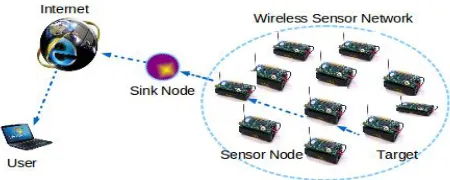
Human endeavor for the comprehension and control of the earth has prompted the advancement of brilliant checking frameworks known as Wireless Sensor Networks (WSNs). These frameworks have been developing amid the most recent decade into more effective and versatile answers for confront an extensive variety of various situations. A remote sensor organize (WSN) is a remote system comprising of spatially disseminated independent gadgets utilizing sensors to helpfully screen physical or natural conditions, for example, temperature, sound, vibration, weight, movement or toxins, at various areas.
With the development of smaller scale sensors and low-control remote correspondences, the innovation of WSN is ending up noticeably progressively settled well ordered. A productive directing administration is an unquestionable requirement require for every one of the applications running on the WSN stage. A great deal of steering conventions extraordinarily intended for WSN have been proposed. The normal conventions incorporate Gossiping Protocol, Sensor Protocols for data by means of Negotiation (SPIN), Directed-dissemination Routing, Greedy Perimeter Stateless Routing (GPSR), and Trajectory Based Routing (TBF). These directing conventions are all not the same as those conventions intended for the customary.
[image:2.612.193.418.613.703.2]In the same way as other propelled innovations, the source of WSNs can be found in military and overwhelming modern applications, far expelled from the light mechanical and customer WSN applications that are pervasive today. The main remote system that drags any genuine likeness to a cutting edge WSN is the Sound Surveillance System (SOSUS), created by the United States Military in the 1950s to identify and track Soviet submarines. This system utilized submerged acoustic sensors – hydrophones – conveyed in the Atlantic and Pacific seas. This detecting innovation is still in benefit today, but serving more tranquil elements of observing undersea natural life and volcanic movement. Reverberating the ventures made in the 1970s to build up the equipment for the present Internet, the United States Defence Advanced Research Projects Agency (DARPA) began the Distributed Sensor Network (DSN) program in 1980 to formally investigate the difficulties in executing disseminated/remote sensor systems.
©IJRASET: All Rights are Reserved
2269
Routing Steering in remote sensor systems varies from regular directing in settled systems in different ways. There is no framework, remote connections are temperamental, sensor hubs may fizzle, and steering conventions need to meet strict vitality sparing necessities. Many steering calculations were produced for remote systems all in all.
From the review, it can be acquired that a steering convention intended for WSN ought to have the capacity of adjusting to various applications and diverse system conditions. In the event that we can change the directing convention remotely as per the applications' prerequisite and the system conditions, can accomplish this objective. Right now, it is extremely troublesome, if not inconceivable, to change a steering administration in an expansive scale sensor arrange in light of the fact that the administration is statically pre-designed into every hub, which is frequently unattended. Thus, it proposes a portability based system reconfiguration framework in WSN which can be powerfully reconfigured.
The paper is requested as takes after. In segment II, it speaks to configuration variables of WSN. In Section III, It characterizes the advancement of relocalisation calculation. Segment IV speak to the proposed framework. Area V depicts the after effects of proposed framework. At long last, conclusion is clarified in Section VI.
II. DESIGN FACTORS IN WSN
A. Network Dynamics
There are three primary segments in a sensor organize. These are the sensor hubs, sink and observed occasions. In numerous applications, the development of sensor hubs or the base station (sink) is fundamental. This implies sensor hubs are moving hubs.
B. Node Deployment
The topological organization of the hubs is application ward and influences the execution of the steering convention. The organization is either deterministic or self-sorting out. In deterministic circumstances, the sensors are physically put and information is steered through foreordained ways. However in self-sorting out framework the sensor hubs are scattered haphazardly makes a foundation in an advertisement - hoc way.
C. Self-Configuration
It is fundamental for remote sensor system to act naturally compose; since the thickly conveyed sensor hubs in a sensor field may bomb because of many reasons (e.g., absence of vitality, physical demolition, condition obstruction, and so forth.) and new hubs may join the network.So they should act naturally arrangement to build up a topology that backings correspondences under extreme vitality imperatives.
D. Energy Consideration
One of the parts of sensor hubs is the power source which is sufficiently constrained. A sensor hub is battery-worked. Thus; life time of a sensor hub depends unequivocally on the battery life time. Many inquires about are concentrating on planning power-mindful conventions and calculations for remote sensor systems with the objective of minimization of vitality consumption.
E. Fault Tolerance
The disappointment of the sensor hub ought not influence the assignment of remote sensor systems. This is the dependability. Adaptation to internal failure is the capacity to maintain sensor organize functionalities with no intrusion because of sensor hub disappointments.
F. Scalability
The quantity of sensor hubs conveyed in the detecting range might be in the request of hundreds, thousands or more and steering plans must be sufficiently versatile to react to occasions.
G. Operating Environment
H. Data Aggregation/Fusion
Since sensor hubs may create noteworthy excess information, comparative bundles from various hubs can be totalled so that the quantity of transmissions would be lessened.
I. Quality of Service (QoS)
The nature of administration implies the quality administration required by the application, it could be the length of life time, the
information dependable, vitality productivity, and area mindfulness, communitarian preparing.
III. DEVELOPMENT OF RELOCALISATION SYSTEM
To design a WSN application, knowledge of many elements of the context is essential as they influence the operation greatly. During the development of such a WSN, it is unknown which influences the nodes might experience, which nodes might crash, and how long exactly the sensor nodes will last with the available energy.
Reconfiguration means adapting components or their arrangement within a system. Recently, techniques of dynamic reconfiguration have attracted increasing attention from the research community. These techniques enable reconfiguration of the sensor network hardware at run time to adapt to external dynamics, providing an innovative approach to designing an energy-efficient WSN in a highly dynamic environment. Due to advances in hardware technology, several reconfiguration techniques have been developed on the sensor node level. The utilization of all reconfiguration techniques have to consider dynamic factors, such as changes in user requirements, variations in communication channel quality, application changes, addition of new nodes, and node failure. This increases the complexity of using dynamic reconfiguration in WSNs. There are most commonly used techniques are given below.
A. Node Level Reconfiguration
The dynamic reconfiguration at node level sought to minimize energy consumption by dynamically adjusting hardware platforms of sensor nodes. We addressed two promising reconfiguration hardware techniques, DVS and DMS, since they have already been separately used on computation and communication systems to reduce the energy consumption.
B. Dynamic Time Allocation
When only limited time was available for the sensor node, it became critical to allocate the time resource for minimizing the total energy consumption. Such an allocation mechanism was called Dynamic Time Allocation (DTA), which determined the optimal share of computation time and transmission time subject to the time constraint.
C. Centralized Reconfiguration
The need for reconfiguration of a WSN by creating a global model based on information coming from sensor nodes at run-time. Next, a design space search is performed in order to come up with a suitable new configuration, which is subsequently transferred on to the sensor nodes. Some provides a method for creating virtual machines for sensor nodes that execute small script-like programs. These scripts can be sent to a node and loaded and unloaded at run-time. This way, nodes can be reconfigured by uploading new individual software components to the nodes and deleting unused parts. Because in some cases this still requires a restart of individual nodes, it is not considered run-time adaptation. However, the reconfiguration does occur after deployment and if the state of a node can be restored after reconfiguration, the WSN can continue its operation. This is not feasible for most actual deployments, because centralized algorithms scale poorly.
D. Distributed Reconfiguration
©IJRASET: All Rights are Reserved
2271
E. Clustering Approach Clustering
It has become an emerging technology for building scalable and energy balanced applications for WSNs. Some derive an efficient failure detection solution using a cluster-based communication hierarchy to achieve scalability, completeness, and accuracy simultaneously. They split the entire network into different clusters and subsequently distribute fault management into each individual region. Intra-cluster heartbeat diffusion is adopted to identify failed nodes in each cluster.
IV. DESCRIPTION OF PROPOSED SYSTEM
Amid the advancement of a WSN, it is obscure which impacts the hubs may understanding, which hubs may crash and to what extent precisely the sensor hubs will last with accessible vitality. At first the WSN will perform well on the grounds that the setting matches the desires amid advancement. However, after some season of advancement, sensor changed position due to some outer occasion, making its sensor readings less exact. Likewise hubs may encounter high impedance, bringing about numerous retransmissions from that hub and require higher vitality utilization can cause the battery run out and once in a while the hub totals sensor data and transmits it to the base station crashes, the entire WSN will be rendered pointless. For this, the issues unraveled by keep up the arrangement notwithstanding when the setting is eccentric. Either modify its affectability or debilitate its sensor to counteract off base readings, or by expanding the length of its obligation cycle, It can totally coming up short on vitality with just a little decline in execution .
In military applications remote sensor arrange is utilized which is a self-sorted out framework with little, autonomous, low controlled and portable hubs dispread over a range with no settled topology having a head taking the information from the detecting hubs and handle an assortment of detecting, inciting, conveying, flag preparing, calculation and correspondence errands, sent without lasting system foundation and condition with constrained or no human availability. To satisfy these prerequisites we propose versatility based dynamic reconfiguration framework in WSN. It utilizes the idea of dynamic reconfiguration steering conventions utilizing microcontroller for area changing of hubs. This work presents how to outline a steering convention, which can address the issue of various area at various conditions, is a to a great degree testing issue. With the assistance of dynamic reconfiguration, the steering convention can be changed by the remote manager as indicated by the need of various applications and diverse system conditions. In this work, all hubs are speaking with each other. A head is accommodated giving the directions to all hubs. The requirement for reconfiguration engineering for sensor organize applications is obvious from the aftereffects of even a basic natural observing calculation. The fundamental execution parameter will be confinement blunder. With the assistance of this, it might demonstrate the better soundness of framework. It takes the situation of security under remote system.
Sensors are arbitrarily spread over the range. Every sensor has a sensor ID appeared alongside it. It will be utilized to address any sensor all through the procedure. Here we take extensive number of sensors so that proposed plan will assess effortlessly. No two hubs cover each other. In run of the mill use situation, the hubs will be uniformly appropriated over an open air condition. This separation between adjoining hubs will be negligible yet the separation over the whole system will be noteworthy. At that point give arbitrary versatility in hubs to demonstrate that all hubs are dynamic in nature. All hubs are speaking with each other are put in least separation so that execution of hubs will be helpful. After the organization of the sensor hubs, there is a Head hub choice by surveying strategy. In a sensor arrange, the fundamental sensors are straightforward and play out the detecting assignment, while some different hubs, regularly called the heads, are all the more capable and concentrate on interchanges and calculations. At that point head check the status of every hub and gathers the ecological information from sensor hubs. .
Head gets some information about condition conditions, at that point answer back to head about status. With a specific end goal to get this capacity however our steering convention, they bolstered a few charges for the overseer to change the directing convention running on the sensor arrange stage. The hubs would change their directing convention when they got the charges. To give the summons a chance to become possibly the most important factor on the hubs, they gave an arrangement of components. With these orders and instruments, this directing convention was blessed with the immense capacity of adjusting to various applications and distinctive system conditions.
it gives the component of dynamic reconfiguration. The dynamic reconfiguration at hub level looked to limit vitality utilization by powerfully altering equipment stages of sensor hubs. The usage of reconfiguration strategy need to consider dynamic elements, for example, changes in client prerequisites, varieties in correspondence channel quality, application changes and so forth.
V. RESULTS & DISCUSSION
In this case, initially configuration of wireless sensor network is setup and then each node senses the data from sensors and transmits
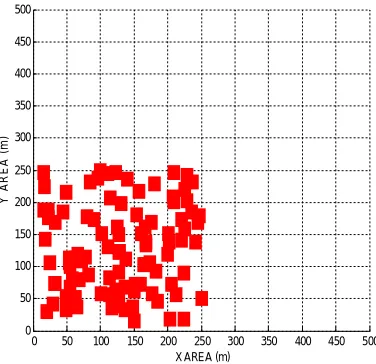
back to head node (base station) so that collected data will be stored. In this work, we are taking the area of 250*250 m2 where 100
[image:6.612.209.397.232.414.2]no. of sensor are placed and each node is movable in nature randomly in given area as shown in figure 2. After placement of nodes, each node requires has its ID with it so that we find out each node in network for communication. Here location is changed by designed the micro controller. Controller is used to control the movement of nodes and it provides the new location or area where nodes are configured. In proposed network microcontroller move the nodes in two directions.
Figure 3: Movable Node in Predefined Area
Figure 4: Movement of Some Particular Nodes
0 50 100 150 200 250 300 350 400 450 500
0 50 100 150 200 250 300 350 400 450 500
X AREA (m)
Y
A
R
E
A
(
m
)
0 50 100 150 200 250 300 350 400 450 500
[image:6.612.206.405.450.684.2]©IJRASET: All Rights are Reserved
[image:7.612.56.536.79.225.2]2273
Figure 5: Localization Response of System
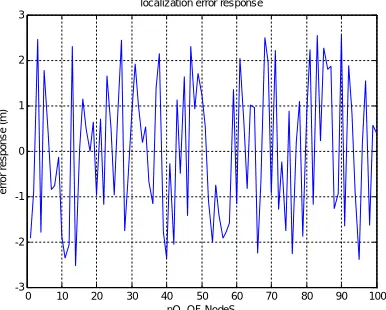
The main parameter of this work is localization error of nodes. As nodes are moving and they changed their location under disaster and when condition are under control then all nodes get back to their location but during this time some localization error occur as shown in figure .
Figure 6: Localization Error of Proposed System
VI. CONCLUSION
Localization is one of the most important applications for wireless sensor networks since the locations of the sensor nodes are critical to both network operations and most application level tasks. The main parameter is the localization error of nodes. So, when all nodes get back to their location after disaster control, there have some localization error but this value must be less than 2% for better response.
REFFERENCES
[1] Jean A. Guevara, Enrique A. Vargas, “Dynamically Reconfigurable WSN Node Basedon ISO/IEC/IEEE 21451 TEDS”, May,2015IEEE
[2] Shan Gaoy,YongPiaoz, “DRRP: A Dynamically Reconfigurable Routing Protocol for WSN”, 2014 IEEE
[3] Martin K. Mwila, Karim Djouani, “An Efficient Approach to Node Localisation and Tracking in Wireless Sensor Networks”, 2014 IEEE Ad Hoc and Sensor
Networking Symposium.
[4] Marcin Szczodrak,OmprakashGnawali,Luca P. Carloni, “Dynamic Reconfiguration of Wireless Sensor Networks to Support Heterogeneous Applications”,
2013IEEE International Conference on Distributed Computing in Sensor Systems.
[5] Abhishek Majumder, Sudipta Roy, Kishore Kumar Dhar, “Design and Analysis of an Adaptive Mobility Management Scheme for Handling Internet Traffic in
Wireless Mesh Network”, 2013International Conference on Microelectronics, Communication and Renewable Energy.
[6] Tiago Condeixa, Susana Sargento, Andr´eaNascimento, Rute Sofia, “Decoupling and Distribution of Mobility Management”, 2012 The 4th IEEE International
Workshop on Mobility Management in the Networks of the Future World
[7] Rajeev Wankar, RajendraAkerkar, “Reconfigurable Architectures and Algorithms: A Research survey”, 2009 International Journal of Computer Science and
Applications, Techno-mathematics Research Foundation.
[8] Haibo Zhang and Hong Shen, “Energy-Efficient Beaconless Geographic Routing in Wireless Sensor Networks, IEEE Transactions On Parallel And
Distributed Systems, Vol 21, Issue 6, pp.881-897,2010.
[9] YunanGu, Miao Pan and Wei Li, “ Maximizing the Lifetime of Delay-Sensitive SensorNetworks via Joint Routing and Sleep Scheduling,” International
Conference on Computing, Networking and Communications, pp.540-544, 2014.
0 10 20 30 40 50 60 70 80 90 100
0 50 100 150 200 250 localization response L o c a ti o n r e s p o n s e ( m ) Node ID original relocalized
0 10 20 30 40 50 60 70 80 90 100
-3 -2 -1 0 1 2 3
localization error response
e rr o r re s p o n s e ( m )
nO. OF NodeS
0 50 100 150 200 250
0 50 100 150 200 250 1 2 3 4 5 6 7 8 9 10 11 12 13 14 15 16 17 18 19 20 21 22 23 24 25 26 27 28 29 30 31 32 33 34 35 36 37 38 39 40 41 42 43 44 45 46 47 48 49 50 51 52 53 54 55 56 57 58 59 60 61 62 63 64 65 66 67 68 69 70 71 72 73 74 75 76 77 78 79 80 81 82 83 84 85 86 87 88 89 90 91 92 93 94 95 96 97 98 99 100
placement of nodes
X area (m)
[image:7.612.209.402.291.446.2][10] AmulyaRatna Swain, R. C. Hansdah and Vinod Kumar Chouhan, “An Energy Aware Routing Protocol with Sleep Scheduling forWireless Sensor Networks:, 2010 24th IEEE International Conference on Advanced Information Networking and Applications, pp.933-940, 2010.
[11] Rama SundariBattula, and O. S. Khanna, “Geographic Routing Protocols for Wireless Sensor Networks: A Review,” International Journal of Engineering and