© 2018, IRJET | Impact Factor value: 6.171 | ISO 9001:2008 Certified Journal | Page 646
An Effective System to Detect Face Drowsiness Status Using Local
Features in a Hierarchical Decision-Making Structure
Maryam Taghizadeh Dehkordi
1, Fariba Sadeghi Hafshejani
2, Hossein Pourghasem
31
Faculty of Technology and Engineering Shahrekord University, Shahrekord, Iran.
2Faculty of Computer Engineering Najafabad Branch, Islamic Azad University, Najafabad, Iran.
3Department of Electrical Engineering Najafabad Branch, Islamic Azad University, Najafabad, Iran.
---***---Abstract
- With increasing development of digitaltechnologies, their presence is felt in life and human affairs more than ever. One of the issues in which the presence of these technologies can be recently observed, is the safety of vehicles and driving them. According to the obtained reports, driver drowsiness is the cause of most accidents and annually causes irreparable damage. Therefore, designing a system capable of meticulously detecting the driver drowsiness is of paramount importance. Driver assistance systems can monitor the status of driver and warn him/her in the case of detecting the driver drowsiness and so, traffic accidents are prevented. In the present study, an algorithm to immediately detect drowsiness was presented. This algorithm calculates 4 parameters of closed eyes, open mouth, the rate of blinking and the rate of yawning, and prioritizes them using harmony search. Then a neural network detects driver drowsiness. The results of testing the plan on YawDD dataset show that the proposed algorithm has been very successful and able to detect well 79- 82% of drowsiness cases. Compared to previous works, the proposed algorithm has acted 4-14% better than the best one.
Key Words: Detection of drowsiness, Harmony search, Neural networks, HSV, YawDD
1.
INTRODUCTION
Although, every day we see the progress of computer systems and their increased presence in our daily lives but, most of relationships between humans and computers are one-sided, and the lack of an effective relationship between user and computer is strongly felt. One of the issues of interest in image processing which can potentially reduce this gap is detection of humans’ normal emotions through their facial features by computers. The human face is a rich source of information about human behavior. Perhaps, detection of human emotions through his face is very simple and commonplace for humans but this process can be time-consuming and costly for an intelligent system. Amongst uses of humans’ emotion detection we can refer to automated training system, review of images and videos, smart environment and driving warning systems [1]. Driver assistance systems can monitor the status of driver and warn him/her or control the vehicle in the case of detecting the deriver drowsiness and prevent from traffic accidents. Generally, detection of facial expressions is divided into three main
phases of face recognition, extraction of features and classification of features [2]. Face recognition phase determines an area of the input image the human face is located in. the extraction phase recognizes features points i.e., eyes, lips, and checks, and finally, the third phase classifies features using the second phase information.
In the proposed scheme, initially, the image is pre-processed, i.e. the color space is changed and the noise is eliminated by median filter. Using thresholding in the HSV color space, skin color areas in the picture will be cut and main processing is performed only on selected areas. This improves the speed of detection algorithm implementation. Then, the components of face and their status will be detected using Sobel edge detection technique and clustering method. Then, the parameters of opening and closing rates of mouth, the rate of blinking, closed eyes and open mouth are measured and these variables as input are entered into neural network and the output of neural network determines the amount of drowsiness. Each of the measured features has a special weight. These coefficients are obtained through harmony search algorithm.
In the second part of the article, previous studies performed on drowsiness detection algorithms are reviewed and compared. In the third part, the method used in present study is described and its different parts are explained in details. Testing method and the results of the proposed method investigation are presented in the fourth part and in the fifth part of the article, the results are represented.
2. Previous studies
Human facial expressionrecognition systems usually use two technologies of image processing and pattern recognition. Image processing is used for face recognition and facial expression extraction process and pattern recognition are used to categorize extracted facial expressions and classify them.
© 2018, IRJET | Impact Factor value: 6.171 | ISO 9001:2008 Certified Journal | Page 647 In [3] reviewing all the video frames, the areas of mouth
and eyes are separated after face recognition. At next stage, segmentation is done. In this system, a neural network was used to update the weight using genetic algorithm. This network provides an optimal structure of the system. Extraction of features can be implemented just on areas separated from eyes and mouth. In order to check the status of open and closed eyes and occurrence of yawning, DIP can be used. DIP is used as an input for neural network to estimate the probability of fatigue. If it is higher than normal level, the warning signal is activated.
In another research study, through measuring variables of bus drivers’ facial expressions such as anxiety, excitement and anger, the amount of accidents risk possibility was determined [4].
In [4], the relationship between the personality of driver and risk of accident was shown and it was concluded that there is a little relationship between the personality of driver and the risk of accident. The possibility of accidents by drivers is determined by assessing some mental situations such as stress, emotional behavior and anger.
In [5], using edge detection method, the status of eyes, mouth and eyebrows when the driver is in normal mood are detected and saved, and then the driver situation is compared with saved ones moment by moment and driver statues is detected based on created changes.
The method presented in [6] permanently follows face gestures and simultaneously detects emotions to check the deriver situation. This method includes 4 steps. Firstly, face recognition is performed using thresholding images in RGB color space. In next step, the areas of eyes and lips are detected. Then, the changes in eyes and lips are traced and finally the situations of driver are detected using fuzzy network.
In [7], firstly the input images are divided to several sub-images and each of them is turned into gray format and the features of images are extracted using LBP technique. These features are sent to a support vector machine (SVM). SVM detects driver drowsiness using what it trained before. This method has limitations for real driving conditions. One limitation of this method is to detect using still images without real-time behaviors of fatigue situations such as deriver closed eye. Another limitation is that it pays no attention to changes and head movements.
In [8], certain areas such as corners of the mouth, eyelids, cheek are detected and connected to each other using vectors. Calculating the changes in sizes and angles of these vectors, the algorithm is able to detect the face status.
In [9], automatic facial expression recognition system is presented based on fully integrated neural network modules. This system was designed in order to integrate several types of classification in a system based on
face model to recognize emotions of faces better. In multi-face model, a method based on feature has been used to trace face features and classifying emotions. Multi-face model has been divided into 5 important components including eyes, eyebrows, cheeks, wrinkles and lips for motion detection part.
In [10], a simple method was introduced to detect the face and its components such as eye, nose, mouth and lips using color images. This algorithm includes 3steps of face recognition, local segmentation and recognition of different facial expressions. In segmentation process of skin color main YCbCr color was used to detect face. This algorithm was compared on RGB and HIS color images. In HIS color images, better results were obtained.
In [11], viola-jones algorithm was used to match pictures according to facial features. This algorithm is applied on images with N*N pixels with gray scale system.
In [12], four different combined face recognition models were provided. These models were convolution neural network educated by a facial features recognition form, a network educated by sound information, an automated encoder which learns space-time properties, this encoder helps with recording human movements and a network which is educated by visual features extracted from near the mouth of main subject in the video.
In [13], the algorithm detects about 65% of driver drowsiness using voice analysis. This is done through voice analysis. This analysis is done given the stretch of sounds, emphasis on spoken words in a sentence and the way of producing sounds. Finally, based on them, different emotions are detected.
In [14], a method was provided that detects drowsiness using the situations of eyes and yawn and through fuzzy system. This method is very accurate but its face detection part uses viola-jones algorithm which is time-consuming and reduces the speed of system.
In [15], a method was introduced to detect open and closed mouth. It can be used to detect the yawn. This method works at two steps. First step is a learning phase that the system is manually educated by the images of open and closed mouth. At second step, it is a detection phase, firstly, image features are extracted by Principal Components Analysis and then they are classified by SVM.
In [16], a plan was introduced to detection of face, lips and eyes. This plan can detect the components of the face instantly. In this plan, the area of face is specified by thresholding and the positions of eyes and mouth are determining using mathematical ratios. The disadvantage of this plan is its high sensitivity to brightness, if the image is bright or dark, the error will increase.
© 2018, IRJET | Impact Factor value: 6.171 | ISO 9001:2008 Certified Journal | Page 648 face using Viola-Jones algorithm and then it specify the
status of mouth using the histogram of the image.
In [18], Viola-Jones algorithm was used to detect the face and mouth. The plan detects drowsiness by recognition of yawn.
3. Introduction of the project
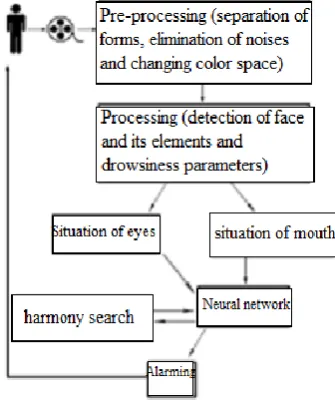
The architecture of proposed project can be seen in figure 1. It consists of four main steps of pre-processing, image processing (detecting parameters affecting drowsiness), adjustment of effectiveness coefficients (harmony search and detection of drowsiness (neural network).
The pre-processing part includes separating image frames to be processed from image sent by camera, eliminating probable noises of image by median filter and changing image color space from RGB to HSV. Image processing system part includes image thresholding to separate the area of face from the image, detection of mouth, eyes and their situations (being open or closed) and calculation of parameters sent to the drowsiness detection part.
[image:3.595.316.555.537.724.2]The part of effectiveness coefficients adjustment determines the effectiveness coefficient at the time of system boot. In fact, the algorithm specifies the situations of eyes and mouth (closed or open) after detecting the face area. In this part, 4 parameters of closed eyes, open mouth, the rate of blinking and the rate of yawning are determined, but they don’t have the same weight for detection of drowsiness. For example, the driver may talk during driving and so, open mouth is not necessarily a reason for drowsiness. The situation of closed eyes is more important than yawning and adjusting effectiveness coefficient in this part helps algorithm act better at detection step. The best effectiveness coefficients are found using harmony search algorithm which is a meta-heuristic search.
Fig -1: Block diagram of the proposed algorithm
3.1 Pre-processing
This section contains separation of image frames in order to process the images sent by the camera, elimination of possible noises of image using median filter and changing the color space of image from RGB color space to HSV color space.
3.1.1 Separation of frames
Images received from the camera installed inside the car have been captured at the rate of 30 frames per second that in this section, any frame of the original image is sent to the next stage as a picture in the RGB color space.
3.1.2 Elimination of noises
The images captured by camera usually have noises; these noises are seen as color pixels in the image. The main reason for the creation of noises is the lack of proper lighting in the environment to capture the image.
Since the noises in image reduce the detection accuracy in the processing stage, in the proposed plan, the median filter was used to eliminate the probable noises as much as possible. This filter exists in MATLAB as a pre-defined function (medfilt2). The main principle of it is that for each pixel of the image, the mean values of its neighbors are considered. For example, in figure 2, the left image has noises and the values of a part of it were represented and the right image is the same image after eliminating the noises.
[image:3.595.76.244.544.746.2]As median filter is an effective and inexpensive filter, in the proposed plan, it was used to remove the noises. Inexpensiveness or low cost of the filter means that its speed of implementation is very high and it can be run in parallel and since the implementation speed of algorithm is very important, it was used in the proposed plan.
© 2018, IRJET | Impact Factor value: 6.171 | ISO 9001:2008 Certified Journal | Page 649 3.1.3 Changing image color space
In this plan, one of the steps of image processing section is to recognize the face and to separate it from the main image. For this purpose, thresholding method (which is described in detail latter) was used in the plan. Since in images with RGB color space, brightness is not raised as an independent parameter, thresholding on the images in this color space must be performed at several steps and conditionally and with a threshold color table. This is more time-consuming than thresholding on images in HSV color space.
In the light of the above, the images received from camera are changed from RGB color space to HSV color space.
3.2 Image processing
Image processing step contains recognition of face and its components, detection of situations of face components such as closed or open eyes and mouth and finally determining the parameters affecting the detection of drowsiness that each of them are described as follows.
3.2.1 Face recognition
Thresholding method was used to detect and separate the face in images sent by camera. Although this method is not an accurate method, but due to its high speed increases the speed of algorithm to recognize drowsiness. Moreover, in the proposed plan, it is not necessary to fully detect face area and specifying the approximate area of the face is sufficient.
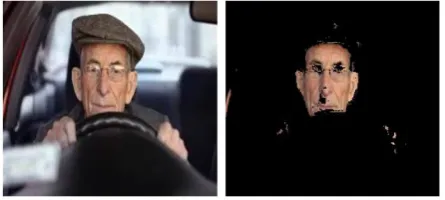
[image:4.595.312.555.195.254.2]The images in HSV color space include three parts of hue, saturation and brightness, that one color can be separated from other colors in the image by limiting these three components at specific intervals. In the proposed plan, 10% of images were selected randomly and each image was explored separately to specify three components of S, H and V for skin color in the image, then an interval was selected for each component which includes all intervals. For instance, an example of thresholding is shown in Figure 3. The values listed in table1 were used for this figure’s image thresholding.
Fig -3: Threshold image
After exploring 10% of images, the dataset of main values were selected for images thresholding, as presented in table2.
Table -1: Example values for image 3thresholding
Component Minimum Maximum
H 0.006 0.105
S 0.285 0.619
V 0.441 1
Table -2: Selected values for thresholding
Component Minimum Maximum
H 0.005 0.208
S 0.281 0.633
V 0.431 1
3.2.2 Detection of eyes and their situations
Closed eyes are one of the most important parameters of drowsiness detection. In the proposed algorithm, in order to detect the position of eyes in the image and their situations, the different light intensities of pupil, i.e. edge detection, and the symmetry of them were used. Sobel algorithm was used for edge detection.
Sobel algorithm has two masks that in the proposed plan, two 3*3 masks were used. Sobel algorithm can be easily implemented, but in MATLAB software there is a pre-defined function for this algorithm which can be used as Edge(). If in MATLAB it is determined for edge detection function to select the horizontal edges with threshold values of 370-530, the position of eyes will be easily identified.
Pre-defined samples are used to detect closed or open eyes. The sample used in present algorithm is presented in table 3. The closed or open eyes can be detected by comparing pre-defined samples with the output of Sobel edge detection algorithm. After edges were detected by Sobel algorithm, that part of image is selected based on specified lines as edge, and finally it is compared with the sample. Since the individuals’ eye sizes are different or the distances between the camera installed in different cars and the driver are different and these result in different sizes of eyes in the image, in the proposed algorithm, the found area is resized to 15*30 pixel so that all the images can be compared to pre-defined samples under the same conditions.
Table -3: The samples defined for detection of eyes situation
Sample
picture Area Pre-defined sample Average length
open 210 7.6
Semi-open 157 6.8
[image:4.595.51.274.606.706.2]© 2018, IRJET | Impact Factor value: 6.171 | ISO 9001:2008 Certified Journal | Page 650 3.2.3 The rate of blinking
In order to estimate the opening and closing rate of eyes (blinking), the algorithm regularly check each image frame and as soon as the eyes are closed, the algorithm saves that time in a memory and then it waits for the eyes to be closed and this action will continue until the end. Blinking in the last five seconds of the image processing is always calculated as the rate of blinking. For example, if the algorithm is processing the image frames at the time of 5:12, it counts the number of closing eyes from 5:07 to 5:12 and calculates its number as the rate of blinking. If the processing time is less than five seconds, the algorithm proportionally calculates the rate of blinking in five seconds.
3.2.4 Detection of mouth and yawning
K-means clustering algorithm is one of the effective techniques to detect changes in the face. In fact, in this algorithm, the shortest distance between classes with regard to yawning detection is the shortest distance between pixels. K-means algorithm has two phases as follows:
Gaining a series of points (pixels) as the center of the cluster.
Assigning each sample to a cluster in a way that it has the shortest distance to the cluster center. The algorithm begins by selecting a series of clusters based on recognized face and the distances of points to the centers of clusters are calculated. As the face state changes from normal to yawning, the distance between points related to the mouth with cluster’s center point becomes longer and algorithm can detect yawning based on this change. In selecting clusters, since the color of lips is different from other parts of skin, the pixels related to lips are placed in a cluster and by changing face status from normal to yawning, the distance of the points in new cluster becomes longer and the algorithm detects the yawn.
3.2.5 The rate of blinking
In order to estimate the opening and closing rate of mouth (yawning), the algorithm regularly check each image frame and as soon as the mouth is opened, the algorithm saves that time in the memory and then it waits for the mouth to be closed and this action will continue until the end. Yawning in the last one minute of the image processing is always calculated as the rate of yawning. For example, if the algorithm is processing the image frames at the time of 10:01, it counts the number of the states mouth is opened from 10:01 to 11:01 and calculates its number as the rate of yawning. If the processing time is less than one minute, the algorithm proportionally calculates the rate of yawning in one minute.
3.3 Adjustment of drowsiness parameters coefficients (Harmony search)
Harmony search is a meta-heuristic search algorithm and since checking all the situations of coefficient for drowsiness parameters is very time-consuming, it was used to find effectiveness coefficients. The algorithm is performed in five stages:
1. Initializing
2. Initializing harmony memory 3. Creating a new harmony 4. Updating harmony memory
5. Repeating steps 3 and 4 until reach the final term In the proposed plan, initializing contains the introduction of a harmony with 4 notes which are the drowsiness parameters. Initializing the memory is done as follows: 50 harmonies are built randomly. Harmony algorithm is run 200 times and at each step, 50 superior harmonies are selected as the primary harmony for next step.
In order to assess the harmonies, 10 videos (5 drowsy cases) are selected randomly and the harmonies are tested on these videos one by one. When a harmony is applied on neural network and the output of network for 10 videos is completely (100 %) correct, this harmony is the best harmony. Given the correct detection with this harmony, the harmonies are ranked and 50 superior harmonies are selected for next step, finally the best harmony is selected.
The best harmony after 200 replications of algorithm is the harmony search algorithm.
Table -4: The best selected harmonies
Closed eye Open
mouth blinking Rate of yawning Rate of 0.391 0.385 0.21 0.014
3.4 Detection of drowsiness
In the proposed algorithm, drowsiness detection is performed by neural network, the plan and training of this network are described as follows:
3.4.1 Neural network
© 2018, IRJET | Impact Factor value: 6.171 | ISO 9001:2008 Certified Journal | Page 651 is equivalent to 1 and open eye is equivalent to 0. Also,
mouth situation has two states: open and closed, open mouth is equivalent to 1 and closed mouth is equivalent to 0.
For example, if the processing section calculated the drowsiness parameters as the values listed in table5, the inputs of neural networks are the values listed in table6.
Table -5: Values calculated in processing section
Table -6: Input and output of neural network
Parameter Input Output Closed eye 0.391 4.23 (drowsy)
Open mouth 0
Rate of blinking 0.63 Rate of yawning 0.014
[image:6.595.310.558.594.741.2]As shown in table6, the parameters specified in processing section, are multiplied by their coefficients and entered into neural network as input and the output of neural network was estimated to be 4.23. As described in neural network training part, neural network learns to produce the value 5 for signs of full drowsiness and the value0 for signs of full consciousness, therefore, in the proposed algorithm it produced the value 4.23 and this implies that neural network has detected drowsiness.
Table -7: Features of dataset videos
Parameter value
Number 322
Image size 480*640
Color space RGB
Frame rate 30 frames per second
Data volume 5GB
3.4.2 Neural network training
Neural network was trained as follows: 5% of dataset was selected randomly and given to the algorithm to extract the signs of drowsiness. After extracting the information, one output is considered for each group of the data which, in fact, is related to an image frame. For the information on consciousness, the output is considered to be 0 and for
information on drowsiness, the output is considered to be 5. Finally, this information was used to train the neural network and the results are presented in fifth section.
4. Algorithm testing
4.1 Algorithm testing dataset
The dataset on which the algorithm was tested is YawDD dataset [19]. The dataset contains two series of videos of different drivers with different situations. In first series of videos, the cameras were installed under the front mirror. These videos include the normal state of face and the situations of talking or reading and yawning. This set includes 322 videos. In second series, the camera was installed on the dashboard and like the first series, videos include different facial expressions, including normal face, talking or reading and yawning. Full details of these two sets can be observed in the Annex.
4.2 Priority coefficients results of drowsiness detection parameters
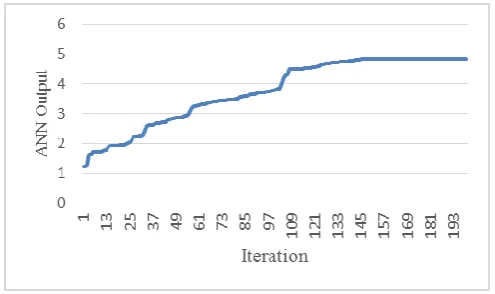
As mentioned, in order to determine the drowsiness detection parameters coefficients, harmony search was used. After each replication of harmony search algorithm, the output of neural network designed for drowsiness detection is recorded as assessment function of harmonies and after comparison, 50 superior harmonies are selected and form the population of the next generation.
On the drowsiness frames, the more closer to 5the output of neural network, the better that harmony is; and in consciousness frames, the more closer to 0 the output of neural network, the more appropriate that harmony is. In chart 1 and 2 the charts related to drowsiness and consciousness frames are shown. As shown in these two charts, after about 100 replications of the algorithm, the slope of changes becomes gentle and more replication doesn’t generate better harmonies practically. For each tested frame, one superior harmony was selected and finally all the superior harmonies were averaged and the average values of harmonies were considered as the best priority coefficients for the algorithm.
Chart -1: Performance of harmony search on drowsiness situation
Parameter Value
Closed eye Closed (1) Open mouth Closed (0)
Rate of blinking 3
© 2018, IRJET | Impact Factor value: 6.171 | ISO 9001:2008 Certified Journal | Page 652 Chart -2:Performance of harmony search on
consciousness situation
The average of the best values used in drowsiness detection algorithm is presented in Table4. As can be guessed, the parameter of closed eyes is a more important parameter than the others. So its coefficient is greater than other coefficients, so it has greater weight at the time of drowsiness detection.
4.3 Performance of neural network
Neural network training was performed by 10000 frames. The information was related to 5.5-minutes video. These frames were selected from dataset frames randomly.
As shown in chart 3, error histogram diagram is one of the diagrams representing the accuracy of neural network training. This diagram represents the number of different errors for three data groups: training, validation and testing. For example the trained neural network has 2000 errors with the value of 0.004061. In this chart, total number of errors is equal to the number of data selected for neural network training (10000) and as the most of errors occurred in the range of zero error, the neural network was trained well.
Chart -3: Error histogram of neural network
4.4 Compared algorithms
OpenCV [20] provides a series of image processing algorithms, among them, there are mouth and face detection algorithms which were used to detect drowsiness.
Diagram1 is the proposed algorithm in [15], it just specifies the situation of mouth. In order to detect drowsiness, the output of Viola-Jones algorithm which has specified the face in the image was given to it. If the mouth is open, the algorithm interprets it as a yawn and finally, detects drowsiness.
Diagram 2 shows the plan proposed in [16]. The open mouth also means yawning and is interpreted as drowsiness.
Diagram 3 and 4 show the plans proposed in [17] and [18], respectively and in both of them, yawning was used as the sign of drowsiness.
Comparison result of the proposed algorithm to detect drowsiness is shown in chart 4. As can be seen in this chart, the algorithm was tested for both video series of A and B and the outputs of face detection and drowsiness detection were compared with previous algorithms. Since in the proposed plan, very simple color thresholding algorithm was used to detect the face, the result of face detection algorithm had no proper performance compared to previous ones but finally, in comparison to all previous plans, the proposed algorithm could provide more successful output to detect drowsiness.
© 2018, IRJET | Impact Factor value: 6.171 | ISO 9001:2008 Certified Journal | Page 653 forehead or the ears may be covered by the hair and so,
the algorithm does not detect the face completely. In the proposed algorithm, the eyes and mouth are fully detected except when the driver has worn sunglasses and therefore, the eyes are not detected by algorithm.
5. Conclusion
Considering the increasing development of image processing uses in different affairs of human life and various sciences, paying attention to this science is of paramount of importance. By adding image processing ability to digital systems, the humans’ role in controlling them can be reduced and this leads to saving money, time and human resources. On the other hand, errors and mistakes done by human are greatly reduced for different reasons. One of the big challenges of image processing is the heavy calculations which require powerful calculating systems or the need to spend more time. Therefore, researchers have done a lot of studies in this regard to cope with this challenge as much as possible. In the algorithm, in order to detect driver drowsiness, four parameters of closed eyes, open mouth, the rate of blinking and the rate of yawning were used and priority coefficients were assigned to them using harmony search. The results showed that the best values for thresholding are the values listed in table2. In addition, the results of testing algorithm on YawDD dataset showed that although the algorithm didn’t act well in terms of face detection but it was very successful in drowsiness detection and it could well detect 82% and 79% of drowsiness in samples A and B, respectively. In sample A, the algorithm correctly detected drowsiness 14 % better than the best algorithm and in sample B, this was 4%.
REFRENCES
[1] S. Shojaeilangari, W. Yau, S. Member, K. Nandakumar, J.
Li, and E. K. Teoh, “Robust Representation and Recognition of Facial Emotions Using Extreme Sparse Learning,” Image Process. IEEE Trans., vol. 24, no. 7, pp. 2140–2152, 2015.
[2] R. Niese, a. Al-Hamadi, B. Michaelis, and H. Neumann,
“Integration of geometric and dynamic features for facial expression recognition in color image sequences,” in Soft Computing and Pattern Recognition (SoCPaR), 2010 International Conference of, 2010, pp. 237–240.
[3] N. G. Narole and P. R. Bajaj, “A Neuro-Genetic System
Design for Monitoring Driver ’ s Fatigue,” IJCSNS Int. J. Comput. Sci. Netw. Secur., vol. 9, no. 3, pp. 87–91, 2009.
[4] L. Mallia, L. Lazuras, C. Violani, and F. Lucidi, “Crash
risk and aberrant driving behaviors among bus drivers: The role of personality and attitudes towards traffic safety,” Accid. Anal. Prev., vol. 79, pp. 145–151, Jun. 2015.
[5] S. Fukuda, “Detecting driver’s emotion: A step toward
emotion-based reliability engineering,” in Recent Advances in Reliability and Quality in Design, Springer, 2008, pp. 491–507.
[6] U. Agrawal, S. Giripunje, and P. Bajaj, “Emotion and
Gesture Recognition with Soft Computing Tool for Drivers Assistance System in Human Centered Transportation,” in 2013 IEEE International Conference on Systems, Man, and Cybernetics, 2013, pp. 4612–4616.
[7] Y. Zhang and C. Hua, “Driver Fatigue Recognition Based
on Facial Expression Analysis Using Local Binary Patterns,” Opt. - Int. J. Light Electron Opt., Sep. 2015.
[8] S. Hachisuka, “Human and Vehicle-Driver Drowsiness
Detection by Facial Expression,” in 2013 International Conference on Biometrics and Kansei Engineering, 2013, pp. 320–326.
[9] M. Gavrilescu, “Proposed architecture of a fully
integrated modular neural network-based automatic facial emotion recognition system based on Facial Action Coding System,” in Communications (COMM), 2014 10th International Conference on, 2014, pp. 1–6.
[10] M. M. Hasan and M. F. Hossain, “Facial features
detection in color images based on skin color segmentation,” in Informatics, Electronics & Vision (ICIEV), 2014 International Conference on, 2014, pp. 1– 5.
[11] S. Agrawal and P. Khatri, “Facial Expression Detection
Techniques: Based on Viola and Jones algorithm and Principal Component Analysis,” in Advanced Computing & Communication Technologies (ACCT), 2015 Fifth International Conference on, 2015, pp. 108– 112.
[12] S. E. Kahou, X. Bouthillier, P. Lamblin, C. Gulcehre, V.
Michalski, K. Konda, S. Jean, P. Froumenty, Y. Dauphin, N. Boulanger-Lewandowski, R. C. Ferrari, M. Mirza, D. Warde-Farley, A. Courville, P. Vincent, R. Memisevic, C. Pal, and Y. Bengio, “EmoNets: Multimodal deep learning approaches for emotion recognition in video,” arXiv Prepr. arXiv1503.01800, no. 1, 2015.
[13] N. Kamaruddin and A. Wahab, “Driver behavior
analysis through speech emotion understanding,” in 2010 IEEE Intelligent Vehicles Symposium, 2010, pp. 238–243.
[14] T. Azim, M. A. Jaffar, and A. M. Mirza, “Fully automated
© 2018, IRJET | Impact Factor value: 6.171 | ISO 9001:2008 Certified Journal | Page 654
[15] C. Bouvier, A. Benoit, A. Caplier, P. Coulon, and P. C.
Open, “Open or Closed Mouth State Detection : Static Supervised Classification Based on Log-polar Signature To cite this version : Open or Closed Mouth State Detection : Static Supervised Classification Based on Log-polar Signature,” 2009.
[16] C. C. Chiang, W. K. Tai, M. T. Yang, Y. T. Huang, and C. J.
Huang, “A novel method for detecting lips, eyes and faces in real time,” Real-Time Imaging, vol. 9, no. 4, pp. 277–287, 2003.
[17] M. Omidyeganeh, S. Shirmohammadi, S. Abtahi, A.
Khurshid, M. Farhan, J. Scharcanski, B. Hariri, D. Laroche, and L. Martel, “Yawning Detection Using Embedded Smart Cameras,” IEEE Trans. Instrum. Meas., 2016.
[18] S. Abtahi, S. Shirmohammadi, B. Hariri, D. Laroche, and
L. Martel, “A yawning measurement method using embedded smart cameras,” in 2013 IEEE International Instrumentation and Measurement Technology Conference (I2MTC), 2013, pp. 1605–1608.
[19] S. Abtahi, M. Omidyeganeh, S. Shirmohammadi, and B.
Hariri, “YawDD: A yawning detection dataset,” Proc. 5th ACM Multimed. Syst. Conf. - MMSys ’14, pp. 24–28, 2014.
[20] “OpenCV| OpenCV.” [Online]. Available: