© 2017, IRJET | Impact Factor value: 5.181 | ISO 9001:2008 Certified Journal
| Page 725
Performance Evaluation of Lane Detection Images Based On Fuzzy
Logic
Tamanna
1, Arushi Bhardwaj
21
M.Tech Scholar, Department of Electronics & Communication Engineering,
Sri Sai College Of Engineering & Technology, Badhani, Pathankot, Punjab, India
2
Assistant Professor, Department of Electronics & Communication Engineering,
Sri Sai College Of Engineering & Technology, Badhani, Pathankot, Punjab, India
---***---Abstract - This paper represents that lane coloration has become popular in real time vehicular adhoc system. Lane detection is normally helpful to localize path limits. Determine undesired lane variations and to enable approximation of the upcoming geometry of the road. There are different types of methods that are used for detecting lines i.e. Hough transform, clustering and curve fitting. The paper shows that Hough transform, clustering and curve fitting work efficiently, but problem is that may fail or not give efficient results when there are curved lane road images. The objective of this paper is to improve lane coloration algorithm by modifying the Hough transform i.e. fuzzy logic with different performance metrics to improve the accuracy. Extensive experiments have shown that proposed technique outperforms over the available techniques.
Key words: Lane detection, Binarization, Curve fitting, Hough transform and Fuzzy logic.
1.Introduction
Passenger's safety is probably one of the most formulated axes concerning exploration in automobile. The vast majority of the vehicle road crashes takes place because of the driver overlooking of the vehicle path so protection is the primary purpose of all of the lane detection methods. The majority of travelling deaths and injuries happen on the country’s highways. According to the fact, improper driving response, high speed as well as U-turn are the main causes behind majority of these incidents. Studies of these accident cases depict that 40% and more mishaps could have been eliminated if perhaps the vehicle had been designed with an alert system. The next generation of driver-assistant system are being developed by consumer analysis organizations, automobile manufacturers and suppliers, as well as other research institutions that will make it possible for vehicles to have more secure tendencies as well as to decrease road injuries and deaths. A computer perspective is involved as one of the primary technologies which become a powerful tool for detection of lanes [18]. Lane detection is normally helpful to localize road boundaries, determine undesired lane variations, and to enable approximation of the upcoming geometry of the road. At Present, two well defined techniques are there for performing lane recognition by making use of video i.e. feature based method and model based method [1, 9] Lane detection enables you to obtain the position as well as direction of the vehicle in addition lane information, as well as an area which includes highways is important to alert a driver associated with lane departure. The lane information is usually used for tracking down other motor vehicles as well as hurdles within the route
of the vehicle and which could be placed on additional growth of the barrier avoiding system [7].
1.1 Binarization
© 2017, IRJET | Impact Factor value: 5.181 | ISO 9001:2008 Certified Journal
| Page 726
1.2 Curve Fitting
A mathematical model is designed for the visual characteristics taken out from a specific frame and in this way road recognition is mostly advised in a top-down fashion. Extracting a compressed high-level reflection of the path is the complete goal of this stage further which is often used for decision making. An even route model along with limits on its thickness as well as curvature is realized so that the particular bottom-up route detection is increased. The boundary points and lateral extent at each centerline location is used to depict the path which clearly describes the boundaries. One of the way to simplify the geometric model is to adjust the framework to bird’s-eye perspective so that the boundaries associated with the road turn out to be identical in curvature and the path’s thickness is approximately consistent.
1.3 Hough Transform
Analysis of detecting lines, curves and ellipses is globally done by Hough transform techniques. It is generally applied after performing edge Detection. According to Hough Transform “Every single pixel in image space corresponds to a line inside a parameter space” also called hough space [18]. The Hough transform (HT) is a useful resource for detecting straight lines inside pictures, even presence associated with noise and missing information, becoming a trendy choice for this task [2]. The Hough transform, HT, was presented as a technique of sensing complicated factors in binary picture information [1]. It defines that by deciding particular prices of variables which characterize these patterns. Spatially lengthy habits are altered so they make spatially lightweight functions in a place of probable parameter values. The HT switches an recognition issue in picture place right into a quicker resolved regional top recognition issue in a parameter space. The main element some ideas of the technique may be shown by contemplating distinguishing models of collinear factors in a image. A couple of picture factors (x, y) which lay on a direct point may be described by way of a connection, f, in a way that f((vh, e), (x, y)) = b – rhx = 0, (1).
Hough Transform Algorithm:
Require: {Binary Image}
Require: δ {Discretization step for the parameter space} 1: Votes ← 0 {Initialization of the voting matrix}
2: for each feature pixel I (x, y) do
3: for 0°≤ Ѳ ˂ 180°, using a δ Discretization step do 4: ρ ← x cos(Ѳ) + y sin(Ѳ)
5: Votes (ρ, Ѳ) ← Votes (ρ, Ѳ) + 1 6: end for
7: end for
1.4 Fuzzy Logic
Fuzzy logic idea is usually than the man being's sensation in addition to inference process. As opposed to established management approach, that really is a point-to-point management, hairy judgement management is a range-to-point and also range-to-range control. The particular creation of any hairy controlled comes from fuzzifications associated with either inputs in addition to components making use of the connected member functions. The crisp and clean feedback might be changed to unique members of the particular connected member features predicated upon it's value. Using this point of view, the particular creation of any hairy judgement controlled can be launched upon it's memberships of various member features, that is thought of as several different inputs.To implement fuzzy logic technique to a real application requires the following three steps:
1. Fuzzifications – convert common information or perhaps highly detailed information directly into hairy information or perhaps Member Functions (MFs).
2. Fuzzy Inference Process – put together account features while using the manage procedures so that you can get the particular unclear output.
3. Defuzzification - apply several methods to estimate every associated outcome plus insert them in to the table: your research table. Grab your outcome in the research table on such basis as today's input during an application.
2. Related work
© 2017, IRJET | Impact Factor value: 5.181 | ISO 9001:2008 Certified Journal
| Page 727
boundary-link features. Tatsuya Kasai et al. [2] verified the lane marker detection method for platooning. For decreased the air resistance, it has been attractive toward cut down the space among two vehicle. If the vehicular space has very small, conservative process, which identifies lane symbols in imagery imprison from a frontage camera, has been in efficient for the reason that lane indictors has occluded via a vehicle in front. Chunzhao Guo et al. [3] Proved that the concurrent lane recognition and localization has been a single key issue for several intelligent transport systems. It has defined lane recognition and tracking process to work in difficult situation where lane border scan be low-distinction and changeful with sound due to a number of factors such as kind, illumination and climate environment, etc. Jia He et al. [4] Described that the visualization based Lane Departure Warning System has been an efficient method to avoid Single auto mobile high way Departure mishap. In performance, a range of composite sound make it extremely hard to identify lane quickly and correctly, so to create a variety of picture processing technique which can provide out come quickly and correctly in the non-ideal environment has been the main exertion. Yu-Chi Leng et al. [5] proposed that the lane-departure recognition method with no fundamental and extrinsic camera parameter calibration. It provides driving protection with track recognition and track departure warning has been paying attention on metro polite an highway through complex track symbols as an alternative of straight forward road scene. Yong Chen et al. [6] described the efficient lane borders projective model and enhanced recognition process in the image capture by a vehicle-mount monocular camera in composite environment, for point rounded arc path initially, a lane borders projective model has been assumed. This lane model not only describes straight-line lane borders, although besides express the tangible pointed rounded arc path borders extremely clearly. Hendrik Deusch et al. [11] proposed that the robust lane colorization has been the prerequisite used for sophisticated driver support system similar to lane departure advice and overtake subordinate . [18]Jung, Soonhong, Junsic Youn, and Sanghoon Sull, proposed a proficient solution to reliably detecting path lanes depending on spatiotemporal images. In a lined up spatio temporal image generated by accumulating the actual p on the scan line along the time axis plus aiming continuous scan lines, the actual trajectory of the side of the road items looks sleek plus styles some sort of direct line. A aligned spatiotemporal photo can be binaries, and 2 principal simultaneous straight lines resulting from the actual temporary uniformity involving side of the road size on the given scan line usually are noticed having a Hough transform, cutting down stance errors. The everywhere you look side of the road items usually are in that case noticed nearby the inter sections of the actual direct outlines along with the latest scan line. Our spatiotemporal domain approach can be tougher lost or maybe occluded lanes as compared with existing frame-based approaches. [image:3.595.153.446.446.709.2]3. PROPOSED METHODOLOGY
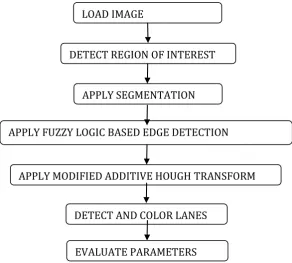
Fig 1: Proposed Methodology
LOAD IMAGE
APPLY SEGMENTATION
DETECT REGION OF INTEREST
APPLY FUZZY LOGIC BASED EDGE DETECTION
APPLY MODIFIED ADDITIVE HOUGH
TRANSFORM
DETECT AND COLOR LANES
© 2017, IRJET | Impact Factor value: 5.181 | ISO 9001:2008 Certified Journal
| Page 728
4.Experimental results
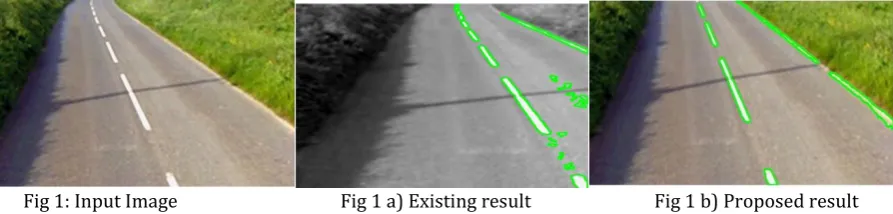
[image:4.595.77.524.228.335.2]For experimentation and implementation the proposed technique is evaluated using MATLAB tool u2013a. Here we compare the lane colorization algorithm i.e. Hough transform with additive Hough transform for removing noise from the images on the basis of various image quality evaluation parameters like recall, f-measure, p_recall and bit error rate. The existing methodology give good results which locate your ln corners with virtually no previous expertise on the highway geometry, in addition to do it within cases for you might be a many chaos inside the highway photograph Thus it becomes a major issue when noise is present in the input image. The proposed approach gives efficient results in improving the existing Lane colorization algorithm. The particular tabular in addition to graphic contrast is accomplished in between established in addition to consist of method based on variables recall, f-measure, p_recall and BER in addition to little bit oversight rate.
Fig 1: Input Image Fig 1 a) Existing result Fig 1 b) Proposed result
1. Recall: Recall (also known as sensitivity) is the fraction of relevant instances that are retrieved. It is defined as collection of positive cases. Recall can be expressed as:
Fig 2: Performance Analysis of Recall
It represents that the increase in recall value of using lane detection images with the use of additive Hough transform.
© 2017, IRJET | Impact Factor value: 5.181 | ISO 9001:2008 Certified Journal
| Page 729
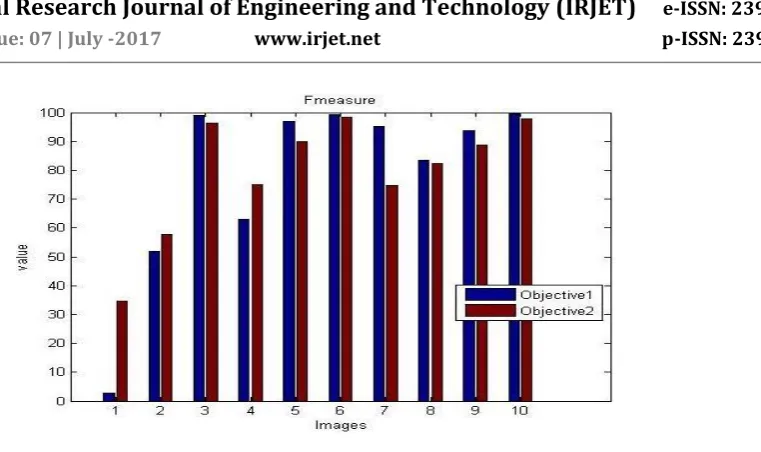
Fig 3: Performance Analysis of F-measureIt represents that the increase in F-measure value of using lane images with the use of proposed additive Hough transform.
3. P_recall: Precision recall is defined as measurement of all positive cases that are identified when making calculations. Precision is also known as positive predictive value.
Fig 4: Performance Analysis of p_recall
It shows that high value of p_recall by using the lane images with use of proposed additive Hough transform.
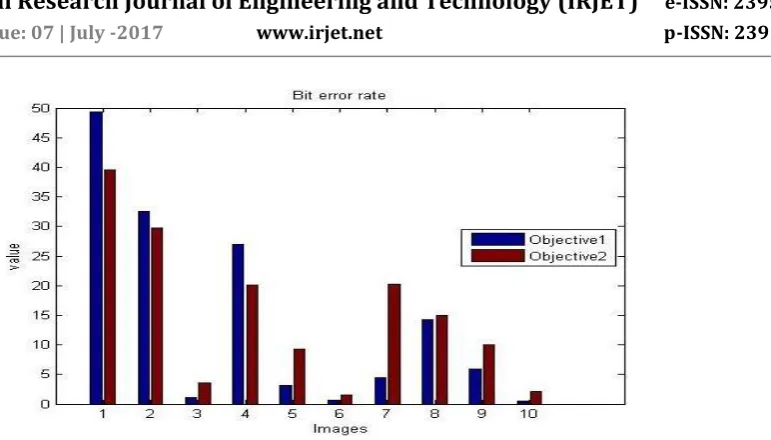
4.Bit Error Rate:Bit error rate is simply the Bit Error Ratio among the input image and final image. It need to be minimized.
[image:5.595.80.468.381.578.2]© 2017, IRJET | Impact Factor value: 5.181 | ISO 9001:2008 Certified Journal
| Page 730
Fig 5: Performance Analysis of Bit Error Rate5. Conclusion
Lane detection enables us to obtain the position as well as direction of the vehicle along with lane information. There are different types of methods that are used for detecting lines. The methods formulated until now are operating effectively as well as providing beneficial results in scenario when the straight lane images are generally there. However challenge is simply because that they are unsuccessful or otherwise not provide successful outcomes whenever there are curved lane road images. In this modify Hough transform i.e. Fuzzy Logic is used to improve straight lane as well as curved lane road images. The comparison has been drawn between Hough transform and Fuzzy Logic by using various parameters recall, f-measure, p_recall, bit error rate (BER). The proposed technique has been designed and implemented in Matlab 2010a by using image processing toolbox. The performance evaluation has shown the improvement in proposed work as compared to the existing.
References
[1] Lin, Qing, Youngjoon Han, and Hernsoo Hahn. "Real-time lane departure detection based on extended edge-linking algorithm" IEEE Second International Conference onComputer Research and Development,pp. 725-730, May 2010.
[2] Kasai, Tatsuya, and Kazunori Onoguchi. "Lane Detection System for Vehicle Platooning using Multi-information Map”IEEE 13th International Conference on, Intelligent Transportation Systems (ITSC), pp. 1350-1356, Sep 2010.
[3] Guo, Chunzhao, Seiichi Mita, and David McAllester. "Lane detection and tracking in challenging environments based on a weighted graph and integrated cues" IEEE/RSJ International Conference on Intelligent Robots and Systems (IROS),pp. 5543-5550, Oct2010.
[4] He, Jia, HuiRong, Jinfeng Gong, and Wei Huang. “A lane detection method for lane departure warning system" IEEE International Conference on Optoelectronics and Image Processing (ICOIP), vol. 1, pp. 28-31, Nov2010.
[5] Leng, Yu-Chi, and Chieh-Li Chen. “Vision-based lane departure detection system in urban traffic scenes" IEEE 11th International Conference on control Automation Robotics & Vision (ICARCV), pp. 1875-1880, Dec 2010.
[6] Chen, Yong, Mingyi He, and Yifan Zhang. "Robust lane detection based on gradient direction" IEEE 6th Conference onIndustrial Electronics and Applications (ICIEA),pp. 1547-1552, June 2011.
[7]Saeedi Xiaoyun, Wang, Wang Yongzhong, and Wen Chenglin. "Robust lane detection based on gradient-pairs constraint" IEEE 30th Chinese Control Conference (CCC),pp. 3181-3185, July2011.
[8] Li, Jian, XiangjingAn, and Hangen He."Lane Detection Based on Visual Attention"IEEE Sixth International Conference
on Image and Graphics (ICIG),pp. 570-575, Aug 2011.
[9] Keyou, Guo, Li Na, and Zhang Mo. "Lane detection based on the random sample consensus" IEEEInternational Conference on Information Technology, Computer Engineering and Management Sciences (ICM), vol. 3,pp. 38-41,Sep 2011.
[10] Li, Hao, and FawziNashashibi. "Robust real-time lane detection based on lane mark segment features and general a priori knowledge" IEEE International Conference on Robotics and Biomimetics (ROBIO), pp. 812-817, Dec2011.
[11] Kang Deusch, Hendrik, Jürgen Wiest, Stephan Reuter, Magdalena Szczot, Marcus Konrad, and Klaus Dietmayer. "A random finite set approach to multiple lane detection" IEEE15th International Conference on Intelligent Transportation Systems (ITSC),pp. 270-275, Sep2012.
© 2017, IRJET | Impact Factor value: 5.181 | ISO 9001:2008 Certified Journal
| Page 731
[13] Cassisi, Carmelo, Alfredo Ferro, Rosalba Giugno, Giuseppe Pigola, and Alfredo Pulvirenti. "Enhancing density-based
clustering: Parameter reduction and outlier detection." Information Systems 38, no. 3 (2013): 317-330.
[14] Wu, Pei-Chen, Chin-Yu Chang, and Chang Hong Lin. "Lane-mark extraction for automobiles under complex
conditions." Pattern Recognition 47, no. 8 (2014): 2756-2767.
[15] Niu, Jianwei, Jie Lu, Mingliang Xu, Pei Lv, and Xiaoke Zhao. "Robust Lane Detection using Two-stage Feature Extraction with Curve Fitting." Pattern Recognition 59 (2016): 225-233.
[16] Lin, Liang, Xiaolong Wang, Wei Yang, and Jian-Huang Lai. "Discriminatively trained and-or graph models for object shape detection." IEEE Transactions on pattern analysis and machine intelligence 37, no. 5 (2015): 959-972.
[17] Niu, Jianwei, Jie Lu, Mingliang Xu, Pei Lv, and Xiaoke Zhao. "Robust Lane Detection using Two-stage Feature Extraction with Curve Fitting." Pattern Recognition 59 (2016): 225-233.
[18] Jung, Soonhong, Junsic Youn, and Sanghoon Sull. "Efficient lane detection based on spatiotemporal images." IEEE