© 2016, IRJET | Impact Factor value: 4.45 | ISO 9001:2008 Certified Journal
| Page 373
Load Frequency Control in Wind-Diesel Based Isolated Power System
by Pitch-Angle Controller
Sunil Kumar
1, Gagan Deep Yadav
21
M-Tech Scholar, YIET Gadhauli, India
2Assistant Professor, YIET, Gadhauli, India
---***---Abstract -
This paper investigates, using pitch angle control, the performance of a standalone hybrid electric power system of which a 300 KVA diesel generator and a 275 KVA wind turbine generator are the constituent subsystems. However, fluctuations of wind generator output power due to variable wind speed adversely affect the system operation and thereby quality of power. One of the effects is the system frequency deviations in power system. Therefore, suitable control mechanism has to be in place to address the issue of intermittent nature of wind power before going in for installation of wind farms. In this work, a pitch angle controller is designed using conventional proportional integral (PI) controller and the same is implemented for obtaining constant power from the wind driven induction generator for wind speeds more than the base speed with a view to regulate the system frequency. A comparison is carried of the system frequency deviations with and without the pitch angle controller using simulations through MATLAB/Simulink. The results show improved frequency regulation with pitch angle controller.Key Words: Wind turbine generator; pitch angle control; frequency deviations; diesel generator
1.
INTRODUCTION
The power demand is constantly increasing which cannot be met by the conventional generation systems alone. Also, there are adverse environmental effects of the conventional power generation systems. This has given rise to the use of renewable sources of energy for power generation of which wind power is the most significant and practically feasible resource. The power generation using renewable energy resources is usually at the distribution level and at small scales. This distribution generation of power is possible only at certain favorable geographical sites. With the advantage of environmentally clean power, the wind power however, has the disadvantage of being unpredictable in nature. Therefore, the availability of a standby power source is of utmost importance to cater to the load requirement in the event of less or no availability of wind power due to changing weather conditions for any span of time. The hybrid power generation system comprising diesel and wind generation is one such suitable solution which can be operated in standalone mode or grid connected mode. In the
present work, however, the wind-diesel hybrid system is considered to be operating in standalone mode supplying to a local load. Because of the diesel generator power, the unpredictable variations in wind power are taken care of and the whole system provides reliable power to the load even during wind power fluctuations.
[image:1.595.316.572.513.667.2]In the event of wind speed being above rated speed, pitch angle control is the most commonly used technique to readjust the alignment of blades and aerodynamic torque of the wind turbine. Wind speed, generator speed, and generator power are some of the variables on the basis of which the pitch angle control is designed and implemented. Conventionally the pitch angle control involves the use of PI controller. Fig. 1 [1] shows the pitch angle controller as part of the basic structure model of variable speed wind turbine system. Pitch angle control is needed to maintain the rotational speed constant in situations when the actual wind speed is more than the rated wind speed. The desired objectives of the pitch angle control include maximizing the wind turbine output power at all wind speeds, restricting the input mechanical power within design limits so as to avoid physical damage to the system, and reducing to the minimum the fatigue loads of the mechanical attachments of the turbine while ensuring that no excessive load is imposed by the control action [1].
Fig 1. Structural representation of wind turbine with pitch angle control [1]
The output power Pa, developed by wind turbine with blade radius ‘r’ can be expressed as under:
(1)
Pitch
Controller
Speed Controller Power
Converter Wind
Turbine and Generator Wind
speed
Cross coupling Rotor speed
β
Power set point Active and
© 2016, IRJET | Impact Factor value: 4.45 | ISO 9001:2008 Certified Journal
| Page 374
where, is the rotor swept area, is the power co-efficient, λ is the tip speed ratio, β is the pitch angle while Vw being the wind speed. The tip speed ratio λ can be described as:
(2)
Wind Diesel hybrid systems can be classified as per penetration levels of wind. The category where the wind penetration is low, the diesel generator runs continuously while the wind power supports the diesel generator output. Wind turbines with low wind penetration levels do not require complex control structures and therefore, the resultant hybrid configuration is simple which results in fuel savings up to ~20% [2].
In medium wind penetration also, the diesel generator is required to be operated continuously. When the wind power available is high, the secondary loads are also supplied power to see that diesel generator is sufficiently loaded; alternatively, if the winds are high and the loading on the system is low, then the turbines are not operated on their full capacities. Simple control mechanism only is sufficient to take care of such type of load dispatching. In the event of high penetration of wind, the diesel generator can be disengaged and auxiliary components are required for the purpose of regulating voltage and frequency. In this work pitch angle controller and capacitor bank take care of this service. It is not practical to keep the diesel generator running in situations when the wind power output alone is capable to supply the load demand.
2.
CONVENTIONAL PITCH ANGLE CONTROL
The pitch angle control is a technique that is used for optimizing turbine output when there are high winds. Pitch servo motors either hydraulic or electrical, are used to position the blades at suitable angle for optimal performance. Blade pitch angle adjustments, within the range of 0 to 45 degrees under normal operating conditions, are carried out usually with rotational speeds of about 5-10º/s [3].
Conventional blade pitch angle control strategies are
depicted graphically in Fig. 3 (a to c). The reference
pitch angle, βref, is controlled by using, as input values,
three different parameters which is explained in the
subsequent paragraphs:
1. Fig. 2(a) shows the control strategy using wind
speed as input where, the graph between pitch angle
and wind speed is used to obtain βref. Because of the
fact that wind speed can be directly measured, the
control strategy turns out to be simple. But,
measurement of wind speed with precision is difficult,
so this strategy may not be suitable.
2.Fig. 2(b) depicts the control strategy using generator
rotor speed as input. The actual rotor speed is
compared against reference rotor speed and the
resultant error signal acts as input to the PI controller
which in turn gives the reference value of the pitch
angle, βref, as output. This work also has utilized the
same strategy to exercise pitch angle control.
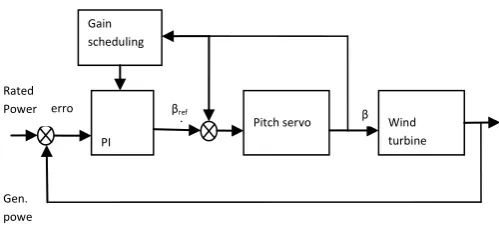
3. Fig. 2(c) depicts the control strategy using generator
power as input. In this strategy, the error signal is
obtained as the difference of actual and the reference
powers of the generator and the same is applied as
input to the PI controller which in turn gives the
reference value of the pitch angle βref.
Fig 2 (a). βref calculation scheme using β-Vw curve.
Fig. 2(b). βref calculation scheme using rotor speed.
Fig. 2(c). βref calculation scheme using generator power.
3. MODELLING AND SIMULATION OF WIN-DIESEL
HYBRID POWER SYSTEM
Fig. 3 shows the wind-diesel hybrid power system, under study in this work, where, both a 300 KVA synchronous generator coupled with a diesel engine and a wind turbine driven 275 KVA induction generator are connected in parallel to feed power to the load of 175 KW.
PI
Pitch servo Wind
turbine Rated
Power βref β
Gen. powe r
erro r
Gain scheduling
PI Pitch servo
Wind turbine Gen.
spee
dd β
βref
Rated speed
erro r
β-Vw
curve Pitch servo
Wind turbine Wind
[image:2.595.318.552.245.299.2] [image:2.595.313.533.354.439.2] [image:2.595.312.562.504.619.2]© 2016, IRJET | Impact Factor value: 4.45 | ISO 9001:2008 Certified Journal
| Page 375
Fig. 2. Modelling schematic of wind diesel hybrid power system.
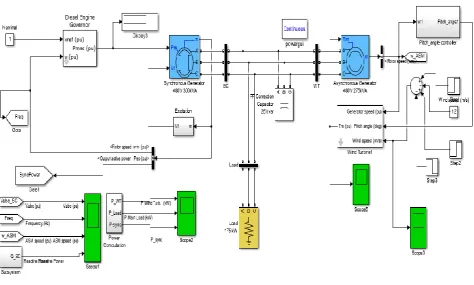
Fig.4. Simulink Schematic of wind-diesel hybrid power system.
Diesel Engine Synchro.
Generator
Wind Turbine Induction Generator
Speed
Governor
Pitch-angle Controller
Voltage
Regulator ωref
Fuel
ω
Vref Power Distribution
Line
ωref
β
Load
Capacitor Bank
[image:3.595.56.531.407.692.2]© 2016, IRJET | Impact Factor value: 4.45 | ISO 9001:2008 Certified Journal
| Page 376
Fig. 5. Diesel engine and its governor system block.
The system of Fig. 3 is modeled and implemented in Matlab/Simulink environment as shown in Fig. 4. The simulation study is then carried out to analyze the performance with pitch angle control.
With wind speed variations, the output power of the wind generator also varies and in that event the diesel generator supplies smooth power to the load to maintain frequency constant. Fig. 5 shows the modeling of diesel engine along with its subsystems, which is as per reference [4]. The current speed, in per unit, of the diesel engine acts as input and the mechanical torque, in per unit, is the output to regulate the diesel engine so that it attains its reference value. The diesel engine is modeled and simulated with the help of a gain relating fuelling rate to torque, restricting the lower and upper torque limits to 0 and 1.1 per unit respectively, and a dead time. A second order system is used to realize the actuator whereas; the speed regulator is realized with PID control.
The pitch angle control scheme regulates the wind turbine output power to its rated value by positioning the blades of the wind turbine by adjusting the pitch angle during strong windy conditions. The error signal input to the PI pitch angle controller is derived as the difference between generator rotor speed (ωg) and the reference value. The output of the pitch angle controller is the reference pitch angle, βref. It helps reduce the operating efficiency of the turbine so as to minimize power coefficient so that the generator is able to maintain its control speed value. Pitch servos are utilized for appropriate positioning of the blades, and a first order delay system is used to model the same. Because the pitch actuation system cannot respond instantly, therefore, introduction of servo delay of 0.024 s became necessary. The actuation speed is yet another parameter which restricts the working of the pitch actuation system, for which a rate limiter of ±2°/s is introduced to model the pitch angle control system more realistically, as per reference [5, 6].
The controller gains Kp and Ki are optimized so that the wind power generation system provides optimum power output during high wind speeds above base value (12m/sec). The optimized values of KP and KI are obtained as 154.7 and 1.7, respectively.
3.
RESULT AND DISCUSSION
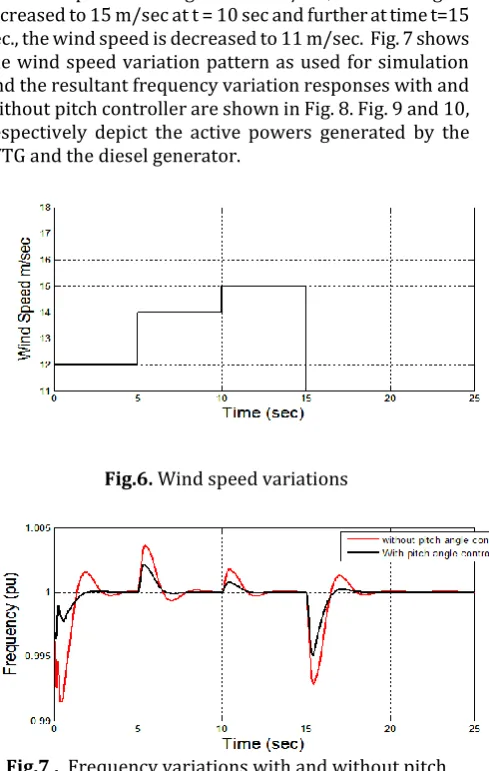
Various simulation runs were carried out on the wind-diesel hybrid power system under the effect of multiple step changes in wind speed and the system performance is evaluated with and without pitch angle controller. However, in a real system, the speed variations are not sharp like step changes but are smoother than a step variation. The base wind speed is taken as 12 m/sec. and the wind speed is initially set at 12 m/sec. After t = 5 sec, the wind speed is changed to 14 m/sec, then it is again increased to 15 m/sec at t = 10 sec and further at time t=15 sec., the wind speed is decreased to 11 m/sec. Fig. 7 shows the wind speed variation pattern as used for simulation and the resultant frequency variation responses with and without pitch controller are shown in Fig. 8. Fig. 9 and 10, respectively depict the active powers generated by the WTG and the diesel generator.
Fig.6. Wind speed variations
[image:4.595.324.569.371.757.2]© 2016, IRJET | Impact Factor value: 4.45 | ISO 9001:2008 Certified Journal
| Page 377
Fig.9. Active power generated by WTG
Fig.9. Active power generated by Sync. generator
When the wind speed varies, the power generated by the wind turbine generator also varies and accordingly the power shared by the diesel generator also changes. For example, between 0-5 sec time periods the power shared by wind turbine generator is around 80 KW and that by diesel generator is about 45 KW as can be seen from Fig. 9 and 10. When wind speed increases to 14 m/sec. at t=5 sec, the WTG produces more power and diesel generator reduces its power accordingly due to governor system. Again at time t=10 sec wind speed is increased to 15 m/sec, which results in changes in the load share of both the generators. Subsequently, when wind speed is reduced to 11 m/sec at time t=15 sec., the output of the WTG falls down and to compensate this shortfall diesel generator starts producing more power. All these variations are illustrated in Fig. 8 and 9. With active power variations due to varying wind speeds, the frequency of the system also varies according to the wind speed, but variation in the frequency is considerably less when pitch angle controller is used. This improvement in performance in terms of frequency variation transients is demonstrated in Fig. 8. The response with pitch angle controller is better as against without controller. Also the maximum values of undershoot and overshoot are less with pitch angle controller to compensate this shortfall diesel generator starts producing more power. All these variations are illustrated in Fig. 8 and 9. With active power variations due to varying wind speeds, the frequency of the system also varies according to the wind speed, but variation in the frequency is considerably less when pitch
5. CONCLUSION
The paper aimed developing a pitch angle control strategy to regulate the frequency in a hybrid wind diesel hybrid power system under the impact of varying wind speed conditions. For this, a pitch angle controller is developed and implemented for the system under investigation to achieve frequency regulation effectively in the face of multiple step variations in wind speed. The simulation results clearly indicate that the frequency deviations in the hybrid power system are very less when pitch controller is used as compared to the system without any controller. The efficient and effective power sharing between wind generator and the diesel generator with varying wind speeds is also demonstrated. The simulations are implemented in MATLAB/Simulink.
REFERENCES
[1] T. Burton, D. Sharpe, N. Jenkins, E. Bossanyi, Wind energy handbook, John Wiley & Sons Limited, Chichester, UK, 2001.
[2] Fay, Ginny, Katherine Keith and Tobias Schwörer, Alaska Isolated Wind-Diesel Systems: Performance and Economic Analysis, prepared for the Alaska Energy Authority, pp 101, June 2010.
[3] Jiannzhong Zhang, Ming Zeng, Zhe Chen, Xiaofan Fu, “Pitch Angle Control for Variable Speed Wind Turbines” IEEE conference on Electric Utility Deregulation and Restructuring and Power Technologies pp 2691 – 2696, 2008.
[4] Yeager KE, Willis JR. “Modelling of emergency diesel generators in an 800 Megawatt nuclear power plant”. IEEE Transactions on Energy Conversion, vol. 8, no. 3, pp. 433-441, 1994.
[5] R.Sebastian, “Simulation Of The Trasition From Wind Only Mode To Wind Diesel System,” IEEE Latin America Transactions, vol.7, no.5, September 2009. [6] The MathWorks, Inc. ‘‘Simulink (built upon Matlab)’’.
![Fig 1. Structural representation of wind turbine with pitch angle control [1]](https://thumb-us.123doks.com/thumbv2/123dok_us/8181725.810909/1.595.316.572.513.667/fig-structural-representation-wind-turbine-pitch-angle-control.webp)