2018 International Conference on Computer, Electronic Information and Communications (CEIC 2018) ISBN: 978-1-60595-557-5
Design of Location Service System for Wireless Ad Hoc Network
Bin ZENG
1, Lu YAO
1and Rui WANG
2,*1
Depart of Management, Naval University of Engineering, Wuhan, Hubei, China
2
Library, Naval University of Engineering, Wuhan, Hubei, China
*Corresponding author
Keywords: Location service system, Ad hoc network, Routing protocol.
Abstract. Location based services bring much convenience to people when they go to a specific place. It is believed that location based services are likely to be a killer application of the wireless Internet. A new location based services system is proposed that is complementary to traditional location based services using positioning technologies. Clients and servers in this system are connected using wireless technologies. Besides, a service range improvement method and corresponding routing protocol are proposed to help the client who is not in the location service range connect to the server through other clients using ad hoc connection. The system can work indoor and people can get desired location based services anytime and anywhere.
Introduction
Mobile personal devices, like cellular phone and PDA …etc., have been so popular to become the necessities of people. These devices have a great advantage of mobility so that people can take them wherever they go. Therefore, mobile personal devices act as great tools that people use them to get desired services anytime and everywhere.
It’s undoubted that variety of applications will flourish with the advent of wireless technologies and mobile personal devices, including location-based applications. In our opinion, there will be lots of location based services servers (LSSs) providing location based services ubiquitously spread in the world. These LSSs act as servers that provide specific location based services and disseminate these services to client devices in a limited distance. When people come into the service range of LSSs, they can get services.
Currently network operators adopt positioning technologies to track the location of each client so that they can provide location based services. Positioning technologies play an important role in this location based service [1, 2]. Lots of technologies methods have been developed. All of them have their limitations. Some require a SIM card, or even the mobile terminal itself, to be changed, whereas others require changes at the network level [3, 4].
System Architecture
Basic Components
The basic components in our architecture are location service servers (LSSs), client devices, and a standard wireless network technology.
A LSS is a server providing specific location based services, connecting to the wireless network, and disseminating these services to client devices. We assume LSSs in our architecture are preset in fixed places. LSSs disseminate their services information in their service range. The size of their service range depends on the wireless ad hoc technology they use.
A client device in our system means a mobile personal device that is able to connect to LSSs. It’s light, portable, short, small and convenient to people to carry it everywhere. After getting the services from LSSs, client devices are able to activate the services so that people can use them.
The wireless ad hoc technology contributes wireless networks acting as the bridge between LSSs and client devices. LSSs send services to client devices through the wireless network. In attention, LSSs and client devices must use the same wireless technology to connect to each other.
Multiple Services
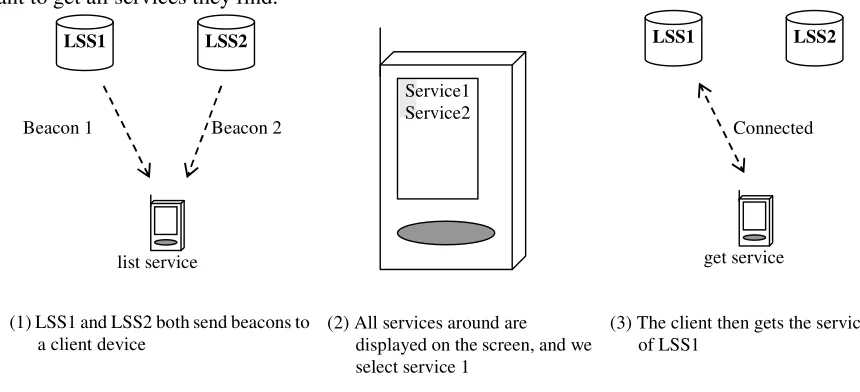
[image:2.612.89.519.331.527.2]In some conditions, there are multiple LSSs nearby and their service ranges are overlapping [7]. When a client device goes into the overlapping of multiple LSSs, people owning the client devices should want to get all services they find.
Figure 1. Steps of getting services.
However, Service overlapping will encounter message conflicts [8]. To solve this problem, we divide the process that LSSs disseminate their service to client devices into three steps. First, each LSS sends a beacon which contains the information about the services to client devices. After client devices receive the beacon, that service information will be displayed on the screen of client devices and people can select any service on the screen as they wish. In the LSS, people can get the selected services. These steps are illustrated in Figure 1.
Service Range Extension
LSSs can only disseminate their service information in a limited distance because of the limitation of wireless technologies. For example, LSSs adopting IEEE 802.11 standard can only serve personal devices below 100 meters [9].
However, we can expand their coverage by connecting client devices into a mobile ad hoc network. In the system, each client device in this network acts as a gateway and interconnects to each other so that one personal device can get services through other personal devices. Although a client device is not in the service range of a LSS, it can still get the service of that LSS.
LSS1
Beacon 1
list service
LSS2
Beacon 2
Service1 Service2
LSS1
get service
LSS2
Connected
(1) LSS1 and LSS2 both send beacons to a client device
(2) All services around are displayed on the screen, and we select service 1
Routing
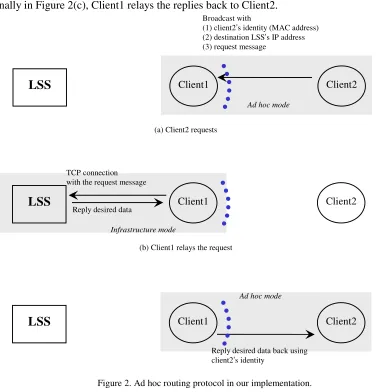
In order to make it possible that one client device can get services through other client devices, we need an ad hoc routing protocol in our implementation. An ad hoc routing protocol is designed to be simple and fewer overhead. Figure 2 illustrates our ad hoc routing protocol.
In Figure 2(a), Client2 is outside the wireless ad hoc which contains the LSS it wants to connect to. Therefore, Client2 cannot get the dynamic IP address from DHCP server. Client2 just broadcast a message including its identity (MAC address), the IP address of the destination LSS, and the message it want to request to the LSS.
Client1 in Figure 2(b) and inside the wireless network gets a dynamic IP address. After Client1 receiving the message transmitted from Client2, it uses the IP address of the LSS inside the message to construct a TCP connection to the LSS and relays the request from Client2 to the LSS, too. Then the LSS replies the requested data to Client1.
[image:3.612.101.480.234.626.2]Finally in Figure 2(c), Client1 relays the replies back to Client2.
Figure 2. Ad hoc routing protocol in our implementation.
Interaction between Modules
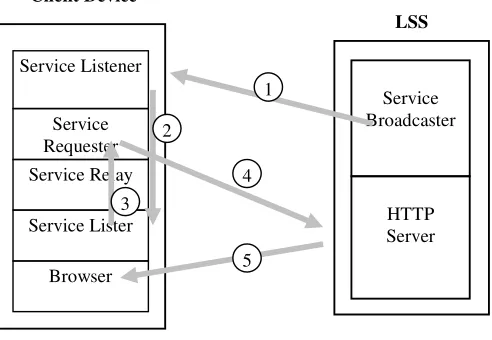
The system components of a LSS are illustrated in Figure 3. In each LSS, a HTTP server will be installed to provide specific location based services.
The HTTP server is a common product now, such as Apache, Microsoft’s IIS (Internet Information Service), and IBM’s WebSphere … etc. We can easily get one of the above-listed HTTP servers to be installed as our service provider in LSSs. Beside, clients should know what services they can get and where (how) to get the services. LSSs take care of this process by implementing service broadcaster
(a) Client2 requests
(b) Client1 relays the request
LSS
Client1 Client2Broadcast with
(1) client2’s identity (MAC address) (2) destination LSS’s IP address (3) request message
Ad hoc mode
LSS
Client1 Client2TCP connection with the request message
Reply desired data
Infrastructure mode
LSS
Client1 Client2Reply desired data back using client2’s identity
module. With the service broadcaster module, LSSs can periodically distribute the beacon of their service descriptions over the wireless networks.
The network module in client devices handles any messages transmitting in the network. They have three components: service listener, service requester, and service relay as illustrated in Figure 3.
The service listener component in a client device periodically listens to all packets from the network.
The service requester component in a client device handles all requests from our system in the client device. The requests include the request to a LSS for services and the request to other client devices for the service descriptions.
The service relay component is the necessary in our ad hoc routing mechanism because all client devices are possibly the medium of a route. It relays all message pass through the client device it belongs to. The requests from client devices to LSSs or the replied services from LSSs to client devices are absolutely handled by the services relay component.
Individual modules in LSSs and client devices have been introduced above. Nevertheless, if these modules cannot communicate to each other, they are absolutely useless. We will discuss this in two conditions: The client device is in the service range of a LSS or not.
The Client Device is in the Service Range of a LSS
[image:4.612.185.431.332.502.2]Service descriptions are transmitted in the following steps: (Figure 3)
Figure 3. Request services from service lister.
(1) The service broadcaster in the LSS periodically broadcasts its service description to client devices.
(2) After the service listener in the client device gets the service description, it saves the service description. Then the service lister adds and displays the service description.
After people choose one of the services in the service lister, the following steps proceed.
(3) The service lister in the client device calls the service requester to send a request message to source LSS of the service description selected in the service lister.
(4) The service requester sends the HTTP request message to the HTTP server in the LSS. (5) With the request, HTTP server replies the front-page of the desired service back to the browser in the client device.
The Client Device is not in the Service Range of a LSS
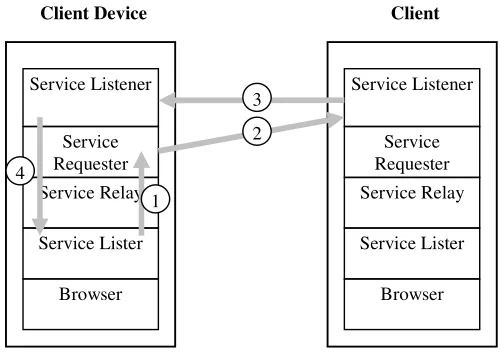
If people cannot find any desired service in one place, they can try to ask nearby client devices for service descriptions they have received. This process proceeds in the following steps: (Figure 4)
(1) A user who wants to ask nearby client devices notifies the service lister in his client devices. Then the services lister calls the services requester in the client device to broadcast the request to other client devices.
LSS
HTTP Server Service Broadcaster
Client Device
Browser Service Listener
Service Lister Service Relay
Service Requester
3
4
5 2
(2) The service listener in each nearby client devices receives this request.
[image:5.612.180.430.129.305.2](3) The service listener sends the known service descriptions back to the requesting client device. (4) The service listener in requesting client device finally receives the service descriptions from other client devices and then the service lister adds and displays these service descriptions.
Figure 4. Ask nearby client devices for service descriptions.
Summary
In the system, a service discovery mechanism is implemented, servers are periodically broadcasting and client devices are periodically listening. If client devices go into the service range of a server, they can get the service from the server. Furthermore, an ad hoc routing mechanism is designed so that clients can get a service through other client devices to the server. We expect that location services servers can spread everywhere and people can get desired location-based services anytime and anywhere.
References
[1] K. Zhai, B. Jiang, W. K. Chan, Prioritizing test cases for regression testing of location-based services: Metrics, techniques, and case study, IEEE Transactions on Services Computing. 7(2014) 54-67.
[2] A. Gazley, A. Hunt, L. McLaren, The effects of location-based-services on consumer purchase intention at point of purchase, European Journal of Marketing. 49(2015) 1686-1708.
[3] H. Fernandes, V. Filipe, P. Costa, et al, Location based services for the blind supported by RFID technology, Procedia Computer Science. 27(2014) 2-8.
[4] H. Shin, Y. Chon, Y. Kim, et al, A participatory service platform for indoor location-based services, IEEE Pervasive Computing. 14(2015) 62-69.
[5] A. Basiri, E. S. Lohan, T. Moore, et al, Indoor location based services challenges, requirements and usability of current solutions, Computer Science Review. 24(2017) 1-12.
[6] M. Terán, J. Aranda, H. Carrillo, et al, IoT-based system for indoor location using bluetooth low energy, 2017 IEEE Colombian Conference on Communications and Computing (COLCOM). IEEE, 2017, pp. 1-6.
Client Device
Browser Service Listener
Service Lister Service Relay
Service Requester
Client
Browser Service Listener
Service Lister Service Relay
Service Requester
1
2 3
[7] D. Lymberopoulos, J. Liu, X. Yang, et al, A realistic evaluation and comparison of indoor location technologies: Experiences and lessons learned, 14th international conference on information processing in sensor networks. ACM, 2015, pp. 178-189.