© 2016, IRJET | Impact Factor value: 4.45 | ISO 9001:2008 Certified Journal
| Page 1787
Studies in esterification reaction using Batch Reactive Distillation column
a
M. A. Suryawanshi
a,
bDr. S.M.Mahajani,
cProf. N.H.Shinde
a
Department of Chemical Engineering, Bharati Vidyapeeth College of Engineering, MH, India.
b
Professor, Indian Institute of Technology, Mumbai, Maharashtra, India.
c
Department of Chemical Engineering, TKIET, Kolhapur, Maharashtra, India.
ABSTRACT:
The esterification of acetic acid with n-butanol was studied in the presence of ion-exchange resin catalysts such as Amberlyst-15 to determine the intrinsic reaction kinetics. The effect of various parameters such as temperature, mole ratio, catalyst loading, and particle size was studied. Kinetic modeling was performed to obtain the parameters related to intrinsic kinetics. Pseudohomogeneous model was developed The rate expressions would be useful in the simulation studies for reactive distillation. In this work, the synthesis of butyl acetate, starting from n-Butanol and acetic acid, using batch reactive distillation on acidic polymeric resins is investigated.
Keywords: Reactive distillation, equilibrium, pseudohomogneous.
Introduction:
Reactive Distillation (RD) is a combination of reaction and distillation in a single vessel owing to which it enjoys a number of specific advantages over conventional sequential approach of reaction followed by distillation or other separation techniques. Improved selectivity, increased conversion, better heat control, effective utilization of reaction heat, scope for difficult separations and the avoidance of azeotropes are a few of the advantages that are offered by RD. The introduction of an
in situ separation process in the reaction zone or vice versa
leads to complex interactions between vapor–liquid equilibrium, mass transfer rates, diffusion and chemical kinetics, which poses a great challenge for design and synthesis of these systems. RD being a relatively new field, research on various aspects such as modeling and simulation, process synthesis, column hardware design, non-linear dynamics and control is in progress. The suitability of RD for a particular reaction depends on various factors such as volatilities of reactants and products along with the feasible reaction and distillation temperature. Hence, the use of RD for every reaction may not be feasible. Reactive distillation provides an attractive alternative for process intensification, especially for reaction/separation systems with reversible reactions.
The esterification of acetic acid with alcohols like n -butanol, ethanol, isobutyl alcohol and amyl alcohol fall in a
typical class of reacting systems. Butyl acetate is an industrially important chemical with wide applications as a versatile solvent. n-Butyl acetate is manufactured by the esterification of acetic acid with n-butanol in the presence of suitable acid catalyst. The alcohol is sparingly soluble in water and the ester is almost insoluble. Another interesting feature of this system is that it is associated with the formation a minimum boiling ternary azeotrope of ester, alcohol and water, which is heterogeneous in nature. Hence, in a typical reactive distillation column that consists of both reactive and non-reactive zones, the heterogeneous azeotrope or a composition close to the azeotrope can be obtained as the distillate product. Moreover, the aqueous phase that forms after the condensation of the vapor is almost pure water. Depending on the requirement either of the phases can be withdrawn as a product and the other phase can be recycled back as reflux. The pure ester i.e. butyl acetate is the least volatile component in the system is realized as a bottom product. In reactive distillation scheme, the option of using a conventional reactor for partial reaction followed by a reactive distillation column has been reported to have offered better economics. The simulation studies on the butyl acetate synthesis have also indicated that this option can be better than conducting the entire reaction in a reactive distillation column. The present work is aimed at performing a detailed experimental investigation on a reactive distillation column operated in such a mode. The important limitation of the Rd is that the volatilities of the components should be favorable. In the present system if we want to remove water, it should either have highest volatility or it should form minimum boiling azeotrope (constant boiling mixture) with one or more than one components in the system.
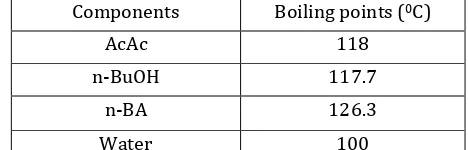
Components Boiling points (0C)
AcAc 118
n-BuOH 117.7
n-BA 126.3
[image:1.612.331.565.611.686.2]Water 100
© 2016, IRJET | Impact Factor value: 4.45 | ISO 9001:2008 Certified Journal
| Page 1788
If we want to increase the conversion towards thebutyl acetate, we have to remove water efficiently during the course of reaction. The boiling points in table 1 may indicate that water and other components have close boiling points and the efficient removal of water may not be possible, as water will possibly carry other components along with it in the overhead product. Water forms ternary azeotrope with BuOH and BA that boils at 87-90 0C. since
this azeotrope is a minimum boiling azeotrope, instead of pure water one gets distillate composition close to the ternary azeotrope. The azeotrope can be either homogeneous or heterogeneous. If on condensation of the vapors, the liquid forms two phases, the azeotrope is called heterogeneous azeotrope. In the present system, the azeotrope is heterogeneous and forms two liquid phases on condensation. The aqueous phase is almost pure water and organic phase that consists of mainly BA and BuOH can be recycled back to the column through reflux. Hence, ideally in the batch RD mode if one starts with stoichiometric ratio of BuOH and AcAc in the reactor, at the end of the experiment, the system should contain only BA in the reactor, if losses of BuOH and other components with the overhead aqueous phase are negligible.Reactive Distillation is an attractive method for chemical synthesis because chemical reactions and product separation occur simultaneously in the same unit. For esterification reactions it is the most effective method of synthesis.
Experimental work
Material and catalysts
n-Butanol and acetic acid bith AR grade as well as commercial grade were obtained from S. D. Fine Chemicals Ltd., India. The packing used in the distillation column were raschig rings and the column insulated with the asbestos ropes.
Apparatus and procedure
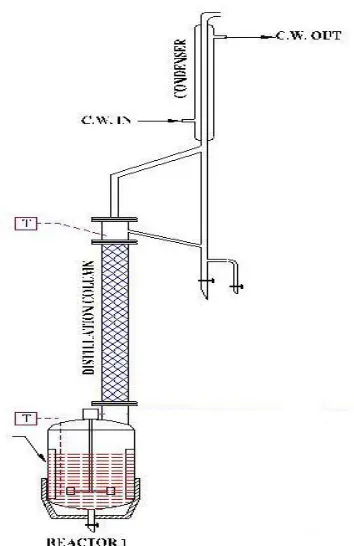
The experimental setup of a laboratory scale batch reactive distillation plant is as shown in Figure 1. A reactor of about 1 lit capacity, heated with the help oh heating mantle. The reactors also equipped with the temperature sensors, impeller, baffle, drain valve. Impellers are driven with the help of common motor. The reactor is connected to distillation column, packed with ceramic raschig rings. The column is insulated with the asbestos ropes. The vapors are collected in the vertical condenser. A dean and stark type arrangement has been done to provide the reflux to column . a cock is provided to withdraw a water formed in the reaction. Amberlyst-15 as a catalyst and materials are fed to the reactor. An electronically driven metering pump is used to transfer the liquid from the feed tank to the column. In the condenser, two immiscible phases are formed, an aqueous phase i.e. almost pure
water and an organic phase containing water, butanol and butyl acetate. The feed is preheated before introducing it to the column. Phase separator with the condenser is used to provide reflux to the column and to continuously withdraw water formed during the reaction.
Batch operation procedure: Firstly the column was operated under total reflux conditions for 30 min. Then the valve of the top product line was opened. During batch reactive distillation, top product flow rates were measured periodically (every after 60 min). Samples from the top product were taken every 60 min. The batch operation conditions, initial mole ratios, reflux ratio.
Analysis:
[image:2.612.367.544.402.675.2]The samples were analyzed using Gas Chromatograph (GC, C-911, MakAnalytica India Ltd.) equipped with thermal conductivity detector (TCD). The column used for the analysis was porapack–Q with hydrogen as carrier gas at the flow rate of 20 ml/min. Injector and detector were maintained at 220 0C and 150 0C respectively. The oven temperature was maintained isothermally at 240 0C to get best resolution in less time.
© 2016, IRJET | Impact Factor value: 4.45 | ISO 9001:2008 Certified Journal
| Page 1789
RESULTS AND DISCUSSIONS
In the first stage of experiments were carried out for the synthesis of butyl acetate on the existing pilot scale RD set up. In this section, runs on the main RD configuration had been studied. We studied the effects of different operation parameters such as reboiler duty, catalyst loading and feed composition. We study the effect of the parameters to achieve steady state condition for the system. It takes around 8-10 hrs to achieve the steady state.
Component Mole Ratio
(Run-1) Mole Ratio (Run-2)
Acetic acid 1.0 1.0
Butanol 1.5 1.2
[image:3.612.33.288.236.330.2]Amberlyst-15
Table 2 : Feed composition
Effect of reboiler duty:
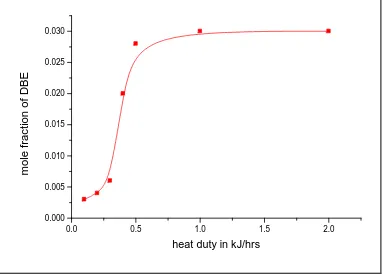
Figure shows the change in the BA and DBE composition in the bottom with changing reboiler heat duty for the feed composition (case-1). It can be seen that the reboiler heat duty above 0.4 kJ/hr gives BA purity above 96%, also shows that increase in heat duty DBE in bottoms increases. This may be due to the increase in the residence time, which has in turn produces more side product. Further simulation runs can be carried out to find the optimized value for heat duty.
0.0 0.5 1.0 1.5 2.0
0.000 0.005 0.010 0.015 0.020 0.025 0.030
m
ol
e
fr
act
ion
of
D
BE
heat duty in kJ/hrs
Figure 2: Effect of reboiler heat duty on mole fraction of DBE in bottoms
0.0 0.5 1.0 1.5 2.0
0.0 0.1 0.2 0.3 0.4 0.5 0.6 0.7 0.8 0.9 1.0
m
ol
e
fr
act
iob
of
BA
heat duty kJ/hrs
Figure 3: Effect of reboiler heat duty on mole fraction of BA in bottoms
Effect of catalyst loading:
As expected, it has been found that increasing the catalyst loading helps to improve the production of BA to some extent, but at high loadings side reaction favored. Interestingly at high loading AcH composition found to be increasing. The water produced from the reaction may have reacted off some of the butyl acetate in the reverse direction to five BuOH and AcH.
0.0 0.5 1.0 1.5 2.0
0.000 0.005 0.010 0.015 0.020
m
ol
e
fr
act
ion
of
acet
ic
aci
d
catalyst per tray kg
Figure 4: Effect of catalyst loading on mole fraction of acid in the bottoms
0.0 0.5 1.0 1.5 2.0
0.000 0.005 0.010 0.015 0.020 0.025 0.030 0.035 0.040
m
ol
e
fr
act
ion
of
D
BE
heat duty kJ/hrs
[image:3.612.346.551.385.507.2] [image:3.612.37.230.439.576.2] [image:3.612.360.557.548.677.2]© 2016, IRJET | Impact Factor value: 4.45 | ISO 9001:2008 Certified Journal
| Page 1790
Effect of feed composition:
The excess butanol in the feed leads to formation of side product dibutyl ether, which is undesired. CRD with feed composition 1:1.5 mole ratio of acid to butanol (run-1) showed significant ether formation at steady state (1 mole% in bottom). In this case the concentration of butanol and water were quite high in reactive section whereas acetic acid concentration was quite low. Changing feed composition to 1:1.20 mole ratio of acid to alcohol (run-2), at steady state, drastic reduction in ether formation was noticed. At steady state, composition profile inside column showed high concentration of acid (more than run-1) and water (less than run-1) in the reaction zone and less concentration of butanol compared to case-1. Therefore, providing higher mole ratio of acid in feed to the column, ether formation can be suppressed significantly.
CONCLUSION& SCOPE FOR FUTURE WORK
The esterification of acetic acid with Butanol a reversible process and must be displaced towards the desired ester butyl acetate by a continuous removal of water using the classical concept of reactive distillation (RD). Hence in this work a new approach of RD is studied for the synthesis of BA. Here simultaneous synthesis and separation of the desired product allows limitations due to chemical equilibrium to be overcome. This enhances the rate of reaction. Hence RD is the most promising approach in the case of equilibrium-limited reactions where almost complete conversion of the reactants can be achieved within a single unit due to the integration of chemical conversion and separation. Here the separation gives higher purity product, which reduces the cost of downstream processing.The developed RD has achieved both high purity and high conversion values. This is a significant result compared to the current technology, where similar purity values can be achieved only through a complex series of reactive and separation steps. Amberlyst-15 which is used as an ion exchange resin is found to be good functional material which plays the role of catalyst to boost the reaction rate. High degree of water removal ensures high purity of BA. The esterification of acetic acid with butanol in a batch reactor was studied in details. The kinetics of homogeneous uncatalyzed and heterogeneous catalytic reactions was investigated to understand its contribution in the overall esterification reaction. The effect of reaction paramenters such as temperature, molar concentration, agitation speed and catalyst loading were investigated thoroughly. For
interpretation of the kinetics, the observed data were used and the rate parameters were evaluated at each temperature using a batch reactor pseudo homogeneous model. The activation energies for heterogeneous forward and backward reactions were evaluated as 45.59 kJ/mol and 23.39 kJ/mol.
Further the reaction was carried out in RD to study the equilibrium behaviour of reaction. The experiments were carried out for the synthesis of butyl acetate using reactive distillation column. The conversion was close to 100%. A considerable time is required to attain the steady state. Ether, the side product can form in reactive distillation column. The formation can be suppressed by adjusting the butanol and acetic acid mole ratios in the feed. The steady state attains in 8-10 hrs. Hence reactive distillation can be effectively used for the synthesis of the butyl acetate. The conversion in reactive distillation is higher than that in conventional steady state reactor. Thus, the use of reactive distillation for this system is justified. The improvement is observed not only through the enhancement in the rate and hence the reduced reactor volume but also through the partial separation of the components involved, thereby reducing the capital and energy cost of downstream processing.
REFERENCES:
1) G Jan Harmses, “Reactive Distillation: A front runner of industrial processes intensification: A full review of commercial application, research, scale up, design and operation”, Chemical Engineering and processing, 46(2007), 274-280.
2) N Calvor, B Ganzalez, A. Domihguiz, “Esterification of Acetic Acid with Ethanol: Reaction kinetics and operation in a packed bed reactive distillation column”, Chemical Engineering and Processing, 46(2007), 1317-1323
3) Alime, HalitHosgun, “Kinetics of synthesis of Isobutyl Propionate over Amberlyst-15”, Turk Journal of Chemstry, 31(2007), 493-499.
4) Yeong-TarngTana, Yi-wei Chen, Huang, Chang Ching Yu, “Design of reactive distillation for acetic acid esterification”, Wiley intersciences,2005.
5) S.S.Dash, K.M.Parida, “Esterification of acetic acid with n-butanolovet manganese nodule leached residue”, Journal of molecular catalysis, 266(2007), 88-92.
6) Robert Hun, fengrang Chen, Michael F. Malone, Michael F. Doherty, “Reactive
distillation for methyl acetate production”, Computers and chemical engineering, 27(2003), 1855-1866.
© 2016, IRJET | Impact Factor value: 4.45 | ISO 9001:2008 Certified Journal
| Page 1791
acid using n-Butyl alcohol”, Journal of molecularcatalysis, 237(2005), 146-154.
8) S. Ismail, Lirbaslar, UmurBramur, “esterification of acetic acid with ethanol catalyzed by an acidic ion exchange resin”, turk Journal of Environmental science, 25(2001), 569-579.
9) Yijun Liu, FolgerLotero, James G., Goodwin, “A comparison of the esterification of acetic acid with methanol using heterogeneous and homogeneous acid catalysis”, Journal of catalysis, 242(2006), 278-286.
10) Thijs Peters, Nieck Benes, Holmen, “Comparison of solid acid catalysis for the esterification of acetic acid with butanol”, Applied catalysis: A general 297(2006), 182-188.
11) SergejBlagor, SandroParada, Oliver Bailer, Peter Moritz, David Lam, “Influence of ion exchange resin catalysis on the side reaction of esterification of n-butanol with n-acetic acid “, Chemical engineering science, 61(2006), 753-765. 12) I-Kuon Lai, Yan-Chun Liu, Chang Ching Yu, Ming
Jer Lee, Ping Huang, “Production of high purity ethyl acetate using Reactive Distillation:Experimentaland start up procedure”, Chemical Engineering and Processing, 47(2008),1831-1843
13) Mehmet Riza, Altiokka, AlimeCitak, “Kinetic study of esterification of acetic acid with isobutanol in presence of amberlyst catalyst”, Applies catalysis: A general, 239(2003), 141-148.
14) Markus Kloker, Koneg, Gorak, “Investigation og different column configurations for the ethyl acetate synthesis via reactive distillation”, DM research, Netherlands.
15) Harvey Garcia, Carmana, “A new operation mode for reactive batch distillation in middle cessel column: Start up and operation”, Computers and chemical engineering, 32(2007), 161-169.
16) Ramona M.,Dragomir, MegalJobson, “Conceptual design of single feed hybrid reactive distillation column”, Chemical engineering science, 60(2005), 4377-4395.
17) Reid, R.C., Prausnitz, J.M., Sherwood T. K., “The properties of gases and liquids”, Mcgraw hill book. 18) Fogler, S.H., "Elements of Chemical Reaction
Engineering", New Delhi :Prentice Hall book. 19) Octave Levelspiel, “Chemical Reaction
Engineering", John Wiley and sons book
20) Phalak, C.A., “Reaction Engineering Studies in Ion Exchange Resin Catalyzed Esterification Reactions ". 21) M.F.Doherty, M.F.Malone, “Conceptual design in distillation systems”.22) Gangadwala, “Production of butyl
acetate by catalytic distillation-Reaction kinetics and process design studies”, 2002, IIT, Mumbai.