© 2016, IRJET ISO 9001:2008 Certified Journal Page 183
DUAL HYBRID SYSTEM
Shailesh Ramkar
1, Atish Langhee
2, Devendra More
31
Bachelor of Engineering, Department of Mechanical, Y.T.I.E.T, Maharashtra, India
2
Bachelor of Engineering, Department of Electronics, S.P.I.T, Maharashtra, India
3
Bachelor of Engineering, Department of Mechanical, B.R.H.C.E.T, Maharashtra, India
---***---Abstract-
For meeting challenges in today’s globalized world many automotive companies have been searching for technological advantages to increase fuel millage and also to protect the environment pollution. The present work proposes the design of a new device to reduce CO2 emissions in order to prevent global warming and accelerated the development of a vehicle having integrated HHO system with the gasoline engine for the goal of achieving twice the fuel efficiency of conventional vehicles. The proposed device combine two motive power sources, such as an internal combustion engine with HHO generator and an electric motor called as Dual hybrid system. Although Dual hybrid system uses an electric motor, they do not require external charging.There are two major phases: The first phase is designing HHO generator which is related to mechanical designs to supply HHO gas to engine and second phase is to combine a gasoline engine and an electric motor which achieves nearly twice the fuel efficiency of conventional gasoline engines. Dual Hybrid system uses efficiency improving technologies such as regenerative braking which converts Vehicles kinetic energy into electric energy for charging the battery rather than wasting its energy. Engine torque also increased and pollution gets reduced to maintaining the green house effect. Reduction in fuel use also depends upon driving conditions. The more stop and go traffic the greater the potential for fuel savings when used as hybrid when compared to conventional vehicle. This is especially relevant for city buses and delivery trucks. This paper analyze about some of advanced hybrid system, its implication and importance of having them in vehicle.
Key Words:
Automotive industries, Gasoline engine,
1. INTODUCTION
1.1 Problem Statement
With such high demand for more efficient engines, our mission is to design and create a device that will increase
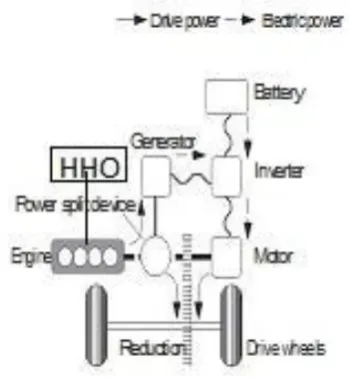
[image:1.595.328.503.369.559.2]engine efficiency without loss of its performance. Such device is a DUAL HYBRID SYSTEM. This system uses hho generator to produce hydrogen from water using electrolysis; the hydrogen will be introduced into the combustion chamber of an engine through the intake manifold and uses a power split device which divides the power from the engine, so the ratio of power going directly to the wheels and to the generator is continuously variable. Since the motor can run on this electric power as it is generated.
Fig -1: Dual Hybrid System
© 2016, IRJET ISO 9001:2008 Certified Journal Page 184
1.2 Project Objectives
1. Design and build a practical and economical way to increase engine efficiency in combustion engines.
2. Build HHO generator that splits waters molecules, using the process of electrolysis. A mixture of hydrogen and oxygen gas, also known as HHO gas.
[image:2.595.345.503.108.299.2]
Fig -2: HHO Block Diagram
[image:2.595.57.233.219.343.2]The process of electrolysis works with an electrical power source that is connected to two electrodes that are made out of typical metal (such as stainless steel, platinum or, titanium), which are submerged in water enhanced with electrolytes. Hydrogen will be produced at the negatively charged electrode (cathode), while oxygen will be produced at the positively charged electrode (anode). The chosen design will be a wet cell system. The stainless steel tubes with a negative charge will be connected to the negative pole of the battery and the positive will be connected to a relay, this will give an on/off control of the system while the car is driven. The HHO gas will go into the engine through the air intake, the output gas of the generator cannot be connected directly to the air intake manifold of the car. For safety reasons is important to use an apparatus called bubbler between the HHO generator and the intake of the car as shown in the figure below. The bubbler will help us avoid any condensed leftover liquid to get into the engine, as well as any back fire from the engine to enter our generator, this could cause an explosion.
Fig -3: Bubbler
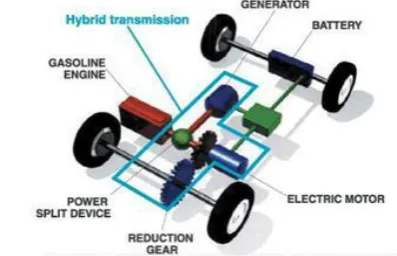
3. Hybrid system configuration: The system consists of two kinds of motive power sources, i.e., a high-efficiency gasoline engine and AC synchronous motor along with a generator, battery and a power control unit. This power control unit contains a high-voltage power circuit for raising the voltage of the power supply system for the motor and the generator, in addition to an AC-DC inverter for converting between the AC current from the motor and the generator and the DC current from the hybrid battery. Other key components include a power split device, which transmits the mechanical motive forces from the engine, the motor and the generator by allocating and combining them. The power control unit precisely controls these components at high speeds to enable them to cooperatively work at high efficiency.
A regenerative braking system is used which, during engine braking and braking using the foot brake, operates the electric motor as a generator, converting the vehicles kinetic energy into electrical energy, which is used to charge the battery.
[image:2.595.318.517.591.719.2]© 2016, IRJET ISO 9001:2008 Certified Journal Page 185
2. SYSTEM OPERATION
1. Start and low to mid-range speeds:
The engine stops when in an inefficient range, such as at start-up and in low to mid-range speeds. The vehicle runs on the motor alone.
2. Driving under normal conditions:
Engine power is divided by the power split device. Some of the power turns the generator, which in turn drives the motor.
The rest of the power drives the wheels directly. Power allocation is controlled to maximize efficiency.
3. Sudden acceleration:
Extra power is supplied from the battery, while the engine and high-output motor provide smooth response for improved acceleration characteristics.
4. Deceleration, braking:
The high-output motor acts as a high-output generator, driven by the vehicles wheels. This regenerative braking system recovers kinetic energy as electrical energy, which is stored in the high-performance battery.
5. Battery recharging:
Battery level is managed to maintain sufficient reserves. The engine drives the generator to recharge the battery when necessary.
6. At rest:
The engine stops automatically.
3. CHARACTERISTICS OF DUAL HYBRID SYSTEM
1. INCREASE IN MILEAGE:
Burning of hydrogen with gasoline results in increase of fuel mileage with less emission of CO2.
2. ENERGY-LOSS REDUCTION:
The system automatically stops the idling of the engine (idling stop), thus reducing the energy that would normally be wasted.
3. ENERGY RECOVERY AND REUSE:
The energy that would normally be wasted as heat during deceleration and braking is recovered as electrical energy, which is then used to power the starter and the electric motor.
4. MOTOR ASSIST:
The electric motor assists the engine during acceleration.
5. HIGH-EFFICIENCY OPERATION CONTROL:
The system maximizes the vehicles overall efficiency by using the electric motor to run the vehicle under operating conditions in which the engines efficiency is low and by generating electricity under operating conditions in which the engines efficiency is high.
The series/parallel hybrid system has all of these characteristics and therefore provides both superior fuel efficiency and driving performance.
4. COMPONENTS
1.
HHO Generator
The HHO Generator the Brown gas generator uses electrolysis to split water (H2O) into its base molecules, 2 hydrogen and 1 oxygen molecule. It is often referred to as an HHO gas generator. The HHO in itself is not an alternative to gasoline but an additive to boost the efficiency of the engine.
2. Pulse Width Modulator
The pulse width modulator is necessary for a controlled electrolysis.
3. EFIE
The Electronic Fuel Injection Enhancer is intercepting signals from the oxygen sensor to the computer and fools the computer by giving it false exhaust readings from the Oxygen sensor. This is necessary because the computer is set up for a regular burn of fuel and compensates for the more efficient and cleaner burn by dumping more gasoline into the engine which ruins your fuel savings.
4. Generators
The generator is similar to an electric motor, but it acts only to produce electrical power.
5. Electric Motor
© 2016, IRJET ISO 9001:2008 Certified Journal Page 186 as a generator For example, when it needs to, it can draw
energy from the batteries to accelerate the car. But acting as a generator, it can slow the car down and return energy to the batteries.
6. Power Control Unit
The power control unit contains an inverter that converts the DC from the battery into an AC for driving the motor and a DC/DC converter for conversion to 12V which is then supply to HHO generator.
5.
SAFETY CONSIDERATION
1. Using hydrogen as a fuel supplement for
combustion engines in cars introduces certain potential safety hazards for consumers. Hydrogen is an odorless, tasteless, colorless, and highly flammable gas. In comparison with gasoline, hydrogen has higher flammability. Storage of hydrogen gas under high pressure introduces hazards to nearby personnel in the event of a loss of containment from material failure, so therefore choosing the correct materials is the key to properly maintain the tolerance required. Hydrogen is a flammable substance that requires care and should be handled with care. Tests and installation of the generator will be conducted in a safe place with no flames or flammable materials around.
2. When the ignition button is pressed, the
system checks whether or not various sensors, the engine, the motor, the generator and the battery are functioning normally. Then, the switches for the components in the high-voltage system, such as the motor, the generator and the battery, are turned on, making the vehicle ready to run. This is the start-up control sequence.
6.
ENVIRONMENTAL IMPACT
1. Pollution
Since the industrial revolution started, the environment has experienced some changes which are irreversible. All the exhaust gasses emitted by factories, coal power plants,
airplanes, vehicles, etc. are heating up the planet and are causing the polar caps to melt. Such phenomenon is changing the global temperature of the planet. We have to look for ways to reduce these emissions and to try to slow Global Warming and stop the ozone layer from depleting thus by implementing HHO will help the environment by consuming less gasoline and they will also emit less harmful gasses.
2. Fuel Consumption
Has achieved higher efficiency by controlling startup and stop mechanism of engine which result in less fuel consumption Reproducing waste energy (i.e. regenerative braking)
3. Noises
Reduced noise emissions resulting from substantial use of the electric motor at idling and low speeds, leading to roadway noise reduction in comparison to conventional gasoline or diesel powered engine vehicles, resulting in beneficial noise health effects.
7.
CONCLUSIONS
Dual hybrid technology for both light and heavy duty applications is commercially available today and demonstrates substantial reductions in tail-pipe emissions and fuel consumption, even when compared to other available low emission technologies. Dual hybrid is particularly effective for urban travel, significantly lowering pollutant emissions and providing cost effective CO2 reductions in personal mobility. Encouraging hybridization of vehicle fleets through enabling policies and incentive structures can serve to lower both conventional and CO2 emission thus improving public health, energy security, and reducing fuel costs. Continuing innovation in hybrid technology and a growing demand for cleaner vehicles will mean that costs are like to fall, particularly in second hand vehicle markets
REFERENCES
[1] NASA Technical Note, May 1977, Emissions and Total
© 2016, IRJET ISO 9001:2008 Certified Journal Page 187
[2] Mathur H.B., Das L.M. (1991). Performance
characteristics of a Hydrogen Fueled SI Engine using Timed Manifold Injection.Int. J. Hydrogen Energy (vol 16, pp. 115117, 1991)
[3] Ronald K. Jrgen Electric and Hybrid-Electric Vehicles
- Engines and Powertrains , SAE International
BIOGRAPHIES
Ramkar Shailesh Prabhakar, Mechanical Engineer,
Yadavrao Tasgaonkar Institute of Engineering and Technology, Mumbai University.
Langhee Atish Jaywant, Electronics Engineer,
Sardar Patel Institute of
Technology, Mumbai University.
More Devendra Shivaji Mechanical Engineer,
B. R. Harne college of engineering
and Technology, Mumbai