Umeå School of Education
Umeå UniversityE D U C AT I O N
I N Q U I R Y
Volume 4, No. 1, March 2013
C O N T E N TEditorial
THEMATIC SECTION
Daniel Faas Ethnic diversity and schooling in national education systems. Issues of policy and identity
Yvonne Leeman & Sawitri Saharso Coming of age in Dutch schools. Issues of schooling and identity
Mary Darmanin The ‘smallness’ of minimalist tolerance
Farzana Shain Race, nation and education: An overview of British attempts to ‘manage diversity’ since the 1950s
Cecile Wright Understanding black academic attainment: Policy and discourse, educational aspirations and resistance
Christina Hadjisoteriou & Panayiotis Angelides The politics of intercultural education in Cyprus: policy-making and challenges
Philipp Schnell, Elif Keskiner & Maurice Crul Success against the Odds: Educational pathways of disadvantaged second-generation Turks in France and the Netherlands
Nathalie Rougier The hijab in the (denominational) Irish education system – tolerated or accepted?
Kalervo N. Gulson & P. Taylor Webb ”A raw, emotional thing”: School choice, commodification and the racialised branding of Afrocentricity in Toronto, Canada
Editors
Professor Nafsika Alexiadou, Umeå University, Sweden Associate Professor Linda Rönnberg, Umeå University, Sweden The editorial board
Professor Marie Brennan, Victoria University, Australia
Professor Bernard Cornu, Directeur de la Formation – CNED, Directeur de CNED-EIFAD, France Professor Per-Olof Erixon, Umeå University, Sweden
Professor David Hamilton, Umeå University, Sweden Professor Brian Hudson, University of Sussex, UK
Professor Gloria Ladson-Billings, University of Wisconsin-Madison, USA Professor Martin Lawn, University of Edinburgh, UK
Assistant Professor Eva Lindgren, Umeå University, Sweden Professor Lisbeth Lundahl, Umeå University, Sweden Professor Kirk Sullivan, Umeå University, Sweden
Associate Professor Manya Sundström, Umeå University, Sweden Professor Gaby Weiner, University of Sussex, UK
Professor Pavel Zgaga, University of Ljubliana, Slovenia Language Editor
Murray Bales, Ljubljana, Slovenia Guidelines for Submitting Articles
See Education Inquiry’s homepage: http://www.use.umu.se/english/research/educationinquiry Send Manuscripts to:[email protected]
©2013 The Authors. ISSN online 2000-4508
Education Inquiry is an international on-line, peer-reviewed journal with free access in the field of Educational Sciences and Teacher Education. It publishes original empirical and theoretical studies from a wide variety of academic disciplines. As the name of the journal suggests, one of its aims is to challenge established conventions and taken-for-granted perceptions within these fields.
Education Inquiry is looking for lucid and significant contributions to the understanding of contextual, social, organizational and individual factors affecting teaching and learning, the links be-tween these aspects, the nature and processes of education and training as well as research in and on Teacher Education and Teacher Education policy. This includes research ranging from pre-school education to higher education, and research on formal and informal settings. Education Inquiry welcomes cross-disciplinary contributions and innovative perspectives. Of particularly interest are studies that take as their starting point, education practice and subject teaching or didactics.
Education Inquiry welcomes research from a variety of methodological and theoretical approach-es, and invites studies that make the nature and use of educational research the subject of inquiry. Comparative and country-specific studies are also welcome.
Education Inquiry readers include educators, researchers, teachers and policy makers in various cultural contexts.
Every issue of Education Inquiry publishes peer-reviewed articles in one, two or three different sections. Open section: Articles sent in by authors as part of regular journal submissions and publis-hed after a blind review process. Thematic section: Articles reflecting the theme of a conference or workshop and published after a blind review process. Invited section: Articles by researchers invited by Education Inquiry to shed light on a specific theme or for a specific purpose and published after a review process.
Nafsika Alexiadou & Linda Rönnberg, Editors
Every issue of Education Inquiry publishes peer-reviewed articles in one, two or three different sections. In the Open section, articles are sent in by authors as part of regu-lar journal submissions and published after a blind review process. In the Thematic section, articles may reflect the theme of a conference or workshop and are published after a blind review process. The Invited section feature articles by researchers invited by Education Inquiry to shed light on a specific theme or for a specific purpose and they are also published after a review process. This issue of Education Inquiry only contains a Thematic section.
The focus of this thematic section is on ethnic diversity and schooling in various na-tional education systems. There are nine articles in this issue, along with an editorial introduction by Daniel Faas who provides an overview of the discussions relating to this very topical theme, and comments on the significance of each of the contributions. The first article by Yvonne Leeman & Sawitri Saharso draws on research in the Netherlands over the last 30 years, and offers an assessment of the changing political and educational frameworks for inclusion and multiculturalism. They draw lessons to be learned from this research and point towards future research agendas.
Mary Darmanin follows with an article that is highly critical of the dominant dis-courses around cultural and ethnic diversity in Malta that are rooted in the country’s history of domination as a former British colony, and a strong emphasis on Catholicism as a “marker of ethnic identity”. The country’s small size is also taken into account in the presentation and critique of contemporary education practices in relation to the integration of immigrant and ethnic minority pupils.
In the third article, Farzana Shain presents a critical account of attempts by the British state to manage the ‘problem’ of ethnic minorities, and the associated English education developments in the post-war period. She examines state policies in rela-tion to race and ethnicity and traces the development and evolurela-tion of discourses of ‘containment’ policies of ethnic minorities and their education.
Staying within Britain, Cecile Wright argues that the neoliberal education policies followed by successive governments have exacerbated inequalities which are particu-larly stark in the performance of black children in schools. The lack of serious political will to address the issue has led to students attempting to use ‘the community’ as a resource to overcome the disadvantages conferred by the education system.
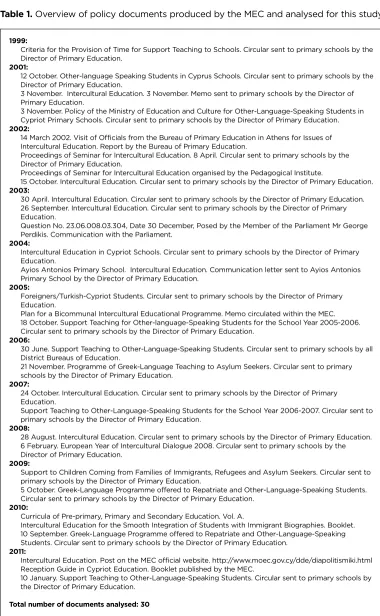
In the next article, Christina Hadjisoteriou and Panayiotis Angelides focus their analysis of intercultural education policies in Cyprus on the higher levels of policy-mak-ing, and in particular the Ministry of Education and Culture. Their work highlights the
practice as discussed by Cypriot policy-makers during interviews.
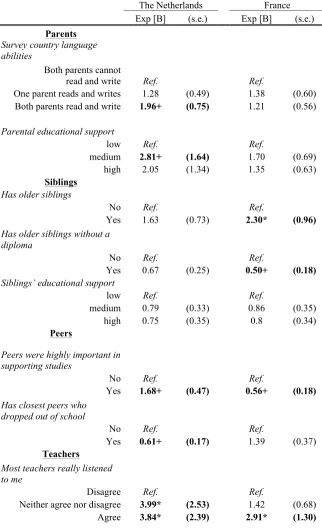
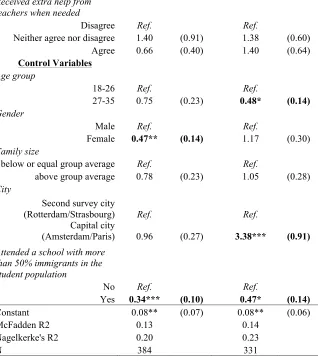
Our next article highlights the institutional mechanisms necessary for the suc-cess of second-generation ethnic minority students. Philipp Schnell, Elif Keskiner & Maurice Crul draw on a combined quantitative and qualitative analysis of data from research on disadvantaged pupils with a Turkish ethnic background in France and the Netherlands. The article foregrounds individual experiences, and situates these against the structural disadvantages the students face, but also the institutional ar-rangements and personal interactions that have made educational success possible. Next, Nathalie Rougier uses a critical discourse analysis approach to study the debate around the hijab in Irish schools. Her analysis highlights the complexity of ‘acceptance’ of religious and ethnic diversity in schools, in a system that is denomi-national and has traditionally had a small number of diverse students.
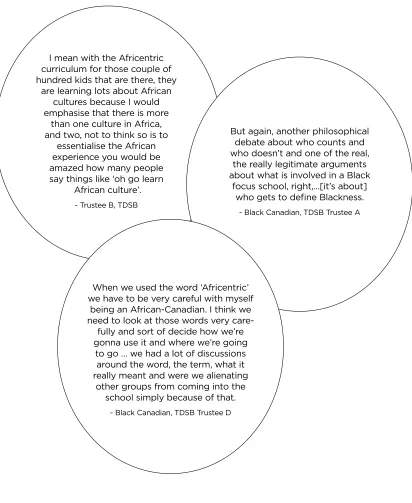
Moving beyond Europe, the next two articles explore aspects of race and gender equality in education. Kalervo Gulson and Taylor Webb present their research on the complex relationships and sometimes unexpected outcomes that are produced by neoliberal education policies intersecting with debates around race and difference. Their research explores these issues as they manifest themselves in the establishment of an Africentric school in Toronto, Canada.
INQ.
Ethnic diversity and schooling in
national education systems
Issues of policy and identity
Daniel Faas*
Societies rely on different models to address ethnic, cultural and religious diversity in education, with different potential consequences for the experiences young people have in schools and different implications for policy and identity. For example, Germany, Greece and Ireland prefer the term interculturalism and intercultural education. In contrast, Britain, the Netherlands, Canada, the United States and Malaysia have his-torically worked with the concept of multiculturalism (Faas, 2010). These different approaches to accommodating ethnic diversity are also reflected for instance in the ease (or not) with which immigrants can apply for and receive permanent residence and citizenship status. Currently, Switzerland (12 years), Italy (10 years), Austria (10 years) and Denmark (9 years) are among the most difficult countries to obtain citizenship whereas Ireland (5 years), the Netherlands (5 years), Canada (3 years) and Belgium (3 years) have relatively fewer barriers.
The literature suggests that countries can broadly be grouped into at least four categories reflecting their legacies and current approaches to ethnic diversity: (1) old migration societies who have traditionally developed a more monocultural vision such as Denmark or Germany; (2) old migration societies that have historically been more multicultural such as the UK and Canada; (3) new migration societies that who have embarked on a more monocultural road such as Greece or Cyprus; and (4) new migration societies with an arguably more multicultural outlook such as Ireland or Portugal. The notion of culture is taken here to include values, identity, habits, lan-guage, religion and citizenship; monoculture thus means substantial sameness within a system such as education, city or country and the promotion of such sameness. Banting and Kymlicka’s Multiculturalism Policy Index which examined the adoption of eight public policies including multiculturalism in the school curriculum, allowing dual citizenship and the funding of ethnic group organizations to support cultural activities, underscores such a categorisation.
In the four Programme for International Student Assessment (PISA) studies carried out to date (a fifth data collection was carried out in 2012 but results will only be available from December 2013), there are large educational performance differences between native and migrant students in Denmark, Germany, Switzerland and Austria and much smaller differences in Britain, Canada, Ireland and Australia. Several of the countries with smaller educational gaps between migrant minorities and ethnic majorities have incorporated diversity into their public policy framework including multicultural (or intercultural) education. However, despite recognition and support for diversity, a country like the UK still faces significant gender, class and ethnic inequalities in education. As the contributions by Cecile Wright and Farzana Shain in this thematic issue indicate, black students continue to be at risk in schools given the absence of any serious political will to address their attainment issues. Similar points could also be noted for several of the Muslim communities in Britain including Turkish, Kurdish and Turkish Cypriots (Enneli et al, 2005).
The work of Koopmans et al (2005, 2012) is also indicative of the range of national policy-practice links, arguing that cross-national differences continue to exist due to different historical legacies and that these have not become smaller over the past three decades. While they found divergences across societies in terms of citizenship acquisition, family reunification, access to public service employment, political rights, educational and other cultural rights, the only convergence was around anti-dis-crimination and expulsion. For example, Athens continues to be the only capital in Europe without a mosque despite year-long debates about feasibility and geographical location of a mosque (Triandafyllidou and Gropas, 2009). Several contributors in this thematic issue including Yvonne Leeman and Sawitri Saharso as well as Farza-na Shain offer a historical assessment of Dutch and British attempts to dealing with migration-related diversity.
Furthermore, Faas (2011) who compared the geography, history and citizenship education curricula in Greece, Germany and England, argued that the relationship between national and European identities and multicultural values was rather differ-ent and dependdiffer-ent on the school subject. Whilst history was found to be ethnocdiffer-entric in all three countries – albeit to varying degrees – Greek geography and citizenship curricula veered between ethnocentrism and Europeanism. In contrast, in England, macro-political notions of multicultural Britishness were reinforced in geography and citizenship education. Following national political trends, German curricula privileged national and European topics, but attempts were made to address ethnic and cultural diversity, particularly in geography.
(1995) suggest that there is a link between how national education systems appear to reproduce, eliminate and exploit diversity, and postmodernity. Postmodernity ‘has shifted from being a way of describing cultural products (allusive, disjointed, pastiche, merging subjectivities) to a way of describing society (fractured, relative, pluralistic, gendered)’ (ibid: 3), reflecting the ways in which a society has shifted from notions of capitalism to information and knowledge. For Coulby and Jones, modernist knowledge is mainly white, Western knowledge; it is primarily associated with the concept of nationalism as well as a subject-based teaching approach rather than an integrated multicultural curriculum. By contrast, according to Coulby and Jones, post-modern-ist knowledge, acknowledges not only the international contribution to European civilisation but also that European knowledge systems themselves must be placed within a global context. This is why two articles in this issue are dedicated to aspects of gender and race equality in education beyond Europe: Canada and Kurdistan-Iraq.
Reflections on the contributions in this thematic issue
The contributions included in this thematic issue include old migration host societies (UK, Netherlands, France and Canada) and new migration destinations (Cyprus, Ireland, Malta and Kurdistan-Iraq). The texts illustrate cases where assimilation-ist tendencies and minimalassimilation-ist approaches to diversity have dominated public and educational discourses such as in Malta (Mary Darmanin) and Cyprus (Christina Hajisoteriou and Panayiotis Angelides). It is important to note, however, that there is variation in responding and managing diversity not just between old and new host states but also among old and new host states and the contribution by Nathalie Rougier powerfully demonstrates how the Irish case differs from other small new migration destinations such as Cyprus and Malta. At the same time, there are striking similar-ities around notions of religion with regard to national identity, be it Catholicism in Malta and Ireland or Orthodoxy in Cyprus, which has made it somewhat difficult to reconceptualise national identities along more pluralistic lines. The ‘smallness’ of several cases in this thematic issue often appears to play an important role with regard to reinforcing national values and identities in education and society at large. One interesting theme raised in a number of contributions is the issue of school
choice. For example, Gulson and Webb argue that school choice policies can enable the
life cannot’. However, while Reay’s parents valued the ‘ethnic other’, many parents feared the ‘working-class other’ (Reay et al. 2007). This reminds us of the importance of class, particularly in the UK, and specifically what Reay et al. (2008: 240) referred to as ‘the socially inclusive middle class as opposed to Gidden’s (2000) [idea of the] socially exclusive middle class’. The ‘socially inclusive middle-class’ student and family actively embraces and chooses diversity and is open to difference. Similarly, Cecile Wright in her contribution concludes that a market orientation based on ‘choice’ and competition as we have seen it in the UK leads to the exacerbation of class and racial inequalities with the elites not contemplating the state education system for their children.
Another cross-cutting theme relates to educational attainment of migrant children and factors affecting achievement. For example, Gulson and Webb in their paper on Canada address the educational disadvantages of Black students similar to Cecile Wright who argues that neoliberal policies in the UK enhance inequalities. Schnell et al. in their paper on France and the Netherlands discuss individual and institutional factors and determinants including family background, peer groups and teachers, as well as institutional arrangements. They conclude that teachers play an important role for successful educational pathways of second-generation Turks from disadvantaged family backgrounds in France and the Netherlands. The support of peers also proved to be significant. They criticise the early streaming and tracking in the Netherlands and found that Turks in France where selection into tracks is postponed enter the academic oriented tracks in higher numbers. Germany has a similarly early tracking system in several of the 16 federal states. Schnell et al.’s focus on mechanisms of success rather than failure is to be commended and there are few other studies that are framed in a more positive tone. Among these is Faas (2010) who takes identity development as a proxy for successful integration in schools and shows how youth identities vary by institution based on peer group dynamics, school ethos and teachers. In a similar vein, Leeman and Saharso in their contribution also explore how education can enhance a sense of collective identity (in this case identification with Amsterdam rather than Netherlands) that transcends ethnic lines in today’s multicultural societies.
A final theme emerging from the contributions in this thematic issue is the role
of Muslims in societies and national education systems. While race has always been
gain votes by playing on the electorate’s fears of the ‘Muslim’ or ‘immigrant’. Farzana Shain in her paper builds on arguments developed in a recent book which reported an empirical study of Muslim boys and education in England (Shain 2011). The book offers an assessment of how and why working class boys who identify as Muslim in England have come to be seen as modern day folk devils or as symbol of crisis and change. She argues that the targets of containment policies have changed from African Caribbeans in the 1970s and 1980s to Muslim students, in general, since then, and that Muslims, asylum seekers and generally those not in paid employment, are seen as outside the nation and its interests. In this context, Rougier’s article makes a very interesting point in that the hijab debate in the Republic of Ireland has been more liberal without any prohibition of religious dress in schools or other public places than in countries such as France or Germany.
Taking a somewhat different angle at first glance, the contribution by Audrey Osler and Chalank Yahya focuses on tensions and challenges facing schools in implementing human rights education in Kurdistan-Iraq, a post-conflict autonomous region. The authors argue that the region’s diversity has increased as a consequence of inward migration due to instability elsewhere in Iraq. At the core of their paper however is an already familiar theme, namely roots of gender, ethnic and religious inequalities in schools and society at large. The paper found that teachers are ill-equipped to ad-dress persisting inequalities, and calls for a reconsideration of teacher education and curriculum documents. A key point in the paper is the call for students to be educated
in human rights, not just about human rights. Societal conditions often undermine
the current teaching about basic human rights. Although the case differs from the other contributions in that it is not a nation-state but rather an autonomous region marked by patriarchal values and lack of democracy, it is yet another example of a multi-faith multicultural society in which factors such as teacher education, policy and curriculum development affect the experiences and identities of young people in schools. The issues discussed in this thematic issue are therefore of relevance to all societies.
References
Coulby, D. & Jones, C. (1995). Postmodernity and European education systems, Stoke-on-Trent: Trentham Books.
Enneli, P., Modood, T. & Bradley, H. (2005). Young Turks and Kurds: A set of ‘invisible’ disad-vantaged groups. York: Joseph Rowntree Foundation.
Faas, D. (2010). Negotiating political identities: multiethnic schools and youth in Europe, Farn-ham: Ashgate.
Faas, D. (2011). ‘The Nation, Europe and migration: A comparison of geography, history and citi-zenship education curricula in Greece, Germany and England, Journal of Curriculum Studies, 43(4), 471-492.
Giddens, A. (2000). Runaway world: How globalization is reshaping our lives, London: Routledge. Koopmans, R., Statham, P., Giugni, M., & Passy, F. (2005). Contested citizenship: immigration
and cultural diversity in Europe, Minneapolis: University of Minnesota Press.
Koopmans, R., Michalowski, I. & Waibel, S. (2012). ‘Citizenship rights for immigrants: National political processes and cross-national convergence in Western Europe 1980-2008’, American Journal of Sociology, 117(4), 1202-1245.
Reay, D., Hollingworth, S., Williams, K., Crozier, G., Jamieson, F., James, D. & Beedell, P. (2007). ‘A darker shade of pale?’ Whiteness, the middle classes and multi-ethnic inner city schooling’, Sociology, 41(6), 1041-1060.
Reay, D., Crozier, G., James, D., Hollingworth, S., Williams, K., Jamieson, F. & Beedell, P. (2008). ‘Re-invigorating democracy? White middle class identities and comprehensive schooling’, So-ciological Review, 56(2), 238-255.
Shain, F. (2011). The New folk devils: Muslim boys and education in England, Stoke-on-Trent: Trentham.
INQ.
Coming of age in Dutch schools
Issues of schooling and identity
Yvonne Leeman* & Sawitri Saharso**
Abstract
In this article we compare research we did 30 years ago in Dutch schools among youth of diverse ethnic backgrounds about their identities with today’s research evidence. Taking the position that education is a site for implicit and explicit identity development mediated by the social conditions in which young people grow up and the political climate regarding multiculturalism and inclusiveness, we sketch a picture of changing frameworks relating to education and multicultural societies and a picture of developments in the identification with others and society of urban youth of different descent. The possibility to meet in ethnically mixed schools, a meaningful curriculum and qualified teachers to guide the processes of identity development of all students towards the ideal of inclu-siveness are among the features of education taken into account. Lessons that can be learned for the research agenda are reflected in the discussion.
Keywords: inclusive education, identity development, teachers’ professionalism, citizenship education
Introduction
What does coming of age look like for Dutch youth in the last three decennia? About 30 years ago we conducted joint research in schools among young people of diverse ethnic backgrounds about their identities, their lives in and outside of school and their education for the multicultural society (Leeman 1994, Saharso 1992). The sol-idarity that citizenship assumes requires that citizens in a multicultural society feel connected to their fellow citizens across and above ethnic lines. We were interested in a possible shared identity and mutual solidarity developing among the youngsters of different descent we interviewed. We were also interested in the ways education could enhance this process. We assumed that an ethnically mixed school, a mean-ingful curriculum and qualified teachers to guide the processes of inclusive identity development are at a minimum among the features of education to take into account. We asked the youngsters about their identifications and about their experiences with lessons in ‘intercultural education’ and with their ethnically mixed school and
*University of Humanistic Studies, The Netherlands, and Department of Education at Windesheim University of Professional Studies, The Netherlands. E-mail: [email protected]
**School of Management and Governance of the University of Twente, the Netherlands and the Department of Sociology of the VU University Amsterdam, The Netherlands. E-mail: [email protected]
living environment. Now, 30 years later, the newcomers are not that new anymore. Migrants became immigrants. School policies regarding cultural and ethnic diversity developed. Again, we want to pose the question of how urban youth identifies with and in particular whether they have developed a collective identity that transcends ethnic lines. What change, if any, took place? And how have schools developed as sites for inclusive identity development?
The Netherlands
The ethnic composition of Dutch society has changed from the early 1950s onwards. Immigrants came from the former colonies of Indonesia, Suriname and the Antilles and as migrant workers from the south of Europe, the north of Africa and Turkey. The largest minority population consists of Muslims of Turkish and Moroccan descent. Immigrants live concentrated in the Randstad (the region that spans the four largest cities in the Netherlands: Amsterdam, Rotterdam, The Hague, and Utrecht).
A difference with 30 years ago is that the migrants of that time have become per-manent settlers. The broader context has changed. Global economic power relations have shifted. Not only immigration, but also Europeanisation and globalisation have affected national identities. Lastly, the Dutch political climate regarding immigration and multiculturalism has changed dramatically over the past years. When we began our project in the 1980s the majority of the native Dutch population had a neutral to positive attitude to immigrants, but since then the percentage of people who think positively about them has steadily decreased until now 61% of the Dutch population believes there are tensions between native Dutch and people of an immigrant origin and 41% of the native Dutch believe that the Western way of life and an Islamic way
of life cannot go together.1 Since 2002 popular discontent has expressed itself in high
voter turnout for populist anti-immigrant parties like the List Pim Fortuyn (LPF) and nowadays the Freedom Party led by Geert Wilders. Meanwhile, Islamic violence has not only manifested itself internationally, but also on Dutch soil. In 2004 Dutch film maker Theo van Gogh was murdered by a radical fundamentalist. Since the turn of the century, multiculturalism has officially been replaced by an emphasis on shared citizenship. Governments follow an integration policy in which immigrants are expected to respect and share the central values of the Dutch culture and democratic constitu-tional state. Measures like compulsory integration courses for immigrants are thought to facilitate integration and to ensure loyalty to the central values of Dutch society.
The government has explicitly expressed its discontent with the multicultural society.2
majority groups. Acculturation was defined as “a bilateral or multilateral process of learning from, accepting and appreciating each other, and of being open to each other’s culture or elements of it” (Ministerie van OCenW 1981: 6). Intercultural education was predominantly embraced in schools that had a student population of mixed origin (Leeman and Ledoux 2003). It was usually aimed at native Dutch students, who had to learn about other cultures and learn not to discriminate against immigrants. One often found a celebration of the cultures of the ‘different other’ and some political critical reflections about processes of migration and immigration. As assimilation has become the dominant ideology, the Ministry of Education no longer actively promotes intercultural education. The focus is now on citizenship education, which has been a compulsory part of the curriculum since 2006. It is aimed at active participation in society and at the acceptance of basic Dutch values, such as democratic decision-mak-ing, freedom of speech and respect for cultural and religious diversity (Bron 2006). Since the 1990s there has been a strong trend towards functionality in education. A focus on qualification for the job market and on socialisation for continuity in society tends to marginalise the subjectivation aim in education (Biesta 2011). In a quest for efficiency and accountability standard tests have become the main means to test students’ knowledge of the basics. Schools are judged on their test results by the inspectorate. These politics limit the opportunities for the development of inclusive identities through schooling in general and citizenship education in particular.
After positioning ourselves theoretically, we will present the findings of the original study and the methodology of the follow-up study that is based on a review of the findings of current Dutch research on youth’s identifications and on education as a site for identity development.
Mapping our theoretical position
SIT posits that if a group belonging is not experienced as satisfying people will (psy-chologically) leave, at least if circumstances permit (Tajfel 1981: 256). Hence, if people objectively belong to a category it does not necessarily follow that they subjectively identify with that category. How immigrants and their descendants identify is shaped by a range of factors. The extensive research literature on the subject found that im-migrants’ identifications are shaped by socio-economic factors such as level of edu-cation and social class (Faas 2009, Lee 2004), discrimination impacts negatively on identification with the host country (Verkuyten and Brug 2002, Rumbaut 2005, Berry et al. 2006) and so does ethnic concentration and segregation at the neighbourhood and school level (Butterfield 2004, Rumbaut 1994). In their study of immigrant life in New York city, Kasinitz et al. (2008) found that the second generation is not likely to identify with the American racial and ethnic identities which native born Amer-icans would ascribe to them or with pan-ethnic identities (e.g. Latino for someone originating from Colombia). In fact, many West Indians distanced themselves from African Americans (Butterfield 2004) and Hispanic respondents found it hard to racially identify themselves. These findings underline that subjective identifications cannot be inferred from objective characteristics; immigrant youth (and native youth) are not necessarily unitary categories.
Moreover, the research literature makes it clear that contexts matter. In a study comparing the United States with France and Germany, Alba (2005) claimed that in Europe ‘religion’ forms a bright boundary comparable to ‘race’ in the United States separating in particular immigrants from Islamic countries from the host society. Other research suggests that within Europe we further have to differentiate between national contexts (e.g. Phalet et al. 2008, Diehl & Koenig 2009, Ersanilli & Saharso 2011). Apart from national contexts, there are also regional and local differences to consider. Comparing majority and Turkish immigrant youth in Germany and Eng-land, Faas (2009) found that the native youth had a national identity encompassing a regional identity (e.g. German and Swabian identity). Youngsters of Turkish origin, however, had a weaker identification with the country of settlement and in particular with the regional identity that they experienced as an ethnic identity. Native German youth also identified as European a supra-national identity. Ersanilli and Saharso (2011) found that despite processes of exclusion (and self-exclusion) from national identity in all three countries they compared, the second generation strongly identi-fied with their place of residence. Applied to our subject, a context-bound approach implies that we see identity development as a process that is rooted in young people’s experiences in and outside of school.
meaningful curriculum that creates possibilities for the development of a collective identity across ethnic lines.
Our studies
Our original research took place in 10 mixed classes in nine schools for secondary education that included the full range of school levels. We stayed in each classroom for several weeks, observing the daily interactions and lessons and the series of inter-cultural lessons on the multiinter-cultural society the teachers had promised to develop and include in the curriculum. Meanwhile, we interviewed 78 pupils of different ethnic backgrounds with a main age of 17. We principally did not differentiate at the outset between native and immigrant youth as this was precisely what we wanted to find out: how did the youth identify and on the basis of what did they differentiate among them? Was having an immigrant or native background a relevant characteristic for the young people’s identifications or was it a characteristic structuring their life experiences? We found ethnicity to be a salient factor in many youngsters’ lives. Whether it con-cerned friendships or feuds ethnicity was always present. E.g. in schools with a majority of immigrant youth the fall guy, whatever his ethnic background, could be sure that unpleasant remarks about his ethnicity would be made.
In Saharso (1992) we noticed that the identity of the immigrant youngsters was connected to a specific culture, language and history that made them differ from each other. For the children of colonial immigrants, like Surinamese, their family history was related to the Dutch history as a colonising and slaveholder nation. They were sometimes prepared by their parents that they might meet with racism. For young-sters of Moroccan or Turkish descent the Netherlands still was very much a new country. They were less aware of racism. As children of labour migrants they strongly aspired to carve out for themselves a successful future in the Netherlands and were confident that they would succeed. On the other hand, immigrant youth shared the experience of being excluded as ‘foreigners’, as they were named at that time, and we saw among them a shared subjective identification developing as ‘foreigners’ in the Netherlands. This ‘foreigner’ identity sometimes also included ‘white’ native Dutch youngsters. There were mixed friendships between youngsters of different immigrant groups occasionally including native Dutch youngsters. Humphrey, for instance, an Indo-European youth, explained that the two native Dutch in his circle of friends were Dutch but just as well could be foreigners because they do not discriminate and they were “cool”. We found that in ethnic mixed cities like Amsterdam friends did not act as if ethnicity did not exist. In boys’ groups mutual commitment and solidarity was expressed by making in an ironic fashion the ‘wrong’ sorts of jokes about ethnicity. The girls expressed their solidarity by showing each other that they knew and accepted each other’s culture. In this we saw signs of an emerging collective identity.
frequently have an ethnically mixed circle of friends than those living in smaller towns. An example is Sietske, an indigenous Amsterdam girl who had a mixed circle of Turkish and Moroccan friends, whom she met every day at the playgrounds around the apartment she lived in. She experienced that native Dutch friends whom she met frequently at a camp-site in the south of the Netherlands and who live in smaller less mixed towns usually did not understand her friendship with immigrants. According to Sietske, they did not know and did not trust immigrants. Like ‘immigrant’ is not a unitary category we found that neither is ‘Dutch’ a unitary category among the in-digenous Dutch youngsters interviewed. It was differentiated by personal and local differences and also by social class.
Looking for context differences between schools we studied the identity politics of the schools the youngsters attended. We found that the identity politics implicit in the practice of (intercultural) education had a static outlook on ethnic identities and a schematic view of the social positions of the indigenous Dutch and immigrants with regard to each other. This was evident from the content of the lessons and the way the students were addressed: the message usually was that ‘we’ should not discriminate but should respect ‘them’ and their cultures. No important differences between schools were found. These politics ran counter to the diversity of interpretation models that the mixed group of youth interviewed had and to the diverse interethnic relations among the youngsters. Some native Dutch youth had the experience of being exclud-ed by the ‘foreigners’, of ‘being discriminatexclud-ed against’ as they saw it, but could not bring this forward. On the other hand, youngsters had interethnic friendships. These youngsters often had intricate knowledge of each other’s lives, but again they were not encouraged to bring up this knowledge in the discussion. Opportunities, we felt, for mutual learning were missed. How are things now, 30 years later?
To answer this question we studied recent literature. Like in the original study, we focused on studies conducted in the Randstad in the Netherlands. We assumed and still do that the potential influence of education in general and special lessons on young people’s identity development is always mediated by everyday experiences in and outside of school influenced by the social conditions in which they grow up and the political climate regarding multiculturalism. It is this position that informed our search strategy regarding the academic literature. We looked for empirical studies published in scientific journals and books in and after 2005. The keywords we used were: youth, ethnic identity, inclusive identity, intercultural education, citizenship education, inclusive education, segregation, teachers’ professionalism. As the official circuit did not provide us with enough sources we added a quick search in the grey circuits of studies by MA-students at the main universities in the Randstad.
(Immigrant) youth’ identifications in the Netherlands
3and Lee (2007) call this phenomenon “the immigrant shadow”. This is also true for Dutch youth of immigrant origin; this has not changed in the past 30 years. What has changed is immigrant youths’ perceptions. Their peers of 30 years ago were largely unaware of Dutch racism and full of hope to find a bright future. The current generation born and raised in the Netherlands, as most of them are, know their way in Dutch society. Measured in terms of educational attainment or value orientations they are better integrated, yet they feel not accepted. Both native Dutch and Moroccan youth and to a lesser extent youth of Turkish origin agree that the events of the past years (e.g. 9/11, the success of anti-immigrant parties, the murder of Van Gogh) have drawn the groups apart, according to the findings of Entzinger and Dorleijn (2008).
Local identities
Local identities have been presented as an alternative to national identity (Uitermark et al. 2008). The big city integrates is the idea; a shared identification and commitment to the city of all living there can promote social cohesion. Several Dutch studies indeed found among youngsters of different ethnic backgrounds a strong identification with the big city (Ersanilli & Saharso 2011, Groenewold 2008). For example, Van der Welle and Mamadouh (2009) found that for many young people of Moroccan, Turkish, Surinamese and native Dutch origin in Amsterdam the identity of Amsterdammer is more open to diversity, more cosmopolitan, than Dutch identity and they, including native Dutch, take pride in that. On the other hand, there is a small group of native Dutch (6%) who saw with regret that they had lost their position as a majority group (currently about half of Amsterdammers have an immigrant origin). These nostalgic Amsterdammers perceive the increasing ethnic diversity as a threat to Amsterdam’s identity (Van der Welle & Mamadouh 2009: 34).
Islamic identity
Another alternative for Dutch national identity is for youngsters of an Islamic back-ground to identify as Muslims. Several studies conducted in different Dutch cities and towns confirm that the primary identification of youngsters of Turkish and in particular Moroccan descent is with a Muslim identity (Duijndam 2009, Ketner 2008, De Koning 2009, Verkuyten & Yildiz 2007). This is for them a way out of several identity conflicts: they are not recognised as Dutch and, most importantly, the Muslim identity gives them a positive identity to counter the negative stigmatisation Moroccan youth in particular experience in Dutch society.
Radical identities
A study on radicalisation among Islamic youth of Moroccan descent (Buijs et al. 2006) again lends more credibility to the picture of Islamic youth experiencing identity con-flicts because of the low social position of their community and negative stereotyping. The 38 youngsters interviewed, themselves highly educated but stemming from lower class families, reported feeling alienated from their parents and from Dutch society. As they are more oriented than Turkish-Dutch youth to Dutch society, they are more vulnerable to discrimination and the negative public image of Islam – the researchers speak aptly of an “integration paradox” (Buijs et al. 2006: 202). The radical belief in a superior religion offers them a solution to their identity problems (also see Van der Valk 2010).
We know very little about radical identities of native Dutch youth. The Dutch youngsters appear as objects of research primarily when it comes to subjects such as toleration and racism (e.g. Van der Valk & Wagenaar 2010). Van San, Sieckelinck and De Winter (2010) took a different theoretical stance and showed in their study on radicalising youngsters from native Dutch and immigrant backgrounds that all are persons with extreme ideals about citizenship looking for active participation in society.
Urban street culture
ethnic lines, but a demarcation between an urban street culture and a suburban civic culture, according to El Hadioui. To illustrate: girls of Antillian and of Turkish descent were teasing each other by reproducing existing prejudices about their ethnic back-grounds. This is done in street language that excludes the students who did not grow up in Rotterdam’s working-class areas. When native Dutch youngsters from outside Rotterdam, who do not speak the street language, joined in the conversation their ‘wrong’ jokes were not appreciated (El Hadioui 2010: 35-36). Those, including native Dutch youth, who speak the street language and act according to the street codes are in the eyes of Rotterdam’s youth ‘allochthonous’. It should be noted, however, that this street culture is hardly present in higher tracks of vocational education and in schools preparing for academic education. Moreover, not all research reports that street culture transcends ethnic lines. Duijndam (2009) compared the identifications of youth in Amsterdam’s Osdorp (a neighbourhood in the new West of Amsterdam) and Le Bourget-Drancy, a Paris banlieue. While in Osdorp there is some identifica-tion with the neighbourhood as revealed by names such as ‘supermocro Osdorp’ (a variant on ‘mocroboys’, mocro is in street language someone of Moroccan descent) it is much weaker than Paris’ youth identification with their city. Another difference is that the youth of Paris refer to themselves in racial terms (noir, beur, blanc), while the Amsterdam youngsters describe themselves primarily in terms of their country of origin (Turkish, Moroccan, Dutch, Surinamese). Duijndam reports for Amsterdam youth group formation on the basis of a common country of origin. There is also group antagonism between Turkish and Moroccan youth and Surinamese youngsters complain that Moroccans jeer at them with racial names (‘What are you looking at me, monkey?’).
Despite the limited ethnic blending in actual social settings, a shared youth culture flourishes through local (social) media. There are multicultural dance and theatre companies. To a large extent, this shared youth culture is generated by FunX, a radio station partly financed by public funds and founded in 2002 to cater primarily to ethnic youth and provide a media outlet for new types of popular urban music. FunX broadcasts on air in the Randstad. FunX has become highly popular amongst urban youth, both immigrant and native. In addition to daily broadcasting, the radio station has launched an interactive website and actively uses social media. An important ingredient of the station’s success is the staff, which in its mixed composition fully reflects FunX’s target group.
clearly impacts on the youth’s identifications. Youth of immigrant origin continue to feel excluded from a Dutch identity and, compared to 30 years ago, all youth perceive the multicultural society more negatively as inherently problematic and fraught with tensions. Our sources suggest that urban youth culture is divided along ethnic and socio-economic lines. Girls’ subcultures are differentiated along ethnic lines and some of the youth of different ethnic backgrounds visit different club scenes. The only ur-ban youth culture in which an urur-ban identity has developed that sometimes seems to transcend ethnic lines is urban street culture, in which youth of an immigrant origin and native Dutch youth of a lower socio-economic origin mix. This street culture is primarily dominated in the Dutch cities by Moroccan and African and Surinamese young men. We caught glimpses of a more positive, creative and hybrid urban youth culture – we are thinking of radio station FunX – but our sources are too limited to draw strong conclusions from that.
Education as a site for identity development
While there is extensive literature on the school careers of immigrant youth the lit-erature on processes of identity development mediated through education is scarce. There are several surveys of the images students have of immigrants and about the students’ experiences with ethnic tensions in schools. However, these studies do not inform us about the relation between interventions and developments in knowledge and attitudes. There is some explorative research on the professionalism of teachers to guide processes of inclusion and identity development in the classroom. Case studies inside schools tend to focus on problematic interactions and problematic images of each other. Studies focussing on ordinary classroom interaction in ordinary mixed schools are heavily under-represented. The literature on the curriculum is dominated by policy documents on what ought to be taught.
Policy-makers see compulsory education as an important site for the identification with others and society. Although official policies influence school culture and the curriculum, it is the practice of teaching in interaction with students which makes a contribution to the experiment of inclusiveness. A process of identity development that is open to inclusiveness presupposes the acceptance of ethnic and cultural differences, the development of the art of communication across differences, and thinking and acting in terms of meeting, of trying to understand and of working together without denying differences (Giddens 1991; Gutman & Thompson 1996; Parker 2003) Re-quirements for this are:
1) the possibility to meet in ethnically mixed schools;
2) a meaningful curriculum that facilitates the formation of inclusive citizenship; and
Do Dutch schools offer young people such an ideal site for learning?
In relation to 1) above, when we conducted our research in the 1980s and early 1990s it was relatively easy to find secondary schools with ethnically mixed classes, including native Dutch pupils. In those days, the population in Randstad was in the majority of native Dutch descent. Nowadays, more than half of the Amsterdam pop-ulation aged 0–19 years is of immigrant descent (Herweijer 2010). There is growing ethnic segregation between schools. In primary education this coincides with the existing socio-economic segregation in living areas. In 2006/2007, nearly 40% of primary schools in Amsterdam had more than 80% of immigrant pupils. One out of four primary schools had 80% of pupils of Dutch descent. The way to school segrega-tion is paved by parents’ right of free school choice and by market forces in educasegrega-tion making schools focus on a specific segment of the pupil population.
In secondary education segregation is partly a different story. Like in primary education, free school choice has an influence, but the connection with the place of living is less strong. The Dutch big cities are (compared to London and Paris) relatively small. As the whole of Amsterdam is easily accessible by public transport, scooter or bicycle, schools cater to pupils in a large area. The segregation in secondary schools is partly due to the system of early (at the age of 12 years) tracking (see OECD 2010). Immigrant students are found more frequently in the lower levels or (pre)vocational track and are underrepresented in the academic track.
Native Dutch pupils in Randstad secondary education have on average 27% immi-grant fellow students; for immiimmi-grant students themselves, this figure amounts to 64% (Herweijer 2010). This leads us to the conclusion that not for all urban youngsters are schools an ethnically mixed site to meet each other and have full possibilities to identify with each other. At the very top end, there are the categorical grammar schools (in Dutch: gymnasia) where native Dutch can live as if in a white enclave while, at the very bottom end, there are schools for lower vocational training of which some have hardly any indigenous Dutch pupils. In-between are schools offering both higher and lower levels of education that have ethnically mixed classrooms.
to associate with native Dutch youth. They feel that ethnic segregation is linked to issues of equity. The centre-left coalition government that held office between 2007 and 2010 stimulated desegregation and allowed municipalities to experiment with interventions. In several Dutch cities an official policy towards desegregation and integration developed. The initiatives incorporate the system of student application and acceptance by schools and parent initiatives aimed at developing neighbourhood schools (Bakker, Denessen, Peters and Walraven 2011). However, in the Randstad these initiatives were not very successful. Yet mixed schools are an important but not a sufficient condition for the development of a collective identity. This learning has to be organised in a meaningful curriculum.
In relation to 2) above, 30 years ago we found in mixed schools examples of inter-cultural education aimed at the preparation of youngsters for life in a multiinter-cultural society. Intercultural education did not become a regular part of the curriculum in all schools and in teacher education either. It has been replaced by citizenship education which has been framed in a national educational policy focused on Dutch core values, democracy and active participation in society (Onderwijsraad 2012).
Several possibilities exist for shaping citizenship education. It can be incorporated in the regular subjects or find a place in the extracurricular activities. Incorporation in the core curriculum has more status and subsequently more possible influence. Recent reports of the Inspectorate show that citizenship education is not yet developed and implemented in Dutch schools. There is an abundance of extracurricular activities such as short periods of service learning, participation of students in decision-mak-ing inside school and events to meet ‘other’ people or to serve or help poor and disadvantaged people. Among these there is a practice of student exchange between segregated schools over a short period of time. Research (Schuitema & Veugelers 2010) showed that it is a pedagogical illusion that learning about the complexities of living in diversity and learning to appreciate multicultural contacts can be realised in such short projects. The material provided to assist teachers to develop citizenship education and the existing ‘good practices’ show diverse approaches. These include lessons on abstract knowledge delivery about democracy, lessons in character ed-ucation, lessons in which debating skills or social interpersonal skills are trained (Onderwijsraad 2012). Ethnical inclusiveness as a lived practice is not among the mainstream of these approaches.
and ethnic differences. This is the context for students and teachers living with diver-sity and commonality in ethnically diverse classes. There are a few studies (Radstake 2009; Stichting Voorbeeld 2005; Veugelers, Derriks and de Kat 2010) available on the opinions of teachers about teaching in an ethnically mixed class. Since September 11 there has been a focus in the national media on problematic interethnic relations in schools and on separatist tendencies among Muslim youth. Stichting Voorbeeld (2005) conducted a quick scan of the intercultural relations at schools for general secondary and intermediate vocational education in Amsterdam. The interviewed teachers of Amsterdam secondary schools sketched a far less problematic picture of the actual intercultural relations in their schools and classrooms than the media. These findings correspond with research (Roede et al. 2008) conducted in a representative group of schools in the Netherlands into the importance of ethnicity and culture in the few escalated conflicts inside schools. It was found that ethnicity and culture were only important in the escalation of a conflict but not at the start of it. Research among students of ethnically mixed schools offers a mixed picture of their companionship inside schools (Verkuyten en Thijs 2002; Bakker et al. 2007). Ethnically segregated groups of friends exist alongside mixed groups. According to a national study, 85% of immigrant youth claims to have a close native Dutch friends against 44% of the native Dutch who state they have close friends of immigrant origin (Vieveen et al. 2009:20). Radicalising students present teachers with questions about the best approach to “keep communication open” (van Eck 2008) and youngsters who identify with an urban street culture prevent teachers in the lowest track of vocational education from serious teaching (Paulle 2005).
The recent study by Radstake (2009) offers new empirical evidence about the ob-jectives and actual behaviour of teachers guiding discussions on diversity issues in their classes. The results show that the five Amsterdam teachers researched are very much aware of the possible constraints on guiding discussions about such topics in ethnically diverse classrooms. They demonstrate a variety of opinions and perspectives on ethnic diversity. Four of them did not have any experience with discussions on diversity issues and only decided to guide such a discussion after the encouragement and help offered by the researchers. They preferred to avoid this kind of issue in the classroom out of a fear of emotional reactions and trouble. The only teacher who had experience with guiding discussions on these topics was a teacher with a Surinamese background. She assumed that her origins automatically gave her an insight into a broader range of perspectives on ethnic diversity in society and she felt that her origins had a positive influence on her relationship with pupils of immigrant origin.
In sum, the mixed schools of the 1980s turned into ethnically segregated schools where in the lower tracks of vocational education immigrant youngsters meet immi-grants’ peers. There are mixed schools where urban youth of different descent can meet each other, but in comparison to 30 years ago these schools are more of an exception. The turn in the political climate toward a plural society and the turn from intercultural education to citizenship education present teachers with fewer incen-tives to focus on ethnic inclusiveness. Democracy and ethnic inclusiveness as a lived practice are not among the mainstream of citizenship activities in schools. Teachers mention here insufficient professionalism and a lack of societal support.
The majority of the teachers still love to teach in the Randstad and subscribe to the ideology of the former Amsterdam Mayor Cohen “to keep things together” and react in a distanced way towards the current political hype in which the multicultural society and the immigrant youth are disqualified as problems. However, street culture and radicalising youngsters pose challenges for which they lack professionalism.
Conclusion and discussion
What does coming of age look like in the Dutch ethnically mixed urban environment? We compared the 1980s with the present. There is now a more negative political cli-mate regarding ethnic diversity and a school context that leaves less space for inclu-sive learning. Immigrant youth in the 1980s were newcomers who were full of hope to build a future for themselves in the Netherlands. The current youth of immigrant origin know their way in Dutch society, are better integrated than their peers of the 1980s, but feel alienated from Dutch society. Native Dutch youth still feel cultural gaps between themselves and immigrant youth.
to, for those who adhere to Islam, a Muslim identity offers a way out from conflicting identity claims. Their joint identification with the big city does not imply that young people with different ethnic backgrounds identify with each other. If we look at the lived identities in the big city, our sources suggest that urban youth culture is divided along ethnic and socio-economic lines. Girls with different ethnic backgrounds find talking about cultural differences inappropriate, they are not united around shared beauty ideals and part of the youth of a different ethnic background visits different club scenes. Ethnicity is still a salient feature structuring their life experiences and identities. The only urban youth culture that occasionally seems to generate an identity that transcends ethnic lines is urban street culture in which youth of an immigrant origin and native Dutch youth of a lower socio-economic origin mix. This street cul-ture is, however, far from the ideal of collective identity that we expected to find or resembling the creative multiculturalism that Kasinitz et al. (2008) observed in New York. There is a shared consciousness based on shared underclass experiences, and group loyalty, but the experiences are negative and the consciousness is in opposition to Dutch society. Rather than an ideal to pursue this, in its violence and sexism street culture is more reminiscent of the oppositional culture that Portes and Zhou (2003) found among American native black and Latino youth, and among immigrant youth of colour, and in an earlier decade Willis (1977) found among white British work-ing-class boys. We suspect there may exist a creative and hybrid youth culture in the cities in the Randstad. The existence of the FunX radio station in Amsterdam and the mixed youth dance and theatre companies bear witness to that, as do the smooth mixed school cultures that do exist next to the (over-exposed) problem schools, but our sources do not allow us to draw firm conclusions on this.
urban schools are positive about the general school climate and relations among the students. But, again, research is scarce. It may well be that our picture of the way diversity is played out in Dutch schools is therefore distorted. The same counts for our portrait of urban youth. The youth studies tend to focus on problem youth and studies on ordinary classroom interaction in ordinary ethnically mixed schools are heavily under-represented.
Our sources are mostly based on qualitative non-representative data. Research into the identity development of Dutch youth has been rare and studies on youth of immigrant descent tend to focus on those who are perceived as problem groups. How ordinary young people of both native Dutch and immigrant origin identify is therefore an issue that still needs to be researched. Likewise, education as a site for inclusive identity development is seriously under-researched as educational research tends to focus on measuring school results and the comparison of educational success among youngsters of different descent. This points to new and important subjects for the Dutch research agenda and, more generally, the research agenda of those interested in how education can enhance a sense of collective identity among youth of different origins in a multicultural society.
Notes
1 COB Kwartaalbericht 2010/1 (SCP).
2 Integratienota Íntegratie, binding en burgerschap’. Ministry of Home Affairs, 16 June 2011, http://www.rijksoverheid. nl/documenten-en-publicaties/notas/2011/06/16/integratienota.html (downloaded 6 June 2012).For a more extensive reconstruction of the retreat of multiculturalism in the Netherlands, see Prins and Saharso 2010.
3 We included in this section both studies that directly address identity development and studies on urban youth cultures assuming that how they spend their leisure time tells us about who they are.
Yvonne Leeman is a Professor in Education at both Windesheim University of Professional Studies and the University of Humanistic Studies in the Netherlands. She works in those areas of education which relate to social justice, cultural and ethnic diversity, the curriculum and the professional identity of teachers. She is a convenor of the network of Social Justice and Intercultural Education of the European Educational Research Association.
References
Alba, R. (2005). Bright vs. Blurred Boundaries: Second-generation Assimilation and Exclusion in France, Germany and the United States. Ethnic and Racial Studies 28, 20-49.
Bakker, J., Denessen, E., Pelzer, B., Veneman, M. and Lageweg, S. (2007). De houding jegens klasgenoten: etnisch gekleurd? [The Attitude towards Classmates: Ethnically Coloured?] Pedagogiek 27, 201-219.
Bakker, J., Denessen, E., Peters, D. and Walraven, G. (eds.) (2011). International perspectives on countering school segregation. Antwerp/Apeldoorn: Garant.
Berry, J.W., Phinney, J.S., Sam D.L. and Vedder, P. (2006). Immigrant youth in cultural transi-tion: acculturation, identity and adaptation across national contexts. New Jersey: Lawrence Erlbaum Associates.
Biesta, G.J.J. (2011). Learning democracy in school and society. Rotterdam: Sense Publishers. Boogaarts, S. (2009). Gedwongen of vrije keuze? In- en uitsluitingsmechanismen in de
etno-par-ty scene [Forced or Free Choice? In- and Exclusion Mechanisms in the Ethno-paretno-par-ty Scene]. Migrantenstudies 25, 88-104.
Bron, J. (2006). Een basis voor burgerschap. Een inhoudelijke verkenning voor het funderend onderwijs [A base for citizenship education. Theoretical exploration for primary and secondary education]. Enschede: SLO.
Buijs, F., Demant, F. and Hamdy, A. (2006). Strijders van eigen bodem. Radicale en democra-tische moslims in Nederland. [Warriors of native soil. Radical and democratic Muslims in the Netherlands]. Amsterdam: Amsterdam University Press.
Butterfield, S.A.P. (2004). ‘We’re just Black’: The Racial and Ethnic Identities of Second- Generation West-Indians in New York. In Becoming New Yorkers: Ethnographies of the New Second Generation, P. Kasinitz, J.H. Mollenkopf and M.C. Waters (eds.), New York: Russell Sage Foundation.
Crul, M. and Heering, L. (eds.) (2008). The position of the Turkish and Moroccan second gener-ation in Amsterdam and Rotterdam. The TIES study in the Netherlands. Amsterdam: AUP. Diehl, C. & Koenig, M. (2009). Religiosität türkischer Migranten im Generationenverlauf: Ein
Befund und einige Erklärungsversuche. [Religiosity of Turkish migrants across generations: The state of affairs and an attempt at an explanation]. Zeitschrift für Soziologie 38, 300-319. Duijndam, C. (2009). De gekleurde werkelijkheid. Een vergelijkend onderzoek naar de
uitwerk-ing van historische, contextuele en beleidsverschillen op de vormgevuitwerk-ing van identiteit, etnic-iteit en vriendschappen van jongeren in buitenwijken van Amsterdam en Paris. [The coloured reality. A comparative research into the effects of historical, contextual and policy differences on the expression of identity, ethnicity and friendship of youngsters in suburbs of Amsterdam and Paris.] Amsterdam: VU University Amsterdam (MA-thesis Sociology).
Duits, L. (2010). Kiezen om normaal te zijn. Normen en waarden in multiculturele meisjescultuur. [Choosing to be normal. Norms and values in multicultural girls’ culture.] Pedagogiek 30, 9-25.
Epstein, A.L. (1978). Ethos and identity. Three studies in ethnicity. London: Tavistock.
Van Eck, S. (2008). Radicalisering in het klaslokaal. [Radicalisation in the classroom]. Amster-dam: UvA & HvA.
Entzinger, H. & Dorleijn, E. (2008). De lat steeds hoger. De leefwereld van jongeren in een multi- etnische stad. [Increasingly setting the bar higher. The lifeworld of youngsters in a multi-ethnic city.] Assen: Van Gorcum.
Faas, D. (2009). Reconsidering Identity: The Ethnic and Political Dimensions of Hybridity among Majority and Turkish Youth in Germany and England. British Journal of Sociology 60, 299-320.
Galtung, J. (1967). Theory and methods of social research. London: George Allen & Unwin. Giddens, A. (1991). Modernity and self-identity. Self and society in the postmodern age.
Cam-bridge: Polity.
Groenewold, G. (2008). Identities and intercultural relations. In The position of the Turkish and Moroccan second generation in Amsterdam and Rotterdam. The TIES study in the Nether-lands, M. Crul and L. Heering (eds.), 105-127, Amsterdam: Amsterdam University Press. Groenewold, G. (2008) Sample design, TIES survey implementation and evaluation. In The
posi-tion of the Turkish and Moroccan second generaposi-tion in Amsterdam and Rotterdam. The TIES study in the Netherlands, M. Crul and L. Heering (eds.), 169-180, Amsterdam: Amsterdam University Press.
Gutman, A. & Thompson, D. (1996). Democracy and disagreement. Cambridge/London: The Belknap Press of Harvard University Press.
Hadioui, I. El (2010). De Straten-Generaal van Rotterdam. Naar een stadssociologisch perspectief op jeugdculturen. [The Streets-general of Rotterdam. Towards an Urban Sociological Perspec-tive on Youth Cultures.] Pedagogiek 30, 26-42.
Hermans, P. (2004). Applying Ogbu’s Theory of Minority Academia Achievement to the Situation of Moroccans in the Low Countries. Intercultural Education 15, 431-439.
Herweijer, L. (2010). Segregation in primary and secondary education in the Netherlands. Den Haag: SCP. Paper presented at AERA 2010 conference, Denver, USA.
Jong, J.D. (2007). Kapot moeilijk. Een etnografisch onderzoek naar opvallend delinquent groepsgedrag van ‘Marokkaanse’ jongens. [Fiendishly difficult. An ethnographic study on eye-catching delinquent behaviour of ‘Moroccan’ boys.] Amsterdam: AUP.
Karsten, S., Roede, E. and Leeman, Y. (2008). Een kwestie van perspectief? Etniciteit en cultuur in conflicten op scholen voor basis en voortgezet onderwijs. [A matter of perspective? Ethnic-ity and culture in conflicts in schools for primary and secondary education.] Den Haag: Nicis Institute.
Kasinitz, P., Mollenkopf, J.H., Waters, M.C. and Holdway, J. (2008). Inheriting the city: The chil-dren of immigrants come of age. New York: Russell Sage Foundation.
Kasinitz, P., Mollenkopf, J.H. and Waters, M.C. (eds.) (2004). Becoming New Yorkers. Ethnogra-phies in the new second generation. New York: Russell Sage Foundation.
Ketner, S. (2009). ‘Ik denk niet in culturen … ik denk eigenlijk meer in mijn geloof.’ Waarom jongeren van Marokkaanse afkomst in Nederland de moslimidentiteit zo sterk benadrukken. [I don’t think in cultures … I actually think more in terms of my religion. Why youngsters of Moroccan origin so strongly stress the Muslim identity.] Migrantenstudies 25, 73-87.
Kropman, W. (2007). Obesity. A Cultural Concern? A Study to the Influence of Culture on the Prevalence of Obesity among VMBO students in the Netherlands. Amsterdam: VU University (MA-thesis).
Lee, S.S. (2004). Class matters: Racial and ethnic identities of working and middle-class second generation Korean-Americans in New York City. In Becoming New Yorkers: Ethnographies of the New Second Generation, P. Kasinitz, J.H. Mollenkopf and M.C. Waters (eds.), New York: Russell Sage.
Leeman, Y. (1994). Samen jong [Young together] Utrecht: Jan van Arkel (PhD thesis).
Leeman, Y. & Ledoux, G. (2003). Intercultural Education in Dutch schools. Curriculum Inquiry, 33, 385-400.
Leeman, Y. (2006). Teaching in Ethnically Diverse Schools: Teachers’ Professionalism. European Journal of Teacher Education 29, 341-356.
Leeman, Y. & Pels, T. (2006). Citizenship Education in the Dutch Multiethnic Context. European Education 38, 64-75.
Ministerie van OCenW (1981). Beleidsplan culturele minderheden in het onderwijs [Policy Plan for Cultural Minority Groups in Education]. Den Haag: Staatsuitgeverij.
OECD (2010). OECD Review of migrant education. Netherlands. www.oecd.org.
Ogbu, J.U. (1992). Understanding Cultural Diversity and Learning. Educational Researcher 21, 5-14.
Paulle, B. (2005). Anxiety and intimidation in the Bronx and the Bijlmer. An ethnographic com-parison of two schools. Amsterdam: Amsterdam University Press.
Parker, W.C. (2003). Teaching democracy: Unity and diversity in public life. New York: Teachers College Press.
Phalet, K., Gijsberts, M., and Hagendoorn, L. (2008). Migration and religion: Testing the secularisa-tion thesis among Turkish and Moroccan Muslims in the Netherlands. 1998–2005. In Migrasecularisa-tion, Integration und ethnische Grenzziehungen. [Migration, integration and ethnic borderlines.], F. Kalter (ed.), Kölner Zeitschrift für Soziologie und Sozialpsychologie 48. Wiesbaden: VS.
Portes, A. & Rumbaut, R.G. (2001). Legacies; the story of the immigrant second generation. New York: Russell Sage Foundation.
Portes, A. and Zhou, M. (1993). The New Second Generation: Segmented Assimilation and its Var-iants. Annals of the American Academy of Political and Social Science 530, 74-96.
Prins, B. & Saharso, S. (2010). From toleration to repression: The Dutch backlash against multi-culturalism. In The Multiculturalism Backlash. European Discourses, Policies and Practices, S. Vertovec and S. Wessendorf, S. (eds.). New York: Routledge.
Radstake, H. (2009). Teaching diversity. Teachers and pupils about tense situations in ethnically heterogeneous classes. Antwerp/Apeldoorn: Garant.
Rooij, D.M. de (2004). ‘Ooh, me bil staat mooi in die broek!’ Over schoonheid en etniciteit bij Af-ro-Surinaamse jonge vrouwen. [Ooh my buttocks look beautiful in that pants! About beauty and ethnicity among Afro-surinamese young women.] Amsterdam: VU University (MA-thesis Ethnic Studies).
Rumbaut, R.G. (1994). The Crucible Within: Ethnic Identity, Self-Esteem, and Segmented Assimi-lation among Children of Immigrants. International Migration Review 28, 748-794.
Rumbaut, R.G. (2005). Sites of belonging: Acculturation, discrimination, and ethnic identity among children of immigrants. In Discovering Successful Pathways in Children’s Develop-ment: Mixed Methods in the Study of Childhood and Family Life, T.S. Weiner (ed.), Chicago: Chicago University Press.