Derivative Estimation Based on Difference Sequence via
Locally Weighted Least Squares Regression
WenWu Wang [email protected]
Lu Lin [email protected]
Qilu Securities Institute for Financial Studies&School of Mathematics Shandong University
Jinan, 250100, China
Editor:Francois Caron
Abstract
A new method is proposed for estimating derivatives of a nonparametric regression function. By applying Taylor expansion technique to a derived symmetric difference sequence, we obtain a sequence of approximate linear regression representation in which the derivative is just the intercept term. Using locally weighted least squares, we estimate the derivative in the linear regression model. The estimator has less bias in both valleys and peaks of the true derivative function. For the special case of a domain with equispaced design points, the asymptotic bias and variance are derived; consistency and asymptotic normality are established. In simulations our estimators have less bias and mean square error than its main competitors, especially second order derivative estimator.
Keywords: nonparametric derivative estimation, locally weighted least squares, bias-correction, symmetric difference sequence, Taylor expansion
1. Introduction
There are three main approaches of nonparametric derivative estimation in the litera-ture: smoothing spline, local polynomial regression (LPR), and difference-based method. As for smoothing spline, the usual way of estimating derivatives is to take derivatives of spline estimate. Stone (1985) showed that spline derivative estimators achieve the optimalL2 rate of convergence. Zhou and Wolfe (2000) derived asymptotic bias, variance, and established normality properties. Heckman and Ramsay (2000) considered a penalized version. In the case of LPR, a polynomial obtained by Taylor Theorem is fitted locally by kernel regres-sion. Ruppert and Wand (1994) derived the leading bias and variance terms for general multivariate kernel weights using locally weighted least squares theory. Fan and Gijbels (1996) established its asymptotic properties. Delecroix and Rosa (2007) showed its uniform consistency. In the context of difference-based derivative estimation, M¨uller et al. (1987) and H¨ardle (1990) proposed a cross-validation technique to estimate the first derivative by combining difference quotients with kernel smoothing. But the variance of the estimator is proportional to n2 in the case of equidistant design. Charnigo et al. (2011) employed a variance-reducing linear combination of symmetric quotients called empirical derivative, quantified the asymptotic variance and bias, and proposed a generalized Cp criterion for derivative estimation. De Brabanter et al. (2013) derived L1 and L2 rates and established consistency of the empirical derivative.
LPR relies on Taylor expansion—a local approximation, and the main term of Taylor series is the mean rather than the derivatives. The convergence rates of the mean estimation and the derivative estimations are different in LPR. When the mean estimator achieves the optimal rate of convergence, the derivative estimators do not (see Table 3 in Appendix I). Empirical derivative can eliminate the main term of the approximation, but it seems that their asymptotic bias and variance properties have not been well studied. Also large biases may exist in valleys and peaks of the derivative function, and boundary problem caused by estimation variance is still an unsolved problem. Motivated by Tong and Wang (2005) and Lin and Li (2008), we propose a new method to estimate derivatives in the interior. By applying Taylor expansion to a derived symmetric difference sequence, we obtain a sequence of approximate linear regression representation in which the derivative is just the intercept term. Then we estimate the derivative in the linear regression model via locally weighted least squares. The asymptotic bias and variance of the new estimator are derived, consistency and asymptotic normality are established. Theoretical properties and simulation results illustrate that our estimators have less bias, especially higher order derivative estimator. In the theory frame of locally weighted least squares regression, the empirical first derivative is our special case: local constant estimator. In addition, one-side locally weighted least squares regression is proposed to solve the boundary problem of first order derivative estimation.
2. Motivation and Estimation Methodology for the First Order Derivative
In this section, we first show that where the bias and variance of derivative estimation come from, and then propose a new method for the first order derivative estimation.
2.1 Motivation
Consider the following nonparametric regression model
Yi =m(xi) +i, 1≤i≤n, (1)
wherexi’s are equidistantly designed, that is,xi=i/n,Yi’s are random response variables,
m(·) is an unknown smooth mean function,i’s are independent and identically distributed random errors with E[i] = 0 and V ar[i] =σ2.
If errors i’s are not present in (1), the model can be expressed as
Yi=m(xi), 1≤i≤n. (2)
In this case, the observed Yi’s are actually the true values of the mean function at xi’s. Derivative estimation in model (2) can be viewed as a numerical computation problem. Assume thatm(·) is three times continuously differentiable on [0,1]. Then Taylor expansions of m(xi±j) at xi are given by
m(xi+j) =m(xi) +m(1)(xi)
j
n+
m(2)(x i) 2!
j2
n2 +
m(3)(x i) 3!
j3
n3 +o
j3
n3
,
m(xi−j) =m(xi)−m(1)(xi)
j
n+
m(2)(xi) 2!
j2 n2 −
m(3)(xi) 3!
j3 n3 +o
j3 n3
.
In order to eliminate the dominant termm(xi), we employ a linear combination of m(xi−j) and m(xi+j) subject to
aij·m(xi+j) +bij·m(xi−j) = 0·m(xi) + 1·m(1)(xi) +O
j n
.
It is equivalent to solving the equations
aij +bij = 0,
(aij−bij)
j n = 1,
whose solution is
aij =
n
2j,
bij =−
n
2j.
So we obtain
m(1)(xi) = m(xi+j)−m(xi−j)
2j/n −
m(3)(xi) 6
j2 n2 +o
j2 n2
Asj increases , the bias will also increase. To minimize the bias, setj = 1. Then the first order derivative m(1)(xi) is estimated by
ˆ
m(1)(xi) = m(xi+1)−m(xi−1) 2/n .
Here the estimation bias is only the remainder term in Taylor expansion.
We now consider the true regression model (1). Symmetric (abouti) difference quotients (Charnigo et al., 2011; De Brabanter et al., 2013) are defined as
Yij(1)= Yi+j−Yi−j
xi+j−xi−j
, 1≤j ≤k, (4)
wherek is a positive integer. Under model (1), we can decompose Yij(1) into two parts as
Yij(1)= m(xi+j)−m(xi−j)
2j/n +
i+j−i−j
2j/n , 1≤j ≤k. (5)
On the right hand side of (5), the first term includes the bias, and the second term contains the information of the variance.
From (3) and (5), we have
Yij(1)=m(1)(xi) +
m(3)(xi) 6
j2 n2 +o
j2 n2
+i+j −i−j
2j/n . (6)
Taking expectation on (6), we have
E[Yij(1)] =m(1)(xi) +m (3)(xi)
6
j2 n2 +o
j2 n2
.
=m(1)(xi) +
m(3)(xi) 6
j2 n2. For any fixed k=o(n),
E[Yij(1)]=. m(1)(xi) +
m(3)(xi)
6 dj, 1≤j≤k, (7)
where dj = j
2
n2. We treat (7) as a linear regression with dj and Y
(1)
ij as the independent variable and dependent variable respectively, and then estimate m(1)(x
i) as the intercept using the locally weighted least squares regression.
2.2 Estimation Methodology
For a fixed xi, express equation (6) in the following form:
whereβi0 =m(1)(xi),βi1 = m
(3)(x
i)
6 ,d1j = j2
n2, andδij =o
j2 n2
+i+j−i−j
2j/n are independent across j. The above expression takes a regression form, in which the independent variable isd1j and the dependent variable Yij(1), and the error term satisfies
E[δij] =o
j2 n2
.
= 0, V ar[δij] = n 2σ2 2j2 .
To reduce the variance and combine the information for all j, we use the locally weighted least squares regression (LWLSR) to estimate coefficients as
ˆ
βi= arg min βi0,βi1
k X
j=1
(Yij(1)−βi0−βi1d1j)2wij = (D>W D)−1D>W Yi(1),
wherewij = σ
2/2
V ar[δij] =
j2
n2, ˆβi = ( ˆβi0,βˆi1)>, superscript>denotes the transpose of a matrix,
D=
1 12/n2
1 22/n2
.. . ... 1 k2/n2
, Yi(1)=
Yi1(1) Yi2(1)
.. .
Yik(1)
, W =
12/n2 0 · · · 0 0 22/n2 · · · ... ..
. 0 . .. 0
0 0 · · · k2/n2
.
Therefore, the estimator is obtained as
ˆ
m(1)(xi) = ˆβi0 =e>1βˆi, (8) wheree1 = (1,0)>.
3. Properties of the First Order Derivative Estimation
In this section, we study asymptotic properties of our first order derivative estimator (8) in interior points, and reveal that empirical first derivative is our special case: local constant estimator. For boundary points, we propose one-side LWLSR to reduce estimation variance.
3.1 Asymptotic Results
The following theorems provide asymptotic results on bias and variance, and establish pointwise consistency and asymptotic normality of the first order derivative estimators.
Theorem 1 (Uniform Asymptotic Variance) Assume that the nonparametric model (1) holds with equidistant design and the unknown smooth function m(·) is three times continuously differentiable on [0,1]. Furthermore, assume that the third order derivative
m(3)(·) is finite on [0,1]. Then the variance of the first order derivative estimator in (8)is
V ar[ ˆm(1)(xi)] = 75σ 2 8
n2 k3 +o
n2 k3
Theorem 1 shows that the variance of the derivative estimator is constant asxchanges, while the following theorem shows that the bias changes with x.
Theorem 2 (Pointwise Asymptotic Bias) Assume that the nonparametric model (1) holds with equidistant design and the unknown smooth function m(·) is five times continu-ously differentiable on [0,1]. Furthermore, assume that the fifth order derivative m(5)(·) is finite on [0,1]. Then the bias of the first order derivative estimator in (8) is
Bias[ ˆm(1)(xi)] =−
m(5)(xi) 504
k4 n4 +o
k4 n4
for k+ 1≤i≤n−k.
Using Theorems 1 and 2, we have that ifnk−3/2 →0 andn−1k→0, then our estimator has the consistency property
ˆ
m(1)(xi) P
−→m(1)(xi).
Furthermore, we establish asymptotic normality in the following theorem.
Theorem 3 (Asymptotic Normality) Under the assumptions of Theorem 2, if k→ ∞ as n→ ∞ such that nk−3/2→0 and n−1k→0, then
k3/2
n mˆ
(1)(x
i)−m(1)(xi) +
m(5)(xi) 504
k4 n4
! d −→N
0,75σ
2 8
fork+1≤i≤n−k. Further, ifk→ ∞asn→ ∞such thatnk−3/2→0andn−1k11/10→0, then
k3/2
n
ˆ
m(1)(xi)−m(1)(xi)
d
−→N
0,75σ
2 8
for k+ 1≤i≤n−k.
Theorem 3 shows that with suitable choice of k our first order derivative estimator is asymptotically normally distributed, even asymptotically unbiased. Using the asymptotic normality property, we can construct confidence intervals and confidence bands. From the above theorems, the following corollary follows naturally.
Corollary 4 Under the assumptions of Theorem 2, the optimal choice of kthat minimizes the asymptotic mean square error of the first order derivative estimator in (8) is
kopt= 3. .48
σ2
(m(5)(xi))2 1/11
n10/11.
With the optimal choice of k, the asymptotic mean square error of the first order derivative estimator in (8) can be expressed as
AM SE[ ˆm(1)(xi)]= 0. .31
σ16(m(5)(xi))6 1/11
Figure 1: (a) Simulated data set of size 300 from model (1) with equidistant xi ∈[0.25,1],
m(x) = px(1−x) sin((2.1π)/(x+ 0.05)), i iid
∼ N(0,0.12), and the true mean function (bold line). (b)-(f) The proposed first order derivative estimators (green dots) and the empirical first derivatives (red dashed lines) for k ∈ {6,12,25,30,50}. As a reference, the true first order derivative is also plotted (bold line).
Now we briefly examine the finite sample behavior of our estimator and compare it with the empirical first derivative given by Charnigo et al. (2011) and De Brabanter et al. (2013). Their estimator has the following form:
Yi[1]= k1
X
j=1
wijY (1)
ij , k1+ 1≤i≤n−k1, (9)
wherek1 is a positive integer, wij = j
2/n2
Pk1
j=1j2/n2
, and Yij(1) is defined in (4).
Figure 1 displays our proposed first order derivative estimators (8) and empirical first derivatives (9) with k1 = k ∈ {6,12,25,30,50}, for a data set of size 300 generated from model (1) withxi ∈[0.25,1],i
iid
estimation bias and variance is clear even visually. Furthermore, if we combine the left part of Figure 1 (d), the middle part of (e) and the right part of (f), more accurate derivative estimators are obtained.
Actually, empirical first derivative and our estimator have a close relationship. Express equation (6) in simple linear regression form
Yij(1)=βi0+ηij, 1≤j≤k, whereβi0 =m(1)(xi),ηij =O
(nj)2+i+j−i−j
2j/n with
E[ηij]= 0. , V ar[ηij] =
n2σ2
2j2 .
This is called the local constant-truncated estimator. By the LWLSR, we get
ˆ
m(1)(xi) =Yi[1],
which is exactly the empirical first derivative. On three times continuous differentiability, we have the following bias and variance
Bias[Yi[1]] = m (3)(xi)
10
k2
n2, V ar[Y [1] i ] =
3σ2
2
n2 k3.
For empirical first derivative and our estimator, symmetric difference sequence eliminates the even-order terms in Taylor expansion of mean function. This is an important advantage, i.e., if the mean function is two times continuously differentiable, then the second-order term is eliminated so that the bias is smaller than the second-order term. In De Brabanter et al. (2013), the bias isO(k/n) which is obtained via a inequality (See Appendix B, De Brabanter et al. 2013). In fact, the bias should be
Bias[Yi[1]]< O(k/n) or Bias[Yi[1]] =o(k/n),
which does not have exact and explicit expression on two times continuous differentiability. In order to obtain explicit expression, we make the stronger smoothing condition—three times continuous differentiability.
In addition, the smoothing assumptions on bias and variance are different in Theorem 1 and Theorem 2. For empirical first derivative and ours, the variance term only needs one time continuous differentiability; whereas the bias term needs three times and five times respectively. From the viewpoint of Taylor expansion, it seems we pay a serious price. However, in practical applications bias-correction is needed especially in the cases of immense oscillation of mean function. From the viewpoint ofWeierstrass approximation theorem,even if a continuous function is nondifferentiable we still can correct the bias.
3.2 Behavior at the Boundaries
our estimator can be obtained directly from the LWLSR without any modification, the only difference is that the smoothing parameter is i−1 instead of k.
For the boundary (3≤i≤k), the bias and variance for our estimator are
Bias[ ˆm(1)(xi)] =−
m(5)(xi) 504
(i−1)4
n4 , V ar[ ˆm (1)(x
i)] = 75σ2
8
n2
(i−1)3. (10) Hence, the variance will be the largest for i = 3 and decrease for growing i till i = k, whereas the bias will be smallest for i= 3 and increase for growing i tilli=k. A similar analysis for n−k+ 1≤i≤n−2 shows the same results.
For the modified estimator (De Brabanter et al., 2013), the bias and variance in the theory frame of the LWLSR are
Bias[ ˆm(1)(xi)] = m (3)(xi)
10
(i−1)2
n2 , V ar[ ˆm
(1)(xi)] = 3σ2 2
n2
(i−1)3,
Which have the analogue change trend like (10) above. Although our estimator has less bias (O(1/n4)) than empirical first derivative (O(1/n2)), the variances both are big enough (O(n2)). So the two estimators are inaccurate and the boundary problem still exists.
In order to reduce the variance, we propose the one-side locally weighted least squares regression method which consists of two cases: left-side locally weighted least squares re-gression (LSLWLSR) and right-side locally weighted least squares rere-gression (RSLWLSR). These estimation methods can be used for the boundary: LSLWLSR is forn−k+ 1≤i≤n
and RSLWLSR is for 1 ≤i≤k. On two times continuous differentiability, the estimation bias isO(k/n) and variance isO(n2/k3).
Assume that m(·) is two times continuously differentiable on [0,1]. For 1≤i≤n−k, define right-side lag-j first-order difference sequence
Yij<1>= Yi+j−Yi
xi+j−xi
, 1≤j ≤k. (11)
Decompose Yij<1> into two parts and simplify from (11) such as
Yij<1>= m(xi+j)−m(xi)
j/n +
i+j−i
j/n
=m(1)(xi) +m (2)(x
i) 2!
j1 n1 +o
j1 n1
+i+j−i
j/n .
(12)
For some fixed i, i is constant as j increases. Thus we express equation (12) in the following form:
Yij<1>=βi0+βi1d1j +δij, 1≤j≤k, whereβi0=m(1)(xi),βi1=−i,d1j = nj, andδij = m
(2)(x
i)
2! j1
n1 +o
j1
n1
+i+j
j/n are indepen-dent acrossj with
E[δij|i] =
m(2)(xi) 2!
j1 n1 +o
j1 n1
.
= 0, V ar[δij|i] =
So we use the LWLSR to estimate regression coefficients as
ˆ
βi= arg min βi0,βi1
k X
j=1
(Yij(1)−βi0−βi1d1j)2wij = (D>W D)−1D>W Yi<1>,
wherewij = σ
2
V ar[δij]=
j2
n2, ˆβi= ( ˆβi0,βˆi1)
>, D=
1 n1/11 1 n1/21 ..
. ... 1 n1/k1
, Yi<1>=
Yi1<1> Yi2<1>
.. .
Yik<1>
, W =
12/n2 0 · · · 0 0 22/n2 · · · ...
..
. 0 . .. 0
0 0 · · · k2/n2
.
Therefore, the estimator is obtained as
ˆ
m(1)(xi) = ˆβi0 =e>1βˆi, (13) wheree1 = (1,0)>.
Following Theorem 1-4 above, we have the similar theorems for the right-side first-order derivative estimator in (13). Here we only give the asymptotic bias and variance as follows.
Theorem 5 Assume that the nonparametric model (1) holds with equidistant design and the unknown smooth function m(·) is two times continuously differentiable on [0,1]. Fur-thermore, assume that the second order derivative m(2)(·) is finite on [0,1]. Then the bias and variance of the right-side first-order derivative estimator in(13) are
Bias[ ˆm(1)(xi)|i] =
m(2)(xi) 2
k1 n1 +o
k1 n1
V ar[ ˆm(1)(xi)|i] = 12σ2
n2 k3 +o
n2 k3
correspondingly for 1≤i≤n−k.
From Theorem 5 above, we can see that the variance and bias for the right-side first-order derivative estimator in (13) is O(n2/k3) and O(k/n), which is the same rate as De Brabanter et al. (2013) deduced on two times continuous differentiability. For further bias-correction, high-order Taylor expansion may be needed. A similar analysis for left-side lag-j
first-order difference sequence obtains the same results.
3.3 The Choice of k
From the tradeoff between bias and variance, we have two methods for the choice of k: adaptive method and uniform method. The adaptive k based on asymptotic mean square error is
ka= 3.48
σ2
(m(5)(x i))2
1/11
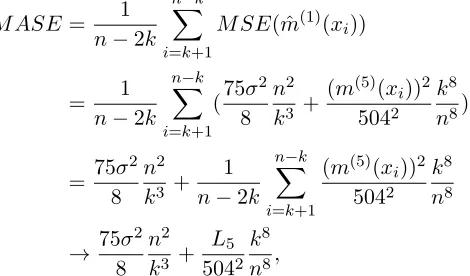
To choosekglobally, we consider the mean averaged square error (MASE) criterion
M ASE = 1
n−2k
n−k X
i=k+1
M SE( ˆm(1)(xi))
= 1
n−2k
n−k X
i=k+1 (75σ
2 8
n2 k3 +
(m(5)(xi))2 5042
k8 n8)
= 75σ 2 8
n2 k3 +
1
n−2k
n−k X
i=k+1
(m(5)(xi))2 5042
k8 n8 → 75σ
2 8
n2 k3 +
L5 5042
k8 n8, whereL5 =
R1 0(m
(5)(x))2dx. Minimizing the M ASE with respect to k, the uniformk is
ku = 3.48(
σ2 L5
)1/11n10/11.
Since the ka andku are unknown in practice, a rule of thumb estimator may be prefer-able. The error varianceσ2 can be estimated by Hall et al. (1990), the fifth order derivative
m(5)(xi) can be estimated by local polynomial regression (R-package: locpol), and L5 is estimated by Seifert et al. (1993).
However, questions still remain. First, k = O(n10/11), which requires n to be large enough to ensure k < n; Second, ‘the higher the derivative, the wilder the behavior’ (Ram-say, 1998), thus the estimations ofm(5)(xi) and L5 are inaccurate. The most important is that when the bias is very small or large we can’t balance the bias and variance via only increasing or decreasing the value of k. From the expression of adaptive k, uniform k and simulations, we put forward the following considerations.
• On the whole, kshould satisfyk < n/2 or else the needed data size 2k goes over the total sizenso that we can’t estimate any derivative. In addition, we can’t leave more boundary points than interior points, so kneeds to satisfy the condition k < n/4.
• The choice ofkrelies on Taylor expansion which is a local concept. There exists some maximum value of k suitable for a fixed mean function, denoted by kmax. However, adaptive and uniformkis determined by many factor: variance, sample size, frequency and amplitude of mean function. Thus it is possible to obtain too big k in the cases of large variance, and now cross validation could be an alternative. As frequency and amplitude increase, the uniform and adaptivekdecrease. This is the reason why our estimator adopting different k for different oscillation has better performance in Figure 1. In addition, as the order of Taylor expansion increases, the kmax becomes large. So our estimator needs a larger kthan empirical derivative.
• When the third-order and fifth-order derivatives are close to zero, the values ofkaand
4. Higher Order Derivative Estimations
In this section, we generalize the idea of the first order derivative estimation to higher order. Different difference sequences are adopted for first and second order derivative estimation.
4.1 Second Order Derivative Estimation
As for the second order derivative estimation, we can show by a similar technique as in (3) that
m(2)(xi) =
m(xi−j)−2m(xi) +m(xi+j)
j2/n2 −
m(4)(xi) 12
j2 n2 +o
j2 n2 . Define
Yij(2) = Yi−j−2Yi+Yi+j
j2/n2 . (14)
Just as in equation (5), decompose (14) into two parts as
Yij(2)= m(xi−j)−2m(xi) +m(xi+j)
j2/n2 +
i−j−2i+i+j
j2/n2 , 1≤j≤k.
Note thatiis fixed asj changes. Thus the conditional expectation of Yij(2) given i is
E[Yij(2)|i] = m(xi−j)−2m(xi) +m(xi+j)
j2/n2 + (−2i)
n2 j2
.
=m(2)(xi) +
m(4)(xi) 12
j2
n2 + (−2i)
n2 j2. Therefore, the new regression model is given by
Yij(2) =βi0+βi1d1j +βi2d2j +δij, 1≤j≤k,
where the regression coefficient vector βi = (βi0, βi1, βi2)> = (m(2)(xi),m
(4)(x
i)
12 ,−2i) >,
covariates d1j = j
2
n2 and d2j = n
2
j2, and the error term δij = i+jj2+/ni−j2 +o
j2
n2
, with
E[δij|i]= 0. , V ar[δij|i] = 2σ2n4
j4 .
Now the locally weighted least squares estimator ofβi can be expressed as
ˆ
βi= (D>W D)−1D>W Yi(2), where D=
1 12/n2 n2/12 1 22/n2 n2/22
..
. ... ... 1 k2/n2 n2/k2
, Yi(2)=
Yi1(2) Yi2(2)
.. .
Yik(2)
, W =
14/n4 0 · · · 0 0 24/n4 · · · ...
..
. 0 . .. 0
0 0 · · · k4/n4
Therefore,
ˆ
m(2)(xi) = ˆβi0 =e>1βˆi, (15) wheree1 = (1,0,0)>.
The following three theorems provide asymptotic results on bias, variance and mean square error, and establish pointwise consistency and asymptotic normality of the second order derivative estimator.
Theorem 6 Assume that the nonparametric model (1) holds with equidistant design and the unknown smooth functionm(·)is six times continuously differentiable on[0,1]. Further-more, assume that the sixth order derivative m(6)(·) is finite on[0,1]. Then the variance of the second order derivative estimator in (15) is
V ar[ ˆm(2)(xi)|i] = 2205σ 2 8
n4
k5 +o(
n4
k5) uniformly for k+ 1≤i≤n−k, and the bias is
Bias[ ˆm(2)(xi)|i] =−m (6)(xi)
792
k4 n4 +o(
k4 n4) for k+ 1≤i≤n−k.
From Theorem 6, we can see that if nk−5/4 → 0 and n−1k→ 0, then our estimator is consistent
ˆ
m(2)(xi)−→P m(2)(xi).
Moreover, we establish asymptotic normality, derive the asymptotic mean square error and the optimalk value.
Corollary 7 Under the assumptions of Theorem 6, if k → ∞ as n → ∞ such that
nk−5/4 →0 and n−1k→0, then
k5/2 n2 mˆ
(2)(x
i)−m(2)(xi) +
m(6)(xi) 792
k4 n4
! d −→N
0,2205σ
2 8
.
Moreover, if nk−5/4 →0 and n−1k13/12→0, then
k5/2 n2
ˆ
m(2)(xi)−m(2)(xi)
d
−→N
0,2205σ
2 8
.
Corollary 8 Under the assumptions of Theorem 6, the optimal k value that minimizes the asymptotic mean square error of the second order derivative estimator in (15) is
kopt= 4. .15
σ2
(m(6)(x i))2
1/13
n12/13.
With the optimal choice ofk, the asymptotic mean square error of the second order derivative estimator in (15) can be expressed as
AM SE[ ˆm(1)(xi)]= 0. .36
σ16(m(6)(xi))10 1/13
Figure 2: (a)-(f) The proposed second order derivative estimators (green points) and the empirical second derivatives (red dashed line) for k ∈ {6,9,12,25,35,60} based on the simulated data set from Figure 1. As a reference, the true second order derivative curve is also plotted (bold line).
Here we also use a simple simulation to examine the finite sample behavior of the new estimator and compare it with the empirical second derivative given by Charnigo et al. (2011) and De Brabanter et al. (2013). Their estimator has the following form:
Yi[2] = k2
X
j=1
wijYij(2), k1+k2+ 1≤i≤n−k1−k2, (16)
where wij = Pkj/n2 j=1j/n
, Yij(2) = (Yi+j(1) −Yi−j(1))/(2j/n), k1 is the same as in (9), and k2 is a positive integer. Figure 2 displays our second order derivative estimators and empirical second derivatives (16) at interior point for the data from Figure 1, where k1 =k2 = k∈ {6,9,12,25,35,60}. The performance of the our second derivative estimator and empirical second derivative is parallel to the first derivative’s case. Note that the k values used here are larger than the counterparts in the first order derivative estimation.
4.2 Higher Order Derivative Estimation
The construction of a difference sequence is particularly important because it determines the estimation accuracy.
When l is odd, set d= l+12 . We linearly combinem(xi±j)’s subject to d
X
h=1
[ai,jd+hm(xi+jd+h) +ai,−(jd+h)m(xi−(jd+h))] =m(l)(xi) +O
j n
, 0≤j≤k,
where k is a positive integer. We can derive 2d equations through Taylor expansion and solve out the 2dunknown parameters. Define
Yij(l)= d X
h=1
[ai,jd+hYi+jd+h+ai,−(jd+h)Yi−(jd+h)].
and consider the linear regression
Yij(l)=m(l)(xi) +δij, 1≤j≤k, whereδij =Pdh=1[ai,jd+hi+jd+h+ai,−(jd+h)i−(jd+h)] +O(nj).
When l is even, set d= 2l. We linearly combine m(xi±j)’s subject to
bi,jm(xi)+ d X
h=1
[ai,jd+hm(xi+jd+h)+ai,−(jd+h)m(xi−(jd+h))] =m(l)(xi)+O
j n
, 0≤j ≤k,
wherekis a positive integer. We can derive 2d+ 1 equations through Taylor expansion and solve out the 2d+ 1 unknown parameters. Define
Yij(l) =bi,jm(xi) + d X
h=1
[ai,jd+hYi+jd+h+ai,−(jd+h)Yi−(jd+h)].
and consider the linear regression
Yij(l)=m(l)(xi) +bi,ji+δij, 1≤j≤k, whereδij =Pdh=1[ai,jd+hi+jd+h+ai,−(jd+h)i−(jd+h)] +O(nj).
Ifkis large enough, it is better to keep the j2/n2 term like (7) to reduce the estimation bias. With the regression models defined above, we can obtain the higher order derivative estimators and deduce their asymptotic results by similar arguments as in the previous subsection; the details are omitted here.
5. Simulations
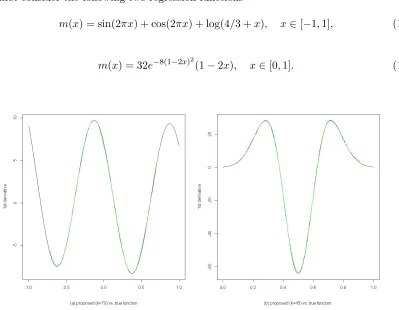
5.1 Finite Sample Results of the First Order Derivative Estimation We first consider the following two regression functions
m(x) = sin(2πx) + cos(2πx) + log(4/3 +x), x∈[−1,1], (17)
and
m(x) = 32e−8(1−2x)2(1−2x), x∈[0,1]. (18)
Figure 3: (a) The true first order derivative function (bold line) and our first order derivative estimations (green dashed line). Simulated data set of size 500 from model (1) with equispaced xi ∈ [−1,1], m(x) = sin(2πx) + cos(2πx) + log(4/3 +x), and
i iid
∼ N(0,0.12). (b) The true first order derivative function (bold line) and our first order derivative estimations (green dashed line). Simulated data set of size 500 from model (1) with equispacedxi∈[0,1],m(x) = 32e−8(1−2x)
2
(1−2x), and
i iid
∼ N(0,0.12).
These two functions were considered by Hall (2010) and De Brabanter et al. (2013), respectively. The data sets are of size n = 500 and generated from model (1) with ∼
N(0, σ2) for σ = 0.1. Figure 3 presents the first order derivative estimations of regression functions (17) and (18). It shows that our estimation curves of the first order derivative fit the true curves accurately, although a comparison with the other estimators is not given in the figure.
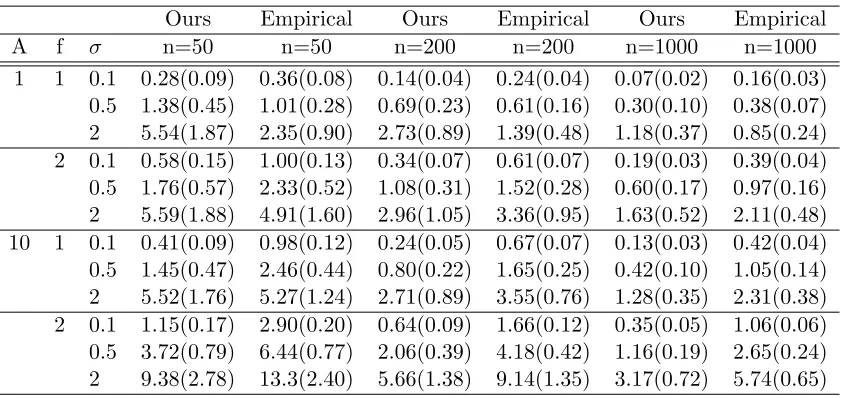
We now evaluate our estimator with empirical first derivative. Since the oscillation of the periodic function depends on frequency and amplitude, in our simulations we choose the mean function
Ours Empirical Ours Empirical Ours Empirical
A f σ n=50 n=50 n=200 n=200 n=1000 n=1000
1 1 0.1 0.28(0.09) 0.36(0.08) 0.14(0.04) 0.24(0.04) 0.07(0.02) 0.16(0.03) 0.5 1.38(0.45) 1.01(0.28) 0.69(0.23) 0.61(0.16) 0.30(0.10) 0.38(0.07) 2 5.54(1.87) 2.35(0.90) 2.73(0.89) 1.39(0.48) 1.18(0.37) 0.85(0.24) 2 0.1 0.58(0.15) 1.00(0.13) 0.34(0.07) 0.61(0.07) 0.19(0.03) 0.39(0.04) 0.5 1.76(0.57) 2.33(0.52) 1.08(0.31) 1.52(0.28) 0.60(0.17) 0.97(0.16) 2 5.59(1.88) 4.91(1.60) 2.96(1.05) 3.36(0.95) 1.63(0.52) 2.11(0.48) 10 1 0.1 0.41(0.09) 0.98(0.12) 0.24(0.05) 0.67(0.07) 0.13(0.03) 0.42(0.04) 0.5 1.45(0.47) 2.46(0.44) 0.80(0.22) 1.65(0.25) 0.42(0.10) 1.05(0.14) 2 5.52(1.76) 5.27(1.24) 2.71(0.89) 3.55(0.76) 1.28(0.35) 2.31(0.38) 2 0.1 1.15(0.17) 2.90(0.20) 0.64(0.09) 1.66(0.12) 0.35(0.05) 1.06(0.06) 0.5 3.72(0.79) 6.44(0.77) 2.06(0.39) 4.18(0.42) 1.16(0.19) 2.65(0.24) 2 9.38(2.78) 13.3(2.40) 5.66(1.38) 9.14(1.35) 3.17(0.72) 5.74(0.65)
Table 1: Adjusted Mean Absolute Error for the first order derivative estimation.
with design points xi =i/n, and the errors are independent and identically normal distri-bution with zero mean and variance σ2. We consider three sample sitesn= 50,200,1000, corresponding to small, moderate, and large sample sizes, three standard deviations σ = 0.1,0.5,2, two frequencies f = 1,2, and two amplitudes A= 1,10. The number of repeti-tions is set as 1000. We consider two criterion: adjusted mean absolute error (AMAE) and mean averaged square error, and find that they have similar performance. For the sake of simplicity and robustness, we choose the AMAE as a measure of comparison. It is defined as
AM AE(k) = 1
n−2k
n−k X
i=k+1
|mˆ0(xi)−m0(xi)|,
here the boundary effects are excluded. According to the conditionk < n/4 and the AMAE criterion, we choosek as follows
ˆ
k= min{arg min
k AM AE(k),
n
4}.
Table 1 reports the simulation results. The numbers outside and inside the brackets are the mean and standard deviation of the AMAE. It indicates our estimator performs better than empirical first derivative in most cases except that the adoptive k is much less the theoretically uniform k.
5.2 Finite Sample Results of the Second Order Derivative Estimation
Figure 4: (a)-(b) The true second order derivative function (bold line) and proposed second order derivative estimations (green dashed line) based on the simulated data sets from Figure 3 correspondingly.
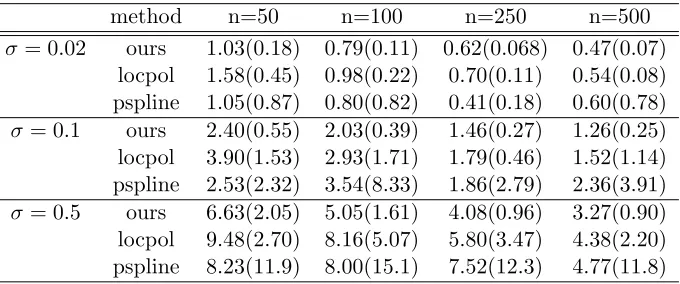
method n=50 n=100 n=250 n=500
σ= 0.02 ours 1.03(0.18) 0.79(0.11) 0.62(0.068) 0.47(0.07) locpol 1.58(0.45) 0.98(0.22) 0.70(0.11) 0.54(0.08) pspline 1.05(0.87) 0.80(0.82) 0.41(0.18) 0.60(0.78)
σ= 0.1 ours 2.40(0.55) 2.03(0.39) 1.46(0.27) 1.26(0.25) locpol 3.90(1.53) 2.93(1.71) 1.79(0.46) 1.52(1.14) pspline 2.53(2.32) 3.54(8.33) 1.86(2.79) 2.36(3.91)
σ= 0.5 ours 6.63(2.05) 5.05(1.61) 4.08(0.96) 3.27(0.90) locpol 9.48(2.70) 8.16(5.07) 5.80(3.47) 4.38(2.20) pspline 8.23(11.9) 8.00(15.1) 7.52(12.3) 4.77(11.8)
Table 2: Adjusted Mean Absolute Error for the second order derivative estimation.
We evaluate our method with two other well-known methods by Monte Carlo studies, that is local polynomial regression withp= 5 (R packageslocpol, Cabrera, 2012) and pe-nalized smoothing splines with norder= 6 andmethod= 4 (R packagespspline, Ramsay and Ripley, 2013) in model (1). For the sake of simplicity, we set the mean function
m(x) = sin(2πx), x∈[−1,1].
6. Discussion
In this paper we propose a new methodology to estimate derivatives in nonparametric re-gression. The method includes two main steps: construct a sequence of symmetric difference quotients, and estimate the derivative using locally weighted least squares regression. The construction of a difference sequence is particularly important, since it determines the es-timation accuracy. We consider three basic principles to construct a difference sequence. First, we eliminate the terms before the derivative of interest through linear combinations, the derivative is thus put in the important place. Second, we adopt every dependent vari-able only once, which keeps the independence of the difference sequence’s terms. Third, we retain one or two terms behind the derivative of interest in the derived linear regression, which reduces estimation bias.
Our method and the local polynomial regression (LPR) have a close relationship. Both methods rely on Taylor expansion and employ the idea of locally weighted fitting. However, there are important differences between them. The first difference is the aim of estimation. The aim of LPR is to estimate the mean, the derivative estimation is only a “by-product”, while the aim of our method is to estimate the derivative directly. The second difference is the method of weighting. LPR is kernel-weighted, the farther the distance, the lower the weight; our weight is based on variance, which can be computed exactly. Our simulation studies show that our estimator is more efficient than the LPR in most cases.
All results have been derived for equidistant design with independent identical dis-tributed errors, and extension to more general designs is left to further research. Also, the boundary problem deserve further consideration.
Acknowledgments
We would like to thank Ping Yu at the University of Hong Kong for useful discussions, and two anonymous reviewers and associate editor for their constructive comments on improv-ing the quality of the paper. The research was supported by NNSF projects (11171188, 11571204, and 11231005) of China.
Appendix A. Proof of Theorem 1
For (8), we yieldV ar[ ˆβi] =V ar[(D>W D)−1D>W Yi(1)] = σ22(D>W D)−1.We can compute
D>W D=
I2/n2 I4/n4
I4/n4 I6/n6
,
whereIl=Pkj=1jl,l is an integer. Using the formula for the inverse of a matrix, we have
(D>W D)−1 = n 8
I2I6−I42
I6/n6 −I4/n4 −I4/n4 I2/n2
.
Therefore the variance of ˆβi0 is
V ar[ ˆβi0] = σ 2 2 e
>
1(D>W D)−1e1= 75σ2
8
n2 k3 +o(
Appendix B. Proof of Theorem 2
From (8), we yield E[ ˆβi] = E[(D>W D)−1D>W Yi(1)] =β+ (D>W D)−1D>W E[δi].So we have
Bias[ ˆβi] = (D>W D)−1D>W E[δi].
Since m is five times continuously differentiable, the following Taylor expansions are valid form(xi±j) aroundxi
m(xi±j) =m(xi) +m(1)(x)(±j
n ) +
m(2)(x) 2! (
±j n )
2+m(3)(x) 3! (
±j n )
3+ m(4)(x) 4! (
±j n )
4 +m
(5)(x) 5! (
±j n )
5+o
(±j
n )
5
.
We have
Yij(1)= Yi+j−Yi−j
xi+j−xi−j
=
m(1)(xi)(2jn) +m(3)(xi)
3 ( j n)3+
m(5)(xi)
60 ( j n)5+o
(nj)5
+ (i+j−i−j) 2j/n
=m(1)(xi) +m (3)(xi)
6 (
j n)
2+m(5)(xi) 120 (
j n)
4+o
(j
n)
4
+ i+j −i−j 2j/n
=m(1)(xi) +
m(3)(xi) 6 (
j n)
2+δ ij.
So
E[δi] =
m(5)(xi) 120
14/n4
24/n4
.. .
k4/n4
+o(
14/n4
24/n4
.. .
k4/n4
),
Bias[ ˆβi] =
m(5)(xi) 120
k4 n4
−5/21 10/9
+o(k
4
n4). The estimation bias is Bias[ ˆβi0] =−m(5)(xi)
504 k4
n4 +o(k 4
n4).
Appendix C. Proof of Theorem 3
Using the asymptotic theory of least squares and the fact that {δij}kj=1 are independent distributed with mean zeros and variance{n2σ2
2j2 }kj=1, it follows that the asymptotic normality
is proved.
Appendix D. Proof of Corollary 4
For the first derivative estimation, the mean square error is given by
M SE[ ˆm(1)(xi)] = (Bias[ ˆm(1)(xi)])2+V ar[ ˆm(1)(xi)] = (m
(5)(xi))2 254016
k8 n8 +
75σ2
8
n2 k3 +o(
k8 n8) +o(
Ignoring higher order terms, we obtain the asymptotic mean square error
AM SE( ˆm(1)(xi)) =
(m(5)(xi))2 254016
k8 n8 +
75σ2
8
n2
k3. (19)
To minimize (19) with respect tok, we take the first derivative of (19) and yield the gradient
d[AM SE( ˆm(1)(xi))]
dk =
(m(5)(xi))2 31752
k7 n8 −
225σ2
8
n2 k4, our optimization problem is to solve d[AM SE( ˆm(1)(xi))]
dk = 0.So we obtain
kopt =
893025σ2 (m(5)(x
i))2 1/11
n10/11= 3. .48
σ2 (m(5)(x
i))2 1/11
n10/11,
and
AM SE( ˆm(1)(xi))= 0. .31(σ16(m(5)(xi))6)1/11n−8/11.
Appendix E. Proof of Theorem 5
The conditional variance of ˆβi0 is V ar[ ˆβi0|i] =σ2(D>W D)−1 = 12σ2n
2
k3 +o(n 2
k3).
Since the conditional bias of δij is
E[δij|i] =
m(2)(xi) 2!
j1 n1 +o
j1 n1
.
Thus the conditional bias of ˆβi0 is
Bias[ ˆβi0|i] = (D>W D)−1D>W E[δi]
= m (2)(x
i) 2
k1 n1 +o
k1 n1
.
Appendix F. Proof of Theorem 6
The conditional variance is given byV ar[ ˆβi|i] = 2σ2(D>W D)−1.We can compute
D>W D=
I4/n4 I6/n6 I2/n2
I6/n6 I8/n8 I4/n4
I2/n2 I4/n4 I0/n0
.
The determinant of D>W D is
|D>W D|= I0I4I8+ 2I2I4I6−I0I 2
6 −I43−I22I8
n12 ,
and the adjoint matrix is
(D>W D)? =
(I0I8−I42)/n8 (I2I4−I0I6)/n6 (I4I6−I2I8)/n10 (I2I4−I0I6)/n6 (I0I4−I22)/n4 (I2I6−I42)/n8 (I4I6−I2I8)/n10 (I2I6−I42)/n8 (I4I8−I62)/n12
Based on the formula for the inverse of a matrix A−1 = |A|1 A?, we have
V ar[ ˆβi0|i] = 2σ2e>1(D>W D)−1e1 =
2205σ2
8
n4 k5 +o(
n4 k5). Revisit the sixth order Taylor approximation for m(xi±j) aroundxi
m(xi±j) =m(xi) +m(1)(xi)( ±j
n ) +
m(2)(xi) 2! (
±j n )
2+m(3)(xi) 3! (
±j n )
3+ m(4)(xi) 4! (
±j n )
4 +m
(5)(x i) 5! (
±j n )
5+m(6)(xi) 6! (
±j n )
6+o
(±j
n )
6
.
We have
Yij(2) = m(xi−j)−2m(xi) +m(xi+j)
j2/n2 +
i−j −2i+i+j
j2/n2 =m(2)(xi) +
m(4)(xi) 12
j2
n2 + (−2i)
n2 j2 +
m(6)(xi) 360
j4 n4 +o
j4 n4
+i−j+i+j
j2/n2 . So the conditional mean is
E[δi|i] =
m(6)(xi) 360
14/n4
24/n4
.. .
k4/n4
+o(
14/n4
24/n4
.. .
k4/n4 ),
and the conditional bias is
Bias[ ˆβi|i] = (D>W D)−1D>W E[δi|i]
= m (6)(xi)
360
5/11
15/11
5/231
k4/n4 k2/n2 k6/n6
+o(
k4/n4 k2/n2 k6/n6
).
We get
Bias[ ˆβi0|i] =−
m(6)(xi) 792
k4 n4 +o(
k4 n4). Appendix G. Proof of Corollary 7
Using the asymptotic theory of least square and the fact that {δij}kj=1 are independent distributed with conditional mean zeros and conditional variance{2σj24n4}kj=1, it follows that
the asymptotic normality is proved.
Appendix H. Proof of Corollary 8
For the second derivative estimation, the MSE is
M SE[ ˆm(2)(xi)|i] =Bias[ ˆm(2)(xi)]2+V ar[ ˆm(2)(xi)] = (m
(6)(xi))2 627264
k8 n8 +
2205σ2
8
n4 k5 +o(
n4 k5) +o(
Ignoring higher order terms, we get AMSE
AM SE[ ˆm(2)(xi)|i] = (m
(6)(xi))2 627264
k8 n8 +
2205σ2
8
n4
k5. (20)
To minimize (20) with respect to k, take the first derivative of (20) and yield the gradient
d[AM SE[ ˆm(2)(xi)|i]]
dk =
(m(6)(xi))2 78408
k7 n8 −
11025σ2
8
n4 k6, our optimization problem is to solve d[AM SE[ ˆm(2)(xi)|i]]
dk = 0.So we obtain
kopt=
108056025σ2
(m(6)(xi))2 1/13
n12/13= 4. .15
σ2
(m(6)(xi))2 1/13
n12/13,
and
AM SE( ˆm(1)(xi))= 0. .36
σ16(m(6)(xi))10 1/13
n−8/13.
Appendix I. Convergence Rates
In Table 3, we give the convergence rate of mean estimator and the first order derivative estimator in LPR.p= 1 means that the order of LPR is 1. V ar0 represents the convergence rate of the variance of the mean estimator, V ar1 represents the convergence rate of the variance of the first order derivative estimator. M SE^1 stands for the convergence rate of the mean square error of first order derivative estimator whenk=k0,
V ar0 Bias20 k0 M SE0 V ar1 Bias21 k1 M SE1 M SE^1
p=1 1/k k4/n4 n4/5 n−4/5 n2/k3 k4/n4 n6/7 n−4/7 n−2/5
p=2 1/k k8/n8 n8/9 n−8/9 n2/k3 k4/n4 n6/7 n−4/7 n−4/9
p=3 1/k k8/n8 n8/9 n−8/9 n2/k3 k8/n8 n10/11 n−8/11 n−2/3
p=4 1/k k12/n12 n12/13 n−12/13 n2/k3 k8/n8 n10/11 n−8/11 n−8/13
Table 3: The convergence rates for mean estimator and the first order derivative estimator.
References
J.L.O. Cabrera. locpol: Kernel local polynomial regression. R packages version 0.6-0, 2012. URLhttp://mirrors.ustc.edu.cn/CRAN/web/packages/locpol/index.html.
R. Charnigo, M. Francoeur, M.P. Meng¨u¸c, A. Brock, M. Leichter, and C. Srinivasan. Deriva-tives of scattering profiles: tools for nanoparticle characterization. Journal of the Optical Society of America, 24(9):2578–2589, 2007.
P. Chaudhuri and J.S. Marron. SiZer for exploration of structures in curves. Journal of the American Statistical Association, 94(447):807–823, 1999.
K. De Brabanter, J. De Brabanter, B. De Moor, and I. Gijbels. Derivative estimation with local polynomial fitting. Journal of Machine Learning Research, 14(1):281–301, 2013.
M. Delecroix and A.C. Rosa. Nonparametric estimation of a regression function and its derivatives under an ergodic hypothesis. Journal of Nonparametric Statistics, 6(4):367– 382, 2007.
R.L. Eubank and P.L. Speckman. Confidence bands in nonparametric regression. Journal of the American Statistical Association, 88(424):1287–1301, 1993.
J. Fan and I. Gijbels. Local Polynomial Modelling and Its Applications. Chapman & Hall, London, 1996.
I. Gijbels and A.-C. Goderniaux. Data-driven discontinuity detection in derivatives of a regression function. Communications in Statistics-Theory and Methods, 33(4):851–871, 2005.
B. Hall.Nonparametric Estimation of Derivatives with Applications. PhD thesis, University of Kentucky, Lexington, Kentucky, 2010.
P. Hall, J.W. Kay, and D.M. Titterington. Asymptotically optimal difference-based estima-tion of variance in nonparametric regression. Biometrika, 77(3):521–528, 1990.
W. H¨ardle. Applied Nonparametric Regression. Cambridge University Press, Cambridge, 1990.
W. H¨ardle, M. M¨uller, S. Sperlich, and A. Werwatz. Nonparametric and Semiparametric Models: An Introduction. Springer, Berlin, 2004.
N.E. Heckman and J.O. Ramsay. Penalized regression with model-based penalties. The Canadian Journal of Statistics, 28(2):241–258, 2000.
J.L. Horowitz. Semiparametric and Nonparametric Methods in Econometrics. Springer, New York, 2009.
L. Lin and F. Li. Stable and bias-corrected estimation for nonparametric regression models. Journal of Nonparametric Statistics, 20(4):283–303, 2008.
H.-G. M¨uller. Nonparametric Regression Analysis of Longitudinal Data. Springer, New York, 1988.
H.-G. M¨uller, U. Stadtm¨uller, and T. Schmitt. Bandwidth choice and confidence intervals for derivatives of noisy data. Biometrika, 74(4):743–749, 1987.
J. Newell, J. Einbeck, N. Madden, and K. McMillan. Model free endurance markers based on the second derivative of blood lactate curves. In Proceedings of the 20th International Workshop on Statistical Modelling, pages 357–364, Sydney, 2005.
C. Park and K.-H Kang. SiZer analysis for the comparison of regression curves. Computa-tional Statistics & Data Analysis, 52(8):3954–3970, 2008.
J. Ramsay. Derivative estimation. StatLib-S news, 1998. URL http://www.math.yorku. ca/Who/Faculty/Monette/S-news/0556.html.
J. Ramsay and B. Ripley. pspline: Penalized smoothing splines. R packages version 1.0-16, 2013. URL http://mirrors.ustc.edu.cn/CRAN/web/packages/pspline/index.html.
J.O. Ramsay and B.W. Silverman. Applied Functional Data Analysis: Methods and Case Studies. Springer, New York, 2002.
D. Ruppert and M.P. Wand. Multivariate locally weighted least squares regression. The Annals of Statistics, 22(3):1346–1370, 1994.
D. Ruppert, S.J. Sheather, and M.P. Wand. An effective bandwidth selector for local least squares regression. Journal of the American Statistical Association, 90(432):1257–1270, 1995.
B. Seifert, T. Gasser, and A. Wolf. Nonparametric estimation of residual variance revisited. Biometrika, 80(2):373–383, 1993.
C.J. Stone. Additive regression and other nonparametric models. Annals of Statistics, 13 (2):689–705, 1985.
T. Tong and Y. Wang. Estimating residual variance in nonparametric regression using least squares. Biometrika, 92(4):821–830, 2005.
![Figure 1: (a) Simulated data set of size 300 from model (1) with equidistant xi ∈ [0.25, 1],m(x) =�x(1 − x) sin((2.1π)/(x + 0.05)), ϵiiid∼ N(0, 0.12), and the true meanfunction (bold line).(b)-(f) The proposed first order derivative estimators(green dots) a](https://thumb-us.123doks.com/thumbv2/123dok_us/9803512.1966315/7.612.90.518.102.330/figure-simulated-equidistant-meanfunction-proposed-rst-derivative-estimators.webp)