http://ijessr.com Page 219 EXPLORING THE EFFECTIVENESS OF TRANSITIONAL SERVICES PROVIDED TO LEARNERS WITH DISABILITIES IN CHINHOYI URBAN SECONDARY SCHOOLS IN
ZIMBABWE
Jabulani Mpofu
Zimbabwe Open University
Department of Disability Studies and Special Needs Education
ABSTRACT
This study explored the effectiveness of transitional services provided to learners with disabilities in Chinhoyi Urban in Zimbabwe as perceived by their parents. The effectiveness was measured in terms of suitability of available transitional services to learners with disabilities in Chinhoyi Urban, whether the services meet the expectations of their parents, availability of vocational skills training and absorption of young adults with disabilities in the world of employment post school level. A survey approach was used to collect information on the effectiveness of transitional services from 30 parents of learners with disabilities (15 Males 15 Female) learning in Chinhoyi Urban Secondary schools. Data was analysed using measures of central tendency. Results from the study indicated that transitional services for learners with disabilities in Chinhoyi Urban were not suitable for most learners with disabilities. The services were also not meeting the expectations of most parents. Learners with disabilities were also not being equipped with vocational skills making it difficult for them to be absorbed by in the world of employment post school level. The findings of this study have the potential for the inclusive education policy makers and researchers to better understand the transitional needs of learners with disabilities in Zimbabwe at large
KEYWORDS: Learners with disabilities, transitional services, vocational skills, employment, adulthood
INTRODUCTION What is transition?
Transition is the process or a period of changing from one state or condition to another, for example transition from childhood to adulthood (Career, 2005). It is strongly believed that learners with and without disabilities should progress smoothly from childhood to adulthood without problems. Transition imparts employment ability skills and individuals gain skills of interdependence and competence as workers (Avoke, 2004). Transition of learners with disabilities is very important in that it addresses lifelong needs after school, (Haugh, 2001). Transition services should aim at fulfilling or meeting the learner’s interest and preferences and should also aim at imparting independent living skills for its clientele (Hoyt & Vaughan, 2000).
http://ijessr.com Page 220 In Zimbabwe, current evidence about the transition of learners with disabilities suggests that it is being marginally provided in Zimbabwean Schools. However, Zimbabwean laws e.g. the Constitution (COPAC, 2013) uphold transitional services for learners with disabilities in Zimbabwean Schools. According to the country’s Laws learners with disabilities like any other learners are mandated by the Constitution (COPAC, 2013, Disabled Persons Act, 1992) to receive transitional services that enables them to progress smoothly from childhood to adulthood without problems. These transitional services assist them in enhancing opportunities for full participation in adult life (Stewart, 2006). Zimbabwean transitional services for learners with disabilities are holistic in nature. They focus on learning academic materials not post school training for employment ability skills. Learners with disabilities in addition to academic skills need empowerment and independent living skills (Blake & Langone, 2007). Academic skills mainly focus on reading and writing. This current situation is probably caused by non-availability of a clear policy on how transitional services must be provided to Zimbabwean youth with disabilities in Zimbabwe Schools (Mpofu et al, 2018). The only policy that is available on transitional services is the Zimbabwe National Youth Policy of 1997. The policy provides framework to provide common aspirations and priorities for youth development across Zimbabwe. Through this policy, the government declares the importance of the active involvement of young people in national development (Zimbabwe Youth Council Amendment Act No 16, 1997). Although the policy is a nice piece of paper it is not clear how it intends to support young learners with disabilities on the transition process. This study investigated the effectiveness of transitional services for learners with disabilities as perceived by their parents in Chinhoyi Urban in Zimbabwe.
METHODS Methodology
A survey approach was used to collect information on the effectiveness of transitional services for learners with disabilities from parents of children with disabilities learning in Chinhoyi Urban Secondary schools. This study made use of survey method because it has the advantage that the findings can be generalised to the target population (Creswell, 2009). Thus in this research findings obtained represent the general parental perception towards the effectiveness of transitional services for learners with disabilities as perceived by parents with children with disabilities learning in Chinhoyi Urban Secondary schools in Zimbabwe.
The research instruments
http://ijessr.com Page 221 Sample and Sampling procedures
The sample of the study was comprised of 30 parents (15 males and 15 females) of learners with disabilities learning in parents in Chinhoyi Urban Secondary schools. This sample constituted 25 % of parents of learners with disabilities learning in Chinhoyi Urban Secondary schools in Zimbabwe. The research used a stratified random sampling to obtain study’s respondents. Stratified random sampling was adopted by this study to accommodate different strata’s found in the target population of the study (Cohen et al, 2005). The study also used stratified sampling techniques because the study population was heterogeneous and organised in isolated (strata). The respondents were selected by separating the population into non-overlapping groups of similar characteristics called strata and then selecting a sample from each stratum (Creswell, 2012).
Pilot testing
An equivalent of 15% (6) of similar subjects from each similar stratum was used to test t he content validity and reliability of the research instruments (Kaputa et al, 2012). The pilot participants were selected using convenient sampling method from a similar population from a neighbouring town to avoid sharing of information (Cohen et al, 2005).
Data collection procedures
Permission for parents to take part in the study was sought from the parents themselves and Ministry of Primary and Secondary Education provided names and location of the respondents. With the information on the location of selected respondent’s in Chinhoyi Urban in Zimbabwe. The researcher made appointments with selected respondents to visit them and collect data on effectiveness of transitional services provided to learners with disabilities in Chinhoyi Urban Secondary Schools in Zimbabwe. Data was collected over a period of two days.
Data presentation and analysis
The researcher used tables for data presentation and analysis to present and analyse data on the effectiveness of transitional services provided to learners with disabilities in Chinhoyi Urban Secondary Schools in Zimbabwe (Creswell, 2009). Tables were adopted in data presentation in this study because they are easily read and understood (Cohen et al, 2001). Raw scores were converted into percentages to explain the information
Ethical Considerations
This study was guided by principles that provide a generalised framework of how the research must be conducted. The study addressed the following ethical considerations:
Informed Consent and Voluntary Participation
http://ijessr.com Page 222 if they participate in the research. However, this study had no risks attached to it. They then choose to participate or not to participate in the study (Makore- Rukuni, 2004). They were also allowed to pull out of the research at any point should they wish to without any penalties.
Protection from Harm
The researcher made sure that respondents were not being exposed to any undue physical harm or psychological harm. The researcher tried to be honest, respectful and sympathetic towards all participants and if by any chance participants required debriefing after completing the questionnaire the researchers provided this and made referral whenever possible (Cohen, Manion & Morrison, 2001).
Confidentiality and Privacy
The researcher promised to protect the anonymity of the research respondent’s and the confidentiality of their disclosures by consent to the release of personal information. Respondents’ information and responses shared during the study was kept private to protect identities of participants (Creswell, 2009).
RESULTS
Results on parent’s perceptions on the effectiveness of transitional services for learners with disabilities in Chinhoyi Urban Secondary Schools in Zimbabwe are presented following the study research questions.
Transitional Services and needs for learners with disabilities
Respondents who were parents of children with disabilities learning in Chinhoyi Urban Secondary schools were asked to give their opinions on whether transitional services for learners with disabilities being implemented in Chinhoi Urban Secondary schools their schools were suitable for the needs of leaners with disabilities. Responses are shown in Table 1
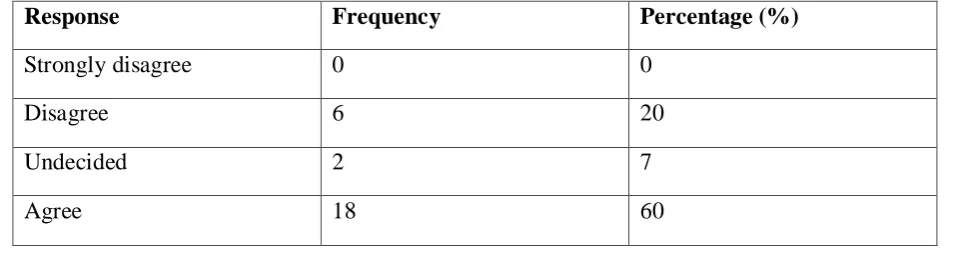
Table 1: Responses from parents of children with disabilities on whether transitional services for learners with disabilities being implemented in their schools were suitable for the needs of their children.
Response Frequency Percentage (%)
Strongly disagree 0 0
Disagree 6 20
Undecided 2 7
http://ijessr.com Page 223
Strongly agree 4 13
Total 30 100
N=30
Table 1 shows responses from parents of children with disabilities on whether transitional services for learners with disabilities being implemented in their schools were suitable for the needs of their children. Twenty percent of the respondents were not in agreement (Disagree) that the transitional services available in their schools were suitable to the needs of their children, 7 % were Undecided, 60% were in agreement (Agree) and 13 % Strongly Agreed that that the transitional services available in their schools were suitable to the needs of their children.
The respondents were also asked whether transitional services available for learners with disabilities in their Secondary schools were responsive to the expectations as parents of learners with disa bilities learning in Chinhoyi Urban Secondary schools. Their responses are shown in table 2
Table 2: Responses from parents of children with disabilities on whether transitional provisions for learners with disabilities in their schools were responsive to their expectations as
parents of learners with disabilities
Response Frequency Percentage (%)
Strongly disagree 1 3
Disagree 14 47
Undecided 1 3
Agree 14 47
Strongly agree 0 0
Total 30 100
N=30
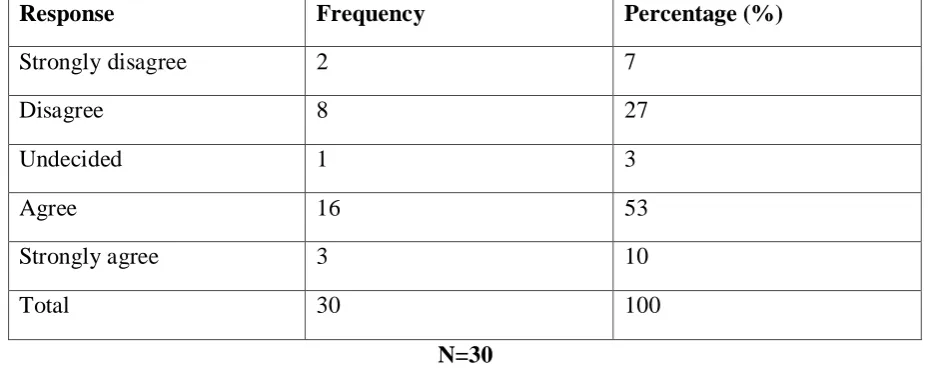
http://ijessr.com Page 224 Table 3 Responses from parents of children with disabilities learning in Chinhoyi Urban Secondary schools on whether the current transitional service provisions for learners with
disabilities at school adequately prepare them for post school adult life.
Response Frequency Percentage (%)
Strongly disagree 2 7
Disagree 8 27
Undecided 1 3
Agree 16 53
Strongly agree 3 10
Total 30 100
N=30
Table 3 shows that 2% of the respondents strongly disagree that the current transitional service provisions for learners with disabilities at school adequately prepares their children for post school adult life , 27 % disagree 3 % were undecided, 53 agreed and 10% strongly agreed
The respondents were also asked if the current transitional activities in their schools were adequately equipping learners with disabilities with skills that will enable them make a meaningful decision in their future careers. Their responses are presented in table 4
Table 4: Responses on whether Learners with disabilities are adequately equipped with skills that will enable them to make meaningful decisions about their future careers
Response Frequency Percentage (%)
Strongly disagree 1 3
Disagree 11 37
Undecided 2 7
Agree 12 40
Strongly agree 4 13
Total 30 100
http://ijessr.com Page 225 Table 4 shows that 3% of the respondents felt strongly disagreed that Learners with disabilities are adequately equipped with skills that will enable them to make meaningful decisions about their future careers, 37 %, disagreed, 7 % were undecided, 40 % agreed and 13 % strongly disagreed. The respondents were also sked if their schools were providing vocational training programs meant to equip learners with disabilities technical skills for the world of work. Their responses are presented in table 5
Table 5: Responses on whether Learners with disabilities are involved in vocational training programmes that adequately prepare them for the world work.
Response Frequency Percentage (%)
Strongly disagree 21 70
Disagree 5 17
Undecided 0 0
Agree 1 3
Strongly agree 3 10
Total 30 100
N=30
Table 4 shows that 70 % of the respondents strongly disagreed that their schools are providing Learners with disabilities are involved in vocational training programmes that adequately prepare them for the world work, 17 % disagreed, 3 % agreed and 10% strongly disagreed.
Parents of children with disabilities were also asked if their children Learners who graduate from transitional programmes at a school are absorbed into the world of work. Their responses are shown in table 6
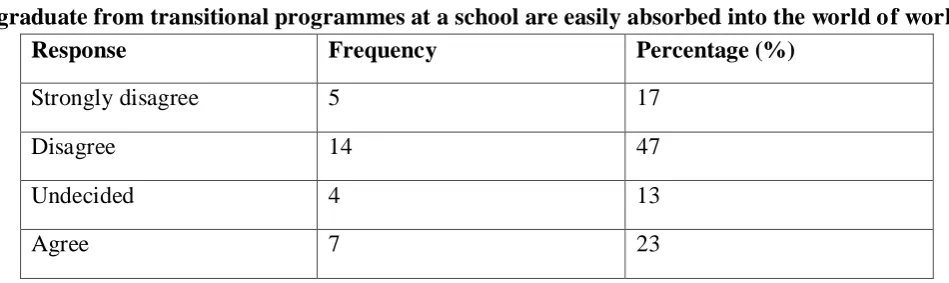
Table 6: Responses from parents of children with disabilities on whether their children who graduate from transitional programmes at a school are easily absorbed into the world of work
Response Frequency Percentage (%)
Strongly disagree 5 17
Disagree 14 47
Undecided 4 13
http://ijessr.com Page 226
Strongly agree 0 0
Total 30 100
According to results on table 6 17 % of the respondents strongly disagreed to the assertion that young learners who graduate from transitional programmes at a school are easily absorbed into the world of work, 47 % disagreed , 13 were not sure and undecided to take a position and , 23% agreed.
DISCUSSIONS
This study results indicated that learners with disabilities in Chinhoyi Urban were not receiving transitional learning activities to tailor made to suit their needs. These transitional services are meant to assist learners with disabilities in enhancing opportunities for full participation in adult life (Stewart, 2006). Transitional services are meant to meet the needs of youth learners with special needs as they move from childhood to adulthood services (Blum et al, 2002). It is more than just a services approach as it involves a process of taking on new roles and adapting or changing existing roles (King et al, 2005). The findings of this research are consistent with the situation in New Zealand. In a research, ‘Creating pathways for young disabled people’ carried out in New Zealand, Ten (2009) noted that despite numerous legislative and policy initiatives on disabilities and transitional services very little action is taking place to alleviate the plight of learners with disabilities on this aspect. It is now over ten years, young learners with disabilit ies are less likely to have school or tertiary qualification or to be employed when compared with everyone else, including other majority groups in New Zealand (Ten, 2009). This suggests that transitional services for learners with disabilities in New Zealand may not be relevant to its clients.
Another study carried out in Canada by Shear & Bauer (2003) on the experiences and outcomes on transitional services for young adults with disabilities’, shows that young learners with disabilities fail to achieve their goals or failed to meet the role expectations and expectations of young learners (Shear & Bauer, 2003). Although learners with disabilities have same aspirations and dreams as those without disabilities, a gap between their aspirations and outcomes has been described in several articles (Wehman, 2007).
http://ijessr.com Page 227 The study also found out that learners with disabilities were not easily absorbed into the world of work. These results also indicated that learners with disabilities were not equipped with the skills that will enable them to make meaningful decisions about their future careers. They were not adequately equipped with vocational skills, community living skills and employment options. The study results are consistent with the situation in other African countries. The literature on learners with disabilities shows that most of them are living in extreme poverty being caused by continuous reliance on poor households and unemployment (Cohen, et al, 2003). Poverty tends to reproduce itself among children with disabilities from already impoverished families. Conditions of poverty further hamper access to basic services offered by social development approach in countries like South Africa. South African policies recognise the ways in which poverty caused by challenges relating to unemployment affects children with disabilities and suggest that government should work jointly with all key stakeholders particularly the private sector in addressing blockages in the labour market. Unemployment among young adults with disabilities turns to bring with it a number of social problems for example poor health, loss off self-esteem and confidence needed to participate in the broader society. Unemployed young adults with disabilities struggle to participate meaningfully in the wide range of concerns and problems they experience in finding employment (Bolin, 2003). Some programs were put in place to help young adults with disabilities such as Expanded Public Works Programme (EPWP), Youth Development Forum, Accelerated and Shared Gr owth Initiative for South Africa and Joint Initiative on Priority Skills Acquisition which address youth unemployment.
In Ghana, some transitional services research studies on learners with disabilities were carried out. Among them were children with mental retardation and handicapped adolescents. The studies show how that transitional services are adversely affected by continuous experiences or failure among these selected groups and therefore they do not get meaningful goals for their future (Hayford, 20 00). Ghanaian has restructured its educational curriculum to include transitional services for learners with disabilities. In the past, the focus was on the number of skills that the student performed in the classroom, although this has not allowed them to achieve a quality of life in adulthood. The life of Secondary school was none of the business (Kniel, 2007).
http://ijessr.com Page 228 vocational rehabilitation (VR), agencies collaborate with state education agencies, local education agencies and institutions of higher education (IHE) to do this.
Western countries such as UK are also reported having effective transitional services for learners with disabilities too. A study conducted by Hung-Chinn (2010) in the United Kingdom on analysis for high-school students with intellectual disability, shows that transitional services were provided in some schools as part of regular education programmes. These programmes were helpful to students. The programmes were given at an early stage even those who did not manage to proceed to secondary school would still use the pre-transitional skills and be able to live a successful adulthood life. It was the school, which will help an individual to get job. In the study, Hayford revealed that, schools have follow up system once the student is out of school after successful completion of course. The school will check on job adjustment problems and inadequate facilities at work place. According to Hayford, it was the duty of schools to check with the employers the provision of special facilities or machine modifications to suit the individual with disabilities. Employers were also seen to be reluctant to hire special persons due to fear that it may affect the output to use individuals with disabilities. The study found out that about 45% were helped to get jobs linkages that were factored into transition programmes (Huang & Cuvo, 2009).
CONCLUSIONS AND RECOMMENDATION
What has been gathered from the research is that schools in Chinhoyi Urban Secondary schools are not giving adequate and effective transitional activities to learners with disabilities. Most of transitional services available in Zimbabwe were much of academic activities not much relevant to the needs of learners with disabilities. Learners with disabilities need to be equipped with vocational skills which are very important for adult world and the world of work. This study recommends the need for further research on inclusion, disability and quality of life. Discourse analysis that investigates the relationship between inclusion and quality of life of learners with disabilities could lead to improved implementation of inclusion. The findings of such studies could guide the development of inclusive policies that encourage community participation of non-dominant cultures such as people with disabilities in designing community activities that enhance their personal development.
REFERENCES
Annabel, R.S. & Water, Z. (2003). Special Education Needs. New York: Englewood Cliffs Prentice Hall.
Avoke, M. K. & Avoke, S. K. (2004). Inclusion, Rehabilitation and Transition Services in Special Education, Winneba: University of Education, Department of Special Education.
Baresford, J. U. (2004). Inclusive Education in Action in South Africa. Pretoria: Van Schaik.
http://ijessr.com Page 229 Black, R.S & Langone, J. (2005). Social Awareness and Transition to Employment for Adolescents with Mental Retardation, Remedial and Special Education, 18, 214-222.
Blum, &Certo, N. (2002). Assessing Post-School Outcomes for young Adults with Disabilities, Beston: Allyn and Bacon.
Barolin, D. E. (2003). Career Education: A Functional Life Skills Approach (3rd ed), Englewood Cliffs, NJ: Prentice Hall Inc.
Career, M. (2005). Transition from School to Work Guide, Hamilton: Author.
Cherono, M. (2003). National Plans of Education: How can the rights and Needs fo Persons with Disabilities be Catered for? Paper presented at the East African Regional Workshop on Education for Persons with Disabilities.
Choruma, T. (2007). The Forgotten Tribe: Persons with Disabilities in Zimbabwe, Harare: Progression.
Cohen, L., Manion & Morison, K. (2003). Research Methods in Education (5th ed). New York: Routledge Falmer-Taylor and Francis Group.
Discussion Paper. (2004). Current Challenges Facing the Future of Secondary Education and Transition Services for Youth with Disabilities in the United States, Retrieved on May 5 2011 from http://www.neset.org/publications/paper.
Division on Career Development and Transition. (2000). Transition Specialist Competences (Fact Sheet), Reston, VA: Author.
Gresham, F.M. & Reschly, D.J (2001). Standards for the Preparation of Transition Specialists, Arlington, VA: Author.
Gumpel, T.P. & Tappe, P. (2000). Designed Vocational Instruction, New Jersey: Merril Prentice. Haugh, B. (Ed). (2008). Transition from School to Adult Life for Pupils with Disabilties: Best Practices in Planning and Programming Transition to Adult Life, New Jersey: Department of Education Office of Special Education Programmes.
Hayford, S. K. (2000). An Evaluation of Vocational Programmes of Special Schools for Children with Disabilities in Ghana, University of Cape Coast unpublished Masters degree, Retrieved on 5 October 2010 from http://www.vocation.org.educatel.
Hoyt, K. B. (2003). Trends in Career Education and Transition, New York: Longman Publishing Group.
Haung, W. & Cuvo, A. J. (2009). Social Skills Training For Adults with Disablities in Job related Settings, Behaviour Modification, 21, 3-44.
Hung-Chin, L. (2010). Analysis of General Transitional Skills for High School Students with Disabilities, Journal of Research in Special Education Needs, June 10 (2): 115.
King, J & Brolin, D. (2005). Life-centred Career Education: A Competency-based Approach, Reston, VA: The Council for Exceptional Children.
Kniel, A. (2007). Transition from School to Work: A Handbook for Parents and Teachers.
http://ijessr.com Page 230 McCrea, L. D. & Miller, S.L (2004). Connecting Vocational Preparation Today with Jobs of Tomorrow, New York: Prentice Hall.
McMillan, J. H. & Schumacher, S. (2007). Parents Expectations about Future Outcomes of Children with Disabilities, Journal of Special Needs, 35 (3), 172-180.
Obi, F. B. (2004). Effective Parenting of Children with Special Needs, Accra: Ashante and Hittsher Printing Press.
Oliver, M. (2007). Understanding Disability: From Theory to Practice, Basingstoke: Macmillan. Peter, L. A. &Hanson, C.J. (2008). Vocational Guidance and Career Development, New York: Macmillan Publishing Co.
Phelps, L. A. Hanley-Maxwell, C. (2007). School to Work Transitions for Youth with Disabilities: A Review of Outcomes and Practices, Review of Educational Research, 67, 176-226
Rainforth, B. (2005). Supported Employment Providing Integrated Employment Opportunities for Persons with Disability, New York: Longman Publishing Group.
Ralph, R. & Usher, E. (2002). Delivering Transition Skills to Special Population Across the Curriculum, Toronto: National Institute on Mental Retardation.
Sarbah, A. L. & Gidiglo, G.P. (2003). Factors Blocking Transition from School to Work for Youths with Disabilities, A Case Study, London: Macmillan Press Ltd.
Schleien, S. & Ray, T. (2005). Leisure Education for a Quality Transition to Adulthood, Journal of Vocation Rehabilitation, 8, 155-169.
Shaughnessy, J. J. & Zechmeister, E.B. (2000). Research Methods in Psychology, New York: McGraw Hill.
Shear, T. M. & Bauer, A. M. (2003). Learners with Disabilities, New York: McGraw Hill.
Sitlington, P. L & Kolstoe, O.P. (2000). TransitionEducation and Services for Adolescents with Disabilities, Boston: Allyn and Bacon.
Stewart, P. (2006). An Ecological Model, Journal of Rehabilitation, 62, 48-55.
Szymaski, E.M. & Parker, R.P. (2003). Work and Disability: Issues an Strategies in Career Developments and Job Placement, (2nd ed), Austin, T.X: PRO-ED.
Ten, S. (2007). Targeting Transition, Retrieved on July 2010 at http://www.tensingma.org/transition. Vlachos, C.J. (2008). Developing and Managing Vocational Training and Transition Planning Programme for Intellectually Disabled Learners, Cardinia: University of South Africa.
Wagner, K.Y. & Lange, C.M. (2005). Delivering Transition Skills to Special Needs Children, Baltimore: Paul Brookes.