Kernel Density Estimation
for the Eigenvalues of Variance
Covariance Matrix of FFT Scaling of DNA Sequences:
An Empirical Study of Some Organisms
Salah H. Abid1,*, Jinan H. Farhood2
1
Mathematics Department, Education College, University of Al-Mustansiriyah, Baghdad, Iraq 2
Mathematics Department, Education College, University of Babylon, Babylon, Iraq
Abstract
Many studies discussed different numerical representations of DNA sequences. In this paper, we discussed the kernel density estimation for the first, second, third and fourth eigenvalues of variance covariance matrix of Fast Fourier Transform (FFT) for numerical values representation of DNA sequences of five organisms, Human, E. coli, Rat, Wheat and Grasshopper. We computed an empirical values for the kernel density estimation for data series according to the following Kernels, Gaussian, Epanechnikov, Rectangular, Triangular, Biweight, Cosine, and Optcosine. To determine the valuable of our work, it should be noted that it is the first time that the variance covariance matrix eigenvalues of (FFT) for numerical values representation of DNA sequences, is used in an analysis like this and related analyzes.Keywords
FFT scaling, DNA, Kernel Density Estimation, Bandwidth, Eigenvalues1. Introduction
In the process of developing the technology, many possible interesting adaptations became apparent: One of the most interesting directions was the use of the technology in the analysis of long DNA sequences. A benefit of the techniques was that it combined rigorous statistical analysis with modern computer power to quickly search for diagnostic patterns within long DNA sequences. Briefly, a DNA strand can be viewed as a long string of linked nucleotides. Each nucleotide is composed of a nitrogenous base, a five carbon sugar, and a phosphate group. There are four different bases that can be grouped by size, the pyrimidines, thymine (T) and cytosine (C), and the purines, adenine (A) and guanine (G). The nucleotides are linked together by a backbone of alternating sugar and phosphate groups with the 5/ carbon of one sugar linked to the 3/ carbon of the next, giving the string direction.
DNA molecules occur naturally as a double helix composed of polynucleotide strands with the bases facing inward. The two strands are complementary, so it is sufficient to represent a DNA molecule by a sequence of bases on a single strand; refer to Fig. 1. Thus, a strand of DNA can
* Corresponding author:
[email protected] (Salah H. Abid) Published online at http://journal.sapub.org/ajms
Copyright©2019The Author(s).PublishedbyScientific&AcademicPublishing This work is licensed under the Creative Commons Attribution International License (CC BY). http://creativecommons.org/licenses/by/4.0/
be represented as a sequence
X tt; 1, 2,...,n
of letters, termed base pairs (bp), from the finite alphabet
A C G T, , ,
.1 The order of the nucleotides contains the genetic information specific to the organism. Expression of information stored in these molecules is a complex multistage process. One important task is to translate the information stored in the protein-coding sequences (CDS) of the DNA (Polovinkina et al. (2016)).Figure 1. The general structure of DNA and its bases
makes up most of the DNA). Another problem of interest that we will address here is that of matching two DNA sequences, say X1t and X2t. The background behind the problem is discussed in detail in the study by Waterman and Vingron (1994). For example, every new DNA or protein sequence is compared with one or more sequence databases to find similar or homologous sequences that have already been studied, and there are numerous examples of important discoveries resulting from these database searches.
One naive approach for exploring the nature of a DNA sequence is to assign numerical values (or scales) to the nucleotides and then proceed with standard time series methods. It is clear, however, that the analysis will depend on the particular assignment of numerical values. Consider the artificial sequence ACGTACGTACGT. . . Then, setting A = G = 0 and C = T = 1, yields the numerical sequence 010101010101. . . , or one cycle every two base pairs (i.e., a frequency of oscillation of 1/ 2 Cycle/bp, or a period of oscillation of length 1/2 bp=cycle). Another interesting scaling is A = 1, C = 2, G = 3, and T = 4, which results in the sequence 123412341234. . . , or one cycle every four bp (1/ 4). In this example, both scalings of the nucleotides are interesting and bring out different properties of the sequence. It is clear, then, that one does not want to focus on only one scaling. Instead, the focus should be on finding all possible scalings that bring our interesting features of the data. Rather than choose values arbitrarily, the spectral envelope approach selects scales that help emphasize any periodic feature that exists in a DNA sequence of virtually any length in a quick and automated fashion. In addition, the technique can determine whether a sequence is merely a random assignment of letters (Polovinkina et al. (2016)).
Fourier analysis has been applied successfully in DNA analysis; McLachlan and Stewart (1976) and Eisenberg et al. (1994) studied the periodicity in proteins using Fourier analysis.
Stoffer et al. (1993) proposed the spectral envelope as a general technique for analyzing categorical-valued time series in the frequency domain. The basic technique is similar to the methods established by Tavar´e and Giddings (1989) and Viari et al. (1990), however, there are some differences. The main difference is that the spectral envelope methodology is developed in a statistical setting to allow the investigator to distinguish between significant results and those results that can be attributed to chance.
The article authored by Marhon and Kremer 2011, partitions the identification of protein-coding regions into four discrete steps. Based on this partitioning, digital signal processing DSP techniques can be easily described and compared based on their unique implementations of the processing steps. They compared the approaches, and discussed strengths and weaknesses of each in the context of different applications. Their work provides an accessible introduction and comparative review of DSP methods for the identification of protein-coding regions. Additionally, by breaking down the approaches into four steps, they
representations by measuring the sensitivity, specificity, correlation coefficient (CC) and the processing time for the protein coding region detection. The proposed technique based on digital filters was used to read-out the period 3 components and to eliminate the unwanted noise from DNA sequence. This method applied to 20 human genes demonstrated that the maximum accuracy and minimum processing time are for the 2-bit binary representation method comparing to the other used representation methods. Results suggest that using 2-bit binary representation method significantly enhanced the accuracy of detection and efficiency of the prediction of coding regions using digital filters. Identification and analysis of hidden features of coding and non-coding regions of DNA sequence is a challenging problem in the area of genomics. The objective of the paper authored by Roy and Barman in 2011 is to estimate and compare spectral content of coding and non-coding segments of DNA sequence both by Parametric and Nonparametric methods. Consequently an attempt has been made so that some hidden internal properties of the DNA sequence can be brought into light in order to identify coding regions from non-coding ones. In this approach the DNA sequence from various Homo Sapien genes have been identified for sample test and assigned numerical values based on weak-strong hydrogen bonding (WSHB) before application of digital signal analysis techniques. The statistical methodology applied for computation of Spectral content are simple and the Spectrum plots obtained show satisfactory results. Spectral analysis can be applied to study base-base correlation in DNA sequences. A key role is played by the mapping between nucleotides and real/complex numbers. In 2006, Galleani and Garello presented a new approach where the mapping is not kept fixed: it is allowed to vary aiming to minimize the spectrum entropy, thus detecting the main hidden periodicities. The new technique is first introduced and discussed through a number of case studies, then extended to encompass time-frequency analysis.
For analyzing periodicities in categorical valued time series, the concept of the spectral envelope was introduced by Stoffer et al., 1993 as a computationally simple and general statistical methodology for the harmonic analysis and scaling of non-numeric sequences. However, The spectral envelope methodology is computationally fast and simple because it is based on the fast Fourier transform and is nonparametric (i.e., it is model independent). This makes the methodology ideal for the analysis of long DNA sequences. Fourier analysis has been used in the analysis of correlated data (time series) since the turn of the century. Of fundamental interest in the use of Fourier techniques is the discovery of hidden periodicities or regularities in the data. Although Fourier analysis and related signal processing are well established in the physical sciences and engineering, they have only recently been applied in molecular biology. Since a DNA sequence can be regarded as a categorical-valued time series it is of interest to discover ways in which time series methodologies based on Fourier
(or spectral) analysis can be applied to discover patterns in a long DNA sequence or similar patterns in two long sequences. Actually, the spectral envelope is an extension of spectral analysis when the data are categorical valued such as DNA sequences.
An algorithm for estimating the spectral envelope and the optimal scalings given a particular DNA sequence with alphabe
b b1, 2,....,br1
, is as follows (Stoffer 2012).1. Given a DNA sequence of length n, from the r1 vectors Y tt, 1, 2,...,n ; namely, for
1, 2,..., ,
t j
j r Y e if Xt bj where ej is a r1 vector with a 1 in the jth position as zeros elsewhere, and Yt 0if Xt bj1.
2. Calculate the Fast Fourier Transform FFT of the data,
1
( / )
nt texp 2d j n Y itj n n.
Note that d j n( / )is a r1complex-valued vector. Calculate the periodogram,
( / ) *
,f j n d j n d j n for j1, 2,....,
n2 ,and retain only the real part, say f ~re
j n .3. Smooth the real part of the periodogram as preferred to obtain f ~re
j n , a consistent estimator of the real part of the spectral matrix.4. Calculate the rr variance–covariance matrix of the data, S
tn1
Yt Y
Yt Y
n, where Y is the sample mean of the data.5. For each j n j, 1, 2,....,
n 2 , determine the largest eigenvalue and the corresponding eigenvector of the matrix 2S1 2f ~re
j S1 2 n.6. The sample spectral envelope ˆ
j is the eigenvalue obtained in the previous step.7. The optimal sample scaling is ˆ
j S1 2v
j , where v
j the eigenvector obtained in the previous step.2. Kernel Density Estimation
The problem of estimation of a probability density function f (x) is interesting for many reasons, among which are the possible applications in the field of discriminant analysis or the estimation of functions of the density. The parametric approach to density estimation assumes a functional form for the density and then estimates the unknown parameters using techniques such as the maximum likelihood estimation or Pearson system based on the estimation of the skewness and the Kurtosis (Oja (1981)). Unless the form of density is known a priori, assuming a functional form for a density very often leads to erroneous inference. It is clear that, nonparametric methods do not make any assumptions as to the form of the underlying density. Today, a rich basket of nonparametric density estimators (Kernel, orthogonal series, histogram, etc.) exists (Bowman and Azzalini (1997); Hall (1982); Silverman (1986)). On other words, the parametric methods assumes that the data is drawn from a known parametric family of distributions, for example a normal distribution but the nonparametric methods does not make this assumption. The main restriction of parametric methods is that they impose restrictions on the shapes that f can have (Lopez-Novoa et al. (2015)). This work focuses on kernel density estimators (KDE).
The kernel density estimator represents one of the important scientific subjects in spectrum theory. It is evident that, the kernel density estimator is a very useful nonparametric method and is very robust to the shape of distribution. An attractive feature of the kernel density estimator is that the resulting estimator can always be bimodal for an appropriate choice of bandwidth, which controls the smoothness of the estimator (Bae and Kim (2008)). Several techniques have been proposed for optimal bandwidth selection. The best known of these contain rules of thumb, oversmoothing, least squares cross-validation, direct plug-in methods, solve-the-equation plug-in method, and the smoothed bootstrap Jones, Marron and Sheather, (1996).
KDE is a common tool in many research areas, used for a variety of purposes, some of the relevant scientific literatures are as follows.
Andre´s Ferreyra et al. in (2001) used density estimates to forecast weather and other factors as part of a model for optimizing maize production. In the same field, it has been applied to evaluate the signature of climate change in the frequency of weather regimes (Corti et al., 1999). Furthermore, in the field of evolutionary computation, density estimation has been used to estimate a distribution of the problem variables in estimation of distribution algorithms (Bosman and Thierens, 2000).
Li et al. in (2007) suggested a nonparametric estimator of the correlation function for data, using kernel methods. They developed a pointwise asymptotic normal distribution for the suggested estimator, when the number of subjects is fixed and the number of vectors or functions within each subject
goes to infinity. Based on the asymptotic theory, they suggested a weighted block bootstrapping method for making inferences about the correlation function, where the weights account for the inhomogeneity of the distribution of the times or locations. The method is applied to a data set from a colon carcinogenesis study, in which colonic crypts were sampled from a piece of colon segment from each of the rats in the experiment and the expression level of p27, an important cell cycle protein, was then measured for each cell within the sampled crypts.
Troudi et al. in (2008) suggested a faster procedure than that of the common plug-in method. The mean integrated square error (MISE) depends directly upon J(f) which is linked the second-order derivative of the pdf. They presented an analytical approximation of J(f), such that the pdf is estimated only once, at the end of iterations. Thus, these two kinds of algorithm are tested on different random variables having distributions known for their difficult estimation.
Bae and Kim in 2008 presented a kernel density estimation approach for the segmentation of the microarray spot. They estimated the density of n pixel intensities for a given target area by the kernel density estimation, and the resulting kernel density estimate gives bimodal density by appropriate choice of the smoothing parameter. They proposed two modes of the kernel density estimate for n pixel intensities as estimates of the foreground (mode with larger value) and the background (mode with smaller value) intensity, respectively.
Fan et al. in (2010) studied nonparametric estimation of genewise variance for microarray data. Microarray experiments are one of widely used technologies nowadays, allowing scientists to monitor thousands of gene expressions simultaneously. They presented a two-way nonparametric model, which is an extension of the famous Neyman-Scott model and is applicable beyond microarray data. The problem itself posed interesting challenges because the number of nuisance parameters is proportional to the sample size and it is not obvious how the variance function can be estimated when measurements are correlated. In such a high-dimensional nonparametric problem, they suggested two novel nonparametric estimators for genewise variance function and semiparametric estimators for measurement correlation, via solving a system of nonlinear equations. Their asymptotic normality is established. The finite sample property is demonstrated by simulation studies. The estimators also improve the power of the tests for detecting statistically differentially expressed genes.
of apicomplexa genes identified several unreliable sequence alignments that had escaped previous detection, as well as a gene independently reported as a possible case of horizontal gene transfer. They also analyzed a set of Epichlo€e genes, fungi symbiotic with grasses, successfully identifying a contrived instance of paralogy. An extensive list of application fields of KDE can be found in Sheather (2004).
Colbrook et al. in (2018) considered a new type of boundary constraint, in which the values of the estimator at the two boundary points are linked. They provided a kernel density estimator that successfully incorporates this linked boundary condition. This is studied via a nonsymmetric heat kernel which generates a series expansion in nonseparable generalised eigenfunctions of the spatial derivative operator. Despite the increased technical challenges, the model is proven to outperform the more familiar Gaussian kernel estimator, yet it inherits many desirable analytical properties of the latter KDE model.
The probability distribution of a random variable X is described through its probability density function (PDF) f. This function f gives a natural description of the distribution of X, and allows us to determine the probabilities associated with X using the relationship
(
P a
>
X>
)
( )b
a
b f X dX
Given several observed data points (samples) from a random variable X, with unknown density function f, density estimation is used to create an estimated density function ˆf from the observed data. Here, we use the non-parametric approach (KDE).
Furthermore, one of the most common techniques for density estimation of a continuous variable is the histogram,
which is a representation of the frequencies of the data over discrete intervals (bins). It is widely used due to its simplicity, but it has several shortcomings, such as the lack of continuity. The KDE technique relies on assigning a kernel function K to each sample (observation in the dataset), and then summing all the kernels to obtain the estimate. In contrast to the histogram, KDE constructs a smooth probability density function, which may reflect more accurately the real distribution of the data. We now describe the KDE technique in more detail as follows (Lopez-Novoa et al. (2015)).
Let x x1, 2,...,xn represent a random sample of sizen
from a random variable with density f
. . Silverman in1986 defined the following kernel density estimate off at the pointx by
1 1ˆ
n ih i
x x
f x K
nh h (1)
where the smoothing parameter h is called the bandwidth and K is generally chosen to be a unimodal probability density symmetric about zero. That is, K is assumed to be an even regular function with unit variance and zero mean. The Kernel K is called regular if it is a square integrated density.
For a practical implementation of KDE, the choice of the bandwidth h is very important. Small h leads to an estimator with a small bias and large variance, whereas large h leads to a small variance at the expense of increase: the bandwidth has to be optimally chosen (Troudi et al. (2008)).
In this case, K satisfies the following conditions, as may be seen below (Sheather and Jones (1991) and Sheather (2004)),
( ) 1,
K y dy
yK y dy( ) 0,
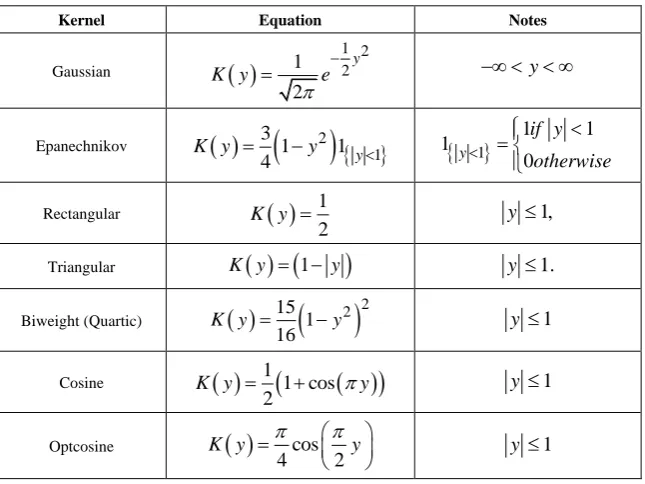
y K y dy2 ( ) 0.Table (1). Kernels under considerations for the kernel density estimation of f (Wolodzko, 2017)
Kernel Equation Notes
Gaussian
1 2 2 1 2 y
K y e
y
Epanechnikov
3
1 2
1
14
y
K y y 1
1 1 10 y if y otherwise
Rectangular
12
K y y 1,
Triangular K y
1 y
y 1.Biweight (Quartic)
2 2 15 1 16
K y y y 1
Cosine
1
1 cos
2
K y y y 1
Optcosine
cos4 2
In practice, there are a lot of popular choices of kernel function K such as: Gaussian, Epanechnikov, Rectangular, Triangular, Biweight, Cosine, Optcosine and others, the focus of attention was on this kernels (Silverman (1986)).
The most commonly kernels used have been considered as in Table (1).
In addition, the bandwidth controls the smoothness of the density estimate and highly influences its appearance. Selecting a suitable h is a pivotal step in estimating f(x).
Supposing that the underlying density is sufficiently smooth and that the kernel has finite fourth moment, by using Taylor series it can be clearly demonstrated that (Sheather (2004)),
2
22 ˆ 2 h h
Bias f x K f x o h
ˆ
1
1,
h
Var f x f x R K o
nh nh
where R K
K2( )y dyAdding the leading variance and squared bias terms produces the asymptotic mean squared error (AMSE) as,
4 2
22
1
ˆ ,
4
h h
A SE f x f x R K K f x
nh
An extensively used choice of an overall measure of the discrepancy between ˆf and f is the mean integrated squared error (MISE), which is defined by,
ˆ
ˆ
2
h h
ISE f E f y f y dy
ˆ
2
ˆ
Bias fh y dy
Var fh y dyUnder an integrability assumption on f , integrating the expression for AMSE gives the expression for the asymptotic mean integrated squared error (AMISE), that is,
4
22
1
ˆ ,
4
h h
A ISE f R K K R f
nh (2) where R f
f
y 2dyIn this way, the value of the bandwidth that minimizes the AMISE is obtained by the following
1/5 1/5 2 2 A ISE R K h nR f K
supposing that f is sufficiently smooth, we can use integration by parts to demonstrate that,
2 4
R f f y dy f y f y dy
Thus, the functional R f
is a measure of the underlying roughness or curvature. In particular, It is clear that the larger the value of R f
is, the larger is the valueof AMISE (i.e., the more difficult it is to estimate f ) and the smaller is the value of hAMISE (i.e., the smaller the
bandwidth needed to capture the curvature in f).
Following, we will briefly review some famous methods for choosing a global value of the bandwidth h,
2.1. Rules of Thumb
The computationally simplest method for choosing a global bandwidth h is based on replacing R f
, the unknown part of hAMISE, by its value for a parametric familyexpressed as a multiple of a scale parameter, which is then estimated from the data. The method seems to date back to Deheuvels, (1977) and Scott, (1979), who each introduced it for histograms. The method was popularized for kernel density estimates by Silverman, 1986, who used the normal distribution as the parametric family.
Let σ and Q denote the standard deviation and interquartile range of X, respectively. Take the kernel K to be the usual Gaussian kernel. Assuming that the underlying distribution is normal, Silverman, 1986showed that (2) reduces to,
1/5
0.9
SROT
h An
where A in s q
, / 1.34 ,
and ,s q are sample standard deviation and sample interquartile range respectively. This rule is commonly used in practice and it is often referred to as Silverman’s rule of thumb.2.2. Cross-Validation Methods
A measure of the closeness of ˆf and f for a given sample is the integrated squared error (ISE), which is defined by Bowman, 1984
ˆ
ˆ
2
h h
ISE f f y f y dy
ˆ
2 ˆ
2
2 .
fh y dy
fh y f y dy
f y dyIt is clear that, the last term on the right-hand side of the previous expression does not involve h. Bowman, 1984 presented choosing the bandwidth as the value of h that minimizes the estimate of the two other terms in the last expression, namely,
2
1 1
1 ˆ 2 ˆ
n
i
n i ii i
f y dy f X
n n
where fˆi
y denotes the kernel estimator constructed from the data without the observation xi. However, themethod is commonly referred to as least squares cross-validation, since it is based on the so-called leave-one-out density estimator fˆi
y .
ˆ 15
hR f R K
nh
where ˆfh is the second derivative of the kernel density estimate (1) and the subscript h denotes the fact that the bandwidth used for this estimate is the same one used to estimate the density f itself. The BCV objective function is thus defined byScott and Terrell, 1987
22
2 1 2
i ji j
X X
K
BCV h R K
nh hn h
Where
c
K
w K w c dw
. We denote the bandwidth that minimizes BCV h
byhBCV. It can be seen that, the above methods are well-known first generation methods for bandwidth selection. These methods were mostly introduced before 1990.Following some of second generation methods, which are introduced after 1990.
2.3. Smoothed Bootstrap
One approach to this method is to consider the bandwidth that is a minimizer of a smoothed bootstrap approximation to the MISE. Early versions of this were presented by Faraway and Jhun, 1990. An interesting feature of this approach is that unlike most bootstrap applications, the MISE in the "bootstrap world can be calculated exactly, instead of requiring the usual simulation step, which makes it as computationally fast as other methods discussed here. Furthermore, the basic idea behind bootstrap smoothing is very simple, we estimate 𝑀𝐼𝑆𝐸(ℎ) by a bootstrap version of the form,
*
2* * ˆ ˆ
ISE h E
fh y fg y dywhere E* denotes the expectation with respect to the bootstrap sample x x1*, *2,...,x*n , g is some pilot bandwidth,
ˆ ( )g
f y is a density estimate which depends on the original sample x x1, 2,...,xn and fˆ ( )h* y is an estimate, based on
* * *
1, 2,..., n
x x x . Then, we choose the value h minimizing
* .
ISE h . The basic differences among the various versions of this bootstrap methodology lie on the choice of the auxiliary window g and on the procedure (smoothed or not) for generating the resampled data x x1*, *2,...,xn*. Here we introduced a smoothed bootstrap procedure (Smoothed bootstrap with pilot bandwidth) which is considered by Faraway and Jhun, 1990 (the bootstrap sample is taken from
ˆ
g
f ) where g is chosen by least-squares cross-validation from x x1, 2,...,xn . These authors do not use an exact expression for ISE*
h . They approximate ISE h*
by resampling; that is, B bootstrap samples are drawn fromˆ
g
f , and ISE h *
is approximated by,
1
*
21 ˆ ˆ
B g h j
j
B ISE h B f y f y dy
Where fˆh j*
y denotes the value of the estimator for the j-th bootstrap sample. The resulting bandwidth h, is defined as the value of h which minimizes B ISE h
.2.4. Plug-in Methods
The slow rate of convergence of LSCV and BCV encouraged much research on faster converging methods. A popular approach, commonly called plug-in methods, is to replace the unknown quantity 𝑅(𝑓′′)in the expression for
A ISE
h given by (2) with an estimate. We next describe the “solve the-equation” plug-in approach developed by Sheather and Jones, 1991, since this method is widely recommended (e.g., Bowman and Azzalini, 1997). The Sheather and Jones, 1991 approach is based on writing g, the pilot bandwidth for the estimate R f
ˆ as a function of h, namely,
( )
1/7 5/7
R f g h C K h
R f
The Sheather–Jones plug-in bandwidth hSJ is the solution
to the above equation.
3. Bivariate Kernel Density Estimation
In the bivariate case the data points are considered by two vectors x1
x11 12 13,x ,x ,...,x1n
and x2
x21,x22,x23,...,x2n
where xi
x1i,x2i
is a sample from a bivariate distribution f. In analogy with the univariate case, the bivariate kernel density estimate is given by the following equation (Bilock et al. (2016))
1 1ˆ
n iH i
x x
f x K
nH H (3)
Here the bandwidth is the positive definite matrix,
11 12 12 22 , h h H h h
and the kernel function K is a symmetric and non negative function fulfilling such that
2
1
R
K y dy .
As in the univariate case the bivariate kernels used in this work have been the Gaussian kernel,
1 12 ,2
y yT
K y e
12
1 1 ,
T
T y y
K y y y
and other bivariate kernels. To evaluate the closeness of a kernel density estimator to the target density an error criteria must be used. A common error estimate for kernel density estimation is the Mean Integrated Square Error (MISE) which is defined by (Bilock et al. (2016)):
ˆ
ˆ
2
H ISE f E f x f x dx
In this case, since the Mean Integrated Square Error depends on the true density f it can only be computed for data sets drawn from known distributions f . The Mean Integrated Square Error can be approximated with the Integrated Mean Square Error IMSE. The expression for the Integrated Mean Square Error IMSE is extracted by moving the expectation value in above equation inside the integral. The IMSE can be computed numerically using Monte Carlo integration, for example. In the bivariate case the plug in method aims to minimize the bivariate AMISE, that is:
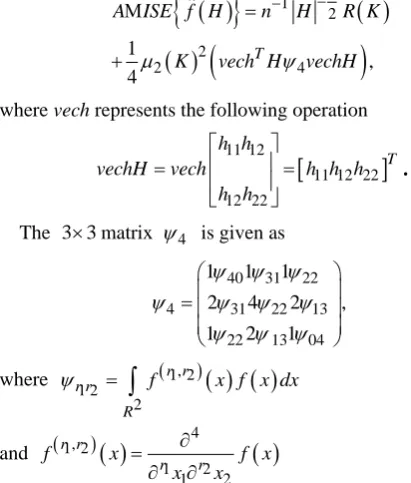
1 1 2 2 2 4 ˆ 1 , 4 TA ISE f H n H R K
K vech H vechH
where vech represents the following operation
11 12
11 12 22 12 22 T h h
vechH vech h h h
h h
.
The 3 3 matrix 4 is given as
40 31 22
4 31 22 13
22 13 04
1 1 1
2 4 2 ,
1 2 1
where 1 2,
1 22
r r r rR
f x f x dx
and
4 , 1 2 1 2 1 2 r r r r
f x f x
x x
is the partial derivatives of x with respect to x1 and x2. Thus, As in the univariate case r r1 2, has to be estimated. A commonly used estimate is
1 2,
2 1 2,
1 1
ˆ ,
n n r r i j
r r G
i j
G n K X X
where
1 G
y
K y K
G G
and G is the pilot bandwidth matrix. In Doung and Hazelton (2003), it is proposed that this matrix should be on the form
2
G g I. Choosing g can be done in a similar way as in
the univariate case. For each entry ,
1 2
r r
in ˆ4 ,
AMSE
g g is chosen such that it minimises the Asymptotic Mean Square Error approximation
2 2
2 1 2 1 2
0 ,
1 2
2 2
1 1 2 1 2 2
2 1 2,2 1 2, 2
ˆ 2 1 0 2
r r r r
r r
r r r r
r r r r
A SE g n g R K
n g K g K
This method may produce 4 matrices that are not positive definite. In that case a minimum to the objective function does not exist. To solve this issue, many researchers such as Doung and Hazelton propose a new approach as opposed to finding one optimal g for each entry in ˆ4 . Instead,
4
SAMSE
g g that minimizes the sum
1 2,
4 1 2
ˆ
r rr r
SAMSE AMSE g
should be calculated and used as a commong for all entries in ˆ4. A closed form expression for g4SAMSE is given in Doung and Hazelton (2003). In analogy with the univariate case, the estimates ofgdepends on r r1 2, and therefore an
easy estimate of ,
1 2
ˆr r
has to be made at some stage (Bilock et al. (2016)).
4. The Proposed Algorithm
The following algorithm steps is performed to achieve our aims
1. Generate the DNA sequence for five organisms, Human, E. coli, Rat, Wheat and Grasshopper with corresponding information in table (2).
Table (2). Relative proportions (%) of Bases in DNA
Organisms A T G C
Human 30.9 29.4 19.9 19.8
E. coli 26.0 23.9 24.9 25.2
Rat 28.6 28.4 21.4 21.5
Wheat 27.3 27.1 22.7 22.8
Grasshopper 29.3 29.3 20.5 20.7
2. The sequence size is n=500 and run size is k=205. 3. Transform DNA sequence to numerical values by
setting one to the base that appears and zero to the other bases.
4. Transform the sequence of numerical values to the corresponding FFT values.
5. An Empirical Study and Results
Discussion
5.1. Univariate Density Estimation
The nonparametric method (kernel density estimation) has been applied of the first, second, third and fourth eigenvalues of variance - covariance matrix of Fast Fourier Transform (FFT) for numerical values representation of DNA sequences of five organisms, Human, E. coli, Rat, Wheat and Grasshopper. It should be noted that it is the first time that the variance covariance matrix eigenvalues of Fast Fourier Transform (FFT) for numerical values representation of DNA sequences, is used in an analysis like this and related analyzes.
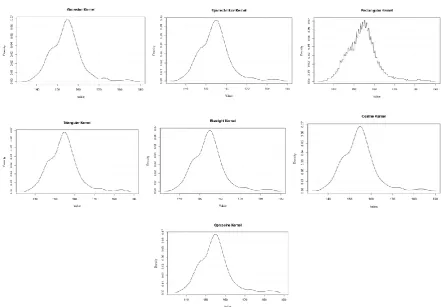
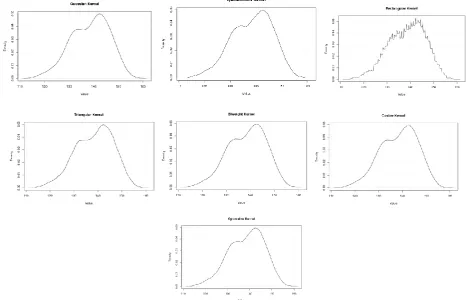
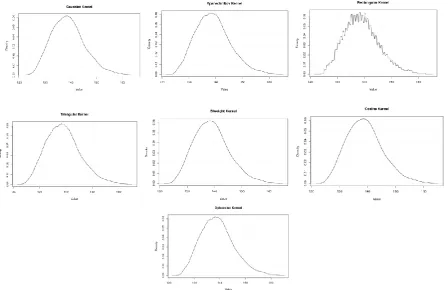
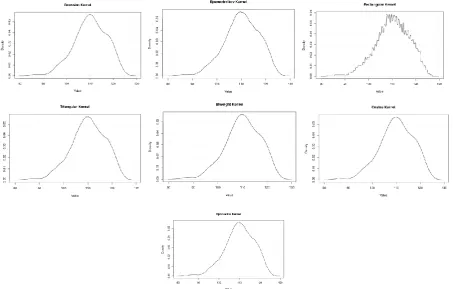
We compute an empirical values for the kernel density estimation for data series according to the following Kernels: Gaussian, Epanechnikov, Rectangular, Triangular, Biweight, Cosine, and Optcosine. The results of simulaion experiment are recorded in variety of tables as may be seen below that is, the results is displayed in a series of images. This section summarizes the results of this work by table (8) in appendix (1) and represented in Figures (12 – 31) in appendix (2).
Table (3). Min Max density (at corresponding x-value) and bandwidth for a kernel among kernels under consideration of the first eigenvalue for each organism
Organism Bandwidth Min
max x-value Kernel
Human 1.85671 0.06740 154.88260 Optcosine Grasshopper 1.97662 0.06025 151.28073 Biweight
E-Coli 1.93667 0.06154 138.54199 Biweight Rat 2.55799 0.04759 147.27848 Triangular
Wheat 2.11323 0.05259 146.07245 Cosine
Table (4). Min Max density (at corresponding x-value) and bandwidth for a kernel among kernels under consideration of the second eigenvalue for each organism
Organism Bandwidth Min
max x-value Kernel
Human 2.16573 0.05499 141.80183 Epanechnikov Grasshopper 2.35564 0.04921 142.70795 Epanechnikov E-Coli 1.28408 0.09281 130.25672 Triangular
Rat 2.40422 0.04378 134.74596 Biweight Wheat 1.72088 0.06842 128.31104 Gaussian
Table (5). Min Max density (at corresponding x-value) and bandwidth for a kernel among kernels under consideration of the third eigenvalue for each organism
Organism Bandwidth Min
max x-value Kernel
Human 1.85671 0.06343 106.89360 Epanechnikov Grasshopper 2.29603 0.05181 108.56873 Cosine
E-Coli 1.39526 0.08385 122.81705 Optcosine Rat 2.01501 0.06203 115.36226 Epanechnikov
Wheat 1.39526 0.08040 118.20472 Gaussian
Table (6). Min Max density (at corresponding x-value) and bandwidth for a kernel among kernels under consideration of the fourth eigenvalue for each organism
Organism Bandwidth Min
max x-value Kernel
Human 1.85671 0.06863 97.64718 Optcosine Grasshopper 1.86035 0.06063 97.56647 Epanechnikov
E-Coli 2.15815 0.05620 109.65297 Epanechnikov
Rat 2.32544 0.05368 104.59309 Gaussian Wheat 1.95486 0.06345 109.84217 Cosine
Tables (3 - 6) shows an optimal kernel estimation among kernels under considerations, which are commonly used for these purposes worldwide.
5.2. Bivariate Density Estimation
The bivariate kernel density estimation has been applied of the first and second eigenvalues from a side and the first and fourth eigenvalues from another side. These eigenvalues of variance covariance matrix of Fast Fourier Transform for numerical values representation of DNA sequences of five organisms, Human, E. coli, Rat, Wheat and Grasshopper.
Table (7) contain the results referred to below.
Table (7). Empirical values for the Bandwidth and Correlation used in KDE of each of five organisms
Organism
First and Second Eigenvalues First and Fourth Eigenvalues
x-axis Bandwidth
y-axis
Bandwidth Correlation
x-axis Bandwidth
y-axis
Bandwidth Correlation
Human 1.85392 2.66480 -0.06517 1.85392 1.97014 -0.57761 Grasshopper 2.41621 2.47512 0.05680 2.41621 2.46776 -0.49434
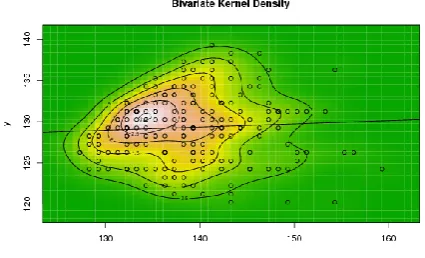
Figure 2. Plot of bivariate kernel density for Human according to first and second eigenvalues
Figure 3. Plot of bivariate kernel density for Human according to first and fourth eigenvalues
Figure 4. Plot of bivariate kernel density for Grasshopper according to first and second eigenvalues
Figure 5. Plot of bivariate kernel density for Grasshopper according to first and fourth eigenvalues
Figure 6. Plot of bivariate kernel density for E-Coli according to first and second eigenvalues
Figure 7. Plot of bivariate kernel density for E-Coli according to first and fourth eigenvalues
Figure 8. Plot of bivariate kernel density for Rat according to first and second eigenvalues
Figure 10. Plot of bivariate kernel density for Wheat according to first and second eigenvalues
Figure 11. Plot of bivariate kernel density for Wheat according to first and fourth eigenvalues
The results in table (7) and plots will be crucial to determine DNA afiliation.
6. Summary
One of important properties of FFT, which is return the variations to their original sources help us tremendously to understand, discriminant and deal with DNA sequences.
Probability behavior of DNA data, represented by the density estimation, is very important. The references stated here, highlights some aspects of that importance.
Univariate density estimation is fitted for first, second, third and fourth eigenvalues of variance covariance matrix of Fast Fourier Transform for numerical values representation of DNA sequences of five organisms, Human, E. coli, Rat, Wheat and Grasshopper.
Bivariate density estimation is fitted for first and second eigenvalues from a side and first and fourth eigenvalues from another side. We treat here with first and second eigenvalues from a side and first and fourth eigenvalues from another side because we think that the relations between them are more interactive than others. These eigenvalues of variance covariance matrix of Fast Fourier Transform for numerical values representation of DNA sequences of five organisms, Human, E. coli, Rat, Wheat and Grasshopper.
The methods used here are aimed to discriminant among different organisms using another point of view. This point of view is based on eigenvalues of variance covariance matrix of FFT for numerical values representation of DNA sequences. It should be noted that, it is the first time this point of view is used to achieve aims like ours.
Empirical studies are conducted to show the value of our point of view and the applications based on. So we recommended that,
(1) Other empirical studies should be done for other organisms and statistical methods by using the point of view adopted here.
(2) Aspects stated here must be used in an applied manner for DNA sequences discrimination.
Appendix (1)
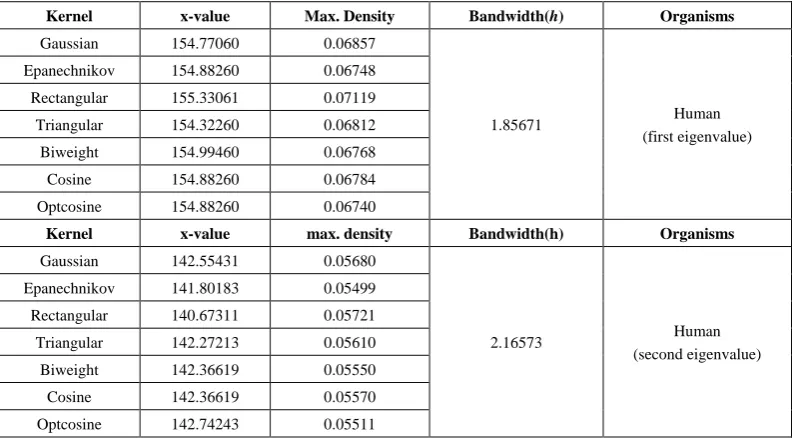
Table (A.1). Empirical values of maximum density and bandwidth for the (first, second, third and fourth) eigenvalues of each of five organisms
Kernel x-value Max. Density Bandwidth(h) Organisms
Gaussian 154.77060 0.06857
1.85671 Human
(first eigenvalue) Epanechnikov 154.88260 0.06748
Rectangular 155.33061 0.07119
Triangular 154.32260 0.06812
Biweight 154.99460 0.06768
Cosine 154.88260 0.06784
Optcosine 154.88260 0.06740
Kernel x-value max. density Bandwidth(h) Organisms
Gaussian 142.55431 0.05680
2.16573 Human
(second eigenvalue) Epanechnikov 141.80183 0.05499
Rectangular 140.67311 0.05721 Triangular 142.27213 0.05610
Biweight 142.36619 0.05550
Cosine 142.36619 0.05570
Kernel x-value max. density Bandwidth(h) Organisms
Gaussian 106.63408 0.06423
1.85671 Human
(third eigenvalue) Epanechnikov 106.89360 0.06343
Rectangular 107.23964 0.06825
Triangular 106.20153 0.06488
Biweight 106.98011 0.06344
Cosine 106.72059 0.06361
Optcosine 107.15313 0.06348
Kernel x-value max. density Bandwidth(h) Organisms
Gaussian 97.84765 0.06978
1.85671 Human
(fourth eigenvalue) Epanechnikov 97.64718 0.06865
Rectangular 97.24624 0.07204 Triangular 98.14836 0.06965
Biweight 97.74742 0.06880
Cosine 97.74742 0.06897
Optcosine 97.64718 0.06863
Kernel x-value max. density Bandwidth(h) Organisms
Gaussian 151.28073 0.06032
1.97662 Grasshopper
(first eigenvalue) Epanechnikov 151.38825 0.06048
Rectangular 151.17320 0.06115 Triangular 151.28073 0.06053
Biweight 151.28073 0.06025
Cosine 151.28073 0.06026
Optcosine 151.38825 0.06048
Kernel x-value max. density Bandwidth(h) Organisms
Gaussian 142.41320 0.04975
2.35564 Grasshopper
(second eigenvalue) Epanechnikov 142.70795 0.04921
Rectangular 142.31495 0.05294 Triangular 142.31495 0.04973
Biweight 142.60970 0.04933
Cosine 142.51145 0.04937
Optcosine 142.41320 0.04930
Kernel x-value max. density Bandwidth(h) Organisms
Gaussian 108.77560 0.05200
2.29603 Grasshopper
(third eigenvalue) Epanechnikov 108.36187 0.05199
Rectangular 107.53440 0.05450
Triangular 108.25843 0.05212
Biweight 108.46530 0.05182
Cosine 108.56873 0.05181
Optcosine 108.25843 0.05201
Kernel x-value max. density Bandwidth(h) Organisms
Gaussian 97.47599 0.06161
1.86035 Grasshopper
(fourth eigenvalue) Epanechnikov 97.56647 0.06063
Rectangular 97.20457 0.06494
Triangular 97.20457 0.06210
Biweight 97.38552 0.06075
Cosine 97.56647 0.06089
Kernel x-value max. density Bandwidth(h) Organisms
Gaussian 138.45650 0.06199
1.93667 E-Coli
(first eigenvalue) Epanechnikov 138.20004 0.06173
Rectangular 138.20004 0.06461
Triangular 138.28552 0.06231
Biweight 138.54199 0.06154
Cosine 138.54199 0.06163
Optcosine 138.20004 0.06175
Kernel x-value max. density Bandwidth(h) Organisms
Gaussian 129.99505 0.09295
1.28408 E-Coli
(second eigenvalue) Epanechnikov 129.89038 0.09363
Rectangular 130.20438 0.10188 Triangular 130.25672 0.09281
Biweight 129.99505 0.09310
Cosine 130.04738 0.09301
Optcosine 129.89038 0.09353
Kernel x-value max. density Bandwidth(h) Organisms
Gaussian 123.42334 0.08471
1.39526 E-Coli
(third eigenvalue) Epanechnikov 122.81705 0.08420
Rectangular 121.87394 0.08663 Triangular 123.28861 0.08651
Biweight 123.22124 0.08399
Cosine 123.28861 0.08409
Optcosine 122.81705 0.08385
Kernel x-value max. density Bandwidth(h) Organisms
Gaussian 110.04454 0.05686
2.15815 E-Coli
(fourth eigenvalue) Epanechnikov 109.65297 0.05620
Rectangular 107.59723 0.05864 Triangular 110.14243 0.05663
Biweight 109.84876 0.05632
Cosine 109.84876 0.05642
Optcosine 109.65297 0.05634
Kernel x-value max. density Bandwidth(h) Organisms
Gaussian 147.12883 0.04778
2.55799 Rat
(first eigenvalue) Epanechnikov 146.97918 0.04774
Rectangular 147.12883 0.04892
Triangular 147.27848 0.04759
Biweight 146.97918 0.04772
Cosine 146.97918 0.04770
Optcosine 146.82954 0.04779
Kernel x-value max. density Bandwidth(h) Organisms
Gaussian 135.18831 0.04419
2.40422 Rat
(second eigenvalue) Epanechnikov 133.30834 0.04387
Rectangular 132.31306 0.04850
Triangular 134.30362 0.04434
Biweight 134.74596 0.04378
Cosine 134.96713 0.04386
Kernel x-value max. density Bandwidth(h) Organisms
Gaussian 116.33431 0.06344
2.01501 Rat
(third eigenvalue) Epanechnikov 115.36226 0.06203
Rectangular 114.74368 0.06576
Triangular 116.15757 0.06259
Biweight 115.89247 0.06229
Cosine 116.15757 0.06249
Optcosine 116.06921 0.06204
Kernel x-value max. density Bandwidth(h) Organisms
Gaussian 104.59309 0.05368
2.32544 Rat
(fourth eigenvalue) Epanechnikov 104.80065 0.05447
Rectangular 104.48931 0.05564 Triangular 105.21576 0.05373
Biweight 104.69687 0.05410
Cosine 104.69687 0.05398
Optcosine 105.00821 0.05425
Kernel x-value max. density Bandwidth(h) Organisms
Gaussian 145.52356 0.05280
2.11323 Wheat
(first eigenvalue) Epanechnikov 146.25542 0.05280
Rectangular 141.77278 0.05921 Triangular 145.34059 0.05298
Biweight 146.16393 0.05262
Cosine 146.07245 0.05259
Optcosine 145.88949 0.052707
Kernel x-value max. density Bandwidth(h) Organisms
Gaussian 128.31104 0.06842
1.72088 Wheat
(second eigenvalue) Epanechnikov 128.74993 0.06928
Rectangular 128.67678 0.07106 Triangular 128.23789 0.06893
Biweight 128.89623 0.06864
Cosine 128.53048 0.06856
Optcosine 128.74993 0.06918
Kernel x-value max. density Bandwidth(h) Organisms
Gaussian 118.20472 0.08040
1.39526 Wheat
(third eigenvalue) Epanechnikov 118.71227 0.08186
Rectangular 118.90260 0.08459
Triangular 119.21982 0.08108
Biweight 118.45850 0.08089
Cosine 118.39505 0.08072
Optcosine 118.64883 0.08143
Kernel x-value max. density Bandwidth(h) Organisms
Gaussian 109.57330 0.06352
1.95486 Wheat
(fourth eigenvalue) Epanechnikov 110.02142 0.06382
Rectangular 108.94594 0.06619
Triangular 110.20066 0.06380
Biweight 109.84217 0.06356
Cosine 109.84217 0.06345
Appendix (2)
Figure A.1. Kernel density estimation plots for the first eigenvalue of Human according to Gaussian, Epanechnikov, Rectangular, Triangular, Biweight, Cosine, and Optcosine kernels
Figure A.3. Kernel density estimation plots for the third eigenvalue of Human according to Gaussian, Epanechnikov, Rectangular, Triangular, Biweight, Cosine, and Optcosine kernels
Figure A.5. Kernel density estimation plots for the first eigenvalue of Grasshopper according to Gaussian, Epanechnikov, Rectangular, Triangular, Biweight, Cosine, and Optcosine kernels
Figure A.7. Kernel density estimation plots for the third eigenvalue of Grasshopper according to Gaussian, Epanechnikov, Rectangular, Triangular, Biweight, Cosine, and Optcosine kernels
Figure A.9. Kernel density estimation plots for the first eigenvalue of E-Coli according to Gaussian, Epanechnikov, Rectangular, Triangular, Biweight, Cosine, and Optcosine kernels
Figure A.11. Kernel density estimation plots for the third eigenvalue of E-Coli according to Gaussian, Epanechnikov, Rectangular, Triangular, Biweight, Cosine, and Optcosine kernels
Figure A.13. Kernel density estimation plots for the first eigenvalue of Rat according to Gaussian, Epanechnikov, Rectangular, Triangular, Biweight, Cosine, and Optcosine kernels
Figure A.15. Kernel density estimation plots for the third eigenvalue of Rat according to Gaussian, Epanechnikov, Rectangular, Triangular, Biweight, Cosine, and Optcosine kernels
Figure A.17. Kernel density estimation plots for the first eigenvalue of Wheat according to Gaussian, Epanechnikov, Rectangular, Triangular, Biweight, Cosine, and Optcosine kernels
Figure A.19. Kernel density estimation plots for the third eigenvalue of Wheat according to Gaussian, Epanechnikov, Rectangular, Triangular, Biweight, Cosine, and Optcosine kernels
REFERENCES
[1] Andre´s Ferreyra, R., Podesta´, G.P., Messina, C.D., Letson, D., Dardanelli, J., Guevara, E., et al. (2001) “A linked-Modeling Framework to Estimate Maize Production Risk Associated with Enso-related Climate Variability in Argentina”, Agricultural and Forest Meteorology, Vol. 107, No. 3, PP. 177–192.
[2] Bae, W. and Kim, C. (2008) “A simple Segmentation Method for DNA Microarray Spots by Kernel Density Estimation”, 30, PP. 223–234, DOI 10.1007/s00291-007-0091-6.
[3] Bajic, V., Bajic, I. and Hide, W. (2000) “A new Method of Spectral Analysis of DNA/RNA and Protein sequences” Centre for Engineering Research.
[4] Bilock, A., Jidling, C. and Rydin, Y. (2016) “Modelling Bivariate Distributions Using Kernel Density Estimation”, Project in Computational Science, Department of information technology.
[5] Bosman, P.A. and Thierens, D. (2000) “Ideas Based on the Normal Kernels Probability Density Function”, Technical Report 11, Department of Computer Science, Utrecht University, The Netherlands.
[6] Bowman, A. (1984) "An alternative method of cross-validation for the smoothing of density estimates", Biometrika, Vol.71, PP. 353–360.
[7] Bowman, A.W. and Azzalini, A. (1997) “Applied Smoothing Techniques for Data Analysis”, Oxford University Press, Oxford, UK.
[8] Colbrook, M., Botev, Z.I., Kuritz, K. and MacNamara, S. (2018) “Kernel Density Estimation with Linked Boundary Conditions”, arXiv:1809.07735v1 [math.ST] 20, PP. 1-50. [9] Corti, S., Molteni, F. and Palmer, T. (1999) “Signature of
Recent Climate Change in Frequencies of Natural Atmospheric Circulation Regimes”, Nature, Vol. 398, No. 6730, PP. 799–802.
[10] Deheuvels, P. (1977) "Estimation Nonparamétrique de la Densité Par Histogrammes Generalizes", Rev. Statist. Appl., Vol. 25, PP. 5–42.
[11] Doung, T. and Hazelton, M. (2003) “Plug-In Bandwidth Matrices for Bivariate Kernel Density Estimation, Nonparametric Statistics”.
[12] Eisenberg, D., Weiss, R.M., Terwillger, T.C., (1994) “The Hydrophobic Moment Detects Periodicity in Protein Hydrophobicity”. Proc. Natl. Acad. Sci., Vol. 81, PP. 140–144.
[13] Fan, J., Feng, Y. and Niu, Y.S.(2010) “Nonparametric Estimation of Genewise Variance for Microarray Data”, NIH Public Access, Vol. 38, No. 5, PP. 2723–2750, doi:10.1214/10-AOS802.
[14] Faraway, J. and Jhun, M. (1990) "Bootstrap choice of bandwidth for density estimation", J. Amer. Statist. Assoc., Vol. 85, PP.1119-1122.
[15] Galleani, L. and Garello, R. (2006) “Spectral Analysis of DNA Sequences by Entropy Minimization”, 14th European
Signal Processing Conference (EUSIPCO 2006), Florence, Italy, September, PP. 4-8.
[16] Hall, P. (1982) “Comparison of two orthogonal series methods of estimating a density and its derivatives on interval”, Journal of Multivariate Analysis, Vol. 12, No. 3, PP. 432–449.
[17] Han, Y., Han, L., Yao,Y., Li, Y. and Liu, X. (2018) “Key Factors in FTIR Spectroscopic Analysis of DNA: The Sampling Technique, Pretreatment Temperature and Sample Concentration”, Analytical Methods, Issue Vol. 21, No. 10, PP. 2436-2443.
[18] Hoang, T., Yin, C., Zheng, H. Yu, C., Lucy He, R. and Yau, S. (2015) “A new Method to Cluster DNA Sequences Using Fourier Power Spectrum”, J Theor Biol. 7; 372:135-45. [19] Jones, M. C., Marron, J. S. and Sheather, S. J. (1996) “A brief
Survey of Bandwidth Selection for Density Estimation”, Journal of the American Statistical Association, Vol. 91, No. 433, PP. 401–407.
[20] Li, Y., Wang, N., Hong, M., Turner, N.D., Luption, J.R. and Carroll, R.J. (2007) “Nonparametric Estimation of Correlation Functions in Longitudinal and Spatial Data, with Application to Colon Carcinogenesis Experiments”, University of Georgia and Texas A&M University, The Annals of Statistics, Vol. 35, No. 4, PP. 1608–1643. [21] Lopez-Novoa, U., Sa´enz, J., Mendiburu, A. and
Miguel-Alonso, J. (2015) “An efficient implementation of kernel density estimation for multi-core and many-core architectures”, The International Journal of High Performance Computing Applications, PP 1-17.
[22] Mabrouk, M. (2017) “Advanced Genomic Signal Processing Methods in DNA Mapping Schemes for Gene Prediction Using Digital Filters”, American Journal of Signal Processing, Vol. 7, No. 1, PP. 12-24.
[23] Marhon, S. and Kremer, S. (2011) “Gene Prediction Based on DNA Spectral Analysis: A literature Review”, J Comput Biol., Apr, Vol. 18, No. 4, 639-76.
[24] McLachlan, A. and Stewart, M. (1976) “The 14-fold Periodicity in Alpha-Tropomyosin and the Interaction with Actin”, J. Mol. Biol., Vol. 103, PP. 271–298.
[25] Oja, H. (1981) “On Location, Scale, Skewness and Kurtosis of Univariate Distribution”, Scandinavian Journal of Statistics, Vol. 8, No.2, PP. 164–168.
[26] Polovinkina, A., Krylova, I., Druzhkova, P., Ivanchenkoa, M., Meyerova, I., Zaikina, A., and Zolotykha, N. (2016) “Solving Problems of Clustering and Classification of Cancer Diseases Based on DNA Methylation”, Data Pattern Recognition and Image Analysis, Vol. 26, No. 1, PP. 176–180.
[27] Roy, M. and Barman, S. (2011) “Spectral Analysis of Coding and Non-coding Regions of a DNA Sequence by Parametric and Nonparametric Methods: A comparative Approach”, Annals of Faculty Engineering Hunedoara– International Journal of Engineering; Tome IX; Faccicule 3; PP. 57-62. [28] Ruiz, G., Israel, Godínez, I., Ramos, S., Ruiz, S., Pérez, H.
and Morales, J. (2018) “Genomic Signal Processing for DNA Sequence Clustering” PeerJ v.6; DOI 10.7717/peerj.4264. [29] Scott, D. (1979) "On optimal and data-based histograms",
[30] Scott, D. and Terrell, G. (1987) "Biased and unbiased cross-validation in density estimation", J. Amer. Statist. Assoc., Vol. 82, PP.1131–1146.
[31] Sheather, S. and Jones, M. (1991) "A reliable Data-based Bandwidth Selection Method for Kernel Density Estimation", J. Roy. Statist. Soc. Ser.B, Vol. 53, PP. 683-690.
[32] Sheather, S. (2004) "Density Estimation", Statistical Science, Vol. 19, No 4, PP. 588-597.
[33] Silverman, B. (1986) "Density Estimation for Statistics and Data Analysis", Chapman and Hall, London.
[34] Stoffer, D., Tyler, D. and McDougall, A. (1993) “Spectral Analysis for Categorical Time Series: Scaling and the Spectral Envelope”; Biometrika, Vol. 80, PP. 611–622. [35] Stoffer, D. (2012) “Frequency Domain Techniques in the
Analysis of DNA Sequences”, Handbook of Statistics Volume 30, PP. 261-295.
[36] Tavar´e, S., Giddings, B. (1989) “Some Statistical Aspects of the Primary Structure of Nucleotide Sequences”, In Waterman M.S. (Ed), Mathematical Methods for DNA Sequences. CRC Press, Boca Raton, Florida, PP. 117–131.
[37] Troudi, M., Alimi, A.M. and Saoudi, S. (2008) “Analytical Plug-InMethod for Kernel Density Estimator Applied to Genetic Neutrality Study”, Hindawi Publishing Corporation, EURASIP Journal on Advances in Signal Processing, Article ID 739082, 8 pages, doi :10.1155/2008/739082.
[38] Viari, A., Soldano, H. and Ollivier, E. (1990) “A Scale-independent Signal Processing Method for Sequence Analysis. Comput. Appl. Biosci., Vol. 6, PP. 71–80. [39] Waterman, M. and Vingron, M. (1994) “Sequence
Comparison Significance and Poisson Approximation”, Stat. Sci., Vol. 9, PP. 367–381.
[40] Weyenberg, G., Huggins, P.M., Schardl, C.L., Howe, D.K. and Yoshida, R. (2014) “Non parametric Estimation of Phylogenetic Tree Distributions”, Original Paper , Vol. 30, No. 16, PP. 2280–2287, doi:10.1093/bioinformatics/btu258. [41] Wolodzko, T. (2017) “Smoothed Bootstrap and Random