Available Online at www.ijpret.com 104
INTERNATIONAL JOURNAL OF PURE AND
APPLIED RESEARCH IN ENGINEERING AND
TECHNOLOGY
A PATH FOR HORIZING YOUR INNOVATIVE WORK
MULTI-STOREY BUILDING AUTOMATION USING ENERGY EFFICIENT
WIRELESS SENSOR NETWORK
MRS. JYOTI G. JADHAO1, PROF. J. R. PANCHAL 2
1. Student, Siddhant College of Engineering, Sudumbare, Pune, Maharashtra INDIA. 2. Professor, Siddhant College of Engineering, Sudumbare, Pune, Maharashtra INDIA.
Accepted Date: 05/03/2015; Published Date: 01/05/2015
\
Abstract: Multi-storey building automation using Wireless Sensor Network (WSN) mainly
consist of hundreds of sensor nodes. Building Automation Systems are centralized, interlinked, which monitor and control the various parameters like temperature, vibrations from earthquake, gas leakage, door status, fire etc. Also the automation system ensures the operational performance of the facility as well as the comfort and safety of building occupants. As the various parameters are measure by the sensor network and in case of any abnormal condition then SMS is sent to the respective flat owner and same information send to the control room through Zigbee. At control room the received information is displayed on LCD also the buzzer is ON, so that security understands what the condition of the flats is.
Keywords: WSN, Automation, Centralized, Networks, Parameters, Safety.
Corresponding Author: MRS. JYOTI G. JADHAO
Access Online On:
www.ijpret.com
How to Cite This Article:
Available Online at www.ijpret.com 105
INTRODUCTION
Now a day there is multi-storey building automation system is very necessary for security and comfort life. Because people want comfort and secure life with an intelligent living spaces equipped with building automation system. So there is increasing the demand for building monitoring products rapidly. The traditional home automation or building monitoring systems use wired connection. However the implementation of these systems requires cable installation at the same time when constructing building. This is inconvenient for users, because when their houses have been built, few of them accept wired solutions because the installation of new cable system can destruct the original home interior decoration. Recent development of wireless technologies has innovated home automation field.
Minh-Thanh Vo [1] design and implemented a WSN for International University (IU) building consisting of more than 30 sensor nodes and the one coordinator node. Rajesh Banala [2] the intelligent remote monitoring system was developed for home security based on ZigBee technology and GSM network. The system can send abnormal images and warning messages through MMS and SMS and receive remote instruction, and can monitor household appliances.
The ZigBee based controlling and monitoring system in multi-storey smart building consists of three main parts: multi-storey building control and monitoring network, gateway node, and the internal remote control for controlling. Zigbee communication protocol built on IEEE 802.15.4 wireless communication standard.
The structured of this paper is as follows: in Section II, Overview of ZigBee Communication is described. Section III describes the need of building automation system, section IV gives the overview of the building automation system briefly. Finally, a conclusion is drawn in V.
I.ZIGBEE COMMUNICATION
Available Online at www.ijpret.com 106
II.NEED OF BUILDING AUTOMATION SYSTEM
Now a days the world is a happening ground for the disasters frequently. These incidents of mass destruction irrespective of the whether natural calamities or man-made catastrophes cause a huge loss of money, property and lives due to unplanning on the part of the governments and the management agencies. Ex. such as the New York 9/11 incident, 2004 South Asia tsunami, and 2012 earthquake in Japan provides strong evidences for such hazards. Therefore steps are required to be taken towards the prevention of these situations by pre determining the causes of these disasters and providing quick rescue measures once the disaster occurs.
Wireless sensor networks are playing a vital role in wireless data transmission infrastructure and can be very helpful in these situations. Wireless sensor networks utilize the technologies which can cause an alert for the immediate rescue operation to begin, whenever this disaster is struck to multi-storey building. For managing disaster using wireless sensor networks (WSN) via disaster detection and alerting system, and search and rescue operations. Building automation using Wireless Sensor Network in which maximizing network lifetime is a key challenge.
IV.BUILDING AUTOMATION SYSTEM
Multi-storey buildings are subjected to natural hazards such as severe earthquakes and strong winds, as well as manmade hazards such as fire, crime, and terrorism, during their long-term use. To mitigate these hazards, monitoring various risks in a building employing an intelligent sensor network is necessary. The sensor network could measure vibrations, gas leakage, temperature etc.
According to the risk monitoring results, appropriate risk control measures (e.g., structural control, maintenance, evacuation guidance, warnings, alarms, fire fighting, rescue, security measures, etc.) can be applied.
A.FLOW DIAGRAM OF THE SYSTEM
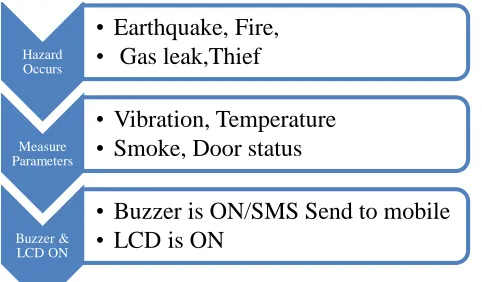
The building automation system mainly consists of temperature sensor, vibration sensor, fire detection sensor, gas leakage detection sensor and door status sensor.
Available Online at www.ijpret.com 107 showing the particular message. If the peoples are in the remote place then SMS is send via mobile and internet network.
Fig 1: Flow Diagram for Building Automation
B.ZIGBEE WIRELESS SENSOR NETWORK
Multi-storey building automation mainly consists of various nodes such as co-ordinator node, router node, end-device node and sensor nodes. . Sensor node mainly consists of smart sensors, signal conditioner, the PIC microcontroller, display unit, buzzer and power supply unit.
Co-ordinator node:
The main function of the co-ordinator node is forming and maintaining the network. Co-ordinator node is responsible for overall network management. The main function of the co-ordinator node is to start the network, assign address to each node or router, holds the list of neighbours and routers and transfers the application packets.
It consists of a microcontroller, 16*2 LCD, buzzer,RS-232 unit, power supply unit, a zigbee module to communicate with the sensor node.
a) RS-232 Unit - The serial communication is used between the coordinator node and the computer.
b) Zigbee Module- The wireless zigbee module is connected to the port C of the PIC and UART
protocol has been used for transmitting and receiving the information. Co-ordinator node sends the commands from the PC unit and takes the status of the sensors to be monitored in the main control program of the sensor node.
c) I/O devices- These are the devices which perform the orders given by the microcontroller or
display the results through appropriate interfaces. Hazard
Occurs
• Earthquake, Fire, • Gas leak,Thief
Measure Parameters
• Vibration, Temperature • Smoke, Door status
Buzzer & LCD ON
Available Online at www.ijpret.com 108
d) Buzzer - is used to indicate the alert conditions.
e) Microcontroller - PIC16F452 is used due to its on-chip UART facility which enables serial communication to and from the computer. It is responsible for processing the input information and applying the requests that come from the coordinator node.
f) Power supply - The power supply unit depends on the power requirement of microcontroller
and other components used.
Router Node:
The main function of the router node is routing and receiving the message. i.e. to communicate between two devices. It is mainly used for increasing the coverage of the network. The main functions of the routers are packet forwarding, packet switching and packet filtering. Routers are work in the network layer. It is mainly used to find the best route to the destination over which the message is transferred.
End-device node:
The main function of the end device node is wake up when want to transmit the data otherwise it is in the sleep mode. i.e. it consume the power only when transmitting the information. So that sensor node can connect or leaves the network when end device node wakes up so that energy consumption takes place.
Sensor node:
Sensor nodes are mainly used for sensing the information. The general block diagram of sensor node is shown in Fig.2. Sensor node consists of smart sensors, signal conditioner, the PIC microcontroller, display unit i.e. LCD, buzzer and power supply unit. Also, for the wireless communication the Zigbee module is employed. In multi-storey building, we monitor all these parameters i.e. temperature, gas leakage, fire detection, vibration and door status of each flat and its surrounding area. So, the gas leak detection, fire detection and door status placed on each flat and vibration sensor for earthquake monitoring and temperature sensor placed inside the building. The centralized node i.e. coordinator node is placed at the center of the building. The Buzzer and LCD are located on each floor of the building to monitor the overall parameters.
Available Online at www.ijpret.com 109 obtained from the structural behavior as well as the actual condition inside the multi-storey building.
a)Microcontroller – PIC16F452 is chosen due to its some specification as follows: It having low
cost, wide availability, in-built 10 bit ADC, 33 I/O, powerful interrupt structure, Harvard architecture, on-chip UART, ISP and SPI facility, serial programming (and re-programming with flash memory) capability.
Fig.2 Block Diagram of the Sensor Node
b) Sensors Used: There are five types of sensors are used in Sensor node as follows:
1) Temperature Sensor:
Temperature sensor LM35 is mainly used for detection of temperature. It is having the range of
−55°C to +150°C and can operates from 4 V to 30 V.
2) Vibration Sensor:
Vibration sensor used in this system is ADXL335 Accelerometer. It is mainly used for measuring strong vibrations. The ADXL335 is a small, low power, 3-axis accelerometer with signal conditioned voltage outputs. This accelerometer measures acceleration with a minimum full-scale range of ±3 g. It can measure the static acceleration of gravity in tilt-sensing applications, as well as dynamic acceleration resulting from motion or vibration.
3) Fire Detector:
Available Online at www.ijpret.com 110
4) Gas Leakage:
A gas leakage sensor used here is MQ-5 for sensing the gas, which is highly sensitive to the natural gas, LPG gas and town gas. This sensor is smaller sensitive to alcohol and cigarette smoke. It having the simple driving circuit. This MQ-5 sensor having 6 pin ,4 of them are used to fetch signals, and other 2 are used for providing heating current.
5) Door Status Sensor:
Door status sensor is mainly used for theft assurance. Here the door status sensor used is MS-1 i.e. Magnetic Door Switch. This sensor offers a low-cost method to monitor the status of the doors that should remain closed. The noncontact magnetic switch mounts to the door of a server rack and connects to a Goose climate monitor. The sensor consists of two main parts, a magnet and a switch with terminals to connect the signal wires. The magnet mounts to a door or access panel, while the switch mounts to the frame. When the door is closed the two pieces should be within 1/2” of each other. When the door opens this distance increases, eventually toggling the switch. This allows the Goose to know when the door is open.
c) Zigbee Module:
Zigbee module is mainly used for transmitting the information wirelessly. Here module used is CC 2431. It is having 2.4 GHz IEEE 802.15.4 systems. Mainly used for Home/building automation, Industrial Control and Monitoring and having low power wireless sensor networks. The CC2431 combines the excellent performance of the leading CC2420 RF transceiver with an industry-standard enhanced 8051 MCU, 8 KB RAM, 128 KB flash memory and many other powerful features.
V.CONCLUSION
Available Online at www.ijpret.com 111
REFERENCES
1. Minh-Thanh Vo, Van-Su Tran, Tuan-Duc Nguyen, Huu-Tue Huynh, “Wireless Sensor Network For Multi-Storey Building: Design and Implementation,” IEEE 2013,978-1-4673-2088-7/13/ 2013
2. Rajesh Banala, D. Upender, “Remote Home Security System Based on Wireless Sensor Network Using NS2,” international Journal of Computer Science and Electronics Engineering ISSN.0975-5664, Vol. 2 Issue 2, December 2012
3. Mircea Ionel Strutu, Dan Popescu, “Indoor Monitoring Applications Using Fixed and Mobile Wireless Sensors” International Journal of Computing, Vol. 10, Issue 4, 373-382, 2011
4. Renjan Raj V.C, “Vision Wireless Sensor Network for Building Monitoring”, The International Journal Of Engineering And Science, Volume 3, Issue 3, Pages 13-18, 2014.
5. D. Culler, D. Estrin, and M. Srivastava, “Overview of sensor networks,” IEEE Computer Magazine, pp. 41–49, 2004.