A study to evaluate effectiveness of structured teaching programme
regarding Needle Stick Injury among first year B.Sc Nursing students in
selected colleges at Ernakulam District
1 Prof Dr. Sindhu Devi M., 2 Mrs. Reshmi R. S.
1 Principal, Obstetrics and Gynecological Nursing, Sree Sudheendra College of Nursing 2 Assistant professor, Commmunity Health Nursing, Sree Sudheendra College of Nursing
1 , 2 Ambalamedu, Ernakulam, Kerala
Email - [email protected]
1. INTRODUCTION:
A needle stick injury is a percutaneous piercing wound typically set by a needle point, but possibly also by other sharp instruments or objects, commonly encountered by people handling needles in the medical setting, such injuries is an Occupational Hazard in the medical community. These events are of concern because of the risk to transmit Blood-Borne diseases through the passage of the Hepatitis B virus (HBV), the Hepatitis C virus (HCV), and the Human Immunodeficiency virus (HIV), the virus which causes AIDS. Despite their seriousness as a medical event, needle sticks injuries have been neglected, most go unreported. Needle sticks have been recognized as occupational hazards.33
Needle stick injuries are a common event in the healthcare environment. When drawing blood, administering an intramuscular or intravenous drug, or performing other procedures involving sharps, the needle can slip and injure the healthcare worker. This sets the stage to transmit viruses from the source person to the recipient. These injuries also
Abstract:
Apre experimental one group pre-test post-test design was undertaken to evaluate the effectiveness of STP on knowledge regarding needle stick injury among first year B Sc nursing student in selected Colleges of nursing at Ernakulam district. The objective were to determine the level of knowledge regarding needle stick injury among First year B.sc nursing students before structured teaching programme and to evaluate the effectiveness of structured teaching programme in terms of gain in knowledge . Also, to find association between pre-test knowledge and certain demographic variables.
Methods
The research approach adopted for this study was quantitative type and the research design was pre experimental one group pre- test post- test design. This study was conducted in among 40 First year BSc nursing students in selected Colleges of nursing at Ernakulam district based on inclusion criteria using convenient sampling technique. The data for the study was collected by structured questionnaire following which samples were subjected to STP on needle stick injury (NSI), and post exposure prophylaxis (PEP) for a duration of one hour. Post test was conducted after seven days following intervention using same knowledge questionnaire. The data were analyzed and interpreted by descriptive and inferential statistics.
Results
Among demographic variables most of the subjects were in the age group of 18-19(70%), 25% of them were in the age group of 16 -17 and 5% was in the age group of 20-21.
The pre-test knowledge score were 20% of the participants obtained between the range of good, 65% obtained score in the range of average and 15% obtained poor score. Similarly post test score were 85% obtained good score and 15% obtained average and nobody obtained poor score.
This indicate that the mean post-test knowledge score (30.37) after intervention is higher than the mean pre-test knowledge (23.12) before intervention. The obtained’t’ value 12.10 is significant at p<0.05 level. So the selected hypothesis H1 is accepted.
Interpretation and Conclusion
The result revealed that there was a significant improvement in knowledge among First year B.sc nursing students regarding needle stick injury after structured teaching programme. This research motivates that first year BSc Nursing students should be given education regarding NSI and PEP prior to their entry to clinics.
commonly occur during needle recapping and as a result of failure to place used needles in approved sharps containers. Generally needle stick injuries cause only minor bleeding or visible trauma, however, even in the absence of bleeding the risk of viral infection remains. A needle stick injury may also pose a risk for a patient if the injured health professional carries HBV, HCV or HIV. Needle stick injuries may occur not only with freshly contaminated sharps, but also, after some time, with needles that carry dry blood. While the infectiousness of HIV and HCV decrease within a couple of hours, HBV remains stable during desiccation and infectious for more than a week.33
The Center for Disease Control (CDC) estimates that about 600,000 to one million needle stick injuries occur each year. Unfortunately about half of these needle stick injuries go unreported. The American Nurse Association (ANA) estimated that of numerous needle stick injuries only about 1,000 health care workers actually contact an infection control department. Due to an increasing problem of HIV infection from needle sticks, the Center for Disease Control has recommended the post – exposure prophylaxis (PEP) for health care workers who are involved directly or indirectly in giving care to the patients.3 According to Department of Health and Human Services (HHS) of United
States (2009), it is important to make PEP available for all health workers as an aspect of safety in work place. It is suggested that PEP must be available worldwide for effective prevention of HIV/AIDS. And the knowledge regarding
PEP should be provided through health education, researches, National programmes and policies.1
Even though the student nurses are rarely exposed to infections acquired from needle stick injuries, the actual injuries still causes psychological perspective; the student nurse should be protected from harm whether physically or psychologically. This aspect is also imbedded in the view of International Labor Organization (ILO) which states that appropriate measures should be taken to prevent infection among student nurses.35.
Needles stick and sharp injuries (NSSI) are identified as one of the occupational hazards among health care workers. NSSI increase risk of spread of diseases like HIV, Hepatitis B, and Hepatitis A. sharp injuries are a major source of infection among health care workers certain groups of individuals are at higher risk than others because of their nature of work. Numerous studies have found nurses to be the commonest group of health care workers in experiencing needle stick injuries due to their limited clinical experience.
This study sought to determine in comprehension needle stick injury. Structured teaching programme can reduce and sustain lower rate of needle stick and sharp object injuries and also to reduce the un reporting of needle stick injury and increasing the effective using of post exposure prophylaxis.36
2. NEED FOR STUDY:
Health care settings are constantly exposed to numerous occupational hazards. The growing trend of HIV infection in recent years has rapidly become one of the hazards that people in the healthcare field fear the most. It has been reported that nearly 3 million health care workers suffer percutaneous exposures each year. Of these, an estimated Hepatitis B of 66,000, .Hepatitis C of 16,000, and HIV infections up to 1000 occur each year.33
Statistics from the US provide some insight into these occupational risks. Every year, healthcare workers experience between 6, 00,000 and 8, 00,000 exposures to blood-borne pathogens. The most serious and commonly transmitted pathogens are Hepatitis B and C virus (HBV, HCV) and the Human Immunodeficiency Virus (HIV), the virus that causes AIDS. Each of these viruses poses a different risk if a healthcare worker is exposed. More than 20 other infections can be transmitted through needle sticks, including Syphilis, Malaria, and Herpes etc. At least 1,000 healthcare workers are estimated to contract serious infections annually from needle stick and sharp injuries. As of June 2001, CDC documented there were at least 57 cases of healthcare workers with occupationally acquired HIV and at least 137 cases of possible transmissions. According to World Health Report 2002 published by WHO, needle stick injury is accountable for 40 per cent of Hepatitis B, 40 per cent of Hepatitis C, and 2 per cent of HIV infections. The centers for disease control and prevention (CDC) estimates that each year, 85,000 needle sticks and other sharps related injuries are sustained by hospital based healthcare personnel. 35
A cross sectional study was carried out in a large tertiary care hospital in Delhi in the month of March 2008. The respondents included 322 health care workers of the hospital, consisting of 64 senior residents, 47 junior residents, 74 interns, 52 nursing staff, 42 nursing students, and 43 laboratory technicians. A large percentage (256 or 79.5%) of HCWs reported having had one or more NSIs in their career, maximum among the nursing students (94.2%), among that 60.9% washed the site of injury with water and soap, a matter of concern is that 14.8% did nothing following their most recent NSI. Only 20 (7.8%) of the HCWs took post-exposure prophylaxis (PEP) against HIV/AIDS after their injury. This included all 11 (4.3%) who knew their NSI to be from a "high risk" patient. Very few of the NSIs get reported to the health care system, only about one in four (27.5%) of the HCWs reported their injury to a supervisor or senior. The study concluded that there is an urgent need to educate on HIV/AIDS among all categories of health care workers.2
especially vulnerable. Moreover, in many parts of the world, the potential for workplace accidents that may expose workers to HIV-infected blood and other body fluids is increasing .22
As per UNAID statistics annually 2.1 million [1.8 million – 2.4 million] people get newly infected with HIV.33.3 million people living with HIV worldwide, for every two persons put on ART, there are five persons who are newly getting infected.HIV cases are now in all states of India approximately 2.27 million Patient Living with HIV(PLHIV) in India (NACO 2008) A report released in an International conference (2010) on “Stop AIDS, Keep the Promise-
Universal Access and Human Rights” conducted at Austria states that India still remains one of the developing Asian
countries having highest number of infected patients.
Nurses are the most common health care staff probably exposed to needle stick injuries and contact with infectious fluids. They also influence the behaviour of other health care works allied with them like the ward boys and cleaners. Hence it is utmost important that they must know how to protect themselves from this potential but devastating professional health hazard. 21
3. OBJECTIVES:
To determine the knowledge regarding needle stick injury among first year BSc Nursing students in selected nursing college at Ernakulum district.
To assess the effectiveness of structured teaching programme regarding needle stick injury among first year BSc Nursing students in selected colleges at Ernakulam District.
To find out the association between pre-test knowledge score and selected demographic variables among first year BSc Nursing students in selected colleges, at Ernakulum District.
4. MATERIALS AND METHODS
The research approach adopted for this study was quantitative type and the research design was pre experimental one group test post- test design. In this study structured teaching programme was given to the samples after pre-test. Seven days after the structured teaching programme post-test was done to assess the knowledge regarding needle stick injury. In this study a comparison between the pre-test and post test score was done to find out the effectiveness of structured teaching programme. This study was conducted in selected College of Nursing at Ernakulam, District, among 40 First year BSc nursing students. The samples were selected on the basis of inclusion criteria by using convenient sampling technique. The investigator introduces them and developed rapport with the subject. The investigators explained purpose of the study and obtained written consent from the subject prior to the study, Pre-test knowledge was assessed with the structured knowledge questionnaire regarding needle stick injury and followed by that a structured teaching programme was done by using PPT slides regarding needle stick injury (NSI), and post exposure prophylaxis (PEP). The post test was conducted after seven days following intervention using same knowledge questionnaire.
5.ANALYSIS:
The data was presented in the form of table and figures.
5.1 SECTION 1.
DISTRIBUTION OF DEMOGRAPHIC VARIABLES AMONG FIRST YEAR BSC NURSING STUDENTS AGE
TABLE 4.1 AGE DISTRIBUTION OF SAMPLES
n=40
Sl No. Age Frequency Percentage
1
2
3
16-17
18-19
20-21
10
28
2
25%
70%
5%
Figure – 4.1 BAR DIAGRAM SHOWING AGE DISTRIBUTION OF SAMPLES GENDER
TABLE 4.2 DISTRIBUTION OF SAMPLES ACCORDING TO GENDER.
n=40
Sl No. Gender Frequency Percentage
1 2
Male Female
3 37
7.5% 92.5%
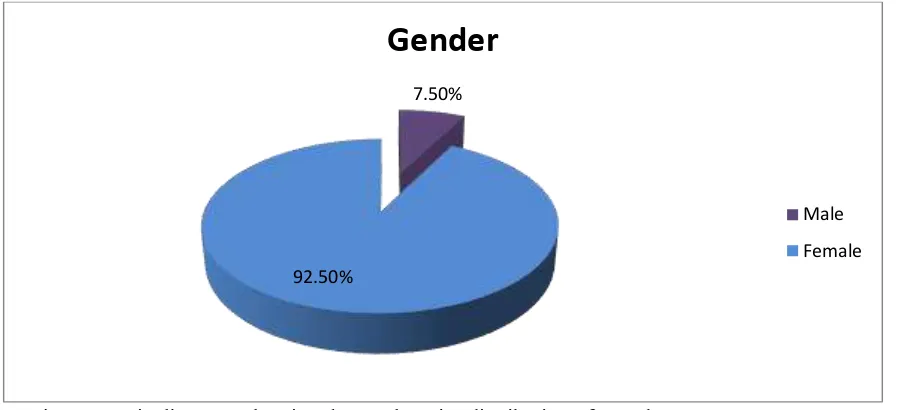
The above table 4.2 shows the gender wise distribution of samples. The table shows that 37(92.5%) of samples are female and 3(7.5%) are male
Figure 4.2 pie diagrams showing the gender wise distribution of samples
EDUCATION
Table 4.3 DISTRIBUTION OF SUBJECTS ACCORDING TO EDUCATIONAL QUALIFICATION
n=40
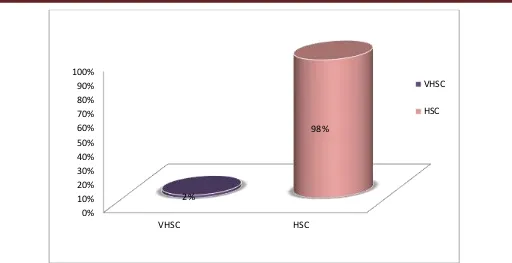
The above table shows the frequency distribution of subjects based on their basic educational qualification 37(98%) of samples posses HSC and 3(2%) VHSC.
25%
70%
5% 0%
10% 20% 30% 40% 50% 60% 70% 80%
16-17 18-19 20-21
16-17
18-19
20-21
7.50%
92.50%
Gender
Male
Female
Sl No. Education Frequency Percentage
1 2
VHSC HSC
3 37
Figure 4.3 Three Dimensional cylindrical diagrams showing the distribution of samples according to educational qualification.
NURSES IN THE FAMILY
TABLE 4.4 DISTRIBUTION BASED ON NURSES IN THE FAMILY
N=40 Sl No. Nurses in the
family
Frequency Percentage
1 2
Yes No
22 18
55% 45%
The above table 4.4 shows the distribution of nurses in the family 22(55%) samples had a nurse in their family
Figure 4.4 Pie diagram showing the distribution of samples based on nurses in the family
RELATIONSHIP WITH NURSES IN THE FAMILY
Table 4.5 DISTRIBUTION BASED ON RELATIONSHIP WITH NURSES IN THE FAMILY n=40
Sl No. Relationship Frequency Percentage
1 2 3
Parent Siblings
Others
1 6 15
4.54% 27.27% 68.18% 0%
10% 20% 30% 40% 50% 60% 70% 80% 90% 100%
VHSC HSC
2%
98%
VHSC
HSC
55% 45%
Yes
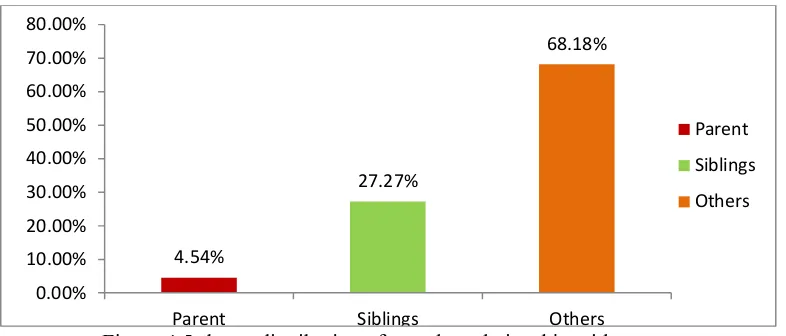
The above table 4.5 shows that distribution of samples relationship with the nurses in the family, 1(4.54%) samples parent works as a nurse, 6(27.27%) Siblings are nurses and 15(68.8%) other relatives are nurses.
Figure 4.5 shows distribution of samples relationship with nurses
5.2 SECTION II.
ASSESSMENT OF KNOWLEDGE ON NEEDLE STICK INJURY AMONG FIRST YEAR B.Sc NURSING STUDENTS DURING PRE - TEST.
Table 4.6 DISTRIBUTION OF PRE TEST LEVEL OF KNOWLEDGE OF THE SUBJECTS
n=40 Knowledge Frequency Percentage
<20 (Poor) 6 15% 20-26 (Average) 26 65% >26-46(Good) 8 20%
The table 4.6 shows the frequency and percentage distribution of the knowledge among first year BSc Nursing student in selected college Ernakulum District regarding the needle stick injury. The levels of knowledge were seen in to 3 categories Poor, Average, and Good. Among first year Bsc Nursing student 6(15%) of the respondents were having poor knowledge, 26(65%) having average knowledge regarding NSI and 8(20%) having good knowledge regarding NSI.
Figure 4.6 Bar diagramme shows distribution of level of knowledge regarding NSI
TABLE 4.7 MEAN, STANDARD DEVIATION AND RANGE OF PRE-TEST KNOWLEDGE REGARDING NEEDLE STICK INJURY AMONG FIRST YEAR B.SC NURSING STUDENTS n = 40
Domain Mean Standard Deviation Range Maximum Score
Knowledge 23.125 3.49 16-30 46
The statistical outcome such as mean, Standard deviation, Range of pre-test knowledge regarding the needle stick injury among first year BSc Nursing student in selected college Ernakulum District is show in table. Out of maximum score of 40, first year BSc Nursing student in selected colleges at Ernakulum district had mean knowledge of 23.12 with standard deviation of 3.49 the range is 16-30
4.54%
27.27%
68.18%
0.00% 10.00% 20.00% 30.00% 40.00% 50.00% 60.00% 70.00% 80.00%
Parent Siblings Others
Parent
Siblings
Others
0% 20% 40% 60% 80%
0-20 (Poor) 20-26 (Average) 26-46(Good)
15%
65%
20%
0-20 (Poor)
20-26 (Average)
5.3 SECTION III.
DISTRIBUTION OF POSTEST KNOWLEDGE PREGARDING NEEDLE STICK INJURY AMONG FIRST YEAR BSC NURSING STUDENT IN SELECTED COLLEGES AT ERNAKULAM DISTRICT.
Table 4.7 DISTRIBUTION OF POST-TEST KNOWLEDGE REGARDING NSI
n=40
Frequency Percentage
Poor (0-20) Average (20-26%)
Good (26-46%)
0 6 34
0% 15% 85%
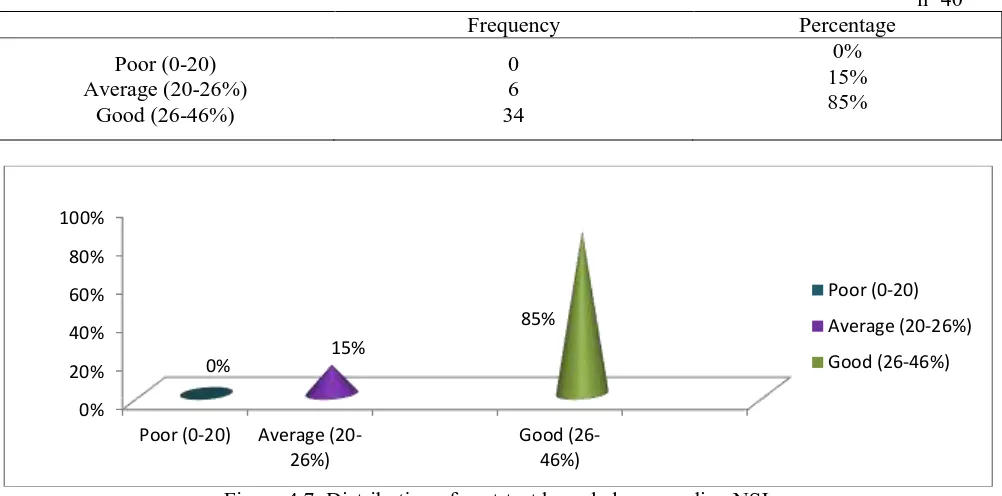
Figure 4.7: Distribution of post-test knowledge regarding NSI.
Table 4.8 Mean standard deviation and range of post-test knowledge regarding needle stick injury among first year B.Sc Nursing student.
Domain Maximum Score Mean SD Range
Knowledge 46 30.37 4.13 20-36
The table 4.8 shows the mean, standard deviation and range of post-test knowledge regarding the needle stick injury among first year BSc Nursing students in selected college at Ernakulum.
The mean, SD and Range of post-test knowledge regarding needle stick injury among first year BSc Nursing student in selected colleges at Ernakulum were shown in table out of Maximum Score of 46 first years BSc Nursing student attained mean knowledge of 30.37 with the standard deviation of 4.13. The range was found to be 20-36.
5.4 SECTION IV.
EFFECTIVENESS OF STRUCTURED TEACHING PROGRAMME ON KNOWLEDGE REGARDING NEEDLE STICK INJURY
Table 4.9: Pre-test and post-test level of knowledge among first year Bsc student in selected colleges at Ernakulum District. n=40
Pre Test Post Test
Frequency Percentage Frequency Percentage
Poor (0-20) Average (20-26)
Good (26-46)
6 26
8
15% 65% 20%
0 6 34
0 15% 85%
The above table compares the pre-test& pose-test knowledge of first year Bsc nursing students in selected college at Ernakulum District. The frequency and percentage distribution of knowledge on re-test, 15% had poor knowledge, 65% had average knowledge and 20% had good knowledge about needle stick injury. In the post-test no one is having poor knowledge, 15% having average knowledge and 85% having good knowledge about needle stick injury
0% 20% 40% 60% 80% 100%
Poor (0-20) Average (20-26%)
Good (26-46%)
0% 15%
85%
Poor (0-20)
Average (20-26%)
COMPARISION OF PRE-TEST AND POST-TEST
Figure 4.8: Comparison of mean, standard deviation and range of pre-test level of knowledge regarding needle stick injury among first year Bsc. Nursing students in selected college at Ernakulum district.
Table 4.10: Mean knowledge score regarding needle stick injury after STP.
n=40
Level of Knowledge Mean SD Range ‘t’ Test
Pre-test Post-test Enhancement 23.125 30.37 7.25 3.49 4.13 0.64 16-30 20-36 4-6 12.10
TESTING OF HYPOTHESIS
H1: There will be statistically significant different in the mean knowledge score of first year Bsc. Nursing
student before & after STP post-test knowledge regarding needle stick injury will be significantly higher than pre-test knowledge.
The table shows that the enhancement in mean knowledge score regarding needle stick injury after STP was significant, the knowledge regarding needle stick injury among first year Bsc. nursing student. Pre-test mean is 23.15, SD is 3.49
after STP mean is 7.25, SD is 0.64, paired’ test value is 12.10 is significant at P<0.05 level.
So research hypothesis (H1) was accepted. The result indicated that the structured teaching programme was
effective.
5.5 SECTION V. Association between the knowledge on needle sticks injury and selected demographic variables among first year BSc Nursing students
Table 4.11: The association between the level of knowledge and selected demographic variables. 15% 65% 20% 0% 15% 85% 0% 10% 20% 30% 40% 50% 60% 70% 80% 90%
poor (0-20) average(20-26) good(26-46)
pre test
post test
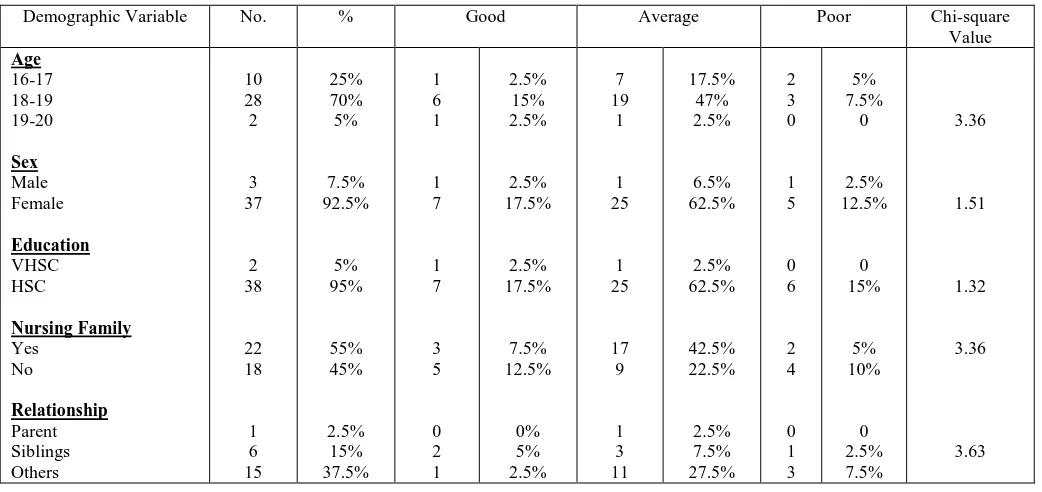
Demographic Variable No. % Good Average Poor Chi-square
The above table 4.11 shows that the association between knowledge and selected demographic variables of first year B sc nursing students such as age, sex, education, nurses in the family, relationship with nurse.
TESTING THE HYPOTHESIS 2:
There will be a significant association between mean pre-test knowledge score and selected demographic variable among these variables none of them have any association with the knowledge.
The result of chi square analysis shows that there is no significant association between the pre-test knowledge of first year B.Sc nursing students and selected demographic variables.
6. FINDINGS OF THE STUDY:
There was a significant improvement in knowledge regarding Needle Stick Injury following structured teaching programme among first year B.Sc Nursing students. Paired‘t’ test value was significant. There is no association between knowledge and selected demographic variables of samples according to age, basic education, nurses in the family and relationship with nurses in the family.
6.1 MAJOR FINDINGS OF THE STUDY: SAMPLE CHARACTERISTICS
BASED ON AGE: Out of 40 samples, 70% of them were 18-19 years old, 25% were 16-17 years old and 5% were 20-21 years old, with respect to gender 92.5% were female and 7.5% were male.
BASED ON THE BASIC EDUCATION: Out of 40 samples 98% underwent HSC and 2% underwent VHSC.
IN RESPECT OF NURSES IN THE FAMILY: Out of 40 samples 55% samples have nurses in the family and 45% do not have nurses in the family.
IN RELATION TO THE RELATIONSHIP WITH NURSES IN THE FAMILY: Out of 40 samples 4.54% parents are nurses, 27.27% siblings are nurses and 68.18% other relatives are nurses.
ASSESSMENT OF KNOWLEDGE ON NEEDLE STICK INJURY AMONG FIRST YEAR BSC NURSING STUDENTS DURING PRE- TEST
The levels of knowledge were seen in to 3 categories poor, average and good. Among 40 samples 15% of samples have poor knowledge, 65% have average knowledge, 20% have good knowledge regarding NSI.
ASSESSMENT OF KNOWLEDGE ON NEEDLE STICK INJURY DURING POST-TEST
Among 40 samples 85% have good knowledge, 15% have average knowledge and nobody have poor knowledge.
EFFECTIVENESS OF STRUCTURED TEACHING PROGRAMME IN TERMS OF GAIN IN KNOWLEDGE ON NEEDLE STICK INJURY
The mean post -test knowledge score (30.37) was significantly greater than mean pre- test score (23.125). The calculated‘t’ value 12.10 was significantly greater than table value at 39 degree of freedom at 0.05 level of significances.
Hence the hypothesis “there will be a significant difference between mean pre-test and post –test knowledge score of first year BSC Nursing students regarding needle stick injury” was accepted. This indicated that the structured teaching programme was an effective strategy to improve knowledge regarding Needle Stick Injury.
RELATIONSHIP BETWEEN SELECTED DEMOGRAPHIC VAERABLES AND PRE-TEST SCORE
The present study showed that there was no significant association between demographic variables and knowledge score.
7. RECOMMENDATIONS:
1. The study can be replicated with large sample size. 2. The same study can be done with control group.
3. Health professionals can be instructed to conduct the health education programme on needle stick injury and its prevention.
8. CONCLUSION:
This research reveals that there was a significant lack in knowledge regarding needle stick injury among 1st year
in improving knowledge. The study revealed that there was no significant association between knowledge and selected demographic variable.
REFERENCES:
1. Anshuli Trivedi1, Pradeep Kumar Kasar2, Rajesh Tiwari3, Prashant Verma4, Arvind Sharma4 (2013),National Journal of Community Medicine│Volume 4│Issue 1│Jan – Mar 2013 Page 132
2. Rahul Sharma, SK Rasania, Anita Verma, SaudanSingh (2010),Department of Community Medicine, VMMC &Safdarjung Hospital, New Delhi, India Year : 2010 | Volume : 35 | Issue : 1 | Page : 74-77
3. Vaz K,MC GrowderD,Crawford T, Alexander.LindoRL.,Irving R .(2003),Prevalence of injuries and reporting of accidents among health care workers at the university hospital in West Indies.
4. AnnilMahajan, Vishal R.Tandon, Harsh Sharma, Kulbirsingh(1997). Post exposure prophylaxis after occupational HIV exposure.Nightingale journal.1997May;9(4).1-17.
5. Do AN, Ciesielski CA, Metler RP, Hammett TA, Li J, Fleming PL;(2003) Occupationally acquired human immunodeficiency virus (HIV) infection: national case surveillance data during 20 years of the HIV epidemic in the United States.; Feb;24(2):.86-96.
6. Avert, International HIV and AIDS charity,(2008), Post exposure prophylaxis and pre exposure prophylaxis journal of Med Mal Infect. 2008 Dec; 38 (12):658-66.
7. Ruchita R, Dixit,(2011) Impact of knowledge about post exposure prophylaxis among nursing students-a cross sectional study; Medical journal of india.2011 Jan-July; 2,(1). 27-30.
8. World health organization, antiretroviral therapy(2006), HIV/AIDS Department. Practice of universal precautions among healthcare workers, journal of National Med Assoc. 2006May;98(5):722–726.
9. P.MDurge.(2011), Impact of knowledge about post exposure prophylaxis among nursing students-a cross sectional study.Journal of Med Mal Infect 2, (1), 2011 January-June, 27-30.
10. Robin.j.(2003) The effectiveness of self-instructional module (sim) on knowledge regarding selected blood- borne disorders and universal precaution among lab technician students NDRK College of nursing Hassan, Karnataka. RGUHS Journal of nursing sciences: 2003June; 56-61.
11. Owalabi R.S, Alabi P, Daniel O, Oqundriran A, Akande T.M, Onafowokan. T,(2011), Knowledge and Practice of Post-Exposure Prophylaxis Infection among Health Care Providers in a Tertiary Hospital in Nigeria, Journal of International Assoc Physicians AIDS Care (chic), 2011 Apr 21; 5, (2) .12-14.
12. Pisal H.Sultar S. Sastry J, etal.(2007), Nurses education program in India increases HIV knowledge and reduce fear. Journal of Indian medical association. 2007; 18(6).32-43.
13. Kocić B, PetrovićBBogdanovićDJovanovićJNikic DM (2008),Professional risk, knowledge, attitudes and
practice of health care personnel in Serbia with regard to HIV and AIDS. PM. Sep; 16 3):134-7.
14. Dhanure SS, Shankpal PD, Rao SN, Deshmukh YA(2002), Post exposure policy in India. IntConf AIDS. Jul;67(2) 21-35.
15. Kumakech E, AchoraS,Berggren V, Bajunirwe F,(2011) Occupational exposure to HIV: a conflict situation for health workers, International Nurses Rev, 2011 Dec;58(4).
16. Gouden YP. Moodleys (2000) Exposure to human deficiency virus among health care workers in South Africa. Font gynecolobstet.2000.69 (3); 265-70.
17. Singru S.A, Banerjee A,(2008) occupational exposure to blood and body fluids among health care workers in a teaching hospital in Mumbai, India, Indian journal of community medicine, 2008 Jan;33(1):26-30.
18. Sharma R, Rasania S, Varma A, Singh S,(2010) Prevalence and Response to Needle Stick Injuries among Health Care Workers in Tertiary Care Hospital in Delhi, India, Indian Journal of community medicine, 2010 jan;35(1): 74-7.
19. Scoular A,WattA.D,Watson M, Kelly B,(2000) knowledge and attitude of hospital staff to occupational exposure to blood borne viruses, Communicable Disease Public Health,Dec;3(4) :247-9.
20. Husoyam, mindeT, Knuden H, Tidsskr No Laegeforen,(2010).Needle stick injury routines.2010 April:130(7),Nowerign. Www .pubmed.Gov. in
21. Rujis WH, Timen (2008).A Guidelines of needle sticks injuries risk assessment and post exposure management in practices Ned TijdschrGeneeskd. 2008 Sep 6; 152(36):1967-71. Review.Dutch.PMID: 18807333.www.pubmed.gov
22. VonOverbeck J, Wess D Furrer H Needle stick accident procedure following potentially infectious exposure in medical personal In Geneva.www.pubmed.gov.in
23. Panunzi,Nunez,Banboza M,Molero.Zambrano T, Fuentes B, Para. cepeda. Biological fluid related accidents amongst professional working in clinical laboratories in Maracaibo,Venezulea. Www .pubmed.gov.in.
25. Van der Maaten G.C, Nyirenda M, Beadsworth M.J, Chitani A, Allain T, Van Oosterhout J.J,(2010) Post exposure prophylaxis of HIV transmission after occupational injuries in Queen Elizabeth Central Hospital, Blantyre, Malawi, 2003-2008. Malawi Med J, 2010 Mar; 22(1):15-9.
26. PisalH.Sultar S. Sastry J, etal.(2007) Nurses’ education program in India increases HIV knowledge and reduce fear. journal of Indian medical association. 2007; 18(6).32-43.
27. Dixit S, Khatri AK, Taneja G, Saroshe S, Baghel SS, Jaiswal S, Soni S, Sengar SS(2009). Impact of Educational Intervention Measures on Knowledge regarding HIV/ Occupational Exposure and Post Exposure Prophylaxis among Final Year Nursing Students of a Tertiary Care Hospital in Central India. Online J Health Allied Scs. 2009;8(4):6
28. Prasanna J, Rakesh Sharma, Anitha Bhatt, Arazoo, Anju yadhav,(2010),nursing student, needle stick injury post exposure measure volume 42 issue 6, November 2010 page no-1744-1750
29. Smith. Derk R and Leggat peter A. (2005) needle stick and sharp injuries among nursing students. Journal of advanced nursing. 51 page no-449-455
30. Saini R. Knowledge and awareness of needle stick injury among students of Rural Dental college, Maharashtra, India. Ann, Nigerian med. 2011; 5:122-4.
31. Anjun Hashmi, Sameer Abu Al Reesh and Lisa Indha” prevalence of needle stick injuries among health care workers, Najram, Saudi Arabia.
32. Mülder K. DtschArztebl.Needle stick [email protected]/wiki/needle stick injury.
33. Prüss-Üstün A, Rapiti E, Hutin Y. Estimation of the global burden of disease attributable to contaminated sharps injuries among health-care workers. Am .J Ind .Med 2005; 48: 482–90. @www.google.com
34. Chalupa S, Markkanen PK, Galligan CJ, Quinn M. Needlestick and Sharps Injury Prevention:Are We Reaching Our Goals?" [email protected]
35. Klein SM, Foltin J, GomellaLG. Emergency Medicine on Call. New York2003.www.google.com 36. www. ncbi. nlm. nih. Gov. by mhkgalougahi 2010