In Vitro/In Vivo Evaluation and Bioavailability Study of Amitriptyline Hydrochloride
from the Optimized Oral Fast Dissolving Films
Zeina D. Salman
1, Nidhal K. Maraie
1, Mustafa G. Alabbassi
1, Mowafaq M. Ghareeb
21Collage of Pharmacy, University of Al-Mustansiriya, Baghdad-Iraq. 2Collage of Pharmacy, University of Baghdad, Baghdad-Iraq.
Article Information Received 25 November 2014 Received in revised form 29 Dec 2014 Accepted 29 Dec 2014
Abstract
The present investigation was undertaken with the objective of developing fast dissolving film(s)
of a tricyclic antidepressant drug amitriptyline hydrochloride in order to improve its bioavailability,
optimize its therapeutic action especially when used to treat major depression and to enhance
the compliance for the developmentally disable, mentally ill, elderly and pediatric patients. Fast dissolving dosage forms have acquired great importance in pharmaceutical industry because of
their unique properties. Ten formulations were prepared by solvent casting method using different
polymer types, plasticizer types, surfactant concentrations and different ratio of hydroxypropyl
methyl cellulose and maltodextrin. The prepared films were evaluated for folding endurance,
thickness, drug content, in vitro/in vivo disintegration time, drug release and tensile test. The
optimized formula F8 containing HPMC 15cp and maltodextrin in 1:1 ratio showed minimum in vitro/in vivo disintegration time 16.8, 13.2 seconds respectively, highest dissolution rate i.e. T80%
1.1 minutes, D2 min (%) 89.77% and satisfactory mechanical properties. The optimized film was
further evaluated for bioavailability compared with a marketed solution (Amitriptyline
Hydrochloride®), the study based on cross over design using experimental animals (rabbits). The
pharmacokinetic results revealed that the fast dissolving films has higher peak blood
concentration (Cmax, 0.927µg/ml) within shorter time (Tmax, 2hours), indicating rapid absorption
and faster onset of action with acceptable bioavailability value. These findings suggest that the
fast dissolving film containing amitriptyline hydrochloride is expected to become one of choices
for the treatment of acute depression. Keywords:
Amitriptyline Hydrochloride, Fast dissolving films, Bioavailability
*
Corresponding Author: E-mail: [email protected] Tel.: 07722657089
1 Introduction
Despite the tremendous advancement in the drug delivery system,
oral route is the most acceptable drug delivery route for patient
compliance aspects. There are many drug delivery systems
accessible for the oral administration of the drugs. All these systems
are related with their own merits and demerits1. The change in lifestyle and changes in patient population in the emerging and
developing countries, painless, simple cost and effective delivery
system is predictable to have a bright future. The industries have
diverted their research focuses from conventional dosage forms to
new drug delivery technologies such as fast dissolving drug delivery
system2.Rapid dissolving oral dosage forms is also known as fast
dissolve, quick disintegrating and rapid melt drug delivery systems
were first developed in the late 1970s as an alternative to capsules,
tablets and syrups for people experiencing difficulty in swallowing
traditional solid dosage forms3. Fast dissolving films (FDF) are the most advanced form of fast dissolving oral dosage forms. It is
developed on the base of the technology of transdermal patch. The
delivery system consists of thin elegant films of edible hydrophilic
polymers of various sizes and shapes like square, rectangle or disc.
The strips may be flexible or brittle, transparent or opaque which is
simply placed on the tongue or any oral mucosal tissue and due to
saliva, it instantly wet, hydrates and adheres onto the site of
application. It rapidly disintegrates and dissolves to release the drug
for oromucosal absorption or will maintain the quick-dissolving
aspects which allow for gastrointestinal absorption to be achieved
UK Journal of Pharmaceutical and Biosciences
Available at www.ukjpb.com
UK J Pharm & Biosci, 2014: 2(6); 33 when swallowed. Fast dissolving films provide rapid, precise dosing
in a safe, efficacious format that is convenient, portable and can be
used anywhere anytime4. Amitriptyline hydrochloride (AMT HCl) is a
tricyclic antidepressant, which is widely prescribed for the treatment
of major depression. It has low bioavailability (30-60%) due to
extensive first- pass effect5. The aim of this study was to formulate
Amitriptyline Hydrochloride as fast dissolving films, to improve the
pharmacokinetic properties of the drug through enhancing the rate of
drug absorption, avoiding hepatic first –pass metabolism and to
provide effective and satisfactory dosage form for patients suffering
from dysphagia, nausea or vomiting and unconscious patients.
2 Materials and Methods
2.1 Materials
Amitriptyline HCl (Samara drug industry-Iraq) Hydroxy propyl methyl
cellulose(HPMC15cp) (Provizerpharma-India), Poly vinyl alcohol
(PVA) (Provizerpharma-India), Sodium carboxy methyl cellulose
(NaCMC) (Provizerpharma-India), Maltodextrin (MDX) (Sigma-
Aldrich- USA), Tween 80 (Riedel-De-Haen-Germany), Glycerine
(GCC-UK), Citric acid (Panreac- Espana),Sodium saccharine
(Avonchem limit-UK), Amitriptyline HCl Solution (Wockhardt –UK),
Diltiazem HCl (Asia pharmaceutical industries-Iraq), Methanol HPLC grade (Biosolve B V–France), n- Hexane HPLC grade (Biosolve B V–France), Acetonitrile HPLC grade (Biosolve B V–France).
2.2 Methods
2.2.1 Preparation of oral film
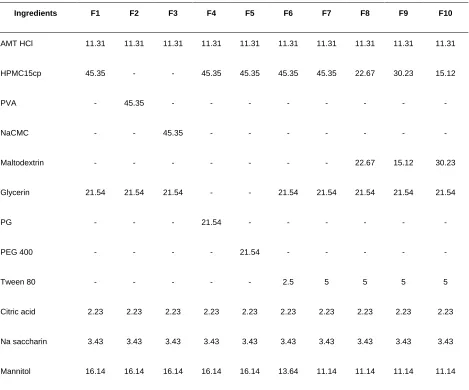
Ten formulations were prepared (F1-F10), using solvent casting
method with different types of polymers and composition as shown in
table 1. The plasticizer, sodium saccharine, citric acid and mannitol
were dissolved in suitable volume of water with heating and
continuous stirring to form a clear viscous solution. After cooling, a
suitable amount of polymers (anaqueous dispersion of film forming
polymer was separately prepared) were added to the previous
solution. Pre-dissolved AMT HCl in water was added with stirring for
4 hours, until uniformly viscous solution achieved, which was kept
undisturbed condition at least for 24 hours to remove the entrapped
air. The resulting solution was poured into a 9 cm petri dish and
allowed to dry in hot air oven at 40 ºC for 24 hours, the dried batch
carefully removed, cut into desired size6.
2.2.3 Evaluation of oral films
2.2.3.1 Visual inspection
Properties such as homogeneity, color, transparency and surface of
the oral films were inspected for all the prepared oral films7.
2.2.3.2 Thickness measurements
The thickness of the film was measured by micrometer screw gauge
at different strategic points. Each film was measured at 5 positions
(center and four corners), and the mean thickness was calculated8.
2.2.3.3 Drug Content Uniformity
The film was allowed to dissolve in 100 ml phosphate buffer pH 6.8
contained in 100 ml volumetric flask, with stirrer maintained at 37°C
for 3 hours and left for 24 hr at room temperature. The filtered
solution was diluted and analyzed by UV-spectrophotometer at λmax
239 nm in triplicate, the average drug content was calculated9.
2.2.3.4 Surface pH study
The surface pH of the oral dissolving film is calculated in order to
investigate the risk of any side effects in vivo, since acidic or alkaline
pH may cause irritation to the oral mucosa and it is measured to
maintain the surface pH as close to neutral as possible. A combined
pH electrode is used for this purpose. The film was slightly wet with
the help of 1 ml of distilled water and kept for 30 seconds. The pH
was measured by bringing the electrode in contact with the surface
of the formulation and allowing it to equilibrate for 1 minute. The
average of three determinations for each film was determined10.
2.2.3.5 Folding endurance
The folding endurance is expressed as the number of folds (number
of times of folding the film at the same plain) required to break the
specimen or developing visible cracks or folded up to 300 times
manually, which was considered satisfactory to reveal good patch
properties and gives an indication of brittleness of the film 11.
2.2.3.5 Tensile test
The mechanical properties of the films were determined using tinius
Olsen testing instrument (Model H50KT, UK). The sample was cut
into a dumbbell shape, then held between two clamps and the strip
was pulled by the top clamp at a rate of 10 cm/min. The force and
elongation were determined as the film broke. The mechanical
properties include tensile strength, percent elongation, elastic
modulus and strain were computed for the characterization of the
film12. Tensile strength is the maximum stress applied to a point at which the strip specimen breaks13, as described from the following equation:
Tensile strength (TS) = Force at break (N)/ Intial cross – Sectional
area of the sample
Percent Elongation at break (E %) was calculated using the flowing
equation
UK J Pharm & Biosci, 2014: 2(6); 34 Where:D0 is the distance between the tensile grips before the
fracture of the film, and Df is the distance between the tensile grips
after the fracture of the film.
Young's modulus or elastic modulus (EM) is the measure of stiffness
of the strip was calculated from the following equation, F/A = EM
[(Df – D0)/D0]
Where F= breaking load (N) and A = cross-sectional area of the
sample.
Strain value was calculated from the flowing equation:
Strain = tensile strength / elastic modulus
Fast dissolving film should possess moderate TS, high %E, low EM,
high strain14.
Table 1: Composition of Different Fast Dissolving Films Containing AMT HCl (Quantities are expressed in terms of %w/w)
Ingredients F1 F2 F3 F4 F5 F6 F7 F8 F9 F10
AMT HCl 11.31 11.31 11.31 11.31 11.31 11.31 11.31 11.31 11.31 11.31
HPMC15cp 45.35 - - 45.35 45.35 45.35 45.35 22.67 30.23 15.12
PVA - 45.35 - - - -
NaCMC - - 45.35 - - - -
Maltodextrin - - - 22.67 15.12 30.23
Glycerin 21.54 21.54 21.54 - - 21.54 21.54 21.54 21.54 21.54
PG - - - 21.54 - - - -
PEG 400 - - - - 21.54 - - - - -
Tween 80 - - - 2.5 5 5 5 5
Citric acid 2.23 2.23 2.23 2.23 2.23 2.23 2.23 2.23 2.23 2.23
Na saccharin 3.43 3.43 3.43 3.43 3.43 3.43 3.43 3.43 3.43 3.43
Mannitol 16.14 16.14 16.14 16.14 16.14 13.64 11.14 11.14 11.14 11.14
2.2.3.6 Disintegration test
2.2.3.6.1 In-vitro disintegration test
The test was performed using USP disintegration test apparatus,
using 250 ml phosphate buffer pH 6.8 at 37±0.5°C as medium, 2×2
cm2 film was placed in the tube of the basket and the disks were placed over it15.
2.2.3.6.2 In- vivo disintegration test
The time required for complete disintegration in the oral cavity was
calculated from three healthy volunteers. The mouth cavity was
rinsed with a cup of water, the film was placed on the tongue and
subsequently the tongue was gently moved. The time required for
disintegration in the mouth was determined. The data were
represented as a mean of three replicate determinations16.
2.2.3.7 In-vitro dissolution study
The dissolution study was carried out using USP dissolution
apparatus type II paddle apparatus in 250 ml phosphate buffer (pH
UK J Pharm & Biosci, 2014: 2(6); 35 was immersed and fixed on a jar glass, five milliliters samples were
withdrawn at the time interval from 0.5, 1, 2, 3, 4, 5, 10, 15, 20, 25,
30, 35, 40 and 45 min and an equal volume of the fresh dissolution
media at the same temperature was replenished. The collected
samples were filtered and analyzed spectrophotometrically at measured λmax. The % release of AMT HCl from film was measured;
results were expressed as mean of three determinations8.
2.2.3.8 Characterization of selected formula using scanning electron
microscopy (SEM)
SEM (SEM Inspect S50-Netherlands) is utilized to assess the
surface morphological characteristics of the optimized formulation.
The sample for SEM was mounted on round brass stub using double
backed adhesive tape and then sputter coated for 30 seconds with
gold palladium under an argon atmosphere. The stub containing the
coated sample was placed in the scanning electron microscope
chamber. Microphotographs were taken on different magnification17.
2.2.3.9 Bioavailability test
2.2.3.9.1 Study design
The protocol for the study was approved by the animal care
committee in National Center for Drugs Control and Researches in
Iraq. Twenty four male rabbits (weighed 1850- 2250 g) were selected
for this study and only 6 rabbits continued in this study because of
several difficulties such as (disease, death of animals during the
study and difficulty to continue sampling as decided schedule times).
All six rabbits were healthy during the period of the experiment. The
study was a simple crossover design with three-week washout
period, in order to reduce variability arising from physiological
variables (e.g. gastric emptying, pH), in addition to the variability
arising from residual effects. The rabbits were fasted overnight (to
minimize the effects of food on pharmacokinetic profile) with free
access of water and single dose 40 mg /kg was administered. The
rabbits were randomly divided into two groups (A and B) each group
consist of three rabbits. Group A were anesthetized by intravenous
injection of pentobarbital in a dose of 25 mg/kg, the rabbits were then
placed on a table with the lower jaw supported in a horizontal
position and the selected formula F8 was placed carefully on the
rabbit's tongue. The rabbits were anaesthetized to ensure the
maintenance of the film in the oral cavity without escaping down the
gastrointestinal tract. A suitable volume of the commercial AMT HCl
solution equivalent to the applied dose was administered orally to
group B via gastric gavage18, 19. Blood samples (2ml) were drawn from the marginal ear vein at zero time and 1, 2, 3, 4, 6, 8, 10 and 24
hours .Blood samples were collected in heparinized tubes and
immediately frozen at- 20°C until analysis 20.
2.2.3.9.2 Chromatographic conditions
A Knauer HPLC system (Germany) was employed in the
bioavailability test and consists of a Wellchrom K-1001 pump, a
Rheodyne 7125 injector and a K 2501 UV detector with a
thermostatic column compartment connected to a Eurochrom 2000
injector. An isocratic high performance liquid chromatography was performed on an analytical C18 column (Knaure;150 ×4.6 mm ;5 μm
particle size; 25cm length ) supported by guard column C18- 4 mm
diameter (Germany).The wave length was set at 254 nm. The mobile
phase was a mixture of acetonitrile and buffer solution of (0 .02 M)
KH2PO4 (35:65 v/v) and adjusted to pH 3.0 by orthophosphoric acid.
Chromatographies were carried out using flow rate of 1.5 ml min-1 and at 40°C 21.
2.2.3.9.3 Preparation of stock solutions
The primary stock solutions of AMT HCl standard and internal
standard (I.S) diltiazem HCl were prepared by dissolving separately
10 mg of each compound in 10 ml of methanol using volumetric
flasks, to produce concentration of 1 mg/ml. These were stored at
-20°C. The working standard solution of the strength 10μg /ml was
prepared by diluted the stock solution 100 fold via using the mobile
phase 22.
2.2.3.9.4 Sample extraction procedure
To one milliliter of blood, 50 µl of I.S (10µg/ml freshly prepared) and
200 µl of 0.5 M NaOH were added together with 4 ml n-hexane. The
resulted mixture was vortexed for 5 min., followed by centrifugation
at 2000 rpm for 10 min, the organic layer was isolated carefully,
transferred to another tube and evaporated at 40°C under stream of
nitrogen .The dry residue was reconstituted with 500 µl mobile phase
and vortexed for 30 seconds. The solution was injected into
autosampler vials of HPLC21.
2.2.3.9.5 Pharmacokinetic and statistical calculations
The peak concentration (Cmax) and peak times (Tmax) were derived
directly from the experimental points. The other pharmacokinetic
parameters of two formulations were computed by non-
compartmental analysis using (Kinetica® software-version 5, Thermo
Fisher scientific, USA), mean value (±SD) were calculated for each
parameter. The pharmacokinetic parameters of the two products (the
prepared film and commercial solution of AMT HCl) were compared
by one way analysis of variance (ANOVA).
3 Results and Discussions
3.1 Visual inspection
The appearance of all prepared AMT HCl fast dissolving films
which contain different film forming polymers showed homogenous,
transparent, flexible, non sticky, smooth in the texture properties with
UK J Pharm & Biosci, 2014: 2(6); 36 3.2 Thickness measurement
The thickness of the films is essential to be uniform as it is directly
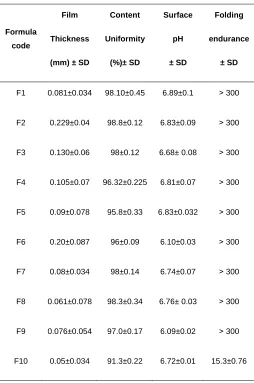
associated to the precision of dose.Thickness of the films was found
to vary between (0.05-0.229 mm) (table 2). Thelow ±SD values in
the film thickness measurements ensured uniformity of thickness in
each formulation and the method used for the formulation of the film
is reproducible with dose accuracy23.
3.3 Drug content uniformity
All the prepared films were found to be within uniform quantity of the
drug, and the preparations met the criteria of United State
Pharmacopeia (USP), as shown in table 2. This indicates that the
drug was uniformly dispersed throughout the films24.
3.4 Surface pH study
The surface pH of films was found to be in the range of (6.1 - 6.89),
which is within the range of salivary pH. It indicates that the fast
dissolving film not create any types of oromucosal irritation.
3.5 Folding endurance
The results indicated that most of the formulas showed satisfactory
folding endurance, the low folding endurance of the films below the acceptable level (usually ˂100 times) were found in the formulations
(F10), this is related to weak bonds between polymer chains that
cannot maintain their integrity upon folding25,as shown in table 2.
3.6 Effect of film forming polymer types
Formulations (F1-F3) that were prepared using different primary film
forming polymers (HPMC 15cp, PVA, NaCMC) to study the effect of
different polymer types on the disintegration, mechanical properties
and release profile of prepared films. The rank order of AMT HCl
films in vitro /in vivo disintegration time is as follows: PVA(F2) >
NaCMC (F3) > HPMC (F1), as shown in table3. Formula F1 film
gave shorter DT compared to other formulations. This may be due to
the high solubility of HPMC film in polar solvents and therefore
undergoes disintegration rapidly without forming a gel residue,
ensuring rapid matrix disintegration26.
The results display theeffect of film forming polymer types on the
mechanical properties of the prepared films (F1-F3), formula F1 gave
satisfactory mechanical property. Formula F2 showed higher strain,
higher TS, higher E% than F1, this may be due to formation of strong
hydrogen bonds between polymer (PVA) and plasticizer there by
imparting the polymer flexibility to withstand rupture27. While F3 showed lower strain value, as shown in table 3.
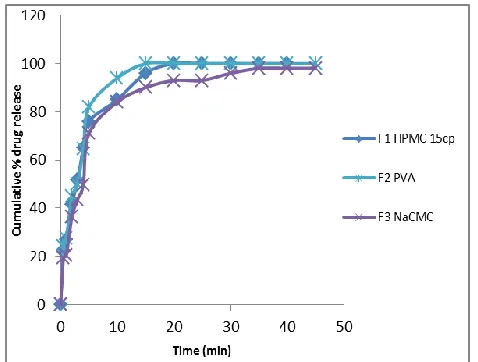
The effect of changing types of the polymer on the drug release
profile from AMT HCl fast dissolving films was conducted by
comparing the release profile of formulations (F1-F3) as shown in
figure 1. The time required for 80% of drug to be released (T80%) and
percent drug dissolved in 2 minutes (D2 min) are scheduled in table 4.
Formulation F2 showed higher dissolution rate than other formulas,
this is attributed to the high solubility of PVA in water, and the
loosely bounded PVA molecules were easily eroded, allowing the
rapid release of the drug 28 .while Formula F4 showed lower
dissolution rate since Na CMC dissolved rapidly leading to the
formation of channels inside the matrix of the film which enhanced
the diffusion of the drug a cross such channels followed by the
formation of a stable gel layer which in turn will control the release of
drug from the film29.
Table 2: The Physical Parameters of The Prepared Oral Films of AMT HCl
Formula code
Film
Thickness
(mm) ± SD
Content
Uniformity
(%)± SD
Surface
pH
± SD
Folding
endurance
± SD
F1 0.081±0.034 98.10±0.45 6.89±0.1 ˃ 300
F2 0.229±0.04 98.8±0.12 6.83±0.09 ˃ 300
F3 0.130±0.06 98±0.12 6.68± 0.08 ˃ 300
F4 0.105±0.07 96.32±0.225 6.81±0.07 ˃ 300
F5 0.09±0.078 95.8±0.33 6.83±0.032 ˃ 300
F6 0.20±0.087 96±0.09 6.10±0.03 ˃ 300
F7 0.08±0.034 98±0.14 6.74±0.07 ˃ 300
F8 0.061±0.078 98.3±0.34 6.76± 0.03 ˃ 300
F9 0.076±0.054 97.0±0.17 6.09±0.02 ˃ 300
F10 0.05±0.034 91.3±0.22 6.72±0.01 15.3±0.76
3.7 Effect of different plasticizer types
Three types of plasticizers glycerin, propylene glycol (PG) and poly
ethylene glycol 400 (PEG400) in concentration of 21.54% w/w
UK J Pharm & Biosci, 2014: 2(6); 37 effect of plasticizer types on DT, mechanical properties and in-vitro
drug release profile of AMT HCl oral film.
Figure 1: Effect of polymer types on the release profile of AMT HCl from the prepared films in phosphate buffer (pH 6.8) at 37˚C
Table 3 indicates that changing plasticizer type caused non
significant effect (p>0.05) in the in vitro/in vivo disintegration time of
oral films; this may be due to the fact that three types of plasticizer
enhanced the disintegration time by facilitated the diffusion of fluid
into the film since plasticizer alter the densely packed chains of
HPMC texture by forming a more porous and less dense polymer
structure that breaks at lesser force, resulting in faster disintegration
of the film30.
On other hand the results of tensile test revealed that, formula F1
causes significant improvement (p<0.05) in mechanical properties of
the films in comparison to F4 and F5, this may be due to the small
size and arrangement of glycerin which makes it easily inserted
between the chains of the polymer lead to provide more influence on
the mechanical properties than the larger molecule31.
Table 4 and figure 2 showed that F1 significant increase (p˂0.05) in
the release profile of AMT HCl film in comparison to F4, F5. Since
the films plasticized with glycerin adsorbed more humidity leading to
increase in the hydrophilic character of films, reducing the internal
hydrogen bonds between the polymer chains and enlarged the
internal space in the molecular structure of polymer32.
3.8 Effect of incorporation of different concentrations of surfactant
(Tween 80)
The effect of different concentrations of surfactant, 2.5% (F6) and
5% (F7) in comparison to F1 (not contain surfactant ) on the
disintegration time, mechanical properties and in-vitro drug release
profile of AMT HCl oral films were studied.
Table 3 revealed that, the increase in concentration of tween 80
caused significant reduction (p<0.05) in disintegration time, since
tween 80 is emulsifying agent, so it facilitates the diffusion of fluid
into the film resulting in faster disintegration of the film33. Therefore formulation F7 disintegrated faster than F6 and F1.
Figure 2: Effect of plasticizer types on the release of AMT HCl from the prepared films in phosphate buffer (pH 6.8) at 37 ˚C
The incorporation of tween 80 in different concentrations 2.5% (F6)
and 5% (F7) significantly improved (p<0.05) the mechanical property
of the prepared films. Since the presence of tween 80 will alter the
structure and form porous and less dense polymer structure and
hence the TS decreased34.
Table 4 and Figure 3 shown that F7 gave fastest dissolution rate,
this may be due to the ability of the surfactant to improve wettability
of the film and reduced the surface tension, making the drug
easily accessible by dissolution medium, immediately dissolves and
diffuses from the interface between the film surface and the
surrounding medium35.
3.9 Effect of polymeric blend and polymeric blend ratio
Formula F7 (not contain MDX), F8 (contain HPMC:MDX in the ratio
1:1) , F9(contain HPMC:MDX in the ratio 2:1) in addition to F10 (
contain HPMC:MDX in the ratio 1:2) were used to study the effect of
polymeric blend and the polymeric blend ratio on the in vitro/in vivo
disintegration time, mechanical properties and in-vitro drug release
profile of AMT HCl oral films.
Table 3 shows an enhancement in the disintegration time with the
addition of MDX compared with formula without MDX, this could be
attributed to the presence of MDX in the formulation that facilitates
water penetration into the film structure due to its high
water-solubility, leading to decrease the thickness of the films and reduced
the DT36.
The results in table 4 showed that as the amount of MDX increased
F8, there was significant decrease (p < 0.05) in TS in addition
UK J Pharm & Biosci, 2014: 2(6); 38 may be due to the ability of MDX to impart greater ductility to the
films, which supports the mechanical properties. Further increase in
the amount of MDX (F31) caused significant suppress in the
mechanical properties of the film leading to brittle, weak and sticky
films, since there will be further reduction in the amount of the 1˚polymer (HPMC) that affects the mechanical properties of the
films dramatically37.
Table 3: The Disintegration and Mechanical Properties of The Prepared Oral Films of AMT HCl
Formula code
In vivo
DT(sec) ± SD
In vitro
DT(sec) ± SD
Tensile Strength
(MPa)
Elongation%
Elastic Modulus
Strain
F1 27±3.3 30.2± 2 17.78 41.40 43.36 0.41
F2 114±3.3 117±2.1 19.17 150.0 5.5 1.5
F3 40.74±1 42.2±1 5.29 14.503 37.78 0.14
F4 27.9±1 30.8±1.3 19.53 28.4 69.75 0.28
F5 28.1±1.4 32.1±2.2 22.4 19.1 117.89 0.19
F6 24.5±1.7 26.33±1.9 15.42 43.24 35.86 0.43
F7 21.4±0.8 23.8±1.1 11.76 45.98 25.57 0.46
F8 13.2±2 16.8±0.8 5.961 53.0 11.25 0.53
F9 18.7±1 22.2±1.3 8.111 47.80 16.9 0.48
F10 7.34±0.5 11.8±2.6 1.435 5.33 2.66 0.05
Table 4: In-vitro Dissolution Parameters in Phosphate Buffer (pH6.8)
Formula F1 F2 F3 F4 F5 F6 F7 F8 F9 F10
D2min(%) 41.3 44.98 36.31 31.03 23.1 60.34 73.68 89.77 79.67 95.0
T80%(min) 5.20 4.88 5.41 9.67 15.3 3.1 2.6 1.1 2.5 0.6
Figure 3 :Effect of increasing the concentration of tween 80 on the release of AMT HCl from the prepared films in phosphate buffer (pH 6.8) at 37˚ C
On the other hand, it was found that as the amount of MDX
increased there was significant increase (p< 0.05) in the drug
release, as shown in table 4 and figure 4, this may be due to the fact
that the presence of HPMC alone (F7) lead to the formation of
viscous gel layer that decreases the mobility of drug particles in
swollen matrices leading to decrease the release rate. But upon the
addition of MDX (F8-F10) resulted in reducing the viscosity of the
1˚polymer with immediate solubilization of the drug in water thus
guide to faster drug release38.
Based on the above physical and mechanical evaluations of all 10
formulations (F1-F10), indicated that formula F8 having fastest in
vitro/ in vivo disintegration time and satisfactory release rate and
mechanical properties, so selected as the optimum formula for
UK J Pharm & Biosci, 2014: 2(6); 39 chosen for further investigation, including: scanning electron
microscopy, bioavailability test.
Figure 4:Effect of polymer blend (HPMC:MDX) in different ratios on the release of AMT HCl from the prepared films in phosphate buffer (pH 6.8) at 37˚ C
3.10 Characterization of selected formula using scanning electron
microscopy (SEM)
The SEM image in figure 5 for the selected AMT HCl film revealed
that the surface morphology of the formulation (F8) had a regular
texture with little pores without any scratches on the film and uniform
distribution of active pharmaceutical ingredients in the film matrix.
Figure 5: Surface SEM Photograph of AMT HCl fast dissolving film (F8)
3.11 Bioavailability test
The concentration of AMT HCl in rabbits blood was determined using
a reproducible, sensitive and rapid HPLC method, which showed two
separated peaks chromatogram for AMT and internal standard
(diltiazem HCl), the chromatographic conditions and extraction
procedure yielded a clear chromatogram for analyte as shown in
figure 6.
The retention times of drug (AMT HCl) and internal standard
(diltiazem HCl) were detected in the mobile phase and blood and
were recorded to be 6.1± 0.05 min for AMT HCl and 4.7± 0.07 min
for internal standard. A straight line with high regression coefficient
(R2 = 0.996) was obtained by plotting the peak height ratio versus
the concentration.
Figure 6:Chromatogram of rabbits blood contains 10μg/ml of IS (A) and blood containing 10μg /ml of AMT HCl and IS (B)
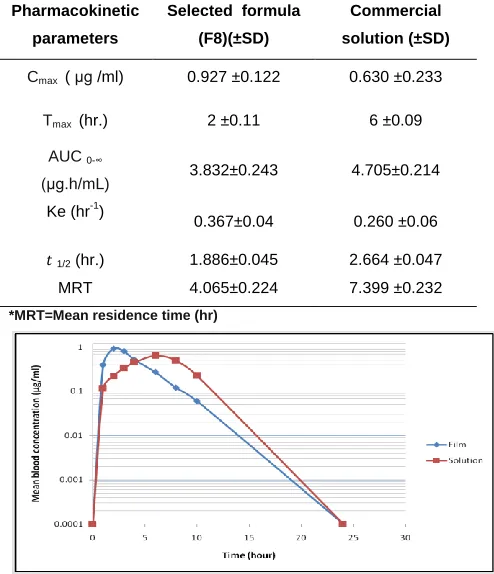
The mean blood concentration of AMT HCl versus time profile
revealed that first order pharmacokinetic model without lag time and
first order elimination rate was considered to be the best fit to explain
the generated data (figure 7). The average pharmacokinetic
parameters (table 5) revealed that C max of AMT HCl from the film
formula (F8) (0.927µg/ml) was significantly higher than Cmax of
Amitriptyline Hydrochloride® solution (0.630µg/ml). The result also showed that the time required to reach peak concentration (Tmax)
from the prepared film (2hr) is significantly less than that required by
the drug from Amitriptyline Hydrochloride® solution (6 hr). Tmax
reflects the rate of absorption from the formulation, therefore the
drug from prepared film showed the higher rate of entrance into the
blood stream and gave faster onset of action. The mean residence
time (MRT) which describes the average time for the drug molecules
to reside in the body. From the results; the MRT of the drug from the
prepared film was significantly less than that from Amitriptyline
Hydrochloride® solution indicated that the drug persist for shorter time in the blood after film administration, and this agreed with the
higher elemination rate constant (ke) (0.367 hr-1) and lower half life
t1/2 (1.886 hr) in comparsion to that from commercial solution where
Ke (0.260 hr-1) and t 1/2 (2.664 hr). The area under the curve (AUC)
of the drug from the prepared film was found to be non significantly
different (p˃ 0.05) from the AUC of the commercial
solution.Therefore, the relative bioavailability of drug from the
prepared film in comparison to solution was found to be 81.447%
which is within the bioequivalence acceptable range of 80-125%39. 4 Conclusions
In vitro and in vivo evaluation of the AMT HCl fast dissolving films confirmed their potential as an innovative dosage form to improve
delivery of amitriptyline hydrochloride. Therefore, the oral fast
dissolving film is considered to be potentially useful for the treatment
of disease where the quick onset of action is desired, also improved
patient compliance.
UK J Pharm & Biosci, 2014: 2(6); 40
Table 5: Statistical Comparison of Mean Pharmacokinetic Parameters Following Administration of 40mg/kg AMT HCl in Orodispersible Film (F8) and Commercial Solution to Six Rabbits (𝑛 = 6)
*MRT=Mean residence time (hr)
Figure 7: Logarithmic mean blood concentration versus time curve for AMT HCl after single oral dose of the selected formula and commercial solution
5 Competing interests
Formulation AMT HCl FDF that provide rapid rate of absorption and
rapid onset of action and improved patient compliance.
6 Author’s contributions
NKM and ZDS carried out literature review of the formulation and in
vitro/in vivo evaluations.
NKM, MGA, MMG and ZDS participate in bioavailability study.
ZDS carried out the formulation of FDF of AMT HCl, in vitro
evaluation and the bioavailability study.
7 References
1. Patel HJ, Patel PB, Kamdar KM, Patel KB, Shah AA, Patel
ZP. Development and Optimization of Fast Dissolving
Film of Losartan Potassium. Am. J. Pharm Health Res.
2013; 1(2):35-44.
2. Arunkanth EA, Novel Drug Delivery Technologies-A
Changing and Challenging Global Scenario. The
Experiment, 2013; 8(3): 468-482.
3. Balaji A, Poladi KK, Vookanti AR. Fast Dissolving Oral
Films for Immediate Drug Release: A Review. World
Journal of Pharmaceutical Research. 2014;
3(2):3751-3775.
4. Gurjeet A, Singh G, Singh A Oral Fast Dissolving Films: A
New Trend of Drug Delivery. International Journal of
Universal Pharmacy and Bio Sciences. 2014; 3(3):
301-317.
5. Sweetman SS, Martindale: The Complete Drug Refrance,
36th edition, 2009, London: Pharmaceutical Press: 381.
6. Singh T, Singh RK, Shah JN, Mehta TA. Mucoadhesive
Bilayer Buccal Patches of Verapamil Hydrochloride:
Formulation Development and Characterization. Int J
Pharm Pharm Sci. 2014; 6(4):234-341.
7. Sabar MH. Formulation and In-vitro Evaluation of Fast
Dissolving Film Containing Amlodipine Besylate Solid
Dispersion. International Journal of Pharmacy and
Pharmaceutical Sciences. 2013; l5 (4): 419-428.
8. Sultana F, Arafat M, Pathan SI. Preparation and
Evaluation of Fast Dissolving Oral Thin Film of Caffeine.
International Journal of Pharmacy and Biological Sciences.
2013; 3(1): 153-161.
9. Rahul S, Bushetti S, Shubhangi W, Bhagwat S.
Development and Evaluation of Rizatriptan Patches for
Buccal. World Journal of Pharmacy and Pharmaceutical
Sciences. 2013; 2(6): 5020-5045.
10. Kumar D, Rathi L, Tripathi A, Maddheshiya YP. A Review
on Oral Mucosal Drug Delivery System. International
Journal of Pharmaceutical Science and Research. 2010;
1(5):50-56.
11. Deepthi A, Reddy BV, Navaneetha K. Formulation and
Evaluation of Fast Dissolving Oral Films of Zolmitriptan.
American Journal of Advanced Drug Delivery. 2014; 2(2):
153-163.
12. Sagban HT, Ismail YK. Formulation and Evaluation of
Orodispersible Film of Sildenafil Citrate. International
Journal of Pharmacy and Pharmaceutical Sciences. 2014;
6(2):81-86.
13. Jyoti A, Gurpreet S, Seema S, Rana AC. Fast Dissolving
Films:A Noval Approach to Oral Drug Delivery. International
Research Journal of Pharmacy. 2011; 2(12):69-74.
Pharmacokinetic parameters
Selected formula (F8)(±SD)
Commercial solution (±SD) Cmax ( μg /ml) 0.927 ±0.122 0.630 ±0.233
Tmax (hr.) 2 ±0.11 6 ±0.09
AUC 0-∞
(μg.h/mL) 3.832±0.243 4.705±0.214
Ke (hr-1)
0.367±0.04 0.260 ±0.06
𝑡1/2 (hr.) 1.886±0.045 2.664 ±0.047
UK J Pharm & Biosci, 2014: 2(6); 41 14. El-Setouhy DA, El-Malak NS. Formulation of A Novel
Tianeptine Sodium Orodispersible Film, AAPS
PharmSciTech. 2010; 11(3): 1018-1025.
15. Sapkal NP, Kilor VA, Daud AS, Bonde M.N.Development
of Fast Dissolving Oral Thin Films of Ambroxol
Hydrochloride: Effect of Formulation Variables.Journal of
AdvancedPharmaceutical Research. 2011; 2(2): 102-109.
16. Abd-Alhammid SN, Saleeh HH. Formulation and
Evaluation of Flurbiprofen Oral Film. Iraqi J Pharm Sci.
2014; 23(1): 53-59.
17. Jyothsna K, Lakshmi GV Omeprazole – Floating Drug
Delivery System. RJPBCS. 2013; 4(2):374-380.
18. Choudhary DR, Patel VA, Chhalotiya UK, Patel HV,
Kundawala J Development and Characterization of
Pharmacokinetic Parameters of Fast –Dissolving Films
Containing Levocetrizine. Scientia Pharmaceutica, 2012;
80:779-787.
19. Vijayalakshmi P, Surender E, Pragna B, Askary MZ,
Borubhadra L, Balamurugan AJ, Joshi H. Formulation
Development and In vitro-In vivo Characterization of Oral
Fast Disintegrating Films of Drug Meant for Chronic
Disease. IJPSR. 2013; 4(1): 287-295.
20. Jang I, Shin J, Shin S Park C, Kim J, Woo J, Cha I.
Pharmacokinetics of Amitriptyline
Demthylation;ACrossover Study with Single Doses of
Amitriptyline and Nortriptyline. The Seoul Journal of
Medicine. 1990; 31(1):11-18.
21. Farag RS, Darwish MZ, FathyWM, Hammad HA. New
HPLC Method to Detect Amitriptyline in the Blood of Rats
on Combination Treatment. International Journal of
Chemical and Analytical Scince. 2013; 4: 120 – 124.
22. Reihanikermani H, Ansari M. Soltani A, Meymandi MS.
Bioequivalence Study of Amitriptyline in Rabbits. Indian J
Pharm Sci. 2008; 70(6): 782-785.
23. Parejiya PB, Patel RC, Mehta DM, Shelat PK, Barot BS.
Quick Dissolving Films of Nebivolol Hydrochloride:
Formulation and Optimization by A Simplex Lattice Design.
Journal of Pharmaceutical Investigation. 2013;
43:343-351.
24. Nagaraju R, Sujatha B, Vidyadhara S, Sasidhar RLC.
Design and Evaluation of Fast Dissolving Films Containing
Nizatidine. Indian Journal of Pharmaceutical Education
and Research. 2012; 46 (4):318-322.
25. Obaidat RM, Bader A, Alrajab W. Preparation of
Mucoadhesive Oral Patches Containing Tetracycline
Hydrochloride and Carvacrol for Treatment of Local Mouth
Bacterial Infections and Candidiasis. Sci Pharm., 2011; 79: 197–212.
26. Vidyadhara S, Balakrishna T, Sasidhar RLC, Babu CS,
Harika DL. Formulation and Evaluation of Zolmitriptan Fast Dissolving Buccal Films.Scholar Research Library, 2013;
5 (4):145-152.
27. Abha D, Sheeja K, Bhagyashri J. Design and Evaluation of
Buccal Film of Diclofenac Sodium.International Journal of
Pharmacy and Biological Sciences. 2011; 1(1): 17-30.
28. Prabhu P, Malli R, Koland M, Vijaynarayana K, Souza
U, Harish NM, Shastry CS, Charyulu RN. Formulation
and Evaluation of Fast Dissolving Films for Delivery of
Triclosan to the Oral Cavity. Int J Pharm Investig,
2011; 1(2): 99-104.
29. Qadir KA, Charyulu RN, Prabhu P, Bhatt S, Shastry CS.
Formulation and Evaluation of Fast Dissolving Films of
Loratadine for Sublingual Use. IRJP, 2012; 3 (7):157-161.
30. ChatapVK, Karale AM, Wagh P, Deshmukh PK, Patil SD,
Bari SB. Fabrication of Specially Designed Novel Mold for
Casting of Perindopril Erbumine Mouth Dissolving Film.
Advances in Pharmacology and Pharmacy, 2013; 1(2):
58-67.
31. Wittaya T. Influence of Type and Concentration of
Plasticizers on the Properties of Edible Film from Mung
Bean Proteins. Kmitl Science and Technology Journal,
2013; 13(1):51-58.
32. Tiwari N. A Review on: Formulation and Evaluation of Fast
Dissolving Tablet. International Journal of Advanced
Research in Pharmaceutical and Bio science.
2013:3(1):60-69.
33. Senthil V. Khatwal RB, Rathi V, Venkata ST. Levocetirizine
Dihydrochloride and Ambroxol Hydrochloride Oral Soluble
Films: Design, Optimization, and Patient Compliance
Study on Healthy Volunteers. International Journal of
Health and Allied Sciences, 2013; 2(4): 246-255.
34. Lakshmi GNA, Swamy SK, Goud BA. Preparation and
Characterization of Mouth Dissolving Films of Valsartan
Solid Dispersion. Journal of Advanced Pharmaceutical
Sciences, 2013; 3(1):415-427.
35. Yasmeen BR., Firoz S, Mouli YC, Vikram A, Mahitha B,
Aruna U. Preparation and Evaluation of Oral Fast
Dissolving Film of Citalopram Hydrobromide. International
Journal of Biopharmaceutics. 2012; 3(2): 103-106.
36. Kumar SK, Nagabhushanam MV, Rao KRSS,
Bhikshapathi DVRN. Preparation and In Vivo Evaluation of
Oral Dissolving Films Containing Sumatriptan Succinate.
UK J Pharm & Biosci, 2014: 2(6); 42 37. Bhupinder B, Sarita J. Formulation and Evaluation of Fast
Dissolving Sublingual Films of Rizatriptan Benzoate.
International Journal of Drug Development and Research,
2010; 4(1):133-143.
38. Karthikeyan D, Sri S, Kumar CS. Development of Fast
Dissolving Oral Film Containing of Rizatriptan Benzoate as
an Anti Migraine Medication. Indo American Journal of Pharmaceutical Research, 2013; 3(3): 2642 -2654.
39. Minzi OM, Marealle IA, Shekalaghe S, Juma O, Ngaimisi
E, Chemba M, Rutaihwa M Abdulla S, Sasi P. Comparison
of Bioavailability Between the Most Available Generic
Tablet Formulation Containing Artemether and
Umefantrine on the Tanzanian Market and the Innovator’s