Iranian journal of educational Sociology
(Interdisciplinary Journal of Education)Available online at: http://www.iase-idje.ir/
Volume 1, Number 10, December 2018
Development of a Causal Model of Virtual Social Networking Dependence in
High School Students
1Roghieh sadeghzadeh1, Hasan Ahadi2,Fariborz Dortaj3, Gholamreza Manshaee4 1. PhD student, Department of Educational psychology, Islamic Azad university, Isfahan, Khorasgan. 2. professor, Allameh Tabataba’i University.
3. professor, Allameh Tabataba’i University.
4. Associate Professor, Department of Educational psychology, Islamic Azad university, Isfahan(Khorasgan) Branch, Iran.
Article history:
Received date: 10 April 2018 Review date: 8 May 2018 Accepted date:22 July 2018
Abstract
Purpose: Extreme dependence on virtual social networks has devastating consequences such as academic underachievement, sleep disorder, and social isolation, clearly highlighting the need for research in this area. The purpose of this study was to investigate the effect of rumination, social support, loneliness and social anxiety on dependence on virtual social networks with an emphasis on the mediating role of self-regulation. Methodology: The statistical population included all female upper secondary school students in Tehran who studied in the academic year of 2017-18. Six hundred (600) students were selected by multistage random cluster sampling. Research data was analyzed using structural equation modeling. Findings: The results indicated that the model had a good fit. Also the direct and indirect effects of social anxiety and social support, as well as the direct impact of loneliness on the dependence on virtual social networks, are rejected at the alpha level of 0/05 and are not significant. Discussion: Rumination and self-regulation variables were significant in direct effect. Rumination and loneliness variables were also significantly correlated with
self-regulation mediation in indirect effect. Keywords:
rumination, social support,
loneliness, social anxiety,
dependence on social network and self-regulation
Please cite this article as: SadeghzadehR, Ahadi H, Dortaj F, ManshaeeGh. (2018). Development of a Causal Model of Virtual Social Networking Dependence in High School Students, Iranian journal of educational Sociology. 1(10), 181-187.
1 This article is based on the thesis of Ph.D. in Educational psychology. Islamic Azad University of Isfahan (Khorasgan)Branch, Iran.
Corresponding Author Email: [email protected]
1. Introduction
Socialization was a fundamental stage of human evolution, paving the way for the formation of civilizations. Socialization is intrinsic to mankind in that all human beings need to communicate with one other in their community. Since the invention of the Internet and its availability in the 1990s, the number of Internet users has increased in a way that, in 2016, around 3.5 billion people had access to it. This figure is about 40% of the world's population (Jaiswal and Sinha, 2017). With the universal access to the Internet, virtual social networks emerged as a means for socialization and provided a platform for sharing information and dialogue (Boyd & Ellison, 2007). Various virtual social networks such as Instagram, Facebook, Google+, and various instant messengers are now available to users for free. These virtual social networks, with unique features, attract more users every day (Andreassen, 2014).
Virtual social networks help us find more friends and communicate with people that are far from us. The unique characteristics and attractiveness of virtual social networks, along with the popularity of these networks in recent years, have led to reports on the high dependence of a number of people on this Network both in the media and in scientific papers. And this dependence has had destructive and negative effects on the real lives of these individuals (Larose, Kim & Peng, 2010; Larose, Mastro, Eastin, 2001).
2. literature Review
Elphinston and & Noller (2011) showed in their research that a strong dependence on virtual social networks could increase isolation in real life and cause a disruption of real-life communication both in the present and in the future. Dependence on virtual social networks is a kind of impulse control disorder in which a person feels tension and anxiety when he does not have access to social networks, and when he accesses these networks he experiences a feeling of liberation (Thadani and Cheung, 2011). The devastating consequences of social networking also reveal the need for research in this area for researchers, therapists, and even parents. Therefore, the main purpose of this study is to identify the factors affecting extreme dependence on virtual networks based on theoretical and research background and the development of a model in this regard.
One of the factors that seem to directly affect the dependence on virtual social networks is the self-regulatory mechanism. Self-regulation refers to the ability to check and control behavior, excitement, and thoughts. A person who has a high self-regulation can adapt or change their thoughts, behaviors, and excitements depending on the requirements of the specific situations and conditions of the environment (Carver & Scheier, 1998). In this regard, Zimmerman (2001) argues that self-regulation is a process that involves metacognitive skills. Self-regulating individuals set goals and take responsibility for those goals. Zimmerman extends this to extreme dependence on virtual social networks and states that people who do not have strong metacognitive skills, or in other words, are not self-regulating, have problems with managing the excitement of these networks and are radically dependent on them. A review of the research background (Spada, 2014; Dawe & Loxton, 2004) confirms this.
Rumination, social anxiety, loneliness and perceived social support are other variables that, in addition to the direct impact on the dependence on virtual social networks, can indirectly affect the dependence on social networks through the intermediary of self-regulation. According to the cognitive-behavioral pattern of maladaptive cognitions in relation to itself and the universe, it can lead to extreme dependence on social networks (Davis, 2001). In this regard, Mai et al. (2012) showed in their research that regardless of the culture of any country, maladaptive cognitions such as rumination, loneliness, social anxiety, and lack of social support can cause dependence on social networks. In 2010, Kaplan moderated the cognitive behavioral pattern of social network dependency and stated that maladaptive cognitive skills, in addition to having a direct effect, could have an impact on dependence on other psychological structures. In the
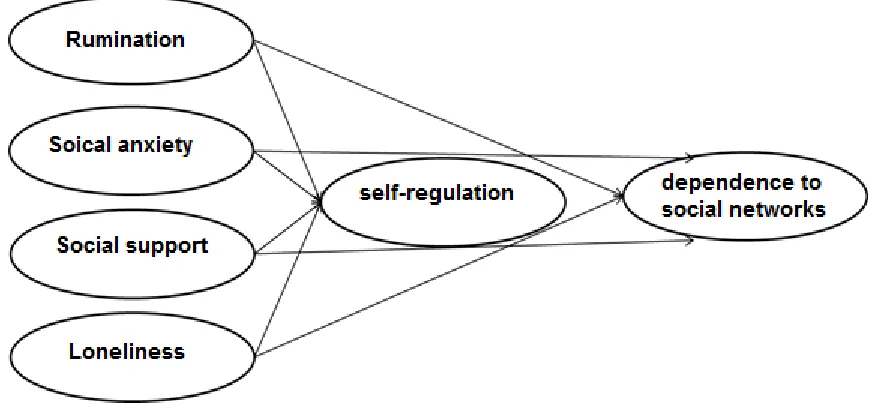
present study, based on this modified model, the self-regulatory construct is considered as an intermediate variable. In sum, and considering the above, the path coefficients of effective factors on dependence on virtual social networks can be determined in the form of a conceptual model. Figure (1) represents the conceptual model of research.
Figure 1. The Conceptual Model of the Factors Affecting dependency on virtual social networks
The present research used structural equation model (covariance matrix approach) to fit the conceptual model to field data. The logic of using the structural equation model is that using the model instead of performing multiple zero hypothesis testings reduces the probability of a type-1 error. This model is also able to calculate the measuring errors. It is clear that this makes it more valid and capable.
3. Methodology
the present study is applied in terms of purpose and in terms of data collection method, it is descriptive and in relation to the relationship between the variables of the research is causal. The method of doing this research is also based on survey One of the most important benefits of which is the ability to generalize the results. The research plan is considered as a correlation type (covariance matrix). The statistical population of this study included all secondary school students in Tehran who studied in the academic year of 2017-18. A total of 600 students were randomly selected and the Multi-stage cluster sampling method was used. From the twenty-two regions of Tehran, four districts were randomly selected from Tehran and then thirty classes were randomly selected from ten schools in districts three, four, eight and twelve. Thirty-five of the students were not members of social networks. Fifty-one of the questionnaires were excluded due to being distorted.
The data was collected using the following six questionnaires: a) the rumination response sub-scale of Nollen, Hoeksma, & Morrow (1991) b) Puklek Social Anxiety Scale (2004) The Multivariate Scale of Perceived Social Support (zimet et al., 1988), Russell's Loneliness Scale (1996), e) Brown, Miller, & Lawendowski’s self-regulation questionnaire (1999) and f) The researcher-made questionnaire which evaluated dependence on virtual social networks. It should be noted that the reliability of these
questionnaires obtained using Cronbach's alpha was 0.90, 0.70, 0.80, 0.90, 0.80, and 0.86 respectively, which indicates a favorable internal consistency in the sample.
4. Findings
In order to evaluate the proposed model of research, Structural Equation Modeling was used through R programming. the Maximum Likelihood Method was used for estimating the pattern among the fit indices, chi-squared test (x2) The Root Mean Square Error of Approximation (RMSEA), The goodness of fit index (GFI), adjusted goodness of fit index (AGFI), the comparative fit index (CFI) and the normed fit index (NFI) have been used. In Table 1, the fit indices of the proposed model of research are presented.
Table 1. Fitting indices of the model
X2 df
RMSEA GFI
AGFI CFI
NFI
60.15 20
0.062 0.99
0.99 0.98
0.96
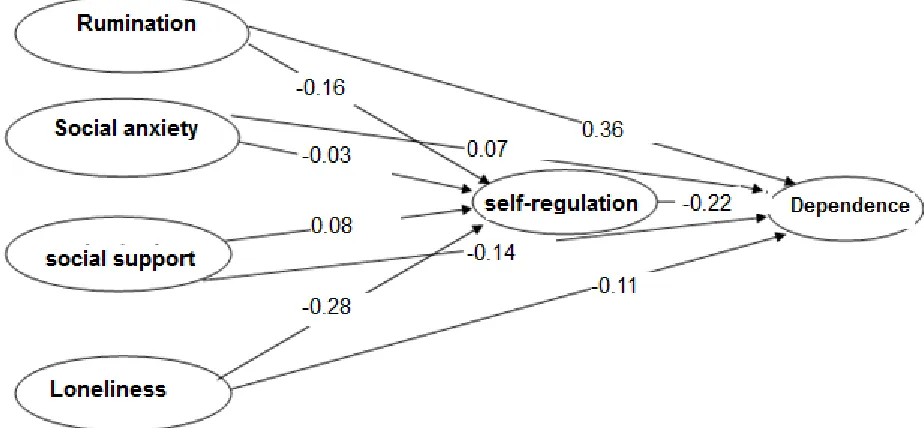
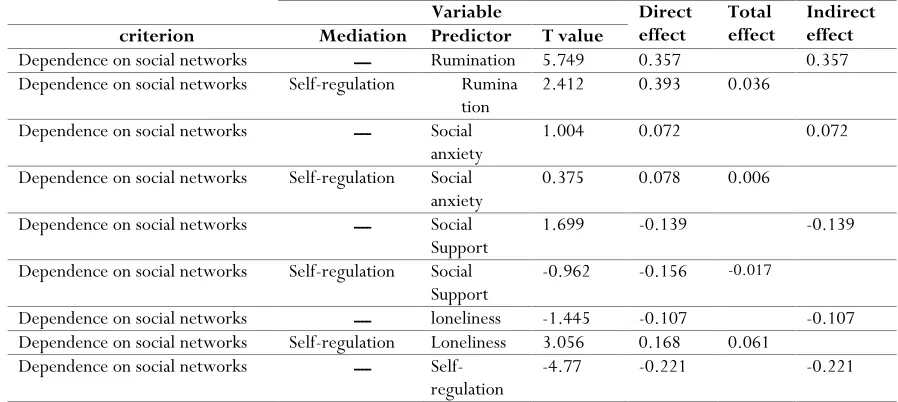
According to the results of Table 1, the model has an Appropriate fit. As a result, the main hypothesis of the research about the fitting of the model with data can be confirmed. Figure 2 shows the model of the path coefficients of the conceptual model of research, and also Table 2, in addition to these coefficients, shows the direct, indirect and total effects of variables and their significance.
Figure 2. The Final Model of the Factors Affecting dependency on virtual social networks
Table 2. Direct and indirect effects of all the variables on dependency on virtual social networks Indirect effect Total effect Direct effect Variable T value Predictor Mediation criterion 0.357 0.357 5.749 Rumination ــــ
Dependence on social networks
0.036 0.393 2.412 Rumina tion Self-regulation
Dependence on social networks
0.072 0.072 1.004 Social anxiety ــــ
Dependence on social networks
0.006 0.078 0.375 Social anxiety Self-regulation
Dependence on social networks
-0.139 -0.139 1.699 Social Support ــــ
Dependence on social networks
-0.017 -0.156 -0.962 Social Support Self-regulation
Dependence on social networks
-0.107 -0.107
-1.445 loneliness
ــــ
Dependence on social networks
0.061 0.168
3.056 Loneliness
Self-regulation Dependence on social networks
-0.221 -0.221 -4.77 Self-regulation ــــ
Dependence on social networks
The results of Table (2) indicate that rumination, directly and indirectly, self-regulation directly and indirectly and loneliness can indirectly affect dependence on virtual social networks. Also, this table indicates that the direct and indirect effects of social anxiety and social support, as well as the direct impact of loneliness on the dependence on virtual social networks, are rejected at the alpha level of 0/05 and are not significant.
5. Discussion
In recent years, the use of the Internet has increased significantly and it has become a vital part of the fields such as social communication, scientific research, and entertainment. Despite the positive and significant effects of the Internet on the everyday life of each individual, various studies have shown that the Internet can cause psychological problems for some people and affect their lives (Widyanto & Griffiths, 2006; Chou, Condron and Belland, 2005). Extreme dependence on virtual social networks is among these psychological problems, which, coupled with the inability to control the use of virtual social networks, can lead to social, educational and professional problems in the life of an individual (Schaffer, Hall, Vander and Bilt 2000). The purpose of this study was to design a structural model of the dependence on virtual social networks based on four variables of rumination, social support, loneliness and social anxiety, with an emphasis on the mediating role of self-regulation and attempted to reveal the complex relationships between these variables using Covariance matrices.
Fitting the conceptual concept with the field data showed that the model had a proper fit because the fitting indexes were in a favorable state, that is, predictive variables (rumination, social support, loneliness, social anxiety and self-regulation) could all have a Significant impact on criterion variables (self-regulation and dependence on virtual social networks). This finding is consistent with some aspects of Giannakos, Chorianopoulos, Giotopoulos and Vlamos (2014), and Panek, Nardis and Konrath (2013) research.
Regarding the effect of self-regulation on the dependence on virtual social networks, self-regulation makes a person capable of producing or adapting thoughts, feelings, and actions, and provides the basis for achieving goals. In other words, self-regulation is associated with the development of knowledge and skills that underlies an individual’s effective change. It is clear that students who do not have this capability, face difficulty to manage their emotions and unreasonably prefer the excitements of the virtual social networks to real-life goals, and are affected by malicious consequences resulted by extreme dependency on it. This
finding is in line with some aspects of the research of the Spada (2014); Dawe and Loxton (2004). Regarding the direct and indirect influence of rumination and also the indirect effect of loneliness on the dependence on virtual social networks, both types of cognitions being incompatible and confirmed in the present study, these incompatible cognitions divest from the individual The ability to properly state and define the problem and provide a solution; in other words, they reduce self-regulation, thereby causing an individual to use virtual social networks uninterruptedly regardless of the prospective consequences. Incompatible cognitions and rumination in particular can remind a person of more amplified memories of virtual networks, which leads to a more and deeper dependency on virtual networks. This finding is consonant with some of the research findings of Davis (2001); Mai et al. (2012); Kaplan (2010); Feinstein et al (2013); Locatelli, Kluwe, Bryant (2012).
Regarding the insignificant relation of the direct and indirect effects of social anxiety and social support, as well as the direct impact of loneliness on dependence, it can be said that the extrinsic and objective nature of social anxiety and social support in such a way that a person only experiences anxiety To take action in a real social position or to objectively receive support from friends or family members has caused the issue not to be extended to virtual space which is not based on reality and all its activities can be done anonymously. The result is insignificancy of the impact of these two structures on the dependence on virtual social networks which is in line with the research of Pumper and Moreno (2012); as well as Campbell, Cumming and & Hughes (2006). Also, in relation to the insignificance of the direct impact of loneliness on dependence, it can be said that loneliness is an inner and stable feeling that in this research, seems to be extended to using virtual space, in a way that a teenager who carries such a feeling, feels the same while using the cyberspace in terms of loneliness. This finding is in line with the research of Karaköse, Yırcı, Uygun, and Özdemir (2016).
This study helps consultants, policy-makers, parents, and teachers to effectively provide the underlying requirements for reducing dependence on virtual social networks. The findings of this study also help researchers to develop a more complicated model in order to achieve a better and understanding of the problem. It should be noted that the present research is based on self-report questionnaires that it is recommended to use other methods of obtaining information such as interview, observation, etc. in other researches. Also, when generalizing the results, it should be noted that this research is for a particular city, section, gender, and a certain time frame that should be considered when generalizing these points.
References
Andreassen C S, Pallesen S. (2014). Social network site addiction: An overview. Current Pharmaceutical Design, 20 (25): 4053– 4061.
Boyd D M, Ellison N B. (2007). Social network sites: Definition, history, and scholarship. Journal of Computer-Mediated Communication, 13(1): 210-230.
Campbell A J, Cumming S R, Hughes I. (2006). Internet Use by the Socially Fearful: Addiction or Therapy? Cyber Psychology & Behavior, 9(1): 69-81.
Caplan S. (2010). Theory and measurement of generalized problematic internet use: A two-step approach. Computers in Human Behavior, 26(5): 1089-97.
Carver C S, Scheier M F. (1998). On the self-regulation of behavior. New York, USA: Cambridge University Press.
Chou C, Condron L, Belland J C. (2005). A Review of the Research on Internet Addiction. Educational Psychology Review, 17(4): 363-388.
Davis R A. (2001). A cognitive–behavioral model of pathological Internet use. Computers in Human Behavior, 17(2): 187-195. Dawe S, Loxton N. (2004). The role of impulsivity in the development of substance use and eating disorders.
Neuroscience and Bio Behavioral Reviews, 28 (3): 343–351.
Elphinston R A, Noller P. (2011) Time to Face it! Facebook intrusion and the Implications for romantic Jealousy and Relationship Satisfaction. Cyber Psychology, Behavior and Social Networking, 14(11): 631-635.
Feinstein B A, Hershenberg R, Bhatia V, Latack J A, Meuwly N, Davila J. (2013). Negative social comparison on facebook and depressive symptoms: Rumination as a mechanism. Psychology of Popular Media Culture, 2(3): 161-170.
Giannakos M, Chorianopoulos K, Giotopoulos K, Vlamos P. (2013). Using facebook out of habit. Behavior & Information Technology, 32(6): 594- 602.
Jaiswal S, Sinha D. (2017). Understanding Online Social Networking in Terms of Mental Health: A Boon or Bane?. Research in Medical & Engineering Sciences, 1 (4): 1 -4.
Karaköse T, Yırcı R, Uygun H, Özdemir T. (2016). The relationship between High School Students' Facebook Addiction and Loneliness Status. Eurasia Journal of Mathematics, Science & Technology Education, 12(9): 2419- 2429.
LaRose R, Kim J, Peng W. (2010). Social networking: Addictive, compulsive, problematic, or just another media habit? In Z. Papacharissi (Ed.), A networked self: Identity, community, and culture on social network sites (pp. 59-81). New York: Routledge, Taylor and Francis.
Larose R, Mastro D, Eastin M S. (2001). Understanding internet usage: A social-cognitive approach to uses and gratifications. Social Science Computer Review, 19(4): 395-413.
Locatelli S M, Kluwe K, Bryant F B. (2012). Facebook use and the tendency to ruminate among college students: Testing meditational hypotheses. Journal of Educational Computing Research, 46(4): 377–394.
Mai Y, Hu J, Yan Z, Et al. (2012). Structure and function of maladaptive cognitions in pathological internet use among Chinese adolescents. Computer in Human Behavior. 28(6):2376–2386.
Panek E T, Nardis Y, Konrath S. (2013). Mirror or Megaphone? How relationships between narcissism and social networking site use differ on Facebook and Twitter. Computers in Human Behavior, 29(5): 2004–2012.
Pumper M, Moreno M. (2012). Perception, Influence, and social anxiety among Adolescent Facebook Users. Journal of Ado - lescent Health, 50 (2): 52-58.
Shaffer H J, Hall M N, Vander Bilt J. (2000). “Computer addiction”: a critical consideration, American Journal of Orthopsychiatry, 70(2): 162–168.
Spada M M. (2014). An overview of problematic Internet use. Addictive Behaviors, 39(1) :3–6.
Thadani D, Cheung C. (2011). Exploring the role of online social network dependency in habit formation. Thirty Second International Conference on Information Systems, Shanghai, China.
Widyanto L, Griffiths M. (2006). "Internet addiction": A critical review. International Journal of Mental Health and Addiction, 4(1): 31-51.
Zimmerman B J. (2001). Theories of self-Regulated learning and academic achievement: an Overview and Analysis. In Zimmerman, B.J. & Schunk, D.H. (eds.). Self-Regulated Learning and Academic Achievement: Theoretical Perspectives (1-65). Mahwah, NJ: Lawrence Erlbaum Associates Publishers