Effectiveness of Interactive Microcontroller Based Speed
Sensors to Improve Students' Analytic Thinking Skills
https://doi.org/10.3991/ijoe.v16i09.15185
Koyimah, Wahono Widodo, Nadi Suprapto, Binar Kurnia Prahani () Universitas Negeri Surabaya, Surabaya, Indonesia
Abstract—This research is a science, technology, engineering and
mathe-matics (STEM) implementation at the senior high school level. The purpose of the research was to produce an interactive microcontroller-based speed sensor that was feasible to improve students' analytical thinking skills (ATS) in the impulse and momentum learning. This research is a kind of research & devel-opment (R&D) that uses a pre-experimental design with one group pre-test post-test study. Data collection used validation sheet, ATS test, observations sheet, questionnaires, and then analysed using Wilcoxon test, N-gain, and de-scriptive qualitative analysis. The research findings were the interactive micro-controller-based speed sensor devices and learning materials which were cate-gorised as very valid. The interactive microcontroller-based speed sensor in im-pulse and momentum learning was effective, as specified by three criteria. First, there was a significant increase in students' ATS at α = 5%. Second, the average N-gain of impulse and momentum learning was categorised as high (.89). Third, students' responses in each learning process were categorised as very positive.
Keywords—Analytical thinking, interactive microcontroller, speed sensor
1
Introduction
Physics as one of the natural sciences or science that studies the behavior and structure of matter. One important aspect that exists in science is the observation or observation of events starting from the initial planning to the implementation. [1]. Observation is an empirical scientific activity based on facts and texts, through the experience of the five senses without using any manipulation [2]. Presenting facts in-class learning is not an easy thing to do, especially in impulse and momentum materi-al. The physical magnitude which influences the discussion of momentum is mass and velocity. But the speed is difficult to measure using simple tools or manuals because it deals with a very short time. In addition to knowing the consequences of the event of the application of momentum and impulses using a gradual calculation and requires measuring devices based on modern technology such as digital speedometers.
involves the process of breaking down material into small parts and determining how the relationship between parts and between each part and the overall structure [10-16]. Three aspects of ATS according to Anderson & Krathwohl [10-11] include distin-guishing, organizing and connecting, while the description of sub-skills for APS [12] includes reviewing ideas, identifying arguments and analyzing arguments [15]. De-parting from the need to deliver students to have higher order thinking skills (i.e. ATS), researchers have developed interactive microcontroller-based speed sensors on learning momentum and impulses. The focus of this article is on the effectiveness of interactive microcontroller-based speed sensors to improve students' ATS.
2
Literature Review
2.1 Interactive microcontroller-based speed sensor
Impulse and momentum observation tools use a speed sensor based on a microcon-troller made from the following materials:
• Photodiode Sensor; also called a light sensor, the electronic component functions to change the light signal into electrical output.
• LCD (Liquid Crystal Display); LCD functions as a display of data both characters, letters or graphics. In this study to display the speed before and after the collision, and the coefficient of restitution.
• DC motor; DC motor is an electric motor that functions to provide direct current voltage on the field coil to be converted into mechanical motion energy.
• Power supply or DC Power Supply; the power supply serves as a source of electric power.
• Laser diode; Diode lasers are semiconductor lasers. The wavelength of the laser diode can be measured using a wave meter. A simple way can be done using a dif-fraction grating.
• Acrylic; Acrylic is a plastic raw material that resembles glass, its characteristics are sturdy and strong and the surface is slippery so that the friction is small.
• Arduino Nano; Arduino is an open source electronic board programmed to be able to read input, process, and provide output as desired.
Fig. 1. Schematic Microcontroller Circuit
Procedures of interactive microcontroller-based speed sensors:
• Power supply functions to provide power supply to all electronic devices that have been installed, starting from the microcontroller, 20x4 LCD character, speed sensor and launch motor.
• The vehicle moves from the launch motor, where the launch motor provides addi-tional energy to the vehicle unit so that the vehicle can go at the speed set.
• The launcher works using two DC motors with the opposite direction of rotation. One is moving CW (clockwise) and the other is CCW (counterclockwise).
• The voltage consumed by the launcher motor comes from the power supply that is passed to the voltage regulator so that the rotation speed of the motor can be regu-lated.
• After passing the launch motor, the vehicle moves to the speed sensor at the end of the track. Where the speed sensor there are 4 pairs of light sensors (Laser and Pho-todiode).
• The light sensor works to detect passing vehicles by comparing the incoming light when it is not blocked by the vehicle and when it is blocked by the vehicle. When blocked by a vehicle, the light from the laser cannot be received by the photodiode sensor. And when the vehicle is not blocked, laser light can be directly received by the photodiode sensor. From these two conditions, the microcontroller can detect the presence or absence of a passing vehicle.
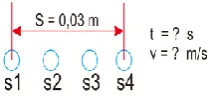
• The speed sensor utilizes several light sensor units. Illustration of the work of the speed sensor in Figure 2.
When the vehicle passes sensor 1 (s1), the microcontroller starts its timing (Timer), until the vehicle reaches sensor 4 (s4). The timer (timer) on the microcontroller gets the time data needed by the vehicle from point S1 to point S4. The distance from S1 and S4 has been determined by the mechanical design as far as 3cm. So, the vehicle speed can be determined by the equation v = s / t.
The speed sensor is placed at the end of the track where the vehicle collides. Be-fore the collision, the vehicle moves from s1 to s4 and vice versa after experiencing collision the vehicle moves from s4 to s1.
With the same principle, the microcontroller can determine the speed of the vehicle before the collision (v) and after the collision (v ').
From the two data v and v ', the restitution coefficient (e) can be determined by the equation e = v' / v. the speed of the impact media is negligible.
All three data are displayed on a 20x4 LCD character.
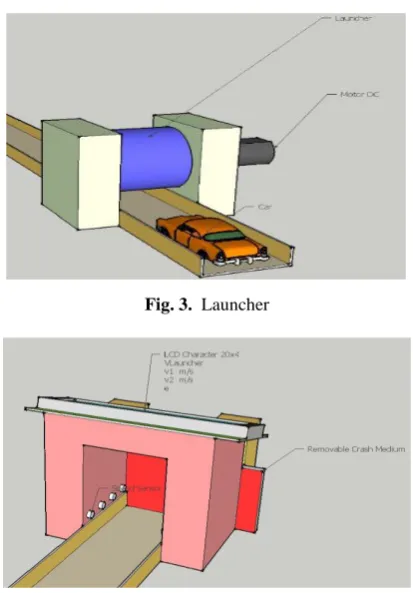
The learning media mechanism for observation consists of 5 main components namely the Launcher, Speed Checker, Speed. Sensor of the hot-wheels and the run-ning of the hot-wheels. Activator that functions to move the car to get to Speed Checker and pass the speed sensor. This drive is equipped with a potentiometer to set the desired speed. Speed hecker walls can be replaced with various materials such as acrylic, rubber, iron and other metals.
Fig. 3. Launcher
After being crushed by hot-wheels, the speed checker can display speed data before the collision, the speed after the collision and the coefficient of restitution. By know-ing speed data both before and after the collision and the coefficient of restitution, it is expected that students will be able to analyze the collision event and the impact of the collision.
2.2 Analytical thinking skills
Based on the literature review [3-16], in this study, researchers formulated ATS in-dicators in Table 1.
Table 1. Indicators of ATS
ATS Science Process Skills
Distinguish Plan an experiment; Measure Classifying; Apply the concept; Communicating results
Organize Make a graph; Predict
Connect Interpret; Apply the concept.
3
Method of Research
This research is a kind of R & D research that uses a pre-experimental design with one group pretest-posttest study [17]. Sample of this research is students in SMAN 1 Kebomas (i.e State Senior High School in Indonesia) with purposive sampling. This research is emphasized on the analysis of the effectiveness interactive microcontrol-ler-based speed sensors by analyzing the increase of students’ ATS before and after following the process of impulse and momentum learning. The research began by giving the ATS pretest (O1) by using the ATS test of students, then providing physics learning (i.e. impulse and momentum learning) with assisted interactive microcontrol-ler-based speed sensors. Finally, after the entire impulse and momentum learning process has been completed, students are awarded a posttest (O2) of the ATS with the same materials and problems as in the pretest. The ATS test was reliable and valid.
In order to analyze the effectiveness interactive microcontroller-based speed sen-sors, an “effective” operational definition is required. The interactive microcontroller-based speed sensors are said to be effective if:
1.There is a significant increase of ATS of students at α = 5% 2.The average N-gain at least in moderate category.
3.Students' responses are at least positive. In order to get increasing level of students' ATS score, the calculation was done by using N-gain [18].
4
Results & Discussion
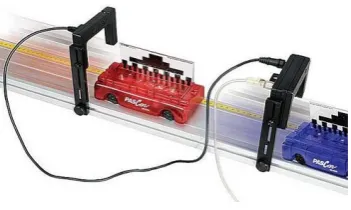
750. This calibration activity was carried out in the Mechanics laboratory at the physics department of the Faculty of Mathematics and Natural Sciences, Surabaya State University, Indonesia.
Fig. 5. Setting of Speed Sensor
Fig. 6. Photo Gate Phasco Interface 750
The calibration results with Photo Gate Phasco Interface 750 obtained the accuracy of the speed sensor reached 99.93%. With the results of the instrument and the calibration results, it can be concluded that this speed sensor is valid for use in research.
The implementation of learning at each stage of learning meets the category very well. The results of the reliability of the instrument learning sheet obtained 100% which means that learning is carried out properly according to the learning implementation plan.
The students' ATS test is carried out before the pretest at the second meeting and after the presentation of the results of the third meeting (posttest). The pretest is done to find out the ability of students before doing the practicum by using a speed sensor.
While the posttest aims to determine changes in students' ATS after the practical process using impact media is accomplished. In this research, statistical test results show that students' ATS data are homogeneous and normally distributed (except posttest score). Therefore, Wilcoxcon test is used to test the students' ATS data. The Wilcoxcon test results of students' ATS are presented in Table 2.
Table 2. The Wilcoxcon test results of students' ATS Pretest-Postest of students' ATS
Z -4.790a
p (2-tailed) .000
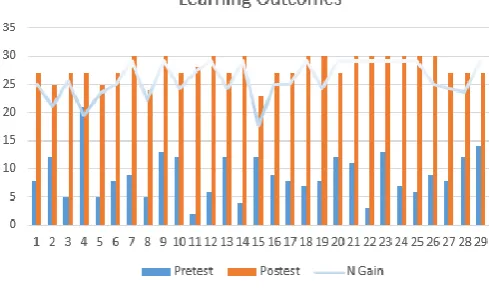
Table 2 shows that the result of Wilcoxcon test is significant, because p < .05. Therefore, Z counts the negative value, then clearly there is a significant difference at α = 5% between the pretest score with the students' ATS posttest. For physics learning with microcontroller-based speed sensor show higher posttest score compared to the pretest score, or the mean scores of students' ATS after impulse and momentum learning process with microcontroller-based speed sensors was higher than before. N-gain score of students' ATS is shown in the Figure 8.
Fig. 8. Students' ATS improvement score
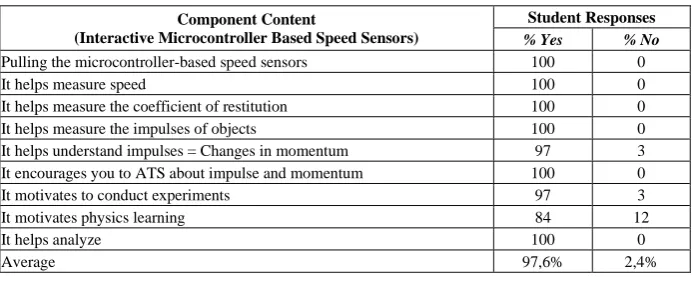
Student responses to guided inquiry learning activities were obtained using a ques-tionnaire sheet that was given after the third meeting learning activity was completed. The results of the analysis of student responses to learning by using a speed sensor can be seen in Table 3.
Table 3. Student response results to interactive microcontroller-based speed sensors Component Content
(Interactive Microcontroller Based Speed Sensors)
Student Responses
% Yes % No
Pulling the microcontroller-based speed sensors 100 0
It helps measure speed 100 0
It helps measure the coefficient of restitution 100 0
It helps measure the impulses of objects 100 0
It helps understand impulses = Changes in momentum 97 3
It encourages you to ATS about impulse and momentum 100 0
It motivates to conduct experiments 97 3
It motivates physics learning 84 12
It helps analyze 100 0
Average 97,6% 2,4%
Table 3 show that students' ATS responses after participating in the learning pro-cess using a speed sensor with a guided inquiry model 100% of students interested, assisted in the measurement of speed, coefficient of restitution, impulse and momen-tum. The students feel motivated in learning get 84% and 100% of students agree that speed sensors help analyze collision-related phenomena.
Based on the results and the discussion above shows that interactive microcontrol-ler-based speed sensors have proven to be effective in increasing students' ATS in impulse and momentum learning. The research finding is supported by research re-sults [4,7-8,19-26] which show that media and learning using science, technology, engineering, and mathematics can improve student learning outcomes (i.e. thinking skills).
5
Conclusion
implication is that interactive microcontroller-based speed sensors can be used as an alternative innovative solution to improve students' ATS.
6
References
[1]Giancoli, D.C, Physics. New York: Addison-Wesley (2010).
[2]Hasanah, H., Teknik-Teknik observasi. Jurnal at-Taqaddum, 8, 1, 21-46 (2016).
[3]Cheng, M.H.M., and Wan, Z.H., Exploring the effects of classroom learning environment on critical thinking skills and disposition: a study of Hongkong 12th graders in liberal stud-ies. Think. Skills Creativity, 24, 152-163 (2017). https://doi.org/10.1016/j.tsc.2017.03.001
[4]Ismail, N.S., Harun, J., Zakaria, M.A.Z.M., and Salleh, S.M., The effect of mobile prob-lem-based learning application dicscience PBL on students’ critical thinking. Think. Skills
Creativity, 28, 177-195 (2018). https://doi.org/10.1016/j.tsc.2018.04.002
[5]Prayogi, S., Muhali, M., Yuliyanti, S., Asy’ari, M., Azmi, I., and Verawati, N.N.S.P. The effect of presenting anomalous data on improving student’s critical thinking ability. Int. J.
Emerg. Technol. Learn., 14, 6, 133-138 (2019). https://doi.org/10.3991/ijet.v14i06.
9717
[6]Wahyudi, Verawati, N.N.S.P., and Ayub, S., The effect of scientific creativity in inquiry learning to promote critical thinking ability of prospective teachers. Int. J. Emerg. Technol.
Learn., 14, 14, 122-131 (2019). https://doi.org/10.3991/ijet.v14i14.9532
[7]Wahyuni, S., Sanjaya, I. G. M., Erman, E., and Jatmiko, B., Edmodo-based blended learn-ing model as an alternative of science learnlearn-ing to motivate and improve junior high school students’ scientific critical thinking skills. Int. J. Emerg. Technol. Learn., 14, 7, 98-110 (2019). https://doi.org/10.3991/ijet.v14i07.9980
[8]Ding, X.W. The effect of wechat-assisted problem-based learning on the critical thinking disposition of EFL learners. Int. J. Emerg. Technol. Learn., 11, 12, 23-29 (2016).
https://doi.org/10.3991/ijet.v11i12.5927
[9]Zetriuslita, H., Ariawan, R., and Nufus, H. Students’ critical thinking ability: description based on academic level and gender. Journal of Education and Practice, 7, 12, 154-164 (2016).
[10]Anderson, L W., and Krathwohl. D.R., A Taxonomy for Learning, Teaching and As-sessing: A Revision of Bloom’s Taxonomy of Educational Objectives. NewYork: Long-man (2001).
[11]Winarti., Profil kemampuan berpikir analisis dan evaluasi mahasiswa dalam mengerjakan soal konsep kalor. Jurnal Inovasi dan Pembelajaran Fisika, 2, 1, 19-24 (2015).https://doi.org/10.26877/jp2f.v7i1.1148
[12]Facione, P.A., Critical thinking: What it is and why it counts. Insight Assessment, 1-28 (2013).
[13]Ennis, R.H., Critical thinking: Reflection and perspective-Part I. Inquiry, 26, 1, 4-18 (2011).
[14]Mulnix, J.W., Thinking critically about critical thinking. Educational Philosophy and The-ory, 44, 5, 464-479, (2012). https://doi.org/10.1111/j.1469-5812.2010.00673.x
[15]Sudibyo, E., Widodo, W., and Jatmiko, B. Pembelajaran Fisika Konteks Olah Raga: Pem-belajaran Berbasis Konteks (CBL) dan Implementasinya. Surabaya: Jaudar Press (2015). (in Indonesian).
[17]Fraenkel, J., Wallen, N., and Hyun, H., How to Design and Evaluate Research in Educa-tion. New York: McGraw-Hill (2012).
[18]Hake, R. R., Interactive-engagement versus traditional methods: A six-thousand-student survey of mechanics test data for introductory physics courses. Am. J. Phy., 66, 1, 64-74 (1998). https://doi.org/10.1119/1.18809
[19]Adam, A.S. and Suprapto, N. One-stop physics e-book package development for senior high school learning media. Int. J. Emerg. Technol. Learn., 14, 19, 150-158 (2019).
https://doi.org/10.3991/ijet.v14i19.10761
[20]Avsec, S., Jagiello-Kowalczyk, M. and Markiewicz, P., Engineering thinking to enhance architectural design. World Trans. on Engng. and Technol. Educ., 16, 2, 134-139 (2018). [21]Flogie, A. and Aberšek, B. Transdisciplinary approach of science, technology, engineering
and mathematics education. J. of Baltic Science Educ., 14, 6, 779-790 (2015).
[22]Gregory, E., Hardiman, M., Yarmolinskaya, J., Rinne, L., and Limb, C., Building creative thinking in the classroom: from research to practice. Inter. J. of Educational Research, 6, 2, 43-50 (2013). https://doi.org/10.1016/j.ijer.2013.06.003
[23]Oberfrancova, L., Legeny, J. and Špaček, R., Critical thinking in teaching sustainable ar-chitecture. World Trans. on Engng. and Technol. Educ., 17, 2, 127-133 (2019).
[24]Purnamawati, Mulbar, U., and Saliruddin, The development of metacognition-based learn-ing media for the industrial electronics field in a vocational high school. World Trans. on
Engng. and Technol. Educ., 15, 1, 82-87 (2018).
[25]Purwaningsih, E., Wasis, Suyatno and Nurhadi, D., Innovative lesson study (LS) to im-prove the pedagogical content knowledge (PCK) of STEM teacher candidates in Indonesia.
Global J. of Engine Educ. 20, 1, 39-47. (2018).
[26]Sumarwati, S., Fitriyani, H., Setiaji, F.M.A., Amiruddin, M.H., and Jalil, S.A. Developing mathematics learning media based on ELearning using moodle on geometry subject to im-prove students' higher order thinking skills. Int. J. Interactive Mobile Technologies. 14, 4, 182-191. (2020). https://doi.org/10.3991/ijim.v14i04.12731
7
Authors
Koyimah, M.Pd. is a Post Graduate Student of Science Education, Universitas Negeri Surabaya, Indonesia.
Assoc. Prof. Nadi Suprapto, Ph.D., Assoc. Prof. Dr. Wahono Widodo.
Dr. Binar Kurnia Prahani are researchers and lecturers in Universitas Negeri Su-rabaya, Indonesia. Email: [email protected].