Jurnal Pendidikan IPA Indonesia
http://journal.unnes.ac.id/index.php/jpiiTHE EFFECTIVENESS USING INQUIRY BASED NATURAL SCIENCE
MODULE WITH AUTHENTIC ASSESSMENT TO IMPROVE THE
CRITICAL THINKING AND INQUIRY SKILLS OF JUNIOR HIGH
SCHOOL STUDENTS
Hairida*
Study Program of Chemistry, Faculty of Teacher Training and Education, Universitas Tanjungpura Pontianak, Indonesia
DOI: 10.15294/jpii.v5i2.7681
Accepted: August 14th 2016. Approved: September 10th 2016. Published: October 2016 ABSTRACT
The aim of this research is to investigate the effectiveness of inquiry-based science modul with authentic assess-ment to develop students’ inquiry skills and critical thinking. This research employed a quasi experiassess-ment method with pretest-posttest control group design. This research is conducted on 7th grade of one of Junior High School in Pontianak, by using 2 classes as a sample. The data was collected by using inquiry skills observation sheets, critical thinking test, and interview. The result shows that the mean of inquiry skills and critical thinking scores of experiment group is higher than the control group, and the significance score from using t-test is (0.00) < 0.05, which means there is a difference of inquiry skills in the experiment and control group. Score of N-gain shows that the mean of experiment group’s inqury skills and critical thinking score after the treatment, is higher than control group. It concludes that science learning by using inquiry-based modul with authentic assessment is effec-tive to develop students’ inquiry skills and critical thinking.
© 2016 Science Education Study Program FMIPA UNNES Semarang Keywords: authentic assessment, critical thinking, inquiry, inquiry skills, science modul
INTRODUCTION
Students’ involvement in the activities un-der investigation (inquiry) in orun-der to find a con-cept is considered primary in science learning. This is important as, in science, learning prioriti-zes skills development and process.
Science learning and inquiry cannot be separated referring to the 2013 curriculum that emphasizes on direct experience in order to de-velop students’ competencies. Thus, students are able to understand the nature around them scientifically and to have the skills of inquiry and critical thinking. There are several findings as the result of the preliminary study of the
lear-ning process in Pontianak Junior High School: 1) teaching and learning process is centered on the teacher, so that students would potentially not de-velop; 2) most of the time, students only listen and record what is described by the teacher. The learning activities tend to be dominated by rote and verbal submission to master knowledge, the-refore, it does not develop students’ critical thin-king skills and scientific work; 3) the assessment of teachers is still limited to paper and pencil test, while the students’ aspects of skills and attitudes tend to be neglected; and 4) the science practi-cum is still rarely performed.
One of the learning strategies that deve-lop curiosity and scientific thinking of students is inquiry learning. Inquiry learning is a method that refers to the students’ activities that develop knowledge (Oguz-Unver & Arabacioglu, 2011).
*Alamat korespondensi: Email: [email protected]
This learning method can help students develop critical thinking skills and construct knowledge as if they are real scientists (Corlu & Corlu, 2012).
Kuhlthau & Todd (2007) stated that in the inquiry strategy, knowledge can be built by the students, so that they are able to carry out inde-pendent learning in science-related issues. Gui-ded inquiry learning model is ideal for science subjects, and some studies have shown that this method is effective to improve student learning outcomes (Abdi, 2014).
Experts’ opinions above reflect that the inquiry learning objective is to develop the thin-king skills of students logically, critically and systematically through inquiry regarding science facts, concepts, and principles. Through inquiry, the critical thinking of students can be developed. Bassham, et al. (2011) suggests that critical thin-king skills are the cognitive skills required to ef-fectively identify, analyze, evaluate arguments or claims what is true, locate and resolve allegations that are subjective, formulate and present the right reason and support the logical conclusion, as well as make decisions about what is to believe and what will be done. Critical thinking skills are also influential for students’ academic and professio-nal success in the future (Quitadamo, et al., 2008) In the inquiry-based science learning, stu-dents’ performance in every inquiry activity is being assessed. For example, during practicum, teachers can assess the process as well as the pro-duct when students conpro-duct group discussions, collect data, answer questions or problems in the handout, conclude solutions, make hypothe-ses, design experiments, take measurements, etc. Thus, the achievement of students in cognitive, affective, and psychomotor can be known quickly and continuously with various types of assess-ment, making it easier for teachers to provide feedback. Assessment that involves all three as-pects are authentic assessment.
The reality in the science learning in Pon-tianak Junior High School shows that many te-achers use the teaching and learning method that is centered on the teacher (traditional). This is because the teachers consider the inquiry strategy difficult to attempt (Wilke & Strait, 2002). Accor-ding to Rustaman (2005), one of the constraints of the implementation of inquiry learning is the limited teaching materials or learning resour-ces. The observations in Pontianak Junior High School show that the inquiry model is rarely prac-ticed because of the lacked supports especially the facilitation for the inquiry activities. Also, te-achers are less skilled in applying inquiry learning strategy. During the science teaching, teachers
of-ten dominate. It is thus necessary to use a new student teaching method, such as inquiry-based science modules. Using inquiry-based modules can help the students to determine the steps of science investigation individually, so that they can develop inquiry skills. Accordingly, this re-search is to answer the question about the effec-tiveness of the implementation of inquiry-based science modules with authentic assessment for ju-nior high school students in improving the skills of inquiry and critical thinking of students.
METHOD
This study aims to determine the effective-ness of the use of inquiry-based science modu-les with authentic assessment. The study used a quasi-experimental research method and the ob-ject was the students of Pontianak Junior High School with the material of food additives. The research design was pretest-posttest control group design (Gall, et al., 2003), with its design as fol-lows:
Pretest Treatment Posttest
Experimental Class O1 X O2 Control Class O1 O2 Information: O1: Pretest Implementation O2: Posttest Implementation X: Treatment
In this study, the pretest was given to the experimental and control class. Then, the posttest was practiced to the experimental students after they learn about food additives using inquiry-based module with authentic assessment, me-anwhile the control class was given the conven-tional learning method.
The population in the study were all of the VII-grade students of 11 Pontianak Junior High School that amounted to 7 classes. The samp-ling technique was cluster random sampsamp-ling, as the homogeneity test results the average score of students’ science daily test is homogeneous. The VIIA class was selected as the experimental group and VIID class as the control group.
The primary variable of this study is the independent and dependent variable. The inde-pendent variable is the learning science using inquiry-based module with authentic assessment in the experimental group, and the learning scien-ce conventionally uses discussions in the control group. The dependent variable in this study are
the skills of inquiry and critical thinking.
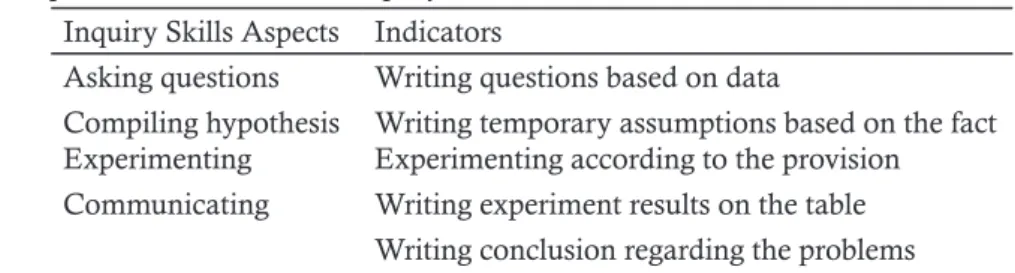
The data collection technique used is data collection tool measurement with the critical thinking & skills tests and observation sheet. Ob-servation sheet is used to measure the skills of quiry during the learning inquiry-based. The in-quiry skills include making observations, asking questions, drawing up hypotheses, and commu-nicating. The complete aspects and indicators of inquiry skills can be seen in Table 1.
The test of critical thinking skill was arran-ged referring to the indicators of critical thinking skill, which is by formulating answers about cases relating to food additives, assessing arguments re-lating to food additives, identifying the relevance and non-relevanan on food additives, finding si-milarities and differences, and making decisions about the negative effects and misuse of food additives. Aspects of critical thinking skill can be seen in Table 2.
Interview implementation refered to the data analysis results of observation, with the aim to support the test result data of critical thinking skills and inquiry skills observation results. Data analysis was performed by grouping the research data based on the indicators on each aspect inqui-ry skill and critical thinking. The average score of students in every aspect was determined by the sum of the scores for each skill aspect, then by the division of number of students. Furthermore, an assessment with hypothesis test using SPSS at the 5% significance level was applied to determine whether there was a difference of critical thinking skills and inquiry among students who applied inquiry-based science module and conventional learning.
The effectiveness in this study can be
seen in the students’ improved skills of inquiry and critical thinking before and after the learning module with inquiry-based food additives with authentic assessment, calculated using the equa-tion normalized gain (Meltzer, 2002), namely: Normalized gain griteria (g)
g < 0,3 : low 7 , 0 3 , 0 ≤g ≤ : middle 0,7≤g : high
The data obtained from the test of critical thinking skills and inquiry skills of observation sheet would be applied with normality test of data distribution using the Shapiro-Wilk statistic, as the sample was <50. If the test results indica-te the the data distribution was normal, then the homogeneity test would be attempted to see di-versed data using Levene’s Test of Equality of Er-ror Variance. To answer a hypothetical problem, AsympSig paired t test (two-tailed) was used.
RESULTS AND DISCUSSION
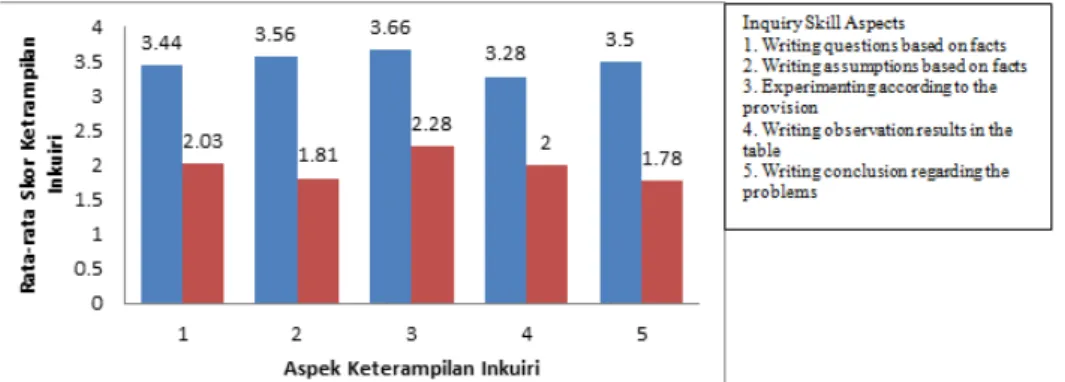
Based on the research data collection, the data of inquiry in the experimental and control class is shown in Figure 1.
Figure 1 above shows that the average skills of inquiry in the experimental class is higher than the control class for all inquiry aspects (writing down the observations results in detail, the ques-tions based on the data, the provisional assump-tions based on facts, the observaassump-tions results in the table, and the conclusion according to the prob-lems). Thus, it can be seen that the inquiry-based science learning on food additives improves the
Table 1. Aspects and Indicators of Inquiry Skills Inquiry Skills Aspects Indicators
Asking questions Writing questions based on data Compiling hypothesis
Experimenting
Writing temporary assumptions based on the fact Experimenting according to the provision Communicating Writing experiment results on the table
Writing conclusion regarding the problems
Tabel 2. Critical Thinking Skill
Aspect Critical Thinking Indicator
Giving simple explanation Formulating answers regarding food additives cases Valuing arguments regarding food additives
Building Basic Skills Identifying the relevance and the irrelevance of food additives Finding the similarities and differences of food additives
Critical Think-ing Inquiry Levene Sta-tistic Sig. Based on Mean .420 .065
Sig price obtained. > 0.05 for all data, meaning the data is expressed homogeneous. All meets the requirements, followed by a test of the hypothesis. Hypothesis test results used paired t-test sig price. (0.00) is less than 0.05, then Ho is rejected, which means that there is a difference between students’ inquiry skills that used inqui-ry-based science modules with authentic assess-ment and conventional learning. Thus, the use of inquiry-based additives module with authen-tic assessment affects the students’ inquiry skills. Similarly, the results of hypothesis testing on the data of critical thinking skills, the sig. (0.00) price skills of inquiry. Analysis of the test data of
stu-dents’ critical thinking skills in experimental and control class obtained on Figure 2:
Figure 2 shows that the average critical thinking skills of students in the experimental class was higher than the control class for all as-pects of critical thinking. Thus, the use of inquiry-based science modules with authentic assessment was considered effective to improve students’ cri-tical thinking skills.
Research hyphothesis test was conducted after the test requirements, which is the normality test on all inquiry and critical thinking skills data. The test results of normality with the Shapiro-Wilk test was obtained as follows:
Price Sig. > 0.05, meaning that data is ot-herwise normal. As all the data is normally distri-buted, then the homogeneity test was conducted, which results as follows:
Information: Blue = Experimental, Red = Control
Figure 1. Inquiry skills of the experimental and control class
Information: Blue = Experimental, Red = Control
obtained is less than 0.05, meaning that there are differences in critical thinking skills among stu-dents who applied inquiry-based science modules with authentic assessment and conventional lear-ning.
Based on the calculation of N-gain score, an average N-Score of inquiry skills is obtained for inquiry skills in the control class with 0,25 in the low category, and in the experimental class with 0,70 in the middle category. Meanwhile, the N-gain score of critical thinking skills in the cont-rol class is 0,14 in the low category and in the experimental class with 0,57 in the middle cate-gory. It can be concluded that the inquiry-based learning science module with authentic assess-ment is effective (the middle category) in order to improve the students’ skills of inquiry and critical thinking. It shows that learning to use inquiry-based science modules with authentic assessment is effectively used in learning activities.
Based on the results of the research hypot-hesis test, it is concluded that there are differen-ces in the skills of inquiry and critical thinking among students who applied inquiry-based scien-ce modules and conventional learning. Therefo-re, inquiry-based science modules with authentic assessment affect the inquiry and critical thinking skills of junior high school students.
The experimental group has average skills of inquiry and critical thinking which is better than the control class, therefore, it can be said that the learning module using science-based inquiry learning with authentic assessment is ef-fective to increase inquiry and critical thinking skills of students. This is in line with the results of the research by Neuby (2010) on inquiry that the initial knowledge and student involvement in learning is increased. Furthermore, the results of the research by Remziye (2011) concluded that the science process skills and scientific attitudes of students increased in inquiry-based learning. This is also in line with Wenning (2011) who concluded, the inquiry can improve scientific li-teracy of students and has a better learning value. Further Sochibin, et al., (2009) found that the un-derstanding of the concepts and critical thinking skills increase.
The high average score of inquiry skills in the experimental class compared to the control
class is due to the inquiry-based science modules with authentic assessment. This module greatly assisted students in finding concepts indepen-dently. In addition, students also felt motivated in learning because of the activities students had to do. The involvement of students in learning can be very high, too. Hmelo, et al., (2006) sta-ted, inquiry as an activity which also includes many activities that students have to do, such as making observations, making questions, reading the source books and other sources of informa-tion, planning investigainforma-tion, reviewing what is already known for obtaining evidence in experi-ments, analyzing and interpreting data, finding answers, explaining and predicting. The activities of inquiry students have to do can create better understanding and positive attitude in learning (Kubicek, 2005)
During the teaching and learning that used inquiry-based science modules with authentic as-sessment, students enthusiastically participated in learning activities at every stage of the pro-ceedings. The curiosity of students was clearly visible at the time of the practicum. Students got curious and excited to see the results of the in-vestigation of food ingredients that they consu-me daily. The results of these activities can train students in considering the option of daily food intake. This is important, because when students face problems in life, which requires them to take important decisions, the students already have a stock of how to take the right decisions (Patricia & Ganaden, 2008).
The module assist students in achieving the learning objectives at every stage of the inqui-ry through questions in order to guide students in finding answers to problems. In the experimental class students, the use of tools and materials was in accordance with the student practicum work procedures. The observations also show that the experimental class students perform accurately, carefully and seriously. In practical activities, the experiment results that students obtained was written meticulously organized and tidy in the report book. Meanwhile, in the control class, the experimental results were less complete and less organized. Results of the analysis of observatio-nal data showed, students in the experimental class are more skilled in the classroom than the Class
Inquiry Skill Critical Thinking Skill Shapiro-Wilk
Statistic Df Sig. Statistic Df Sig.
Control .940 32 0.076 .943 32 .089
control class. Thus, the experimental class stu-dents have a better psychomotor abilities.
Modules can be studied by students inde-pendently (Prastowo, 2011). Pummawan research results (2007) regarding the effectiveness of the module development concluded that the module can develop students’ cognitive abilities. Therefo-re, the inquiry-based module is considered a te-aching material that is systematically arranged by following the steps of inquiry and equipped with authentic assessment, which is to help students achieve learning goals. The use of inquiry-based learning modules in the experimental class gre-atly assist students in inquiry activities. Module-based inquiry can guide students in conducting investigations based on the stage in the inquiry learning.
Inquiry strategiy provides an opportunity for students to be active in the working groups (Rigeway & Padilla, 1998). This is in accordance with the opinion of Harlen (2014) that the during inquiry learning, students play an active role to develop understanding in finding ways to resol-ve the problem. Thus, the critical thinking skills, the communication, and the ability to work in-dependently can be developed in a collaborative inquiry-based learning.
According to the aspect of the inquiry skill, observing is the highest acquisition of the score both in the experimental class and the control class (indicator: writing down observation results in detail). On the indicator to make observations, students’ direct observation is to find informati-on. Interview with chemistry teachers obtained information that during this time in chemistry learning, students are used to the lab and creating an individual report after practical completion. Thus, students are used to createing and repor-ting the results of the practicum.
Observational data on both class show that actually most students had followed the procedu-re when they aprocedu-re experimenting in the lab, howe-ver many students in the control class had not yet done their Student Worksheet rightly and comp-letely. More in-depth interviews obtained infor-mation that the students did not complete filling because the time was already over. They also thought that the teachers would not grade their work on the Student Worksheet. Interview with the science teachers obtained information that the student worksheets so far were only being col-lected, without being given any feedback. This is different with what of in the experimental class. Each student was given inquiry-based modules. In addition, authentic assessments were also provided in the modules, so that students could
gauge their own understanding and skills as ac-companied guide / assessment rubric was alrea-dy available. Azim and Khan (2012) concluded that authentic assessment can develop high-level skills, such as: developing questions, interviews, collect data or information, analyze information, presentation, and communication.
Inquiry skills on conclusion writing in ac-cordance with the problems of the control class obtained the smallest average score compared to other aspects, both in the control class itself and the experimental class. According to observation and interviews, it can be concluded that the data written in student worksheet was incomplete. This might be the reason of why students were less interested in filling the questions in the work-sheet. Consequently, when asked to make inqui-ries based on existing data, the students could not do it. When they were asked to make a hypot-hesis, they did many erroneous, too. Therefore, inquiry was highly recommended to practice ana-lytical thinking skills and student learning satis-faction (Nuangchalerm & Thammasena, 2008).
The module assist students in achieving the learning objectives at every stage of the inqui-ry through questions in order to guide students in finding answers to problems. In the experimental class students, the use of tools and materials was in accordance with the student practicum work procedures. The observations also show that the experimental class students perform accurately, carefully and seriously. In practical activities, the experiment results that students obtained was written meticulously organized and tidy in the report book. Meanwhile, in the control class, the experimental results were less complete and less organized. Results of the analysis of observatio-nal data showed, students in the experimental class are more skilled in the classroom than the control class. Thus, the experimental class stu-dents have a better psychomotor abilities.
CONCLUSION
The results of the calculation of the N-gain score indicates that inquiry and critical thinking skills of the students in experimental class is higher than the control class. Therefore, inquiry-based science modules with authentic assessment on food additives is effective to improve the skills of inquiry and critical thinking of students. The results of this study can be used by teachers to improve the skills of inquiry and critical thinking of the junior high school students in learning science.
ACKNOWLEDGEMENT
Gratitude goes for everyone who helped the process of initiating, doing, and finishing this research, who are as follows: Dean of the Faculty of Teaching of Tanjungpura University, Head of Chemistry Education Study Program who had given permission to carry out this rese-arch, teachers of Pontianak Junior High School who had participated in the research, lecturers of chemistry education study program, and ad-ministration staffs who had helped especially on administration concerns.
REFERENCES
Abdi, Ali. (2014). The Effect of Inquiry-based Learn-ing Method on Students’ Academic Achieve-ment in Science Course. Universal Journal of Educational Research 2(1): 37-41.
Azim, S., Khan, M. (2012). Authentic assessment: An instructional tool to enhance students learning.
Academic Research International, 2(3), 314-320. Bassham, G., Irwin, W., Nardone, H., Wallace, J.
(2011). Critical Thinking: A Student’s Introduc-tion. New York; McGraw-Hill.
Corlu, M.A., & Corlu, M.S. (2012). Scientific Inquiry Based Professional Development Models In Teacher Education. Educational Sciences: Theory & Practice. 12(1), 514-521.
Gall, M. D., Gall, J. P., & Borg, W. R. (2003). Educa-tional Research: An introduction (7th ed.). Boston: Allyn & Bacon Publications.
Harlen, Wynne. (2014). Helping children’s develop-ment of inquiry skills. Inquiry in primary science education (IPSE). 1(1): 5-19.
Hmelo, C. E. S., Ducan, R. G., & Chinn, C.A,. (2006). Scaffolding and achievemen in problem-based and inquiry learning:A response to Kirschner, Sweller, and Clark. Journal Educational Psychol-ogist, 42 (2), 99-107.
Kubicek, P. John. (2005). Inquiry-Based Learning, the Nature of Science, and Computer Technology: New Possibilities in Sience Education. Canadi-an Journal of Learning Canadi-and Technology. 31(1), 1-5 Kuhlthau & Todd. (2007). Guided Inquiry: A Frame-work for Learning Through School Librariesin 21st Century Schools. New Jersey: CISSL. (Online). http://cissl.scils.rutgers.edu/guided inquiry/ introduction.-html.htm. on 20 July 2012 Meltzer. 2002. “The Relationship Between
Math-ematics Preparation and Conceptual
Learn-ing Gains in Phisics: a Possible “Hidden Vari-able” in Diagnostic Pretest Scores”. AM. J. Phys,70(12), 1259-1268.
Neuby, Barbara. (2010). Inquiry Teaching in the Col-lege Classroom. The Journal of Effective Teach-ing. 10(1), 4-21.
Nuangchalerm, P & Thammasena, B. (2008). Cogni-tive Development, Analytical Thinking and Learning Satisfaction of Second Grade Stu-dent Learned through Inquiry-Based Learn-ing. Asian Social Science 5 (10), 82-87.
Oguz-unver, A. & S. Arabacioglu. (2011). Overviews On Inquiry Based And Problem Based Learn-ing Methods”. Western Anatolia. Journal of Educational Sciences (WAJES). 1 (3), 30 – 303. Patricia, Rachel & Ganaden, Mildred. (2008). Creative
Activities and Student’s Higher Order Thinking Skills”. Education Journal. 1(66), 22-33. Rastowo, Andi. (2011). Panduan Kreatif Membuat
Ba-han Ajar Inovatif: Menciptakan Metode yang Men-arik dan Menyenangkan. Jogjakarta; Diva Press . Pummawan, Archaree. (2007). The Development of
An E-Learning Module on The Sandy Shores Ecosystem For Grade-8 Secondary Students.
Educational Journal of Thailand, 1(1),95-110. Quitadamo, I.J., Celia L.F., James E.J., & Marta J.K.
(2008). Community-based Inquiry Improves Critical Thinking in General Education Biol-ogy, Science Education Journal, 27, 327 – 337. Ridgeway, V.G & Padilla, M.J. (1998). Guided
Think-ing, Using Tree-level thinking guides to pro-mote Inquiry in the lassroom. The Science Teachr, 8(65), 18-21.
Remziye, Ergul. (2011). The Effect Inqury-Based Sci-ence Teaching on Elementary School Student’s Science Attitudes”. Bulgarian Journal of Science and Education Policy Education. 5(1): 48-68. Rustaman, Nuryani Y. (2005). Perkembangan Penelitian
Pembelajaran Berbasis Inkuiri dalam Pendidikan Sains. Seminar Nasional II Himpunan Ikatan Sarjana dan Pemerhati Pendidikan IPA. Indo-nesia: Universitas Pendidikan Indonesia. Sochibin, A., Dwijananti, P. Marwoto, P. (2009).
Penerapan Model Pembelajaran Inkuiri Ter-pimpin untuk Peningkatan Pemahaman dan Keterampilan Berpikir Kritis Siswa SD. Jurnal Pendidikan Fisika Indonesia, 5, 96-101.
Wilke, R. R. & Straits, W.J. (2002). Practical consider-ations for assessing inquiry-based instruction.
Journal of College Science Teaching, 31(7), 432-435.
Wenning, C. J. (2005). “Levels of inquiry: Hierarchies of pedagogical practices and inquiry process-es.” Journal of Physic Teacher Education Online, 2