Vol. 2, 2013, 36-42
ISSN: 2320 –3242 (P), 2320 –3250 (online) Published on 15 August 2013
www.researchmathsci.org
International Journal of
Type-2 Fuzzy Shortest Path
V. Anusuya1 and R.Sathya2 1
PG and Research Department of Mathematics Seethalakshmi Ramaswami College Tiruchirappalli – 620 002, TamilNadu, India
E-mail : [email protected] 2
Department of Mathematics, K.S.Rangasamy College of Arts & Science Tiruchengode – 637 215, TamilNadu, India
E-mail: [email protected]
Received 16 July 2013; accepted 29 July 2013
Abstract. This paper addresses a Type – 2 fuzzy shortest path on a network using ranking function. A proposed algorithm gives the shortest path and shortest path length from source node to destination node. Here each arc length is assigned to type-2 fuzzy number. An illustrative example is also included to demonstrate our proposed algorithm.
Keywords: Type-2 fuzzy number, Ranking function , Interval type-2 fuzzy number, Footprint of Uncertainty
AMS Mathematics Subject Classification (2010): 03B52, 03E72 1. Introduction
The concept of a type-2 fuzzy set was introduced by Zadeh [14] as an extension of the concept of an ordinary fuzzy set. A type-2 fuzzy set is characterized by a membership function where the membership value for each element of this set is a fuzzy set in [0,1], unlike an ordinary fuzzy set where the membership value is a crisp number in [0,1]. They are useful for incorporating linguistic uncertainties, for example the words that are used in linguistic knowledge can mean different things to different people [5,6].
The fuzzy Shortest path problem was first analyzed by Dubois and Prade [1]. Okada and Soper [10] developed an algorithm based on the multiple labeling approach, by which a number of non dominated paths can be generated. Nagoorgani and Anusuya [8] have studied on Fuzzy shortest path by linear multiple objective programming.
In conventional shortest path problem it is assumed that decision maker is certain about the parameters (distance, time etc.) between different nodes. But in real life situations, there always exist uncertainty about the parameters between different nodes. In such cases the parameters are requested by fuzzy numbers. Lee and Lee [4] have introduced “ Shortest path problem in a Type-2 Weighted Graph”.
This paper is organized as follows: In section 2, some basic concepts are given. Section 3, gives an algorithm to find out the Type-2 fuzzy shortest path and shortest path length from source node to destination node. Section 4 gives the network terminology. To illustrate the proposed algorithm the numerical example is solved in Section 5.
2. Concepts
2.1. Type-2 Fuzzy Set
A Type-2 fuzzy set denoted A, is characterized by a Type-2 membership function
( , )
A
x u
µ
where x∈
X and u∈
Jx⊆
[0,1].i.e., A = { ((x,u),
µ
A( , )
x u
) / ∀ x∈
X, ∀ u∈
Jx⊆
[0,1] } in which 0≤
µ
A( , )
x u
≤
1.A can be expressed as A =
( , ) /( , )
x A x X u J
x u
x u
µ
∈
∫ ∫
∈Jx
⊆
[0,1], where ∫ ∫ denotesunion over all admissible x and u. For discrete universe of discourse ∫ is replaced by ∑.
2.2. Interval Type-2 Fuzzy Set
Interval type-2 fuzzy set is defined to be a T2FS where all its secondary grade are of unity for all fx(u) = 1.
2.3. Footprint of Uncertainty
Uncertainty in the primary membership of a type-2 fuzzy set, A, consists of a bounded region that we call the footprint of uncertainty (FOU). It is the union of all primary membership.
i.e., FOU(A) = x x X
J
∈
∫
The FOU can be described in terms of its upper and lower membership function.
FOU(A) = x X∈
∫
[
µ
A( ) ,x lµ
A( )x u].2.4. Principal Membership Function
i.e., Pr (A) = / x
( )
1x X
u x f u
∈
=
∫
.2.5. Type-2 Fuzzy Number
Let ܣሚ be a type-2 fuzzy set defined in the universe of discourse R. If the following conditions are satisfied:
1. A is normal,
2. A is a convex set,
3. The support of A is closed and bounded, then A is called a type-2 fuzzy number.
2.6. Normal Type-2 Fuzzy Number
A T2FS, A is said to be normal if its FOU is normal IT2FS and it has a primary membership function.
2.7.Extension Principle
Let A1, A2, . . . . , Ar be type-1 fuzzy sets in X1, X2, . . . ,.Xr, respectively. Then, Zadeh’s Extension Principle allows us to induce from the 1 fuzzy sets A1, A2, . . , Ar a type-1 fuzzy set B on Y, through f, i.e,B = f(Atype-1, . . . .,Ar), such that
1 1 1 2 1 1 , ,... ( )
( )
sup
min{
( ),...,
(
)
( )
n n
B A A n
x x x f y
y
x
x iff
y
µ
µ
µ
φ
− − ∈⎧
=
⎨
≠
⎩
0,
f
−1( )
y
=
φ
2.8.Addition on Type-2 Fuzzy Numbers
Let A =
(
)
foralla
FOU A
αα
∪
= (AL,AM,AN,AU)= (( aL1, aL2, aL3, al4;
λ
A), ( aM1, aM2, aM3, aM4), ( aN1, aN2, aN3, aN4), ( aU1, aU2, aU3, aU4))and Let B =
(
)
foralla
FOU B
αα
∪
= (BL, BM, BN, BU)= (( bL1, bL2, bL3, bl4;
λ
B), ( bM1, bM2, bM3, bM4), ( bN1, bN2, bN3, bN4), ( bU1, bU2, bU3, bU4)) be two normal type-2 fuzzy numbers. By using extension principle we haveA + B =
(
)
forallaFOU A
αα
⎡
⎤
⎢
⎥
⎣
∪
⎦
+ foralla(
)
FOU B
αα
⎡
⎤
⎢
⎥
⎣
∪
⎦
= ( AL + BL, AM + BM, AN + BN, AU + BU )
2.9.Ranking Function on Type-2 Fuzzy Number
Let A = (( aL1, aL2, aL3, al4;
λ
A), ( aM1, aM2, aM3, aM4), ( aN1, aN2, aN3, aN4), ( aU1, aU2, aU3,aU4)) be a type-2 normal trapezoidal fuzzy number, then the ranking function is defined
as
R(A) = ( aL1 + 2aL2 + 2aL3 + al4 + 2aM1 + 4aM2 + 4aM3 + 2aM4 + 2aN1 + 4aN2 + 4aN3 + 2aN4 + aU1 + 2aU2 + 2aU3 + aU4) / 36.
3. Algorithm
Step 1: Form the possible paths from starting node to destination node and compute the corresponding path lengths,
L
i i = 1,2,. . . .n for possible n paths.Step 2: Compute the ranking function for all possible lengths
( )
iR L
= ( aL1 + 2aL2 + 2aL3 + al4 + 2aM1 + 4aM2 + 4aM3 + 2aM4 + 2aN1 +4aN2 + 4aN3 + 2aN4 + aU1 + 2aU2 + 2aU3 + aU4) / 36.Step 3: Decide the shortest path length and corresponding path with the minimum rank.
4. Network Terminology
Consider a directed network G(V,E) consisting of a finite set of nodes V = {1,2, . . .n} and a set of m directed edges E⊆VXV . Each edge is denoted by an ordered pair (i,j), where i,j
∈
V and i≠j. In this network, we specify two nodes, denoted by s and t, which are the source node and the destination node, respectively. We define a path Pij as a sequence Pij = {i = i1, (i1,i2),i2,. . . ., il-1, (il-1,il), il = j} of alternating nodes and edges. The existence of at least one path Psi in G(V,E) is assume for every node i∈
V – {s}.
d
ij denotes a Type-2 Fuzzy Number associated with the edge (i,j), correspondingto the length necessary to transverse (i,j) from i to j. The fuzzy distance along the path P
is denoted as
d P
( )
is defined as( , )
( ) ij
i j P
d P d
∈
= ∑
5. Numerical Example
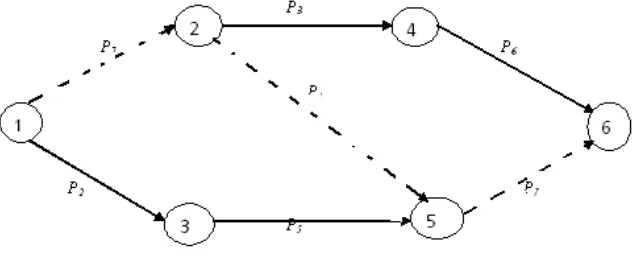
The problem is to find the shortest path and shortest path length between source node and destination node in the network with type-2 fuzzy number.
In this network each edge have been assigned to type-2 fuzzy number as follows:
P1 = ((1.5, 1.8, 2.0, 2.5; 0.3), (1.2, 1.5, 2.0, 2.2), (1.1, 1.3, 1.5, 2.0), (1.0, 1.3, 1.5, 2.0))
P2 = ((1.6, 1.7, 1.8, 2.0; 0.4), (1.5, 1.6, 2.0, 2.5), (1.3, 1.5, 2.0, 2.3), (1.2, 1.4, 1.5, 1.8))
P3 = ((1.8, 1.9, 2.2, 2.6; 0.7), (1.6, 1.9, 2.2, 2.6), (1.5, 1.7, 2.1, 2.3), (1.2, 1.8, 2.3, 2.6))
P4 = ((1.3, 1.5, 1.9, 2.0; 0.9), (1.3, 1.4, 2.3, 2.4), (1.2, 1.6, 2.3, 2.8), (1.0, 1.5, 1.9, 2.3))
P5 = ((1.8, 1.9, 2.3, 2.5; 0.5), (1.6, 1.8, 2.3, 2.4), (1.5, 1.6, 1.9, 2.3), (1.3, 1.6, 1.9, 2.5))
P6 = ((1.5, 1.7, 2.0, 2.5; 0.7), (1.3, 1.6, 2.2, 2.5), (1.2, 1.6, 2.3, 2.6), (1.1, 1.5, 1.8, 2.0))
P7 = ((1.9, 2.0, 2.3, 2.4; 0.6), (1.8, 2.1, 2.3, 2.5), (1.5, 1.7, 2.0, 2.3), (1.4, 1.7, 2.0, 2.5))
Solution:
Step 1: Form the possible paths from starting node to destination node and compute the corresponding path lengths
L
i, i = 1,2,. . . .n for possible n paths.Possible paths are 1 – 2 – 4 – 6; 1 – 2 – 5 – 6; 1 – 3 – 5 – 6. Path lengths are L1 = 1 – 2 – 4 – 6 = P1 + P3 + P6
L2 = 1 – 2 – 5 – 6 = P1 + P4 + P7 L3 = 1 – 3 – 5 – 6 = P2 + P5 + P7
1
L
= ((1.5 + 1.8 + 1.5, 1.8 + 1.9 + 1.7, 2.0 + 2.2 + 2.0, 2.5 + 2.6 + 2.5; min{0.3, 0.7, 0.7 }), ( 1.2 + 1.6 + 1.3, 1.5 + 1.9 + 1.6, 2.0 + 2.2 + 2.2, 2.2 + 2.6 + 2.5), ( 1.1 + 1.5 + 1.2, 1.3 + 1.7 + 1.6, 1.5 + 2.1 + 2.3, 2.0 + 2.3 + 2.6 ), ( 1.0 + 1.2 + 1.1, 1.3 + 1.8 + 1.5, 1.5 + 2.3 + 1.8, 2.0 + 2.6 + 2.0 ))1
L
= ((4.8, 5.4, 6.2, 7.6; 0.3), (4.1, 5.0, 6.4, 7.3), (3.8, 4.6, 5.9, 6.9), (3.3, 4.6, 5.6, 6.6))2
L
= ((1.5 + 1.3 + 1.9, 1.8 + 1.5 + 2.0, 2.0 + 1.9 + 2.3, 2.5 + 2.0 + 2.4; min{0.3, 0.9, 0.6}), (1.2+ 1.3 + 1.8, 1.5 + 1.4 + 2.1, 2.0 + 2.3 + 2.3, 2.2 + 2.4 + 2.5), 1.1 + 1.2 + 1.5, 1.3 +1.6 + 1.7, 1.5 + 2.3 + 2.0, 2.0 + 2.8 + 2.3), (1.0 + 1.0 + 1.4, 1.3 + 1.5 + 1.7, 1.5 + 1.9 + 2.0,2.0 + 2.3 + 2.5))2
L
= ((4.7, 5.3, 6.2, 6.9; 0.3), (4.3, 5.0, 6.6, 7.1), (3.8, 4.6, 5.8, 7.1), (3.4, 4.5. 5.4, 6.8))3
L
= ((1.6 + 1.8 + 1.9, 1.7 + 1.9 + 2.0, 1.8 + 2.3 + 2.3, 2.0 + 2.5 + 2.4; min{0.4, 0.5, 0.6}), (1.5 + 1.6 + 1.8, 1.6 + 1.8 + 2.0, 2.0 + 2.3 + 2.3, 2.5 + 2.4 + 2.5), ( 1.3 + 1.5 + 1.5, 1.5 +1.6 + 1.7, 2.0 + 1.9 + 2.0, 2.3 + 2.3 + 2.3), ( 1.2 + 1.3 + 1.4, 1.4 + 1.6 + 1.7, 1.5 + 1.9 +2.0, 1.8 + 2.5 + 2.5))3
L
= ((5.4, 5.6, 6.4, 6.9; 0.4), (4.8, 5.4, 6.6, 7.4), (4.3, 4.8, 5.9, 6.9), (3.9, 4.7, 5.4 6.8))Step 2: Compute the ranking function for all possible lengths
( )
iR L
= ( aL1 + 2aL2 + 2aL3 + al4 + 2aM1 + 4aM2 + 4aM3 + 2aM4 + 2aN1 + 4aN2 + 4aN3 + 2aN4 + aU1 + 2aU2 + 2aU3 + aU4) / 36.1
( )
R L
= ( 4.8 + 2(5.4) + 2(6.2) + 7.6 + 2(4.1) + 4(5.0) + 4(6.4) + 2(7.3) + 2(3.8) + 4(4.6) + 4(5.9) + 2(6.9) + 3.3 + 2(4.6) + 2(5.6) + 6.6) / 36= 197.7 / 36
1
( )
R L
= 5.4922
(
)
R L
= (4.7 + 2(5.3) + 2(6.2) + 6.9 + 2(4.3) + 4(5.0) + 4(6.6) + 2(7.1) + 2(3.8) + 4(4.6) +4(5.8) + 2(7.1) + 3.4 + 2(4.5) + 2(5.4) + 6.8) / 36= ( 4.7 + 10.6 + 12.4 + 6.9 + 8.6 + 20 + 26.4 + 14.2 + 7.6 + 18.4 + 23.2 + 14.2 + 3.4 + 9.0 + 10.8 + 6.8 ) / 36
= 197.2 / 36
2
(
)
R L
= 5.483
(
)
R L
= (5.4 + 2(5.6) + 2(6.4) + 6.9 + 2(4.8) + 4(5.4) + 4(6.6) + 2(7.4) + 2(4.3) + 4(4.8) + 4(5.9) + 2(6.9) + 3.9 + 2(4.7) + 2(5.4) + 6.8) / 36= ( 5.4 + 11.2 + 12.8 + 6.9 + 9.6 + 21.6 + 26.4 + 14.8 + 8.6 + 19.2 + 23.6 + 13.8 +3.9 + 9.4 + 10.8 + 6.8 ) / 36
= 204.8 / 36
3
(
)
R L
= 5.69Step 3: Decide the Shortest path length and corresponding path with minimum rank.
1
( )
R L
= 5.4922
(
)
R L
= 5.483
(
)
R L
= 5.69Path length L2 is having the minimum rank (
R L
(
2)
= 5.48) The shortest path length is((4.7, 5.3, 6.2, 6.9; 0.3), (4.3, 5.0, 6.6, 7.1), (3.8, 4.6, 5.8, 7.1), (3.4, 4.5. 5.4, 6.8)) And the corresponding shortest path is
1 – 2 – 5 – 6 6. Conclusion
In this paper, we proposed an algorithm for finding shortest path and shortest path length of type-2 fuzzy number by using linear ranking function for type-2 fuzzy numbers from source node to destination node on a network. This proves that it is more flexible and intelligent way in solving problems which deals with uncertainty and ambiguity for choosing the best decision since it uses type-2 fuzzy number rather than type-1 fuzzy number.
REFERENCES
1. D. Dubois and H. Prade, Theory and Applications: Fuzzy Sets and Systems, Man and Cybernetics, 23(2) (1993), 403-405.
2. E. Hisdal, The IF THEN ELSE statement and interval-valued fuzzy sets of higher type, Intern. J. Man-Mach. Stud., 15 (1981), 385-455.
3. R.I. John, Type-2 fuzzy sets: An appraisal of theory and applications, Intern. J. Uncertainty, Fuzziness Knowledge-Based Systems, 6 (6) (1998), 563-576.
5. J.M. Mendel, Computing with words when words can mean different people, Presented at Intern. ICSC Congress On Computational Intelligence: Methods and Applications, Rochester, New York, June 22–25, 1999.
6. M. Mendel and R. I. Bob John, Type-2 Fuzzy Sets made simple, IEEE Transactions on Fuzzy Systems, 10(2) (2002), 117 – 127.
7. H.B. Mitchell, Ranking type-2 fuzzy numbers, IEEE Transactions On Fuzzy Systems, 14(2) (2006), 287 - 294.
8. A. Nagoorgani, and V. Anusuya, Fuzzy shortest path by linear multiple objective programming, Proceedings of the International Conference On Mathematics and Computer Science. Loyola College, Chennai, January 10-11, 2005.
9. Nilesh. N. Karnik and Jerry M. Mendel, Operations on type-2 fuzzy sets, Fuzzy Sets and Systems, 122 (2001), 327–348.
10. S. Okada and T. Soper, A shortest path problem on a network with fuzzy arc lengths, Fuzzy Sets and Systems, 109 (2000), 129–140.
11. D.S. Dinagar and A. Anbalagan, Fuzzy programming based on type-2 generalized fuzzy numbers, Intern. Journal of Math. Sci. and Engg. Appls., 5(4) (2011), 317 – 329.
12. D.S. Dinagar and A. Anbalagan, A new type-2 fuzzy number arithmetic using extension principle, Intern. Conference on Advances in Engineering, Science and Management, March 30-31, 2012.
13. D.S. Dinagar and K. Latha, Some types of type-2 triangular fuzzy matrices, Intern. Journal of Pure and Applied Mathematics, 82(1) (2013), 21–32.