IJPAR |Vol.5 | Issue 4 | Oct - Dec -2016 Journal Home page: www.ijpar.com
Research article Open Access
“Formulation and evaluation of fast dissolving lovastatin tablets by solid
dispersion”
Huma Fatima
1, Dr. S. Shahid Mohammed
2Deccan School of Pharmacy, Aghapura, Dar-Us-Salam, Hyderabad, Telangana.
*Corresponding Author: Huma FatimaEmail:[email protected]
ABSTRACT
The Fast Dissolving Tablets of Lovastatin by solid dispersion using Eudrgit RS100 were successfully prepared by direct compression method. The physiochemical evaluation results for the powdered blend of all trials pass the official limits in angle of repose, compressibility index. The prepared tablet for immediate release also maintained the physiochemical properties of tablets such as thickness, hardness, weight variation, friability.
The optimized formulation F4 contains the average thickness of 2.75 mm average hardness of 5.6 kg/ cm2, average weight variation of ± 0.5, and friability of 0.66%. The F4 formulation of Fast Dissolving Tablets of Lovastatin showed 100% drug release within 20 mins using Eudragit RS100 as carrier whereas marketed formulation showed 100% drug release in 60 mins.
Keywords:
Angle of repose, Compressibility index and Direct compression methodINTRODUCTION
The oral route is most common and preferred route for drug delivery system, it is convenient and easy ingestion. Poorly water-soluble drugs are expected to have dissolution-limited absorption. [1] Increasing the drug solubility may substantially improved drug absorption, and consequently drug bioavailability. Solid dispersion techniques have been used to enhance the dissolution and oral bioavailability of many poorly soluble drugs. Hence the researchers focused on two areas i) to enhance solubility and dissolution ii) to increase the permeability of poorly water soluble drugs. The
main use of solid dispersion technique is to improve the dissolution rate and bioavailability of poorly water soluble drugs. [2] Many researches denoted that drugs are poor water solubility and high permeability for solid dispersion system (BCS) classification, this type of drugs shown dissolution rate is limited and categorized class-II drugs. Therefore for oral route of administration to increase the dissolution and bio availability by using solid dispersion systems for class-II drugs. [3]
resultant dispersion and hence improvement in oral bioavailability. Among various approaches to improve the dissolution rate of poorly soluble drugs, the preparation of solid dispersions has often proved to be successful. [4]
Solid
dispersions
Chiou and Riegelman defined the term solid dispersion as „the dispersion of one or more active ingredients in an inert carrier matrix at solid-state prepared by the melting (fusion), solvent or melting- solvent method‟ While Corrigan suggested the definition as „product formed by converting a fluid drug-carrier combination to the solid state [5]
Several insoluble drugs have been shown to improve there dissolution character when incorporated into solid dispersion. It releases the drug through different mechanisms, and the rate of release of drug to the surrounding fluid is mainly dependent on the type of solid dispersion formed. [6] Solid dispersion technique has been widely employed to improve the dissolution rate, solubility and oral adsorption of poorly water soluble drug‟s. [7]
AIM AND OBJECTIVE OF THE
STUDY
The aim of the present study is to prepare fast dissolving tablets of Lovastatin by solid dispersion techniques and compare with marketed product. [8]
Objectives
1. To improve the solubility and dissolution rate. 2. To estimate release of drug after solid dispersions. 3. To optimize the best formulation of Lovastatin
with the most suitable technique.
4. To evaluate tablets for their fast dissolving properties.
5. To compare with market formulation.
METHODOLOGY
Formulation of Solid Dispersion
An accurately weighed quantity of solid dispersion equivalent to 20 mg of Lovastatin was taken into a 100ml volumetric flask, dissolved in acetone and suitably diluted with 0.1N Hcl. The content of Lovastatin was determined
spectrophotometrically at 243 nm against suitable blank using UV-visible spectrophotometer.9
In-vitro dissolution studies [10]
Powdered blend of α-cyclodextrin, Chitosan, Eudragit which were prepared using kneading method, solvent evaporation method, co-precipitation method in different ratios ( i.e., 1:1, 1:2, 1:3) were filled in muslin cloth, tied with thread and tied to the paddles of USP-II.
Beakers were filled with 900ml of 0.1N Hcl with pH 1.2 at 37±0.5◦C at a speed of 50rpm.
Aliquot of 5ml was withdrawn at predetermined time intervals (5, 10, 15, 20, 30, 45, 60) and equivalent amount (5ml) of fresh medium was replaced to maintain a constant volume after each sampling and analyzed spectrophotometrically at 243nm against suitable blank using UV-visible spectrophotometer.
Preparation of fast dissolving tablets of
lovastatin
solid
dispersion
by
direct
compression method [11]
Solid dispersion of Lovastatin: Eudragit (1:3) equivalent to 20 mg of drug prepared by solvent evaporation method were taken and mixed with directly compressible disintegrant, filler and glidant, in a plastic container. Powder blend were directly compressed using 8 mm, round-shaped flat punch in a tablet compression machine.
Solid Dispersion of Lovastatin with α
-Cyclodextrin, Chitosan and Eudragit
Methods of Preparation of Solid Dispersion
Solid dispersions were prepared by different methods like kneading method, solvent evaporation method, co-precipitation method in 1:1, 1:2, 1:3
Where,
1:1 = 200 mg Drug + 200 mg Carrier 1:2 = 200 mg Drug + 400 mg Carrier 1:3 = 200 mg Drug + 600 mg Carrier
Formula to calculate % drug release [12]
X X X DF
Invitro
dissolution
studies
using
solid
dispersion
Invitro dissolution studies for lovastatin
:α-cyclodextrin
In vitro drug release studies were carried out using USP XXIV dissolution apparatus type II, with 900ml of dissolution medium maintained at
37±0.5°C for 1 hr, at 50 rpm, 0.1 N HCl was used as a dissolution medium. 5ml of sample was withdrawn at predetermined time intervals replacing with an equal quantity of drug free dissolution fluid. The samples withdrawn were filtered, and drug release in each sample was analyzed after suitable dilution by UV/Vis Spectrophotometer at 243nm.
Table No: 1 Dissolution Studies of Solid Dispersion Lovastatin: α-Cyclodextrin (1:1, 1:2, 1:3)
Lovastatin : α-Cyclodextrin Kneading Method (1:1, 1:2, 1:3)
Solvent evaporation Method (1:1, 1:2, 1:3)
Co-precipitation Method (1:1, 1:2, 1:3)
TIME (min) SDC1 SDC2 SDC3 SDC4 SDC5 SDC6 SDC7 SDC8 SDC9
5 7.2 8.0 7.9 8.4 10.2 10 15.6 16.4 7.3
10 19.2 20.4 22.1 20.3 19.0 26.5 25.4 26.1 22.6 15 36.5 32.2 34.4 30.0 35.1 37.9 38.5 37.1 34.5 20 45.4 46.5 49.8 48.7 46.5 48.8 48.1 48.3 49.3 30 59.8 59.9 56.6 60.1 60.4 56.4 54.2 55.1 56.6 45 64.1 66.2 69.4 72.1 63.7 64.5 65.1 68.4 69.1 60 70.1 78.4 78.9 80.1 71.4 74.5 79.6 80.4 78.1
Invitro dissolution studies for lovastatin: chitosan
Table No: 2 Dissolution Studies Of Solid Dispersion Lovastatin: Chitosan (1:1, 1:2, 1:3)
Lovastatin : Chitosan
Kneading Method (1:1, 1:2, 1:3)
Solvent evaporation Method (1:1, 1:2, 1:3)
Co-precipitation Method (1:1, 1:2, 1:3)
TIME(mins) SDS1 SDS2 SDS3 SDS4 SDS5 SDS6 SDS7 SDS8 SDS9
5 15.4 16.4 18.7 10.2 10 15.6 8.0 7.9 18.9
10 21.4 22.8 25.6 19.0 26.5 25.4 20.4 22.1 21.4 15 36.4 35.4 39.6 35.1 37.9 38.5 32.2 34.4 38.4 20 49.5 48.7 50.9 46.5 48.8 48.1 46.5 49.8 51.4 30 56.5 66.1 79.4 60.4 56.4 54.2 59.9 56.6 78.9 45 56.5 80.4 79.4 60.4 64.5 65.1 59.9 69.4 84.5 60 56.5 90.1 79.4 60.4 74.5 79.6 59.9 78.9 92.1
Invitro dissolution studies for lovastatin: Eudragit Rs 100
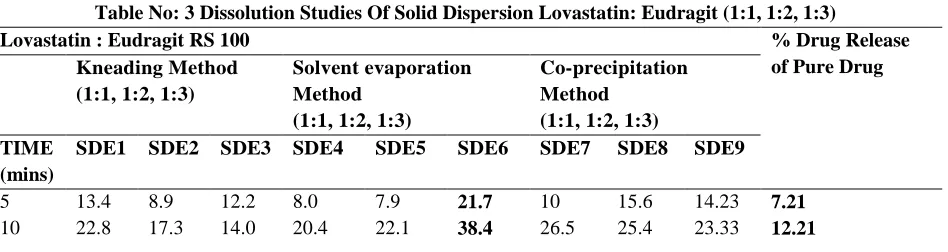
Table No: 3 Dissolution Studies Of Solid Dispersion Lovastatin: Eudragit (1:1, 1:2, 1:3)
Lovastatin : Eudragit RS 100 % Drug Release
of Pure Drug Kneading Method
(1:1, 1:2, 1:3)
Solvent evaporation Method
(1:1, 1:2, 1:3)
Co-precipitation Method
(1:1, 1:2, 1:3) TIME
(mins)
SDE1 SDE2 SDE3 SDE4 SDE5 SDE6 SDE7 SDE8 SDE9
5 13.4 8.9 12.2 8.0 7.9 21.7 10 15.6 14.23 7.21
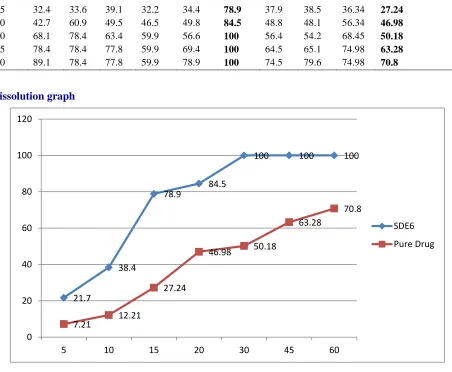
15 32.4 33.6 39.1 32.2 34.4 78.9 37.9 38.5 36.34 27.24
20 42.7 60.9 49.5 46.5 49.8 84.5 48.8 48.1 56.34 46.98
30 68.1 78.4 63.4 59.9 56.6 100 56.4 54.2 68.45 50.18
45 78.4 78.4 77.8 59.9 69.4 100 64.5 65.1 74.98 63.28
60 89.1 78.4 77.8 59.9 78.9 100 74.5 79.6 74.98 70.8
Dissolution graph
Fig No: 1 Comparison of Dissolution Studies of SDE6 Formulation and Pure Drug
DISCUSSION
Dissolution studies were carried out by different Solid Dispersion techniques (Kneading Method, Solvent Evaporation Method, Co – Precipitation Method) using different carriers (α – cyclodextrin, Chitosan, Eudragit RS100) in different ratios (1:1, 1:2, 1:3).Formulation SDE 6 (Solvent Evaporation using Eudragit RS100) in 1:3 ratio released 100% drug in 30 mins whereas pure drug released 50.18% in 30 mins. Therefore tablets were prepared using Eudragit RS100 as carrier.
Formulation development of lovastatin fast
dissolving tablets
Preparation of fast dissolving tablets
Accurately weighed quantities of ingredients were blended manually. Homogeneous blend was compressed in to tablets (200 mg each) using 8mm diameter, deep concave punches. The compression force was adjusted to give tablets with approximately 2.92 kg/cm2 on a Monsanto tablet hardness tester. [13]
Table: 4 Formulation Chart
Ingredients(mg) F1 (mg) F2 (mg) F3 (mg) F4 (mg) F5 (mg) F6 (mg) F7 (mg) F8 (mg) F9 (mg)
Lovastatin SD 40 40 40 40 40 40 40 40 40
SSG 10 15 20
CCS 10 15 20
CP 10 15 20
Mg.stearate 5 5 5 5 5 5 5 5 5
21.7
38.4
78.9 84.5
100 100 100
7.21 12.21
27.24
46.98 50.18
63.28
70.8
0 20 40 60 80 100 120
5 10 15 20 30 45 60
SDE6
Talc 5 5 5 5 5 5 5 5 5
Lactose 140 140 140 135 135 135 130 130 130
Total weight 200 200 200 200 200 200 200 200 200
* SD – Solid Dispersion
* SSG – Sodium Starch Glycolate * CCS – Cross Carmellose Sodium * CP – Cross Povidone
Conclusion
Formula 4 (F4) has shown optimized results.
Optimized Formulation: F4
RESULTS AND DISCUSSION
Pre formulation studies
PARAMETER DRUG
Organoleptic Evaluation White, fine hygroscopic powder. Observed Melting Point
174
◦
C
Solubility Analysis Insoluble in water and partially soluble in organic solvents
PRE-COMPRESSION PARAMETERS
Evaluation of lovastatin powder
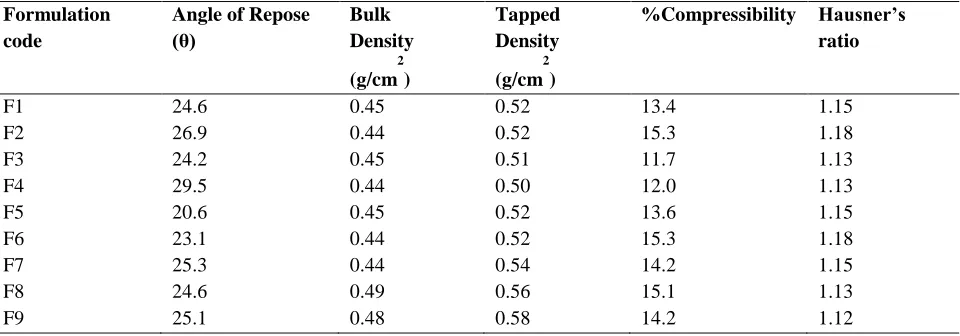
Table No 5: Evaluation Parameters For Pre-Compression Studies
Formulation code
Angle of Repose (θ)
Bulk
Density
(g/cm
2
)
Tapped
Density
(g/cm
2
)
%Compressibility Hausner’s
ratio
F1 24.6 0.45 0.52 13.4 1.15
F2 26.9 0.44 0.52 15.3 1.18
F3 24.2 0.45 0.51 11.7 1.13
F4 29.5 0.44 0.50 12.0 1.13
F5 20.6 0.45 0.52 13.6 1.15
F6 23.1 0.44 0.52 15.3 1.18
F7 25.3 0.44 0.54 14.2 1.15
F8 24.6 0.49 0.56 15.1 1.13
F9 25.1 0.48 0.58 14.2 1.12
From the above pre-compression parameters it was clear evidence that powder has excellent flow properties.
POST COMPRESSION EVALUATION PARAMETERS
Post Compression Parameters for Immediate Release Tablets
Table No 6: Evaluation Parameters for Post-Compression Studies
Formulation code Weight variation
(%)
Hardness
( kg/cm
2
)
Friabilty (%)
Thickness
(mm)
Content
uniformity (%)
F1 +( 0.5) 6.4 0.72 2.6 99.28
F2 0 6.3 0.68 2.6 97.16
F4 0.5 5.6 0.66 2.75 101.1
F5 1 5.7 0.68 2.6 98.19
F6 -(1) 5.9 0.65 2.62 99.41
F7 3 5.6 0.68 2.6 98.23
F8 2 5.5 0.69 2.7 96.98
F9 -(2) 5.9 0.66 2.75 99.00
Acceptance criteria
7.5 4-8 <1 - 90-110
Physical characterization of tablets
The thickness of the tablets was found to be in the range of 2.75 – 2.6 mm. Hardness was found to be in between 5.5 – 6.4 Kg/cm2. Friability below
1% was an indication of good mechanical resistance of tablets. All the formulations showed more than 95% of drug content indicating content uniformity in the prepared batches.
COMPARISON BETWEEN OPTIMISED FORMULATION AND MARKETED
FORMULATION
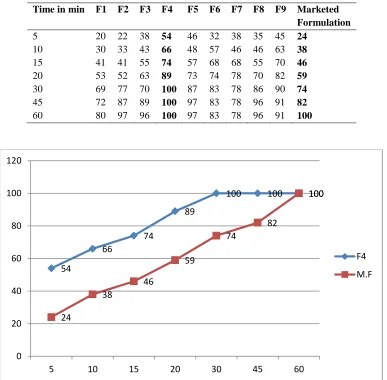
Table No: 7 Dissolution Values Of Optimized Formulation And Comparison With Marketed Formulation.
Time in min F1 F2 F3 F4 F5 F6 F7 F8 F9 Marketed Formulation
5 20 22 38 54 46 32 38 35 45 24 10 30 33 43 66 48 57 46 46 63 38 15 41 41 55 74 57 68 68 55 70 46 20 53 52 63 89 73 74 78 70 82 59 30 69 77 70 100 87 83 78 86 90 74 45 72 87 89 100 97 83 78 96 91 82 60 80 97 96 100 97 83 78 96 91 100
Fig No: 2 Comparison Of Dissolution Studies Of Optimized Formulation (F4) And Marketed Formulation. 54
66
74
89
100 100 100
24
38
46
59
74
82
100
0 20 40 60 80 100 120
5 10 15 20 30 45 60
F4
DISCUSSION
The release profile of formulationsF1, F2, F3, F4
F5, F6, F7, F8 and F9 comprising various polymers
like crospovidone, croscarmellose and sodium starch glycolate with different concentrations exhibits different release rates at various time intervals as shown in the table. Among all of these 9 formulations F4 which contains sodium starch
glycolate shows maximum drug release at the end of 30 mins where as marketed formulation shows maximum drug release at 60 mins. Hence it was optimized and decided to develop further formulations.
STABILITY DATA OF OPTIMIZED
FORMULATION
Stability studies were carried out according to ICH guidelines by exposing
the formulations CSF4 in their final packing mode to the temperature 40±2°C and relative humidity 75±5 % in programmable environmental test chamber (CHM-10S, Remi Instruments Ltd., Mumbai, India). Aliquot were withdrawn at 30 and 60 days and analyzed for change in drug content and in-vitro dissolution profile.
Following conditions were used for Stability
Testing
1. 21˚C/45% RH analyzed every month for period of three months.
2. 25˚C/60% RH analyzed every month for period of three months.
3. 30˚C/70% RH analyzed every month for period of three months.
1
STMONTH
INITIAL LONG TERM INTERMEDIATE ACCELERATED
Wt variation 0.5 0.5 0.5 0.49
Hardness 5.6 5.7 5.8 5.8
Friability 0.66 0.7 0.8 0.8
Thickness 2.75 2.75 2.75 2.75
Content uniformity 99.8 99.0 99.8 99.0
2
NDMONTH
INITIAL LONG TERM INTERMEDIATE ACCELERATED
Wt variation 0.5 0.5 0.5 0.5
Hardness 5.75 5.82 5.84 5.84
Friability 0.66 0.7 0.8 0.8
Thickness 2.75 2.75 2.75 2.75
Content uniformity 99.4 99.8 99.0 99.2
3
RDMONTH
INITIAL LONG TERM INTERMEDIATE ACCELERATED
Wt variation 0.5 0.5 0.5 0.5
Friability 0.66 0.7 0.8 0.8
Thickness 2.75 2.75 2.75 2.75
Content uniformity 99.6 99.8 99.4 99.0
STABILITY STUDIES FOR DISSOLUTION
1
STMONTH
DISSOLUTION TIME (Mins) INITIAL LONG TERM INTER MEDIATE
ACCELERATED
15 71 70.6 69.8 68.6
30 98 97.8 96.9 96.5
60 100 99.6 99.5 99.1
2
NDMONTH
DISSOLUTION TIME (Mins) INITIAL LONG TERM INTER MEDIATE
ACCELERATED
15 68.9 70.6 69.6 67.9
30 96.9 97.6 96.8 96.3
60 98.9 97.6 95.1 92.4
3
RDMONTH
DISSOLUTION TIME (Mins) INITIAL LONG TERM INTER MEDIATE
ACCELERATED
15 64.8 61.6 61.6 61.9
30 92.9 90.5 94.7 96.3
60 96.8 99.6 98.0 99.1
CONCLUSION
For preparation of Fast Dissolving Tablets of Lovastatin, dissolution studies were carried out by different Solid Dispersion techniques (Kneading Method, Solvent Evaporation Method, Co – Precipitation Method) using different carriers (α – cyclodextrin, Chitosan, Eudragit RS100) in different ratios (1:1, 1:2, 1:3). Formulation SDE 6 (Solvent Evaporation using Eudragit RS100) in 1:3 ratio released 100% drug in 30 mins whereas pure drug released 50.18% in 30 mins. Therefore tablets were prepared using Eudragit RS100 as carrier.
Formulation (F4) using Eudragit RS 100 as carrier in solid dispersion technique (solvent evaporation - 1:3) and Sodium Starch Glycolate as superdisintegrant was optimised. Results of pre compression and post compression were within acceptable limits. Of all formulations, F4 was found to be better for stability and dissolution studies when compared to marketed formulation.
Therefore solid dispersion was found to be better for drug release of poor aqueous soluble drugs belonging to class - II.
REFERENCES
[1]. Leon Lachman, Herbert A, Lieberman “The Theory and Practice of Industrial Pharmacy”, Special Indian Edition, Published By CBS Publishers &Distributors Pvt. Ltd.New Delhi-110002, INDIA. 296-303.
[2]. Patrick J. Sinko , “Martin's Physical Pharmacy and Pharmaceutical Sciences”, Published by Wolters Kluwer
[3]. Shobha Rani R. Hiremath, “Textbook of Industrial Pharmacy Drug Delivery Systems, and Cosmetics and Herbal Drug Technology”, Published by Universities Press (India) Private Limited, Hyderabad, India.5-18. [4]. C.V.S. Subrahmanyam, “Textbook of Physical Pharmaceutics”, Vallabh Prakashan, Delhi, 3, 124-223.
[5]. KD Tripathi “Essentials of Medical Pharmacology” Published by Jaypee Brothers Medical Publishers. Pvt.Ltd. New Delhi, India. 5, 451-453
[6]. Knistch A, Hagen E, Munz HD. “Production of porous tablets”, 1979.
[7]. Ravi kumar.et.al, “Formulation Evaluation of Mouth Dissolving Tablets of Fenofibrate Using Sublimation
Technique”, Int.J. ChemTech, 2009, 16-32.
[8]. Syed azeem, Shaweta Sharma, “Immediate Release Drug Delivery Systems: A Review”, 30-33, 293, 2011,
155-64, 24-46.
[9]. Rahamathulla M, Rathod N, “Solubility and dissolution improvement of rofecoxib using solid dispesion
technique”, Pak J Pharm Sci. 2008, 350-355.
[10].Sheu MT, Yeh CM, Sokoloski TD, “Characterization and dissolution of fenofibrate solid dispersion systems”,
Int J Pharm. 1994, 137-146.
[11].Moneghini M, Carcano A, Zingone G, Perissutti B. “Studies in dissolution enhancement of atenolol”, Int J
Pharm, 2, 341-47, 1998, 177-183.
[12].Brahmankar, D. M., Jaiswal, S. B., “Biopharmaceutics and Pharmacokinetics A Treatise”, Ist Edition, Vallabh
Prakashan, 2006, 296- 297.
[13].Rinaki, E., Valsami, G., Macheras P. “Quantitative Biopharmacuetics Classification System; the central role of
dose/solubility ratio”, Pharmaceutical Research. 2003.
[14].Kumar, A., Sahoo, S.K., Padhee, P., Kochar, P.P.S., Satapathy, A., Pathak, N. “Review on solubility
enhancement techniques for hydrophobic drugs”, Pharmacy Global International Journal of Comprehensive Pharmacy. 2011.