Evaluation of some properties of heat curing denture base materials
cured by different curing techniques
Received: 21/4/2016 Accepted: 9/10/2016
Abstract
* Department of Prosthodontics, College of Dentistry, Hawler Medical University, Erbil, Iraq. Introduction
The most commonly used denture base resin is Polymethyl methacrylate (PMMA), different mechanisms are used for its
polymerization process.1 PMMA was used
since the 1930s; it is characterized by easy handling, reduced cost, and satisfactory
clinical outcomes.2 They composed of
polymer and monomer; they mixed together, the mixture needs curing, which
may be self-curing or may be heat curing.3
The conventional polymerization cycle is a long, low-temperature water-bath polymerization where the acrylic resin is
processed at 74oC for 9 hours.4 There are
also post polymerization cycles such as
terminal boiling at 100oC for durations
of 30 minutes (short-term) or longer than
1 hour (long-term).5 Microwave heating
is independent of thermal conductivity. A cleaner method of processing, less
cumbersome equipment and reduced curing time are advantages of curing
denture base resin by microwave energy.6,7
The final product of this technique has the same quality of physical properties, and a better accuracy of fit, resulting in
improvement denture base adaptation.5,8
Heat cured denture base material exhibited higher tensile strength as compared to
self-cure denture base material.9 Acrylic
resin cured by microwave showed the highest mean transverse strength, while
the lowest mean showed by visible light cured acrylic resin. Slightly lower
transverse strength values calculated
in heat cured resins had than
microwave-cured resin.10 Porosity may be
due to many factors such as the presence of residual monomer, air entrapment during mixing, monomer contraction during the polymerization, monomer vaporization
Background and objective: Dry pressure curing device is one of the devices used in
curing of acrylic resin denture bases. This study aimed to evaluate some properties of acrylic resins, cured by three different techniques.
Methods: Two hundred and fifty two specimens were prepared from two brands of heat
curing acrylic resin (Paladent20 and Major). The specimens were cured by three techniques (dry heat pressure curing, conventional curing and microwave irradiation). For each curing technique, seven specimens were prepared and some mechanical and
physical properties were tested.
Results: Less residual monomer showed in the dry heat pressure curing of Paladent 20
acrylic resin. The conventional curing of Major acrylic resin has shown the least porosity. The highest bending strength and less water sorption showed by microwave irradiation of Major acrylic resin specimens.
Conclusion: Some properties of the specimens cured by the dry heat pressure curing
device were better than other curing techniques. The microwave irradiation has some good properties when compared with other techniques. The Paladent 20 brand of acrylic resin showed better properties than the Major acrylic resin.
Keywords: Dry pressure curing device; Denture base materials; Curing techniques;
Properties
2
associated with exothermic reaction5.
It have been concluded that the mean percent porosity was related to the specimens’ weights and the absolute
density of acrylic resin.11 The amount of
water sorption on the surface and into the body of the material represents sorption of a material. The presence of deeper porosity and surface flaws may be the
cause of water sorption in acrylic resin.12
Incomplete conversion of monomers into the polymer is known as residual monomer, which causes inflammation, irritation, and
an allergic response of the oral mucosa.15
The mechanical properties level of residual monomer are closely related to the
polymerization conditions.16 When terminal
boils was used in polymerization cycles the levels of residual monomer were markedly
decreased.17 Nowadays, many types of
equipment developed for simplifying the curing procedure and to produce better properties for the cured acrylic resin. One of these new types of equipment is dry heat pressure curing unit. This study aimed to select the most suitable curing cycle of a new curing technique (dry heat pressure curing device) for heat curing acrylic denture base resin and evaluate the effect of dry heat pressure curing on the properties of ( transverse strength, porosity test, water sorption, water solubility and residual monomer release) of cured denture base material in comparison to the conventional and microwave irradiation curing techniques of two brands (Paladent 20 and major) heat cured acrylic resin.
from two brands of Heat curing acrylic resin: the first 126 specimens made from
the brand (Paladent®20) (HerausKulzer
GMBH) while the other 126 specimens made from the brand (Major) (Major. Base20, Major ProdottiDentariS.p.A.). The specimens evaluated for changes in bending, porosity, water sorption, water solubility and residual monomer tests.
Dry pressure curing unit:
Dry pressure curing unit (Guangzhou Lingchen Trading Co. Ltd, China) is one of the new devices; used for the processing of heat curing acrylic resin by dry curing and under permanent constant pressure. It is a manual press used in packing of heat curing acrylic resin into flasks. During packing, the pressure will be applied manually to press the lower half of the flask into position. It has two thick plates one below and the other above the flask, the flask will be pressed between them and the flask maintain in position for curing acrylic resin. The metal plates contain electrical heaters, the heat transmitted through the direct contact between the plates and the body of the flask. The device has an on-off switch bottom and an automatic timer, Figure (1.A).
Microwave flask:
A special type of the flask was used in this study. It was a triangle-shaped fiberglass flask, has three screws for tightening the parts of the flask together. The flask have upper and lower metal parts used during pressing the flask by the hydraulic press to avoid its fracture. It is removed from the flask when placed in the microwave oven to prevent reflection of the wave inside it, Figure (1.B)
Methods
Two hundred fifty two specimens prepared
Figure (1): A- Dry pressure curing unit B- Microwave flask.
Preparations of specimens A. Metal pattern preparation
For each test metal patterns prepared according to the following shapes and dimensions:
1. For the transverse test metal with the dimension of (65 x10 x 3) mm ± 0.03mm in length x width x depth, respectively (ADA no. 12, 1999)
2. For porosity test trapezoidal patterns with Dimensions of (65 x 62 x 64 x 61) mm
with 3 mm thickness.18
3. For water sorption and solubility test disc pattern with the dimensions of (50 ± 1 mm in diameter and 0.5 ± 0.1mm thickness), according to ADA specification No.12 4. For measuring the residual monomer of heat curing acrylic resin, metal pattern with the dimensions of (20 X 20 X 3) mm length,
width, and thickness respectively.19
B. Mould preparation and packing
Dental stone mixed by ratio 19 ml distilled water to 100 gr stone by a vacuum mixer, poured into the lower half of dental flask on a vibrator. The metal pattern fixed by a drop of glue to a glass plate and coated with separating medium, then covered with stone to avoid trapping of air. The glass plate with the metal pattern inverted over and pressed against the stone slurry in the lower half of the flask, and remained under pressure until the stone was set. After setting, the glass plate removed and the metal pattern left uncovered and coated with separating medium. The upper half of the flask placed in position and filled with stone. Setting allowed under clamp for one hour, then the metal block removed, and separating medium applied before packing. The heat curing acrylic denture base resin mixed according to the manufacturers' instruction, the polymer/monomer ratio used for the Paladent20 was 30gm/14ml while for the Major acrylic was 33gm / 14ml. The mixing performed for 60 seconds, the mix at dough stage; packed into the flasks.
C. Curing:
Each group contained seven specimens
was cured by one of the following techniques:
I- Water bath curing:
The flask was placed in a water bath and
remained for 1 hour in 70oC and then 30
minutes in 100oC.
II- Dry pressure curing:
The heat was applied to clamped flask through the heaters in the metal plates surrounded the flask and the acrylic resin then apply pressure about 1200 Ibs and
750C for the temperature and cured for
about 20 minutes.
III- Microwave curing:
After removal of the metal part from above the flask, the tighten flask then put in the microwave oven in 18% of 700 wattage output for 15 minutes.
D-Removal of specimens:
The cured specimens were removed from the flask after bench cooling of flasks for 15 minutes.
Tests
The tests performed for each group as follows:
1. Transverse strength:
The transverse deflection and transverse strength of the specimens were measured
in air by three points bending on a computerized universal testing machine. The device was supplied with a central loading plunger and two supports with polished cylindrical and projection in the center of the cylindrical; the two support were apart from each by the 50mm parallel to each other and perpendicular to the longitudinal central line. The force and deflection were sensed by a sensor linked directly to the computed program and record it in sequence. The test specimens were held at each end of the two supports which away from each other by 50mm, and the loading plunger placed midway between supports, the tests were carried out with a constant cross-head speed of 0.5mm/ minute.
2. Porosity test:
4
paper 240 followed by grade 400 and 600 until a very thin section (0.4-0.5)mm was obtained. The specimens then polished using pumice, to be examined clearly under Optical MoticDigital Microscope. Equal square fields of (5) mm from each specimen were made two of them at the
periphery of the specimens and the other two at the center. The fields were examined under the optical microscope (at magnification 100×) to record the number of pores in each field, the mean of the pores for each specimen was calculated by dividing the total number of pores in the four fields by the number of that field.
3. Sorption test:
The cured disks were dried in a desiccator
containing silica gel at 37oC ± 2oC for 24
hours then removed to a similar analytical room temperature for 1 hour, then weighed with an analytical balance of (0.0001 gm) accuracy. The specimens were weighed every 24 hours until a constant weight
was attained, it considered as (W1). The
specimens then immersed in distilled water
at 37 ± 1oC inside an oven. Every 24 hours
the specimens were removed from the water, wiped with a clean, dry hand towel, until free from visible moisture, waved in
the air for 15 seconds, and weighed 1 minute after removal from the water and
until constant weight was obtained, this
represents as (W2). The water sorption
calculated according to this equation:
Sorption (mg/cm2) = W2 -W1 /SA (surface
area of the disk)
4. Solubility test:
After the final weight obtained in water sorption test, the disks were reconditioned to constant weight by returning to the desiccator which containing silica gel at 37
± 2oC as was done in previous sections,
this value represents (W3). The soluble
matter lost during immersion was
determined to the nearest 0.01 mg/cm2.
The water sorption was calculated according to the following equation:
Solubility(mg/cm2)
= W1 - W3/ SA (surface area of the disk)
5. Residual monomer:
HPLC was used to quantify the residual methyl methacrylate (MMA) content in the sample of heat-cure and self-cure material. A sample of 50 mg was dissolved in 1 ml of acetone and then 10 ml of methanol was added to the solution to precipitate the polymer. The supernatant of the solution
was filtered through a 0.45μm pore
Millipore filter. HPLC analysis was performed using LC-2010C Shimadzu Japan system equipped with a CAPCELL PAK C18 column. Ten ml of the sample solution was injected and analyzed at 40ºC at a flow rate of 1.0 ml/min with acetonitrile
water (50/50).22
Statistical analysis:
All data were expressed in means + standard deviation. The statistical analysis
was carried out using the statistical package for the social sciences (version
19). One-way analysis of variance (ANOVA) was used to compare between means of groups. Least Significant Difference (LSD) was used to compare between each two specific means within the list of means analyzed by ANOVA.
A P value of ≤0.05 was considered
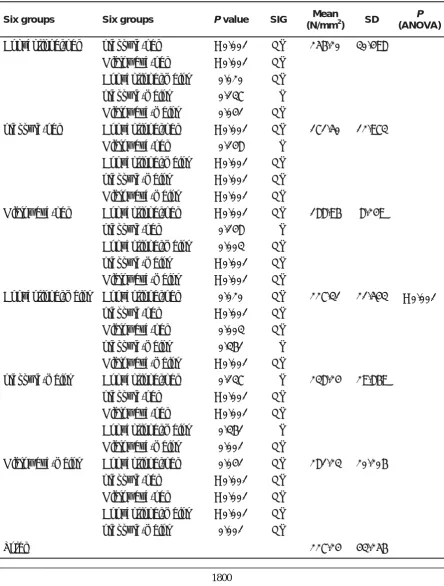
Transverse strength test: The results of Results
Table 1: Descriptive statistics, LSD test, mean value, SD and ANOVA for the Transverse
strength test.
Six groups Six groups P value SIG Mean
(N/mm2) SD
P
(ANOVA)
Conventional-pal pressure-pal < 0.001 HS 256.20 30.498
< 0.001 Microwave-pal < 0.001 HS
Conventional-major 0.020 HS pressure-major 0.137 NS Microwave-major 0.041 HS
pressure-pal Conventional-pal < 0.001 HS 171.50 12.973 Microwave-pal 0.148 NS
Conventional-major < 0.001 HS pressure-major < 0.001 HS Microwave-major < 0.001 HS
Microwave-pal Conventional-pal < 0.001 HS 188.96 8.249 pressure-pal 0.148 NS Conventional-major 0.003 HS pressure-major < 0.001 HS Microwave-major < 0.001 HS
Conventional-major Conventional-pal 0.020 HS 227.31 21.543 pressure-pal < 0.001 HS Microwave-pal 0.003 HS pressure-major 0.361 NS Microwave-major < 0.001 HS
pressure-major Conventional-pal 0.137 NS 238.24 29.869 pressure-pal < 0.001 HS
Microwave-pal < 0.001 HS Conventional-major 0.361 NS
Microwave-major 0.001 HS
Microwave-major Conventional-pal 0.041 HS 281.23 20.206 pressure-pal < 0.001 HS Microwave-pal < 0.001 HS Conventional-major < 0.001 HS pressure-major 0.001 HS
Total 227.24 43.256
6
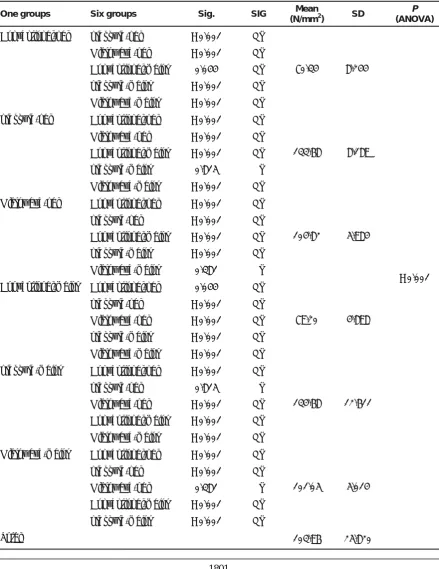
2. Porosity test: The results porosity test
for Paladent20 and Major acrylic resins and the result of LSD test shown in Table 2 that there was no statistical
significance difference present in only two comparisons, between
pressure-Paladent20, pressure-Major,
microwave-Paladent20 and microwave-Major.
Table 2: Descriptive statistics, LSD test, mean value, SD and ANOVA for porosity test.
One groups Six groups Sig. SIG Mean
(N/mm2) SD
P
(ANOVA)
Conventional-pal pressure-pal < 0.001 HS
70.34 8.244
< 0.001 Microwave-pal < 0.001 HS
Conventional-major 0.044 HS
pressure-major < 0.001 HS
Microwave-major < 0.001 HS
pressure-pal Conventional-pal < 0.001 HS
133.68 8.189 Microwave-pal < 0.001 HS
Conventional-major < 0.001 HS
pressure-major 0.815 NS
Microwave-major < 0.001 HS
Microwave-pal Conventional-pal < 0.001 HS
104.82 5.984 pressure-pal < 0.001 HS
Conventional-major < 0.001 HS pressure-major < 0.001 HS
Microwave-major 0.381 NS
Conventional-major Conventional-pal 0.044 HS
79.20 4.898 pressure-pal < 0.001 HS
Microwave-pal < 0.001 HS
pressure-major < 0.001 HS
Microwave-major < 0.001 HS
pressure-major Conventional-pal < 0.001 HS
134.68 12.611 pressure-pal 0.815 NS
Microwave-pal < 0.001 HS
Conventional-major < 0.001 HS
Microwave-major < 0.001 HS
Microwave-major Conventional-pal < 0.001 HS
101.05 5.014 pressure-pal < 0.001 HS
Microwave-pal 0.381 NS
Conventional-major < 0.001 HS
pressure-major < 0.001 HS
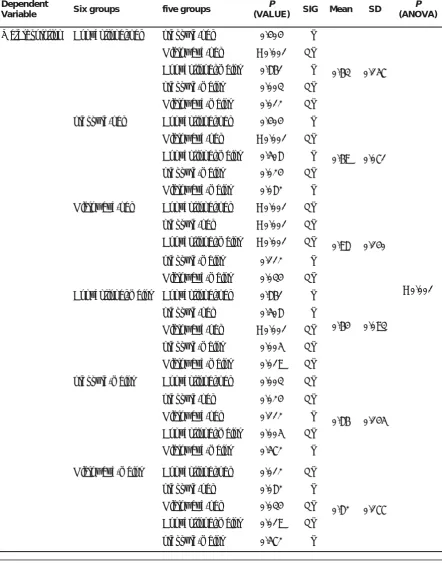
3. Water sorption: The results of water
sorption test with LSD test and
ANOVA result are shown in Table 3.
Table 3: Descriptive statistics, LSD test, mean value, SD and ANOVA for water sorption
test.
Dependent
Variable Six groups five groups
P
(VALUE) SIG Mean SD
P
(ANOVA)
Water_sorption Conventional-pal pressure-pal 0.404 NS
0.63 0.157
< 0.001 Microwave-pal < 0.001 HS
Conventional-major 0.861 NS
pressure-major 0.003 HS
Microwave-major 0.012 HS
pressure-pal Conventional-pal 0.404 NS
0.69 0.071 Microwave-pal < 0.001 HS
Conventional-major 0.508 NS
pressure-major 0.024 HS
Microwave-major 0.082 NS
Microwave-pal Conventional-pal < 0.001 HS
0.98 0.140 pressure-pal < 0.001 HS
Conventional-major < 0.001 HS
pressure-major 0.112 NS
Microwave-major 0.034 HS
Conventional-major Conventional-pal 0.861 NS
0.64
0.093 pressure-pal 0.508 NS
Microwave-pal < 0.001 HS
pressure-major 0.005 HS
Microwave-major 0.019 HS
pressure-major Conventional-pal 0.003 HS
0.86 0.145 pressure-pal 0.024 HS
Microwave-pal 0.112 NS
Conventional-major 0.005 HS
Microwave-major 0.572 NS
Microwave-major Conventional-pal 0.012 HS
0.82 0.177 pressure-pal 0.082 NS
Microwave-pal 0.034 HS
Conventional-major 0.019 HS
8
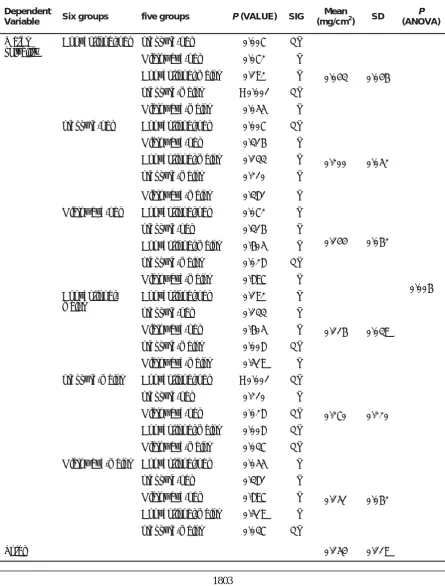
4. Water solubility: The results of water
solubility test with LSD test and
ANOVA result are shown in Table 4.
Table 4: Descriptive statistics, LSD test, mean value, SD and ANOVA for water solubility
test.
Dependent
Variable Six groups five groups P (VALUE) SIG
Mean
(mg/cm2) SD
P
(ANOVA)
Water
solubility Conventional-pal pressure-pal 0.007 HS
0.043 0.046
0.006 Microwave-pal 0.072 NS
Conventional-major 0.192 NS
pressure-major < 0.001 HS
Microwave-major 0.055 NS
pressure-pal Conventional-pal 0.007 HS
0.200 0.052 Microwave-pal 0.316 NS
Conventional-major 0.133 NS
pressure-major 0.210 NS
Microwave-major 0.381 NS
Microwave-pal Conventional-pal 0.072 NS
0.144
0.062 pressure-pal 0.316 NS
Conventional-major 0.605 NS
pressure-major 0.028 HS
Microwave-major 0.897 NS
Conventional-major Conventional-pal 0.192 NS
0.116 0.039 pressure-pal 0.133 NS
Microwave-pal 0.605 NS
pressure-major 0.008 HS
Microwave-major 0.519 NS
pressure-major Conventional-pal < 0.001 HS
0.270 0.220 pressure-pal 0.210 NS
Microwave-pal 0.028 HS
Conventional-major 0.008 HS
Microwave-major 0.037 HS
Microwave-major Conventional-pal 0.055 NS
0.151 0.062 pressure-pal 0.381 NS
Microwave-pal 0.897 NS
Conventional-major 0.519 NS
pressure-major 0.037 HS
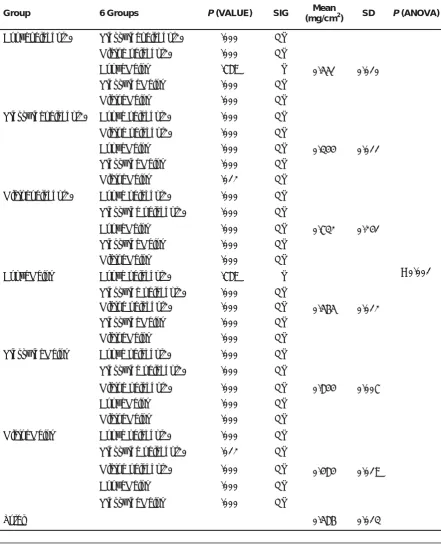
5. Residual monomer: The results of
residual monomer levels in Paladent 20 and Major acrylic resins, LSD test and ANOVA shown in Table 5 revealed
that all the groups have highly statistical significance among all the group and only (conventional-Paladent20 and conventional -Major) not statistical significance.
Table 5: Descriptive statistics, LSD test, mean value, SD and ANOVA for residual
monomer test.
Group 6 Groups P (VALUE) SIG Mean
(mg/cm2) SD P (ANOVA) Conv_paladent20 Pressure_paladent20 .000 HS
0.551 0.010
< 0.001 Micro_ paladent20 .000 HS
Conv_Major .789 NS
Pressure_Major .000 HS
Micro_Major .000 HS
Pressure_paladent20 Conv_ paladent20 .000 HS
0.344 0.011 Micro_ paladent20 .000 HS
Conv_Major .000 HS
Pressure_Major .000 HS
Micro_Major .012 HS
Micro_paladent20 Conv_ paladent20 .000 HS
0.732 0.241 Pressure_ paladent20 .000 HS
Conv_Major .000 HS
Pressure_Major .000 HS
Micro_Major .000 HS
Conv_Major Conv_ paladent20 .789 NS
0.565 0.012 Pressure_ paladent20 .000 HS
Micro_ paladent20 .000 HS
Pressure_Major .000 HS
Micro_Major .000 HS
Pressure_Major Conv_ paladent20 .000 HS
0.844 0.007 Pressure_ paladent20 .000 HS
Micro_ paladent20 .000 HS
Conv_Major .000 HS
Micro_Major .000 HS
Micro_Major Conv_ paladent20 .000 HS
0.484 0.019 Pressure_ paladent20 .012 HS
Micro_ paladent20 .000 HS
Conv_Major .000 HS
Pressure_Major .000 HS
10
The microwave irradiation for Major acrylic resin showed the mean value of transverse
strength more than the microwave irradiation for the Paladent20 that showed
the lowest mean value. This may refer to the difference in the chemical structure between the two materials and free radical polymerization reaction does not result in complete conversion of all carbon–carbon double bonds of Major acrylic, therefore, acrylic resins known to contain and release unpolymerized monomers. The highest mean value of porosity produced by dry
heat pressure curing for both acrylic resins may be due to the type of heat transmission during curing. The flask first heated, transmitted to the investment and then the acrylic dough gets heated so that the time may be used for curing not the correct time until heating reaches to the polymer and it affects the polymerization. The heat used in this technique was applied to the upper and lower surfaces, not like the microwave and conventional which heated in all area so that may be the heating for the polymerization not equal in every direction. Conventional curing technique, compared with the microwave technique produced lowest mean value for the water sorption. The increased water sorption in microwave irradiation may be due to faster curing of the resin compared to the conventional water bath, and degree of curing increased a little. Microwaves act only on the monomer, which decreases in the same proportion as polymerization increases. Microwave causes the monomer molecules within the acrylic to orient themselves in an electromagnetic field, numerous polarized molecules are flipped over rapidly and generate heat due to molecular friction. Initiating radicals then able to react with monomers to start polymerization. Microwave processing
temperatures beyond 100.3oC caused
vaporization of the monomer and produced porosity, voids in the structure of cured
resin increase water sorption.5,20,21
The lowest mean value for solubility in
conventional curing when compared with microwave irradiation can be explained by that the acrylic resin cured by microwave ovens polymerized by microwave energy released the least residual monomer, due to internal boiling of the acrylic monomer. One of the soluble materials present in acrylic resins is a free monomer. So when more residual monomer present more solubility will be present. The lowest residual monomer appeared in dry heat pressure curing for Paladent20 acrylic resin when compared with the other techniques. This may be due to the high temperature was reached within the specimens make the polymerization proceeds to a high conversion and low level of residual monomer was detected.
Discussion
Conclusion
The new technique pressure heat curing of Paladent 20 produced some improvement of properties by lower water sorption and lower level of residual monomer, while it produced higher porosity, more water sorption, and less resistance to bending. This technique of curing of Major acrylic resin induced more porosity, higher bending strength, water sorption and solubility. The level of residual monomer was lowered in both brands when cured by pressure heat curing. All properties of Major acrylic denture base resin were lower when cured by the conventional method. Microwave irradiation of Paladent 20 showed the higher values of most of the properties, except the bending strength and water sorption showed lower values. Microwave irradiation curing of Major acrylic denture base induced more porosity, higher bending strength, and water solubility, while the water sorption and residual monomer level were decreased.
Conflicts of interest
The authors report no conflicts of interest.
References
2. Craig RG .Restorative Dental Materials. Philadelphia, Pa: Saunders; 1993. P. 478.
3. Rahal JS, Mesquita MF, Henriques GE, Nobilo MA. Surface roughness of acrylic resins submitted to mechanical and chemical polishing. J Oral Rehabil 2004; 31:1075–9.
4. Phoenix RD. Denture base resins. In: Anusavice K. Phillips’ science of dental materials. 11th ed. China: Saunders Elsevier; 2003. P. 721-57.
5. Vallittu PK, Ruyter IE, Buykuilmaz S. Effect of polymerization temperature and time on the residual monomer content of denture base polymers.Eur J Oral Sci 1998; 106:588-93.
6. Compagnoni MA, Barbosa DB, de Souza RF, Pero AC. The effect of polymerization cycles on porosity of microwave-processed denture base resin. J Prosthet Dent 2004; 91(3): 281–5.
7. Schneider RL, Curtis ER, Clancy JMS. Tensile bond strength of acrylic resin denture teeth to a microwave- or heat-processed denture base.J Prosthet Dent 2002; 88: 145-50.
8. Schibayama R, GennariFilho H, Mazaro JVK, Vedovatto E, Assunclo WG. Effect of flasking and polymerization techniques on tooth movement in complete denture processing. J Prosthodont 2009; 18(3): 250-64.
9. Arora S, Khindria S, Garg S, Mittal S. Comparative Evaluation of Linear Dimensional Changes of Four Commercially Available Heat Cure Acrylic Resins. Indian J Dent Sci 2011; 4(3): 133-80.
10. Unalan F, Dikbas I, Gurbuz O. Transverse strength of polymethylmethacryltate reinforced with different forms and concentrations of E-glass fibers. OHDMBSC 2010; IX (3):134-76.
of a method for evaluating porosity in denture base resins. Gerodontology 2011; 28(2):127-33. 12. Anusavice K. Philip’s science of dental materials.
11th ed. Philadlphia: WB Sauders; 1996. P.143-69 13. Takashi A, Hiroshi M, Taizo H. Properties of
highly cross-linked autopolymerizing reline acrylic resins. J Prosthet Dent 1995; 73: 55-9.
14. Al-Nori, Ali AA, Rajab LT. Water sorption of heat-cured acrylic resin.Al-Rafidain Dent J 2007; 7(2): 186-94.
15. Jorge JH, Giampaolo ET, Machado AL, Vergani CE. Cytotoxicity of denture base acrylic resin. J Appl Oral Sci 2003; 14(3):190-3.
16. Dogan A, Bek B, Cevik N, Usanmaz A. The effect of preparation conditions of acrylic denture base materials on the level of residual monomer, mechanical properties and water absorption. J Dent 1995; 23: 313–8.
17. Harrison A, Huggett R. Effect of the curing cycle on residual monomer levels of acrylic resin denture base polymers.J Dent 1992; 20:370-4.
18. Habib SH. The effect of microwave post-poymerization treatment on some properties of cold cured and visible light-cured acrylic resin materials. M. Sc. Thesis, College of Dentistry,
Hawler Medical University; 2011.
19. Hassan AL-Bahar ZJ. Evaluation the Effect of Incorporated Hydroxyapatite Prepared from Dried Egg Shell on Some Properties of Relined Denture Base. M.Sc thesis, Mosul University; 2011. 20. John C, Eugene P. Porosity reduction and its
associated effect on the diametral tensile strength of activated acrylic resins. J Prosthet Dent 1985; 53(3): 374–9.
21. Lai CP, Tsaia MH, Chena M, Chang HS, Tayb HH.Morphology and properties of denture acrylic resins cured by microwave energy and conventional water bath. Dent Mater 2004; 20: 133–41.