PARTIALLY SIGHTED CHILDREN: THE
VISUAL PROCESSING OF WORDS AND
PICTURES.
Thesis presented for the degree of PhD. The Institute of Education,University of London.
1992
ABSTRACT.
Reading is normally by eye and by ear, but what happens if eyesight is severely impaired? The hypothesis put forward in the first part of this thesis is that partially sighted children adopt a predominantly nonlexical word recognition and production strategy. This is likely to be because of the reading tuition they receive, which emphasises individual letters and letter patterns in words in relation to pronunciation. This study explores the word and picture processing abilities of a small group of partially sighted children, using a series of experimental tasks.
Surprisingly, the analysis of oral reading errors in Study 1 revealed that the partially sighted children were using the same salient graphic cues as young fully sighted readers were normally found to be using.
ACKNOWLEDGEMENTS.
I would like to express my great thanks to the many friends and colleagues who have contributed so generously to the completion of this thesis.
I wish to thank particularly:-
- the children who participated in these Studies, their parents and teachers, for giving so freely of their time, joy and enthusiasm.
- Mr. Tony Cline, Department of Psychology, University College, London, formerly Principal Educational Psychologist, ILEA, for his constant encouragement.
- Dr. Linda Pring, Senior Lecturer in Psychology, Goldsmiths' College, University of London, for her great patience and determination, as Supervisor of the thesis.
TABLE OF CONTENTS.
ABSTRACT. 2 '
ACKNOWLEDGEMENTS. 4
TABLES OF APPENDICES AND FIGURES. 10
CHAPTER
1 A FRAMEWORK FOR RESEARCH WITH PARTIALLY SIGHTED CHILDREN.
1.Introduction. 13
1.1.Previous Relevant U.K.Research Concerning PS Children. 13
1.2. Lansdown's Initial Survey 15
1.2.1.Lansdown's Research Context. 15 1.2.2.0ne Initial Hypothesis. 16 1.2.3.Methods and Procedures Used in the Initial Survey. 16 1.2.4. Conclusions from the Initial Survey. 16 1.2.5. Limitations and Unanswered Questions. 17 1.3. Lansdown's Main Study (1973) 17
1.3.1. The Main Hypothesis 18
1.3.2. Methods Used in the Main Study 18
1.3.3 Procedures 20
1.3.4. Conclusions of the Main Study 20 1.3.5. Limitations of the Main Study 21 1.3.6. Lansdown's Paradox and the Unanswered Question. 21 1.4. Some Issues Concerning Measures of Ability of PS subjects and
1.5.1.Closed Circuit Television. 26 1.5.2.Partially Sighted Children Reading. 27
1.6. Models of Reading 28
1.7.The Processing of Words. 31
1.8. Summary. 33
2 THE WORD SUBSTITUTIONS MADE BY PARTIALLY SIGHTED CHILDREN.
2. Introduction. 35
2.1.Relevant Literature Concerning Oral Reading Errors.
2.1.1. General. 36
2.1.2. Ages Sampled. 36
2.1.3. Content of Studies. 36
2.1.4. Summary of Findings From Previous Studies. 37 2.2. Stages or Strategies in the Development of the Reading Process38
2.3. Implications. 40
2.4. Study 1. The Oral Reading Errors of PS Children. 41 Pilot Study 1.The Immediate Recall of Visually
Presented Digits. 43 3 WORD RECOGNITION IN YOUNG PARTIALLY SIGHTED
CHILDREN.
3.Introduction. 59
3.1.The Research Framework. 61
3.1.1.Further Processing Considerations. 68
3.1.2.The Lexicon. 71
3.2.1.Word Recognition and PS Children. 75 3.2.2. Are PS Children Nonlexical Readers. 76
3.2.3. Pilot Study 2. 77
3.3. Experiment 1 An Investigation of the Lexical Route and Format
Distortion. 79
3.4. Experiment 2. An Investigation of the Processing of
Pseudohomophones. 90
3.5. Experiment 3. An Investigation of the Processing of
Pseudohomophones and Legal Nonwords. 96 3.6. Experiment 4. An Investigation of the Effect of Disrupting
Functional Spelling Units. 103 3.7.Experiment 5. A Further Investigation of the Effect of Disrupting
Functional Spelling Units. 112
3.8.Summary. 125
4 THE SPELLINGS OF PARTIALLY SIGHTED CHILDREN.
4.Introduction. 132
4.1.Pictographs and Word Syllabic Phonography. 133 4.2.Relevant Literature Concerning Children's Spelling. 135 4.3. Spelling and PS Children. 138 4.4. Stages, Steps or Available Strategies. 140 4.5.Seymour & Evans Parallel Development of the Spelling Process140 4.6. Frith's 6 Step Model of Skills in Reading and Writing
Acquisition. 142
4.7. Evidence that the Lexical Route is Being Used. 142
4.8. Spelling Tuition. 143
5 A SUMMARY OF FINDINGS CONCERNING THE WORD
PROCESSING OF PARTIALLY SIGHTED CHILDREN 157
6 PICTURE PROCESSING.
6. Introduction 160
6.1. The Basis of Picture Processing ? 160 6.2. Pilot Study 3.Preliminary Picture Processing
Tasks with Children. 161 6.2.1.Identification of Photographs and Line Drawings. 161 6.2.2. Conclusions from the Preliminary Studies. 164 6.2.3. Compensatory Strategies. 164 6.3. A Model for Picture Processing. 165
6.4. Recognition. 170
6.5. Recall. 171
6.5.1. Recall Research. 171
6.6. Interference and Cross-Modal Transfer. 173
6.7. Elaboration. 174
6.8. Orienting Tasks. 174
6.9 Summary. 175
7 THE RECOGNITION OF PICTURE STIMULI BY PARTIALLY SIGHTED CHIDREN.
7. Introduction. 176
7.3. Pilot Study 4. Visual Recognition. 181 7.4. Experiment 6. An Investigation of the Visual Recognition 183
Memory of Partially Sighted Children.
7.5. Experiment 6. Analysis 2. An Investigation of the Misplacing
of Pictures. 196
7.6. Experiment 6. Analysis 3. The Impact of Picture
Complexity and Familiarity on Recognition. 202 7.7. Experiment 6. Analysis 4. The Impact of Picture Complexity
and Familiarity on Naming. 208 7.8. General Summary and Conclusions. 212
8 THE RECALL OF PICTURE STIMULI BY PARTIALLY SIGHTED CHILDREN.
8. Introduction. 215
8.1. Pilot Study 5. Visual Recall. 216 8.2. Experiment 7a. An Investigation of the Recall of
Visually Inspected Pictures by Partially Sighted Children. 217 8.3. Experiment 7b. The Impact of Orienting Questions on the
Recall of Pictures by Partially Sighted Children. 226 8.4. Experiment 7c. The Effect of Elaborative Sentences on
Picture Recall 236
9 PARTIALLY SIGHTED CHILDREN AND
PICTURE PROCESSING 245
10 IMPLICATIONS. 254
APPENDICES AND FIGURES.
APPENDIX 8. APPENDIX 9. APPENDIX 10.
APPENDIX 11(a )
APPENDIX 11 (b ) APPENDIX 11 c) APPENDIX 12 APPENDIX 13
Definitions of Partial Sight. 283
The Visualtek CCTV 284
Some Components of Phonic Reading Tuition. 285 Teacher - Child Strategies.
Study 1.Sample of Partially Sighted Children. 291 The Visual Status of the PS Children in the 4 Studies293 Ginn 360 Reading Scheme. 294 Two Examples of the Transcripts of the Child-Teacher Reading Interactions. Study 1. 295 The Weber Graphic Similarity Index. 302 Study 2. Pilot Study 2. 305 Study 2. Sample of PS and FS Subjects 307 for the Lexical Decision Tasks.
Word Stimuli for the Lexical Decision Tasks 309 Performed by the PS and FS Subjects in Study 2.
Experiment 1.
Word Stimuli for Study 2. Experiments 2 and 3. 311 Word Stimuli for Study 2. Experiments 4 and 5. 315 The Spellings of Partially Sighted Children. 320 A Comparison Between Spelling Age and 333 Chronological Age of the PS Subjects at the
Beginning and at the End of the Studies. A Comparison Between the Reading Age and Chronological Age of the PS Subjects, at the
APPENDIX 14 Identification by PS children of Photographs and Line
Drawings. 335
APPENDIX 15 Visual Recognition - A Short Term Visual Memory Task from the British Ability Scales. 337 APPENDIX 16 Samples of PS and FS Subjects for Experiments
with Picture Stimuli. 339
APPENDIX 17 Picture Stimuli for the Recognition Tasks 341 APPENDIX 18 ANOVA Tables for the Recognition of Picture Stimuli.
Tables of means and standard deviations for the
misplaced Picture Stimuli. 348 APPENDIX 19 British Ability Scales - Recall of Designs. 356 APPENDIX 20 Picture Stimuli for the Recall Tasks. 358 APPENDIX 21 ANOVA Tables for the Recall of the
FIGURES.
Figure 1 A model for both the direct and the phonically mediated recognition, comprehension and naming of written words.
Ellis, 1984. 29
Figure 2 A Model of Linguistic Competence. Ehri, 1978. 32 Figure 3 A model of the parallel development of the spelling
process. Seymour& Evans, 1991. 141 Figure 4 The 6 step model of skills in reading and writing. acquisition
Frith, 1985. 142
Figure 5 Schematic depiction of the structure of verbal and nonverbal symbolic systems. Paivio, 1986. 166
Figure 6 A Model of Visual Object Recognition. Humphreys and 168 Riddoch 1987.
Figure 7 A model of the hypothesised events in the picture
CHAPTER 1
A FRAMEWORK FOR RESEARCH WITH PARTIALLY SIGHTED CHILDREN.
1. INTRODUCTION.
The main purpose of this thesis is to examine some aspects of word recognition, spelling and picture processing by young partially sighted (hereafter PS) children being taught to read by a method which emphasises individual letters and letter patterns in relation to their pronunciation. The underlying thinking is that visual impairment and/or tuition method may bias the reader/speller towards the use of one kind of processing rather than another.
This thesis builds on the work of Lansdown (1973). It concerns the same age range (5/6 years to 9/10 years) and studies solely the cognitive processes of PS children. In this first section particular attention is paid to reading and spelling, and in the second section, emphasis is on picture processing.
A working definition of partial sight for present purposes ( see Appendix 1 for a fuller definition) is partial sight sufficient to warrant education in a special school, but where the pupils learn to read and write print and not Braille.
predominantly in mainstream schools. There, if their needs are adequately met, they merge into the general school population.
A comprehensive piece of research into the visuoperceptual performance of PS childreri relationship I67reading and spelling, is that of Lansdown (1973). In that study he reviewed the relevant literature up to that date in the U.K. and the U.S.A. as it related to partial sight and school attainment. Of the twelve studies he reviewed, only four were from the U.K. Two of these were small studies (Lansdown, 1967, Carroll and Hibbert, 1973). Lumsden (1934) carried out a national survey commissioned by the Board of Education into the educational status of partially sighted children. The Fine Report (1968) was also a large educational survey of blind as well as PS children and focused on incidence, aetiology and provision, rather than detailed cognitive functioning.
These four studies, together with those from the U.S.A., presented a picture of poor academic performance in school by PS children. This was confirmed by the Vernon Report (1972), a U.K. government enquiry into The Education of the Visually Handicapped.
Because of the dearth of relevant and recent research literature concerning young PS children, the method adopted here has been to review Lansdown's findings in detail, in the theoretical context in which his study was set, and then to address the major question his thesis raised:'how it can occur that PS children, who start from a position of visuoperceptual delay at the age of six, can learn to read and write as well as their fully sighted (hereafter FS) peers by the age of eight ?'
Following this initial literature review, each Study is also introduced by a short review, drawn appropriately from reported studies of FS children.
1.2.LANSDOWN'S INITIAL SURVEY (1973).
The work for this first survey was started in 1969 and involved approaches to five PS schools in the London area.The proposition under investigation was that PS children performed poorly in school. The aim in the initial study was to test hypotheses derived from this proposition in as general a way as possible, with a view to studying a smaller sample in more detail later.
1.2.1.LANSDOWN'S RESEARCH CONTEXT.
Lansdown took the work of Vernon (1957, 1971) and of Gibson (1962, 1965) as reference points for studying the visuoperceptual functioning of PS children, though both Vernon and Gibson stressed that reading and spelling were complex skills which demanded much more than visuoperceptual competence. The ability to perceive the distinctive features of letters and words was only a part of that process.
to reach similar conclusions, his main study was very different. It demonstrated quite clearly with very carefully matched samples of children, that good reading can be accompanied by delay in visuoperceptual processing.
1.2.2.ONE INITIAL HYPOTHESIS.
An initial hypothesis was that partial sight loss led to a lowering of performance in the sphere of visual perception and that this was associated with poor academic performance.
1.2.3. METHODS AND PROCEDURES USED IN THE INITIAL SURVEY.
136 PS children in the age range 7 - 11 years 11 months were available from three day special schools for PS pupils. Of those, 107 girls and boys were tested; those having secondary handicaps which severely affected their learning capacity were omitted.The children were divided into two groups, 'simple' - PS with no secondary handicap, and `complex' - PS with a secondary handicap. Visual acuity was between 6/24 and 3/60. The children were tested in their own schools on standardised tests and no control groups were included. Statistical analysis allowed for comparisons of the PS against standard norms, and of the 'simple' PS group against the PS 'complex' group, as well as school by school comparisons.
1.2.4.CONCLUSIONS FROM THE INITIAL SURVEY.
Focusing on the one hypothesis mentioned in 1.2.2., the results revealed a significant partial correlation between scores on the Frostig Developmental Test of Visual Perception and the Burt Word Reading Test, when ability, measured on the Vocabulary subtest of the Wechsler Intelligence Scale for Children (WISC), was held constant.
and spelling on the part of all PS subjects in two schools and by the 'complex' PS group in the third school. However, the 'simple' PS group from the third school scored almost at an average level on the tests of reading and spelling, despite this perceptual delay. It is true, of course, that their mean WISC Vocabulary subtest score was 11 -slightly higher than that of the other two 'simple' PS groups.
There was support for Lansdown's hypothesis that in the age range 7 - 11 years 11 months, delays in visuoperceptual development were associated with delays in acquiring reading and spelling skill. However, the anomalous finding from one school threw into question whether or not PS children generally perform poorly in school. Some clearly did not.
1.2.5.LIMITATIONS AND UNANSWERED QUESTIONS.
No comparisons with FS pupils were undertaken in this initial survey. The sample was drawn from three special schools and was not necessarily representative of PS children as a whole. The sample was heterogeneous, as PS children with a secondary handicap formed the 'complex' group. Some of the tests were old, or, such as EPVT, unsatisfactory for use with PS children. The results from one of the three schools were better than those from the other two and this, too, raised doubts about the generalisability of the findings. These considerations all influenced the design of the main study.
1.3.LANSDOWN'S MAIN STUDY (1973).
1.3.1. THE MAIN HYPOTHESES. Lansdown's first hypothesis stated:
`That partial sight does not result in a significant concomitant educational handicap.' His fifth and last hypothesis stated:
`That there is no significant relationship between the results of tests of accuracy and speed of visual perception and those of reading and spelling.'
The remaining three hypotheses concerned comparisons between PS and FS children in their speed and accuracy of discriminating 2 D forms and in their reading and spelling attainments.
1.3.2. METHODS USED IN THE MAIN STUDY.
There were changes and improvements in the battery of tests:
- newer reading and spelling tests replaced some of the previous ones: - measures of ability were improved:
- the range of perceptual tasks was altered.
Ability in the Main Study was measured by the WISC Vocabulary and Similarities subtests and Raven's Coloured Matrices.
The three tests of visual perception in the initial survey all required a motor response. Lansdown commented that the Benton Test of Visual Retention was lengthy and found to be tedious by the PS subjects. The Frostig DTVP was also lengthy. These two tests and the shape copying were replaced by the Bender Visual Motor Gestalt Test which requires the copying of visual designs from printed examples. A second perceptuomotor task was introduced - the measuring of perceptions in response to the Mueller-Lyer illusion figure.
Three new, specially devised visuoperceptual tasks were introduced: - shape matching
- letter matching
- matching letter-like forms
In each case the task was to match the target figure with the appropriate stimulus, and the target was either a single or a triple figure.
Speed of processing was viewed as important and was measured in four ways: - the speed of drawing a line.
- the speed of completing a sentence. - the speed of button pressing.
1.3.3. PROCEDURES.
The pilot studies led to some modifications in the arrangements for timing, to prevent what Lansdown described as 'grabbing' on the part of the PS children. When timing was automatic, the PS seized the first possible solution and had no opportunity for self correction. The result was the recording of a high number of avoidable errors. When timing was by hand operated stop watch, the children could self correct and make their considered choice, before the timer was stopped.
The pilot tests also showed that on some tasks, there was a steep initial practice effect. In view of this, the first three scores were regarded as practice trials and not included in the final result for those tests.
Statistical analysis allowed for direct comparisons of performance between the PS and FS groups.
1.3.4.CONCLUSIONS OF THE MAIN STUDY.
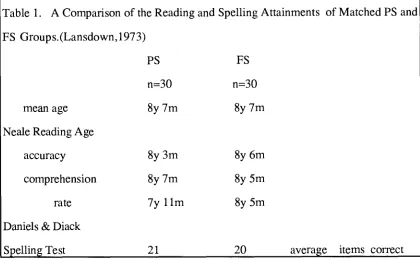
Significant differences in performance on the visuoperceptual tasks between the PS and the FS groups, were accompanied by equivalent performance on the attainment tasks by the same PS and FS children, who were of average ability.
Table 1. A Comparison of the Reading and Spelling Attainments of Matched PS and FS Groups.(Lansdown,1973)
PS FS
n=30 n=30
mean age 8y 7m 8y 7m
Neale Reading Age
accuracy 8y 3m 8y 6m
comprehension 8y 7m 8y 5m
rate 7y 1 lm 8y 5m
Daniels & Diack
Spelling Test 21 20 average items correct Lansdown's fifth hypothesis, set out in 1.3.1. was not upheld, but his first hypothesis was upheld. Partial sight does not result in a significant concomitant educational handicap.
1.3.5.LIMITATIONS OF THE MAIN STUDY.
Lansdown's very carefully selected PS sample was not a national one and was drawn from day pupils in special schools only. Matching PS and FS pupils using available intelligence tests is problematic (see 1.4. below). Both these factors could be considered to be limitations to the study.
1.3.6.LANSDOWN'S PARADOX AND THE UNANSWERED QUESTION.
same was so for the letter matching errors. The PS 6 year olds made nearly twice as many errors as the 6 year old FS children, but by the age of 8 years, this large difference had gone. On one of the reading tests, the 6 year old PS children could read fewer than half the number of words that the FS 6 year olds could read. By the age of 8 years, both groups were reading equally well. Such a difference was not present with spelling at 6 years of age.
The paradox, then, which Lansdown presented, was that at 6 years of age, PS children of average ability were less accurate than FS children of the same age and ability at shape matching, letter matching and reading. But by the age of 8 years, the PS and the FS were reading and spelling at the same level.
The question which Lansdown did not address, except in passing, was, what learning processes occurred between the ages of 6 and 8 years to bring about these changes?
It is the purpose of this thesis to clarify the implications of the early visuoperceptual delay on the part of the PS children and to explore the strategies which are available between the ages of 5/6 and 8/9 years to yield the level of attainment which Lansdown found at the latter age. Attempts to predict reading ability from early visuoperceptual capability or to correlate the two, lead to no further advances in our understanding of the learning abilities of PS children, nor of the cognitive processes involved in reading.
1.4. SOME ISSUES CONCERNING MEASURES OF ABILITY OF PS CHILDREN. AND MATCHING PS AND FS SUBJECTS.
If, as Reynell and Zinkin (1975) demonstrated, the young PS child below the age of six displayed some language delay, particularly in the sphere of vocabulary acquisition, then the use of a Vocabulary test at a later age should be undertaken with caution. Scores on such a test were likely to be an underestimate of ability.
Tobin (1978) quoted studies by Tillman (1967), Tillman and Osborne (1969) and Smits and Mommers (1976) looking at the performance of blind and sighted children on the various subtests of the Wechsler Intelligence Scale for Children (WISC).
Tillman's studies in the U.S.A. were of a large sample of blind and sighted children in which the inclusion of scores for auditory memory (WISC Digit Span subtest) increased the IQ scores of the blind and made up for low scores by the blind on the WISC Similarities and Comprehension subtests.
Smits and Mommers in Holland compared the WISC Digit Span scores of large groups of blind and sighted children and found that the mean auditory memory scores of the blind were higher than those of the sighted. They stressed that the blind and the sighted did not have the same WISC profile.
Smits and Mommers examined the Digit Span scores of blind children without residual vision and those with residual vision.These would be closest visually to the PS children under consideration here. They found that blind children without residual vision had higher mean scores on the Digit Span subtest than both blind children with residual vision and sighted children. However, blind children with residual vision also had slightly higher mean scores on this subtest than the sighted, but lower scores than the blind.
control group. The authors above advised that in computing an IQ for blind subjects, it was desirable to include the Digit Span score and then to prorate the total Verbal subtest scores. It is likely that the same advice could usefully be followed in the case of PS subjects.
In the Studies in this thesis similar difficulties were encountered in the measuring of the IQ of the PS subjects. The British Ability Scales (Revised Edition, Elliott 1983) were used as having been standardized recently in the U.K. However, the standardization sample of these Scales did not include partially sighted children so individual scores must be interpreted with caution. Subtests used included tests of reasoning (Matrices, Similarities ), spatial imagery (Block Design Level, Block Design Power), short term memory (Recall of Designs, Recall of Digits, Visual Recognition), retrieval and application of knowledge (Word Definitions).
A further difficulty arose in the matching of PS and FS subjects by reading age. Early observations for this series of studies revealed that young PS children made a slow start with reading, even though they were of average ability and were receiving appropriate tuition. Thus, in the early years, their reading ages might be lower than expected. In some cases this slow reading progress persisted for several years. An 8 1/2 year old PS child of average ability with a reading age below chronological age might be progressing satisfactorily and along recognised lines. An FS child in this position, however, might have specific word processing difficulties. Matching PS and FS children on reading age was, therefore, likely to be problematic.
1.5.READING AND PARTIAL SIGHT.
many small featural differences which many FS children have difficulty in distinguishing.
There are two ways of comprehending what the impact might be on a PS beginner reader of having letter images which might differ from those of the FS beginner reader in terms of clarity and stability. One way is to study the physiological processes of the eye and the way in which the flutter of patterns on the retina becomes electrical impulses transmitted to the cortex by the optic nerve. The other way is to study the psychophysics of normal and low vision reading, looking, for example, at the two interacting subsystems for transient and sustained vision, reflected in spatial frequency analysis (Stein, 1991, Lovegrove, 1991).
Legge et al (1985) commented as follows: 'In recent years, a great deal has been learned about basic sensory mechanisms of pattern vision, but we still know next to nothing about the roles played by those mechanisms in important everyday tasks like reading.' And with regard to low vision readers: 'Very little is known about the effects of visual impairment on reading.'
character, whilst for the low vision reader a matrix density of 13 x 13 samples per character was more appropriate.
Legge et al (1985) also studied character size and window width, or number of letters in view, in relationship to speed of reading. All these aspects of the psychophysics of reading are of more relevance than the Snellen high spatial frequency measures of acuity, on which registration as partially sighted is based.
What Legge et al made clear was that although the physiological working of the visual system may be understood, the understanding of vision as it related specifically to reading, was less so. Although the total understanding of how impaired vision affected reading was also not clear, there were two aspects which did affect speed of reading: the first was whether central vision was intact or not, the second was whether the visual media were clear or not. The effect of damaged central vision, as in retinal aplasia, was to reduce reading speed, so, too, was the effect of cloudy media, as in cataract.
For adult or skilled readers, speed is important. This is not so for children and beginner readers. Indeed, it may be an advantage initially for reading to be slow.
1.5.1. CLOSED CIRCUIT TELEVISION.
Variations in print character size, contrast polarity, luminance and image resolution are obtainable by use of a Visualtek closed circuit television (CCTV). This system consists of a TV monitor with a trolley beneath it, on which the printed text rests. Individual controls allow for quick individual adjustment by the reader along each dimension (see Appendix 2).
the slowness of reading speed associated with the CCTV could be regarded as an advantage in learning to process words accurately.
1.5.2.PARTIALLY SIGHTED CHILDREN READING.
The Committee chaired by Vernon, appointed in 1968 to look into the Education of the Visually Handicapped, reported in 1972 and commented as follows on the reading attainment of PS children in England and Wales:
'The most frequent general observation was that reading standards among PS children were significantly lower than standards among sighted children. Like blind children, PS children are likely to fall well below the reading speeds of sighted children, but the PS child may also be slow to master the basic techniques of reading.'
Lansdown (1973) demonstrated that lower standards on the part of the PS were not inevitable. Despite this, the general observation made in the Vernon report has some validity. The presence of partial sight si does have educational implications. If the PS reader is taught inappropriately, without sufficient attention to his or her specific requirements, then the literacy standard achieved will be low.
There are some practical arrangements to be made when planning the reading tuition for a young PS beginner reader - seating, lighting, print size, the clarity of the layout of the book, the quality of the pictures and the content of the text. But, less well appreciated, is the need for an understanding of issues to do with the time required by the PS child to process visually presented information, to do with fatigue, together with the teaching method which will best capitalise on the PS child's strengths. These might be in the sphere of linguistic competence and phonological awareness, both of which might minimise the impact of impaired vision.
taught intensively, specifically and methodically. This is a very different starting point from that of the FS child.
Lansdown's research focused on some aspects of visual perception. The underlying assumption was that some information being passed through the visual system was inaccurate and might yield later difficulties when it came to be reused. A comparable approach by Barraga (1964) showed how young visually impaired children could be taught to improve their visuoperceptual skills. These principles were incorporated into the Look and Think materials (Chapman, Tobin, Tooze and Moss, 1989) for use with blind and PS children in their infant and junior years of schooling.
The emphasis in this thesis is on the processes which come to bear on the sensory perceptions, not just on the perceptual information itself. So, in the case of the visual processing of pictures, which forms the second part of the thesis, both visual recognition and visual recall memory processes are studied in respect of PS children.
1.6.MODELS OF READING.
Three conceptual models inform this thesis: two will be described here briefly for later reference, and one relating to picture processing is presented in Chapter 6.
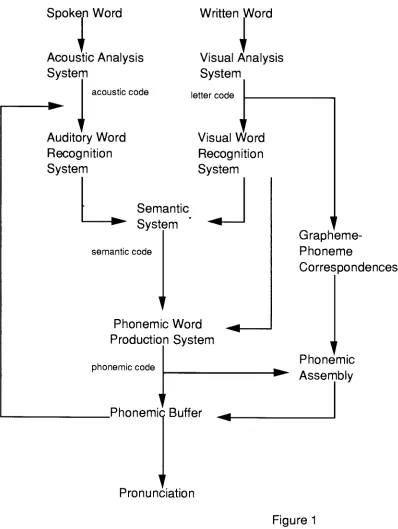
A model for both the direct and the phonically mediated recognition, comprehension and naming of written words (Ellis, 1984).
Acoustic Analysis System
MP-
1acoustic code
Auditory Word Recognition System
Spoke Word
l
i Written WordVisual Analysis System
letter code
Visual Word Recognition System
Grapheme-Phoneme
Correspondences
Phonemic Assembly
Phonemic Buffer
Pronunciation
Figure 1
The model is based around the concept of two processing routes - the lexical and the nonlexical, the lexical process being shorter, more direct and faster than the nonlexical
Semantic. System
semantic code
Phonemic Word Production System
one. Reading by eye is accomplished by means of the lexical route, which leads quickly and directly into the semantic system. Reading by ear is achieved by the nonlexical route which contains a grapheme - phoneme correspondence unit. Access to the semantic system for words processed by this route is through entry to the acoustic system - in other words, the printed word is converted into acoustic form and enters the auditory word recognition system.
In this model, decisions about a word's authenticity can be taken on the basis of whether a letter code or an acoustic code exists in the recognition systems. There is some controversy about the lexicon. Ellis (1984) depicts two lexical systems, one for auditory word recognition, the other for visual word recognition, both of which access the semantic system. These contain word recognition units which contain all orthographic and phonological specifications of words. Others might just depict one comprehensive lexicon.
There is also disagreement about the two separate processing routes for the written word. Glushko (1979) maintained that this dual route model was inadequate to account for observations that the two traditional systems, the lexical (word specific ) and the rule based (orthographic ), worked together in the use of analogy. He used the term word mechanisms not routes, and spoke of a unitary process of activation, so that there could be activation of orthographic and phonological information from various sources to enable a reader to pronounce, for example, 'love' and 'move' or 'leaf and 'deaf.
addressed here, is whether this group of PS children make predominant use of the nonlexical route. This bias might arise either because of the teaching received, which stressed grapheme - phoneme conversion, or it might arise because sight impairment might be associated with impairment of the direct visual lexical route, or for both reasons. Causality for the bias, if it exists, cannot, however, be determined here.
1.7. THE PROCESSING OF WORDS.
D
A Model of Linguistic Competence (Ehri, 1978)
Sequence of printed letters. Sequence of speech sounds
Graphic Component Phonol gical Component
Orthographic Phonological
Lexicon
Identity Identity
Morphological Syntactic Semantic
Identity Identity Identity
4
Sequence of Lexical Units
Syntactic Imponent Semantic Component
V
Meaning Figure 2
Ehri stressed the importance of the visual image of the word: this visual image was built up by learning spelling patterns and by experience of working with the visual form of the word. The process of acquiring the visual image was partly induced and partly explicitly taught.
The visual image was central for Ehri in printed word learning: so, too, were memory processes rather than perceptual ones. In other words, she stressed the gradual learning and building up of these visual word images which incorporated not only the linguistic and orthographic specifications already mentioned, but the semantic ones, too.
1.8.SUMMARY.
In this Chapter has been outlined, in brief, the position of the young PS child as he or she approaches the task of learning to read. On the one hand is the general educational observation (Vernon Report, 1972) that this task is a difficult one and that the standard attained may be low. On the other hand, comes the finding (Lansdown, 1973) that for the young PS child of average ability, this low achievement is not inevitable. What is missing is a detailed account of the learning strategies of the PS child and how these compared with those of an FS child of the same age and ability.
The literature on PS children presented earlier in this Chapter indicates that PS children will enter the first stage of reading with a language delay affecting language structures and vocabulary, and with a visuoperceptual delay affecting the speed and accuracy of the recognition of shape. The extent of the language delay is unlikely to affect the early stages of reading or of picture processing, but the delay in visuoperceptual development is likely to have clear consequences. Lansdown has defined this difficulty. He has described the starting point of the 6 year old PS child. He has also described the endpoint - the attainment of the 8 year old PS reader. But he has not described the available processing strategies which enabled that endpoint to be reached.
The focus of the Study is on the number and types of word substitutions or oral reading errors made by the young PS readers and on the types of cues they use to solve the task of word reading.
The study of misreadings, or of partially correct readings, is based on the premiss that the child is using purposefully any available information and experience to solve the problem before him. It provides ' a window on the reading process'. (Goodman and Goodman, 1977). A partially correct word reading is thought to provide the adult with insights, not available from the correct reading, about what information sources the child is, or is not, using. This knowledge can then be used diagnostically by the adult to refine the teaching of the child or to understand more of what stage the child has reached in the reading process.
Also provided in Chapter 2 is a brief mention of the teaching method and the materials used for this group of PS children, for both the method and the type of materials will affect the word substitutions made by the readers.
This method of studying the learning style of young PS readers has an advantage over simply measuring reading and spelling levels on standardised tests. It is dynamic. It provides particular information about the strategies that the teacher and child are using. These implicit strategies can be made explicit and so reused, if successful.
CHAPTER 2
THE WORD SUBSTITUTIONS MADE BY PS CHILDREN. 2.INTRODUCTION.
If a child has difficulty in matching shapes, one implication might be that the child's ability to match and discriminate words will also be inaccurate.That ability is a necessary part of processing by the visual lexical route. Increasing perceptual accuracy, as well as a memory for what has been seen before, are both required at the early logographic stage of reading. Inaccurate discriminations of words might lead to the generation of words, in response to the printed target word, which are nearly correct but not quite. Such miscues, misreadings or misidentifications have been studied widely for the information they provide about the unlearned and taught strategies of the young reader. As PS children are less accurate and slower than FS children at shape matching, the first hypothesis is that PS children make more errors than do FS children in discriminating visually similar words. A high number of their readings might be misreadings. These oral reading miscues might prove to reveal a lower level of graphic similarity to the target than miscues of FS readers of the same age. Study 1 was designed to investigate this issue.
First, the misreading performance of PS children was compared with relevant studies of FS children reported in the published literature.This required a qualitative analysis of reading behaviour along selected dimensions such as graphic similarity and the use of salient visual cues in recognising words.
2.1.RELEVANT LITERATURE CONCERNING ORAL READING ERRORS. 2.1.1.GENERAL.
Miscue analysis (Goodman 1969) provided researchers into the reading process with a powerful new tool, and in the 1970s this was put to use with young readers. Despite its usefulness, however, both Donald (1980) and Leu (1982) pointed to methodological difficulties. For example, there were several different taxonomies of miscue. Moreover, until Weber (1970) and Soderbergh (1971) produced their statistical methods for comparing miscue and target, it was difficult to quantify data. Comparisons between studies were difficult to make.
2.1.2.AGES SAMPLED.
Despite this, it was clear that in the 1970s, there were ongoing studies in the USA, England and Scotland, of children in the earliest stages of reading. Reading research had entered the classroom and could use the materials available there.
2.1.3.CONTENT OF STUDIES.
There was a general search to establish stages or phases in the type of miscue produced by the young reader. These miscues reflected the strategies being used:
- drawing on previously learned print words. - using context.
- using existing language competence. - using salient letters or word length as cues.
- using more complex letter- sound correspondences.
Use of one of the taxonomies of miscue type or Weber's Graphic Similarity Index (GSI) enabled shifts to be detected from one strategy to another as reading skill developed (Biemiller, 1970, Cohen, 1975) or as a reflection of tuition (Elder,1971, Barr, 1972).
2.1.4.SUMMARY OF FINDINGS FROM PREVIOUS STUDIES.
A consensus developed from those studies that young readers in various countries brought similar strategies into use when trying to master print :
- they had first of all their own language competence and this guided their syntactic, grammatical and semantic choice of word (Weber,1970).
- however, print words initially were kept separate from spoken words, and for those taught initially by sight word methods, initial choice of word almost always came from their store of learned print words.
- this was not so for those taught to use letter- sound decoding. This method seemed to lead them to tap into their own spoken store, and their selection of a miscue might well not come from their print, but from their speech store (Barr 1974 -75)
- as reading improved, so did the closeness of miscue and target, yielding a higher GSI, up to a reading level of 7 years (Francis, 1984). In Francis' study, there was then a further increase, amongst those with a reading age above 7 years, in generation of misreadings with no letters in common with the target. Even in Burke's study of older readers of 7, 8 and 9 years, miscues were being made which yielded a modest GSI, as though this type of word substitute did not just fade away. There was perhaps a balance, or trade off, between speed and accuracy.
- note was taken that phonic tuition first gave rise to a period of non-response and to the production of nonwords or nonsense (Barr 1972, 1974-75, Cohen, 1975). Some maintained that this means of instruction paid less attention to meaning and led to slower reading for a time (Elder, 1971) .
2.2.STAGES OR STRATEGIES IN THE DEVELOPMENT OF THE READING PROCESS.
Biemiller (1970) demonstrated stages in the reading process in the first year of tuition, from 6 - 7 years, a progression from a position of use of contextual information, to one of nonresponse, as the first strategy was replaced by the taught one. Finally, came a stage of response, in which there was evidence of both syntactic and phonological influence in the quality of the word substitutions. In the present study, it was not so much these shorter time spans which were in focus, but changes which took place more broadly over several years of reading acquisition.
Two broad areas were examined. The first was exemplified by the four stages in the reading process, set out by Marsh et al (1981), or by the steps and phases depicted by Frith (1985), in a model which she stated was speculative. The second concerned what children actually saw when they recognised a word, whether those salient graphic cues changed in influence as reading became more fluent, and whether the young readers' strategies altered or developed.
In considering a stage or phase model, it could be reasoned that the stages only appeared because of the tuition the children received. The strategies described by Frith did not necessarily occur in the sequential order presented in the model for all children. (see Seymour and Elder, 1986). Several authors (Francis, 1990, Ehri and Wilce, 1985) maintained that children made use of several available strategies even in the early stages of reading, and it was instruction which biased them to favour any one rather than another.
The second line of enquiry concerned an analysis of what it was that enabled a young reader to recognise a word, and whether those early cues gave way to different ones as reading became more fluent. At the two theoretical extremes was the idea that a word was recognised as a whole by its overall shape, or alternatively, that it was recognised letter by letter. Both these extremes have been refuted experimentally. Instead, partial salient cues were identified, such as the use of the first letter and last letter (Marchbank and Levin, 1965, Williams et al, 1970). There was some evidence that first grade children only gradually made use of the last letter and that this was observable first in their recognition of short three letter words. Differences were found between the cues used by children and by adults. Word shape was not found to be a useful salient cue, nor was word length, except by the youngest readers. Barron (1980) pointed out that the strategies used by children and adults in experimental word recognition tasks depended on the nature of the task and the level of processing required. For example, word length was important in a naming task but not in a lexical decision task (Frederikson and Kroll, 1976).
These findings about the use of salient graphic cues gave rise to an examination of their use by young PS readers in Study 1. One question was whether they were gaining and using information about underlying orthographic features in the same way as were FS children.
2.3.IMPLICATIONS.
Some care must be taken in viewing the stages described by Frith and by Marsh et al. The sequential ordering could lead to the idea that if one stage is not accomplished then later ones will be placed in jeopardy, or that difficulty at one stage implies impossibility. Difficulty should only indicate that compensatory strategies may be needed, different from, or over and above, those generally available.
The child brings his or her own strategies to the task. Barr (1974-75) showed that these individual strategies generally yielded to the taught strategies by the end of the first year of tuition. In this case, it is a question of careful selection of reading strategy to match the individual reader's requirements.
2.4. STUDY 1. THE ORAL READING ERRORS OF PS CHILDREN. 2.4.1.INTRODUCTION.
The purpose of Study 1 is to examine the oral reading miscues of a class of 10 PS children, aged 5 - 8 years, over the period of the final 7 months of a school year, the first year of a longer study of the same children. The reading tuition provided
emphasises grapheme - phoneme correspondences and letter patterns in words in relationship to pronunciation. The reading materials are designed for eclectic teaching.
ANALYSIS OF READING TUITION ( see Appendix 3).
The data on reading tuition method was listed under four main headings:
1. Independent child strategy (e.g. sounding out or naming letters, self-correction) requiring no teacher intervention.
3. Teacher initiated strategy, requiring a response by the child (e.g.sounding out a word, spelling a word, providing a rhyme or analogy, word cueing).
4. Independent teacher strategy, requiring no response other than repetition by the child (e.g. providing a word, praising, giving instructions).
MAIN EXPECTATIONS.
The main expectations of this Study are that, because of their shape matching difficulty: 1. There will be an increase, over the time of the study, in the mean graphic similarity index (GSI) for each subject, as reading attempts more closely resemble the target word and as other processing strategies enable each subject to overcome the shape matching difficulty.
2. There will be a noticeable increase in the GSI in step with increased reading level. 3. The word substitutions made by the PS subjects will reveal a lower graphic similarity to the target words than those made by FS subjects.
4. The PS subjects will make a higher number of word substitution errors than FS readers of the same age: their reading will be inaccurate.
5. There will be a clear decrease in the number of word substitutions in line with an increase in reading age.
6. There will be a decrease in the number of substitutions made by each individual over the time of the study, as reading improves and attempts give way to accurate reading. 7. High use of both first and last letters as salient graphic features will be positively correlated to high reading level.
8. High use of the first letter only as a salient graphic cue will be negatively correlated to high reading level.
9. Word length will not be correlated significantly to reading level.
11. Word substitutions having all letters but one in common with the target will be correlated significantly with high reading age.
12. Word substitutions with no letters in common with the target will be correlated significantly with a low reading age.
13. Lack of identification of apostrophes will not be correlated with reading age.
Before embarking on any investigations of the reading or spelling processes of PS children, it was necessary to carry out a preliminary study to test their ability to participate in such a Study.
PILOT STUDY FOR STUDY 1.
THE IMMEDIATE RECALL OF VISUALLY PRESENTED DIGITS.
N.Ellis (1991) found in a longditudinal study of 40 children, aged 4 3/4 to 6 1/2 years, that their Visual Digit Span, together with their ability at phoneme segmentation, syllable segmentation, sound blending and letter knowledge, was a good predictor of reading age.
This Pilot Study was carried out to determine that the PS subjects could see discrete digits and could reproduce them verbally in order. This ability seemed basic to the process, not only of reading, but also of spelling, which is the focus of Chapter 4.
This task required PS subjects to look at an array of digits for 3 seconds at a time, and then, with the stimulus removed, to say the digits in the correct order, as seen.
Two print types were used for the digits - Helvetica 36 point and Souvenir 24 point. Digits were printed in Kroy lettering, positioned centrally on postcard sized paper. These were presented individually for optimal viewing.
Number of digits for each stimulus increased stepwise from 1 - 11. There were three examples of each length of digit array at each print size. Maximum lengths achieved ranged from 4 - 9 digits.
Length of visual digit span correlated with reading age tested at the time (Spearman's r = .71, p < .05, one tailed test).
Each subject could tackle the task sufficiently well to take part in the following series of studies.
2.4.2.METHOD. SAMPLE.
10 PS children, 5 boys and 5 girls, took part in Study 1. At the outset, their ages were 5 years 8 months - 8 years 7 months, with a mean age of 7 years 1 1/2 months
(s.d.1 y lm ). Their mean reading age was 7 years 1 month (s.d. 1 y 6m). 9 of these children formed one class, one girl joined it a little after the start of the study. The 6th subject listed had not yet reached the stage of word recognition so did not contribute to any of the statistical analyses for Study 1 (Full details of the sample are provided in Appendix 4).
The school was an all age ( 2 1/2 - 17 year) school, especially designed and equipped for PS pupils, drawing on a large urban and suburban catchment area. Pupils entering the school did so on the basis of a rigorous multidisciplinary assessment, which established that the primary reason for their attendance there, was to follow a programme of study specifically to meet the needs of partially sighted learners.
form this thesis, but at the time of Study 1, was not receiving formal reading tuition. The same 11 children listed took part in all the later Studies.
DATA COLLECTION.
The data collection consisted of weekly tape recordings of reading sessions carried out by the class teacher and individual pupils, using the school basal reading scheme, Ginn Reading 360. There were 308 samples of reading taken, each averaging three minutes in duration. This constituted a sample only of the total reading tuition provided over the period of the Study.
The Ginn reading scheme has 12 levels and at the outset readers were positioned on levels 2, 3, 5, 6 and 8 (Details in Appendix 6).
None moved beyond level 8 during the Study, but most moved up further on the reading scheme with time, so that there were reading samples from each level up to 8 by the end of the Study. There was one subject who was at the letter learning stage and so used an alphabet book, not part of Ginn Reading 360.
DATA ANALYSIS.
The tape recordings were transcribed by the author, following the format used by Campbell (1986) ( Two examples are provided in Appendix 7). Two types of word analysis were made:
1.Word substitutions.
2.Salient Graphic Features.
Note was taken whether the word substitute and target shared first letters, first and last letters or last letter only, word length or had one letter only different, or no letters in common. Attention was also paid to whether the apostrophe in the word had been identified. This was included because punctuation was difficult for the PS readers to see.
The Weber Index has an advantage over the Goodman & Goodman Taxonomy (1965, _ 1969) used by Burke (1976) in that it is more precise. It is also more appropriate for this age group than the one used by Francis (1977), devised by Soderbergh for a younger child. The Weber Index has been used in studies with children of six and older, for whom it was designed. The calculation includes credit for relevant features of salient letter recognition, such as the beginnings and endings of words, word length, single and double letters in common, in both forward and reverse order.
PS sample FS sample FS sample FS sample Present study Weber, 1970 Francis, 1984 Campbell, 1986
n=9 n = 21 n=48 n = 2
7y 11/2m 6.3y 5 - 6 y 6y 7m and 6y 10m
8% includes self correction
12.25% 9.39% and 9.97% includes self correction. Mean age.
Mean misidentifi-cations as % of total text read.
Mean Weber
GSI. 417.3 High(fast progress) 421.6 and 401.
Group 407.9 Low(slow progress) Group 269.5 Whole Class 350.8 2.4.3.RESULTS.
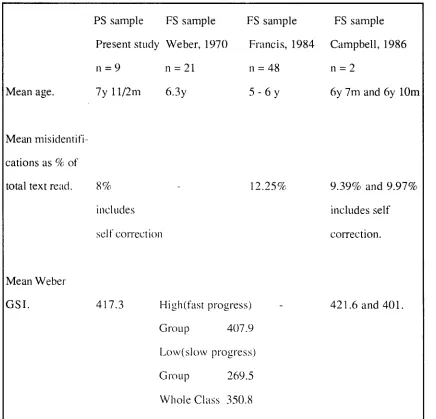
Table 2. Data from four separate studies of partially sighted and fully sighted children with regard to misidentifications and graphic similarity.
These figures do not yield to further statistical analysis.
letter by letter similarity between substitute words and their targets was only modest. However, it was the quality of the error which was the more important issue.
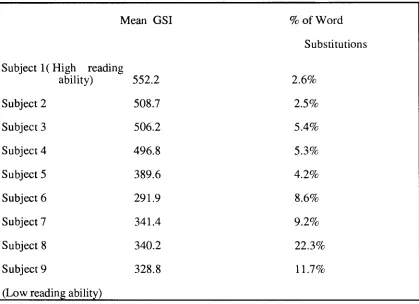
Table 3. The mean Graphic Similarity Index score for each PS subject, and the number of word substitutions made by each PS subject, as a percentage of the total words read. Subjects are listed in order of reading ability.
Mean GSI
Subject 1( High reading
% of Word Substitutions
ability) 552.2 2.6%
Subject 2 508.7 2.5%
Subject 3 506.2 5.4%
Subject 4 496.8 5.3%
Subject 5 389.6 4.2%
Subject 6 291.9 8.6%
Subject 7 341.4 9.2%
Subject 8 340.2 22.3%
Subject 9 328.8 11.7%
(Low reading ability)
There was a significant positive correlation ( Spearman's r =.9, p <.01,one tailed test) between the reading ability of the PS subjects, measured on the Salford Sentence Reading Scale or BAS, and the level of the GSI.
A correlation carried out between the mean GSI and the chronological age of the PS subjects did not reach significance.( r = .47, p.>.05, one tailed test)
There was a significant negative correlation between reading ability (up to Reading Age 9 years 3 months) and percentage of word substitutions ( r =-.9, p < .01)
A separate analysis was carried out for each subject to determine whether there was a change in the number and quality of word substitutions between the first and the second parts of this Study. No significant change was found. In several cases, there was a decrease in the mean GSI between part one and part two.
Table 4. The salient graphic features shared by the word substitutions and the target words.Subjects are listed in reading age order with Subject 1 having the highest reading age and Subject 9 the lowest. Figures provided represent a percentage of each child's total word substitutions.
1st letter same Same end letter 1 letter different 1st & last same Zero letters same Length same No apostro- -phe.
1. 32 15 46 39 4.5 30 9
2. 46 8 37 25 6.3 27 14
3 34 8 31 35 5.6 35 6
4. 42 11 26 28 5.3 27 7
5. 45 16 25 13 5.3 47 2
6. 52 7 26 4 25.9 37 4
7. 52 9 12 5 18.5 23 10
8. 56 5 13 13 9.1 39 10.5
9. 51 5 15 12 14.6 39 10
There was a significant negative correlation between high reading age and use of the first letter only as a salient feature in choice of word substitute (Spearman's r = - .8,
p <. 01, one tailed test), and between high reading age and number of word substitutions which have no letters in common with the target word (r = -.68, p < .05, one tailed test).
BBL LONDIN.
There was also a significant positive correlation between reading age and the use of both first and last letter in selection of a word substitute ( r = .75,p < .05, one tailed test) and between reading age and the number of word substitutes which differed by only 1 letter from the target ( r = .9, p < .01, one tailed test). The correlation between high reading age and the presence of the same last letter as the target word reached significance ( r = .6, p < .05, one tailed test)
The correlations between
- high reading age and word length ( r = -.43)
- high reading age and lack of response to apostrophes (r = -.13) did not reach significance (n = 9, p > 0.05,one tailed test)
2.4.4.DISCUSSION.
The purpose of Study 1 was to analyse the oral reading of PS children against the background of the tuition they were receiving.
Two aspects of the children's reading were examined in detail: 1.The word substitutions they made.
2. The salient graphic features they used in the selection of their word substitutions.
The findings of Study 1 were:
1.The PS subjects in Study 1 produced word substitutions which resembled those of younger FS children in terms of GSI (see Table 2).
3. As the reading level of the PS subjects improved, the number of word substitutions decreased, and the GSI increased.
4.The PS children read at least 50% of the total text words accurately and smoothly. However, when looking at the quality of the relatively small number of misidentifications, it seemed that the mean Graphic Similarity Index of PS children
?),
could reflect their shape matching difficulty as-well as reflecting, the range of reading ability within the PS group. GSI increased as reading age improved, but despite the skill of the older PS readers, the GSI did not reach complete identity with the target words, as though a residual difficulty prevented complete accuracy.
5.With regard to the salient features being used, the less skilled PS readers relied significantly on the first letter of a word, and had significantly more word substitutes which shared no letters with the target. This bore out expectations derived from studies of young FS readers.
The more skilled PS readers relied significantly on first and last letters in common, and had a significant number of word substitutes which differed from the target by only one letter. This, too, bore out previous findings that after the first letter, the last letter was the next most salient, as being the carrier of important morphemic information, for example, about tense or number.
6.The results showed that the PS generally had difficulty in seeing the apostrophes in words. This did not relate to age nor to reading age.
The general purpose of Study 1 was to see how the visuoperceptual delay described by Lansdown (1973) affected reading performance. Three aspects have been considered in the Study and will be discussed below:
a) the nature of the word substitutions made. b) the graphic features used.
c) the effect of the reading tuition provided.
WORD SUBSTITUTIONS.- Sounds versus the Visual Index.
Because of the reading instruction provided for these PS children, the hypothesis was that they would have a bias towards using grapheme-phoneme decoding as they read, and that their misreadings would reflect this bias. The evidence provided so far does not differentiate between the use of aural and visual cues.
The tape recorded data provided evidence that the PS children were often not just looking at a word and reading it from sight, but were sounding it out. Many word substitutes arose from full or partial decoding achieved in this way. Obviously the graphic form of the letters always has to be seen first, and then it is a question of whether the visual array on its own achieves a lexical match or whether grapheme-phoneme decoding is required. Because of their strategy bias, these young PS readers were quick to provide sounds to use in conjunction with what they saw. But the question is whether they ultimately used sounds instead of what they saw. This is difficult to demonstrate, although there were some occasions when this seemed to be the case. 'Peas' was read as 'peace' and 'tall' as 'tail'.
although there was not a complete record of what each child's print reading store comprised, and some of the children were quite experienced readers, there were very few words which were clearly drawn from outside the expected print repertoire. Some examples were the use of 'panther' instead of 'parrot' and of the names 'Fred' and 'Bill' instead of 'Ted' and 'Ben'. The presence of word substitutes with no letters in common with the target was evidence of a child's reliance on its spoken word store rather than on what was seen on the page. Here such reliance was evident amongst the less skilled readers. Mostly, the children kept very close to the printed text and this is probably reflected in the high number of word substitutes which differed by only one letter from the target print word.
All the PS readers made considerable use of word length as a cue, and it might seem that this was evidence of visual information in use, however, it could also be argued that in a sequential letter-sound analysis of a word, a young reader was also aware of length or number of syllables in the match between target and substitute.
The overall conclusion from examining the word substitutes was that it was not possible to deduce exactly which strategy was being used predominantly. Much letter-sound decoding occurred, but this seemed not to be at the expense of reliance on what was seen. Phonic tuition can mistakenly be viewed as being concerned principally with sounds. A main element of this type of tuition, seen here, consisted of specifying the visual components of each word. Each was analysed and specified visually and phonologically.
SALIENT GRAPHIC FEATURES.
The second focus of analysis in Study 1 was the type of graphic features used by the PS readers in selecting a word substitute. Here, as in other studies, the same salient graphic features were used:
The younger, poorer readers made more use of the first letter as a salient cue. Or, they provided a word with no letters in common with the target. This latter strategy was noticed in previous studies, in which the younger readers maintained the story line With one of their own words, if the printed one was not known or could not be recognised by use of any of their available strategies. The finding here of an overall decrease in such word substitutes as reading improved, at first sight seemed to differ somewhat from the finding of Francis (1984) with younger children. In her study, in the age range 5 - 7 years, there was first a decrease in the number of such 'zero' word substitutes as reading improved, but then there was an increase from reading age seven. For her the better readers generated word substitutes both with a high number of letters in common and with none at all. Here, the better PS readers were held closely to the printed text. A subject by subject analysis of word substitutes with zero letters in common with the target showed that in this Study too, between parts one and two, the readers who started with a reading age of 5 - 6 3/4 years eventually increased this type of 'zero letter match' word reading response &So first, the beginner readers decreased their 'guesses' based on maintaining the storyline, but then they increased them again, perhaps as their reading speeded up.This occurred at a stage when they were struggling to make use of letter-sound decoding.
The better readers made more use of first and last letters to aid their generation of a word substitute. In a smaller number of instances, the word substitutes and targets shared the last letter in common.This, too, was noted in Weber's study (1970) and that of Francis (1984).
decreased. This idea was borne out by the fact that there was a tendency for the GSI of word substitutions to decrease in the second half of the Study as compared with the first half. As fluency developed, reading became faster, and a little less accurate.
THE EFFECT OF THE METHOD OF READING TUITION.
In this Study the teaching method emphasised individual letters and letter patterns in relation to pronunciation, the reading materials provided a range of printed words, whose written form was predictable or unpredictable from the spoken form. (Venezky, 1970)
In addition to the strategies brought to the task by the child, (sounding-out, self correction, partial sounding out ), there were also the teacher initiated strategies.
These were of several kinds: -spelling a word.
-sounding it out.
-breaking a word up into smaller parts.
-a mixture of all these until the child could find the correct version of the word. Or - - providing prompts or cues which enabled the child to go back to the point of error and try again.
This kind of cueing was of two kinds:
-the first, was to return to the last word the child had read correctly, reread it with a query, as though to ask: 'What comes next ?'.
-the second way was to say 'no' immediately an incorrect word was read, so that the child was required to reread from that point on.
These teacher initiated strategies were a form of modelling for the child of how to approach the reading of new words. This modelling was accompanied by verbal instructions (see Appendix 3).
These instructions were of three kinds:
-to look at the letters, the position of the letters, to look at parts of words.
-to sound out letters, to break a word up, to put it together again, to spell the word. -to reflect on whether the word was new, or had been read recently.
There was a fourth type of instruction, too, which consisted of instructions not to guess, not to read too fast, and very gradually to put over the idea that not all words could be read successfully by analysis of the sound correspondences of individual letters or letter clusters.
As in other studies, the word substitutions revealed the use of graphic cues. The number of word substitutes was modest but was accompanied by other successful or partially successful strategies, such as sounding out and self-correction.
There was very little evidence of nonresponse, except on the part of the youngest reader. The fact that PS pupils begin to read later than their FS peers may, however, count as nonresponse and is commented on further in Chapter 4.
When listening to a child trying to sound out a word, that 'sounded out' version was
often far from the target - particularly as in this Study, when the reading materials were
not specifically designed for phonic tuition. Often the teacher had to help the child with
partial sounding out.The teacher's version was moulded to the target word because the
teacher knew what that word was and could subtly make the component letters sound
like it in a way that was not possible for the beginner reader.
If the child were left to read uninterrupted, then many of these 'sounded' attempts
would be nonwords or nonsense. However, in this Study, the tuition and the reading
were very tightly controlled. With a few exceptions, incorrect versions were not
allowed to pass but help continued until the correct version was achieved.
Barr (1978) maintained that even eclectic teaching in the early stages of reading, did not
lead the child to develop parallel strategies, but rather one dominant one, which was
progressively refined. Here, only one strategy was taught, yet it is interesting that the
cues used even by the youngest, least competent readers, of first and/or last letter
shared, were the same cues used by Wiley's (1928 ) and Francis' (1984) subjects
following sight word tuition. Barr's (1972) starting point was to ask whether tuition
method made any difference to the child's strategies. It seems that it does, but there are
nonetheless commonalities both of cue and of error type.
CONCLUSION.
In terms of the dimensions of interest in this Study, there is clear evidence from the
literature of an increase in graphic similarity between target and substitute word as a
function of reading level (Francis, 1984). This was true also for the PS children here.
As reading level increased, there was an accompanying increase in the level of graphic
similarity between the target and the substitute. Clearly the children, although being
pronunciation, were using a visual strategy in reading. Age was not a significant factor, and although word substitutions decreased significantly with reading age, there was no such decrease between the first and the second halves of the Study. This suggests that such a drop in word substitutions is a slow and gradual process over years rather than months.
Study 1 has provided a qualitative account of the reading performance of a group of PS subjects over a period of over half a year. Its limitation is the impossibility of making direct comparisons with a comparable group of FS children on specific word processing tasks.