Chemoselective Synthesis of 1,1-diacetate Using Ni2+@
Hydroxyapatite-core@shell γ-Fe2O3 Nanoparticles as an
Efficient and Reusable Lewis Acid Catalyst under
Solvent Free Conditions
E. Rezaee Nezhad
*,1,
S. Sajjadifar
1, Z. Abbasi
2, and S. Rezayati
11Department of Chemistry, Payame Noor University, PB BOX 19395-4697 Tehran, Islamic Republic of Iran 2Young Researchers and Elite club, Ilam Branch, Islamic Azad University, Ilam, Islamic Republic of Iran
Received: 16 March 2014 / Revised: 10 June 2014 / Accepted: 28 June 2014
Abstract
A simple and efficient method for the chemoselective 1,1-diacetate protection of
aromatic aldehydes with acetic anhydride by using Ni
2+supported on
hydroxyapatite-core-shell magnetic γ-Fe2O3
nanoparticles (γ-Fe2O3@HAp-Ni
2+) under solvent free
conditions. This method has several advantages, including high yield, short reaction
time, simple work-up and recyclable property of the catalyst. The catalyst can be readily
isolated by using an external magnet and no obvious loss of activity was observed when
the catalyst was reused in five consecutive runs.
Keywords:γ-Fe2O3nanoparticles, 1,1-diacetate; Chemoselective; Solvent free.
*Corresponding author: Tel: +988412228316; Fax: +988412221053; Email: [email protected]
Introduction
In the past decade, the application of magnetic nanoparticles (MNPs) as catalysts has attractive and interesting materials because of their high surface area, unique magnetic properties and high catalytic activity, moreover, they have a wide range of novel applications in physical and chemical fields; such as magnetic fluids [1] catalysis [2,3] biology and medical applications [4] magnetic resonance imaging (MRI) [5, 6] data storage,[7] and environmental remediation [8,9]. Moreover, they can be used in various organic reactions such as knoevenagel reaction [10,11], nucleophilic substitution reactions of benzyl halides [12], epoxidation of alkenes [13], synthesis of α-amino nitriles [14], hydrogenation of alkynes [15], esterifications [16], CO2 cycloaddition reactions [17], Suzuki coupling reactions [18] and three-component
condensations [19].
anhydride under acidic medium. A variety of catalysts including sulfamic acid [29], triflic acid [30], NBS [31], CAN [32], H2SO4-SiO2[33], H6P2W18O62.24H2O [34], Bi(NO3)3.5H2O [35], PVA-FeCl3 [36], Fe+3 on montmorillonite [37], zirconium sulfophenyl phosphonate [38] and zeolites [39].
Although in many cases have convenient protocols with good to high yields most of these methods suffer from some disadvantages such as reaction under oxidizing conditions, prolonged reaction time, high reaction temperature, tedious work-up procedure, the use of expensive catalysts or harmful solvents, strong conditions and tedious work-up procedure. Therefore, it seems that there is still a need for development of novel methods that proceed under green and eco-friendly conditions.
We herein wish to report a fast and efficient procedure for the synthesis of acylals from various aldehydes with acetic anhydride using γ-Fe2O3 @HAp-Ni2+as a heterogeneous catalyst under solvent-free conditions.
Materials and Methods
Products were characterized by comparison of their spectroscopic data (1H NMR, 13C NMR and IR) and physical properties with those reported in the literature.
The reaction progress was checked by TLC on silica gel polygram SIL G UV 254 plates. Chemicals were purchased from Fluka, Merck, and Aldrich.
Preparation of γ-Fe2O3@HAp-Ni2+
In this study, γ-Fe2O3@HAp-Ni2+was prepared in two steps [40]. The Iron oxide magnetic particles (IOMP) were synthesized by co-precipitation method in the basic condition. IOMP/HAP was prepared by the impregnation method according to known procedures with some modifications. Then hydroxyapatite-encapsulated γ-Fe2O3 (0.6 g) was introduced into 100 ml of distilled water containing 6.4 mmol of NiCl2.6H2O. The mixture was stirred (500 rpm) for 48 h, filtered, and washed several times with ethanol. The recovered solid was dried at 50 °C overnight. The mean size and the surface morphology of the γ-Fe2O3 @HAp-Ni2+were characterized by TEM, SEM, VSM, XRD and FTIR techniques.
General procedure for formation of acylals
To a mixture of various aldehydes (1 mmol) in acetic anhydride (2 mmol), γ-Fe2O3@HAp-Ni2+ (20 mg) was added and then they were taken in a round bottom flask and stirred under solvent free condition at room temperature. The time required for each reaction is indicated in Table 3. The reaction was followed by
FeCl2 4H2O
FeCl36H2O
+
(NH4)2HPO4
γ-Fe2O3@HAP
NH4OH (25%)
25oC, O 2
Ca(NO3)24H2O
γ-Fe2O3 γ-Fe
2O3@HAP-Ni2+
NiCl2 6H2O
300oC, 3h
90oC, 2 h 48 h, 25oC
γ-Fe2O3 HAP Ni2+
Scheme 1. Synthesis of Ni2+supported on hydroxyapatite-core-shell γ-Fe 2O3
R
H
O
R
O
O
CH
3Me
O
O
H
Me
O
Me
O
O
γ-Fe
2O
3@HAp@Ni
2+Solvent free
r.t.
TLC (n-hexane:EtOAc, 5:1). After completion of the reaction, CH2Cl2(30 mL) was added to the mixture and filtered and then again the solid material (γ-Fe2O3@HAp-Ni2+) was washed with CH2Cl2(2×5 mL) and collected for reusing. Evaporation of the solvent
followed by column chromatography on silica gel afforded the pure corresponding 1,1-diacetates. The structures of products were determined on the basis of their spectral data.The residual catalyst in the reaction vessel was washed and dried and then subjected to the next run directly.
Results and Discussion
An infrared spectrum was obtained in the 400-4000 cm−1 range, by a Perkin-Elmer FTIR spectrometer.The samples and KBr were fully dried before the FT-IR analyses exclude the influence of water. Fig. 1 presents the FTIR spectra of γ-Fe2O3@HAp, (b) γ-Fe2O3 @HAp-Ni2+. The characterization of Ni2+ supported on hydroxyapatite-core-shell γ-Fe2O3 NPs was further carried out by FT-IR. The band at 3417 cm-1 was assigned to the stretching and bending modes of the OH groups in the hydroxyapatite structure. The bands at 1042 cm-1 were attributed to the asymmetric and symmetric stretching vibration of the phosphate group
Figure 1. FT-IR spectra of (a) γ-Fe2O3@HAp, (b)
γ-Fe2O3@HAp-Ni2+.
Figure 2. XRD pattern of HAP, γ-Fe2O3@HAp and
γ-Fe2O3@HAp-Ni2+
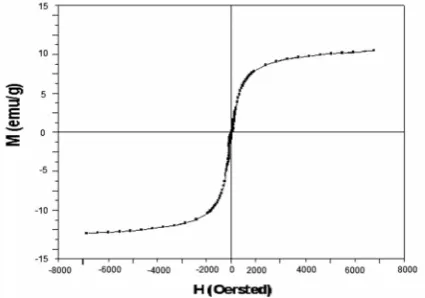
Figure 3. Magnetization curves of γ-Fe2O3@HAp-Ni2+
Figure 4. SEM images of γ-Fe2O3@HAp-Ni2+
(PO4-3) and the bending modes of Fe–O was observed at 604, 558 cm-1. In addition, the band at 875 cm-1 indicated that HPO4-2 may also be present in the hydroxyapatite as an impurity.
The X-ray diffraction patterns of γ-Fe2O3@HAp and γ-Fe2O3@HAp-Ni2+, is shown in Fig. 2.
Fig. 3. Shows the magnetization curves for Ni2+ supported on hydroxyapatite-core-shell γ-Fe2O3 NPs. The magnetization curve gives a saturation magnetization value of 11.13 emu/g.
Scanning electronic microscopy (SEM), the morphology of the surface of Ni2+ supported on hydroxyapatite-core-shell γ-Fe2O3NPs was investigated using a scanning electronic microscope of XL30 type (Netherland).
The structural and morphological characterization of Ni2+ supported on hydroxyapatite-core-shell γ-Fe
2O3 NPs were performed by measuring SEM using a Philips XL30 scanning electron microscope (Fig. 4).
TEM micrographs provide more accurate information on the particle size, morphology and loading of Ni2+ supported on hydroxyapatite-core-shell γ-Fe2O3 NPs. These nanoparticles which consist of relatively small, nearly spherical particles, with an average size of 50 nm, are much smaller than the sizes obtained from the XRD measurements (Fig.5).
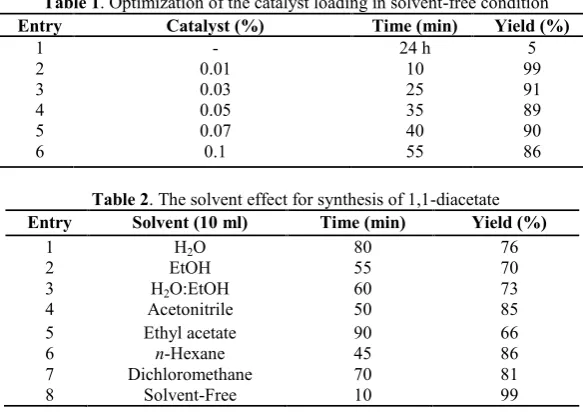
Herein we wish to report a simple, efficient, and chemoselective method for the protection of aromatic compounds with acetic anhydride by using γ-Fe2O3@HAp-Ni2+under solvent free conditions In the first, the catalytic effect of γ-Fe2O3@HAp-Ni2+on the condensation reaction of benzaldehyde and acetic anhydride compound under solvent-free conditions described. The reaction in the without of catalyst in 5%
yield within 24 hours (Table 1, Entry 1), but in the presence of γ-Fe2O3@HAp-Ni2+catalyst, reaction time was increased and the mixture of various 1,1-diacetates were produced. With used about 0.1 mol% of γ-Fe2O3@HAp-Ni2+the reaction took longer time and low yield (Table 1, Entry 6). To improve the yield, the same reaction was carried out in the presence of a catalytic amount of 0.01 mol% surprisingly, a significant improvement was observed and the excellent yield was dramatically increased to 99% (Table 1, Entry 2).
The use of this solvent-free conditions approach is better, because when the reaction is carried out in solvent including ethanol, water, mixture water-ethanol, and acetonitrile and it’s at room temperature not improve the yields and it took longer reaction time 70– 100 min (Table 1, Entries 1-7). Thus we have optimized the reaction condition at room temperature for 10 min and in the presence of a catalytic amount of 0.01 mol%, under solvent free condition (Table 2).
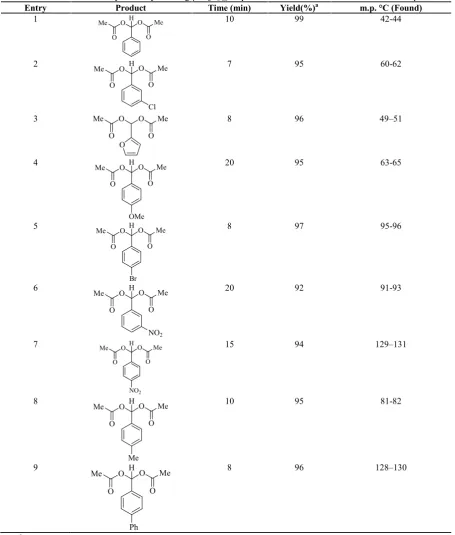
The results listed in Table 3 show that aldehydes aromatic and aliphatic reacts smoothly with acetic anhydride compound to afford the corresponding 1,1-diacetates that all these products are good to excellent of yield and reaction time. All the reactions were completed within 5-25 min with high yields (89–99 %). When the reaction was carried out using aromatic aldehydes we obtained good to excellent yields and reaction time better (Table 3, Entries 1, 5, 11, and 15). The powerful electron-releasing substituent Ome slightly decreased the yield and increased the reaction time (Table 3, Entry 14).
As it can be seen in Table 4, γ-Fe2O3@HAp-Ni2+as a catalyst was afforded good results in comparison to the other catalysts.
Table 1. Optimization of the catalyst loading in solvent-free condition
Entry Catalyst (%) Time (min) Yield (%)
1 - 24 h 5
2 0.01 10 99
3 0.03 25 91
4 0.05 35 89
5 0.07 40 90
6 0.1 55 86
Table 2. The solvent effect for synthesis of 1,1-diacetate
Entry Solvent (10 ml) Time (min) Yield (%)
1 H2O 80 76
2 EtOH 55 70
3 H2O:EtOH 60 73
4 Acetonitrile 50 85
5 Ethyl acetate 90 66
6 n-Hexane 45 86
7 Dichloromethane 70 81
Catalyst reusability is of major importance for large scale operations and an industrial point of view. The recovery and reusability of the catalyst were studied using benzaldehyde, acetic anhydride as model reaction. Since the catalyst can be separated from the
reaction mixture using an external magnetic field, it was recovered with a simple magnet after the dilution of the reaction mixture with ethanol. The catalyst was consecutively reused five times without any noticeable loss of its catalytic activity (Table 4).
Table 3. Conversion of aldehydes to acylals using γ-Fe2O3@HAp-Ni2+under solvent-free condition at room temperature
Entry Product Time (min) Yield(%)a m.p. °C (Found)
1 Me OH O Me
O O
10 99 42-44
2 Me O H O Me
O O
Cl
7 95 60-62
3 Me O O Me
O O
O
8 96 49–51
4 Me O H O Me
O O
OMe
20 95 63-65
5 Me OH O Me
O O
Br
8 97 95-96
6 Me OH O Me
O O
NO2
20 92 91-93
7 Me O HO Me
O O
NO2
15 94 129–131
8 Me O H O Me
O O
Me
10 95 81-82
9 Me O H O Me
O O
Ph
8 96 128–130
Table 3. Conversion of aldehydes to acylals using γ-Fe2O3@HAp-Ni2+under solvent-free condition at room temperature
10 Me O H O Me
O O
OH
10 90 103-104
11 Me O H O Me
O O
Cl
5 99 79-81
12
O Me O
Me
H O
O 10 93 98-100
13 Me O H O Me
O O
OH
15 90 91-92
14 Me O H O Me
O O
OMe
2 89 Oil
15 Me O H O Me
O O
OMe OH
15 97 90-91
16 H
OAc OAc
25 89 Oil
17
OAC OAC
H 15 84 181-182
18
OAC OAC
H 10 75 Oil
aisolated yield.
Table 4. Comparison of catalytic ability of catalysts.
Entry Catalyst/solvent/temperature Reaction time (min) Yield % Ref.
1 SBSA/S.fa/r.t.b 4 98 41
2 CoPy2Cl2/ S.f/r.t. 3 98 42
3 SPDTSA/S.f/r.t. 4 94 43
4 RHA-SO3H/ S.f/r.t. 0.5 93 44
5 SBA-15-Ph-PrSO3H/H2O/reflux 60 100 45
6 γ-Fe2O3@HAp-Ni2+/S.f/r.t. 10 99 This work
Conclusion
In this research, Ni2+ supported on hydroxyapatite-core-shell magnetic γ-Fe2O3 nanoparticles is a chemoselective and highly efficient catalyst for the formation of acylals from aldehydes. The advantages of the present procedure are its simplicity of operation, very short reaction times in comparison to the other procedures, and the high yields of products. In this way, the catalyst can be easily recovered by simple magnetic decantation and reused several times with no loss of activity.
References
1. Chikazumi S., Taketomi S., Ukita M., Mizukami M., Miyajima H., Setogawa M., Kurihara Y., Physics of magnetic fluids.J. Magn. Magn. Mater65:245-251 (1987). 2. Nemati F., Saeedirad R., Nano-Fe3O4 encapsulated-silica
particles bearing sulfonic acid groups as a magnetically separable catalyst for green and efficient synthesis of functionalized pyrimido[4,5-b]131erminal131131 and indeno fused pyrido[2,3-d]pyrimidines in water. Chin. Chem. Lett24:370–372 (2013).
3. Maleki A., Fe3O4/SiO2 nanoparticles: an efficient and
magnetically recoverable nanocatalyst for the one-pot multicomponent synthesis of diazepines, Tetrahedron
68:7827–7833 (2012).
4. Gupta A. K., Gupta M., Synthesis and surface engineering of iron oxide nanoparticles for biomedical applications.
Biomaterials26: 3995-4021 (2005).
5. Mornet S., Vasseur S., Grasset F., Verveka P., Goglio G., Demourgues A., Portier J., Pollert E., Duguet E., Magnetic nanoparticle design for medical applications. Prog. Solid State Chem34:237-247 (2006).
6. Li Z., Wei L., Gao M. Y., Lei H., One-pot reaction to synthesize biocompatible magnetite nanoparticles. Adv. Mater17:1001-1005 (2005).
7. Hyeon T., Chemical synthesis of magnetic nanoparticles.
Chem. Commun8: 927-934 (2003).
8. Elliott D. W., Zhang W.X., Field assessment of nanoscale bimetallic particles for groundwater treatment. Environ. Sci. Technol35:4922-4926 (2001).
9. Takafuji M., Ide S., Ihara H., Xu Z., Preparation of poly(1-vinylimidazole)-grafted magnetic nanoparticles and their application for removal of metal ions. Chem. Mater 16: 1977-1983 (2004).
10. Karaoğlu E., Baykal A., Senel M., Sözeri H., Toprak M. S., Synthesis and characterization of Piperidine-4-carboxylic acid functionalized Fe3O4 nanoparticles as a
magnetic catalyst for Knoevenagel reaction. Mater. Res. Bull47:2480-2486 (2012).
11. Zhang Y., Xia C., Magnetic hydroxyapatite-encapsulated γ-Fe2O3 nanoparticles functionalized with basic ionic
liquids for aqueous Knoevenagel condensation. Appl. Catal. A: General366:141-147 (2009).
12. Kiasat A. R., Nazari S., Magnetic nanoparticles grafted with β-cyclodextrin–polyurethane polymer as a novel nanomagnetic polymer brush catalyst for nucleophilic substitution reactions of benzyl halides in water. J. Mol. Catal. A: Chem365:80-86 (2012).
13. Kooti M., Afshari M., Phosphotungstic acid supported on magnetic nanoparticles as an efficient reusable catalyst for epoxidation of alkenes.Mater. Res. Bull47:3473 (2012). 14. Kassaee M. Z., Masrouri H., Movahedi F., Sulfamic
acid-functionalized magnetic Fe3O4nanoparticles as an efficient
and reusable catalyst for one-pot synthesis of α-amino nitriles in water.Appl. Catal. A: General395:28-33 (2011). 15. Abu-Reziq R., Wang D., Post M., Alper H., Platinum nanoparticles supported on ionic liquid-modified magnetic nanoparticles: selective hydrogenation catalysts. Adv. Synth. Catal349:2145-2150 (2007).
16. Jiang Y. Y., Guo C., Xia H. S., Mahmood I., Liu C. Z., Liu H. Z., Magnetic nanoparticles supported ionic liquids for lipase immobilization: Enzyme activity in catalyzing esterification.J. Mol. Catal. B: Enzym58:103-109 (2009). 17. Zheng X. X., Luo S. Z., Zhang L., Cheng J. P., Magnetic
nanoparticle supported ionic liquid catalysts for CO2
cycloaddition reactions.Green Chem11:455-458 (2009). 18. Taber A., Kirn J. B., Jung J. Y., Ahn W. S., Jin M. J.,
Highly Active and Magnetically Recoverable Pd-NHC Catalyst Immobilized on Fe3O4Nanoparticle-Ionic Liquid
Matrix for Suzuki Reaction in Water. Synlett 15:2477– 2482 (2009).
19. Zhang Q., Su H., Luo J., Wei Y. Y., A magnetic nanoparticle supported dual acidic ionic liquid: a “quasi-homogeneous” catalyst for the one-pot synthesis of benzoxanthenes.Green Chem.14:201-208 (2012). 20. Kochhar K. S., Bal B. S., Deshpande R. P., Rajadhyaksha
S. N., Pinnick H. W., Protecting groups in organic synthesis. Part 8. Conversion of aldehydes into 131erminal diacetates.J. Org. Chem48:1765-1767 (1983)
21. Snider B. B., Amin S. G., An international journal for rapid communication of synthetic organic chemistry.Synth. Commun8:117-125 (1978).
22. Heerden F. R. V., Huyser J. J., Bradley W. D., Holzapfel C. W., Palladium-catalysed substitution reactions of 131erminal allylic diacetates. Tetrahedron Lett 39: 5281-5284 (1998).
23. Sandberg M., Sydnes L. K., The chemistry of acylals. Part II. Formation of nitriles by treatment of acylals with trimethylsilyl azide in the presence of a Lewis acid.
Tetrahedron Lett39:6361-6364 (1998).
24. Sandberg M., Sydnes L. K., The chemistry of acylals. 3. Cyanohydrin esters from acylals with cyanide reagents. Org. Lett2:687-689 (2000).
25. Sydness L. K., Sandberg M., The chemistry of acylals. Part I. The reactivity of acylals towards Grignard and organolithium reagents. Tetrahedron 53:12679-12690 (1997).
Table 5. The catalytic activity of γ-Fe2O3@HAp-Ni2+in 5 cycles
Run 1 2 3 4 5
26. Yadav J. S., Reddy B. V. S., Srihari P., Scandium triflate catalyzed allylation of acetals and gem-aiacetates: a facile synthesis of homoallyl ethers and acetates. Synlett5 :673-675 (2001).
27. Frick J. G., Harper R. J., Acetals as crosslinking reagents for cotton. J. Appl. Polym. Sci29:1433-1447 (1984). 28. Shelke K., Sapkal S., Kategaonkar A., Shingate B.,
Shingare M. S., An efficient and green procedure for the preparation of acylals from aldehydes catalyzed by alum [Kal(SO4)2.12H2O]. South Afr. J. Chem 62:109-112
(2009).
29. Jin T. S., Sun G., Li Y. W., Li T. S., An efficient and convenient procedure for the preparation of 1,1-diacetates from aldehydes catalyzed by H2NSO3H. Green Chem 3:255-256 (2002).
30. Firouzabadi H., Iranpoor N., Amani K., Heteropoly acids as heterogeneous catalysts for thioacetalization and transthioacetalization reactions. Synthesis1:59-60 (2002). 31. Karimi B., Seradj H., Ebrahimian G. R., Mild and efficient
conversion of aldehydes to 1,1-diacetates catalyzed with N-bromosuccinimide (NBS). Synlett5:623-624 (2000). 32. Roy S.C., Banerjee B., A mild and efficient method for the
chemoselective synthesis of acylals from aldehydes and their deprotections 132erminal132 by ceric ammonium nitrate.Synlett10:1677-1688 (2002).
33. Pourmousavi S. A., Zinati Z., H2SO4-silica as an efficient
and chemoselective catalyst for the synthesis of acylal from aldehydes under solvent-free conditions. Turk J Chem
33:385-392 (2009).
34. Romanelli G. P., Thomas H. J., Baronettic G. T., Autino J. C., Solvent-free catalytic preparation of 1,1-diacetates from aldehydes using a Wells–Dawson acid (H6P2W18O62·24H2O). Tetrahedron Lett 44:1301-1303
(2003).
35. Aggen D. H., Arnold J. N., Hayes P. D., Smoter N. J., Mohan R. S., Bismuth compounds in organic synthesis. Bismuth nitrate catalyzed chemoselective synthesis of acylals from aromatic aldehydes. Tetrahedron 60 :3675-3679 (2004).
36. Li Y. Q., A rapid and convenient synthesis of 1,1-diacetates from aldehydes and acetic anhydride catalyzed by PVC-FeCl3 catalyst. Synth. Commun 30:3913-3917
(2000).
37. Li T.S., Zhang Z. H., Gao Y. J., A rapid preparation of acylals of aldehydes 132erminal132 by Fe3+
-montmorillonite,Synth. Commun28:4665-4671 (1998). 38. Curini M., Epifano F., Marcotullio M. C., Rosati O.,
Nocchetti M., Preparation and deprotection of 1,1-diacetates (acylals) using zirconium sulfophenyl phosphonate as catalyst. Tetrahedron Lett 43:2709-2711 (2002).
39. Kumar P., Hedge V. R., Kumar T. P., An efficient synthesis of diacetates from aldehydes using beta zeolite.
Tetrahedron Lett36:601-602 (1995).
40. Sajjadifar S., Abbasi Z., Rezaee Nezhad E., Rahimi Moghadam M., Karimian S., Miri S., Ni2+ supported on
hydroxyapatite-core-shell γ-Fe2O3 nanoparticles: a novel,
highly efficient and reusable lewis acid catalyst for the regioselective azidolysis of epoxides in water.J Iran Chem Soc 11:335-340 (2014).
41. Sajjadifar S., Rezayati S., Synthesis of 1,1-diacetates 132erminal132 by silica-supported boron sulfonic acid under solvent-free conditions and ambient temperature.
Chemical Papers68(4):531–539 (2014).
42. Rezayati S., Erfani Z., Rezayati S., Hajinasiri R., Rekavandi M., Dipyridine cobalt chloride as an efficient and chemoselective catalyst for the synthesis of 1,1-diacetates under solvent-free conditions. Iran. Chem. Commun2:77-86 (2014).
43. Nouri Sefat M., Deris A., Niknam, K. Preparation of silica-bonded propyl-diethylene-triamine-N-sulfamic acid as a recyclable catalyst for chemoselective synthesis of 1,1-diacetates.Chin. J. Chem29:2361–2367 (2011).
44. Shirini F., Mamaghani M., Seddighi M., Sulfonated rice husk ash (RHA-SO3H): A highly powerful and efficient
solid acid catalyst for the chemoselective preparation and deprotection of 1,1-diacetates. Catal. Commun 36:31–37 (2013).
45. Zareyee D., Moosavi S. M., Alaminezhad A., Chemoselective synthesis of 132erminal diacetates (acylals) usingeco-friendly reusable propylsulfonic acid based nanosilica(SBA-15-Ph-PrSO3H) under solvent-free