P R I M A R Y R E S E A R C H
Open Access
The association between hypoxia-inducible factor-1
α
gene G1790A polymorphism and cancer risk: a
meta-analysis of 28 case
–
control studies
Yuqiao Zhou
1†, Lin Lin
1†, Yun Wang
1, Xin Jin
1, Xin Zhao
1, Dongjuan Liu
1, Ting Hu
1, Lu Jiang
1, Hongxia Dan
1,
Xin Zeng
1, Jing Li
1*, Jiayi Wang
2*and Qianming Chen
1Abstract
Purpose:Hypoxia-inducible factor-1 (HIF-1) is a key transcription factor that regulates the cellular adaptation to hypoxia. HIF-1αgene single nucleotide polymorphisms (SNPs) are implicated to be associated with cancer risks. However, results from the published studies remained inconclusive. The aim of this study is to investigate the relationship of HIF-1αgene G1790A polymorphism with cancer using meta-analysis.
Methods:A comprehensive search in Pubmed, EMBASE and China National Knowledge Infrastructure (CNKI) was conducted to identify all publications on the association between this polymorphism and cancer until December 13, 2013. Odds ratios (OR) with 95% confidence intervals (95% CI) were used to evaluate the strength of this association. Association between lymph node metastasis and G1790A was also investigated.
Results:A total of 5985 cases and 6809 controls in 28 case–control studies were included in this meta-analysis.
The A allele of HIF-1αgene G1790A polymorphism was found to be significantly associated with increased
cancer risk in four genetic models: AA + AG vs. GG (dominant model OR = 1.85, 95% CI = 1.27-2.69), AA vs. AG + GG (recessive model OR = 5.69, 95% CI = 3.87-8.37), AA vs. GG (homozygote comparison OR = 6.63, 95% CI = 4.49-9.79), and AG vs. GG (heterozygote comparison OR = 2.39, 95% CI = 1.53-3.75). This variant was also significantly associated with higher risks of pancreatic cancer, head and neck cancer, lung cancer and renal cell carcinoma. However, the A allele of G1790A was not significantly associated with increased lymph node metastasis in the dominant model by overall meta-analysis.
Conclusions:Our meta-analysis suggests that the substitution of G with A of HIF-1αgene G1790A polymorphism is a risk factor of cancer, especially for pancreatic cancer, lung cancer, renal cell carcinoma and head and neck cancer. The association is significant in Asian, Caucasian population and public based control subgroups. However, it’s not associated with risk of lymph node metastasis.
Keywords:Cancer, HIF-1α, Polymorphism, Meta-analysis
* Correspondence:[email protected];[email protected]
†Equal contributors
1State Key Laboratory of Oral Diseases, West China College of Stomatology, Sichuan University, No.14 the 3rd Section of Renmin South Road, Chengdu, Sichuan 610041, China
2
Department of Oral Radiology, West China College of Stomatology, Sichuan University, No.14 the 3rd Section of Renmin South Road, Chengdu, Sichuan 610041, China
Introduction
Cancer is a multifactorial disease involving interac-tions between inherited and environmental factors [1]. Hypoxia is one of the fundamentally important charac-teristics of solid cancer [2]. It triggers a cascade of mo-lecular events including angiogenesis and involving cell-cycle control proteins, which are closely associ-ated with tumor growth, metastasis and poor progno-sis. These responses to hypoxia are highly dependent on the activation of hypoxia inducible factor-1-alpha (HIF-1α).
Hypoxia-inducible factor-1 (HIF-1) is a key transcrip-tion factor that regulates the cellular adaptatranscrip-tion to hyp-oxia. HIF-1 trans-activates a large number of genes that are involved in cellular processes, such as glucose uptake and metabolism, angiogenesis, cell proliferation, differ-entiation and apoptosis [3,4]. HIF-1 is a heterodimeric transcription factor that consists ofα and βsubunits. Β subunit is constitutively expressed while the expession of HIF-1αis regulated by the oxygen level [5]. Under nor-moxic conditions, HIF-1α is degraded due to targeted ubiquitination and degradation by the proteasome. This process is mediated by direct binding of von Hippel– Lindau tumor suppressor protein (pVHL), a component of the E3 ubiquitin–protein ligase complex, with the minimal N-terminal transactivation domain (N-TAD), which is located within the oxygen-dependent degrad-ation domain of HIF-1α. On the contrary, in hypoxic conditions, the degradation of HIF-1α is suppressed and the expression of HIF-1α increases in the cell. Over-expression of HIF-1α has been reported in many types of cancer, including lung, prostate, breast, colon and rectum carcinoma, and in regional or distant me-tastases, implying that it may play a vital role in tumor progression [6-11].
A number of polymorphisms and mutations have been identified within HIF-1α gene, among them, G1790A (rs11549467), which results in alanine to threonine amino acid substitutions has been found recently. It is located within the oxygen-dependent degradation domain of the HIF-1αgene. This polymorphic variant has been shown to cause an increased trans-activation capacity of HIF-1α under hypoxic conditionsin vitro[12]. The possible asso-ciation between HIF-1α SNPs and cancer risk has been studied by several investigators, but the results were in-conclusive or even contradictory [7,9,11,13-20]. Tongfeng Zhao et al. [21] conducted a meta-analysis about HIF-1α polymorphisms and cancer risk in 2009, however, the sample size was limited (2058 cancer cases and 3062 con-trols) and studies published in the past 3 years were not included. In order to obtain a more comprehensive know-ledge of the association between HIF-1α G1790A poly-morphism and cancer risk, a meta-analysis on eligible case–control studies was conducted.
Method
Literature search and data extraction
A comprehensive literature search in PubMed, Embase and China National Knowledge Infrastructure (CNKI) database was carried out by two reviewers independently to identify publications evaluating the association of can-cer risk and HIF-1αG1790A polymorphism (last update: December 13, 2013). The search terms used were as follows: (cancer or carcinoma) and (Hypoxia-inducible factor-1α or HIF-1α) and (Polymorphism or mutation or variant). Selection criteria of an eligible study were: (a) investigation of the polymorphism G1790A of HIF-1α and cancer risk; (b) use of a case–control design based on unrelated individuals and (c) sufficient geno-type distributions for cases and controls so that an odds ratio (OR) with 95% confidence interval (CI) could be estimated. If more than one article was published using the same patient population, only the latest or the study with largest sample size would be used in this meta-analysis. Data including publication date, first author, original country, ethnicity, gender and cancer site (those cancer sites only exist in one article were divided into “other site group”), total number of casea and controla, source of control (population-based or hospital-based) and genotyping method were independently extracted by two investigators and conformity on all items was reached through consultation. Articles containing data on lymph node metastasis were also extracted. Patients were divided into “lymph node metastasis positive” group and “lymph node metastasis negative”group [8-10,16,22-24].
Statistical study
Crude odds ratios (ORs) and 95% confidence intervals (95% CIs) were used to estimate the strength of associ-ation between the G1790A and cancer risk or lymph node metastasis and they were determined by Z-test. The pooled ORs were estimated for the genetic models including dominant model (AA + AG vs. GG), recessive model (AA vs. AG + GG), homozygote comparison (AA vs. GG) and heterozygote comparison (AG vs. GG). The models were selected based on the following assumptions:
1. Dominant model: The heterozygous (AG) and homozygous (AA) genotypes have similar risk as a single copy of A is sufficient to alter the risk. Hence these two genotypes are combined and compared with the homozygous GG.
2. Recessive model: The AG and GG genotypes have the same effect. Hence to modify two copies of A allele is essential. Therefore this model compares the combination of AG + GG with the homozygous genotype variant allele AA.
Figure 1Flow chart of the process of selecting related publications.
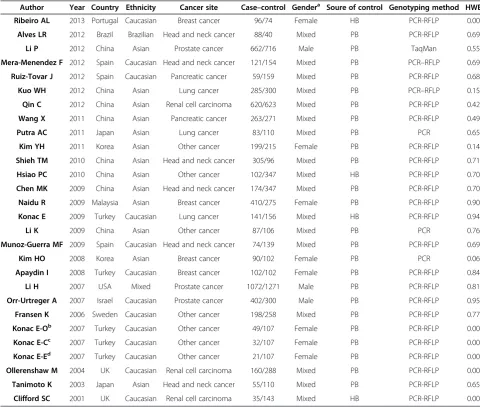
Table 1 Characteristics of populations and cancer types of the studies included in the meta-analysis
Author Year Country Ethnicity Cancer site Case–control Gendera Soure of control Genotyping method HWE
Ribeiro AL 2013 Portugal Caucasian Breast cancer 96/74 Female HB PCR-RFLP 0.00
Alves LR 2012 Brazil Brazilian Head and neck cancer 88/40 Mixed PB PCR-RFLP 0.69
Li P 2012 China Asian Prostate cancer 662/716 Male PB TaqMan 0.55
Mera-Menendez F 2012 Spain Caucasian Head and neck cancer 121/154 Mixed PB PCR–RFLP 0.69
Ruiz-Tovar J 2012 Spain Caucasian Pancreatic cancer 59/159 Mixed PB PCR-RFLP 0.68
Kuo WH 2012 China Asian Lung cancer 285/300 Mixed PB PCR–RFLP 0.15
Qin C 2012 China Asian Renal cell carcinoma 620/623 Mixed PB PCR-RFLP 0.42
Wang X 2011 China Asian Pancreatic cancer 263/271 Mixed PB PCR-RFLP 0.49
Putra AC 2011 Japan Asian Lung cancer 83/110 Mixed PB PCR 0.65
Kim YH 2011 Korea Asian Other cancer 199/215 Female PB PCR-RFLP 0.14
Shieh TM 2010 China Asian Head and neck cancer 305/96 Mixed PB PCR-RFLP 0.71
Hsiao PC 2010 China Asian Other cancer 102/347 Mixed HB PCR-RFLP 0.70
Chen MK 2009 China Asian Head and neck cancer 174/347 Mixed PB PCR-RFLP 0.70
Naidu R 2009 Malaysia Asian Breast cancer 410/275 Female PB PCR-RFLP 0.90
Konac E 2009 Turkey Caucasian Lung cancer 141/156 Mixed HB PCR-RFLP 0.94
Li K 2009 China Asian Other cancer 87/106 Mixed PB PCR 0.76
Munoz-Guerra MF 2009 Spain Caucasian Head and neck cancer 74/139 Mixed PB PCR-RFLP 0.69
Kim HO 2008 Korea Asian Breast cancer 90/102 Female PB PCR 0.06
Apaydin I 2008 Turkey Caucasian Breast cancer 102/102 Female PB PCR-RFLP 0.84
Li H 2007 USA Mixed Prostate cancer 1072/1271 Male PB PCR-RFLP 0.81
Orr-Urtreger A 2007 Israel Caucasian Prostate cancer 402/300 Male PB PCR-RFLP 0.95
Fransen K 2006 Sweden Caucasian Other cancer 198/258 Mixed PB PCR-RFLP 0.77
Konac E-Ob 2007 Turkey Caucasian Other cancer 49/107 Female PB PCR-RFLP 0.00
Konac E-Cc 2007 Turkey Caucasian Other cancer 32/107 Female PB PCR-RFLP 0.00
Konac E-Ed 2007 Turkey Caucasian Other cancer 21/107 Female PB PCR-RFLP 0.00
Ollerenshaw M 2004 UK Caucasian Renal cell carcinoma 160/288 Mixed PB PCR-RFLP 0.00
Tanimoto K 2003 Japan Asian Head and neck cancer 55/110 Mixed PB PCR-RFLP 0.65
Clifford SC 2001 UK Caucasian Renal cell carcinoma 35/143 Mixed HB PCR-RFLP 0.00
a
Mixed means samples contain both female and male; PB, public based; HB, hospital based; HWE, Hardy-Weinberg equilibrium; PCR, polymerase chain reaction; RFLP, restriction fragment length polymorphism; TaqMan, TaqMan SNP Genotyping Assays.
bcd
The significance of OR was analyzed by Z test,P< 0.05 was considered statistically significant. As most articles only used (AA + AG vs. GG) model for lymph node ana-lysis, only this genetic model (AA + AG vs.GG) was used in the lymph node metastasis analysis.
In addition to the comparison between cases and con-trols, subgroup analyses were also performed according to cancer site, ethnicity, source of controls and gender.
Heterogeneity was evaluated by a chi square-based Q statistic, and statistical significance was assumed for
P value less than 0.05. A fixed-effect model was used whenPheterogeneity was more than 0.05, otherwise a random effect model was used. Sensitivity analysis was performed to assess the stability of the current analysis. Studies which didn’t follow Hardy–Weinberg equilibrium (HWE) were excluded [25].
Publication bias was examined visually by the Begg’s funnel plot and the degree of asymmetry was tested by Egger’s test.
All of the statistical tests were performed by STATA11.0.
Results
Characteristics of studies included
Basic characteristics of studies
463 relevant publications were identified after initial screen-ing based on our search criteria (last updated on December 13, 2013). After reading the titles and abstracts, 47 articles were subjected to further examination. 18 articles were ex-cluded for no relevance to G1790A. 3 articles were exex-cluded as allele frequency was not reported (Figure 1). Finally, a
Figure 2A allele frequency of HIF-1αG1790A among control subjects stratified by ethnicity.
Table 2 Associations between the G1790A polymorphism and cancer risk
Varibles AA + AG VS GG AA VS AG + GG AA VS GG AG VS GG
na OR (95% CI) Pb na OR (95% CI) Pb na OR (95% CI) Pb na OR (95% CI) Pb
Overall 25 1.85 (1.27-2.69 ) 0 26 5.69 (3.87-8.37) 0 12 6.63 (4.49-9.79) 0 11 2.39 (1.53-3.75) 0
Overall for HWEc 22 1.82 (1.27-2.59) 0 10 7.01 (4.42-11.09) 0 10 7.75 (4.87-12.34) 0 10 3.4 (2–5.8) 0
cancer cite
Prostate cancer 3 1.41 (0.93-2.14) 0.1 1 3.24 (0.13-79.9) 0.47 1 3.34 (0.13-82.30) 0.46 1 1.98 (0.07-50.4) 0.67
Head and neck cancer 6 3.57 (0.98-12.99) 0.05 3 58 (1.75-1924.88) 0.02 3 101.38 (22.09-65.29) 0 3 12.53 (2.42-64.76) 0
Pancreatic cancer 2 2.5 ( 0.93-6.72) 0.06 1 18.8 (0.96-371.55) 0.05 1 18.3 (0.93-360.19) 0.05 1 29.4 (1.12-772.37) 0.04
Lung cancer 3 2.14 ( 1.56-2.95) 0 2 4.5 (2.3-8.81) 0 2 5.42 (2.74-10.7) 0 2 3.02 (1.48-6.16) 0
Renal cell carcinoma 3 0.94 ( 0.16-5.29) 0.95 2 2.69 (1.20-6.03) 0.01 2 3.71 (1.72-7.99) 0.46 1 0.81 (0.33-2) 0.65
Other cancer 5 2.11 ( 1.03-4.32) 0.45 1 0.35 (0.01-8.80) 0.53 1 0.35 (0.01-8.8) 0.52 1 0.36 (0.01-9.68) 0.54
Breast cancer 3 0.63 ( 0.19-2.08) 0 2 1.44 (0.34-6.08) 0.62 2 1.43 (0.37-5.44) 0.59 2 1.45 (0.34-6.17) 0.61
Subgroup by ethnicity
Asian 13 1.75 (1.3-2.37) 0 7 3.37 (1.94-5.86) 0 7 3.82 (2.19-6.66) 0 7 2.41 (1.31-4.43) 0
Caucasian 9 1.12 (0.41-3.03) 0.81 4 3.74 (1.85-7.54) 0 4 5.05 (2.53-10.07) 0 3 2.66 (0.33-21.23) 0.35
control source
PB 22 1.95 (1.33-2.85) 0 11 5.9 (4.0-8.8) 0 11 7.2 (4.79-10.82) 0 11 2.39 (1.53-3.75) 0
HB 3 0.39 (0.01-9.90) 0.56 1 0.88 (0.04-16.82)c 0.93 1 0.44 (0.02-8.53) 0.59 0 No statistics
Gender
Female 5 0.92 (0.46-1.84) 0.82 3 1.11 (0.34-3.66) 0.85 3 1.13 (0.34-3.7) 0.83 3 1.13 (0.31-4.02) 0.84
Male 3 1.41 (0.93-2.14) 0.1 1 3.24 (0.13-79.9) 0.47 1 3.34 (0.13-82.3) 0.46 1 1.98 (0.07-50.4) 0.67
a
Number of comparisons.
bP
value of Q-test for heterogeneity test.
c
total of 28 case–control studies from 26 articles (Table 1) with 5985 cases and 6809 controls in total were included in the pooled analysis. Out of those 28 studies, 6 studies fo-cused on head and neck cancer, 3 on prostate cancer, 4 on breast cancer, 3 on lung cancer, 3 on renal cell carcin-oma, 2 on pancreatic cancer and 7 on other types of cancers such as gastric, hepatocellular and colorectal cancer. Among the 26 articles, 1 article provided data on three types of cancer (cervical cancer, endometrial cancer and ovarian cancer) [7]. Each type of cancer in one article was treated as an individual study in the meta-analysis. The ethnicities studied included Cauca-sian (13 articles), ACauca-sian (13 articles), Brazilian (1 art-icle) and mixed population (1 artart-icle). The gender studied were female (8 articles), male (17 articles) and mixed (3 articles). 7 articles provided data on lymph node metastasis, 1511 negative cases and 491 positive cases were included.
Characteristics of allele average frequency
In the control group, no significant difference of the average A allele frequency of HIF-1α G1790A was de-tected between Asian population (0.040) and Caucasian population (0.045) (P= 0.7, t-test) (Figure 2).
Quantitative data synthesis
G1790A polymorphisms and cancer: a meta-analysis of 28 case–control studies
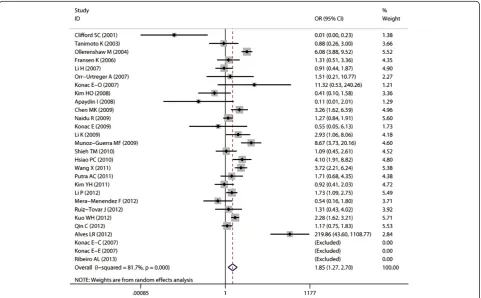
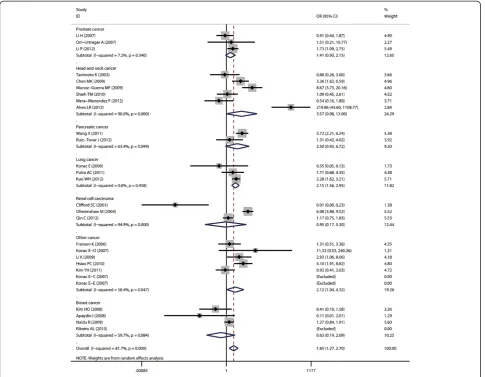
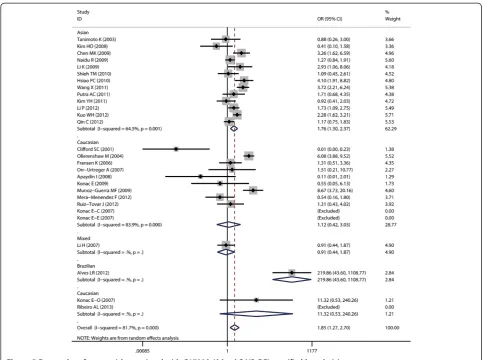
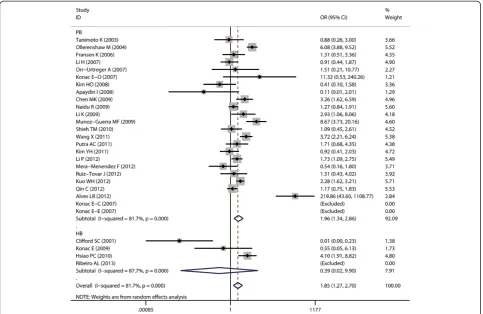
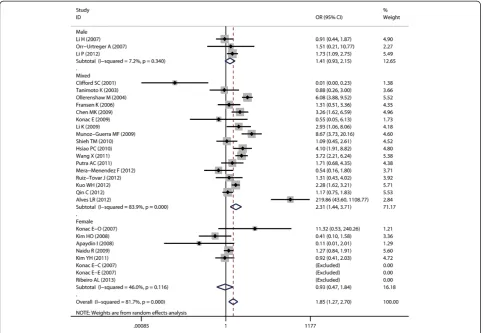
Aggregated ORs and heterogeneity test results for the as-sociation between G1790A and cancer risk were shown in Table 2. The forest plots of cancer risk associated with G1790A (AA + AG vs. GG) were shown in Figures 3, 4, 5, 6 and 7.
Overall, A allele of G1790A was found to be significantly associated with increased cancer risk in four genetic models: AA + AG vs. GG (dominant model OR = 1.85, 95% CI = 1.27-2.69), AA vs. AG + GG (recessive model OR = 5.69, 95% CI = 3.87-8.37), AA vs. GG (homozygote comparison OR = 6.63, 95% CI = 4.49-9.79), and AG vs. GG (heterozy-gote comparison OR = 2.39, 95% CI = 1.53 -3.75).
In cancer-site subgroup analysis, significant association with cancer risk was found in the following genetic models: AA vs.AG in pancreatic cancer (OR = 29.4, 95% CI = 1.12-772.37); AA + AG vs. GG (OR = 2.14, 95% CI = 1.56-2.95), AA vs. GG + AG (OR = 4.5, 95% CI = 2.3-8.81) and AA vs. GG (OR = 5.42, 95% CI = 2.74-10.7) in lung cancer; AA vs. GG + AG (OR = 58, 95% CI = 1.75-1924.88), AA vs. GG (OR = 101.38, 95% CI = 22.09-65.29 ) and AG vs. GG (OR = 12.53, 95% CI = 2.42-64.76) in head
and neck cancer; AA vs. GG + AG (OR = 2.69, 95% CI = 1.2 -6.03) and AA vs.GG (OR = 3.71, 95% CI = 1.72-7.99) in renal cell carcinoma.
As for ethnicity subgroup analysis, significant associ-ation was detected in Asian populassoci-ation in all four genetic models: AA + AG vs. GG (OR = 1.75, 95% CI = 1.3-2.37), AA vs. AG + GG (OR = 3.37, 95% CI = 1.94-5.86), AA vs. GG (OR = 3.82, 95% CI = 2.19-6.66), and AG vs. GG (OR = 2.41, 95% CI = 1.31-4.43). However, in Caucasian subgroup, significant increased risk was only found in the following models: AA vs. GG + AG (OR = 3.74, 95% CI = 1.85-7.54) and AA vs. GG (OR = 5.05, 95% CI = 2.53-10.07).
When stratified by control sources, significant associ-ation was found among public based control source in these models: AA + AG vs. GG (OR = 1.91, 95% CI = 1.3-2.8), AA vs. AG + GG (OR = 5.9, 95% CI = 3.97-8.75), AA vs. GG (OR = 7.2, 95% CI = 4.79-10.82), and AG vs. GG (OR = 2.39, 95% CI = 1.53-3.7). However, no significant as-sociation was found among hospital based control source.
G1790A polymorphisms and lymph node metastasis: a meta-analysis of 7 case–control studies
As for lymph node metastasis analysis, no significant association between A allele of G1790A and increased lymph node metastasis was found for AA + AG vs.GG (OR = 1.56, 95% CI = 0.99-2.46).
When stratified by ethnicity and control source, sig-nificant higher risk of lymph node metastasis was found in Caucasian (OR = 14.28, 95% CI = 1.74-117.17), Asian (OR = 1.39, 95% CI = 1.01-1.92) and public based popula-tion (OR = 1.62, 95% CI = 1.01-2.61) for AA + AG vs.GG (Table 3).
Heterogeneity analysis and sensitivity analysis
Significant heterogeneity was found in overall compari-sons in four genetic models: dominant model P< 0.01, recessive modelP< 0.01, homozygote comparisonP< 0.01 and heterozygote comparisonP< 0.05. Although the geno-type distribution in the control group of 6 studies did not follow HWE, the pooled ORs only altered a little after we
performed the sensitivity analysis, and the conclusion didn’t change (Table 2).
Publication bias
The shape of the funnel plots did not reveal any evi-dence of obvious asymmetry (Figure 8), suggesting that there was no obvious publication bias. Egger’s test showed no significant publication bias in this meta-analysis (t = 0.77,P= 0.45 for AA + AG vs. GG).
Discussion
HIF-1 is a key transcription factor that regulates cellular reaction to hypoxia and is over-expressed in most solid tumors in response to low oxygen concentrations [12]. It has the ability to influence metabolic reprogramming, angiogenesis, metastasis and over-expression of HIF-1α has been reported in many types of cancers as well as in regional or distant metastatic lesions [22,26].
Several polymorphisms in HIF-1 gene have been sug-gested to be related with individual’s predisposition to cancer [7,27,28]. Among them, G1790A has been re-cently identified [27]. The possible association between
G1790A and cancer risk has been extensively studied, but the results are inconclusive. One possible reason is that the rareness of A allele in both case and control populations [29] allows only a small number of A car-riers to be analyzed in many studies. In order to get a more precise conclusion, a comprehensive meta-analysis including 28 case–control studies was performed.
In the current study, we summarized the latest data on the association between G1790A of HIF-1α gene poly-morphism and cancer risk. Subgroup analysis by cancer site, ethnicity, source of controls and gender were also performed, based on four genetic models.
Overall meta-analysis showed that the A allele of G1790A was significantly associated with increased can-cer risk in all four genetic models. One possible mechan-ism is that G1790A SNP results in amino acid change from alanine 588 to threonine within the Oxygen dependent degradation (ODD) domain of the HIF-1α gene. Such amino acid change in this critical regulatory domain may enhance the transcriptional activity of HIF-1αgene [12]. It may also increase the stability of HIF-1α protein and promote the binding ability of HIF-1α
protein with the accessory proteins involved the expres-sion of downstream target genes. The protein products of these target genes play crucial roles in the acute and chronic adaptation of cells to oxygen deficiency, including erythropoiesis, glycolysis, promotion of cell survival, in-hibition of apoptosis, inin-hibition of cell differentiation and angiogenesis, all of which are critical in tumor formation, invasion and metastasis [27]. Further studies are required to address this question.
When stratified by cancer site, significant association be-tween A allele of G1790A and increased cancer risk was observed in pancreatic cancer, lung cancer, renal cell car-cinoma and head and neck cancer, but not in breast cancer, prostate cancer and other cancers. As cancer of different sites are exposed to different micro-environmental factors that can regulate or influence the gene expression profiles, gene-environment interaction may be different in these cancers. Furthermore, different tissues have different ex-pression profiles of HIF-1α, thus the same polymorphism may play different role in different tissues [30,31]. However, all those results should be treated with caution as there were only 2 or 3 studies included in some cancer site sub-groups, which might reduce the results’reliability.
As for subgroup of ethnicity, despite the possible gen-etic background difference among different ethnicities
[32], as well as environment and life-style difference be-tween Asian and Caucasian, A allele of G1790A was found to be significantly associated with increased can-cer risk in both Asian and Caucasian population. How-ever, population of this subgroup analysis was limited to Caucasian and Asian only. No study based on African participants found. Further case–control studies with large sample size and multiple ethnicities are required.
It has been reported that HIF-1α may facilitate lymph node metastasis by reducing cell adhesion, degrading extracellular matrix through up-regulating matrix metal-loproteinase (MMPs) or lysyl oxydase (LOX) [33] and increasing chemotaxis [3,34]. As G1790A enhances the stability and trans-activating capacity of HIF-1α [12], it is possible that it may also affect the risk of lymph node metastasis. In the current study, the association between A allele carriers (AA or AG) and the risk of lymph node metastasis in 7 case–control studies was not observed. After stratification by ethnicity and control source, sig-nificant association of AA or AG genotype with risk of lymph node metastasis was found in Caucasian and Asian, and PB population. However, only 1 or 2 studies were available for each subgroup analysis and only the dominant model (AA + AG vs. GG) was used. Therefore, the results should be treated with caution.
In this study, significant heterogeneity was found in four genetic models in both overall and subgroup ana-lysis. Six studies included in our meta-analysis did not follow HWE. Deviation from HWE reflects potential er-rors existing in those 6 studies, such as laboratory or genotyping errors, population stratification or selection bias in the choice of controls and unaccounted con-founding factors [25,35]. Sensitivity analysis was per-formed to assess the stability of the current analysis. After excluding those 6 studies deviated from HWE, the conclusions didn’t change, indicating that our conclu-sions were stable.
There were still some limitations in the current meta-analysis. The sample size for some subgroup analysis was limited, which could increase the possibility of type I and type II errors. Even though our funnel plot and Egger’s test did not show any bias, publication bias was also not avoidable, as positive results have higher
Table 3 Associations between the G1790A polymorphism and lymph node metastasis risk
Varibles na AA + AG VS GG
OR (95% CI) Pb
Overall 7 1.56 (0.99-2.46) 0.05
PB 6 1.62 (1.01-2.61) 0
Asian 6 1.39 (1.01-1.92) 0.04
Caucasian 1 14.28 (1.74-117.17) 0.01
a
Number of comparisons.
b
Pvalue of Q-test for heterogeneity test.
Figure 8Funnel Plot of publication bias of the G1790A Polymorphism.Each point represents a single study for the indicated association. Log (OR): natural logarithm of OR. Horizontal line: mean effect size.
chances to be published. Also, most studies were based on Asian and Caucasian population, and no studies were from Africans. Thus, further studies are needed in other ethnic population because of possible ethnic differences of G1790A polymorphism.
Conclusions
Our meta-analysis suggests that the substitution of G al-lele with A of HIF-1α gene G1790A polymorphism is a risk factor of cancer, especially for pancreatic cancer, lung cancer, renal cell carcinoma and head and neck cancer. The association is significant in Asian, Caucasion population and public based control subgroups. How-ever, it’s not associated with risk of lymph node metasta-sis by overall meta-analymetasta-sis. When stratified by ethnicity and control source, significant higher risk of lymph node metastasis was found in Caucasian, Asian and public based population.
Competing interests
The authors declare that they have no competing interests.
Authors’contributions
Conceived and designed the experiments: YZ, LL, JW, QC and JL Performed the experiments: YZ, LL, YW, XJ, XZ (Xin Zhao), DL, TH, LJ, HD, XZ (Xin Zeng), JL, JW and QC. Analyzed the data: YZ, LL, YW, XJ, XZ (Xin Zhao), DL, TH, LJ, HD, XZ (Xin Zeng), JL, JW and QC. Contributed reagents/materials/analysis tools: YZ, LL, YW, XJ, XZ (Xin Zhao), DL, TH, LJ, HD, XZ (Xin Zeng), JL, JW and QC. Wrote the manuscript: YZ, LL, YW, XJ, XZ (Xin Zhao), DL, TH, LJ, HD, XZ (Xin Zeng), JL, JW and QC. All authors read and approved the final manuscript.
Grant support
This work was supported by grants from the National Natural Science Foundation of China (No.30930100, 81061120531, 81200791, 81102060, 81001208,81302371), Doctoral Fund of Ministry of Education of China (No.20110181110055, 20100181120057, 20120181120011, 20130181120084) and the International Science and Technology Cooperation Program of China (No. 2012DFA31370).
Received: 17 December 2013 Accepted: 22 April 2014 Published: 1 May 2014
References
1. Pharoah PD, Dunning AM, Ponder BA, Easton DF:Association studies for finding cancer-susceptibility genetic variants.Nat Rev Cancer2004, 4(11):850–860.
2. Ruan K, Song G, Ouyang G:Role of hypoxia in the hallmarks of human cancer.J Cell Biochem2009,107(6):1053–1062.
3. Wang GL, Semenza GL:Purification and characterization of hypoxia-inducible factor 1.J Biol Chem1995,270(3):1230–1237.
4. Dery MA, Michaud MD, Richard DE:Hypoxia-inducible factor 1: regulation by hypoxic and non-hypoxic activators.Int J Biochem Cell Biol2005,37(3):535–540.
5. Wang GL, Jiang BH, Rue EA, Semenza GL:Hypoxia-inducible factor 1 is a basic-helix-loop-helix-PAS heterodimer regulated by cellular O2 tension. Proc Natl Acad Sci U S A1995,92(12):5510–5514.
6. Frank B, Hoffmeister M, Klopp N, Illig T, Chang-Claude J, Brenner H:Single nucleotide polymorphisms in Wnt signaling and cell death pathway genes and susceptibility to colorectal cancer.Carcinogenesis2010,31(8):1381–1386. 7. Konac E, Onen HI, Metindir J, Alp E, Biri AA, Ekmekci A:An investigation of
relationships between hypoxia-inducible factor-1 alpha gene polymor-phisms and ovarian, cervical and endometrial cancers.Cancer Detect Prev 2007,31(2):102–109.
8. Naidu R, Har YC, Taib NA:Associations between hypoxia-inducible factor-1alpha (HIF-1alpha) gene polymorphisms and risk of developing breast cancer.Neoplasma2009,56(5):441–447.
9. Hsiao PC, Chen MK, Su SC, Ueng KC, Chen YC, Hsieh YH, Liu YF, Tsai HT, Yang SF:Hypoxia inducible factor-1alpha gene polymorphism G1790A and its interaction with tobacco and alcohol consumptions increase susceptibility to hepatocellular carcinoma.J Surg Oncol2010,102(2):163–169. 10. Kim YH, Park IA, Park WY, Kim JW, Kim SC, Park NH, Song YS, Kang SB:
Hypoxia-inducible factor 1alpha polymorphisms and early-stage cervical cancer.Int J Gynecol Cancer2011,21(1):2–7.
11. Fransen K, Fenech M, Fredrikson M, Dabrosin C, Soderkvist P:Association between ulcerative growth and hypoxia inducible factor-1alpha polymorphisms in colorectal cancer patients.Mol Carcinog2006, 45(11):833–840.
12. Tanimoto K, Yoshiga K, Eguchi H, Kaneyasu M, Ukon K, Kumazaki T, Oue N, Yasui W, Imai K, Nakachi K, Poellinger L, Nishiyama M:Hypoxia-inducible factor-1alpha polymorphisms associated with enhanced transactivation capacity, implying clinical significance.Carcinogenesis2003,24(11):1779–1783. 13. Li H, Bubley GJ, Balk SP, Gaziano JM, Pollak M, Stampfer MJ, Ma J:
Hypoxia-inducible factor-1alpha (HIF-1alpha) gene polymorphisms, circulating insulin-like growth factor binding protein (IGFBP)-3 levels and prostate cancer.Prostate2007,67(12):1354–1361.
14. Apaydin I, Konac E, Onen HI, Akbaba M, Tekin E, Ekmekci A:Single nucleotide polymorphisms in the hypoxia-inducible factor-1alpha (HIF-1alpha) gene in human sporadic breast cancer.Arch Med Res2008,39(3):338–345. 15. Putra AC, Tanimoto K, Arifin M, Hiyama K:Hypoxia-inducible factor-1alpha
polymorphisms are associated with genetic aberrations in lung cancer. Respirology2011,16(5):796–802.
16. Qin C, Cao Q, Ju X, Wang M, Meng X, Zhu J, Yan F, Li P, Ding Q, Chen J, Gu M, Zhang W, Yin C, Zhang Z:The polymorphisms in the VHL and HIF1A genes are associated with the prognosis but not the development of renal cell carcinoma.Ann Oncol2012,23(4):981–989.
17. Ollerenshaw M, Page T, Hammonds J, Demaine A:Polymorphisms in the hypoxia inducible factor-1alpha gene (HIF1A) are associated with the renal cell carcinoma phenotype.Cancer Genet Cytogenet2004,153(2):122–126. 18. Ling TS, Shi RH, Zhang GX, Zhu H, Yu LZ, Ding XF:Common single
nucleotide polymorphism of hypoxia-inducible factor-1alpha and its impact on the clinicopathological features of esophageal squamous cell carcinoma.Chin J Dig Dis2005,6(4):155–158.
19. Orr-Urtreger A, Bar-Shira A, Matzkin H, Mabjeesh NJ:The homozygous P582S mutation in the oxygen-dependent degradation domain of HIF-1 alpha is associated with increased risk for prostate cancer.Prostate2007, 67(1):8–13.
20. Hu X, Lin S, Zheng J, Guo R, Li H, You C:Clinicopathological significance of hypoxia-inducible factor-1 alpha polymorphisms in cancers: evidence from a meta-analysis.Tumour Biol2013,34(5):2477–2487.
21. Zintzaras E, Lau J:Synthesis of genetic association studies for pertinent gene-disease associations requires appropriate methodological and statistical approaches.J Clin Epidemiol2008,61(7):634–645.
22. Shieh TM, Chang KW, Tu HF, Shih YH, Ko SY, Chen YC, Liu CJ:Association between the polymorphisms in exon 12 of hypoxia-inducible factor-1alpha and the clinicopathological features of oral squamous cell carcinoma.Oral Oncol2010,46(9):e47–e53.
23. Wang X, Liu Y, Ren H, Yuan Z, Li S, Sheng J, Zhao T, Chen Y, Liu F, Wang F, Huang H, Hao J:Polymorphisms in the hypoxia-inducible factor-1alpha gene confer susceptibility to pancreatic cancer.Cancer Biol Ther2011, 12(5):383–387.
24. Mera-Menendez F, Hinojar-Gutierrez A, Guijarro RM, de Gregorio JG, Mera-Menéndez E, Sánchez JJ, Quintanilla M, Cerezo L, Gamallo C: Polymorphisms in HIF-1alpha affect presence of lymph node metastasis and can influence tumor size in squamous-cell carcinoma of the glottic larynx.Clin Transl Oncol2013,15(5):358–363.
25. Min JH, Yang H, Ivan M, Gertler F, Kaelin WG Jr, Pavletich NP:Structure of an HIF-1alpha -pVHL complex: hydroxyproline recognition in signaling. Science2002,296(5574):1886–1889.
26. Munoz-Guerra MF, Fernandez-Contreras ME, Moreno AL, Martin ID, Herraez B, Gamallo C:Polymorphisms in the hypoxia inducible factor 1-alpha and the impact on the prognosis of early stages of oral cancer.Ann Surg Oncol2009, 16(8):2351–2358.
28. Spinola M, Conti B, Ravagnani F, Fabbri A, Incarbone M, Cataldo I, Pira E, Pelucchi C, La Vecchia C, Dragani TA:A new polymorphism (Ser362Thr) of the L-myc gene is not associated with lung adenocarcinoma risk and prognosis.Eur J Cancer Prev2004,13(1):87–89.
29. Shivamallappa SM, Venkatraman NT, Shreedhar B, Mohanty L, Shenoy S: Role of angiogenesis in oral squamous cell carcinoma development and metastasis: an immunohistochemical study.Int J Oral Sci2011,3(4):216–224. 30. Hanahan D, Weinberg RA:Hallmarks of cancer: the next generation.
Cell2011,144(5):646–674.
31. Ribeiro AL, Correia J, Ribeiro V:Ethnic variability of HIF-1alpha polymor-phisms.Cancer Biomark2009,5(6):273–277.
32. Schaid DJ, Jacobsen SJ:Biased tests of association: comparisons of allele frequencies when departing from Hardy-Weinberg proportions.Am J Epidemiol1999,149(8):706–711.
33. Gao Y, Xiao Q, Ma H, Li L, Liu J, Feng Y, Fang Z, Wu J, Han X, Zhang J, Sun Y, Wu G, Padera R, Chen H, Wong KK, Ge G, Ji H:LKB1 inhibits lung cancer progression through lysyl oxidase and extracellular matrix remodeling. Proc Natl Acad Sci U S A2010,107(44):18892–18897.
34. Teicher BA, Fricker SP:CXCL12 (SDF-1)/CXCR4 pathway in cancer. Clin Cancer Res2010,16(11):2927–2931.
35. Knechtel G, Szkandera J, Stotz M, Hofmann G, Langsenlehner U, Krippl P, Samonigg H, Renner W, Langner C, Dehchamani D, Gerger A:Single nucleotide polymorphisms in the hypoxia-inducible factor-1 gene and colorectal cancer risk.Mol Carcinog2010,49(9):805–809.
doi:10.1186/1475-2867-14-37
Cite this article as:Zhouet al.:The association between hypoxia-inducible
factor-1αgene G1790A polymorphism and cancer risk: a meta-analysis of 28
case–control studies.Cancer Cell International201414:37.
Submit your next manuscript to BioMed Central and take full advantage of:
• Convenient online submission
• Thorough peer review
• No space constraints or color figure charges
• Immediate publication on acceptance
• Inclusion in PubMed, CAS, Scopus and Google Scholar
• Research which is freely available for redistribution