Hypercube Related Polytopes
MIRCEA V.DIUDEA
Department of Chemistry, Faculty of Chemistry and Chemical Engineering, Arany Janos
Str. 11, 400028, “Babes−Bolyai” University, Cluj, Romania
ARTICLE INFO ABSTRACT
Article History:
Received 14 November 2017 Accepted 27 November 2017 Published online 11 December 2017 Academic Editor: Ali Reza Ashrafi
Body centered structures are used as seeds for a variety of structures of rank 3 and higher. Rhombellane structures are introduced and their design and topological properties are detailed.
© 2018 University of Kashan Press. All rights reserved
Keywords:
Polyhedron
n-Polytope 24-Cell Rhombellane Rank
1
I
NTRODUCTIONA regular polyhedron is a polyhedron having congruent regular polygons as faces, arranged in the same manner around identical vertices; its symmetry group acts transitively on its flags, a regular polyhedron being vertex-, edge- and face-transitive [1]. They show three
symmetry groups: tetrahedral; octahedral (or cubic) and icosahedral (or dodecahedral).
Any shapes with icosahedral or octahedral symmetry will also include the tetrahedral symmetry.
There are five regular polyhedra, known as Platonic polyhedral solids: tetrahedron
(T), cube (C), octahedron (O), dodecahedron (D) and icosahedron (I), written as {3,3};
{4,3}; {3,4}; {5,3} and {3,5} by using the basic Schlӓfli [2] symbols {p,q} where p is the
number of vertices in a given face while q is the number of faces containing a given vertex.
Corresponding Author (Email address: [email protected]) DOI: 10.22052/ijmc.2017.101019.1318
They show pair duals: (cube & octahedron) and (dodecahedron & icosahedron) while the tetrahedron is selfdual.
Generalization of a polyhedron to n-dimensions is called a polytope [1,3]. Regular
4-polytopes are written as {p,q,r} and have cells of the type {p,q}, faces {p}, edge figures
{r} and vertex figures {q,r}; it means that r-polyhedra (of the type {p,q}) meet at any edge
of the polytope. There are six regular 4-polytopes: 5-cell {3,3,3}; 8-cell {4,3,3}; 16-cell {3,3,4}; 24-cell {3,4,3}; 120-cell {5,3,3} and 600-cell {3,3,5}. Five of them can be associated to the Platonic solids but the sixth, the 24-Cell has no 3D equivalent. Among them, 5-cell and 24-cell are selfduals while the others are pairs: (8-cell & 16-cell); (120-cell & 600-cell).
A 5-polytope is written as {p,q,r,s}, where {p,q,r} is the 4-face type, {p,q} is the
cell type, {p} is the face type; {s} is the face figure, {r,s} is the edge figure and {q,r,s} is
the vertex figure. The three types of convex regular polytopes in dimensions 5 and higher, are as follows.
The n-simplex [1,4], with the Schlӓfli symbol {3n−1}, and the number of its k-faces
1 1 n k
; it is a generalization of the triangle or tetrahedron to n-dimensions. A regular n
-simplex may be constructed from a regular (n− 1)-simplex by connecting a new vertex to
all original vertices.
The hypercube Qn is a generalization of the 3-cube to n-dimensions; it has the
Schlӓfli symbol {4,3n−2} and the number of k-faces given by 2n k
nk . The hypercube canbe constructed by the Cartesian product graph of n edges: ( 2)n
n
P Q ; the Q4 hypercube is
called 8-cell or also tesseract.
The n-orthoplex or cross-polytope [1] has the Schlӓfli symbol {3n−2,4} and k-faces
1 1
2k n k
; it is the dual of n-cube. The cross-polytope faces are simplexes of the previous
dimensions, while its vertex figures are other cross-polytopes of lower dimensions.
For general surfaces, Euler [5] characteristic χ can be calculated as an alternating
sum of figures of rank k [6−8]:
0 1 2 3
( )S f f f f ...,
It may be used for checking the consistency of a proposed structure.
An abstract polytope is a structure which considers only the combinatorial properties of a classical polytope: angles and edge lengths are disregarded. No space, such as Euclidean space, is required to contain an abstract polytope [7], which is a partially ordered set (poset). Every polytope has a dual, of which partial order is reversed; the dual of a dual
is isomorphic to the original. A polytope is self-dual if it is the same as (i.e. isomorphic to)
[1,1,1]Propellane is an organic molecule, first synthesized in 1982 [9]; by IUPAC
rules, it is named tricyclo[1.1.1.01,3]pentane, a hydrocarbon with formula C5H6. The length
of central bond separating the triangles is 160 pm, much longer than 154 pm, the average
length of sp3 C-C bond; this bond may be considered non-effective and the propellane
consisting of squares/rhombs, a triangle-free structure.
Rhombellation is a procedure enabling the design of generalized rhombellanes, performed as follows: join by a point (called “rbl-point”) the two vertices lying opposite
diagonal in each rhomb of an all rhomb-map (considered the zero-generation, Rh0). Then,
add new vertices opposite to the parent vertices and join each of them with the rbl-vertices lying in the proximity of each parent vertex, thus local Rh-cells being formed. The process
can continue, considering the envelope Rhn as “Rh0” for Rhn+1, in this way shell by shell
being added to the precedent structure. Since the two diagonals may be topologically different, each generation may consist of two isomers.
Proposition [10]. A structure is a rhombellane if all the following conditions are obeyed: a) All strong rings are squares/rhombs;
b) Vertex classes consist of all non-connected vertices; c) Omega polynomial has a single term: 1X^|E|;
d) Line graph of the original graph shows a Hamiltonian circuit;
e) Structure contains at least one K2.3 subgraph.
A fast detected condition is Ω(x) = 1xe , in words: all the edges in G are topologically
parallel. Omega polynomial is defined as: Ω(x) = Ʃsmxs, m being the number of opposite
edge strips, ops, of length s, in a graph G. There are graphs with a single ops, which is a
Hamiltonian circuit. For such graphs, omega polynomial has a single term: Ω(x) = 1xs ; s =
e = |E(G)|. Hamiltonicity is an np-complete problem, being here a corollary of a single ops
in the omega polynomial; however, not any graph having a Hamiltonian circuit has all the edges topologically parallel (see the case of cube and cuboctahedron). By construction, the rhombellanes have all classes of vertices not connected to each other within a same class.
The smallest rhombellane is K2.3, i.e., the complete bipartite graph (corresponding to the
[1,1,1]propellane molecule); any K2.n graph fulfills all the above conditions. A K2.ngraph
consists of n(n-1)(n-2)/6 K2.3 substructures. There are graphs with more than two vertex
classes obeying the above conditions; the proposed rhombellation operation enables the design of such graphs.
Rhombellanes represent n-partite graphs, both by topology and coloring [11,12]. Some
crystal networks also fulfill the above criteria; among these, only the dia net is full
2
B
ODY−C
ENTEREDC
LUSTERSBody centered clusters, derived from the Platonic solids (here denoted by MPn), represent
cell-duals of polyhedra having n-cells around a central cell; they are objects of Euclidean
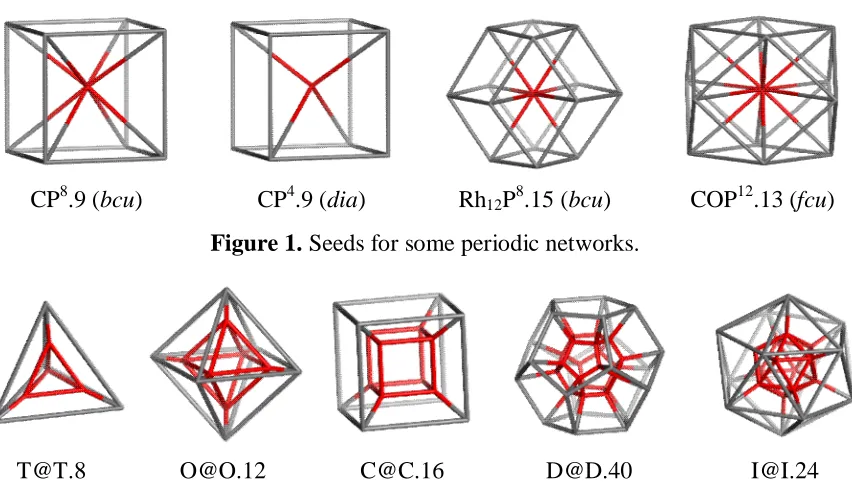
4D-space [13]; this idea can be extended to objects other than Platonics (Figure 1); extension of P central point to a same cell leads to “cell-in-cell” clusters (Figure 2). Such body centered clusters have been used to design a plethora of polyhedral or non-polyhedral objects, and also periodic networks [14].
CP8.9 (bcu) CP4.9 (dia) Rh12P8.15 (bcu) COP12.13 (fcu)
Figure 1. Seeds for some periodic networks.
[email protected] [email protected] [email protected] [email protected] [email protected]
Figure 2. Cell-in-cell clusters of the Platonic solids.
3.
T
HE24−C
ELLThe 24-cell (Figure 3, left) is a convex regular 4-polytope, also called “icositetrachoron”, “octaplex”, or polyoctahedron”, as it consists of 24 octahedral cells, with six of them meeting at each vertex and three at each edge; its vertex figure is a cube. The 24-cell is the unique self-dual regular polytope, (of which dual is) neither a polygon nor a simplex; by this reason, it has no analogue in 3D.
The vertex figure at a given vertex comprises all the figures incident on that vertex;
edges, faces, etc. A vertex figure of an n-polytope is an (n−1)-polytope (e.g., the vertex
figure of a 4-polytope is a 3-polytope, or a polyhedron) [14].
The first 8 vertices of 24-cell are the vertices of a regular 16-cell while the
construction either by rectification of 16-cell (i.e., medialm(16-cell)) or by dualization of
8-cell (i.e., d(8-cell)). There are several 3D projections of 24-cell, of which envelopes are
the rhombic dodecahedron Rh12, cuboctahedron CO, hexagonal bi-antiprism, elongated
hexagonal bipyramid or a tetrakis hexahedron (i.e., stellated cube st(C) – Figure 3, middle).
Starting from the idea of MPn clusters, and keeping in mind the projection of 24-cell
with a st(C) envelope, a construction of 24-cell as all-body-centered hypercube Q4.8CP8.24
is proposed here, by joining eight CP8 units (Figure 3, right). In our best knowledge, this
construction was not yet reported in literature.
24-Cell.24 Cuboctahedron orthogonal projection
st(CP8).15 Q4.8CP8.24
Figure 3. 24-Cell appearance.
The figure count and topology sequence for Q4.8CP8.24 are given in Tables 1 and 2,
respectively. As can be seen, both CP8 and Q4.8CP8.24 have the rank k = 4. There is a
single class of vertices in 24-cell, thus a single sequence of connectivity (provided by the layer matrix of connectivity LC) and rings around vertices (in terms of layer of rings LR)
will fully describe its topology [15,16]. Omega polynomial [17,18] Ω = 96X^1 shows that
there are 96 f3 (i.e., triangles), counted as non-topologically parallel 96 edges. It means that
24-cell is not a Rhombellane (cf. Proposition).
Table 1. Figure count in Q4 related structures.
Polytope v e f3 f4 f6 2 K2.3 K2.4 Ada(Py4) 3 4 χ k
CP8 9 20 12 6 0 18 0 0 (6) 7 - 0 4
Q4.8CP8 24 96 96 0 0 96 0 0 0 24 - 0 4
CP4 9 16 0 18 0 18 10 0 0 11 - 0 4
4.
A
R
HOMBELLANICH
YPERCUBER
ELATIVEBy deleting, in an alternating manner, four edges incident at each central point in
Q4.8CP8.24 it results in a new structure, Q4.8CP4.24 (Figure 4), which is a rhombellane
relative of the hypercube Q4 (see below). The repeating unit is now CP4.9, a 4-polytope (k
= 4, see Table 1); it consists of ten simplest rhombellanes K2.3. There are eight CP4 facets
(of rank k = 4) binding Q4.8CP4.24; each pair of CP4 facets shares a facet of rank k = 3,
namely the rhombellane K2.4; thus, Q4.8CP4.24 is a 5-polytope (k = 5). In the figure count,
two adamantine ada units (k = 3) and eight hexagons f6 were considered (Figure 4, middle
and right); adamantane is not a polyhedron but a tile [19], similar to rhombellanes, from
which it originates. Sequences of Q4.8CP4.24 topology are given in Table 2. There are two
vertex classes, of degree 4 {16} and 8 {8}, respectively. Omega polynomial consists of a
single term, Ω = 1X^64, saying that the edges of Q4.8CP4.24 are all topologically parallel and thus the structure is a rhombellane. The vertex classes have all non-connected points (as a bipartite structure), an additional proof supporting the rhombellanic nature of this structure of higher rank. About centrality, counted by our centrality index [15], the 16 points class appears lying more central (C=0.1256396237) than the remaining 8 vertices (C= 0.1203238919). Computations have been done by our Nano-Studio software program [20].
Q4.8CP4.24 Ada.CP4.15 (inside) Ada.CP4.15 (outside)
Figure 4. A rhombellanic hypercube Q4 relative (left); details of its inside (middle) and outside (right).
Table 2. Sequence of connectivity (LC) and rings around vertex (LR) in all-centered 8-Cell
(Tesseract) Q4.8CPn.24.
Polytope LC LR Ω Degree Rings
Q4.8CP
8
.24
24 × 1 - 8 - 14 - 1 12 - 96 - 168 - 12 96X^1 8 3^12
Q4.8CP4.24
16 × 8 ×
1 - 4 - 14 - 4 – 1 1 - 8 - 6 - 8 - 1
18 - 144 - 252 - 144 – 18 36 - 144 - 216 - 144 - 36
1X^64 4 8
5.
C
ONCLUSIONThe smallest rhombellane, [1,1,1]propellane, is a real chemical molecule; its associate
graph is the complete bipartite graph, K2.3. Generalized rhombellanes are designed by
Diudea’s rhombellation procedure. Rhombellanes have all the edges topologically parallel, as shown by the single term in Omega polynomial (further involving Hamiltonian circuits
visiting their edges). Rhombellanes consist of at least one K2.3 subgraph.
A new building way for the 4-polytope, 24-cell, from all-P8 body centered
hypercube Q4 was proposed. Its P4 analogue, Q4.8CP4.24, is a 5-polytope.
Structure representation in terms of small rhombellanes brings more structural insight and may unveil relations among structures apparently not related. Rhombellanes represent a new class of structures, with interesting properties, both in theory and applications.
A
CKNOWLEDGMENT.
Computer support from Dr. Csaba Nagy is highly acknowledged.R
EFERENCES1. H. S. M. Coxeter, Regular Polytopes, 3rd Ed. New York, Dover, 1973.
2. L. Schläfli, Theorie der vielfachen Kontinuität Zürcher und Furrer, Zürich, 1901
(Reprinted in: Ludwig Schläfli, 1814–1895, Gesammelte Mathematische Abhandlungen, Band 1, 167–387, Verlag Birkhäuser, Basel, 1950).
3. B. Grünbaum, Convex Polytopes, 2nd Ed., Graduate Texts in Mathematics 221,
Kaibel, Klee, Ziegler Eds. Springer, New York, 2003.
4. F. Buekenhout, M. Parker, The number of nets of the regular convex polytopes in
dimension ≤ 4, Discrete Math. 1998 186, 69−94.
5. L. Euler, Elementa doctrinae solidorum. Novi Comm. Acad. Scient. Imp. Petrop.
1752-1753, 4, 109–160.
6. E. Schulte, Regular Incidence Complexes, PhD Disertation, Dortmund Univ. 1980.
7. E. Schulte, Regular incidence-polytopes with Euclidean or toroidal faces and
vertex-figures. J. Combin. Theory Ser. A1985 40(2), 305–330
8. E. Schulte, Polyhedra, complexes, nets and symmetry, Acta Cryst. A 2014 70,
203−216.
9. K. B. Wiberg, F. H. Walker, [1.1.1]Propellane. J. Am. Chem. Soc. 1982 104 (19),
5239–5240.
10.M. V. Diudea, Rhombellanes-a new class of structures, Int. J. Chem. Model. 2017
11.J. Mycielski, Sur le coloriage des graphes. Colloq. Math.1955 3, 161−162.
12.A. Soifer, The Mathematical Coloring Book: Mathematics of Coloring and the
Colorful Life of its Creators, Springer, New York, 2009.
13.A. Parvan-Moldovan, M. V. Diudea, Cell@cell higher dimensional structures,
“Studia Univ. Babes-Bolyai”, Chemia, 2015 60 (2), 379−388.
14.M. V. Diudea, Multi-Shell Polyhedral Clusters, Springer, Berlin, 2017.
15.M. V. Diudea, O. Ursu, Layer matrices and distance property descriptors, Indian J.
Chem. A 2003, 42, 1283−1294.
16.C. L. Nagy, M. V. Diudea, Ring signature index, MATCH Commun. Math. Comput.
Chem. 2017, 77, 479−492.
17.M. V. Diudea, Omega polynomial, Carpath. J. Math. 2006, 22, 43–47.
18.M. V. Diudea, S. Klavžar, Omega polynomial revisited, Acta Chem. Sloven. 2010,
57, 565−570.
19.V. A. Blatov, M. O’Keeffe, D. M. Proserpio, Vertex-, face-, point-, Schläfli-, and
Delaney-symbols in nets, polyhedra and tilings: recommended terminology, Cryst.
Eng. Comm. 2010, 12, 44−48.
20.C. L. Nagy, M.V. Diudea, Nano-Studio software, Babes-Bolyai University, Cluj,