The aim of present investigation was to develop an optimized buccoadhesive film of Amiloride hydrochloride (AMHCl), a BCS class III drug, to provide unidirectional sustained drug delivery to the buccal mucosa that has potential to enhance the bioavailability. The films were prepared using HPMC K4M as film former, carbopol 934P as buccoadhesive polymer and dimethyl sulfoxide as penetration enhancer, by solvent casting
3
technique. The films were characterized for various pharmacotechnical parameters and 2 full factorial design was employed to study the effect of independent variables. The design was validated by extra design checkpoint formulation (F9). The responses of design were analyzed using Design Expert 8.0.2 and the analytical tools of software were used to draw Pareto charts. On the basis of software analysis, formulation F4 with desirability factor of 0.698 was selected as optimized formulation and was evaluated for independent parameters. Optimized formulation showed 8.3 hr ex-vivo residence time, good permeation (41.52%) through goat buccal mucosa and 85.15% drug release after 8hr. The release kinetics of optimized formulation best fitted the higuchi model. Histopathological studies revealed no buccal mucosal damage. Hence F4 formulation can be concluded as promising drug delivery system to enhance the permeability limited absorption of AMHCl.
3
Keywords: Amiloride hydrochloride, 2 full factorial design, buccoadhesive film, optimization, pareto charts, response surface plots
ABSTRACT
Submitted: 16/05/2011 Revised: 19/07/2011 Accepted: 4/1/2012INTRODUCTION
The oral drug delivery is considered to be the most preferred route by majority of the patients amongst the various available routes of drug delivery. However, oral administration of drugs has certain disadvantages such as hepatic first pass metabolism and enzymatic degradation within the GI tract that prohibits oral administration of
1
various classes of drugs . Now-a-days buccal route is available as an alternate for oral delivery of drugs due to its attractive advantages; viz. larger surface area for drug
2
application and good accessibility . Buccal mucosa is relatively permeable with a rich blood supply. Furthermore buccal delivery avoids first pass effect and provides facile removal of dosage form in case of need. Recently developed 3 mucoadhesive buccal delivery systems such as creams ,
4 5 6 7
adhesive tablets , gels , patches , and films . Tablets, films and patches appear to be the most preferred formulations. However, buccal films are preferable over adhesive tablets in terms of flexibility and comfort. In addition, they can circumvent the relatively short residence time of oral gels on the mucosa, which are easily washed off and removed by the continuous salivary secretion. Mucoadhesive films appear attractive because they can readily adhere to buccal mucosa;
Development and Statistical Optimization of Buccoadhesive Films of Amiloride
Hydrochloride:
In-vitro
and
Ex-vivo
Evaluation
Pankaj Kumar, Gulshan Chhabra* and Kamla Pathak
Department of Pharmaceutics, Rajiv Academy for Pharmacy, Mathura (UP), India-281001
*Address for Correspondence:
Gulshan Chhabra, Assistant Professor, Department of Pharmaceutics, Rajiv Academy for Pharmacy, Mathura (U.P.) – 281001, India
E-mail: [email protected], [email protected]
they are retained for longer period of time and can be removed 8
at any time during the treatment .
Most of the research for drugs with high degree of
9 10
lipophilicity such as fentanyl (logP 2.98), lidocaine (logP
11 12
1.62), omeprazole (logP 2.20), propranolol (logP 3.60) etc. have been reported for buccoadhesive delivery. Therefore, buccoadhesive films of amiloride hydrochloride, a BCS class-III drug were addressed in current investigations, to obtain unidirectional release of the drug, greater surface area of contact, and administer the bitter drug without taste
[13]
masking . Because of the properties such as hydrophobicity, low water permeability, drug impermeability, and moderate flexibility, ethyl cellulose was used as a backing layer
14
polymer to prevent drug loss . Amiloride hydrochloride (AMHCl); 3,5 diamino-N-(aminoiminomethyl)-6-chloropyrazine carboxamide is a potassium sparing diuretic
+
and antihypertensive agent that acts as Na channel blocker 15
present at the luminal site . It is a BCS class III drug i.e. high solubility and low permeability (log P value -0.76). The drug is incompletely (15 to 20%) absorbed from gastrointestinal
16
Commercially only tablet formulations of AMHCl are available in the market while the literature reports available on AMHCl are nano-liposomal dry powder inhaler of
17 18
AMHCl and liposomal formulation of AMHCl that has limitations like easy washout of the formulation from nose leads to invariable dose administration and thus low bioavailability, while collapsibility and instability of the liposomal formulation respectively also results similar problems. The concept of administration of AMHCl via buccal route by formulating the buccoadhesive film has not been fully explored so far as per best of our knowledge, hence to overcome the above mentioned problems, buccoadhesive
3 films of AMHCl was developed and optimized using 2 full factorial design aiming to enhance the permeability and consequently bioavailability and do deliver the drug in controlled manner.
MATERIAL AND METHODS
MATERIALS
AMHCl received as gift sample from Panacea biotech Ltd., Chandigarh, India; Ethyl cellulose received from Hercules Aqualon 100 USA; Propylene glycol received from Sigma Aldrich Chemie GmbH, Netherlands; Dimethyl sulfoxide received from s.d fine-chemicals Ltd, Mumbai, India, Dibutyl phthalate received from Qualigen chemicals, Mumbai, India; Hydroxypropyl methyl cellulose and Carbopol 934P received from central drug house, New Delhi, India. All the ingredients were of pure analytical grade.
METHODS
Experimental design
3
A 2 randomized full factorial design was used in this study. Three factors were evaluated, each at two levels and
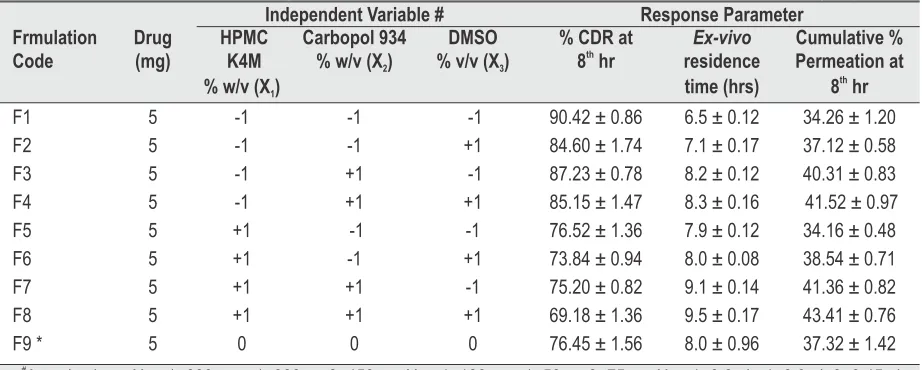
experimental trials were performed on all eight possible combinations (Table 1). The amount of HPMC K4M as film former (X ), the amount of carbopol 934P as buccoadhesive 1 polymer (X ) and concentration of DMSO as penetration 2 enhancer (X ) were selected as independent variables. The 3
th
percent cumulative drug release (% CDR) at 8 hr, ex-vivo
th residence time and cumulative % permeation at 8 hr respectively were selected as dependent variables. Regression polynomials for the individual dependant variables were calculated with the help of Design Expert 8.0.2 software (Stat-Ease, Inc, USA) and applied to approximate the response surface and contour plots. The general model as shown below was
generated-Y = B + B X + B X + B X +…+ B X X + B X X + 0 1 1 2 2 3 3 12 1 2 13 1 3
B X X +…+B X X X +….….eq. (1)23 2 3 123 1 2 3
B is estimated coefficient for the factor X , similarly B and B 1 1 2 3 are estimated coefficients for the factor X and X respectively. 2 3 The main effects (X , X and X ) represent the average result of 1 2 3 changing one factor at a time from its low to high value. The interaction terms show how the response changes when three factors are simultaneously changed.
Preparation of buccoadhesive films
Backing layer: For preparation of backing layer a glass petri dish of 9 cm diameter was used as a casting surface. Backing membrane of ethyl cellulose was fabricated by slowly pouring a solution containing 500 mg of ethyl cellulose and 2% dibutyl phthalate in 10 ml ethanol to the glass petri dish and air drying for 1 hr.
Buccoadhesive layer containing drug: 3% w/v HPMC K4M was dissolved in 10 ml of ethanol and water (3:2) under constant stirring till a clear solution was obtained. To this 1%
#
Actual values: X , +1=600 mg, -1=300mg 0=450mg; X , +1=100mg, -1=50mg 0=75mg; X , +1=0.6ml, -1=0.3ml, 0=0.45ml1 2 3 *extra design check point formulation
Independent Variable # Response Parameter
Frmulation Drug HPMC Carbopol 934 DMSO % CDR at Ex-vivo Cumulative %
th
Code (mg) K4M % w/v (X )2 % v/v (X )3 8 hr residence Permeation at
th
% w/v (X )1 time (hrs) 8 hr
F1 5 -1 -1 -1 90.42 ± 0.86 6.5 ± 0.12 34.26 ± 1.20
F2 5 -1 -1 +1 84.60 ± 1.74 7.1 ± 0.17 37.12 ± 0.58
F3 5 -1 +1 -1 87.23 ± 0.78 8.2 ± 0.12 40.31 ± 0.83
F4 5 -1 +1 +1 85.15 ± 1.47 8.3 ± 0.16 41.52 ± 0.97
F5 5 +1 -1 -1 76.52 ± 1.36 7.9 ± 0.12 34.16 ± 0.48
F6 5 +1 -1 +1 73.84 ± 0.94 8.0 ± 0.08 38.54 ± 0.71
F7 5 +1 +1 -1 75.20 ± 0.82 9.1 ± 0.14 41.36 ± 0.82
F8 5 +1 +1 +1 69.18 ± 1.36 9.5 ± 0.17 43.41 ± 0.76
F9 * 5 0 0 0 76.45 ± 1.56 8.0 ± 0.96 37.32 ± 1.42
3
w/v neutralized carbopol 934P (0.5g f carbopol 934P was neutralized by approximately 0.2g of sodium hydroxide) and 5% v/v propylene glycol was added by stirring using magnetic stirrer. Then sufficient amount of AMHCl was added with stirring so as to have 5mg of drug per 2 cm diameter of film. The mixture was stored at low temperature in order to remove air bubbles. The resultant clear solution was then poured on preformed backing layer of ethyl cellulose and allowed to dry undisturbed for 4 h at 60°C in the oven to ensure complete removal of solvent. The dried film was cut into discs of 2 cm diameter and packed in aluminum foil and stored in desiccators.
PHARAMACOTECHNICAL CHARACTERISTICS OF BUCCOADHESIVE FILMS
Film thickness, weight and content uniformity
The thickness of F1-F8 films was measured using screw gauge (Mitutoyo corporation, Kavasaki, Japan) and the weight of films was determined using electronic balance (Sansui, Japan). For content uniformity, the film was dissolved in 100 mL isotonic phosphate buffer pH 6.8 ± 0.2, filtered through 0.4μ nylon disc filter and resultant solution was analyzed by UV spectrophotometer (Pharmaspec 1700, Shimadzu, Kyoto, Japan) at 362 nm. The experiment was performed in triplicate.
Surface pH
The micro environmental pH of F1-F8 formulations was measured so as to predict its effect on buccal mucosa. The formulations were first wetted by adding 1 ml distilled water to its surface. The surface pH was then recorded by bringing a glass electrode near the surface of the formulation and allowing it to equilibrate for 1 min. The average pH ± SD was determined for all formulations.
Swelling index
Buccoadhesive films were weighed individually (designated as W ) and placed separately in 2% agar gel plates, incubated 1 at 37 ± 1ºC and examined for any physical changes. At regular 1-hour time intervals until 3 hours, films were removed from the gel plates and excess surface water was removed carefully using the filter paper. The swollen films were then reweighed (W ) and the swelling index (SI) was calculated using the 2 following formula:
W -W2 1 SI = --- x 100
W1
... eq. 2
The experiment was performed in triplicate and average ± SD values were recorded.
Folding endurance
Folding endurance of the films was determined by repeatedly folding and unfolding the film at the same place till it broke or
for 300 times, which is considered to be a satisfactory value to reveal good folding endurance properties. The number of times the film could be folded at the same place without breaking gave the value of the folding endurance.
Ex-vivo buccoadhesive Strength
The ex-vivo buccoadhesive strength of the prepared films was measured from modified physical balance using the fresh goat's buccal mucosa which was cut into pieces and washed with phosphate buffer pH 6.8. A piece of buccal mucosa was tied in the open mouth of a glass vial, filled with phosphate buffer pH 6.8. This glass vial was tightly fitted into a glass beaker filled with phosphate buffer pH 6.8, 37ºC ± 1ºC so it just touched the buccal surface. The film was stuck to the lower side of a rubber stopper with cyanoacrylate adhesive. Two pans of the balance were balanced with a 5g weight on the right-hand side pan. The 5g weight was then removed from the left hand side pan, which lowered the pan along with the film over the mucosa. The balance was kept in this position for 5 minutes of contact time. The water was added slowly at 100 drops per min to the right-hand side pan until the film detached from the mucosal surface. The weight in grams required to detach the film from the mucosal surface provided the measure of mucoadhesive strength. The experiments were performed in triplicate and mean ± SD values were reported.
ASSESSMENT OF RESPONSE PARAMETERS
Ex-vivo residence time
The ex-vivo residence time was studied (n = 3) after application of film on freshly cut goat buccal mucosa. The fresh goat buccal mucosa was fixed in the inner side of a beaker about 2.5 cm from the bottom. One side of each film was wetted with 1 drop of phosphate buffer pH 6.8 and pasted to the buccal mucosa by applying a light force with a fingertip for 30 seconds. The beaker was filled with 500 ml of phosphate buffer pH 6.8 and was kept at 37ºC ± 1ºC. After 2 minutes, a 50-rpm stirring rate was applied to simulate the buccal cavity environment, and film adhesion was monitored for 8 hr. The time required for the film to detach from the goat buccal mucosa was recorded as the residence time.
In-vitro drug release
analyzed at 362nm by UV spectrophotometer. The model dependent parameters were calculated using PCP-Disso-Ver.2.0 software, Pune, India.
In-vitro buccal permeation
The in-vitro buccal permeation study of AMHCl through goat buccal mucosa was performed using franz diffusion cell. A specimen of fresh goat buccal mucosa was mounted between the donor and receptor compartments. The film was placed on the mucosa, and the compartments were clamped together. The donor compartment was filled with 1 ml of phosphate buffer pH 6.8. The receptor compartment was filled with isotonic phosphate buffer pH 7.4 maintained at 37.0 ± 0.2ºC and hydrodynamics in the receptor compartment were maintained by stirring magnetically at 50 rpm. Aliquots of 1ml sample were withdrawn at predetermined time intervals and analyzed by UV spectrophotometer at 362nm.
STATISTICAL ANALYSIS OF RESPONSES BY DESIGN EXPERT SOFTWARE
Design Expert 8.0.2 software (Stat-Ease, Inc, USA) was used for the analysis of effect of each variable on the designated response. Pareto charts were made for the analysis of each response coefficient for its statistical significance. Quantitative and qualitative contribution of each variable on each of the response was analyzed. The significant response polynomial equations generated by design expert were used
19, 20
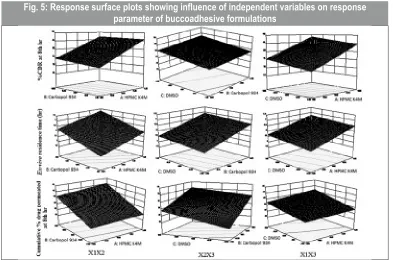
to validate the statistical design . Response surface plots were generated to visualize the simultaneous effect of each variable on each response parameter. Possible interactions between X1X2, X2X3 and X1X3 were also studied and analyzed.
Validation of experimental design
The polynomial equations were utilized for validation of the 19, 20
experimental design . An extra checkpoint formulation F9 was prepared with the predicted value of 76.45% for in-vitro
th
drug release (%CDR at 8 hr), 37.32% cumulative th
permeability at 8 hr and 8.0 hr ex-vivo residence time. Experimental values were determined by formulating and evaluating F9 and close resemblance between predicted and experimental values indicated validity of the generated model. Finally an optimized formulation was selected on the basis of higher in-vitro drug release after 8 hr (%CDR), higher
ex-vivo residence time, and higher cumulative % permeability th
at 8 hr with good desirability factor using software analysis.
DIFFERENTIAL SCANNING CALORIMETRY ANALYSIS
Differential scanning calorimetry (DSC) analysis was performed for detecting drug-polymer interaction. DSC
thermograms were recorded on a differential scanning calorimeter equipped with liquid nitrogen sub ambient accessory (Perkin-Elmer). The instrument was operated -1 under nitrogen pure gas at a rate of 20 ml min . Approximately 3 to 4 mg of each sample of pure drug, polymers, physical mixture and film were hermetically sealed in a flat-bottomed aluminium pan and heated over a temperature range of 20 to 250˚C at a linear heating rate of 10ºC/min.
HISTOPATHOLOGICAL STUDY
Histopathological evaluation of goat buccal mucosa tissue (control) incubated in phosphate buffer saline solution pH 6.8 was compared with that treated with buccal film for 8 hr. The tissue was properly washed twice using normal saline solution to remove the adhered tissues and protein. The tissue was fixed with 10% formalin, routinely processed and set in paraffin. Paraffin sections were cut on glass slides and stained with hematoxylin and eosin. Examine the transverse sections of treated goat buccal mucosa under light microscope to detect any cellular damage to buccal mucosa tissue.
RESULTS AND DISCUSSION
The buccoadhesive films of AMHCl were successfully prepared using HPMC K4M as film former, carbopol 934P as buccoadhesive polymer, propylene glycol as plasticizer and DMSO as permeation enhancer as per experimental design (Table 1). Films consisting of a drug loaded buccoadhesive layer composed of HPMC K4M and carbopol 934P (hydrophilic); and a drug free non adhesive protective layer (hydrophobic); made up of ethyl cellulose. It is important to mention that a perfect binding between buccoadhesive layer and protective backing layers was achieved. All the prepared buccoadhesive films (F1-F8) were characterized for physical characteristics and various pharmacotechnical parameters; and are shown to be uniform in appearance, transparent, flexible and having a smooth surface without entrapped air spaces.
PHARMACOTECHNICAL CHARACTERISTICS OF THE FILMS
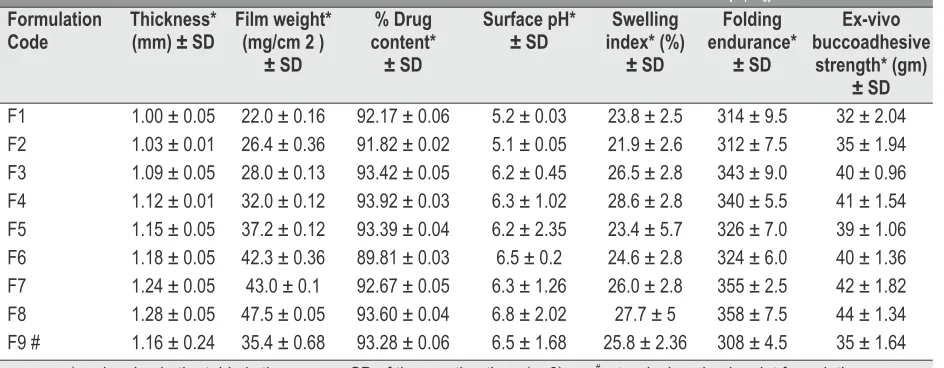
The pharmacotechnical characteristics data of the films are shown in (Table 2). Based on the quantities of the HPMC K4M and Carbopol 934P, the thickness of different formulations was found to vary from 1.0 ± 0.05 mm to 1.09 ± 0.05 mm. The weight of the films found to vary from 22.0 ±
2 2
values were close to buccal mucosa pH6.4hence no mucosal irritation and allergic response can be expected due to formulation.
Swelling study
The swelling study was done to calculate degree of swelling of buccal films (F1-F8) in simulated saliva solution. The films started to swell within 5 min due to presence of swellable HPMC K4M and carbopol 934P, and maximum degree of swelling was observed after 30 min. Percent swelling index was calculated as per equation 2, films containing high level of carbopol 934P (F3, F4, F7, F8) exhibited higher degree of swelling as compared to films containing low level of carbopol 934P (F1, F2, F5, F6). This is be due to the concentration based swelling behavior of carbopol 934P, more the carbopol 934P available for swelling, more will be [21] the swelling index which is beneficial for buccoadhesion . Swelling phenomenon of the polymers makes strong secondary hydrogen bonding with buccal mucosa and thus results in mucoadhesion. Swelling results in the formation of a thick swollen mass which provide unidirectional release of drug in sustained manner.
Folding endurance
All the developed formulations were flexible and displayed good folding endurance ranging from 278.0 ± 7.5 to 358 ± 9.5 due to presence of propylene glycol as plasticizing agent. Carbopol 934P generally is known to increase the softness and flexibility which could be related to its highly crosslinked
10 conformation and configuration .
Ex-vivo buccoadhesive strength
The results of ex-vivo buccoadhesive strength for AMHCl buccal films are shown in Table 2. The formulations (F1 to F8) exhibited buccoadhesion strength of 32 ± 2.04g to 44 ± 1.34 g,
and the cut off value for buccoadhesion of a dosage form is [22]
33g . Thus F1 was rejected and among the rest of the formulations containing high level of carbopol 934P (F3, F4, F7, F8) exhibited higher buccoadhesive strength than F2, F5, F6 formulation which may be due to surface adhesion phenomenon as well as due to formation of secondary hydrogen bonds with mucosa as a result of rapid swelling of
23
carbopol 934P . Buccoadhesion is also regulated by the addition of HPMC K4M. It has synergistic effect on buccoadhesive strength over carbopol 934P, correspondingly F7 and F8 displayed highest buccoadhesive strength. This may be attributed to the hydrosolubility of HPMC K4M that despite its moderate swelling properties promoted liquid entry and entrapment in the polymer network and thus
24 increased mucoadhesion .
ASSESSMENT OF RESPONSE PARAMETERS
Ex-vivo residence time
The ex-vivo residence time of the formulations ranged between 6.5 ± 0.12 to 9.5 ± 0.17 hr. As seen from Table 1, the films containing high level of carbopol 934P (F3, F4, F7, F8) showed higher residence time of 8.2 to 9.5 hr as films containing low level of carbopol 934P (F1, F2, F5, F6) that show residence time of 6.5 to 8.0 hr. This may due to surface adhesion phenomenon as well as due to formation of secondary hydrogen bonds with goat buccal mucosa as a
23
result of rapid swelling of carbopol 934P . Among F3, F4, F7, F8 formulations, F7 and F8 show higher residence time than F3 and F4 due to presence of HPMC K4M at high level. Hence it can be concluded that ex-vivo residence time increased with increase in the HPMC concentration in the formulation. The addition of DMSO did not affect the ex vivo
residence time appreciably. The effect of levels of polymers has been statistically discussed in the later sections.
#
*each value in the table is the mean ± SD of three estimations (n=3), extra design check point formulation Formulation Thickness* Film weight* % Drug Surface pH* Swelling Folding Ex-vivo
Code (mm) ± SD (mg/cm 2 ) content* ± SD index* (%) endurance* buccoadhesive
± SD ± SD ± SD ± SD strength* (gm)
± SD F1 1.00 ± 0.05 22.0 ± 0.16 92.17 ± 0.06 5.2 ± 0.03 23.8 ± 2.5 314 ± 9.5 32 ± 2.04 F2 1.03 ± 0.01 26.4 ± 0.36 91.82 ± 0.02 5.1 ± 0.05 21.9 ± 2.6 312 ± 7.5 35 ± 1.94 F3 1.09 ± 0.05 28.0 ± 0.13 93.42 ± 0.05 6.2 ± 0.45 26.5 ± 2.8 343 ± 9.0 40 ± 0.96 F4 1.12 ± 0.01 32.0 ± 0.12 93.92 ± 0.03 6.3 ± 1.02 28.6 ± 2.8 340 ± 5.5 41 ± 1.54 F5 1.15 ± 0.05 37.2 ± 0.12 93.39 ± 0.04 6.2 ± 2.35 23.4 ± 5.7 326 ± 7.0 39 ± 1.06 F6 1.18 ± 0.05 42.3 ± 0.36 89.81 ± 0.03 6.5 ± 0.2 24.6 ± 2.8 324 ± 6.0 40 ± 1.36 F7 1.24 ± 0.05 43.0 ± 0.1 92.67 ± 0.05 6.3 ± 1.26 26.0 ± 2.8 355 ± 2.5 42 ± 1.82 F8 1.28 ± 0.05 47.5 ± 0.05 93.60 ± 0.04 6.8 ± 2.02 27.7 ± 5 358 ± 7.5 44 ± 1.34 F9 # 1.16 ± 0.24 35.4 ± 0.68 93.28 ± 0.06 6.5 ± 1.68 25.8 ± 2.36 308 ± 4.5 35 ± 1.64
in the range of 0.51 to 0.76 indicating that the drug release followed non-fickian diffusion and the best fit model was
2
observed to be higuchi model (r =0.9945) implying that the films can provide sustained drug release up to 8 hr.
In-vitro buccal permeation
AMHCl being hydrophilic with log P value of -0.76 exhibits low permeability through buccal mucosa and there is a need to enhance its buccal permeation with help of permeation
27
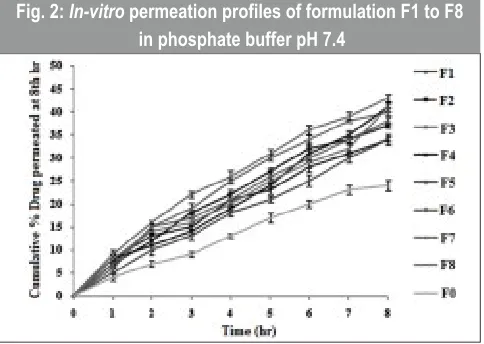
enhancer that causes perturbation and dissolution of 28 paracellular fluid, enhancing its paracellular transport . Based on this fact, different concentrations of DMSO were tried to improve the permeation of AMHCl through buccal mucosa. The results suggested that on increasing the concentration of DMSO up to 6%, permeability of drug increased. As a preliminary investigation F0, film F1 without permeation enhancer (acted as a reference formulation for displaying the influence of permeation enhancer, F0) was prepared as it had low levels of rate controlling polymers based on the assumption that low levels of rate controlling polymers will result in higher drug release facilitating concentration gradient directed permeation across the mucosa as compared to rest of the formulations. In-vitro
buccal permeation of F0 resulted in % cumulative drug th
permeation of 24.36 ± 4.87% at 8 hr (data not shown). Hence it was thought worthwhile to improve its permeation. DMSO has been reported as effective permeation enhancer for e n h a n c i n g t r a n s b u c c a l d i ff u s i o n o f s m a l l a n d
29 30
macromolecules like sumatriptan succinate and insulin respectively. In the present study incorporation of DMSO showed almost two times significant permeation enhancement (p<0.05) across goat buccal mucosa, probably by opening mucosal non-selective porous pathway.
In the experimental design, formulations F2, F4, F6 and F8 containing high level of DMSO showed higher permeation of AMHCl than formulations F1, F3, F5 and F7 which is highlighting the significance of level of DMSO (Figure 2). Amongst all the films containing high levels of DMSO, the descending order for permeability coefficient was
In-vitro drug release
The comparative in-vitro drug release profiles of F1-F8 films are shown in Figure 1. Films containing low level of HPMC K4M (F1, F2, F3, F4) displayed higher in-vitro drug release (85.15 ± 1.47% to 90.42 ± 0.86%) than formulations containing high level of HPMC K4M (F5, F6, F7, F8) that displayed only 69.18 ± 1.36% to 76.52 ± 1.36% drug release after 8 hr which may due to increased viscosity offered by the gelling of the hydrophilic HPMC K4M polymer. The increased viscosity of formulation resulted in a corresponding decrease in the drug release. A similar observation has been
25
obtained by Dortune where a decrease in atenolol release was obtained on increasing the concentration of HPMC and carbopol 934P.
Fig. 1:
In-vitro
drug release profiles of formulation
F1 to F8 in phosphate buffer pH 6.8
th
Though highest % CDR of 90.42 ± 0.86% at 8 hr was recorded for F1, the formulation was rejected based on poor
ex-vivo residence time, thus F3 was considered as second best formulation in terms of %CDR (87.23%) and least by F8 (69.18 ± 1.36%) which is showing an inverse relation between concentration of HPMC K4M and in-vitro drug release (Table 1). In formulations F1, F2, F3, F4 drug release decrease with increasing the concentration of carbopol 934P. Since carbopol934P is insoluble in simulated saliva and swelling behavior of carbopol934P is attributed to unchanged COOH group that get hydrated by forming hydrogen bonds on imbibing with water and therefore extending polymer
26
chain . It was observed that films containing combination of high levels of both carbopol 934P and HPMC K4M exhibited delayed drug release indicating better matrix characteristics. Strong matrix integrity inhibits the entry of dissolution media and delays the dissolution of drug. To investigate the release kinetics of drug release from buccal films, the release data was subjected to fit various kinetics models (such as zero order, first order, higuchi, peppas or hixon crowell's model) by using software PCP disso ver. 2.0 Pune, India and value of
2
r , n and k were determined. All buccal films showed 'n' values
F8>F4>F6>F2 and it can be concluded that proper formulation optimization is essential.
STATISTICAL ANALYSIS OF RESPONSES BY DESIGN EXPERT SOFTWARE
Based on the results obtained for ex-vivo residence time, %
th th
CDR at 8 hr and cumulative % drug permeation at 8 hr, the response polynomial coefficients were determined in order to evaluate each response. Each response coefficient was studied for its statistical significance by Pareto charts as shown in (Figure 3). Pareto charts establish't' value of effect that is studied by two limit lines namely the Bonferroni limit line (t value of effect=3.752) and t limit line (t value of effect=2.345). Coefficients with t value of effect above the Bonferroni line are designated as certainly significant coefficients with t value of effect between Bonferroni line and t limit line are termed as coefficients likely to be significant, while t value of effect below the t limit line is statistically insignificant coefficient and should be removed from the analysis. Thus non-significant response coefficients were deleted and the following significant polynomial response
th equation(s) for ex-vivo residence time, %CDR at 8 hr and
th 19, 20
cumulative % drug permeation at 8 hr were generated .
Ex-vivo residence time = 8.08 + 0.55X + [0.70×(X )] + 1 2 [0.15×(X )] + [0.10 ×(X X X )] ... eq. (3)3 1 2 3
th
% CDR at 8 hr = 79.88 -6.63X + [-0.88×(X )] + [-2.13× (X )] 1 2 3
+ [-0.88×(X X X )] ... eq. (4)1 2 3
th
Cumulative % drug permeated at 8 hr = 38.55 -0.55X + 1 [1.30×(X )] ... eq. (5)3
Validation of experimental design
These equations were utilized for validation of the experimental design. An extra design checkpoint formulation (F9) was prepared and the predicted value(s) for ex-vivo
th
residence time, % CDR at 8 hr and cumulative % permeation
th 20
at 8 hr were generated . Experimental values were determined by formulating and evaluating F9, and close resemblance between predicted and experimental values indicated validity of the generated model (Table 1 &3).
Interaction studies and response surface plots
The possible interactions between X X , X X , and X X for 1 2 2 3 1 3 each response were also investigated (Figure 4). Graphically the interactions are visualized by lack of parallelism in the lines but in this case, parallel lines obtained the response parameter ex-vivo residence time suggesting lack of interaction between the dependent variables for this particular
th response. However Cumulative % drug permeated at 8 hr was affected by each interaction term(s), whereas % CDR at
th
8 hr was predominantly affected by X and X . This in turn 1 2 indicates that the experimental design has maximum efficiency in estimating the main effects. Figure 4 shows the
Fig. 3: Response coefficient significant study on
th th
(a) Ex-vivo residence time (b) Cumulative % Permeation at 8 hr and (c) % CDR at 8 hr by Pareto charts
Response Formulation Predicted Experimental % RSD
parameter code value value
th
% CDR at 8 hr F9 79.88 76.45 ± 1.56 1.75
F4 84.89 85.15 ± 1.47 1.23
th
Cumulative % permeation at 8 hr F9 38.55 37.32 ± 1.42 0.58
F4 41.01 41.52 ± 0.97 1.68
Ex-vivo residence time (hr) F9 6.08 6.00 ± 0.96 0.98
F4 6.3 6.3 ± 0.16 1.88
Fig. 4: Interaction studies between various independent variables of buccoadhesive formulations
qualitative effect of the variables used and the quantitative effects can be estimated by response surface plots. The response surface plots (Figure 5) generated using polynomial equations represent quantitative simultaneous effect of any two variables on response parameter taking one variable at constant level. The results were similar to interaction studies but were quantifiable. However Design Expert software can analyze both qualitative and quantitative effects of variables
on the response parameters and hence can facilitate selection of optimized formulation.
Selection of optimized formulation
The qualitative and quantitative influence of independent variables on ex-vivo residence time, % permeability and % CDR were clearly interpreted from (Figure 6) by Design Expert that is an equally advantageous tool for selection of
optimized formulation. The tool offers the possibility to vary each variable simultaneously and presents possible optimum [30] selections with their respective desirability value .
th
According to our criteria of higher %CDR at 8 hr, higher residence time and higher cumulative % drug permeated after 8 hr, F4 was selected as optimized formulation (desirability factor of 0.698). Consequently, the coded optimized level for the amount of HPMC K4M, concentration of carbopol 934P and volume of DMSO for F4 were identified as -1, +1 and +1 respectively. These coded optimized values can be converted to actual optimized values by using principles of
20, 31 transformation by use of the following equation .
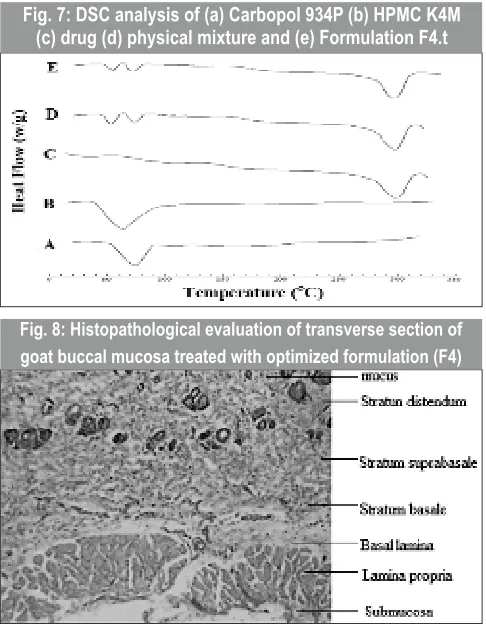
histopathological evaluation. The microscopic observation of the transverse section showed no damage to the buccal mucosa at cellular level (Figure 8). All the layers mucus, stratum distendum, stratum basale, basal lamina and submucosa were found to be intact establishing the non-toxicity of the optimized film.
CONCLUSION
An optimized buccoadhesive film of amiloride hydrochloride was developed that has the potential to enhance the permeability limited bioavailability and to provide a unidirectional sustained drug delivery through the buccal mucosa. The developed buccoadhesive film exhibited sufficient pharmacotechanical properties and buccoadhesive character and was sustained the drug release of highly water soluble drug for 8 hr without causing any damage to the buccal mucosa. However the in-vivo performance of the developed formulation should be investigated that will decide its appropriateness in the clinical practice.
ACKNOWLEDGEMENT
Authors are acknowledged to Panacea biotech Ltd., Chandigarh, India for providing gift sample of AMHCl.
DECLARATIONS OF INTEREST
The authors report no declarations of interest.
Fig. 6: Percentage contribution and effect of independent variables on various response parameters of buccoadhesive formulations
Actual value (X') – Average of the actual level Coded value x =
½ difference between actual levels
The release of AMHCl from F4 best followed higuchi model 2
(r =0.9829) and the possible mechanism for drug release might be diffusion of drug from the swollen matrix of HPMC K4M and carbopol 934P.
DIFFERENTIAL SCANNING CALORIMETRY ANALYSIS
Differential scanning calorimetry (DSC) analysis was performed for detecting drug-polymer interaction. DSC thermogram showed sharp endothermic peaks at 65 ºC and 75 ºC; and a broad endothermic peak at 300ºC corresponding to the melting point of HPMC K4M, Carbopol 934P and amiloride hydrochloride respectively (Figure 7). DSC of additive concentrate F4 also displayed endothermic peaks at 65ºC, 75ºC and 300ºC indicated the presence of HPMC K4M, carbopol 934P and amiloride hydrochloride respectively. No other peak was appeared in the DSC of additive concentrate confirmed that there is no interaction between drug and polymers.
HISTOPATHOLOGICAL STUDY
The goat buccal mucosa specimen at the end of permeation study of optimized formulation F4 was subjected to
Fig. 8: Histopathological evaluation of transverse section of goat buccal mucosa treated with optimized formulation (F4)
REFERENCES
1. El-Samaligy MS, Yahia SA, Basalious EB. Formulation and evaluation of diclofenac sodium buccoadhesive discs. Int J Pharm 2004;286:27–39.
2. Rathbone M, Drummond B, Tucker B. The oral cavity as a site for systemic drug delivery. Adv Drug Del Rev 1994;13:1-22. 3. Gurny R, Meyer JM, Peppas NA. Bioadhesive intra oral
release system: design, testing and analysis. Biomaterials 1984;5:336-40.
4. Voorspoels J, Remon JP, Eechaute WDW. Buccal absorption of testosterone and its esters using a bioadhesive tablet in dogs. Pharm Res1996;13:1228–32
5. Shin SC, Bum JP, Choi JS, Enhanced bioavailability by buccal administration of triamcinolone acetonide from the bioadhesive gels in rabbits. Int J Pharm 2000;209:37–43. 6. Senel S, Ikinci G, Kas S, Yousefi-Rad A, Sargon MF, Hıncal AA.
Chitosan films and hydrogels of chlorhexidine gluconate for oral mucosal delivery. Int J Pharm 2000;193:197–203. 7. Lee JW, Park Robinson JH. Bioadhesive-based dosage forms:
the next generation. J Pharm Sci 2000;8:850–66.
8. Mumtaz AM, Ch'ng HS. Evaluation of bioadhesive buccal tablets containing triamcinolone acetonide in healthy volunteers. Int J Pharm 1995;121:249-54.
9. Gordon D, Schroeder M. Oral transmucosal fentanyl citrate-OTFC (ACTIQ ®) www.eperc.mcw.edu.
10. Abu-Huwaij R, Assaf S, Salem M, Sallam A. Potential mucoadhesive dosage form of lidocaine hydrochloride: II. In vitro and in vivo evaluation. Drug Dev Ind Pharm 2007;33:437–48.
11. Choi H, Kim C. Development of omeprazole buccal adhesive tablets with stability enhancement in human saliva. J Control Rel 2000;68:397–04.
12. Munasur AP, Pillay V, Chetty DJ, Govender T. Statistical optimization of the mucoadhesivity and characterization of multipolymeric propranolol matrices for buccal therapy. Int J Pharm 2006;323:43–51.
13. Guo JH, Cooklok KM. The effects of backing materials and multilayered systems on the characteristics of mucoadhesive buccal filmes. J Pharm Pharmacol 1996;48:255.
14. Supriya SS, Pritesh VT, Neha MD, Vilasrao JK. Buccal drug delivery of pravastatin sodium. AAPS Pharm Sci Tech 2010;11:416-24.
15. Robertson RM, Robertson D, Hardman JG, Limbird LE, Molinoff PE, Ruddon RW, Gilman AG. Goodman and Gilman's: The Pharmacological Basis of Therapeutics. 9th ed. New York: McGraw Hill;2007.
16. http://www.drugs.com/mmx/amiloride-hydrochloride.html, accessed on 30/12/2010
17. Chougule BM, Padhi KB, Ambikanandan. Nano-liposomal dry powder inhaler of amiloride hydrochloride. J Nanosci Nanotech 2006; 6:3001-9.
18. Alam MN, Ahmad SJ, Sultana Y. Development and characterization of liposome- based formulation of amiloridr hydrochloride. J Dis Sci Tech 2008;29:415-20.
19. Bolton S, Bon C. Pharmaceutical statistics: practical and clinical applications. 4th ed. New York: Marcel Dekker;2004. 20. Shah M, Pathak K. Development and statistical optimization of
3
solid lipid nanoparticles of simvastatin by using 2 full-factorial design. AAPS Pharm SciTech 2010;11:489-96.
21. Satishbabu BK, Srinivasan B P. Preparation and evaluation of buccoadhesive films of atenolol. Ind J Pharm Sci 2008;70:175-9.
22. Adel N, Ismail F, Boraie N, Mortada L. Mucoadhesive delivery systems II. Formulation and in-vitro/in-vivo evaluation of buccal mucoadhesive tablets containing water soluble drugs. Drug Dev Ind Pharm 2004;30:995–1004.
23. Valenta C. The use of mucoadhesive polymers in vaginal delivery. Adv Drug Del Rev 2005;57: 1692– 712.
24. Kumar PTM, Shivakumar H G. Novel core in cup buccoadhesive systems and films of terbutaline sulphate–development and in vitro evaluation. Asian J Pharm Sci 2006;1:175-87.
25. Dortune B, Gunal N. Release of acetazolamide from swellable hydroxypropylmethylceelulose matrix tablets. Drug Dev Ind Pharm 1997;23:1245–9.
26. Moratazavi S. In-vitro assessment of mucus/mucoadhesive interactions. Int J Pharm 1995;124:173–82.
27. Senel S, Hincal SS. Drug permeation enhancement via buccal route: possibilities and limitations. J Control Rel 200;72:133–44.
28. Hao J, Paul WSH. Buccal delivery systems. Drug Dev Ind Pharm 2003;29:821–32.
29. Supriya S, Shidhaye NS, Saindane SS, Vilasrao K. Mucoadhesive bilayered patches for administration of sumatriptan succinate. AAPS Pharm Sci Tech 2008; 9: 909-16. 30. Aungst B, Rogers N. Comparison of the effects of various
transmucosal absorption promoters on buccal insulin delivery. Int J Pharm 1989;53:227-35.