ScholarWorks@UNO
ScholarWorks@UNO
University of New Orleans Theses and
Dissertations Dissertations and Theses
5-8-2004
Synthesis, Characterization and Properties of Nanostructured
Synthesis, Characterization and Properties of Nanostructured
Materials by Template-Directed Method
Materials by Template-Directed Method
Ran Liu
University of New Orleans
Follow this and additional works at: https://scholarworks.uno.edu/td
Recommended Citation Recommended Citation
Liu, Ran, "Synthesis, Characterization and Properties of Nanostructured Materials by Template-Directed Method" (2004). University of New Orleans Theses and Dissertations. 166.
https://scholarworks.uno.edu/td/166
This Thesis is protected by copyright and/or related rights. It has been brought to you by ScholarWorks@UNO with permission from the rights-holder(s). You are free to use this Thesis in any way that is permitted by the copyright and related rights legislation that applies to your use. For other uses you need to obtain permission from the rights-holder(s) directly, unless additional rights are indicated by a Creative Commons license in the record and/or on the work itself.
A Thesis
Submitted to the Graduate Faculty of the University of New Orleans in partial fulfillment of the requirements for the degree of
Master of Science in
The Department of Chemistry
by Liu Ran
First I would like to express my sincere appreciation to my research advisors, Professor John B. Wiley and Professor Paul Hanson for their invaluable guidance, support and encouragement throughout my graduate research. I am also very grateful to the member of my committee, Professor Matthew A. Tarr for his helpful comments and constructive suggestions.
I am indebted to the Dr. Weilie Zhou at Advanced Materials Research Institute, who helped me in taking electronic microscope images.
Also, I am grateful to all the members in Wiley group for their help and friendship. And last, but not least, my special thanks go out to my parents for their love, understanding and encouragement throughout these years.
Abstract ... iv
Chapter 1 Introduction ...1
1.1 Introduction to Nanomaterials ...1
1.2 Template-based Methods ...1
1.3 Templates...2
1.3.1 Commercially Available Anodic Alumina Membrane ...3
1.3.2 Anodic Alumina Membrane made in the lab...5
1.4 Electrochemical Deposition Method...6
Chapter 2 Nanowires and Nanotubes...9
2.1 Introduction One Dimensional Nanomaterials ...9
2.2 Experimental Section ...9
2.2.1 Materials and Equipment ...9
2.2.2 Fabrication of Metal Nanowires in the AAO membrane...10
2.2.3 Characterization ...16
2.3 Results and Discussion ...17
2.3.1 Chronopotentiogram for Electrodeposition ...17
2.3.2 Microscope Characterizations...17
2.3.3 Aggregation of the nanowires observed by Optical Microscope...21
2.4 Conclusion ...24
Chapter 3 Superlattice Nanowires Made by Polymer Free Method ...25
3.1 Introduction...25
3.2 Experimental Section ...26
3.2.1 Materials and equipment...26
3.2.2 Equipment for polymer-free method ...26
3.2.3 Electrochemical Deposition of Striped Nanowires into the AAO membrane 28 3.2.4 Post-treatment of the sample...28
3.2.5 Microscope Characterization ...29
3.2.6 Alignment under magnetic field ...29
3.3 Results and Discussion ...30
3.3.1 SEM images ...30
3.3.2 Field-Emission SEM images...31
3.3.4 Magnetic alignment ...32
3.4 Conclusion ...33
Reference ...34
Vita...35
Nanowires and nanotubes with single component such as gold and nickel were fabricated by electrochemical deposition method directed by the Anodic Alumina Membrane (AAO) as a template. A so called “polymer-free” method has been investigated to make striped nanowires with superlattice structure. Various methods have been used to characterize these nanomaterials, including SEM, FESEM TEM, STM and Optical Microscope. The aggregation of the nanowires and their alignment under the magnetic force were observed under the optical microscope.
Chapter 1
Introduction
1.1 Introduction to Nanomaterials
Nanostructured materials are materials with a microstructure, the characteristic length scale of which is on the order of typically 1-100 nanometers. The microstructure refers to the chemical composition, the arrangement of the atoms (the atomic structure), and the size of a solid in one, two, or three dimensions. Effects controlling the properties of nanostructured materials include size effects (where critical length scales of physical phenomena become comparable with the characteristic size of the building blocks of the microstructure), changes of the dimensionality of the system, changes of the atomic structure, and alloying of components (e.g., elements) that are not miscible in the solid and/or the molten state.
The synthesis, characterization and processing of nanostructured materials are part of an emerging and rapidly growing field. Research and development in this field emphasizes scientific discoveries in the generation of materials with controlled microstructural characteristics, research on their processing into bulk materials with engineered properties and technological functions, and introduction of new device concepts and manufacturing methods.
1.2 Template-Based Method
generally accepted that template-directed synthesis provides a simple, high-throughput, cost-effective procedure that also allows the complex topology present on the surface of a template to be duplicated in a single step. This method has a number of interesting and useful features. First, it is very general; people have used this method to prepare tubules and fibrils composed of electronically conductive polymers,[2] metals,[3] semiconductors,[4] carbons,[5] and other materials. Furthermore, nanostructures with extraordinarily small diameters can be prepared. For example, Wu and Bein have used this method to prepare conductive polymer nanofibrils with diameters of 3nm (30Å).[6] It would be difficult to make nanowires with diameter this small using lithographic methods. It addition, because the pores in the membranes used have monodisperse diameters, analogous monodisperse nanostructures are obtained. Finally, the tubular or fibrillar nanostructure synthesized can be freed from the template membrane and collected. Alternatively, an ensemble of nanostructures that protrude from a surface like the bristles of a brush can be obtained. As a major drawback, nanostructures synthesized using template-directed methods are often polycrystalline, and the quantity of structures that can be produced in each run of synthesis is relatively limited.
1.3 Templates
membranes are commonly used in such synthesis: polymer films containing track-etched channels and alumina films containing anodically etched pores. Both of them can be obtained commercially from a number of venders such as Nuclepore, Poretics, and Whatman. For track-etching, a polymer film (6-20µm thick) is irradiated with heavy ions from nuclear fission to generate damaged spots in the surface of this film. These spots are then amplified through chemical etching to generate uniform, cylindrical pores penetrating the membrane film.[13] The pores fabricated using this method are often randomly scattered across the membrane surface; and their orientation may also be tilted by as much as 34° with respect to the surface normal. Porous alumina membranes are often prepared using anodization of aluminum foils in an acidic medium,[14] and they usually contain a hexagonally packed 2D array of cylindrical pores with a relatively uniform size. Unlike the polymer membranes fabricated by track-etching, the pores in alumina membranes have little or no tilting with respect to the surface normal and the pore density is also much higher. So it is usually used by our lab to serve as the template.
1.3.1 Commercially Available Anodic Aluminum Oxide (AAO) Membrane
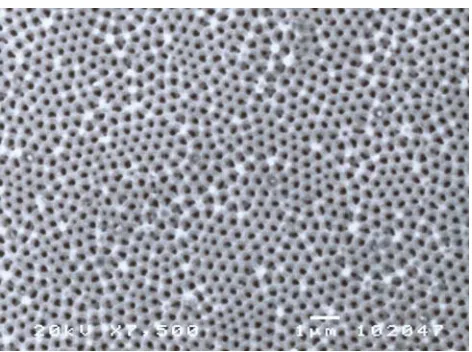
membrane has the pore size about 200nm if it is labeled as 0.02µm (not shown here) pore size. From the SEM image it’s obvious to see that the pore sizes are not distributed uniformly. The reason for these defects is because of the difficulties in controlling the experiments parameters in the anodization process.
Figure 1.1 SEM image of commercial Anodic Alumina membrane labeled with 200nm pore size
Second, the shape of the pore is not very regular. Other than the ideal round, some pores have shapes like ellipse or even polygon. And instead of hexagonally packed 2D array, the pores are just randomly distributed without any order although their density is high. Figure 1.1 shows these irregularities.
Due to a lot of defects of the commercial available AAO membrane, some research groups prepare their own Anodic Alumina Membranes. Such membranes have also been prepared in our group.
1.3.2 Anodic Aluminum Oxide (AAO) Membrane made in the lab
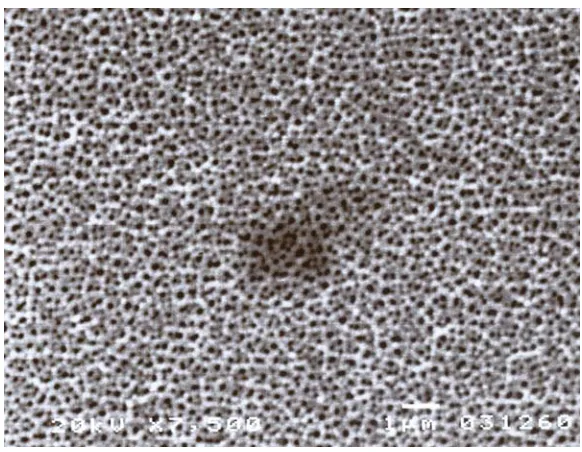
The procedure to prepare the AAO membrane is well known. After the high purity aluminum foil is polished and annealed, it is placed in an acid solution under a positive electric field and converted to AAO membranes during anodization. Their self-organized pore diameters and intra-pore distances can be adjusted by changing the voltage and acid concentration. Anodization time controls the membrane’s thickness, which limits the length of nanowires and nanotubes grown in the pores. The researchers have made AAO membranes with pore diameters ranging from 10 to 400 nanometers and with lengths up to 70 micrometers.[15] The AAO membrane consists of three distinct layers: aluminum metal, a thin barrier oxide layer, and a relatively thick porous oxide layer, Figure 1.2 shows the SEM results of the AAO membrane made in our lab. The aluminum foil was oxidized in H3PO4 at 0°C under the voltage of 195V.
From the image, we can see that the pores are distributed more evenly, and the pore sizes are more uniform.
1.4 Electrochemical Deposition Method
There are several methods to load various materials into the channels of these porous membranes physically or chemically. For example, metals (such as Bi) with relatively low melting points can be directly injected as liquids into pores of the AAO membrane and subsequently solidified into highly crystalline nanowires.[16] Most recently, Cao and co-workers also demonstrated the use of electrophoretic deposition to fill the pores of a polymeric or alumina membrane with charged sols generated in situ from a sol-gel precursor.[17]
Several different methods can be used to control the electrochemical deposition. The most commonly used one is Chronopotentionmetry, which means the working current density is constant during the deposition. The advantage of this method is that the lengths of nanowires are easy to be controlled because they are determined by the current density and deposition time. The second one is Chronoamperometry, which means the working potential is fixed during the experiment. It has the merit of selecting the metal to be deposited since different metals will be reduced at different potentials. The drawback of the method is it needs a standard electrode to verify the potential. The third one is the Pulsed Electrodeposition Method. It utilizes the rectifying properties of barrier, which allow the pores of the membrane to be filled uniformly by pulsed sequence.
In Pulsed Electrodeposition Method, the deposition is based on modulated pulse signals in the microsecond range. (Figure 1.3) [19] During the relatively long pulse of negative current the metal is deposited on the pore ground. In comparison to the direct current deposition, relatively high current density are applied at the moment of metal deposition, which should increase the number of deposition centers in each pore and also the nuclei formed at higher frequencies are more crystalline. After a short abrupt rise in the negative current pulse, the measured signal of the potential increases a little further, which is due to the charging of the capacitance of deposition interface. After the deposition pulse, a short pulse of positive polarization follows to discharge the capacitance of the barrier layer and to immediately interrupt the electric field at the deposition interface. The delay time toff, was varied between 10ms and 5s. During this period
the ion concentration recovers. Thus, the concentration of the metal ions is high at the bottom of each pore when the subsequent deposition pulse appears. The delay time, toff, improves the
efficient method to deposit materials like Fe, Co, and NiFe-alloys without removing the barrier layer of the AAO membrane.
Chapter 2
Nanowires and Nanotubes
2.1 Introduction
Recently, one-dimensional (1D) nanostructures such as wires, tubes have become the focus of intensive research owing to their unique applications in mesoscopic physics and fabrication of nanoscale devices. It is generally accepted that 1D nanostructures provide a good system to investigate the dependence of electrical[20] and thermal transport[21] or mechanical properties[22] on dimensionality and size reduction (or quantum confinement). They are also expected to play an important role as both interconnects and functional units in fabricating electronic, optoelectronic, electrochemical, and electromechanical devices with nanoscale dimensions. In comparison with quantum dots and wells, the advancement of 1D nanostructures has been slow until very recently, as hindered by the difficulties associated with the synthesis and fabrication of these nanostructures with well-controlled dimensions, morphology, phase purity, and chemical composition. As described in Chapter One, electrochemical deposition in an alumina oxide membrane as the template can provide a very effective way to fabricate metal nanowires.
2.2 Experimental Section
2.2.1 Materials and Equipment
All solvents and chemicals were of reagent quality and were used as received.
Membrane: The Whatman AnodiscTM Aluminum Oxide Membrane (AAO) was purchased from VWR Company.
Plating solution: The commercial Ni (Nickel Sulfamate RTU, Ni(H2NSO3)2 solution, pH ~ 4.0)
and Au (Orotemp 24 RTU, KAu(CN)2 solution, containing 8.2 g/liter gold, pH ~ 8.0)
Chemicals: Dichloromethane CH2Cl2 (99.5%, EM Science) NaOH (98%, Sigma)
Glue 3M all purpose glue purchased from Walmart Retail Store
Equipment: VMP2 Multi-Channel Potentiosat from Princeton Applied Research
2.2.2 Fabrication of Metal Nanowires in the AAO membrane
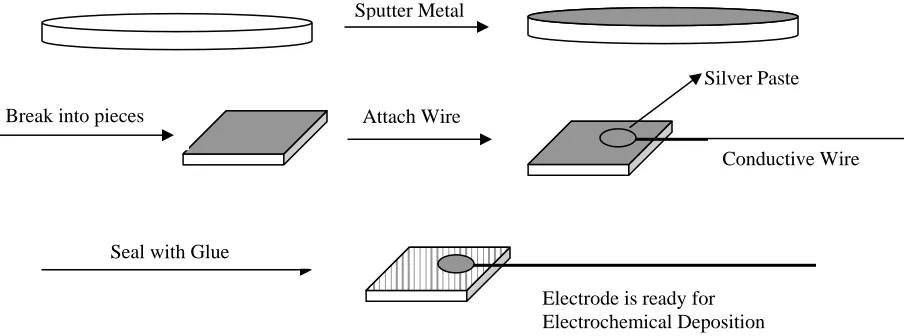
Electrode Fabrication: The whole procedure can be illustrated as the following:
Sputter Metal
Silver Paste
Attach Wire
Conductive Wire
Break into pieces
Seal with Glue
Electrode is ready for Electrochemical Deposition
Figure 2.1 Schematic diagram of making the electrode
remove the Au-Pd film, which can be difficult since it’s hard to apply the force uniformly on the brittle membrane when it is polished on the sandpaper.
Ag films solve this problem since they can be dissolved in the dilute nitric acid. Ag can be oxidized in the air but the oxide layer won’t affect the conductance very much as long as the membrane is not exposed in air very long after it is deposited.
Another purpose of sputtering metal is to seal the pores of the membrane so the metal can fill the pore completely. However, the sputtered metal actually can not fill the pore because the pore size is relatively big in comparison with the thickness of the metal film. The thickness of the sputtered metal film is proportional to the sputtering time. Our experience told us that at least 800 s sputtering is needed to make the surface of the membrane conductive. And even after 2000 s deposition, we can still find the pores of the membrane are not completely sealed, as shown in Figure 2.2.
Fragmentation of Membrane: A very sharp blade is needed to cut the membrane into pieces on a very flat surface since the membrane is very brittle. It is preferred that the membrane is cut into pieces with regular shapes since we need to measure the area of the electrode.
Attach the wire: Conductive silver paste is used to attach the wire to the membrane. The density of the silver paste and the amount of the silver paste are two important factors. If the silver paste is too dense, it will be hard to fill the gap between the wire and the membrane. On the other hand, too diluted silver paste will not only weakens the strength of the attachment but also spread out onto the membrane, penetrate the pores and clog them. Usually acetone is used to adjust the density of the silver paste. In terms of the amount of the silver paste, it should be sufficient to maintain the strength of the attachment of the wire to the membrane. But too much glue will also spread out over the membrane and clog the pores.
Sealing with Glue: Sealing the membrane with glue has two functions. First, it can cover the surface of the sputtered metal to make it insulated. Otherwise the plating solution will be reduced on the sputtered metal side since it has less resistance to deposit metal onto the conductive side than to deposit it into the pores. Second, it will seal the incomplete space of the pores that are left after the sputtering so that the plating solution will not pass through the pores and get reduced on the other side. The density of the glue is very important in this step since the glue will enter the unsealed pores. Dense glue will not enter the pores too much, while diluted glue will enter the pores. And after it dries, glue nanowires will be formed which can help forming the long nanotubes, which will be discussed later.
Electrochemical deposition:
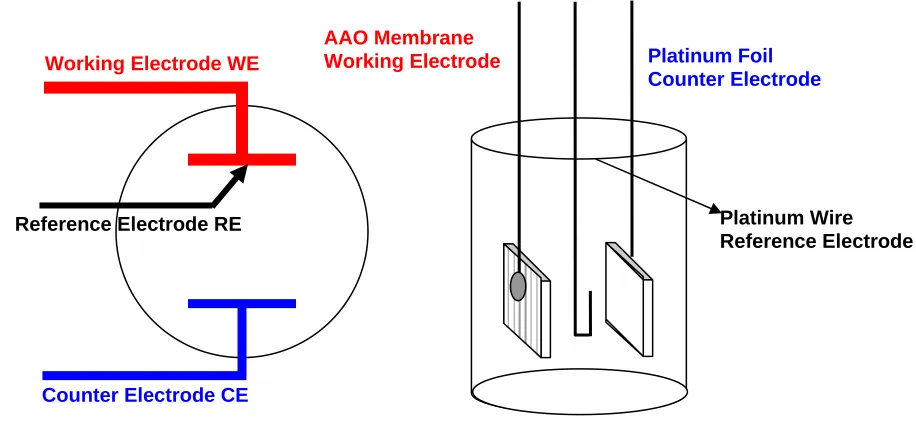
electrochemical deposition process is carried out in a standard electrochemical cell which is composed of three electrodes as shown in Figure 2.3. The working electrode is the membrane itself, and the counter electrode is made of Pt foil. The reference electrode is simply a piece of bended Pt wire. The reason to choose Pt as the electrodes is due to the stableness of Pt.
Counter Electrode CE
Platinum Wire Reference Electrode
AAO Membrane
Working Electrode Platinum Foil Counter Electrode
Reference Electrode RE
Working Electrode WE
Figure 2.3 Schematic Diagram of Electrochemical Cell
The next step is to calculate the current for the deposition. The current is determined by the current density and electrode area as the following equation:
Current (I) =Current Density (Idensity)*Electrode Area(S)
density we choose is only 0.1 mA/cm2, which will guarantee that the nanowires can have smooth surface.
After we setup the current of the potential equipment, we can start to deposit the metal into the pores. This process should be kept undisturbed. The nanowires will grow in the pores at the rate which is determined by the plating solution as well as the current density. Nickel is deposited into the channels first since it can remove the imperfectness at the end of the channels. (Figure 2.4)
Post-treatment of the samples:
Figure 2.4 Schematic diagram of depositing Ni into the channels of the membrane
After the electrochemical deposition is finished, we need to process the electrode in order to characterize the nanowires or measure their properties and collect the nanowires for future use.
There are several methods that we can use to treat the electrodes after the deposition is finished. It depends on what kind of assembly of the nanowires we need.
Nanowires Arrays: If we need to get nanowires arrays standing on a substrate, we can just simply remove the membrane by 2M NaOH or KOH for half hour since the membrane is composed of Al2O3 which can be dissolved in the basic solution. After soaked in the basic
observed under SEM because the alumina coated on the nanowires will make the SEM images look fuzzy.
Freestanding Nanowires: If we need to collect these nanowires as freestanding ones, we have to remove the sputtered metal which serve as the substrate and hold these nanowires. Before removing the sputtered metal, we need to remove the glue that seals the membrane. Usually we use CH2Cl2 to dissolve the glue since it’s a very good organic solvent. This step is very tricky
since the glue is an adhesive mixture of polymer. When the glue meets CH2Cl2, it will become
diluted glue and enter into the channels of the membrane, which will attach to the nanowires after the membrane is removed. Due to its adhesive property, once it has stuck to nanowires it will be very hard to clean. So in order to avoid the glue enter into the channel, we need to soak the electrode in CH2Cl2 for very long time (at least one week is needed, and fresh CH2Cl2 should
be changed everyday). The glue inside the channels will diffuse out but the process is really slow. After the glue is cleaned the electrode is polished to remove the sputtered metal if it’s composed of Au-Pd. And we use nitric acid (4M) to dissolve the sputtered metal if it’s silver. Put the sample into NaOH and the sample soon becomes soft and thin. Now if we shake it with hand, we can find they break into pieces and become little fragments. In the meanwhile, the solution becomes cloudy. After this, we sonicate the sample for a few seconds; we can find the solution become homogeneous colloid with the metal color immediately.
collected at the bottom of the test tube. We add several milliliters of distilled water into the test tube and redisperse these nanowires. Repeat this process for 5-6 times until the nanowires are clean. Add C2H5OH to the test tube and disperse the nanowires into it for future use.
2.2.3 Characterization
Scanning Electron Microscopy Characterization:
Scanning electron microscopy (SEM) and energy dispersive X-ray spectroscopy (EDX) analysis were performed on a JEOL JSM 5410 SEM. The nanowire arrays were affixed to conductive carbon tape and loaded on specimen mounts for SEM. The nanowires solution can be dropped onto the SEM sample holder directly and after the solution is evaporated, nanowires will be left on the surface of the specimen mounts.
Transmission Electron Microscopy Characterization
Transmission electron micrographs (TEM) and electron diffraction patterns were obtained by using a JEOL 2010 TEM operating at 200 kV. The samples were prepared by mounting small pieces of mesh on TEM copper grid and directly loaded in TEM for observation.
Optical Images:
Optical images with 400 times magnification were obtained by Fluorescence Microscope (Olympus IX-70). A high performance charge-coupled device (CCD) camera (Rupert Scientific, model 256HB) with a 512×512 pixel array is used for digital fluorescence imaging of the samples.
Scanning Tunneling Microscope (STM) Characterization:
2.3 Results and Discussion:
2.3.1 Chronopotentiogram for Electrodeposition
Figure 2.5 is a typical chronopotentiogram for the electrodeposition of gold into AAO membrane with about 300 nm diameter pore size at applied constant current density of 0.10 mA/cm2. The potential-time curve shows a slight overpotential at the first stage of electrodeposition, and then eventually the potential reaches a steady state. The stable plating potential indicates homogeneous growth of gold within the AAO membrane, thus the length of Au deposited can be controlled by varying the plating time.
Figure 2.5 Chronopotentiogram for the electrodeposition of gold into AAO membrane
2.3.2 Microscope Characterizations
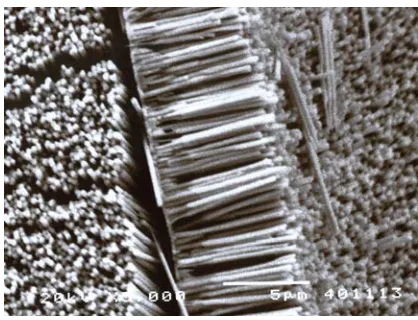
the channels at current density 0.2mA/cm2 for 40mins. Then the channels were filled by gold at current density of 0.1mA/cm2 for 9 hours. The darker parts in the images are nickel and brighter parts are gold.
Figure 2.6 Gold nanowires array on the substrate after the membrane is removed by NaOH
Figure 2.7 (a), (b) shows dispersed gold nanowires. Ni was deposited into the channels at Idensity = 0.2mA/cm2 for 30 mins. Then the channels were filled by gold at Idensity= 0.1mA/cm2 for
8 hours.
Figure 2.7(b) SEM image of higher magnification of gold nanowires
Figure 2.7(a) SEM image of free standing gold nanowires.
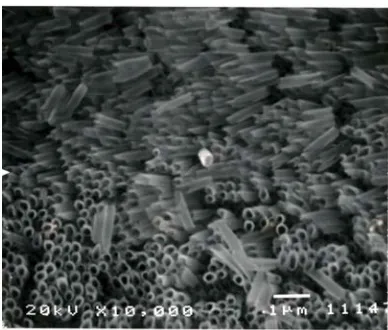
of glue. Nickel was deposited into the channels for 2h at current density of 0.1mA/cm2. According to higher magnification SEM image, the external diameters and internal diameters of these nanotubes are around 300nm and 200nm, respectively. The wall thickness of these nanotubes is around 50nm.
Figure 2.8(b) Higher magnification of SEM image of Ni nanotubes formed in the AAO membrane
Figure 2.8(a) SEM image of Ni nanotubes formed in the AAO membrane
Because the sputtered metal can’t seal the pores completely, the conductive part exposed to the plating solution will be a circle-like shape after sealed by the glue. At the same time, the glue will enter into the unsealed pores. If the glue is dense and not used too much, the glue will form a “hill” at the bottom of the pore. (Figure 2.9) When the electrochemical deposition is carried out under this condition, the nanotubes will grow inside the pores by the direction of the sputtered metal circle. But eventually the nanotubes will seal themselves after several hours of deposition at current density of 0.1mA/cm2.
If the glue is diluted and larger amount is used, it will flow into the pores, after drying, glue nanowires will form inside the channel, Figure 2.10 the SEM image of glue nanowires. Very long metal nanotubes can formed inside the channel by the direction of these glue nanowires.
Figure 2.10 Glue nanowires formed in the AAO membrane
Figure 2.11 is TEM image of the nanowire made by pulsed electrochemical deposition method at current density 20mA/cm2, the pulse time is 0.01s with 4000 cycles while the rest time is 2s each time. Because there is no nickel seal, the end of the nanowire forms a branch structure, reflecting the irregular channel at the bottom of the membrane.
Figure 2.12 (a), (b) show STM results of the nanowires fabricated in the AAO membrane labeled with 20 nm pore size. Thus the nanowires have pore size of around 200 nm. And STM results show the pore sizes are consistent with what are expected. Figure 2.12(a) shows lower magnification of a single nanowire, which breaks into small parts and leave their position due to the sweep of the STM tip. Figure 2.12(b) is the higher magnification image of this nanowire.
Figure 2.12 (a) (b) STM results of a single gold nanowire. Lower and higher magnification respectively
2.3.3 Aggregation of the nanowires observed by Optical Microscope
(a) (b)
(c)
(d)
(g) (h)
(i) (j)
2.4 Conclusions
Chapter 3
Striped Nanowires Made by Polymer Free Method
3.1 Introduction
two-dimensional assemblies between nanowire and substrate, and to prepare three-dimensional colloidal crystals from nanowire-shaped objects. [27]
Due to the difficulties in removing the glue when treating the sample, it was necessary to find another way to alternate route. A polymer-free method described in this paper provides a very practical method to fabricate nanowires with stripes. It shortens the period of the experiment and allows a large scale of nanowires with stripes to be successfully made.
3.2 Experimental Section:
3.2.1 Materials and equipment
All the chemicals and equipments are the as same as what described in Section 2.2.1 in chapter 2. The filter holder is purchased from VWR which can fit AAO membranes that have diameters of 25mm.
3.2.2 Equipment for polymer-free method
Shown in Figure 3.1, the equipment is actually made from a modified filter holder. The plastic outlet on the cap is cut so that the filter can be put on flat table. And a big hole is made at the bottom of the support base in order to let the plating solution contact the membrane adequately. Two holes were drilled on the wall of the support base symmetrically. One hole is for putting the reference electrode in, one is for counter electrode. The support grid is not used in this system because it will prevent the solution from contacting the membrane. The membrane is sputtered with Ag film. And the conductive side is clamped to a copper film by the filter. A conductive wire was soldered on the copper film to serve as working electrode. An O-ring is used in this system to guarantee the seal between the membrane and the copper film. However, the effect of this seal is not very ideal, initially there was plating solution coming between the membrane and the copper film, which resulted in metal depositing onto the conductive side of the membrane. Thus modification was made to this system, which is to add one more O-ring between the cap and the copper film as the Figure 3.2 shows:
O-ring
One more O-ring Copper film
Membrane
Figure 3.2 Schematic Diagram of membrane assembly in polymer-free method
As an advantage, the surface area of the membrane is fixed in this system because only membrane with diameter of 25mm can fit into this filter. The inside diameter of the membrane determines the electrode area that will be exposed to the plating solution.
3.2.3 Electrochemical Deposition of Striped Nanowires into the AAO membrane
By switching the plating solution, striped nanowires can be fabricated into the channels of the membrane. First, nickel is deposited into the channels to seal the pores as well as fill the bottom of the channel with imperfect structures. Since Ni can be dissolved in the acid, so it can be easily removed even though it’s deposited on the other side of the membrane. At the current density 0.1mA/cm2, at least 24 hours are needed to seal the pores and remove the imperfections of the channels in the membrane. Otherwise gold wires will link to each other since some channels at the bottom of the membrane merge together. This will bring difficulties to separate these nanowires after the membrane is removed.
Gold is deposited into the pores in relatively shorter time. We can calculate the deposition time of the gold by measuring the length of the nanowires and their deposition time since they are proportional. Deposition at current density of 0.2mA/cm2 for 26 minutes is needed if gold segment length is 300nm according to our calculation. We can label this gold as Au-1.
Consequently, relatively longer nickel segments are deposited at current density of 0.3mA/cm2 for 4hrs and labeled as Ni-1.
Repeat these steps for another 2 times, thus Au-2, Ni-2, Au-3 can be loaded into these channels.
3.2.4 Post-treatment of the sample
remove membrane, the free standing nanowires were obtained after sonication. An adequate amount of basic solution must be added to dissolve the AAO membrane, otherwise the alumina oxide will react with NaOH to form a white flocculant, which will absorb onto the nanowires and making SEM observation difficult. The nanowires were rinsed with distilled water for several times and finally dispersed in C2H5OH.
Remove Template
Figure 3.3 Schematic diagram of post-treatment of striped nanowires
3.2.5 Microscope Characterization:
SEM, TEM, Optical Microscope were used to characterized these striped nanowires similarly as described in Chapter 2 Section 2.2.3
In order to obtain the detailed surface morphology of these striped nanowires, LEO 1530VP Variable PressureField-Emission Microscope is used to characterize these nanowires.
3.2.6 Alignment under magnetic field
3.3 Results and Discussion
3.3.1 SEM images
Figure 3.4 shows some gold nanowires synthesized by this polymer free method. Here nanowires were still immobilized on the substrate because the plating solution leaking between the membrane and the copper and metal was deposited on the back contact side of the membrane. Not enough deposition of nickel may also cause this problem.
Figure 3.4 Initial result of gold nanowires fabricated by the polymer-free method
Some improvements are made when the Ni deposition time is elongated. From Figure 3.5 (a), (b), we can still find that the nanowires’ surface roughness which maybe caused by the incomplete seal.
After one more O-ring is added, the qualities of the striped nanowires are enhanced due to much better seal between the membrane and the copper film, as shown in Figure 3.6 (a), (b).
Figure 3.6 (a), (b) Striped nanowires obtained after better seal by adding one more O-ring
3.3.2 Field-Emission SEM images
Figure 3.7(a), (b) show the Field-Emission SEM images of the striped nanowires. This microscope has two modes which are InLens and MPSE respectively. The InLens mode has the capability of obtaining high resolution image under high vacuum, while the MPSE mode has the advantage of acquiring three-dimensional information of the object. Thus the mixed signal of InLens and MPSE is used to take both of the two advantages.
Figure 3.7 (b) FESEM image obtained by the signal of MPSE
3.3.4 Magnetic alignment
Figure 3.8 (a),(b) show the alignment of these stripe nanowires
3.4 Conclusions
References
[1] a) Z.L. Wang. Adv. Mater. 2000, 12, 1295-1299
b) J. Hu, T.W. Odom.; C.M. Lieber. Acc.Chem.Res. 1999, 32, 435-445 [2] Parthasarathy, R.; Martin, C.R. Nature 1994,369, 298-301
[3] Martin, C.R. Adv. Mater. 1991, 3, 457-459
[4] Klein, J.D.; Herrick, R.D.I.; Palmer, D.; Sailor, M.J.; Brumlik, C.J.; Martin, C.R. Chem. Mater. , 1993, 5, 902-904
[5] Parthasarathy, R.; Martin, C.R. Adv. Mater. 1995, 7, 896-898 [6] Wu, C.G..; Bein, T. Science, 1994, 264, 1757-1759
[7] M.P. Zach.; K.H. Ng, R.M. Penner, Science, 2000, 290, 2120 [8] C.R. Martin. Acc.Chem.Res.1995, 28, 61-63
[9] C.J. Murphy.; N.R. Jana. Adv. Mater.2002, 14, 80-87
[10] D.Zhang.; L.Qi.; J.Ma.; H.Cheng. Chem.Mater. 2001, 13, 2753-2760
[11] K.Keren.; M.Krueger.; R.Gilad.; G.. Ben-Yoseph.; U.Sivan.; E.Braun. Science, 2002, 297, 72-75
[12] C.R. Martin, Science, 1994, 266, 1994-1996
[13] R.L. Fleisher.; P.B. Price.; R.M. Walker, Nuclear Tracks in Solids, University of California Press, Berkeley, CA 1975
[14] A. Despic, V.P. Parkhutik, in Modern Aspects of Electrochemistry, Vol 20, Plenum Press, New York 1989, Ch.6
[15] F. Li.; L. Zhang.; R.M. Metzger, Chem. Mater.1998, 10, 2470-2479
[16] Z. Zhang.; D.Gekhtman.; M.S. Dresselhaus.; J.Y. Ying. Chem. Mater.1999, 11, 1659-1664 [17] S.J. Limmer.; S.Seraji.; Y. Wu.; T.P. Chou.; C. Nguyen.; G. Cao. Adv. Funct. Mater.2002,
12, 59-65
[18] M.E.T. Malares.; V. Buschmann.; D. Dobrev.; R. Neumann.; R.Scholz.; I.U. Schuchert.; J.Vetter. Adv. Mater.2001, 13, 62-74
[19] K. Nielsch.; F. Muller.; A.P. Li.; U. Gosele. Adv.Mater.2000, 12, 582-586 [20] X. Duan.; Y. Huang.; Y.Cui.; J.Wang.; C.M. Lieber. Nature2001, 409, 66-68 [21] Y. Wu.; P.Yang.; Adv. Mater.2001, 13, 520-528
[22] P. E. Marszalek.; W.J. Greenleaf.; H.Li.; A.F. Oberhauser.; J.M. Fernandez. PNAS2000, 97, 6282-6290
[23] B.R. Martin.; D.J. Dermody, B.D. Reiss.; M.M. Fang.; L.A. Lyon.; M.J. Natan.; T.E. Mallouk. Adv. Mater.1999, 11,
[24] D.J Pena.; J.K.N. Mbinodyo.; A.J. Carado.; T.E. Mallouk.; C.D. Keating.; B.Razavi.; T.S. Mayer. J.Phys.Chem. B 2002, 106, 7458-7467
[25] S.R. Nicewarner-Pena.; R.G. Freeman.; B.D. Reiss.; L,He.; D.J. Pena.; I.D. Walton.; R. Cromer.; C.D. Keating.; M.J. Natan. Science, 2001, 294, 137-139
[26] B.D. Reiss.; J.N.K. Mbinbyo.; B.R. Martin.; S.R. Nicewarner.; T.E. Mallouk.; M.J. Natan.; C.D. Keating. Mater .Res.Soc. Symp. Proc. 2001,263,132-145