Technology (IJRASET)
©IJRASET 2013: All Rights are Reserved
362
Performance Evaluation of Crumb Rubber
Modified Bitumen by Using Various Sizes of
Crumb Rubber
B.Sudharshan Reddy1, N.Venkata Hussain Reddy2 1, 2Department of Civil Engineering, AVR & SVR College of Engineering and Technology, Nandyal.
Abstract--Increase in environmental concerns has been leading to develop innovative and eco-friendly ideas to re-use the waste byproducts from industries and domestic use. The abundance and increase of waste tyre disposal is a serious problem that leads to environmental pollution. Crumb rubber obtained from shredding of those scrap tires has been proven to enhance the properties of plain bitumen since the 1840s. It can be used as a cheap and environmentally friendly modification process to minimize the damage of pavement due to increase in service traffic density, axle loading and low maintenance services which has deteriorated and subjected road structures to failure more rapidly. Use of crumb rubber leads to excellent pavement life, driving comfort and low maintenance. The rheology of CRMB depends on internal factors such as crumb rubber quantity, type, particle size, source and pure bitumen composition, and external factors such as the mixing time, temperature, and also the mixing process (dry process or wet process). The present study aims in investigating the experimental performance of the bitumen modified with 15% by weight of crumb rubber varying its sizes. Four different categories of size of crumb rubber will be used, which are coarse (1 mm -600 μm); medium size (600 μm - 300 μm); fine (300 μm-150 μm); and superfine
(150 μm - 75 μm). Common laboratory tests will be performed on the modified bitumen using various sizes of crumb rubber and thus analyzed. Marshall Stability method is adopted for mix design. Finally a comparative study is made among the modified bitumen samples using the various sizes of Crumb Rubber particles and the best size is suggested for the modification to obtain best results
Keyword--Bitumen, CRMB, Crumb Rubber, Marshall Stability Test and Pavement
I. INTRODUCTION
India has a road network of over 4,689,842 kilometres in 2013 , the second largest road network in the world. It has primarily flexible pavement design which constitutes more than 98% of the total road network. India being a very vast country has widely varying climates, terrains, construction materials and mixed traffic conditions both in terms of loads and volumes. Increased traffic factors such as heavier loads, higher traffic volume and higher tyre pressure demand higher performance pavements. So to minimize the damage of pavement surface and increase durability of flexible pavement, the conventional bitumen needs to be improved. There are many modification processes and additives that are currently used in bitumen modifications such as styrene butadiene styrene (SBS), styrene-butadiene rubber (SBR), ethylene vinyl acetate (EVA) and crumb rubber modifier (CRM).
Crumb rubber is the term usually applied to recycled rubber from automotive and truck scrap tires. During the recycling process steel and fluff is removed leaving tire rubber with a granular consistency. Continued processing with a granulator and/or cracker mill, possibly with the aid of cryogenics or mechanical means, reduces the size of the particles. From physical and chemical interaction of crumb rubber with conventional bitumen Crumb Rubber Modified Bitumen (CRMB) is made. Its advantages are: Lower susceptibility to daily & seasonal temperature variations, higher resistance to deformation at elevated pavement temperature, better age resistance properties, higher fatigue life of mixes, Better adhesion between aggregate & binder, Prevention of cracking & reflective cracking, and Overall improved performance in extreme climatic conditions & under heavy traffic condition.
II. REVIEW OF LITERATURE
Technology (IJRASET)
©IJRASET 2013: All Rights are Reserved
363
Shankar et al (2009), crumb rubber modified bitumen (CRMB 55) was blended at specified temperatures. Marshall’s mix design was carried out by changing the modified bitumen content at constant optimum rubber content and subsequent tests have been performed to determine the different mix design characteristics and for conventional bitumen (60/70) also. This has resulted in much improved characteristics when compared with straight run bitumen and that too at reduced optimum modified binder content (5.67 %).
S.D.Katara, C.S.Modhiya, N.G.Raval (2014) stated that fly ash and waste tyre of vehicles is one of the most industrial waste residues in India. Fly ash is the main solid waste discharged by coal-fired power plant. In India, the annual emission of fly ash is more than 0.3 billion tons, and it is one of the main industrial waste residue. The use of four wheeler, two wheeler vehicles etc. is increasing day by day. As a result amount of waste tyres also increasing. Waste tyres in India are categorized as solid or hazardous waste. It is estimated that about 60 per cent of waste tyres are disposed via unknown routes in the urban as well as rural areas. This leads to various environmental problems which include air pollution associated with open burning of tyres and aesthetic pollution. Therefore, it is necessary to utilize the wastes effectively with technical development in each field. A good design of Modify bituminous mix is expected to result in a mix which is adequately strong, durable and resistive to fatigue and permanent deformation and at the same time environment friendly and economical. A mix designer tries to achieve these requirements through a number of tests on the mix with varied proportions of material combinations and finalizes the best one. The research result shows that the Marshal method of bituminous mix design was carried out for varying percentages of Fly ash to determine the different mix design characteristics.
A detailed review of research works carried out related to the present study are described as below. The penetration is a measure of hardness or softness of bitumen binder which shows an effect by adding crumb rubber to bitumen binder; it decreases as rubber content is increased. The penetration shows lower values as rubber content increases at different mix conditions of rubberized bitumen binder, indicating that the binder becomes stiff and more viscous
The softening point refers to the temperature at which the bitumen attains a particular degree of softening. The use of crumb rubber in bitumen modification leads to an increase in the softening point and viscosity as rubber crumb content increases (Mahrez, 1999; MAshaan et al , 20011a). Mahrez and Rehan (2003) claimed that there is a consistent relationship between viscosity and softening point at different aging phases of rubberized bitumen binder.
According to a study conducted by Lee et al. (2008), the higher crumb rubber content produced increased viscosity at 135°C and improved the rutting properties. It was also observed that the increased crumb rubber amount (fine crumb rubber) produced rubberized bitumen with higher viscosity and lower resilience. However, optimum crumb rubber content still needs to be determined for each crumb rubber size and asphalt binder. It is believed that a physicochemical interaction that occurs between the asphalt and the crumb rubber alters the effective size and physical properties of the rubber particle, thus influencing pavement performance (Huang et al, 2007)
Becker et al, (2001) claimed that blend properties will be influenced by the amount of crumb rubber added to the bitumen. Higher amounts indicated significant changes in the blend properties. As rubber content generally increases, it leads to increased viscosity, increased resilience, increased softening point and decreases penetration at 25°C.
The mixture showed improved performance in dynamic stability, 48 h residual stability, flexural strength and strain value. Asphalt containing 0.2 and 0.4 mm size rubber indicated the best laboratory results (Souza and Weissman ,1994). The particles size disruption of crumb rubber influenced the physical properties of bitumen rubber blend. In general, small difference in the particles size has no significant effects on blend properties. However, the crumb rubber size can certainly make a big difference. According to a study of Shen et al. (2009), the particle size effects of CRM on high temperature properties of rubberized bitumen binders was an influential factor on visco- elastic properties. The coarser rubber produced a modified binder with high shear modulus and an increased content of the crumb rubber decreased the creep stiffness which in turn showed significant thermal cracking resistance.
When crumb rubber is blended at high temperatures with bitumen to produce a modified binder (i.e wet process), the two materials interact once bitumen components migrate into the rubber causing it swell (Bahia and Davies, 1994). Initially, the interaction between crumb rubber and bitumen is a non- chemical reaction, where the rubber particles are swollen by the absorption of the aromatic oils of bitumen (Heitzman,1992)
Technology (IJRASET)
©IJRASET 2013: All Rights are Reserved
364
higher binder modification (Abedlrahman and Carpenter, 1999).
III. MATERIALS
VG-30 bitumen, Fine crumb rubber, Softening point apparatus, Penetration test Apparatus, Bitumen mixing setup, Marshall test apparatus, Air voids apparatus
Fig1: crumb rubber sample
IV. EXPERIMENTAL PROGRAMS
A. Mixing Of Crumb Rubber With Plain Bitumen
In preparing the modified binders, about 500 g of the bitumen was heated to fluid condition in a 1.5 litre capacity metal container. For blending of crumb rubber with bitumen, it was heated to a temperature of 160 °C and then crumb rubber was added. For each mixture sample 15% [3] of crumb rubber by weight of four different sizes is used, which are coarse (1 mm - 600 μm); medium size (600 μm - 300 μm); fine (300 μm-150 μm); and superfine (150 μm - 75 μm). The blend is mixed manually for about 3-4 minutes. The mixture is then heated to 160 °C and the whole mass was stirred using a mechanical stirrer for about 50 minutes. Care is taken to maintain the temperature between 160 °C to 170 °C. The contents are gradually stirred for about 55 minutes. The modified bitumen is cooled to room temperature and suitably stored for testing.
B. Common Tests On The Modified Bitumen
Penetration test and Softening point tests on both the plain and modified CRMB are performed and the results are analyzed for further study.
C. Preparation Of Bituminous Mix
[image:4.612.116.496.143.236.2]For the present study Bituminous concrete mix gradation was used following specifications stated by MORT & H table 500-19. Three specimens of Marshall moulds and one loose mix (uncompacted) are prepared for each size of crumb rubber. Aggregates are oven dried and sieved according to BC gradation and separated. The amount of each size of fraction required to produce a mixed aggregate of 1200gm as per gradation is weighed. The required height of specimen is 63.5(+/-1). Bitumen and aggregate is heated separately to 160 °C and 150 °C respectively. Then bitumen is poured in aggregate as per requirement. Then the mixture is mixed till a uniform coating is obtained on aggregate while the mixture is being heated together maintained at around 170 °C. The specimens mould and compaction hammer are cleaned thoroughly and mould assembly is heated in hot air oven to a temperature about 150 °C. A little grease is applied to the mould before the mix is placed. The mould is assembled and the mix is transferred and tampered using spatula. Then 75 blows are applied on either sides of the mould manually. Then the specimen is extracted after 24 hours.
Technology (IJRASET)
©IJRASET 2013: All Rights are Reserved
365
D. Marshall Stability Tests
[image:5.612.96.516.157.269.2]Before testing the moulds their dimensions is measured to note the volume and their weight in air, weight in water, and weight of dry SSD are taken. After that they are kept in water bath maintained at 25 for 30 minutes. The moulds are tested within 3 to 4 minutes after taken out from water bath. The mould is put out on Marshall Apparatus and Marshall Stability and flow dial gauge readings are recorded.
Fig 3: moulds immersed in water bath for 24 hours
Fig 4: Marshall Stability Test Setup
E. Density and Air Void Analysis
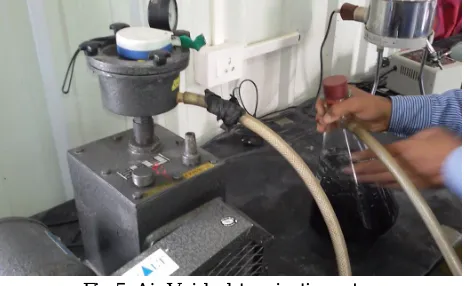
The following quantities are worked out by carrying out density voids analysis: Bulk specific gravity of Compacted Mixture, Theoretical Maximum specific Gravity, Percent air voids, Percent air voids in mineral aggregates (VMA), Percent aggregate voids filled with bitumen (VFB) and further graphs are plotted .
Bulk Specific Gravity (Gmb) = [A / (B – C)] Where;
A= Weight in grams of the specimen in air. B= Weight in grams, surface dry.
C= Weight in grams, in air.
Theoretical Maximum Specific Gravity (Gmm) = A / (A + D –E) Where;
A= mass of oven-dry sample on air
D = mass of flask filled with water up to neck at (25°C )
E = mass of container filled with sample and water up to neck at (25°C )
[image:5.612.210.421.296.460.2]Technology (IJRASET)
©IJRASET 2013: All Rights are Reserved
366
Gmb = Bulk specific gravity
Gmm = Theoretical maximum specific gravity
Voids in mineral aggregate (VMA) = 100 [ 1–((Gmb ( 1- Pb)) / Gsb )] Where;
Gmb = Bulk Specific Gravity of compacted mix. Gsb = Bulk Specific Gravity of total aggregate. Pb = Percent of bitumen by weight.
Voids Filled With Bitumen (VFB) = 1- (Va/VMA) Where;
Va = % Air voids
[image:6.612.191.423.248.391.2]VMA = Voids in mineral aggregate
Fig 5: Air Voids determination setup
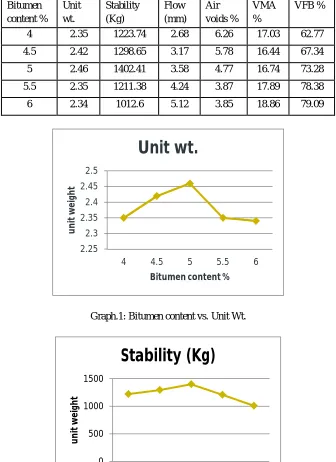
The bitumen content corresponding to 4% air voids is taken as optimum bitumen content (OBC). With that OBC the Marshall tests are repeated for the CRMB mixes prepared using four different sizes of crumb rubber as stated earlier. And the results are analyzed and compared to identify the best size of crumb rubber to be added for modification.
V. TESTS RESULTS Common Tests on Plain and Modified Bitumen
Penetration value of VG-30 bitumen =63.78mm Softening Point of plain VG-30 bitumen = 50.82 °C
TABLE 1: rubber sizes Sample No.1:(1mm-600) μm Crumb rubber Sample No.2:(600 -300) μm Crumb rubber Sample No.3:(300 -150) μm Crumb rubber Sample No.4:(150 -75)μm Crumb rubber
TABLE 2: Softening Point test results for CRMB of different crumb rubber sizes Test
Property
Sample No.1 Sample No.2 Sample No.3 Sample No.4
Temper ature (°C)
Ball No.1
Ball No.2
Ball No.1
Ball No.2
Ball No.1
Ball No.2
Ball No.1
Ball No.2
56.1 58.5 57.7 60.7 59.6 61.1 63.3 64.1
Mean Softening point
Technology (IJRASET)
[image:7.612.138.474.197.659.2]©IJRASET 2013: All Rights are Reserved
367
TABLE 3: Penetration Point test results for CRMB of different crumb rubber size. Test Property Sample
No.1 Sample No.2 Sample No.3 Sample No.4
penetration (mm) 42.33 41.76 36.33 38.17
A. OBC Determination
The Marshall Stability test and air voids analysis results are tabulated as under
TABLE.4: Observation table for Marshall tests Bitumen content % Unit wt. Stability (Kg) Flow (mm) Air voids % VMA % VFB %
4 2.35 1223.74 2.68 6.26 17.03 62.77
4.5 2.42 1298.65 3.17 5.78 16.44 67.34
5 2.46 1402.41 3.58 4.77 16.74 73.28
5.5 2.35 1211.38 4.24 3.87 17.89 78.38
6 2.34 1012.6 5.12 3.85 18.86 79.09
Graph.1: Bitumen content vs. Unit Wt.
Graph.2: Bitumen Content vs. Stability
2.25 2.3 2.35 2.4 2.45 2.5
4 4.5 5 5.5 6
u n it w ei gh t
Bitumen content %
Unit wt.
0 500 1000 1500
4 4.5 5 5.5 6
u n it w ei gh t
Bitumen content %
Technology (IJRASET)
©IJRASET 2013: All Rights are Reserved
368
Graph.3: Bitumen content vs. Flow
Graph.4: Bitumen Content vs. Air Voids
Graph.5: Bitumen content vs. VMA
Graph.6: VFB vs. Bitumen Content
0 2 4 6
4 4.5 5 5.5 6
u n it w e ig h t
Bitumen content %
Flow (mm)
0 2 4 6 84 4.5 5 5.5 6
A ir vo id s %
Bitumen content %
Air voids %
15 16 17 18 19 20
4 4.5 5 5.5 6
u n it w ei gh t
Bitumen content %
VMA %
0 50 100
4 4.5 5 5.5 6
u n it w e ig h t
Bitumen content %
Technology (IJRASET)
©IJRASET 2013: All Rights are Reserved
369
B. Marshall tests using CRMB prepared by different sizes of crumb rubber
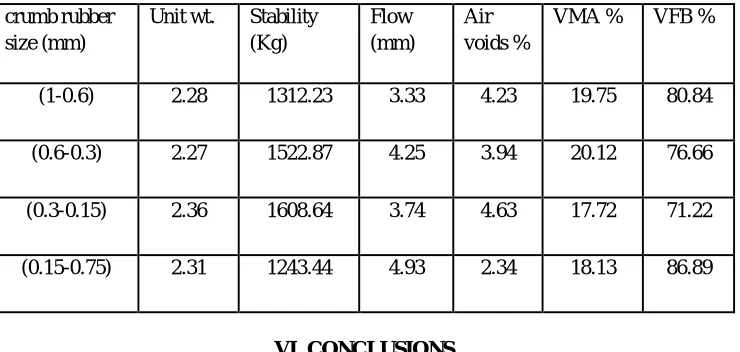
[image:9.612.124.494.153.329.2]Using OBC 5.1% as obtained from graph 4 :, three CRMB marshall samples and one loose mix (uncompacted) are prepared taking 5.1% by weight of modified bitumen. Then Marshall Stability tests and density void analysis tests are performed as mentioned earlier for the plain bitumen and the results are tabulated as below.
TABLE 5: Observation table for Marshall Stability tests on CRMB mix crumb rubber
size (mm)
Unit wt. Stability (Kg)
Flow (mm)
Air voids %
VMA % VFB %
(1-0.6) 2.28 1312.23 3.33 4.23 19.75 80.84
(0.6-0.3) 2.27 1522.87 4.25 3.94 20.12 76.66
(0.3-0.15) 2.36 1608.64 3.74 4.63 17.72 71.22
(0.15-0.75) 2.31 1243.44 4.93 2.34 18.13 86.89
VI. CONCLUSIONS
By studying the test results of common laboratory tests on plain bitumen and crumb rubber modified bitumen it is concluded that the penetration values and softening points of plain bitumen can be improved significantly by modifying it with addition of crumb rubber which is a major environment pollutant.
From the table 5 it can be observed that the sample prepared using crumb rubber size (0.3-0.15mm) give the highest stability value of 1608.64 kg, minimum flow value, maximum unit weight, maximum air voids and minimum VMA and VFB % values. So the best size to be used for crumb rubber modification can be suggested as (0.3-0.15mm) size for commercial production of CRMB.
REFERENCES
[1] S.K. Khanna and C.E.G Justo “Highway Engineering” 2008
[2] IRC SP: 53-2002, 2004, 2010 “Guidelines on use of Polymer and Crumb Rubber Modified binders”. [3] Ministry Of Road Transport & Highways (MORT & H), “Specifications for road and bridge works”. [4] http://www.pavementinteractive.org/
[5] http://www.trb.org/NCHRP/NCHRP.aspx