2000
To improve quality of managing safety in Chinese
maritime safety administration
Zhiqing Li
World Maritime University
Follow this and additional works at:http://commons.wmu.se/all_dissertations Part of thePublic Affairs, Public Policy and Public Administration Commons
This Dissertation is brought to you courtesy of Maritime Commons. Open Access items may be downloaded for non-commercial, fair use academic purposes. No items may be hosted on another server or web site without express written permission from the World Maritime University. For more
Recommended Citation
Li, Zhiqing, "To improve quality of managing safety in Chinese maritime safety administration" (2000).World Maritime University Dissertations. 358.
TO IMPROVE QUALITY OF MANAGING SAFETY
IN CHINESE MARITIME SAFETY
ADMINISTRATION
By
LI ZHIQING
ChinaA dissertation submitted to the World Maritime University in partial fulfillment of the requirements for the award of the degree of
MASTER OF SCIENCE
in
MARITIME ADMINISTRATION AND ENVIRONMENTAL PROTECTION
degree has previously been conferred on me.
The contents of this dissertation reflect my own personal views, and are not necessarily endorsed by the University.
(Signature)
(Date)
Supervised by:
Jan Åke Jönsson
Office: Associated Professor of MAEP and MSEP
World Maritime University
Assessor:
Dick Hodgson
Office: Associated Professor of MAEP
World Maritime University
Co-assessor:
Olle Wadmark
Office: Head of Section
Liljedahl for their helpful opinions and valuable materials at my preparation stage.
I would like to extend my thanks to all the staff at World Maritime University for their help and assistance in many ways, especially, to all the staff in the library. I would give my sincere thanks to Inger Battista for her English language assistance.
My special gratitude goes to my Director Mr. Wang Huaifeng and my Division Chief, Mr. Zhao Dianrong in the Tianjing Maritime Safety Administration for giving me their appreciation and trust and the first chance of our regional administration to study at World Maritime University. I would also like to say thanks to all my former colleagues in my Division, who have taken extra responsibility because of my absence from the work.
I would like to recall the benefaction from DANIDA of Denmark for their generous sponsorship for my studies at World Maritime University.
I will never forget my management courses taught by Prof. D. Hodgson and the ISM Code Seminar, as well as the field training in VIKING company and in Finnish Maritime Administration from which I got so many bright points in my ideas, which are now included in my dissertation.
Some of my good friends have assisted me towards the successful completion of the dissertation. In particular, I would like to record my gratitude to Mr. Song Zhen, Mr. Chen Biwu and Mr. Xiao Ming.
The dissertation is a study of the common principles and practices for successful safety management in the world shipping industry, which forms the foundation of improving the safety quality administration in CMSA.
A brief look is taken at the primary functions of maritime safety administration in general and the author’s personal views of the inter-relationship between safety and quality.
The successful practices of applying quality strategy in maritime safety management are investigated.
The background of the Chinese maritime industry is reviewed and the maritime safety policy and the current maritime safety situation are explored, with a view to ascertaining the strengths and the weaknesses for further improvement.
Many efforts were made to analyze the reasons for improving the quality of managing safety with the aim to show the imminent needs in the future development of CMSA.
A substantial part of the dissertation consist of the suggestions for improvement in CMSA, which are generated from the TQM theory, the successful maritime safety management practices and risk control methodology considering the Chinese characteristics and the current situation in CMSA.
Managing safety needs a supportive atmosphere of thetop level management’s truthful commitment, the total involvement from all the levels, and qualified, well-trained and motivated people.
To improve the quality of managing safety can only be achieved within a system.
Risks should be treated with the scientific methodology both reactively and proactively.
The exchange of experiences, testing of ideas and sharing of views on the national level and international level will also be one of the cornerstones of our work in the future.
Abstract iv
Table of Contents v
List of Tables viii
List of Figures viii
List of Abbreviations viii
Chapter 1 Introduction 1
Chapter 2 The introductory framework of MSA 4
Definition of “ administration” 4
The functions of MSA 5
National economy and maritime safety 7
Link between MSA and quality 8
Chapter 3 What is safety quality management 10
What is quality 10
Quality management in public administration 11 What contributed to safety improvement 11 Modern management system’s approach to safety 12
Chapter 4 Challenges faced by CMSA today 15
Managing organization 15
Government reformation 15
Challenges from the industry 16
− The nature of maritime sectors 16
− Environmental protection and economic development 16 − Marine transport has many error- inducing factors 17
− Viewing “Safety” 17
− Addressing human element 18
− The culture of safety 19
Chapter 5 The successful systematic quality approaches applied in marine
safety management 21
ISO9002 21
SEP 23
ISM code 23
FSA 24
Chapter 6 Analysis the current situation of CMSA 41
Chinese characteristics 41
− China is a developing country with a very big population. 41 − Superior natural condition for developing water transport. 41
− China is a socialist country 42
Transport and national economy 42
Safety production policy 44
CMSA 45
Current maritime safety situation in China 48
Weaknesses of CMSA 49
Chapter 7 The reasons for improvement 51
State’s responsibility 51
Flag State Self-Assessment Form of IMO 53
PSC 54
Lessons learned from disasters 55
International trends of safety management 57
Safety culture 58
The benefits of implementing MSQA system in CMSA 61 The advantage of setting improvement as a goal 62 Sharing information within the community 63
Chapter 8 Suggestions for improvement (I)
Develop a supportive atmosphere for safety culture 66
Understanding quality 66
Top management commitment 68
Total involvement 69
Competent staff 71
Motivation 73
Understanding the causes of accidents/incidents 74 Understanding environmental protection policy 77
Chapter 9 Suggestions for improvement (II)
Set up MSQA System in CMSA 78
Policy formulation 78
Organizing 79
Planning for safety 80
Implementation 81
Measuring performance 82
Reviewing lessons learned 86
Chapter 11 Suggestions for improvement (IV)
Promotion communication both inside and out side CMSA 95
Information input into the Administration 95 Information flows within the Administration 96 Flows of information from the Administration 97 The methods to improve communication within the Administration 98 Set up Chinese Maritime Safety Information System 100
Chapter 12 Final thoughts 103
Table 1 ISO 9002 requirements 22
Table 2 Six functional requirements of ISM code 25
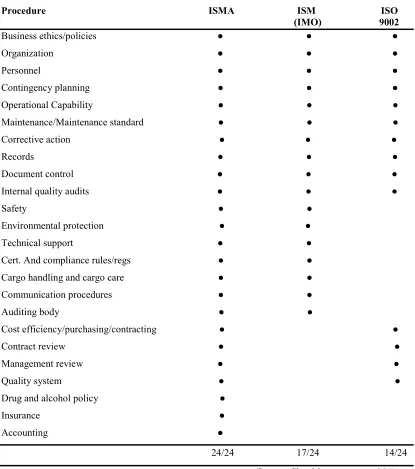
Table 3 A comparison of the various safety and quality codes 29
Table 4 Task and Scientific Terms of Typical Safety Case 35
Table 5 The statistics of 1996 – 1998 Chinese flag vessel detention 54
LIST OF FIGURES
Figure 1 Principal Claim cause - frequency 19
Figure 2 Graphical presentation of risk regions 27
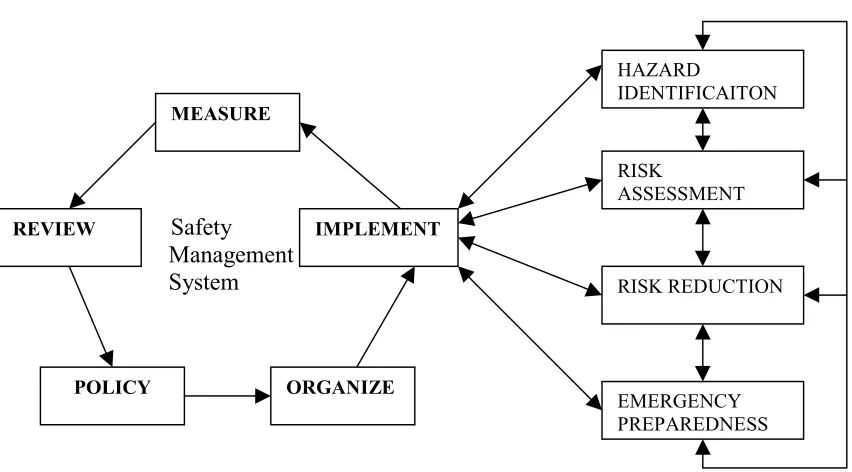
Figure 3 Key elements of the safety case concept 35
Figure 4 The organizational structure of CMSA(headquarter) 46
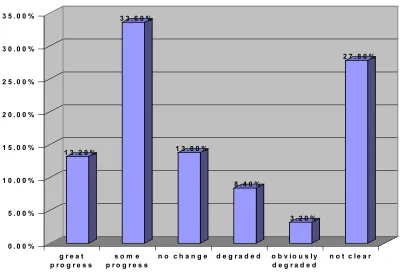
Figure 5 Public comments in environmental pollution 70
Figure 6 Anticipation of future environmental condition 70
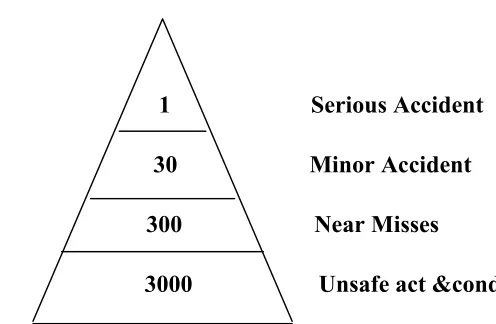
Figure 7 Dr. W.Heinrich’s “Accident Distribution Model” 75
Figure 8 A Sample of Accident Cause Ranges 76
Figure 9 TQS flow process 78
Figure 10 A framework for setting performance standards 84
LIST OF ABBREVAITIONS
CMSA Chinese Maritime Safety Administration MSA Maritime Safety Administration
FSA Formal Safety Assessment
ISMA International Ship Managers’ Association
PSC Port State Control
QSS Quality Standard System
ISM International Safety Management SEP Safety & Environment Protection
MSQA Maritime Safety Quality Administration
QAT Quality Action Team
PTP Prevention Through People
Chapter One
Introduction
Quality and safety are words that are flashing towards us from every article on a shipping theme. Substandard ships, substandard operation, substandard Flag States, substandard Port States and substandard classification societies have been recurring issues on the agenda.
Both authorities and the public in general are concerned with the increasing impact of technology on our common environment. Certain accidents have triggered increased public pressure and an accelerated political activities which have resulted in laws and requirements with impacts which are not totally foreseeable.
The shipping catastrophy review over the last 20 years shows a clearly increasing trend. The tragic accidents of the “Herald of Free Enterprise” and the Scandinavian Star” have initiated work within IMO, resulting in IMO resolution A.647(16): Guidelines on Management for the Safe Operation of Ships and for Pollution Prevention, and also the succeeding resolution A.680(17). The accident of the “Exxon Valdez” with severe oil pollution in sensitive waters, has certainly contributed to and accelerated the formulation of the American Oil Pollution Act (OPA 90).
Historically, the marine industry has used prescriptive rules and regulations for treating safety.
change of approach is to be adopted, the major hurdles to be overcome will need to be identified, and possible solutions suggested.
Furthermore, quality management principles have been used by the land based industry for quite some time. Quality management had became an important tool for improving the way organizations function in the 1990s, both in the industry and in the private and public service sectors. It was not until recently that these ideas got foothold within the shipping industry.
The ISM Code, with its requirement for shipowners to have in place a Safety Management System, aims to increase safety consciousness in the operation of ships. FSA on the other hand aims to improve the regulatory regime in IMO. The two initiatives are complementary, and both will help reduce risks at sea.
“If governments do not work well ─ economies won’t work well” Juhani Turunen, the Finnish Permanent Under-Secretary of State said. Increasing globalization will mean growing interdependency. International events and actors will increasingly influence issues that have traditionally been domestic.
Organizations, which manage marine safety successfully, display a number of common characteristics. They have their safety and environmental risks under control and can demonstrate a progressive improvement in their safety records.
From CMSA’s point of view, many reasons show that
• The tradition regulatory regime in CMSA are facing challenges;
• The quality of managing safety in CMSA has to be improved;
CMSA, as the competent maritime safety authority in China, has three issues to confronte:
1. What does CMSA need to do to enable the safety management regime in CMSA to cater to the rapidly changing situation in the safety management arena?
2. How can the industry be encourage to be safety conscious?
3. How can the administrative regime become comprehensive and proportional to the risks faced by the industry?
China is at presemt carrying out a government reform, which involves all the public sectors. So does the CMSA. The reform in CMSA is under planning in conformity with clear political guidelines and strong political support.
The above situations provide the CMSA an unprecedented opportunity to initiate a substantial change in the way of managing safety. The future reform should be done not only for the sake of central government directives, but also for the citizens and for business. It is important that their views are reflected in this reform and the future work of CMSA must genuinely respond to their expectations.
Chapter Two
The introductory framework of MSA
Definition of “ administration
”
“Administration” can be broadly interpreted as the management of organization” (Vanchiswar, 1996). The reason for this lies in the fact that administration is generally viewed in the context of public, or in an even more narrow sense – State administration. State administration is in effect the management of government business. At this point, the expression (“administration”) is subject to management and governing, i.e. performing with authority. The source of the authority is the law concerned.
Administration is treated as the foundation of the organized society of today. A very common theory assumes that all types of organizations are to be managed in the same way, i.e. the management can be applied universally, if various types of organization are considered. However, not only many common features but also many differences can be observed.
administration or hierarchical order, whether in the economy, administration or other institutions.
The functions of MSA
Public administration, i.e. goals and normative framework of the organization acts according to the State goals and norms.
The role of the state has developed far beyond the basic activities of external defense and internal law and order, to an interventionist and active planning role. The original role can be seen as negative, in that it was primarily concerned with stopping other people doing things that were primarily concerned with stopping other people doing things that were inconvenient to society; the modern role is more positive – actually providing for society a large range of goods and services in and out of the marketplace.
---- Glen Plant
The Maritime Administration of a country is an integral part of its overall public administration. “The expression ‘Maritime Administration’ means the administration of essential matters pertaining to the maritime sector in any country and calls for specialized knowledge and skills of a high order.” (Vanchiswar, 1996).
Since the expression “ Maritime Administration” is a generic, the concept of its nature and extent can vary depending upon whether a) the Ministry responsible for maritime matters itself, is being viewed as the Maritime Administration, or b) a sub-formation under the said Ministry is to be the Maritime Administration.
The aforesaid Ministry is responsible for maritime legislation and for implementation of government policy in the ultimate, and for overall co-ordination, as well as for relevant action in harmony with the ministries responsible for inter alia trade, economy and planning. It has to be appreciated that there is a very important need for a specialized sub-formation (i.e. support formation) manned by knowledgeable and competent officials to assist the Ministry to:
• formulate the proposed maritime policy,
• draft the legislation,
• implement the formulated policy and legislation,
• promote maritime development.
Such a formation needs to encompass or ensure coverage of the following:
• the obligatory functions of the MSA, and
• the voluntary, although it is important functions related to the promotion of maritime development.
Every maritime country, whether developed or developing, needs to have a MSA as an essential part of the maritime administration. The MSA is the specialized executive arm of a maritime government to implement or enforce the regulatory and allied functions embodied in the national maritime legislation, especially those pertaining to registration of ships, maritime safety, marine personnel, maritime casualty investigations and protection of the marine environment.
According to P S Vanchiswar, the roles and functions of a MSA would tend to fall into the following four categories:
• Advisory function
Policy making especially in its final stage is expected to be a political function of government. The policy process itself has three aspects, i.e. formation, implementation and evaluation. As regards the “formation” the advisory functions of MSA would be as knowledgeable, specialized formation in form of suggestion/drafting of such formation for consideration and approval at the political level. In most cases the above would need to be supplemented by discussions and verbal clarifications by the top officials of MSA.
• Administrative function
administrative units of the government, following the administrative and financial rules and procedures and to ensure implementation of policies and carry out the mandated specialized functions.
• Regulatory function
Maritime Safety Administration is not only part of the Public Administration of a government but also the specialized executive arm of the government regarding maritime matters. As a specialized executive arm of a maritime government, regulatory and allied functions embodied in the national maritime legislation have to be implemented and enforced.
• Developmental / promotional function
Besides the above-mentioned functions, the developmental functions contribute directly to maritime development. They can take the forms of participation in the process of formulating the policy of the government with regard to maritime safety development, e.g. promotion of safety culture, and deciding upon the activities to be undertaken in connection with such development.
Based on the above categorization, the management of MSA can be broadly divided into administration and service, whether they are delivered together or separately. In other words, the administration of CMSA has its administrative side and its service side.
The relationship between an integrated national economy and
maritime safety and environmental protection policy
national maritime policy. As maritime policy can be understood as an integral part of the overall economic policy of a country, it embraces regulatory, financial and fiscal measures to be employed by authorities in relation to the country’s maritime transport sector.
As about 90 percent of the world international trade in volume is sea-borne, and the percentage is even higher in some maritime countries (Ma,1999), nobody can deny the important role of maritime transport to a country. Maritime policy is of great importance to the development of shipping and related activities and the national economy at large.
Maritime policy of a country is a system that consists of a number of specific policy measures in connection with different areas including maritime safety and environmental protection policy. These policies should be consistent and interrelated.
If maritime safety policy is an integral part of the country’s general economic policy, this policy should then be formulated based on the following two understandings:
• What is the role of MSA in the development of a country? This has been discussed in the above section.
• What measures are really needed to be taken for the general interest of the maritime sector and of the national economy? That will be exploited in the following discussions.
Link between MSA and quality
Governments have created a vast array of institutions designed to exercise collective control and influence over the societies and economies for which they have been given responsibility.
and to serve society better. The effort must be carried on even on the face of “ill structured” or “intractable” problems, and often in the service of a mass public that neither recognizes nor appreciates the efforts involved. Contemporary public servants are neither martyrs nor saints, but they are individuals charged with continuously making collective decisions and to enforce precious decisions on behalf of the public interest. The leaders of a government are also in charge of reforming and improving the internal performance of their organizations.
Understanding administrative reforms requires understanding the traditional modal of governance that is the backdrop against which attempts at reforming must be viewed.
The roles of MSA are not only viewed as kind of authority, but as kind of service as well. The effectiveness and efficiency of “measures taken” in its work are meaningful to the policy of national economy and social stability. Today countries recognize more and more that sound economic development must be environmentally sustainable and be concerned with how to do this, whereby MSA can always find the incentives to improve the quality of its administration.
Chapter Three
What is safety quality management
What is quality
Quality is often used to signify ‘excellence’ of a product or service. Within half a century, the concept of quality has evolved in a remarkable way:
• conformity to a specification
In some engineering companies the word may be used to indicate that a piece of metal conforms to certain physical dimension characteristics and often set down in the form of a particularly ‘tight’ specification.
• Meeting the requirements
Quality then has been opened up to meet the customer requirements, and this has been expressed in many ways by other authors:
“Quality should be aimed at the needs of the consumer, present and future” – Deming.
“Fitness for purpose or use” –Judan.
“The totality of characteristics of an entity that bear on its ability to satisfy stated or implied needs” – BS8402, 1995
“The total composite product and service characteristics of marketing engineering, manufacture and maintenance though which the product and service in use will meet the expectation by the Customer” – Feigenbaum.
“Conformance to requirements” – Crosby.
Quality improvement: Action taken throughout the organization to increase the effectiveness and efficiency of activities and processes to provide added benefits to both organizations and its customers.
Quality improvement is achieved by improving processes. Every activity or item of work in an organization comprises one or more processes. Quality improvement is a continuous activity, aiming for higher process effectiveness and efficiency. Quality improvement efforts should be directed towards constantly seeking opportunities for improvement, rather than waiting for a problem to reveal opportunities.
Quality management in public administration
By adopting quality management strategies, business and industry have learned to work smarter and to gain a competitive edge in the new global economy. The principles of quality management, used in the private industry, are creating a quiet revolution in the public sector. Government is under constant pressure to deliver more services with fewer resources and to improve quality of service in cost-effective ways.
Recently, quality management has been even more and more widely introduced into public sectors like government departments, schools, hospitals, and police forces. to achieve effective citizen/client-focused service or product delivery and to discover the power of continuous improvement. Organizations everywhere are becoming more and more aware of the high cost of poor quality.
What contributed to safety improvement?
The National Safety Council of USA reported that:
reported.” This quite satisfying result can be attributed to measures taken in the areas of safety technology, education and law.
Accident prevention is, therefore, above all a demand to which not only the State, and especially appointed agencies, but also the individuals must subordinate themselves. Thus, in the past years in China:
• Many laws dealing with the improvement of occupational safety have been made, like in all industrialized countries;
• Research institutes have been founded and research programmes have been conducted;
• Offices for the inspection of factories and workshops have been established;
• Work on the safe construction of machines and equipment has made progress;
• Campaigns have been started in factories as well as in public;
• Attempts have been made to make employees receptive to safety-related affairs.
Modern management system’s approach to safety?
According to Terje Staalstrom, it is the application of special, technical and managerial skills to systematic (planned, disciplined, organized) forward—looking (before-the –fact) identification and control of hazards throughout the lifecycle of a process, project, program or activity. Not an after– the–fact philosophy of accident prevention, “do-fail–fix-do” approach.
A definition of “safety” was proposed by Kuo (1990), as follows:
“ Safety is a perceived quality that determines to what extent the management,
engineering and operation of a system is free of danger to life, property and the environment.”
There have been many successful safety & quality management approaches set up including:
• Safety case
• International Ship Managers’ Association (ISMA)
• Euro Norm, British Standards Institute International Standards Organization. (EN.BS.ISO 9000 series)
• Risk Profiling
• Formal Safety Assessments
• Investment in People (IIP)
• Prevention Through People (PTP), United State Merchant Marine Academy.
Furthermore, many most advanced management concepts were introduced into the safety management system, such as:
• Participative Management,
• Quality Circles, and
• Total Quality Management
Quality is not free, but it pays back. Costs related to safety and environment protection or quality of shipping can be divided into two parts:
• The appraisal and preventive cost
Such cost may include the expenditure related to design review, special training, audits, quality planning, prevention equipment and activities, quality measures and qualification, test and inspection equipment and activities,
• The failure cost or the losses
These include losses of lives or property, damage to the environment, loss of business of shipping companies; the losses may also be spread to the extent which are out of the control of a single company.
Chapter Four
Challenges faced by CMSA today
Managing organization
Complex systems are not static. They are subject to dynamic development in order to safeguard their own existence; systems constantly reproduce themselves.
The development of an organization does not result primarily from this social differentiation. However, the behavior of elements in this progress considerably determines how the system fits in with its environment. The reference is the constantly changing difference between a system and its environment.
Constant adaptation through observation and constant redevelopment can ultimately be regarded as the only possibility for social systems to master the complexity of their environment.
Government reformation
During the 1990s, new projects to reform public administration were initiated in China. This reform program involved the ministerial level of public administration and all subordinate offices. Within this framework, the functions of public administration, the organizational structures and operations were examined and appropriate measures taken. The individual goals are as follows:
• Reassessment of the functions and management structure of public administration by concentration on central functions
• Increase in the productivity of public administrations with regard to the effectiveness and efficiency of fulfilling functions
• Less burden on the management through concentration on the real tasks of management and development of instruments to support a result-oriented management of administration
• Achievement of balanced division of labor for the employees of public administration
• Increased citizen-orientation of the administration
• Increased citizen-orientation of the administration though reinforcement of the service functions.
Challenges from the industry
Shipping has always been international whereby a mixture of inputs from various country origins is found in a single shipping activity. However, not only this tradition has been largely generalized in virtually all economic sectors. In shipping itself, new development has been observed. Flag, capital, accounting, crew, management and operation, marketing. are all being formulated and piece-by-piece being globalized to an even greater extent. CMSA is facing more and more challenges from the current situations of the world maritime industry as:
− The nature of maritime sectors
The effect of the maritime sector has never been restricted within the national boundaries and it is even more internationalized nowadays. It becomes more and more apparent as a result of the current process of integration of the national economic system, i.e. globalization, safety and environmental problems are achieving in a way of being solved at global level. The role of international organizations, like IMO, ILO, OECD, ITF, WTO and regional ones, such as EU and all the PSC MOUs are constantly increasing. This of course may and does modify the nature of national policies whether actively or passively. This trend is most likely to continue in the future.
The economics of shipping continue to put extreme pressure on vessel operations to minimize costs as one way of achieving an acceptable return. Despite the benefits obtained from the use of modern technology, the economies of scale derived from vessel size and optimum utilization and the reduced crew numbers, it is increasingly difficult to achieve an acceptable return on capital in the shipping industry.
Ports around the world are facing increased pressure for development of newer, larger and more efficient facilities to accommodate increased waterborne trade carried by larger and larger vessels, which posed more and more potential risks to the environment. Today countries have recognized that sound economic development must be environmentally sustainable. The urgent need to safeguard the environment for future generations emphasizes the need not only to discuss the problems, but also to find strategies and effective measures to solve them.
− Marine transport has many error- inducing factors • Immense diversity and complexity,
• New technologies yield increased output rather than increased safety,
• Centralized shipboard authority,
• Commercial and operational pressures,
• Courts designed to fix blame rather than avoid accidents,
• Increasing traffic density, shrinking staff numbers and aging fleet.
− Viewing “Safety”
worthy of being done. Very few ship operators will apt for anything beyond the minimum safety standards. (Kuo, 1998)
Everyone has some safety-related experience and lessons learned, and therefore some appreciation of what he or she thinks safety is all about. Fortunately, nobody is expecting to gain all the valuable experiences and the sound appreciation of safety from disaster and losses suffered. So winning support for alternative ideas is therefore an even more demanding task for them.
− Addressing human elements
The regulatory process has been overwhelmingly reactive. Each time the industry has suffered another costly mishap, the regulatory process has responded, mostly in a political way, and mostly aimed at reaffirming the safety inspection or redesigning the vessel so as to make it more difficult for the humans to recreate the last mishap.
Some of the big marine mishaps have occurred to relatively new vessel rather than the substandard rust buckets everybody all disdains. And some have occurred to owners that one would clearly place in the safety conscious end of the spectrum and to crews that have been well trained and well qualified by long experience. The regulatory process has not reduced the likelihood of an otherwise competent individual to make an error in judgement at a critical point in time. Any new approach to safety needs to address this anomaly: What is missing when a competent individual in a safety conscious organization, aboard a fully compliant vessel, makes a major error in judgement?
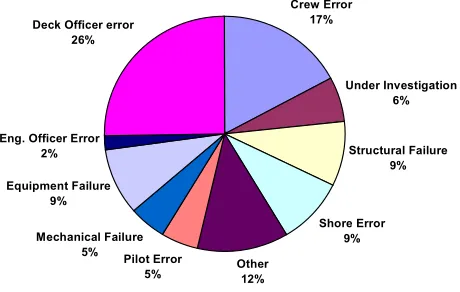
person error is identified as a continuing major problem. Crew error continues to cause 45% of all personal injury claims.
Figure 1 Principal Claim Cause – Frequency (Source UK P&I Club)
− The culture of safety
Culture norms have a significant impact on an organization’s ability to change. Many behavior patterns are held in common by most types of organizations and are deeply ingrained, e.g. do not ever disagree with the boss; do not give the boss any bad news; do not share information with co-workers. Some are almost instinctive and can act as real barriers to change in any organization, even in some shipping companies that have begun quality improvement efforts. (Cohen & Brand, 1993)
Crew Error 17%
Under Investigation 6%
Structural Failure 9%
Shore Error 9% Other
12% Mechanical Failure
5% Equipment Failure
9% Eng. Officer Error
2%
Deck Officer error 26%
In the past, the safety of shipping and other maritime activities have been treated by what is called the prescriptive approach, with mainly technical requirements that are easy to be applied and verified, whereby the authorities draw up rules and regulations and the users obey them without questioning. Safety at sea mainly depends on the design characteristics of the ship, operational aspects and competence of the crew, which should be integrated by safe management of the company covering all activities both on board and ashore.
IMO deals mainly with ship design and equipment, and only in recent years, recognizing the fundamental role played by the human element, did it start devoting more and more attention to the other aspects, which are also to be regarded as essential components of an indivisible system. The revised STCW Convention and the ISM Code are two main instruments recently developed by the IMO to tackle human element issues. Also the Formal Safety Assessment (FSA) could be another important tool for taking the human element fully into account in the IMO rule-making process. It is a rational and systematic approach for assessing the risks associated with shipping activities and for evaluating the cost and benefits of IMO’s options for reducing the risks.
Chapter Five
The successful systematic quality approaches applied in
marine safety management
As a matter of fact, quality is not a strange term in the marine safety management arena. Using quality the approach to improve safety standards has been introduced into the marine safety management by many organizations since quite a period of time ago. Also, the application was developed from using some general applied quality safety standards to setting up some particular marine sectors dedicated quality safety standards. The following is going to give a general review of the successful safety quality management systems or approaches widely used within the marine community.
ISO9002
The ISO 9002 Standard, used world-wide to certify quality systems, defines quality assurance. The citation ISO 9002 is now found in the company literature of a vast range of businesses and enterprises both within the marine industry as well as others.
It is a part of the International Standard for Quality: ISO 9000 series. Quality system registration demonstrates that the client can be confident that the registered company maintains a system that assures the best practices in quality, avoids errors and improves its performance.
It is the tried and tested quality standard used by many manufacturing and service industries worldwide. ISO 9002 needs to be interpreted from the ship operations viewpoint to make it “shipping friendly”.
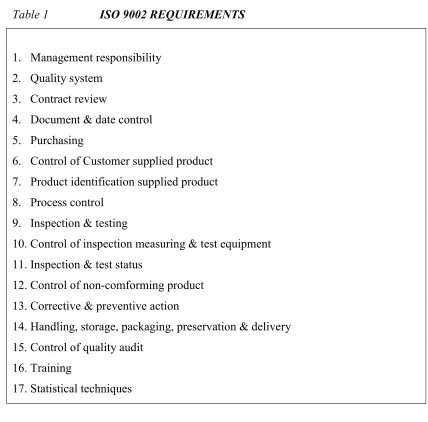
Table 1 ISO 9002 REQUIREMENTS
1. Management responsibility 2. Quality system
3. Contract review
4. Document & date control 5. Purchasing
6. Control of Customer supplied product 7. Product identification supplied product 8. Process control
9. Inspection & testing
10.Control of inspection measuring & test equipment 11.Inspection & test status
12.Control of non-comforming product 13.Corrective & preventive action
14.Handling, storage, packaging, preservation & delivery 15.Control of quality audit
16.Training
17.Statistical techniques
ISO 9002 focuses mainly on four points:
• Management commitment and responsibility
• Contract review
• Production process control
• Methods of inspection and prevention of quality deficiencies.
This standard applied in the maritime industry represents a guide to assist management and executives in introducing a quality and safety management system. It offers a way to define quality, safety and environmental protection objectives; and to focus and the direct the resulting system towards concrete goals.
SEP
Prior to the adoption of the ISM Code as a regulatory requirement several classification societies launched their own version of safety code covering virtually the same aspects of safety, pollution and environment. Most of them were not widely adopted and DNV’s SEP Rules are maybe the only rules that are still mentioned to any great extent.
SEP is blend of ISO 9002 and IMO Resolution A.647(17), prepared by Class. The continued use of SEP is most common and widely used by Scandinavian shipowners and shipmanagers. But it is likely that its use will diminish as operators choose to confine themselves to a safety management system based on the ISM.
ISM Code
In each of the major contributory accidents mentioned in the previous section, the software received the major part of the criticism in the various report findings. The ship/shore management interface was identified as a serious weakness and, consequently, the focus of the operation requiring the most attention.
The IMO responded to the safety management aspects of the inquiry by adopting a resolution (A741 (18)) to approve and recommend “IMO Guidelines for the Management of Safe Ship Operation and Pollution Prevention”. These guidelines have progressed from voluntary adoption to the International Safety Management Code, which became mandatory by the direct reference of SOLAS Chapter 9.
“The cornerstone of good safety management is commitment from the top”. In matters of safety and pollution prevention it is the commitment, competence and motivation of individuals at all levels that determines the results.
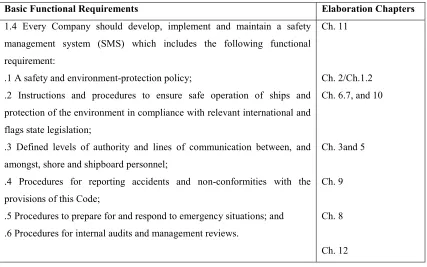
The code does not give any specific requirements about the structure of the SMS Manual, but expresseses in broad terms which can be used as general principles and objectives so that it can have a widespread application and different levels of knowledge and awareness of the items outlined. The core of the Code is the Chapter 1.4 “Six functional requirements” (see Table 2)
FSA
The term FSA originated about seven year ago, when the Marine Safety Agency took forward one of the principal conclusions of Lord Carver’s report on safety aspects of ship design and technology. This was that a more scientific approach to ship safety should be adopted, based on the assessment and control of risks, together with a move towards performance rather than prescriptive standards where possible. As what Secretary General of IMO, Mr. William O’Neil said, “the main response to the Exxon Valdez tanker disaster was to make double hulls mandatory for all oil tankers, even though the accident was the result of a navigational error and double hulls would probably not have prevented the oil escaping in any case.”
Table 2 SIX FUNCTIONAL REQUIREMENTS OF ISM CODE
Basic Functional Requirements Elaboration Chapters
1.4 Every Company should develop, implement and maintain a safety management system (SMS) which includes the following functional requirement:
.1 A safety and environment-protection policy;
.2 Instructions and procedures to ensure safe operation of ships and protection of the environment in compliance with relevant international and flags state legislation;
.3 Defined levels of authority and lines of communication between, and amongst, shore and shipboard personnel;
.4 Procedures for reporting accidents and non-conformities with the provisions of this Code;
.5 Procedures to prepare for and respond to emergency situations; and .6 Procedures for internal audits and management reviews.
Ch. 11
Ch. 2/Ch.1.2 Ch. 6.7, and 10
Ch. 3and 5
Ch. 9
Ch. 8
Ch. 12
The motivation of the approach proposed by the UK in response to the Carver report was to “improve” the formulation of prescriptive rules and regulations, and it was formally presented to IMO in May 1993. This approach, which was termed “Formal Safety Assessment” (FSA), has been accepted and endorsed by IMO. Thus, FSA is a tool which is intended to be used for assessing and managing risks in a cost effective way, not for individual ships, but for ships in general as part of the rule making process. The individual steps involved in this approach will now be given using the exact wordings adopted in the submission.
Step 1:Identification of Hazards
In this step, the hazards associated with a given type of ship, e.g., a tanker, will be identified using various techniques such as HAZOP.
Step 2:Assessment of the Risks Associated with These Hazards
Step 3:Ways of Managing the Identified Risks
It is unclear what is meant by the title of this step, because it was the “hazards” that were identified, see Step 1, while the “risk” (risk levels) were assessed, see Step 2. More recently, the wording has been altered to “ Suggest options for managing the identified risks”, but even this alteration does not clarify the usage of the terms “hazard” and “risk”. At the same time the proposers have no doubt in their minds that a number of methods should be used for dealing with the hazards identified and needing attention.
Step 4:Cost/Befit Assessment of Identified Options
It is implied in this step that a number of options will be produced as a result of Step 3, and these will be assessed using criteria associated with cost and benefit. The output will be a list of options and ratings.
Step 5:Final Selection of Option
This step will begin with a list of options and how they rate with respect to cost/benefit criteria. The prescribing authorities will then choose the option that best meets their requirements and use it to improve their relevant prescriptive rules and regulations.
The introduction of FSA into IMO shows its significance in terms of the formation of prescriptive safety rules and regulations of IMO that:
• The limitations of using prescriptive rules and regulations are highlighted;
• “Hazard Identification” and “Risk Assessment” were applied;
• The role of Human Factors in dealing with safety was addressed;
• Cost/Befit analysis as a basis for selecting a given option was used.
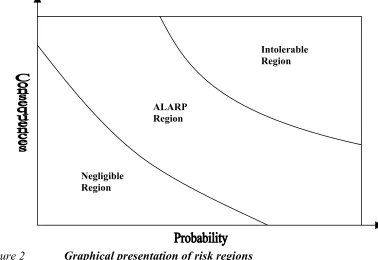
Conversely, there is a region of negligible risk in the lower left part of the matrix: spending time and money trying to reduce risks which are already negligible is wasteful. In the middle is what is called the ALARP region, (see Figure 2) where efforts should be made to reduce the risks to As Low As Reasonably Practical, bearing in mind the costs and difficulties involved in doing so.
Figure 2 Graphical presentation of risk regions
ISMA Code
The ISMA Code is a detailed and comprehensive quality code written specifically for ship management (and, latterly, crew management) companies including safety and environmental protection requirements. The ISMA Code incorporates the basic principles of ISO 9002 and IMO Resolution A.741(18).
The ISMA produced a code in 1992 designed to cover all the major aspects of ship management that could reasonably be required in order that a company could call itself a shipmanager. It also established a minimum level of the service required.
Intolerable Region
ALARP Region
The ISMA Code committee took as its starting point the ISO 9002 model for quality assurance and attempted to interpret the standard in a way that would be general for all ship managers, thus avoiding many of the traps found in the bare interpretation of ISO 9002. It also took into account other requirements such as the IMO guidelines, Resolution A741(18) that later became the ISM Code, the “oil major” requirements and the functions of insurance and accounting. In addition to the basic needs, the code also attempted to outline the minimum expectations that a client might have of a ship manager. These were outlined as the ethics expected of an ISMA member.
ISMA Code remains an excellent starting point for anybody contemplating quality assurance since it interprets the outline requirements of ISO 9002, ISM, oil company and charterers requirements in a consistent form so that achievement of the ISMA standards demonstrate quality to a known base line. The interpretation is in a language understood by the industry with respect to the level of quality expected.
The scope of the accreditation is defined in the code itself and does not require to be checked as for example the ISO 9002.
Table 3 A comparison of the various safety and quality codes
Procedure ISMA ISM ISO (IMO) 9002
Business ethics/policies ● ● ●
Organization ● ● ●
Personnel ● ● ●
Contingency planning ● ● ● Operational Capability ● ● ● Maintenance/Maintenance standard ● ● ● Corrective action ● ● ● Records ● ● ● Document control ● ● ● Internal quality audits ● ● ● Safety ● ●
Environmental protection ● ● Technical support ● ● Cert. And compliance rules/regs ● ● Cargo handling and cargo care ● ● Communication procedures ● ● Auditing body ● ●
Cost efficiency/purchasing/contracting ● ● Contract review ● ● Management review ● ● Quality system ● ● Drug and alcohol policy ●
Insurance ●
Accounting ●
24/24 17/24 14/24
QSCS
More than 100 governments have authorized classification societies, in view of their expertise and the world availability of a highly qualified surveying staff, to implement the statutory regulations of the conventions and related codes and resolutions, either wholly or in part, and to issue statutory certificates on their behalf. However, it is important to note that delegating administrations still retain their responsibilities and obligations under the conventions, that they have ratified.
Delegating Administrations must have some means of monitoring the organization, to which they have delegated, to ensure that the work is being adequately and satisfactorily performed. It therefore follows that each delegated organization should have a satisfactory quality system such that it may demonstrate, to all concerned, the quality of its services. In this respect, IACS has set up a QSCS implemented by the IACS Quality Secretary. The Quality Secretary is responsible to the IACS Council via the IACS Quality Committee. The quality system requirements of IACS have been based upon the applicable requirements of ISO 9001(1994) adopted and applied as stated in ISO 9004 and other applicable standards such as IMO Resolution A.739(18).
IACS’ QSCS is an arrangement of organizational structure, responsibilities and procedures to verify and certify the conformity of a classification society’s internal quality system to the requirements of IACS QSCS.
As implied by the definition, the main objectives of QSCS are to verify that
• A Society has developed its own internal quality system;
• The system of the Society is in conformity with the requirements laid down by IACS including the “Code of Ethics” and IACS procedural requirements;
Within the QSCS the following functions (services) are performed:
• Review and evaluation of the system documentation,
• Audit of system implementation,
• Certification,
• Maintenance of certification by annual and renewal audits,
• Maintenance of documented evidence, and
• Consideration of appeals.
Additionally however, in order to conform with efficient application of a Quality System in practice, the IACS QSCS incorporates a requirement for vertical audit. This is carried out on a sample basis in various areas of work selected by the IACS Quality Secretary, and goes beyond the ISO requirements. Each member Society has been audited by an IACS audit team led by the Quality Secretary, on the basis of which the IACS Quality system Certificate of Conformity has been issued.
PTP
From its beginning, the U.S. Coast Guard and industry have worked closely together to ensure that both the government and industry needs are met. A PTP Quality Action Team (QAT) was chartered by the Coast Guard in 1994 to "develop a long-term strategy to rebalance the safety equation by refocusing prevention efforts on casualties caused by human error." The PTPQAT was composed of representatives from the Office of Marine Safety, Security, and Environmental Protection (currently G-M), in partnership with personnel from the Office of Navigation, Safety and Waterways Services (currently G-O) and they completed a comprehensive Prevention Through People Study. The QAT found that about 80% of all accidents have their root cause in the human element.
major portion of these problems come from organizational errors and promotes a cultural change to develop a "do it right" mindset.
PTP was developed as a systematic risk based approach to safety management. This systematic approach looks at the entire picture, taking into account all information that is involved in the system. It ensures that all aspects of ship design, construction, management and operations are addressed, including the ship's operating environment.
The system components for PTP are: management, work environment, behavior of people and appropriate technology. These are all based on a solid foundation of rules, regulations and standards. This systematic approach requires a constant balance of the interaction among these four components. The foundation also includes non-governmental organizations, which play an important role in supporting the pillars. Examples include the direct contributions of class societies, standard bodies and port authorities, as well as indirect contributions from insurers. When those who make up the foundation act in concert, operators are provided with an even base upon which better operators can compete evenly. Marginal operators are forced either to improve or are driven out of business.
The organizational management pillar sets the stage for safe operations. It embodies the corporate culture that promotes safe and environmentally sound operations. A company's goals of no oil or chemical spills and injury-free operations, as well as its expectation of full compliance with all safety and environmental standards, demonstrate the corporate safety culture. Management's commitments to safety and ethics affect performance and influence the safety outcomes.
industry. Up to the end of 1998, they have signed partnership agreement with the following:
• American Waterways Operators (AWO), signed September 1995.
• Passenger Vessel Association (PVA), signed January 1996.
• American Petroleum Institute (API) & The Chamber of Shipping America, signed October 1996. (Chamber of Shipping America was formerly United States Chamber of Shipping.)
• International Council of Cruise Lines (ICCL), signed March 1997.
• International Association of Independent Tanker Owners (INTERTANKO), signed April 1998.
• Spill Control Association of America (SCAA) & Association of Petroleum Industry Cooperative Managers (APICOM), signed July 1998.
• Baltic International Maritime Council (BIMCO), signed September 1998. (Source: http://www.uscg.mil)
SAFETY CASE
In other industries, the risk based approach is typically applied by means of a so-called “safety case”. The safety case is a document which establishes, for a particular installation, that operations are acceptably safe. It does this by means of an objective and quantified assessment of risk and consideration of risk management options.
Question 1: What aspects of this System can go wrong?
This is an obvious first question because no system can be designed, built or operated exactly as intended, but by identifying what might go wrong we shall be able to give attention to that aspect in good time.
Question 2: What are the chances and effects of them going wrong?
Once an aspect that could go wrong is identified, it is important to establish the chances of this actually happening and how serious it would be. Clearly, if the consequences are very serious but the chances of occurrence are extremely low, it is a matter of limited concern. Likewise, if the chances of occurrence are very high but the consequences are trivial, it is also a matter of limited concern. However, if the chances of occurrences are high and the consequences are very serious, then the matter calls for attention.
Question 3: How could these chances and effects be reduced?
Once the importance of failure of a particular aspect is determined, attention should be given to reducing its effects, or the chance of its occurrence, or both.
Question 4: What should be done if an accident does occur?
No matter how well a system is designed, constructed or operated, it is always possible for something to go wrong, because it would be impossible to eliminate or cater for all eventualities. It is therefore essential to be prepared and to have contingency plans.
Question 5: How can the system be managed to ensure Safety?
Table 4 summarizes the five questions and the tasks that need to be done in order to answer them, together with the relevant scientific terminology.
Table 4 Task and Scientific Terms of Typical Safety Case
No. Question Task and Scientific Terms 1. What aspects can go wrong? Identify hazards systematically (Hazard Identification)
2. What are the chances and effects? Assess the risk levels of the hazards (Risk Assessment)
3. How can they be reduced? Reduce risk levels of selected hazards (Risk reduction)
4. What to do if an accident occurs? Be prepared to respond to emergencies (Emergency Preparedness)
5. How can safety be managed? Manage and control risk levels of hazards (safety Management System) ___________________________________________________________________
Safety
Management System
(source: Managing Ship Safety , p35)
MEASURE
REVIEW IMPLEMENT
POLICY ORGANIZE
HAZARD
IDENTIFICAITON
RISK
ASSESSMENT
RISK REDUCTION
EMERGENCY PREPAREDNESS
Figure 3 illustrates pictorially the relationship of the different elements of the safety case concept expressed in the scientific terminology.
It can be seen from Figure 3 that the central element is the Safety Management System, which has five components, as follows:
• Policy formation.
• Organize resources and the communication of information.
• Implement the agreed policies and actions.
• Measure that the required standards are being met.
• Review performance and make relevant refinements.
The other four elements of the concept are:
• Hazard identification: Identify the likely hazards of the system. For a ship, typical examples would include collision and fire.
• Risk Assessment: Evaluate the risk level of each hazard in order to determine whether it is in the intolerable, tolerable or negligible region.
• Risk Reduction: Reduce the hazards with an intolerable risk level and, if it can be done cost-effectively, lower also the hazards with a tolerable risk level.
• Emergency Preparedness: Prepare for emergencies that could occur in the event of a potential hazard becoming a reality, even when all precautions against it have been taken. (Kuo, 1998)
STCW Convention
This Convention, which was revised in 1995, reinforces the criteria for eligibility of seafarers, and requires proof of the effectiveness of measures introduced to satisfy the intentions of the Convention.
According to requirements of STCW95 Regulation I/8, each party should ensure that all training, assessment of competence, certification, endorsement and revalidation activities carried out by non-governmental agencies or entities under its authority are continuously monitored through a QSS to ensure achievement of defined objectives, including those concerning the qualifications and experience of instructors and assessors.
The criterion of the QSS further requires that:
• Within the QSS the education and training objectives and related standards of competence to be achieved are clearly defined and the levels of knowledge, understanding and skills appropriate to the examinations and assessments required under the Convention are identified.
• The field of application of the quality standards must cover the administration of the certification system, all training courses and programmes, examinations and assessments and the qualifications and experience required of instructors and assessors, having regard to the policies, systems, controls and internal quality assurance reviews established to ensure achievement of the defined objectives.
1. all internal management control and monitoring measures and follow-up actions comply with planned arrangements and documented procedures and are effective in ensuring achievement of the defined objectives;
2. the results of each independent evaluation are documented and brought to the attention of those responsible for the area evaluated; and
3. timely action is taken to correct deficiencies.
Apart from general provisions of QSS, the minimum compulsory standards for the qualification and certification of the skills of seafarers are covered, namely,
• Requirements for masters and seafarers
• Requirements for engine room crew
• Requirements for radio operators
• Specific requirements concerning certain types of ships
• Requirements concerning safety, emergencies, medical care and conditions of survival at sea
• Conditions for maintaining certification of seafarers during the transitional period provided for in the Convention
• Requirements to be respected for surveillance at sea in order to ensure the safety of those on board during a voyage.
Every company must be able to prove that the seafarers on board its ships possess the skills needed to perform the functions assigned to them. They also have to set up a training programme, to maintain and even develop such skills.
Some safety reporting systems
1. The Human Factors Group Marine Safety Reporting System (MSRS) – The MSRS was developed for the maritime industry based upon the ASRS and was initiated in the fall of 1995. The data entry form is simple to complete. Although there are no statutory protections or incentives for reporting, over 300 reports have been received to date. Limited reporting of the results has been accomplished.
2. The Nautical Institute International Marine Accident Reporting Scheme (MARS) –This scheme is also an anonymous reporting system but collects reports of accidents (http://www.nautinst.org/marineac.html ). The information on the accident and analyzed casual factors are carefully reported in highly readable accounts that are popular reading in journals and magazines.
3. Canadian Transportation Safety Board ( SECURITAS) –The SECURITAS system is run by the National Transportation Safety Board of Canada. The system focuses on collection unsafe procedures and practices from each of the different modes of transportation. Information leading to identifying the reporter’s identity is not released. Occurrence reports are developed and published based on the reported information and the use of other information to verify the incident/accident situation. Reports are made available on their Internet site(
http://bsttsb.gc.ca ).
4. The National/International Maritime Safety Incident Reporting System
(NMSIRS)
The system is currently in its formative stage and is being driven by an industry/labor-based working group under the society of Naval Architects and Marine Engineer’s organization umbrella. This initiative is jointly facilitated by the U.S. Maritime Administration and US Coast Guard. (BIMCO Bulletin 1998 November)
Chapter Six
Analysis of the current situation of CMSA
Chinese characteristics
As mentioned in Chapter 2, shipping is an industry of international nature. The functions and structure of maritime administrations in various countries do have something in common. They are following similar rules, therefore they can share some experiences gained in this field with each other, whether in a developed or a developing country. On the other hand, it should be born in mind that each Maritime Administration is situated in a specific country, i.e. while China is applying the experience of other maritime countries, her own history, customs and geographical features have to be taken into consideration.
− China is a developing country with a very big population
Recently, the population in China has reached 1.3 billion. About half of the Chinese mainland population live within the coastal area and they generate 53% of the gross national output, in so far as agriculture and industry are concerned.
− China has a vast area of land and sea area and superior natural condition for developing water transport
China’s mainland coastline extends to 18,000 km. It has a sea area of 3.38 mn km²
and covers 10 provinces, autonomous regions and municipalities. There are also some 6,500 islands with an additional coastline of 14,000 km. The majority of China’s coastline is ice free throughout most of the year.
Canal and other small rivers, there is a good inland waterway network. (SHEN, 1999).
Since 90 percents of import and export cargoes in China are carried by sea, the importance of optimizing shipping has been confirmed.
− China is a socialist country
After the founding of the new China, the government carried out a policy of centralization. Since 1979 a new general policy has been adopted; this is a policy of reform, open-door and invigorating the economy. Now, the structure of the government in China is still carrying out the process of reform in order to be in line with the general policy.
Transport and national economy
Experience shows that transport development is essential and instrumental to economic and social growth, especially in a developing country like China. Transport facilities form an integral part of a nation’s infrastructure and are basically indispensable and service- oriented. A sophisticated transportation system must push forward social and economic growth, otherwise it will only impede it, resulting in a waste of resources and a downgrading of economic benefits. With a comprehensive and well-developed transportation network, the country can accelerate the exchange of commodities, become port- oriented, be a part of the world economy and have ability to attain a stable economic growth for the nation.
Authoritative sources say that China’s water transportation used to be regarded as a bottleneck hindering the development of the national economy. Now the water transport market has gained rapid developments thanks to the effort in breaking down the barriers between trades , between departments or regions, and to encourage diversified economic sectors to jointly develop water transport services.
For these reasons, the Chinese State Council gives priority to state economic planning in such a way that transport must go ahead of the other industries and it can assume its responsibility of expediting, national economic development.
It is the MOC which is viewed as the Maritime Administration in China. and, its major functions and responsibilities include the following:
• To formulate development strategies, principles, policies and regulations of the country’s waterway transportation according to the demands of national economic and social developments and to supervise the enforcement thereof;
• To organize the drawing up of development planning for the national waterway transport and make the long- and medium-term and annual plans;
• To be responsible for the administration of the waterway transport industry and transport organizations;
• To regulate and control the transport of goods and materials which are important to the national economy and people’s livelihood or emergency use;
• With joint efforts of other departments concerned, to foster and regulate national transportation market and transport infrastructure construction market; to set up and gradually improve the information and service system; to guide the transport industry to develop in a coordinated way with rational structure.
are indicated. In another words, one part of MSA’s functions should be to guide the maritime industry to develop in a coordinated way with rational structure, to foster national maritime market and to promote the national economic and social development.
The safety production policy
The Central Committee of the Communist Party of China and the State Council have always attached great importance to safety in the production. The Chinese President, Jinag Zemin emphasized the importance of understanding the relations between the safety and production, safety and efficiency, and safety and development. The vice-premier of the Chinese State Council, Wu Bangguo, stressed that safety needs to be integrated with production and efficiency. It is of vital importance to balance safety with production, economic growth and people’s livelihood. It is also linked to the country's reform, development and stability and has a significant bearing on the sound performance of the national economy.
The safety policy made by the State Council includes, inter alia,
• Production safety should become top priority. The "safety first" principle should be underscored, while preventive measures should be enhanced, especially in enterprises which are undergoing organizational reform and restructuring;
• Leading officials at al levels should respect safety in production;
• A safety education in production should be launched in all departments and areas.
• A responsible system must be instituted in all production units and further implemented.
• Work safety weak points should be supervised and improved;
• The causes of accidents should be found and lessons drawn. Measures shall be taken to prevent possible hidden dangers causes of major accidents;