Improving consent form documentation
and introduction of procedure-speci
fi
c
labels in a district general hospital
Stefan Bajada, Samuel Dwamena, Zabihullah Abdul, Rhodri Williams, Owain Ennis
To cite:Bajada S,
Dwamena S, Abdul Z,et al.
Improving consent form documentation and introduction of procedure-specific labels in a district
general hospital.BMJ Quality
Improvement Reports
2017;6:u211571.w4730.
doi:10.1136/bmjquality. u211571.w4730
Received 22 March 2016 Revised 24 July 2016
Glangwili General Hospital, Hywel Dda University Health Board, Carmarthen, United Kingdom
Correspondence to Stefan Bajada
ABSTRACT
Informed consent is an important aspect in patient care. Failings in this area may result in patient dissatisfaction or litigation. The aim of this project was to assess our practice in consenting and institute changes to maintain best practice. A consecutive series of 140 patients undergoing elective and trauma procedures were randomly identified over a nine-month period. The consent forms were reviewed and the following information collected: patient/ consenter details, procedure, legibility, if copy was offered/ given to patient and adequacy of procedure-specific complications listed (scored 0-3). The issues identified included: 25% of consents were not fully legible particularly in the complications section. 62% were noted to have inadequate complications listed (score 0 [>5 risks missing]) when compared to an accepted standard. None of the consent form copies were offered or given to the patients. Focused teaching to juniors as well as procedure-specific complication stickers were implemented to improve the documentation of complications. Following several improvement cycles all consents (100%) were fully legible and had the adequate procedure-specific labels with all complications listed. There was an increase to 38% of consent forms offered to patients. We have asked surgeons in the department to comment on which consent method they prefer and all consenters felt that the procedure-specific labels where easier to read and understand. Departmental education as well as introduction of simple procedure-specific complication stickers has resulted in significant improvements in practice.
PROBLEM
The Oxford English Dictionary defines consent as ‘permission for something to happen or agreement to do something’.1 However, this does not entail understanding of the action agreed to. So in healthcare we use the term‘informed consent’which is the
‘permission granted in the knowledge of the possible consequences’.1 The General
Medical Council guidance on consent
“Consent: patients and doctors making deci-sions together”2 states that valid consent
revolves around a partnership between patient and doctor. This includes explaining the options to the patient, setting out the potential benefits, risks, burdens and side effects of each option, including the option to have no treatment. The guidelines advice that documentation should be recorded of the key elements of the discussion. In Wales, all NHS health boards use the “All Wales” consent form which have been issued by the Welsh Government to “help clinicians obtain properly informed consent from patients undergoing examination or treatment”.3 Nevertheless, these forms are generic docu-ments which leave blank spaces for pertinent information to be added by hand. Thus, time-constraints, legibility, and personal aptitude often limits the extent to which these forms are completed. Unfortunately, this puts hos-pital trusts and individual surgeons at risk of litigation following a poor documentation of consent.4Further, a study in the United States found that risks of procedure accounted for 70% of informed consents complaints, con-cluding that improved informed consent would decrease these complaints.5
The aim of this project was tofind out if we were completing our consent forms for ortho-paedic procedures completely and improve any shortcomings by at least 30% within a 9 month period using simple interventions. 30% is an arbitraryfigure which we felt would be achievable within this time frame.
This study was based in two district general hospitals covering trauma and orthopaedics in both an acute and elective setting, serving a population of 184,000. Collectively, there are 70 dedicated trauma and orthopaedic beds with 4000 procedures performed annu-ally, both acutely and as elective cases. The department comprises of 11 consultants, 10 middle grades, 11 senior house officers (SHOs) and 2 specialist nurses. Of these, 1 middle grade, 2 SHOs and 2 consultants make up the team conducting this study.
Protected by copyright.
on September 12, 2020 by guest.
BACKGROUND
Several publications have highlighted the problem of consent in orthopaedics. Ahmad et al6 have reported poor documentation of risks for distal radius fracturefi x-ation. Similarly, other publications showed inadequate consent in hip fracture surgery and elective total hip or knee surgery.7 8These studies hypothesized that utilizing pre-printed consent forms could improve outcomes. For purposes like these, the Orthoconsent website has been created. Designed by a group of orthopaedic surgeons and originally endorsed by the British Orthopaedic Association, this website contains procedure-specific information and consent forms to complement the consent process.4 9 The approach has been shown to improve patient understanding of risks and procedure involved. However, with the latter a generic hand written consent form still needs to be completed. Still, St John
et al.10 reported on an audit cycle utilizing electronically generated procedure specific consent forms in elective general surgery. This approach improved the quality and consistency of consent documentation.
BASELINE MEASUREMENT
A consecutive series of 40 patients undergoing elective and trauma procedures were randomly identified over a
three-month period. The “All Wales” consent forms (type 1; for people aged 16 years and over with mental capacity and people under 16 years of age who are Gillick competent) were reviewed and the following information collected: patient and consenter details, type of procedure, whether a copy of consent form was offered to the patient, adequacy of procedure-specific complications risks listed and legibility. The complica-tion risks listed were scored on a scale of 0-3 as follows: 3
– all risks mentioned, 2 – one risk missing, 1 - < four risks missing 0 - > five risks missing when compared to an accepted standard. This standard being the Orthoconsent website which lists specific complication risks for common orthopaedic procedures.4 8 In add-ition, documentation of whether consent forms were offered to the patients were evaluated (Figure 1).
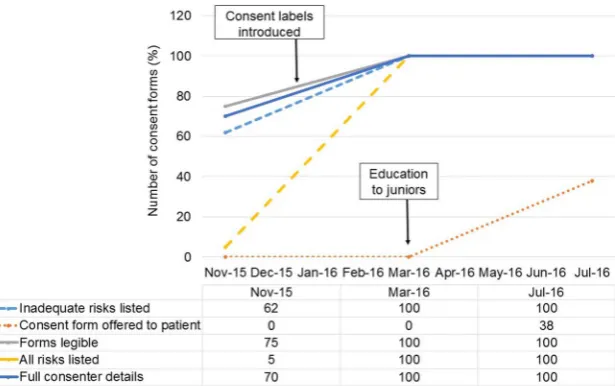
80% of patients were consented by senior house offi -cers, 15% by consultants and 5% by registrars. Adequate full patient identification was present in 95%. Adequate procedure and side was present in 100%. Full consenter details were present in 70%. 0% of consent copies were offered to the patients. 25% of consents were not fully legible particularly in the complications section. 62% were noted to have inadequate complications listed (score 0 [>5 risks missing]) when compared to the standard. A low score was also present when patients
Figure 1 “All Wales”consent form; adequacy and improvement of documentation was the aim of this study. Open Access
Protected by copyright.
on September 12, 2020 by guest.
were consented by consultant and registrar level. Only 5% had a score of 3 – that is all complications listed. The above data sets were measured throughout the project to evaluate whether our aim had been met.
DESIGN
When considering the underlying cause of this problem, it became clear that most of the consenting, particularly in trauma situations, were performed by senior house officers. Through informal discussions with the juniors, the overwhelming sentiment was a lack of knowledge and confidence regarding orthopaedic procedures. Thus, focused teaching to juniors including a regular rota to theatre sessions was introduced. A lack of adequacy, legibility and reproducibility of risk and com-plications documented was noted. The simplest approach identified was to utilize the current, generic consent forms and prepare procedure-specific stickers which fit the complications and risk section at an adequately readable font. This design was reviewed by the trust consent managerial lead and trust lawyers. It
was noted that in view of the Montgomery vs
Lanarkshire Health Board Supreme court judgment 11 which indicates that risk assessment should not only be generic but also reviewed for significance to the particu-lar patient, a further note was inserted in the sticker stating;“Please consider and add patient specific risks by hand". This was aimed at not only advising but also reminding the consenter of their legal obligation to pause and engage in the discussion with the patient. The procedure-specific stickers with the complications listed were then reviewed by the consultant body and adjusted accordingly. Teaching on their use and applica-tion was then given to the surgical team.
STRATEGY
The issues identified in the baseline measurement that we felt needed to be improved included: 1. consent forms not offered to the patients. 2. Consent forms were not fully legible, particularly in the complications section. 3. 62% were noted to have inadequate complica-tions listed (score 0 [>5 risks missing]) when compared to the standard. 4. full consenter details in 70%.
Plan, Do, Study, Act (PDSA) Cycle 1 (November 2015)
–thefirst aim was to divulge our results andfind ways to prepare printed consent stickers. These were pre-pared utilising patient detail label stickers and were dis-cussed between consultants in charge of audit, and during departmental meeting. Thefirst test was to assess its legibility, ability to put enough complications and ease of use. Following review by 6 consultants, whilst being satisfied with the ability to improve quality, it was felt that it should be reviewed by the Hospital Trust’s management and legal team. Legal advice regarding the use of the consent stickers by the Trust’s consent team and lawyers was obtained. These were then modified accordingly to add changes to allow for Montgomery
legal judgment on consent. These changes were then re-reviewed by the consultants and approved for use.
PDSA Cycle 2 (December 2015) –the aim was to trial the changes in a small number (10) of orthopaedic trauma patients to review for ease and adequate use by the surgical team. Similarly, we checked if patients can easily read the stickers. As predicted, patients were able to read adequately and these were easy to use.
PDSA Cycle 3 ( January 2016 – March 2016) – the introduction of consent stickers was trialed over a three month period in 50 patients. Adequate full patient iden-tification and procedure was present in 100%. Full con-senter details were present in 95%. All consents were fully legible and had the adequate procedure-specific label used. We have asked surgeons in the department to comment on which consent method they prefer and all consenters felt that the procedure-specific labels where easier to read and understand.
PDSA Cycle 4 (May 2016 - July 2016) - in the previous cycles it was noticed that none of the patient copies (English or Welsh versions) were offered to the patients. The aim of this cycle was therefore to improve the offering of the consent forms to patients. We discussed this concern with the junior surgeons and consenters, pro-vided encouragement and small group teaching aimed at improving this outcome. From our preceding PDSA cycles we have found open dialogue to be quite a successful method in our setting. Subsequently, we performed another study cycle where 50 consent forms were reviewed. There was an increase from 0% to 38% of consent forms offered to patients before and after intervention.
RESULTS
In the baseline measurement we found that consenter details was present in 70%, 25% of consents were not fully legible particularly in the complications section. 62% were noted to have inadequate complications listed (score 0 [>5 risks missing]) when compared to an accepted standard. Also, 0% of consents were offered to the patients. Following our interventions, all consenter details was present in 100%, all consent forms were fully legible and had the adequate procedure-specific label used. Thus, all consents had now achieved a score of 3 (all relevant com-plications and risks present). 38% of consents were now offered to patients (Figure 2). We have asked surgeons in the department to comment on which consent method they prefer and all consenters felt that the procedure-specific labels where easier to read and understand. Departmental education as well as introduction of simple procedure-specific complication stickers has resulted in significant improvements in practice and patient satisfac-tion. It was noted that there was improvement in the docu-mented benefits listed for the procedure.
LESSONS AND LIMITATIONS
We learnt a number of lessons from carrying out this project. Simple interventions by junior staff are
Protected by copyright.
on September 12, 2020 by guest.
achievable. When designing an intervention on consent, discussion with the trust managerial team on consent allows for improved design and implementation. The confidence that this has been vetted by the trust’s legal department allows for a better adoption rate by seniors and juniors alike. Ultimately, teaching and training in small groups can achieve change.
Nevertheless, there are limitations with this study. First, the duration of review (9 months) following imple-mentation of the interventions was short, meaning that we could not adequately assess for sustainability and con-tinual improvement in the long term. Also, our results might be secondary to chance due to sampling bias. This is particularly so since the patients were sampled randomly rather then the whole population being studied over an extended period to time. In addition, this has be trialled on trauma patients which represent a mixed cohort of patients of different ages, diagnosis and pathologies. Still, structures have been introduced for more data to be collected regularly over 2 years to maintain quality improvement, and feedback question-naires will be given to the team to assess any barriers to sustainability. Another limitation to the study is the potential for observer bias. The individuals collecting the data were from the orthopaedic team thus the risk of leniency in data collection could exist to allow for a
more favourable outcome for the department.
Nonetheless, this was mitigated by using a standardised proforma for collecting the data which is clear and limits individual interpretation, and will be further mitigated in the future by using a data collector from outside the department. Finally, although the advent of electronic health records and digital consent forms may limit the transferability of the procedure-specific labels to certain trusts in the UK, for places like Wales where currently the consent forms require handwritten input, these labels can be adapted and utilised in other surgical and medical teams offering procedures to patients.
CONCLUSION
Informed consent is an important aspect in patient care. Failings in this area may result in patient dissatisfaction or litigation. The aim of this project was to assess our practice in consenting and institute changes to maintain best practice. The most important findings of the first cycle was that consent forms were not fully legible par-ticularly in the complications section. Lack of legibility was previously noted in
consent forms in several specialties. In this study, we also noted that our consent forms had inadequate com-plications listed when compared to an accepted stand-ard. As previously reported and as found in our study, some of the important complications like infection and bleeding are usually listed.6 7 However, with the increas-ing complexity of orthopaedic surgery, a more proced-ure specific approach including its particular complications should be applied. Similarly, in view of the Montgomery judgment11 a novel approach which is more patient centred should be implemented. As an intervention, we focused on teaching to juniors as well as procedure-specific complication stickers to improve the documentation of complications. We found this very effective and on re-audit we report that all consents were fully legible and had the adequate procedure-specific label used. We have asked doctors in the department to comment on which consent method they prefer. All con-senters felt that the procedure-specific labels where easier to read, use and understand. In the long term, we fell that this simple approach will improve communica-tion between consenters and patients. Ultimately, in improving the informed consent process, we expect increased patient satisfaction and reduction of com-plaints and risk of litigation 5. Moreover, the use of procedure-specific stickers is simple and easily generaliz-able to other surgical and medical departments that use consent forms requiring handwritten input. In view of its ease and satisfaction of use, this implementation should be sustainable in the long term.
Figure 2 Run-through chart showing improvement of baseline parameters over time.
Open Access
Protected by copyright.
on September 12, 2020 by guest.
AcknowledgementsMadeline Peters - Trust lead on consent
Declaration of interests None declared
Ethical approval This study has been reviewed and approved by the hospital audit unit and did not require formal ethical approval.
Open Access This is an open-access article distributed under the terms of the Creative Commons Attribution Non-commercial License, which permits use, distribution, and reproduction in any medium, provided the original work is properly cited, the use is non commercial and is otherwise in compliance with the license. See:
• http://creativecommons.org/licenses/by-nc/2.0/
• http://creativecommons.org/licenses/by-nc/2.0/legalcode
REFERENCES
1. Oxford English Dictionary. (2016) Consent. Available at: http://www. oxforddictionaries.com/definition/english/consent. Viewed on: 18 April 2016.
2. General Medical Council. (2008) Consent: patients and doctors making decisions together. Available at http://www.gmc-uk.org/ guidance/ethical_guidance/consent_guidance_contents.asp. Viewed on 18 April 2016.
3. Welsh Assembly Government. (2015). Patient Consent. Available at: http://www.wales.nhs.uk/sites3/page.cfm?orgid=465&pid=11930. Viewed on 17 September 2016.
4. Atrey A, Leslie I, Carvell J, Gupte C, Shepperd JA, Powell J, Gibb PA; British Orthopaedic Association. Standardised consent forms on the website of the British Orthopaedic Association.J Bone Joint Surg Br. 2008 Apr;90:422–3.
5. Pasner KL, Severson J, Domino KB. The role of informed consent in patient complaints: Reducing hidden health systems costs and improving patient engagement through shared decision making.Journal of Healthcare Risk Management. 2015
Sep;35:38–45.
6. Ahmad R, Shobaki S, Etezadi V, Raju S, Case R. Adequacy of consent in patients with distal radius fractures.Int Orthop. 2009 Oct;33:1311–3.
7. Rahman L, Clamp J, Hutchinson J. Is consent for hip fracture surgery for older people adequate? The case for pre-printed consent forms.J Med Ethics. 2011 Mar;37:187–9.
8. Beresford-Cleary NJ, Halliday J, Breusch SJ, Biant LC. Consent process for elective total hip and knee arthroplasty.J Orthop Surg (Hong Kong). 2011 Dec;19:274–8.
9. Atrey A, Gibb PA, Leslie I, Shepperd J, Carvell J, Gupte C. Orthoconsent.com. Available at: http://www.orthoconsent.com/body2. asp. Viewed on 19th September 2016.
10. St John ER, Scott AJ, Irvine TE, Pakzad F, Leff DR, Layer GT. Completion of hand-written surgical consent forms is frequently suboptimal and could be improved by using electronically generated, procedure-specific forms.Surgeon. 2016 Jan 11. pii: S1479-666X (15)00119-5.
11. Montgomery (Appellant) v Lanarkshire Health Board (Respondent) (Scotland) [2015] UKSC 11.
Protected by copyright.
on September 12, 2020 by guest.