Http://www.ijetmr.com©International Journal of Engineering Technologies and Management Research [13-26] IJETMR
AN OVERVIEW OF THE CONCEPT OF LEAN CONSTRUCTION AND
THE BARRIERS IN ITS IMPLEMENTATION
Radhika R*1, S.Sukumar2 *1
P.G Student of Civil Engineering Department, Nehru Institute of Technology, Coimbatore, India
2
Assistant Professor, Civil Engineering Department, Nehru Institute of Technology, Coimbatore, India
DOI: 10.5281/zenodo.478010
Abstract:
Many project management approaches have emerged to improve performance in the construction industry. Lean construction is one of the ways to design systems to minimize wastage of materials, time and effort in order to generate maximum possible amount of value. Lean Six Sigma is the combination of two well-known techniques Lean and Six sigma which focuses on quality improvement, reduction in variation and waste elimination. The purpose of this paper is to make an overview of the lean concept and also to include the barriers in implementing this approach. A detailed review of the literature has been done with the view of collecting relevant data necessary for the paper. A questionnaire survey has been conducted to find the barriers affecting its implementation. It was found that six main barriers are there in implementing the concept of Lean construction. These data were subjected to statistical analysis and necessary preventive measures are recommended for mitigating those barriers that were identified. By the implementation of Lean, it is found that, there is a significant reduction in waste, cost and time.
Keywords:
Lean Construction; Key Concepts of Lean Construction; Barriers in Implementing Lean Construction.
Cite This Article: Radhika R, and S.Sukumar, “AN OVERVIEW OF THE CONCEPT OF
LEAN CONSTRUCTION AND THE BARRIERS IN ITS IMPLEMENTATION” International
Journal of Engineering Technologies and Management Research, Vol. 4, No. 3(2017), 13-26. DOI: https://doi.org/10.29121/ijetmr.v4.i3.2017.78.
INTRODUCTION 1.
Http://www.ijetmr.com©International Journal of Engineering Technologies and Management Research [13-26] There are many construction companies that are trying to enhance the performance by reducing all kind of problems in construction. These problems are the reason behind the project delays and time and cost overruns.
The scope of this paper is to review the concept of lean construction, its benefits and the barriers arised in its implementation. Data collection should be carried out from 30 construction companies by direct observations, interviews, email questionnaire and through telephone. Based on the gathered data, analysis was conducted to identify the factors affecting the industry. After the identification of factors, there is a need to find the root causes of these factors or problems. By identifying the root causes and its extent, we can recommend the best measures to control these problems.
2. LEAN CONSTRUCTION
Lean Construction is an effective technique which aims at eliminating the wastes in construction. The goal of Lean construction is to achieve customer satisfaction by using less of everything ,ie; materials, money and resources. This construction method is most suitable for complex and speed projects. It develops team work and also assigns the matching labor to the right work. In this concept, variation is under control by the practice of;
Following a set of objectives
Aiming at maximizing the extent of performance
Concurrent designing of process
Implementing production control throughout the entire life of project.
It is a new form of the application of management concept into construction. These projects are easier to manage safe, quick completion, reduced cost and also of appreciable quality (Gregory Howel,1999).
3. KEY CONCEPTS OF LEAN CONSTRUCTION
The key concept of lean construction is to enable the flow of steps by eliminating the non-value added activities which are time, resource or space consuming. It focuses on process improvement through the reduction of duration for each activity. The concept of Lean Construction provides the base for the foundation of project management.
The principles of Lean construction consists of seven keys that are specific value, Identify and map the value stream, flows, pull, perfection, Transparency, process variability. Lean thinking can be redefined in the following three ways: They are unique custom product, Deliver instantly, Nothing in stores.( Harris and McCaffer,1997). The key concepts of Lean construction must be introduced during the starting stage of construction.
4. BARRIERS TO LEAN IMPLEMENTATION: A REVIEW
Http://www.ijetmr.com©International Journal of Engineering Technologies and Management Research [13-26] subject or chosen field of study. It documents the contents with respect to the subject or topic that we are writing about.
According to Gaoshang(2014), lean practices and associated barriers in implementing lean factors in China construction industry were identified. The factors identified in this paper include lack of long term philosophy, absence of lean culture, use of multi-layer subcontracting, people and partner issues, and also issues related to managerial and organizational, lack of support, culture and philosophy, Government and procurement. Forbes et al(2002), in his paper explains that the main obstacle to implementation of lean
is that the construction firms do not focus on productivity and quality.
Alinaite(2009) highlighted barriers as technical aspects. According to him, the barriers can be divided into two groups; viz barriers those influence the worker productivity and those barriers which are easier to overcome.
Olatunji(2008), classified the barriers of implementing lean into seven groups which are skills and knowledge related, management related, Government related, Attitude related, resource related and logistics related.
Abdulla et al and Mossman (2009), suggests that lack of top management commitment was one of the main barriers in Lean construction implementation. He also added that, lack of communication among the labors and top management may also cause barriers in Lean Construction adoption.
In Howell’s (1999) opinion, human attitude slows down the execution of Lean construction in the industry, lack of discussions and meetings also leads to the decrease in Lean construction adoption.
Olatunji(2008),describes the barriers on the basis of financial aspects. Poor management of time, Lack of incentives, low wages etc are some of the examples of the barriers in Lean Construction implementation.
Figure 1: Different aspects of Lean barriers
Barriers Skill and Knowledge
Management
Educational
Government
Technical aspects Attitude
Resource Logistics
related Financial
Http://www.ijetmr.com©International Journal of Engineering Technologies and Management Research [13-26]
5. METHODOLOGY
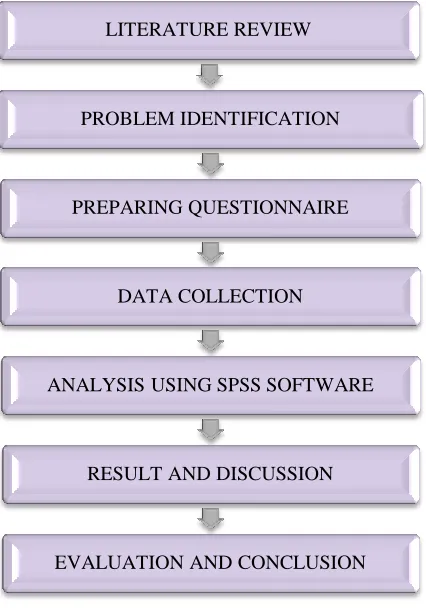
In this paper, a list of barriers as explained above and a questionnaire has been prepared. The data were gathered through questionnaire survey from 30 construction companies. The questionnaire survey was conducted on the basis of 4-point Likert scale, scaling from Strongly agree (1) to Strongly disagree (4). The results obtained from the data are evaluated in order to identify the 6 critical factors in implementing lean in construction industry. The data were analyzed using SPSS Software and ranked on the basis of their Relative Important Index. From the analysis, the cause and effects of these barriers are obtained. A cause and effect diagram must be generated representing the cause and effect of factors affecting the implementation of Lean construction. By using proper remedial measures, the identified problems can be mitigated. The adopted actions will be implemented in the current and future works in order to overcome the barriers in Lean Construction Implementation. The following flow chart represents the Methodology of this paper that is explained above.
Figure 2: Methodology
6. BARRIERS IN LEAN IMPLEMENTATION
Based on the relative important Index method analysis, the ranking is provided according to the data. From this analysis, the six most critical factors are identified and are given in the following table. These barriers have been chosen on the basis of their Relative Important index, where the Relative Important Index are calculated using the formula:
LITERATURE REVIEW
PROBLEM IDENTIFICATION
PREPARING QUESTIONNAIRE
DATA COLLECTION
ANALYSIS USING SPSS SOFTWARE
RESULT AND DISCUSSION
Http://www.ijetmr.com©International Journal of Engineering Technologies and Management Research [13-26] RII(%) = Σa*(n/N)*(100/5)
Where,
RII = Relative Important Index
a= constant expression weight
n = frequency of response
N = total number of response
Table 1: The Six Topmost Barriers in Lean Implementation
Barriers Rank
Equipment breakdown 1
Work structuring 2
Lack of skilled labours 3
Works defects 4
Poor material management
5
External delay 6
7. CAUSES OF BARRIERS FOR LEAN IMPLEMENTATION
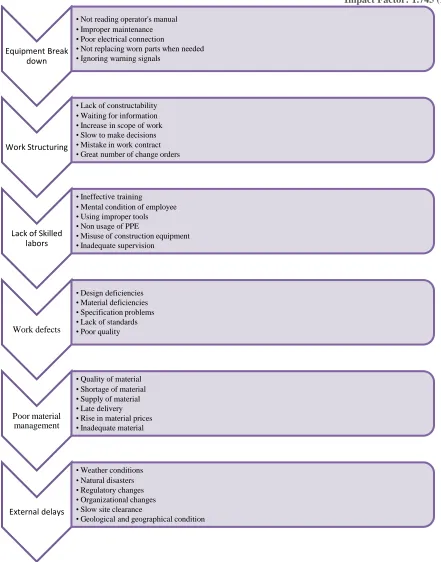
This section is designed to assess the barriers for lean implementation from the literature review and also from the questionnaire survey. There are in total of about six critical factors that acts as barriers. They are equipment break down, Work structuring, Lack of skilled labors, Work defects, Poor material management and external delays. These barriers and their causes are given in the figure 3.
Http://www.ijetmr.com©International Journal of Engineering Technologies and Management Research [13-26] Figure 3: Causes of Barriers in Construction Industry
Equipment Break down
• Not reading operator's manual • Improper maintenance • Poor electrical connection
• Not replacing worn parts when needed • Ignoring warning signals
Work Structuring
• Lack of constructability • Waiting for information • Increase in scope of work • Slow to make decisions • Mistake in work contract • Great number of change orders
Lack of Skilled labors
• Ineffective training
• Mental condition of employee • Using improper tools • Non usage of PPE
• Misuse of construction equipment • Inadequate supervision
Work defects
• Design deficiencies • Material deficiencies • Specification problems • Lack of standards • Poor quality
Poor material management
• Quality of material • Shortage of material • Supply of material • Late delivery • Rise in material prices • Inadequate material
External delays
• Weather conditions • Natural disasters • Regulatory changes • Organizational changes • Slow site clearance
Http://www.ijetmr.com©International Journal of Engineering Technologies and Management Research [13-26]
8. EQUIPMENT BREAK DOWN
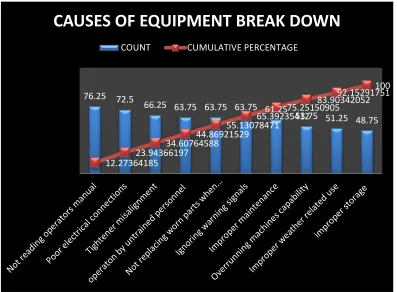
Break down of equipment can be defined as its failure to function. It has the following effects on construction industry; Time Overrun, Additional Labour Cost, Extra Demand Of Equipment, Lack Of Continuity, Need Of Rental Equipment, Waste Of Equipment Usage. The extent of each causes in construction industry and also the preventive measures are given below.
Figure 3: Pareto chart for Equipment breakdown
8.1.CONTROL MEASURES FOR EQUIPMENT BREAK DOWN
Taking steps to reduce the equipment break down can seem overwhelming, but the money saved, and additional profits earned from making adjustments to reduce downtime are worthwhile. To eliminate equipment break down, the following measures can be adopted.
1) Implement an automatic tracker that will detect downtime immediately and be able to alert you in real time to problems that have occurred. Then, find out why each instance occurred.
2) User errors can be controlled properly by training their employees to know how to use tools effectively.
3) Involving your staff members in the decision process helps them feel more invested in your works and gives them an incentive to work toward achieving the profits.
4) To prevent the problem of maintenance, practicing regular, ongoing preventative
maintenance strategies, is important for keeping machines from breaking down.
5) Set specific company goals for reducing errors and improving productivity. Then, offer bonus amount to employees who reach those goals.
76.25 72.5
66.25 63.75 63.75 63.75 61.25
53.75 51.25 48.75
12.27364185 23.94366197
34.60764588 44.86921529
55.13078471 65.39235412
75.25150905 83.90342052 92.15291751 100
CAUSES OF EQUIPMENT BREAK DOWN
Http://www.ijetmr.com©International Journal of Engineering Technologies and Management Research [13-26] 6) Effective lubrication is extremely critical to all equipments and will help prevent gear and
bearing failures.
7) A higher grade belt like EPDM belt, which can resist higher temperature and longer life,
can be used for the purpose of belt deterioration and improper alignment.
9. LACK OF SKILLED LABORS
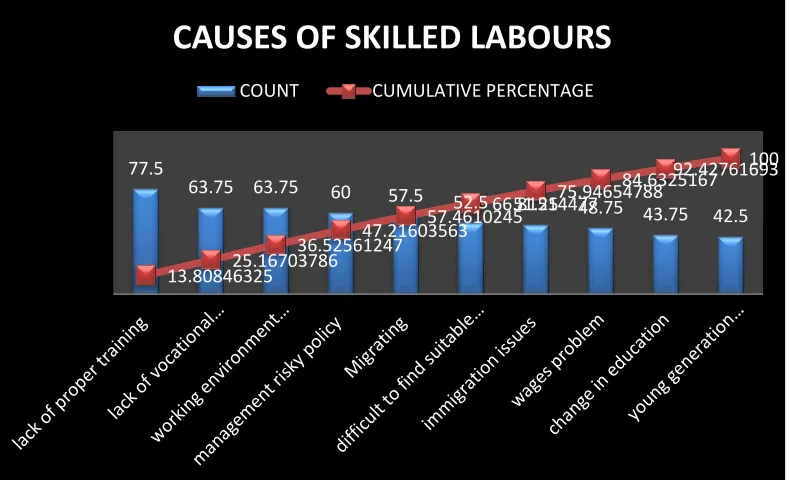
Unskilled labor is a segment of the workforce associated with a limited skill set or minimal economic value for the work performed. Skill shortages can have many causes such as general under-investment in skills development; rapid structural change combined with low levels of overall unemployment; and particular spots of weakness in the training system. The extent of each causes and the control measures are as below.
Figure 4: Paretochart for Skilled Labors
9.1.CONTROL MEASURES FOR LABOR PROBLEMS
The Shortage and lack of experience of skilled worker may result in lack of trade’s skills which lead to waste. lack of experience of skilled labor was the main cause of building waste on sites.
1) Conduct awareness about accident prevention programmes and the loss that occurs due to
accidents.
2) Share jobs between employees by replacing full time employees with part time workers.
3) Providing cross training to employees enable us to make changes including layoff and also helps to perform a variety of operations.
4) The problem due to technology change can be reduced by improved worker education and training.
5) Increase the level of compensation
77.5
63.75 63.75 60 57.5
52.5 51.25 48.75 43.75 42.5
13.80846325 25.16703786
36.52561247 47.21603563
57.4610245 66.81514477
75.94654788 84.6325167 92.42761693 100
CAUSES OF SKILLED LABOURS
Http://www.ijetmr.com©International Journal of Engineering Technologies and Management Research [13-26] 6) Provide PPE and force them to use protective equipment’s and also make them aware
about the necessity of those equipment’s.
10.WORK STRUCTURING
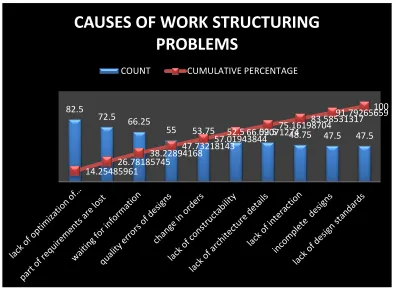
Work structuring determines how the work of a system is structured in terms of how resources are organized down to the design of operations. If the work structuring is not properly managed during construction it leads to poor quality, rework and large variations in work flow. The effects of work structuring in construction are Arbitration, Work Postponement, Variation In Scheduled Work, Extension Of Time, Slow Down Of Work, Litigation
Figure 5: Paretochart for Work Structuring Problems
10.1. CONTROL MEASURES FOR PROBLEMS IN WORK STRUCTURING
The work structuring is complete when the activities described on it are detailed enough to let you schedule, budget and delegate the work. In order to control the problems in work structuring, following points can be considered:
1) Schedule the daily task for the next week. 2) Order material deliveries and line up labours 3) Limit socializing and schedule daily breaks
4) Monitor the weather and document
5) Update the critical path
6) Develop Responsibility Assignment Matrix
7) Assign the schedule for Rework, retesting and refurbishing
82.5
72.5 66.25
55 53.75 52.5 52.5 48.75 47.5 47.5
14.25485961 26.78185745
38.22894168 47.73218143
57.01943844 66.09071274
75.16198704 83.58531317 91.79265659 100
CAUSES OF WORK STRUCTURING
PROBLEMS
Http://www.ijetmr.com©International Journal of Engineering Technologies and Management Research [13-26]
11. WORK DEFECTS
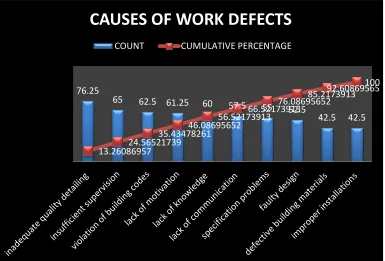
Defects are caused by incorrect method due to non-standard operations, differences in the way that processes are undertaken by different operators. They fail to maintain equipment, machines and fixtures and these may allow defects to occur. Lack of motivation, Lack of knowledge, Lack of communication, Defective building materials, Insufficient supervision, Faulty design are the effects of work defects in the industry.
Figure 6: Paretochart for Work Defects
11.1. CONTROL MEASURES FOR WORK DEFECTS
Defects are caused by incorrect method due to the failure in standard operations, differences in the way that processes are being undertaken before. They fail to maintain equipment, machines and fixtures and these may allow defects to occur. In order to control work defects, following measures can be adopted:
1) Implement a comprehensive quality control program to avoid construction defect claims,
improvement in safety, and limit costs with delayed delivery dates and rework.
2) Conduct pre-construction meetings to review plans and specifications and discuss potential issues.
3) Maintain project-related records, such as inspections, materials, schedules.
4) Ensure Proper Production Management during the Design phase: During design phase, architect should implement procedures that will subject the design to extensive review and analysis before it is released to construction.
5) Maintain open communication between Designer, architect and contractor throughout the
project.
76.25
65 62.5 61.25 60
57.5 55 52.5
42.5 42.5
13.26086957 24.56521739
35.43478261 46.08695652
56.52173913 66.52173913
76.08695652 85.2173913 92.60869565 100
CAUSES OF WORK DEFECTS
Http://www.ijetmr.com©International Journal of Engineering Technologies and Management Research [13-26]
6) Limit overtime and shift work where possible
12. POOR MATERIAL MANAGEMENT
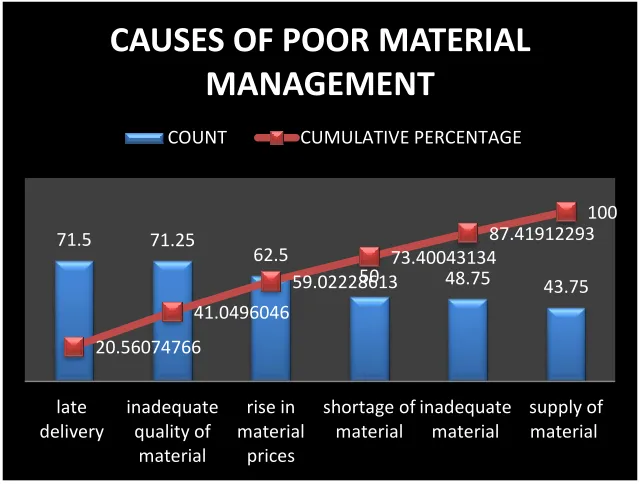
Material management is the process which ensures that the right materials are available at the right place at the right time in the right quantity and quality and at the right cost. Procurement, Stocking of materials, Availability of spares etc belongs to material management. Poor material management produces construction wastes and cost overrun. The effects of poor material management are Poor Quality Of Work, Wastage Of Materials, Loss Of Wealth, Raise The Risk Of Damage, Loss Of Time, Loss Of Capacity.
Figure 7: Paretochart for Poor Material Management
12.1. CONTROL MEASURES FOR POOR MATERIAL MANAGEMENT
Improved material management saves time, manages inventory, generates invoices, and improves cash flow. Following are the points which help to control Poor Material management:
1) Proper Planning and Scheduling
2) Monitoring and Controlling of all construction activities in material management are conducted to ensure the right source of materials with quality are available at the right time and for minimum cost construction process
3) In order to use the resources in an optimal way and to minimize costs,The organization must be structured to provide for the timely performance of the work.
4) Enough provision should be provided for Material storage, protection and control of building materials and components on site during the construction process
5) Better planning of raw materials on site can help to eliminate project delays and reduces activity times, resulting in better service.
71.5 71.25
62.5
50 48.75 43.75
20.56074766
41.0496046
59.02228613
73.40043134
87.41912293 100
late delivery
inadequate quality of
material
rise in material
prices
shortage of material
inadequate material
supply of material
CAUSES OF POOR MATERIAL
MANAGEMENT
Http://www.ijetmr.com©International Journal of Engineering Technologies and Management Research [13-26]
13.EXTERNAL DELAYS
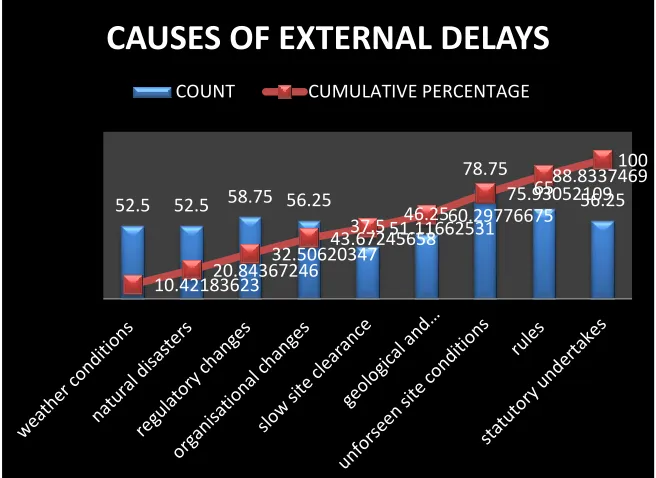
Construction delays can be considered as time lag in completion of activities from a fixed time as per contract. When project delay occurs it means project cannot be completed within stated time. The effects are poor quality of work, wastage of materials, loss of wealth, raise the risk of damage, loss of time, loss of capacity.
Figure 8: Paretochart for External Delays
13.1. CONTROL MEASURES FOR EXTERNAL DELAYS
Construction delays can be considered as time lag in completion of activities from a fixed time as per contract.These delays can be controlled by;
1) Thorough and accurate planning.
2) Using a knowledgeable designer can help mitigate communication problems.
3) Using materials and a system that can resist moisture and stain can prevent triggering the mechanism
4) Inspections have to be timed correctly to keep a project flowing smoothly,
5) Each party should know what is going on with each phase To prevent frequent changes of
design and construction.
6) Documentation of details containing plans, changes, inspections, orders and progress is key to avoiding delays.
14. CONCLUSION
Lean is a best and effective concept which is about designing and operating the right process at the right time. The basic idea of lean six sigma is that if performance is improved, there will be an increase in the quality, energy sources and environment and reduction in waste. The main
52.5 52.5 58.75 56.25
37.5 46.25 78.75
65
56.25
10.42183623 20.84367246
32.50620347 43.67245658
51.11662531 60.29776675
75.93052109 88.8337469 100
CAUSES OF EXTERNAL DELAYS
Http://www.ijetmr.com©International Journal of Engineering Technologies and Management Research [13-26] objective of this paper was to find the major barriers in lean implementation such as equipment break down, work structuring, external delays, poor material management, This paper presents an exploratory study on the results of questionnaire survey among construction participants to explore the factors. The most affected factors are identified by ranking using Statistical Package for Social Sciences analysis.
In this paper, the barriers in implementing lean, the causes and their extent on construction are explained. Also includes the control measures for each barriers that can be recommended for the future use. By adopting these measures, the benefits like Reduced overhead cost, Elimination of hazard, Increased profitability, Reduced variability, Reduced lead time, Better quality of materials, Reduced rework, Improved work efficiencies, Minimize the chances of future delay, Elimination unnecessary cost can be achieved.
15. ACKNOWLEDGEMENT
On the very beginning of this paper, I would like to prolong my sincere & heartfelt responsibility towards all the personalities who have helped me in the completion of this undertaking, Without their active guidance, help, cooperation & encouragement, I would not have completed this paper.
16.REFERENCES
[1] Ahmed Mousa., Lean, six sigma and lean six sigma Overview, International Journal of Scientific & Engineering Research, Volume 4, (Issue 5), May.2013, pp. 1137-1153 [2] S. Sriram., Implementation of Six Sigma Concepts in Construction Project for Ensuring
Quality Improvements, International Journal of Innovative Research in Science, Engineering and Technology, Volume. 5. (Issue 4), 2016, pp. 4913-4921.
[3] S M Abdul Mannan Hussain1 , Barriers To Implement Lean Principles In The Indian Construction Industry, International Journal Of Innovative Research In Advanced Engineering (IJIRAE) ISSN: 2349-2763 , Issue 01, Volume 3 (January 2016).
[4] Mohd Arif Marhani , Aini Jaapara, Nor Azmi Ahmad Baria, Mardhiah Zawawib. Sustainability through Lean Construction Approach: A literature review Procedia – Social and Behavioral Sciences 101(2013),90-99.
[5] Abdelhamid, T.S. (2003). Six-Sigma in Lean Construction Systems Opportunities and Challenges. Retrieved 26 August 2012 from http://www.leanconstruction.dk
[6] Abdullah, S., Abdul Razak, A., Abu Bakar, A. H. & Mohammad, I. S. (2009). Towards Producing Best Practice in the Malaysian Construction Industry: The Barriers in Implementing the Lean Construction Approach. Retrieved 26 August 2011 from http://eprints.usm.my
[7] Alinaitwe, H.M. (2009). Prioritising Lean Construction Barriers in Uganda's Construction Industry. Journal of Construction in Developing Countries, 15-30.
[8] Howell, G.A. (1999). What is Lean Construction?. Proceeding Seventh Annual Conference Of International Group Of Lean Construction, IGLC-7, University Of California, Berkeley, CA, USA.
Http://www.ijetmr.com©International Journal of Engineering Technologies and Management Research [13-26]
[10] Koskela, L. (1992) Application of the new production philosophy to construction. Tech. Report No. 72. CIFE, Stanford University, CA.