SYNTHESIS OF 2,3-DIPHENYL QUINOXALINE USING
BIOCOMPATIBLE DEEP EUTECTIC SOLVENT.
Santosh Bansilal Katariya*
Department of Chemistry, SIES College, Sion, Mumbai 400 022, India.
Article Received on 11/05/2016 Article Revised on 31/05/2016 Article Accepted on 21/06/2016
ABSTRACT
An efficient protocol for the synthesis of 2, 3-diphenyl quinoxaline in
deep eutectic solvents under solvent-free conditions is reported here.
Quinoxaline derivatives are well known in the pharmaceutical industry
for their broad-spectrum of biological activities. The reaction is
remarkably facile because of the air and water stability of the catalyst,
and needs no special precautions. The reaction was completed within 25 minutes with
excellent yield. The product formed was sufficiently pure, and can be easily recovered. The
use of deep eutectic solvent choline chloride/urea in solid phase offered several significant
advantages such as low cost, greater selectivity and easy isolation of products.
KEYWORDS: Green chemistry, deep eutectic solvent (DES), Ultrasonic irradiation.
1. INTRODUCTION
Quinoxaline derivatives are an important class of nitrogen containing benzo heterocyclic
compounds containing a ring complex made up of a benzene ring and a pyrazine ring.[1]
Quinoxalines derivatives are important biological agents and therefore a significant
development of research has been directed towards the synthesis of this class of
compounds.[2] In particular, they are used as antibacterial,[3] anti-tumor,[4] antiviral,[5]
anti-inflammatory,[6] antifungal,[7] anti-tubercular,[8] antimalarial,[9] antileishanial,[10] and
anticonvulsant.[11] They are also used in the agricultural field as insecticides fungicides and
herbicides, pesticides as well as their application in dyes, chemical controllable switches,
efficient electroluminescent materials and organic semiconductors.[12-14]
World Journal of Pharmaceutical and Life Sciences
WJPLS
www.wjpls.org
SJIF Impact Factor: 3.347*Corresponding Author
Santosh Bansilal
Katariya
Department of Chemistry,
SIES College, Sion,
Heterocycles are used in many various industries. However most of these compounds aren’t
extracted from natural source, but are synthesized to complete the demand. Consequently,
many methods have been developed for the synthesis of quinoxaline, despite the progress, the
synthesis of these compounds remains some modification less than ideal. Thus, the
development of environmentally friendly benign (Green Chemistry), high-yield and clean
approaches for the yield of quinoxaline derivatives still remains a highly desired goal in
organic synthesis. Performing organic reactions in water has attracted much attention over the
past decades due to its numerous advantages such as being considerably safe, nontoxic,
environmentally friendly, and cheap. In addition, reactions in water can facilitate access to
different reactivity and selectivity patterns compared with those observed in common organic
solvents.[15] Numerous methods are available for the synthesis of quinoxaline derivatives
which involve condensation of 1, 2-diamines with α-diketones,[16] condensation of
o-phenylenediamines with 1,2-dicarbonyl compounds in MeOH/AcOH under microwave
irradiation.[17]
Recently Feng J., et al used o-phenylenediamines and α-hydroxy ketones as reactants in the
synthesis of quinoxaline derivatives.[18] Different reaction media were used to perform this
synthesis such as the use of acetonitrile or DMSO as solvents,[19, 20] or even cleaner ways as
the solvent-free reaction, with various ways to give energy to the substrate, such as
microwave radiation,[21] ultrasound[22] or even room temperature.[23] Recently development of
a mild and eco-friendly protocol for these highly significant classes of compounds was
investigated by Mahadik and coworkers,[24] Where they used ultrasonic radiations to complete
the reaction; ethanol employed as a solvent was not only inexpensive but also
environmentally benign.
Many of these processes suffer from one or more limitations such as drastic reaction
conditions, relatively expensive reagents, low yields, the use of toxic metal salts as catalysts
and tedious work-up procedures.
In view of the disadvantages, there remains a scope for the development of facile and green
method for the synthesis of the quinoxaline derivatives. Here we use deep eutectic solvent
choline chloride/urea in solid phase offered several significant advantages such as low cost,
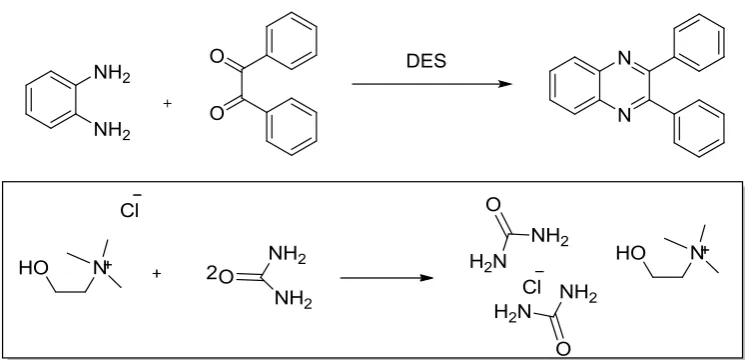
Scheme
Choline chloride (2-hydroxyethyltrimeethylammoniumchloride) reacts with urea to produce
DES.
Table 1: Comparison between traditional synthesis and green techniques.
2. MATERIALS AND METHODS
All common reagents and solvents were used as obtained from commercial supplires without
further purification. All chemicals were from S.D Fine chemicals India. Melting points were
reported are uncorrected. IR spectra recorded on a FTIR-4100 spectrometer and The 1H NMR
spectra were recorded on a Bruker (400 MHz) spectrometer using TMS as internal standard.
Chemical shifts were given in ppm relative to internal reference for DMSO and CDCl3.
Representative procedure for the preparation of deep eutectic solvent
Choline chloride (2.8 g, 20 mmol) and urea (2.4 g, 40 mmol) were placed in a round
bottomed flask and heated to 70◦C to 80◦C, until homogenous colourless liquid was formed
which was used directly for the reactions.
Method A: O-phenylenediamine (0.108 gm, 0.001 mol) and Ben zil (0.210 gm, 0.001 mol)
were taken in f at bottom flask, dissolved in ethanol (5 ml) and then p-TSA (0.034g, 0.002
mol) was added to this mixture. The mixture was sonicated for 8 minutes. After completion
Compound
Parameter Traditional method
Green Techniques
A B C D
of reaction, reaction ass was poured on crushed ice. It was stirred for 10 minutes. The solid
separated was filtered, washed with water, dried in oven and crystallized in ethanol.[24]
Method B: O-phenylenediamine (0.18 gm, 0.001 mol), Benzil (0.210 gm, 0.001 mol) and
p-TSA ((0.034g, 0.002mol) were taken in flat bottom flask, dissolved in ethanol (5 ml). The
mixture was stirred for 10 minutes. After completion of reaction, reaction mass was poured
on crushed ice. It was stirred again for 10 minute. The solid separated was filtered, washed
with water, dried in oven and crystallised in ethanol.[24]
Method C: O-phenylenediamine (0.18 gm, 0.001 mol), Benzil (0.210 gm, 0.001 mol) and
p-TSA (0.034g, 0.002mol) were taken in flat bottom flask, dissolved in water (10 ml). The
mixture was stirred for 20 minutes. After completion of reaction, solid separated was filtered,
washed with water, dried in oven and crystallized in ethanol.[24]
Method D: O-phenylenediamine (0.18 gm, 0.001 mol), Benzil (0.210 gm, 0.001 mol) and 1
ml deep eutectic solvent were added, then the reaction was stirred for 25 min and a solid
product gradually formed. After the completion of reaction as indicated by thin layer
chromatography (TLC), water was added, the reaction mass was stirred and the mixture was
filtered. The crude product obtained was purified by recrystallization using absolute alcohol.
3. RESU LTS
IR: Characterization
1665.50, 1585.40, 1446.20, 1317.38, 1210.32, 1167.95, 1069.75, 995.33, 873.20, 786.55,
716.78, 639.86(cm-1). The absorption bands at 1665 cm-1 and 1585.40 cm-1 are due to C-C
stretching of aromatic ring at 1210.32 cm-1 due to plain bending of C-H in aromatic phenyl
ring, weak absorption band at 3061 cm-1 due to aromatic -C-H stretching, strong absorption
band at 716.78 cm-1 and 786.55 cm-1 indicate mono substituted benzene ring. The weak
absorption band at 1446 cm-1 is due to –C=N stretching.
1
H-NMR: (400MHz, CDCl3), δ p pm.
7.3 (m, 6H), 7.52 (d, 4H), 7.76 (dd, 2H,), 8.19 (dd, 2H,) ppm.
4. DISCUSSION
Compared with traditional method, and methods reported in literature our method is more
convenient. Reactions can be carried out at milder conditions, in shorter time with higher
correlated for safer and efficient synthesis of other products. This new strategy has several
advantages, such as short reaction time, simple experimental as well as isolation procedures,
excellent yield, low cost, and finally, it is in agreement with the green chemistry protocols.
5. CONCLUSION
DES technique is advantageous over conventional methods due to shorter reaction time,
avoiding the use of harmful solvents, cleaner reactions, easy work up, and minimization of
waste products for synthesis of 2,3-diphenyl quinoxaline. Compared with traditional
methods, the applied methods are more convenient and reactions can be carried out in higher
yield, shorter reaction time and milder conditions, without generation of pollution. It can be
concluded that the DES method is an efficient, fast, simple and environment friendly method
for the synthesis of a large number of organic heterocyclic molecules. In addition there is an
increase in the yield. Hence it is a viable and feasible method for performing the synthesis of
drug, intermediates and chemicals.
REFERENCES
1 Ghadage R.V. and Shirote P.J., Bangladesh J Pharmacol., 2011; 6: 92-99.
2 Dailey, J. W.; Feast, R. J.; Peace, I. C.; Sage, S.; Till, E. L.; Wood, P. J. Mater. Chem.,
2001; 11: 2238.
3 John, P. D.; Leonard, J. C.; Beryl, W. D.; Richard, B. J.; Richard, M. P.; Joseph, E., P.;
Wendell, W. W. J. Med. Chem., 1979; 22: 1118.
4 Weng, Q.; Wang, D.; Guo, P.; Fang, L.; Hu, Y.; He, Q.; Yang, B. Eur. J. Pharmacol.,
2008; 581: 262.
5 Wilhelmsson, L. M.; Kingi, N.; Bergman., J. J. Med. Chem., 2008; 51: 7744.
6 Wagle, S.; Adhikari, A. V.; Kumari, N. S. Indian J. Chem., 2008; 47: 439.
7 Xu, H.; Fan, L. L. Eur. J. Med. Chem., 2011; 46: 1919.
8 Rao, G. K.; Kotnal, R. B.; Pai, T. J. Chem. Pharm. Res., 2010; 2: 368.
9 Guillon, J.; Moreau, S.; Mouray, E.; Sinou, V.; Forfar, I.; Fabre, S. B.; Desplat, V.;
Millet, P.; Parzy, D.; Jarry, C.; Grellier, P. Bioorg. Med. Chem., 2008; 16: 9133.
10 Guillon, J.; Forfar, I.; Mamani-Matsuda, M.; Desplat, V.; Saliege, M.; Thiolat, D.;
Massip, S.; Tabourier, A.; Leger, J.; Dufaure, B.; Haumont, G.; Jarry, C.; Mossalayi, D.
Bioorg. Med. Chem., 2007; 15: 194.
11 Wagle, S.; Adhikari, A. V.; Kumari, N. S. Eur. J. Med. Chem., 2009; 44: 1135.
13 Khaksar S. and Rostamnezhad F., Bull. Korean Chem. Soc, 2012; 33(8): 2581.
14 Singh S., Mishra P., Srivastava M., SingShyam B., Singh J., Tiwari K. P., Green
15 Chemistry Letters and Reviews, 2012; 5(4): 587-593.
16 Kolvari E., Mohammad Ali Z., Marjan P.,Green Chemistry Letters and Reviews, 2012;
5(2): 155-159.
17 Kim S. Y., Park K. H., Chung Y. K., Chem. Commun., 2005; 1321-1323.
18 Zhao Z., Wisnoski D. D., Wolkenberg S. E., Leister W. H., Wang Y., Lindsley C. W.,
Tetrahedron Lett., 2004; 45(25): 4873-4876.
19 Feng J., Liu Y., Meng Q., Liu B., Synth. Communication, 1998; 28: 193.
20 More S.V., Sastry M.N.V., Wang C.C., Ching-Fa Y., Tetrahedron Lett., 2005; 46:
6345-6348.
21 Rajesh S.B., Swapnil R.S., Suresh S.A., Wamanrao N.J., Sudhakar R.B., Rajendra P.P.,
Tetrahedron Lett., 2005; 46: 7183-7186.
22 Jafarpour M., Rezaeifard A., Danehchin M., Appl. Catal. A., 2011; 394: 48–51.
23 Sadjadi S., Sadjadi S., Hekmatshoar R.,Sonochem., 2010; 17: 764–767.
24 Krishnakumar B., Velmurugan R., Jothivel S., Swaminathan M., Catal. Commun., 2010;
11: 997–1002.
25 Pranita Mahadik1, Rupen Joshi International Journal of Innovative Science, Engineering