The Thirty-Third AAAI Conference on Artificial Intelligence (AAAI-19)
A Topic-Aware Reinforced Model for Weakly Supervised Stance Detection
Penghui Wei, Wenji Mao, Guandan Chen
†SKL-MCCS, Institute of Automation, Chinese Academy of Sciences, Beijing, China
‡University of Chinese Academy of Sciences, Beijing, China
{weipenghui2016, wenji.mao, chenguandan2014}@ia.ac.cn
Abstract
Analyzing public attitudes plays an important role in opinion mining systems. Stance detection aims to determine from a text whether its author is in favor of, against, or neutral to-wards a given target. One challenge of this task is that a text may not explicitly express an attitude towards the target, but existing approaches utilize target content alone to build mod-els. Moreover, although weakly supervised approaches have been proposed to ease the burden of manually annotating large-scale training data, such approaches are confronted with noisy labeling problem. To address the above two issues, in this pa-per, we propose a Topic-Aware Reinforced Model (TARM) for weakly supervised stance detection. Our model consists of two complementary components: (1) a detection network that in-corporates target-related topic information into representation learning for identifying stance effectively; (2) a policy network that learns to eliminate noisy instances from auto-labeled data based on off-policy reinforcement learning. Two networks are alternately optimized to improve each other’s performances. Experimental results demonstrate that our proposed model TARM outperforms the state-of-the-art approaches.
Introduction
Analyzing and mining public attitudes has attracted in-creasing attention from opinion mining research commu-nity. Stance detection is the task of automatically inferring
from an opinionated text whether its author isin favor of,
against, orneither of themtowards a given target. The target of interest may be a person, a government policy, a product, a claim and so on (Mohammad et al. 2016). Unlike senti-ment analysis which centers on identifying the sentisenti-ments towards entities (Liu 2012), stance analysis aims to mine the essential viewpoints people stand, which reflects what people think and believe intrinsically. Thus, mining the stances in user-generated contents has broad applications such as social media monitoring and government decision making.
Recent stance detection studies have focused on analyz-ing online contents from social media platforms, and typ-ically Twitter (Rajadesingan and Liu 2014; Sasaki et al. 2018). Figure 1 shows an example of Twitter stance detec-tion task defined by Mohammad et al. (2016). According to the tweet content, we can infer from it that the tweet
Copyright c2019, Association for the Advancement of Artificial Intelligence (www.aaai.org). All rights reserved.
Target:Atheism
Tweet:Be still. Be patient. Watch and let God work.
Stance:against Overall sentiment:positive
Figure 1: Twitter stance detection: An example.
author is opposed to “Atheism”. As we can see, a tweet
may not explicitly express an attitude towards the target
of interest, which is a major difference between stance de-tection and aspect-level sentiment classification. Because the semantic information carried by target content itself is limited, it may not be able to provide enough information for classifying stance accurately. Existing approaches for Twitter stance detection usually utilize target content alone to build models (Augenstein et al. 2016; Du et al. 2017; Zhou, Cristea, and Shi 2017; Wei, Mao, and Zeng 2018; Dey, Shrivastava, and Kaushik 2018). Therefore, capturing
target-related implicit expressionin text has become a chal-lenging research issue in targeted stance detection task.
Meanwhile, as manually annotating large-scale training
data is time-consuming and labor-intensive,weakly
super-visedapproaches for stance detection are in great need. In real-world scenarios, it is often required to tackle new targets which do not have ready-made labeled data. For instance, in a general election, the candidates are probably new targets and there is no labeled data with respect to them. Through build-ing detection models on auto-labeled large-scale datasets, weakly supervised stance detection approaches are advanta-geous in such scenarios.
Related studies that focus on weakly supervised stance detection (Wei et al. 2016; Augenstein et al. 2016; Ebrahimi, Dou, and Lowd 2016a; 2016b) adopt Distant Supervision (DS) (Go, Bhayani, and Huang 2009) to construct auto-labeled training data based on manually-selected stance-indicative patterns. For instance, if a tweet content contains the pattern “#blessed”, its author is probably opposed to “Atheism” and DS will annotate the tweet with anagainst
label. Obviously, DS avoids the drawback of manual annota-tion, however, it also brings noisy instances annotated with incorrect stance labels. Thus, reducing the negative impact of
To address the above two challenging issues, in this
pa-per, we propose a novelTopic-Aware ReinforcedModel
(TARM) for weakly supervised stance detection task, which
consists of two complementary components: a topic-aware detection network and a stance revision policy network.
Intuitively, although a tweet may not explicitly express an attitude towards the given target, it usually talks about
one or more target-related topics, and expresses attitudes
towards these topics to implicitly stand its viewpoint towards the target. If we take such topic information into account, it will contribute to understanding target-related implicit expres-sions. Motivated by this, we design a topic-aware detection network (TDNet) that incorporates topic information into the tweet representation learning process. Specifically, we first extract target-related topics from large-scale corpus. Then, TDNet learns to capture text spans talking about these topics, and obtains tweet representations with respect to different topics. Compared to the models that only consider target in-formation, TDNet represents a tweet via various views (i.e., multiple topics), and through which we can effectively iden-tify targeted stance based on captured implicit expressions.
Further, unlike previous approaches that directly build de-tection models on noisy labeled data, we resort to learn a
denoising policy that caneliminate noisy tweetsfor
improv-ing the capability of TDNet. Because no supervised signal can inform whether a tweet’s label annotated by DS is correct, we need a trial-and-error process to explore a reliable policy. Moreover, tweets containing the same pattern are partially related, thus it is natural to make sequential decisions instead
of individual ones on them. Motivated by theexploration
ability of reinforcement learning (RL), we introduce a stance revision policy network (SRNet) that learns an RL-based pol-icy to revise the auto-labeled data. Specifically, we formulate this as a sequential decision process: for each tweet, SRNet makes a decision to indicate whether it should be eliminated, where the current decision is affected by previous decisions. After obtaining a revised dataset, TDNet measures its quality by producing a reward signal, and the goal of SRNet is to achieve higher cumulative reward.
To make the exploration (i.e., trial-and-error) process of
SRNet achieve timely reward signals from TDNet, we
alter-natelyoptimize TDNet and SRNet after pre-training them on auto-labeled data: TDNet provides tweet representations and rewards to SRNet, and guides it to learn a good revision policy; SRNet produces revised data for training a better TD-Net. Such procedure is alternate, aiming to make TDNet and SRNet improve each other’s performances. Moreover, to
ac-celerate the training process of SRNet, we leverageoff-policy
algorithm to optimize SRNet, which makes the training pro-cess significantly faster than traditional on-policy algorithms.
The contributions of this work are as follows:
• To address the target-related implicit expression issue in
stance detection, we integrate topic information into tweet representation for effectively identifying targeted stance.
• To reduce the negative impact of noisy stance labeling in
weakly supervised setting, we introduce a policy network that learns to eliminate noisy instances from auto-labeled data, and employ off-policy strategy to accelerate training.
• Experimental results show that our proposed model TARM
is superior to the state-of-the-art approaches.
Related Work
Stance detection aims to identify the position expressed in a text towards a target, which is a research field related to argument mining (Lippi and Torroni 2016) and aspect-level sentiment analysis (Ma, Peng, and Cambria 2018), and also plays a crucial role in fact checking (Mohtarami et al. 2018). Previous studies mainly focus on debates (Thomas, Pang, and Lee 2006; Somasundaran and Wiebe 2009; Hasan and Ng 2013). They utilize lexical and structural features extracted in text to build stance classifiers. Recent studies pay more attention to online contents from social media (Rajadesingan and Liu 2014; Chen and Ku 2016; Sasaki et al. 2018; Xu et al. 2018; Wei, Lin, and Mao 2018). In this paper we center on detecting stance towards a pre-defined proposition or entity, e.g., a government policy or a specific person.
Existing studies on supervised stance detection in Twitter mainly adopt neural networks. Zarrella and Marsh (2016) pre-train LSTM on unlabeled corpus by predicting hashtags. Du et al. (2017) and Zhou, Cristea, and Shi (2017) employ target-specific attention models to attend important words in tweets, and Dey, Shrivastava, and Kaushik (2018) extend their work to a two-phase solution. Wei, Mao, and Zeng (2018) adopt memory networks to iteratively polish the representations of stance clues and tweets. Sun et al. (2018) combine linguis-tic factors (sentiment, argument and dependency features) by an elaborate hierarchical attention model. Benton and Dredze (2018) present a user embedding method capturing user behaviors and social features for pre-training GRU.
Different approaches are proposed to tackle the weakly supervised setting, and they utilize distant supervision (Go, Bhayani, and Huang 2009; Xia, Jiang, and He 2017) to auto-matically annotate data for training models. Ebrahimi, Dou, and Lowd (2016a) model the interactions among stance, tar-get and sentiment by an undirected graphical model. Fur-ther, they (2016b) collectively classify tweet stances and user stances by Markov random fields with the constraint of user relationships. To leverage the semantic information of tar-get, Augenstein et al. (2016) propose the model BiCond that encodes tweets by a bidirectional LSTM in which initial cell states are conditional on the target. BiCond achieves the best performance of this task among related studies.
Target Donald Trump Tweet
Trump is America’s last hope. #VoteTrump #DonaldTrump may be racist but he's telling the truth.
… 1.
2.
3.
Unlabeled Data Tweet1.
2.
3.
Stance Noisy Labeled Training Data
…
Topic
poll, republication, president, … mexico, mexican, … illegal, immigrant, border, … … 1) 2) 3) 4) Distant Supervision Topic Modeling h1 h2 h3 hJ o1 o2 oI+1
<latexit sha1_base64="k2czrbwMEBOMuuik4J3Xyj8nOXw=">AAACAXicbVA9SwNBEJ2LXzF+RS1tFoMgCOFOBC2DNtpFMB+QnGFvs5cs2b09dveEcKTyN9hqbSe2/hJL/4l7yRUm8cHA470ZZuYFMWfauO63U1hZXVvfKG6WtrZ3dvfK+wdNLRNFaINILlU7wJpyFtGGYYbTdqwoFgGnrWB0k/mtJ6o0k9GDGcfUF3gQsZARbKzU6QYCycf07syb9MoVt+pOgZaJl5MK5Kj3yj/dviSJoJEhHGvd8dzY+ClWhhFOJ6VuommMyQgPaMfSCAuq/XR68gSdWKWPQqlsRQZN1b8TKRZaj0VgOwU2Q73oZeJ/Xicx4ZWfsihODI3IbFGYcGQkyv5HfaYoMXxsCSaK2VsRGWKFibEpzW0JRJaJt5jAMmmeVz236t1fVGrXeTpFOIJjOAUPLqEGt1CHBhCQ8AKv8OY8O+/Oh/M5ay04+cwhzMH5+gUpoZcz</latexit><latexit sha1_base64="k2czrbwMEBOMuuik4J3Xyj8nOXw=">AAACAXicbVA9SwNBEJ2LXzF+RS1tFoMgCOFOBC2DNtpFMB+QnGFvs5cs2b09dveEcKTyN9hqbSe2/hJL/4l7yRUm8cHA470ZZuYFMWfauO63U1hZXVvfKG6WtrZ3dvfK+wdNLRNFaINILlU7wJpyFtGGYYbTdqwoFgGnrWB0k/mtJ6o0k9GDGcfUF3gQsZARbKzU6QYCycf07syb9MoVt+pOgZaJl5MK5Kj3yj/dviSJoJEhHGvd8dzY+ClWhhFOJ6VuommMyQgPaMfSCAuq/XR68gSdWKWPQqlsRQZN1b8TKRZaj0VgOwU2Q73oZeJ/Xicx4ZWfsihODI3IbFGYcGQkyv5HfaYoMXxsCSaK2VsRGWKFibEpzW0JRJaJt5jAMmmeVz236t1fVGrXeTpFOIJjOAUPLqEGt1CHBhCQ8AKv8OY8O+/Oh/M5ay04+cwhzMH5+gUpoZcz</latexit><latexit sha1_base64="k2czrbwMEBOMuuik4J3Xyj8nOXw=">AAACAXicbVA9SwNBEJ2LXzF+RS1tFoMgCOFOBC2DNtpFMB+QnGFvs5cs2b09dveEcKTyN9hqbSe2/hJL/4l7yRUm8cHA470ZZuYFMWfauO63U1hZXVvfKG6WtrZ3dvfK+wdNLRNFaINILlU7wJpyFtGGYYbTdqwoFgGnrWB0k/mtJ6o0k9GDGcfUF3gQsZARbKzU6QYCycf07syb9MoVt+pOgZaJl5MK5Kj3yj/dviSJoJEhHGvd8dzY+ClWhhFOJ6VuommMyQgPaMfSCAuq/XR68gSdWKWPQqlsRQZN1b8TKRZaj0VgOwU2Q73oZeJ/Xicx4ZWfsihODI3IbFGYcGQkyv5HfaYoMXxsCSaK2VsRGWKFibEpzW0JRJaJt5jAMmmeVz236t1fVGrXeTpFOIJjOAUPLqEGt1CHBhCQ8AKv8OY8O+/Oh/M5ay04+cwhzMH5+gUpoZcz</latexit><latexit sha1_base64="k2czrbwMEBOMuuik4J3Xyj8nOXw=">AAACAXicbVA9SwNBEJ2LXzF+RS1tFoMgCOFOBC2DNtpFMB+QnGFvs5cs2b09dveEcKTyN9hqbSe2/hJL/4l7yRUm8cHA470ZZuYFMWfauO63U1hZXVvfKG6WtrZ3dvfK+wdNLRNFaINILlU7wJpyFtGGYYbTdqwoFgGnrWB0k/mtJ6o0k9GDGcfUF3gQsZARbKzU6QYCycf07syb9MoVt+pOgZaJl5MK5Kj3yj/dviSJoJEhHGvd8dzY+ClWhhFOJ6VuommMyQgPaMfSCAuq/XR68gSdWKWPQqlsRQZN1b8TKRZaj0VgOwU2Q73oZeJ/Xicx4ZWfsihODI3IbFGYcGQkyv5HfaYoMXxsCSaK2VsRGWKFibEpzW0JRJaJt5jAMmmeVz236t1fVGrXeTpFOIJjOAUPLqEGt1CHBhCQ8AKv8OY8O+/Oh/M5ay04+cwhzMH5+gUpoZcz</latexit>
Interaction Matrix Topic Embeddings Tweet Representation S … … … r2 r1 rI+1
<latexit sha1_base64="yuF6krKN9EReGsZd89yjmNzPNqU=">AAACAXicbVA9SwNBEJ2LXzF+RS1tFoMgCOFOBC2DNtpFMB+QnGFvs5cs2b09dveEcKTyN9hqbSe2/hJL/4l7yRUm8cHA470ZZuYFMWfauO63U1hZXVvfKG6WtrZ3dvfK+wdNLRNFaINILlU7wJpyFtGGYYbTdqwoFgGnrWB0k/mtJ6o0k9GDGcfUF3gQsZARbKzU6QYCqcf07syb9MoVt+pOgZaJl5MK5Kj3yj/dviSJoJEhHGvd8dzY+ClWhhFOJ6VuommMyQgPaMfSCAuq/XR68gSdWKWPQqlsRQZN1b8TKRZaj0VgOwU2Q73oZeJ/Xicx4ZWfsihODI3IbFGYcGQkyv5HfaYoMXxsCSaK2VsRGWKFibEpzW0JRJaJt5jAMmmeVz236t1fVGrXeTpFOIJjOAUPLqEGt1CHBhCQ8AKv8OY8O+/Oh/M5ay04+cwhzMH5+gUubJc2</latexit><latexit sha1_base64="yuF6krKN9EReGsZd89yjmNzPNqU=">AAACAXicbVA9SwNBEJ2LXzF+RS1tFoMgCOFOBC2DNtpFMB+QnGFvs5cs2b09dveEcKTyN9hqbSe2/hJL/4l7yRUm8cHA470ZZuYFMWfauO63U1hZXVvfKG6WtrZ3dvfK+wdNLRNFaINILlU7wJpyFtGGYYbTdqwoFgGnrWB0k/mtJ6o0k9GDGcfUF3gQsZARbKzU6QYCqcf07syb9MoVt+pOgZaJl5MK5Kj3yj/dviSJoJEhHGvd8dzY+ClWhhFOJ6VuommMyQgPaMfSCAuq/XR68gSdWKWPQqlsRQZN1b8TKRZaj0VgOwU2Q73oZeJ/Xicx4ZWfsihODI3IbFGYcGQkyv5HfaYoMXxsCSaK2VsRGWKFibEpzW0JRJaJt5jAMmmeVz236t1fVGrXeTpFOIJjOAUPLqEGt1CHBhCQ8AKv8OY8O+/Oh/M5ay04+cwhzMH5+gUubJc2</latexit>
<latexit sha1_base64="yuF6krKN9EReGsZd89yjmNzPNqU=">AAACAXicbVA9SwNBEJ2LXzF+RS1tFoMgCOFOBC2DNtpFMB+QnGFvs5cs2b09dveEcKTyN9hqbSe2/hJL/4l7yRUm8cHA470ZZuYFMWfauO63U1hZXVvfKG6WtrZ3dvfK+wdNLRNFaINILlU7wJpyFtGGYYbTdqwoFgGnrWB0k/mtJ6o0k9GDGcfUF3gQsZARbKzU6QYCqcf07syb9MoVt+pOgZaJl5MK5Kj3yj/dviSJoJEhHGvd8dzY+ClWhhFOJ6VuommMyQgPaMfSCAuq/XR68gSdWKWPQqlsRQZN1b8TKRZaj0VgOwU2Q73oZeJ/Xicx4ZWfsihODI3IbFGYcGQkyv5HfaYoMXxsCSaK2VsRGWKFibEpzW0JRJaJt5jAMmmeVz236t1fVGrXeTpFOIJjOAUPLqEGt1CHBhCQ8AKv8OY8O+/Oh/M5ay04+cwhzMH5+gUubJc2</latexit>
<latexit sha1_base64="yuF6krKN9EReGsZd89yjmNzPNqU=">AAACAXicbVA9SwNBEJ2LXzF+RS1tFoMgCOFOBC2DNtpFMB+QnGFvs5cs2b09dveEcKTyN9hqbSe2/hJL/4l7yRUm8cHA470ZZuYFMWfauO63U1hZXVvfKG6WtrZ3dvfK+wdNLRNFaINILlU7wJpyFtGGYYbTdqwoFgGnrWB0k/mtJ6o0k9GDGcfUF3gQsZARbKzU6QYCqcf07syb9MoVt+pOgZaJl5MK5Kj3yj/dviSJoJEhHGvd8dzY+ClWhhFOJ6VuommMyQgPaMfSCAuq/XR68gSdWKWPQqlsRQZN1b8TKRZaj0VgOwU2Q73oZeJ/Xicx4ZWfsihODI3IbFGYcGQkyv5HfaYoMXxsCSaK2VsRGWKFibEpzW0JRJaJt5jAMmmeVz236t1fVGrXeTpFOIJjOAUPLqEGt1CHBhCQ8AKv8OY8O+/Oh/M5ay04+cwhzMH5+gUubJc2</latexit>
Topic Distribution of Topics
1 2 I
… … … … Target-Related Topics Fused Representation r State Tweet 1 Action Sequential Decision … Tweet 2 s1 s2 … a1 a2 State, Reward
Revised Training Data
Data and Topic Processing Topic-Aware Detection Network Stance Revision Policy Network
1 2 3
I+ 1
<latexit sha1_base64="aCP95APtWfSa3oXcbtxUlvTV+QA=">AAAB6nicbVBNS8NAEJ3Ur1q/qh69LBZBEEoigh6LXvRW0X5AG8pmO2mXbjZhdyOU0J/gxYMiXv1F3vw3btsctPXBwOO9GWbmBYng2rjut1NYWV1b3yhulra2d3b3yvsHTR2nimGDxSJW7YBqFFxiw3AjsJ0opFEgsBWMbqZ+6wmV5rF8NOME/YgOJA85o8ZKD3dnXq9ccavuDGSZeDmpQI56r/zV7ccsjVAaJqjWHc9NjJ9RZTgTOCl1U40JZSM6wI6lkkao/Wx26oScWKVPwljZkobM1N8TGY20HkeB7YyoGepFbyr+53VSE175GZdJalCy+aIwFcTEZPo36XOFzIixJZQpbm8lbEgVZcamU7IheIsvL5PmedVzq979RaV2ncdRhCM4hlPw4BJqcAt1aACDATzDK7w5wnlx3p2PeWvByWcO4Q+czx91A409</latexit>
<latexit sha1_base64="aCP95APtWfSa3oXcbtxUlvTV+QA=">AAAB6nicbVBNS8NAEJ3Ur1q/qh69LBZBEEoigh6LXvRW0X5AG8pmO2mXbjZhdyOU0J/gxYMiXv1F3vw3btsctPXBwOO9GWbmBYng2rjut1NYWV1b3yhulra2d3b3yvsHTR2nimGDxSJW7YBqFFxiw3AjsJ0opFEgsBWMbqZ+6wmV5rF8NOME/YgOJA85o8ZKD3dnXq9ccavuDGSZeDmpQI56r/zV7ccsjVAaJqjWHc9NjJ9RZTgTOCl1U40JZSM6wI6lkkao/Wx26oScWKVPwljZkobM1N8TGY20HkeB7YyoGepFbyr+53VSE175GZdJalCy+aIwFcTEZPo36XOFzIixJZQpbm8lbEgVZcamU7IheIsvL5PmedVzq979RaV2ncdRhCM4hlPw4BJqcAt1aACDATzDK7w5wnlx3p2PeWvByWcO4Q+czx91A409</latexit><latexit sha1_base64="aCP95APtWfSa3oXcbtxUlvTV+QA=">AAAB6nicbVBNS8NAEJ3Ur1q/qh69LBZBEEoigh6LXvRW0X5AG8pmO2mXbjZhdyOU0J/gxYMiXv1F3vw3btsctPXBwOO9GWbmBYng2rjut1NYWV1b3yhulra2d3b3yvsHTR2nimGDxSJW7YBqFFxiw3AjsJ0opFEgsBWMbqZ+6wmV5rF8NOME/YgOJA85o8ZKD3dnXq9ccavuDGSZeDmpQI56r/zV7ccsjVAaJqjWHc9NjJ9RZTgTOCl1U40JZSM6wI6lkkao/Wx26oScWKVPwljZkobM1N8TGY20HkeB7YyoGepFbyr+53VSE175GZdJalCy+aIwFcTEZPo36XOFzIixJZQpbm8lbEgVZcamU7IheIsvL5PmedVzq979RaV2ncdRhCM4hlPw4BJqcAt1aACDATzDK7w5wnlx3p2PeWvByWcO4Q+czx91A409</latexit>
<latexit sha1_base64="aCP95APtWfSa3oXcbtxUlvTV+QA=">AAAB6nicbVBNS8NAEJ3Ur1q/qh69LBZBEEoigh6LXvRW0X5AG8pmO2mXbjZhdyOU0J/gxYMiXv1F3vw3btsctPXBwOO9GWbmBYng2rjut1NYWV1b3yhulra2d3b3yvsHTR2nimGDxSJW7YBqFFxiw3AjsJ0opFEgsBWMbqZ+6wmV5rF8NOME/YgOJA85o8ZKD3dnXq9ccavuDGSZeDmpQI56r/zV7ccsjVAaJqjWHc9NjJ9RZTgTOCl1U40JZSM6wI6lkkao/Wx26oScWKVPwljZkobM1N8TGY20HkeB7YyoGepFbyr+53VSE175GZdJalCy+aIwFcTEZPo36XOFzIixJZQpbm8lbEgVZcamU7IheIsvL5PmedVzq979RaV2ncdRhCM4hlPw4BJqcAt1aACDATzDK7w5wnlx3p2PeWvByWcO4Q+czx91A409</latexit> J 1 2 … … Policy Gradient X <latexit sha1_base64="GauA5oGsRS7QbOWcmn8rizNPsOA=">AAAB63icbVA9SwNBEJ2LXzF+RS1tFoNgFe5E0DJoYxnBxEByhL3NJlmyu3fszgnhyF+wsVDE1j9k579xL7lCEx8MPN6bYWZelEhh0fe/vdLa+sbmVnm7srO7t39QPTxq2zg1jLdYLGPTiajlUmjeQoGSdxLDqYokf4wmt7n/+MSNFbF+wGnCQ0VHWgwFo5hLPZuqfrXm1/05yCoJClKDAs1+9as3iFmquEYmqbXdwE8wzKhBwSSfVXqp5QllEzriXUc1VdyG2fzWGTlzyoAMY+NKI5mrvycyqqydqsh1Kopju+zl4n9eN8XhdZgJnaTINVssGqaSYEzyx8lAGM5QTh2hzAh3K2FjaihDF0/FhRAsv7xK2hf1wK8H95e1xk0RRxlO4BTOIYAraMAdNKEFDMbwDK/w5invxXv3PhatJa+YOYY/8D5/ADHrjlM=</latexit> <latexit sha1_base64="GauA5oGsRS7QbOWcmn8rizNPsOA=">AAAB63icbVA9SwNBEJ2LXzF+RS1tFoNgFe5E0DJoYxnBxEByhL3NJlmyu3fszgnhyF+wsVDE1j9k579xL7lCEx8MPN6bYWZelEhh0fe/vdLa+sbmVnm7srO7t39QPTxq2zg1jLdYLGPTiajlUmjeQoGSdxLDqYokf4wmt7n/+MSNFbF+wGnCQ0VHWgwFo5hLPZuqfrXm1/05yCoJClKDAs1+9as3iFmquEYmqbXdwE8wzKhBwSSfVXqp5QllEzriXUc1VdyG2fzWGTlzyoAMY+NKI5mrvycyqqydqsh1Kopju+zl4n9eN8XhdZgJnaTINVssGqaSYEzyx8lAGM5QTh2hzAh3K2FjaihDF0/FhRAsv7xK2hf1wK8H95e1xk0RRxlO4BTOIYAraMAdNKEFDMbwDK/w5invxXv3PhatJa+YOYY/8D5/ADHrjlM=</latexit> <latexit sha1_base64="GauA5oGsRS7QbOWcmn8rizNPsOA=">AAAB63icbVA9SwNBEJ2LXzF+RS1tFoNgFe5E0DJoYxnBxEByhL3NJlmyu3fszgnhyF+wsVDE1j9k579xL7lCEx8MPN6bYWZelEhh0fe/vdLa+sbmVnm7srO7t39QPTxq2zg1jLdYLGPTiajlUmjeQoGSdxLDqYokf4wmt7n/+MSNFbF+wGnCQ0VHWgwFo5hLPZuqfrXm1/05yCoJClKDAs1+9as3iFmquEYmqbXdwE8wzKhBwSSfVXqp5QllEzriXUc1VdyG2fzWGTlzyoAMY+NKI5mrvycyqqydqsh1Kopju+zl4n9eN8XhdZgJnaTINVssGqaSYEzyx8lAGM5QTh2hzAh3K2FjaihDF0/FhRAsv7xK2hf1wK8H95e1xk0RRxlO4BTOIYAraMAdNKEFDMbwDK/w5invxXv3PhatJa+YOYY/8D5/ADHrjlM=</latexit> <latexit sha1_base64="GauA5oGsRS7QbOWcmn8rizNPsOA=">AAAB63icbVA9SwNBEJ2LXzF+RS1tFoNgFe5E0DJoYxnBxEByhL3NJlmyu3fszgnhyF+wsVDE1j9k579xL7lCEx8MPN6bYWZelEhh0fe/vdLa+sbmVnm7srO7t39QPTxq2zg1jLdYLGPTiajlUmjeQoGSdxLDqYokf4wmt7n/+MSNFbF+wGnCQ0VHWgwFo5hLPZuqfrXm1/05yCoJClKDAs1+9as3iFmquEYmqbXdwE8wzKhBwSSfVXqp5QllEzriXUc1VdyG2fzWGTlzyoAMY+NKI5mrvycyqqydqsh1Kopju+zl4n9eN8XhdZgJnaTINVssGqaSYEzyx8lAGM5QTh2hzAh3K2FjaihDF0/FhRAsv7xK2hf1wK8H95e1xk0RRxlO4BTOIYAraMAdNKEFDMbwDK/w5invxXv3PhatJa+YOYY/8D5/ADHrjlM=</latexit> I <latexit sha1_base64="nRAJNhMEYHCrj/BVl5Oh8TzR1B0=">AAAB6HicbVBNS8NAEJ3Ur1q/qh69LBbBU0lE0GPRi95asB/QhrLZTtq1m03Y3Qgl9Bd48aCIV3+SN/+N2zYHbX0w8Hhvhpl5QSK4Nq777RTW1jc2t4rbpZ3dvf2D8uFRS8epYthksYhVJ6AaBZfYNNwI7CQKaRQIbAfj25nffkKleSwfzCRBP6JDyUPOqLFS475frrhVdw6ySrycVCBHvV/+6g1ilkYoDRNU667nJsbPqDKcCZyWeqnGhLIxHWLXUkkj1H42P3RKzqwyIGGsbElD5urviYxGWk+iwHZG1Iz0sjcT//O6qQmv/YzLJDUo2WJRmApiYjL7mgy4QmbExBLKFLe3EjaiijJjsynZELzll1dJ66LquVWvcVmp3eRxFOEETuEcPLiCGtxBHZrAAOEZXuHNeXRenHfnY9FacPKZY/gD5/MHnv2MzQ==</latexit> <latexit sha1_base64="nRAJNhMEYHCrj/BVl5Oh8TzR1B0=">AAAB6HicbVBNS8NAEJ3Ur1q/qh69LBbBU0lE0GPRi95asB/QhrLZTtq1m03Y3Qgl9Bd48aCIV3+SN/+N2zYHbX0w8Hhvhpl5QSK4Nq777RTW1jc2t4rbpZ3dvf2D8uFRS8epYthksYhVJ6AaBZfYNNwI7CQKaRQIbAfj25nffkKleSwfzCRBP6JDyUPOqLFS475frrhVdw6ySrycVCBHvV/+6g1ilkYoDRNU667nJsbPqDKcCZyWeqnGhLIxHWLXUkkj1H42P3RKzqwyIGGsbElD5urviYxGWk+iwHZG1Iz0sjcT//O6qQmv/YzLJDUo2WJRmApiYjL7mgy4QmbExBLKFLe3EjaiijJjsynZELzll1dJ66LquVWvcVmp3eRxFOEETuEcPLiCGtxBHZrAAOEZXuHNeXRenHfnY9FacPKZY/gD5/MHnv2MzQ==</latexit> <latexit sha1_base64="nRAJNhMEYHCrj/BVl5Oh8TzR1B0=">AAAB6HicbVBNS8NAEJ3Ur1q/qh69LBbBU0lE0GPRi95asB/QhrLZTtq1m03Y3Qgl9Bd48aCIV3+SN/+N2zYHbX0w8Hhvhpl5QSK4Nq777RTW1jc2t4rbpZ3dvf2D8uFRS8epYthksYhVJ6AaBZfYNNwI7CQKaRQIbAfj25nffkKleSwfzCRBP6JDyUPOqLFS475frrhVdw6ySrycVCBHvV/+6g1ilkYoDRNU667nJsbPqDKcCZyWeqnGhLIxHWLXUkkj1H42P3RKzqwyIGGsbElD5urviYxGWk+iwHZG1Iz0sjcT//O6qQmv/YzLJDUo2WJRmApiYjL7mgy4QmbExBLKFLe3EjaiijJjsynZELzll1dJ66LquVWvcVmp3eRxFOEETuEcPLiCGtxBHZrAAOEZXuHNeXRenHfnY9FacPKZY/gD5/MHnv2MzQ==</latexit> <latexit sha1_base64="nRAJNhMEYHCrj/BVl5Oh8TzR1B0=">AAAB6HicbVBNS8NAEJ3Ur1q/qh69LBbBU0lE0GPRi95asB/QhrLZTtq1m03Y3Qgl9Bd48aCIV3+SN/+N2zYHbX0w8Hhvhpl5QSK4Nq777RTW1jc2t4rbpZ3dvf2D8uFRS8epYthksYhVJ6AaBZfYNNwI7CQKaRQIbAfj25nffkKleSwfzCRBP6JDyUPOqLFS475frrhVdw6ySrycVCBHvV/+6g1ilkYoDRNU667nJsbPqDKcCZyWeqnGhLIxHWLXUkkj1H42P3RKzqwyIGGsbElD5urviYxGWk+iwHZG1Iz0sjcT//O6qQmv/YzLJDUo2WJRmApiYjL7mgy4QmbExBLKFLe3EjaiijJjsynZELzll1dJ66LquVWvcVmp3eRxFOEETuEcPLiCGtxBHZrAAOEZXuHNeXRenHfnY9FacPKZY/gD5/MHnv2MzQ==</latexit>
I<latexit sha1_base64="nRAJNhMEYHCrj/BVl5Oh8TzR1B0=">AAAB6HicbVBNS8NAEJ3Ur1q/qh69LBbBU0lE0GPRi95asB/QhrLZTtq1m03Y3Qgl9Bd48aCIV3+SN/+N2zYHbX0w8Hhvhpl5QSK4Nq777RTW1jc2t4rbpZ3dvf2D8uFRS8epYthksYhVJ6AaBZfYNNwI7CQKaRQIbAfj25nffkKleSwfzCRBP6JDyUPOqLFS475frrhVdw6ySrycVCBHvV/+6g1ilkYoDRNU667nJsbPqDKcCZyWeqnGhLIxHWLXUkkj1H42P3RKzqwyIGGsbElD5urviYxGWk+iwHZG1Iz0sjcT//O6qQmv/YzLJDUo2WJRmApiYjL7mgy4QmbExBLKFLe3EjaiijJjsynZELzll1dJ66LquVWvcVmp3eRxFOEETuEcPLiCGtxBHZrAAOEZXuHNeXRenHfnY9FacPKZY/gD5/MHnv2MzQ==</latexit><latexit sha1_base64="nRAJNhMEYHCrj/BVl5Oh8TzR1B0=">AAAB6HicbVBNS8NAEJ3Ur1q/qh69LBbBU0lE0GPRi95asB/QhrLZTtq1m03Y3Qgl9Bd48aCIV3+SN/+N2zYHbX0w8Hhvhpl5QSK4Nq777RTW1jc2t4rbpZ3dvf2D8uFRS8epYthksYhVJ6AaBZfYNNwI7CQKaRQIbAfj25nffkKleSwfzCRBP6JDyUPOqLFS475frrhVdw6ySrycVCBHvV/+6g1ilkYoDRNU667nJsbPqDKcCZyWeqnGhLIxHWLXUkkj1H42P3RKzqwyIGGsbElD5urviYxGWk+iwHZG1Iz0sjcT//O6qQmv/YzLJDUo2WJRmApiYjL7mgy4QmbExBLKFLe3EjaiijJjsynZELzll1dJ66LquVWvcVmp3eRxFOEETuEcPLiCGtxBHZrAAOEZXuHNeXRenHfnY9FacPKZY/gD5/MHnv2MzQ==</latexit><latexit sha1_base64="nRAJNhMEYHCrj/BVl5Oh8TzR1B0=">AAAB6HicbVBNS8NAEJ3Ur1q/qh69LBbBU0lE0GPRi95asB/QhrLZTtq1m03Y3Qgl9Bd48aCIV3+SN/+N2zYHbX0w8Hhvhpl5QSK4Nq777RTW1jc2t4rbpZ3dvf2D8uFRS8epYthksYhVJ6AaBZfYNNwI7CQKaRQIbAfj25nffkKleSwfzCRBP6JDyUPOqLFS475frrhVdw6ySrycVCBHvV/+6g1ilkYoDRNU667nJsbPqDKcCZyWeqnGhLIxHWLXUkkj1H42P3RKzqwyIGGsbElD5urviYxGWk+iwHZG1Iz0sjcT//O6qQmv/YzLJDUo2WJRmApiYjL7mgy4QmbExBLKFLe3EjaiijJjsynZELzll1dJ66LquVWvcVmp3eRxFOEETuEcPLiCGtxBHZrAAOEZXuHNeXRenHfnY9FacPKZY/gD5/MHnv2MzQ==</latexit><latexit sha1_base64="nRAJNhMEYHCrj/BVl5Oh8TzR1B0=">AAAB6HicbVBNS8NAEJ3Ur1q/qh69LBbBU0lE0GPRi95asB/QhrLZTtq1m03Y3Qgl9Bd48aCIV3+SN/+N2zYHbX0w8Hhvhpl5QSK4Nq777RTW1jc2t4rbpZ3dvf2D8uFRS8epYthksYhVJ6AaBZfYNNwI7CQKaRQIbAfj25nffkKleSwfzCRBP6JDyUPOqLFS475frrhVdw6ySrycVCBHvV/+6g1ilkYoDRNU667nJsbPqDKcCZyWeqnGhLIxHWLXUkkj1H42P3RKzqwyIGGsbElD5urviYxGWk+iwHZG1Iz0sjcT//O6qQmv/YzLJDUo2WJRmApiYjL7mgy4QmbExBLKFLe3EjaiijJjsynZELzll1dJ66LquVWvcVmp3eRxFOEETuEcPLiCGtxBHZrAAOEZXuHNeXRenHfnY9FacPKZY/gD5/MHnv2MzQ==</latexit>
Trump is America’s last
hope. #VoteTrump
#DonaldTrump may be
racist but he's telling the truth.
…
topics and one target
⇡⇥
<latexit sha1_base64="6suKzIKbsSca8iC/yvRuBrZjm3k=">AAAB83icbVBNS8NAEN3Ur1q/qh69LBbBU0lE0GPRi8cK/YImlM120i7dbMLuRCihf8OLB0W8+me8+W/ctjlo64OBx3szzMwLUykMuu63U9rY3NreKe9W9vYPDo+qxycdk2SaQ5snMtG9kBmQQkEbBUropRpYHErohpP7ud99Am1Eolo4TSGI2UiJSHCGVvL9VAxyvzUGZLNBtebW3QXoOvEKUiMFmoPqlz9MeBaDQi6ZMX3PTTHImUbBJcwqfmYgZXzCRtC3VLEYTJAvbp7RC6sMaZRoWwrpQv09kbPYmGkc2s6Y4disenPxP6+fYXQb5EKlGYLiy0VRJikmdB4AHQoNHOXUEsa1sLdSPmaacbQxVWwI3urL66RzVffcuvd4XWvcFXGUyRk5J5fEIzekQR5Ik7QJJyl5Jq/kzcmcF+fd+Vi2lpxi5pT8gfP5A0HQkdA=</latexit>
<latexit sha1_base64="6suKzIKbsSca8iC/yvRuBrZjm3k=">AAAB83icbVBNS8NAEN3Ur1q/qh69LBbBU0lE0GPRi8cK/YImlM120i7dbMLuRCihf8OLB0W8+me8+W/ctjlo64OBx3szzMwLUykMuu63U9rY3NreKe9W9vYPDo+qxycdk2SaQ5snMtG9kBmQQkEbBUropRpYHErohpP7ud99Am1Eolo4TSGI2UiJSHCGVvL9VAxyvzUGZLNBtebW3QXoOvEKUiMFmoPqlz9MeBaDQi6ZMX3PTTHImUbBJcwqfmYgZXzCRtC3VLEYTJAvbp7RC6sMaZRoWwrpQv09kbPYmGkc2s6Y4disenPxP6+fYXQb5EKlGYLiy0VRJikmdB4AHQoNHOXUEsa1sLdSPmaacbQxVWwI3urL66RzVffcuvd4XWvcFXGUyRk5J5fEIzekQR5Ik7QJJyl5Jq/kzcmcF+fd+Vi2lpxi5pT8gfP5A0HQkdA=</latexit><latexit sha1_base64="6suKzIKbsSca8iC/yvRuBrZjm3k=">AAAB83icbVBNS8NAEN3Ur1q/qh69LBbBU0lE0GPRi8cK/YImlM120i7dbMLuRCihf8OLB0W8+me8+W/ctjlo64OBx3szzMwLUykMuu63U9rY3NreKe9W9vYPDo+qxycdk2SaQ5snMtG9kBmQQkEbBUropRpYHErohpP7ud99Am1Eolo4TSGI2UiJSHCGVvL9VAxyvzUGZLNBtebW3QXoOvEKUiMFmoPqlz9MeBaDQi6ZMX3PTTHImUbBJcwqfmYgZXzCRtC3VLEYTJAvbp7RC6sMaZRoWwrpQv09kbPYmGkc2s6Y4disenPxP6+fYXQb5EKlGYLiy0VRJikmdB4AHQoNHOXUEsa1sLdSPmaacbQxVWwI3urL66RzVffcuvd4XWvcFXGUyRk5J5fEIzekQR5Ik7QJJyl5Jq/kzcmcF+fd+Vi2lpxi5pT8gfP5A0HQkdA=</latexit>
<latexit sha1_base64="6suKzIKbsSca8iC/yvRuBrZjm3k=">AAAB83icbVBNS8NAEN3Ur1q/qh69LBbBU0lE0GPRi8cK/YImlM120i7dbMLuRCihf8OLB0W8+me8+W/ctjlo64OBx3szzMwLUykMuu63U9rY3NreKe9W9vYPDo+qxycdk2SaQ5snMtG9kBmQQkEbBUropRpYHErohpP7ud99Am1Eolo4TSGI2UiJSHCGVvL9VAxyvzUGZLNBtebW3QXoOvEKUiMFmoPqlz9MeBaDQi6ZMX3PTTHImUbBJcwqfmYgZXzCRtC3VLEYTJAvbp7RC6sMaZRoWwrpQv09kbPYmGkc2s6Y4disenPxP6+fYXQb5EKlGYLiy0VRJikmdB4AHQoNHOXUEsa1sLdSPmaacbQxVWwI3urL66RzVffcuvd4XWvcFXGUyRk5J5fEIzekQR5Ik7QJJyl5Jq/kzcmcF+fd+Vi2lpxi5pT8gfP5A0HQkdA=</latexit> ✘ ✔ S23 … … Multi-head Attention Topic-Dependent Representations (word-level) (tweet-level)
Figure 2: Overview of our topic-aware reinforced model (TARM) for weakly supervised stance detection.
Task Definition
Stance detection task is defined as: given a tweet and a target,
identify whether the tweet author isin favor of,against, or
neither of them towards the target. In weakly supervised
setting, adomain corpuscontaining large-scale target-related
tweets without stance labels is available for building models.
Proposed Approach
Overview
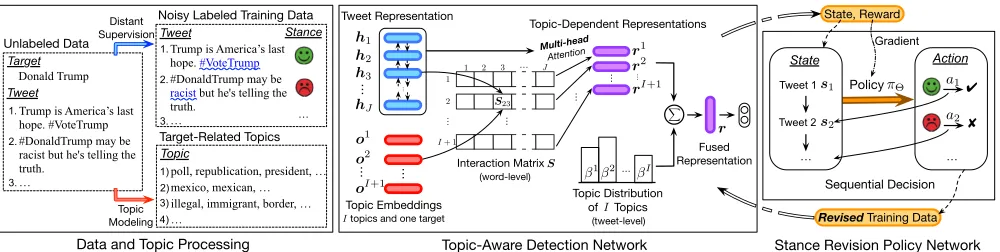
Figure 2 gives an overview of ourTopic-AwareReinforced
Model (TARM). To obtain training data, we first
automati-cally annotate domain corpus and extract topics from it. Then, a topic-aware detection network (TDNet) learns tweet rep-resentation by integrating topic information for identifying stance effectively, and a stance revision policy network (SR-Net) learns to eliminate noisy instances from the auto-labeled data via maximizing the total reward computed by TDNet. Subsequently, TDNet continues to be fine-tuned with the revised data provided by SRNet, and SRNet can be further optimized using the better TDNet. The above optimization procedure is alternate, and the two networks can improve each other’s performances.
Data and Topic Processing
Noisy Stance Labeling To obtain large-scale labeled train-ing data without manual annotation, we adopt Distant Super-vision (DS) (Go, Bhayani, and Huang 2009) to automatically annotate the domain corpus by stance-indicative patterns.
We manually select a set of favor-target patterns and a set of against-target patterns from the domain corpus. Tweets that contain at least one favor-/against- target pattern and do not simultaneously contain two types of patterns will
be annotated withfavor/againststance. This constructs a
noisy labeled training setD.Dis a two-class dataset, i.e., no
instance inDis labeled withneitherstance1. The strategy of
classifyingneitherstance will be detailed in next section.
Enriching Target Content via Topic Modeling To enrich the target content with target-related topic information, we
extract topics2 from the domain corpus via Biterm Topic
1
It is hard to select patterns forneithertweets because they vary from objective contents to totally irrelevant contents.
2
Here, a topic is represented as a set of correlated words.
Model (BTM) (Cheng et al. 2014), a classical topic modeling method over short texts. BTM models the generation of word co-occurrence to avoid the data sparsity in short texts.
We extract I topics using BTM, and each topic Ti is
formally denoted as a word sequenceTi = (wi
1, . . . , wiN),
whereNmeans that we select top-N words for each topic.
As a result, we use these topics to enrich target content for building a topic-aware stance detection model. For the convenience of description, we denote the target itself as the
(I+ 1)-th topic. Hence, we have a total ofI+ 1topics now.
Topic-Aware Detection Network (TDNet)
We design a topic-aware detection network (TDNet) for learn-ing to represent the input tweet and topics. It consists of four layers and effectively incorporates topic information into the representation learning process.
Input Layer All words are mapped into their vector rep-resentations (i.e., word embeddings) using a look-up matrix. TDNet then represents tweet and topics in the following way.
Tweet encoder.We adopt a bi-directional GRU (biGRU), an effective sequence modeling method, to encode the input tweet. It captures contextual information for each word and outputs a sequence of hidden states (suppose that the length
of the input tweet isJand the output dimension is2d):
H= (h1, . . . ,hJ)∈R2d×J (1)
where each hidden statehtis the concatenation of thet-th
hidden states in two directions, i.e.,ht= [
−→
ht;
←−
ht]∈R2d.
Topic embeddings.We adopt the same biGRU used for
tweet to encode each topic. For the topicTi= (wi
1, . . . , wiN)
(i∈ [1, I+ 1]), we represent it using the concatenation of
the last step hidden states in two directions, named topic
embeddingoi∈
R2d:
oi= [−→hiN;
←−
hi1] (2)
LetO={o1, . . . ,oI,oI+1} ∈
R2d×(I+1)denote allI+1
topic embeddings. Next, we detail how to utilize such topic information to learn a topic-aware tweet representation.
We compute an interaction matrixS ∈R(I+1)×Jto score
how well a tweet word and a topic match, with bi-linear
function (parametrized byW) as the score function:
S=O>WH (3)
whereSij = (oi)>Whjmeasures the semantic relatedness
between the topicTiand thej-th wordh
jof the input tweet.
Representation Layer Based on the above alignment com-puting, this layer further incorporates topic information into representation learning for effective stance detection.
Topic-dependent tweet representations. According to various topics, a tweet can be represented with various
views. Specifically, for each topicTi, TDNet learns a
topic-dependent tweet representationri∈
R2d(i∈[1, I+ 1]) via
attention (Bahdanau, Cho, and Bengio 2015), a commonly-used technique to capture informative parts of input.
Thei-th row ofS(denoted asSi:∈RJ) stores semantic
relatedness information between topicTiand the input tweet.
For the topicTi, we obtain the attentive vectorαi ∈
RJ
by normalizingSi:, and then compute the weighted sum of
(h1, . . . ,hJ)to get the representationridependent on this
topic, aiming to assign higher weights to topic-related spans:
αi= softmax(Si:) (4)
ri =Hαi (5)
Finally we getI+ 1representations{r1, . . . ,rI,rI+1}
with respect to these topics. The above mechanism can be
regarded as a variant ofmulti-headattention (Vaswani et al.
2017): each topic embeddingoiplays the role of the query
vector in one attention head (totallyI+ 1heads). In TDNet,
different attention heads share the same parameter matrixW,
while each attention head has its own query vector.
Topic distribution over a tweet.A tweet content usually centers on a tiny number of topics that its author intends to
discuss. Note that topicsT1, . . . ,TIare extracted by training
a BTM on the domain corpus. Hence, given the input tweet, we use the trained BTM to infer its topic distribution of such
Itopics, denoted as(β1, . . . , βI), wherePI
i=1βi= 1.
Fused representation for a tweet.Further, we fuse the
topic-dependent tweet representations{r1, . . . ,rI}by
uti-lizing the topic distribution as weights, and then concatenate
rI+1. As a result, we obtain the fused tweet representationr:
r=
rI+1;
I
X
i=1 βiri
(6)
Detection Layer Because the noisy labeled training setD
is a two-class dataset, asoftmaxlayer is used to output the
predicted stance distribution(yf avor, yagainst), with
param-etersWD,bDto be learned:
(yf avor, yagainst)>= softmax(WDr+bD) (7)
At test time, if a tweet’s predicted stance distribution meets
the condition of|yf avor−yagainst|60.1, we classify it to
neitherclass. This is a usual strategy in previous work (Wei et al. 2016; Ebrahimi, Dou, and Lowd 2016a).
TDNet is pre-trained on the auto-labeled training setD
using cross entropy criterion, and then it will be fine-tuned during the joint training procedure of TDNet and SRNet.
Stance Revision Policy Network (SRNet)
Motivated by theexplorationability of reinforcement
learn-ing (RL), we design a stance revision policy network (SRNet), aiming at learning a policy to eliminate noisy tweets from
the auto-labeled datasetDfor building a cleansed datasetD0.
Revision of Noisy Labeled Data We formulate the
revi-sion of the noisy labeled data D as a sequential decision
process: for each tweet inD, given itsstate, SRNet samples
anactionto decide whether it should be eliminated fromD; the current action is affected by previous actions and will affect following actions. After the revision process, TDNet
gives arewardsignal to indicate how well the actions do, and
SRNet is optimized via maximizing the cumulative reward. To improve the frequency of receiving reward, we group
all tweets inDby their stance-indicative patterns, creating
a set of subsets:D={G1,G2, . . .}. After revising one
sub-set, TDNet computes a reward, and we sum the cumulative rewards of all subsets to obtain the objective function for the
whole revision process. Based on a subsetGthat consists of
T tweets, we detail the revision process that hasTtime steps.
State.For thet-th tweet inG, its state vectorstrepresents
the current information after previous actions from time step
1tot−1. Formally,stis the concatenation of three parts:
st= [rt; ¯r1→t−1;pt], t∈[1, T] (8)
wherertis the tweet representation by Eq. (6),r1¯→t−1is the
average representation of tweets which are not eliminated by
the policy from step1tot−1, andptis the sum of word
embeddings in this tweet’s pattern.
Policy and Action.The goal of our revision policy is to eliminate the tweets annotated with incorrect stance labels
fromG, and keep the tweets having correct labels. Hence,
we use a binary action spaceA={‘elimination’,‘keep’}:
tweets assigned with the action ‘elimination’ by the policy
will be discarded fromG, and other tweets assigned with the
action ‘keep’ compose the cleansed subsetG0.
At each time stept, given the statest, a corresponding
actionat∈ Ais sampled from a stochastic policyπΘwhich
outputs a probability distribution over two actions inA:
at∼πΘ(at|st) (9)
whereπΘ(at|st)is the probability of choosing the actionat.
We utilize a single-layer networkπΘ(at =‘keep’ |st) =
σ(Wπst+bπ) to parametrize the RL policy with Θ =
{Wπ,bπ}to be learned, whereσ(·)islogisticfunction.
Reward.After obtaining the revised subsetG0by the
cur-rent policy πΘ, TDNet gives a rewardrT to measure its
quality. Intuitively, if we feed a set which consists of
high-quality htweet, labeli pairs into TDNet, we will obtain a
lower average negative log-likelihood (NLL). Hence, we use
the average of log-likelihood values in the subsetG0 as the
reward function to indicate the quality of instances inG0:
rT = 1
|G0|
X
htweet,labeli∈G0log(ylabel) (10)
where the predicted stance probabilityylabelof an instance
Algorithm 1Joint Training Procedure of TARM
Require: 1) the noisy labeled datasetD, which is
repre-sented by a set of subsets{G1,G2, . . .}. Each subsetG
containsTtweets.
2) the TDNetΨ; the SRNetΘ; the “old” SRNetΘ0.
1: for allepisodee←1toEdo 2: for allsubsetG ∈ Ddo
3: for alltime stept←1toT do
4: Compute the state vectorstby the TDNetΨ;
5: Sample an actionat∼πΘ0(at|st)∈ Afrom the
old policyπΘ0;
6: end for
7: Compute the rewardrT of the revisedG0 by the
TDNet;
8: end for
9: Sum the objectives of all subsets, obtainJΘ0(Θ);
10: Update the SRNet Θ by optimizing JΘ0
(Θ) (K
epochs);
11: Θ0←Θ;
12: Update the TDNetΨusing the revised dataD0;
13: end for
On-Policy Optimization For a subsetG, letτ denote a
trajectory τ = (s1, a1, . . . ,sT, aT)determined by the
re-vision policyπΘ. The cumulative reward forτ isR(τ) =
PT
t=1rt=rT. The objective of SRNet is to maximize the
expected cumulative rewardJ(Θ) = Eτ∼πΘ[R(τ)], which
can be optimized by stochastic gradient ascent (SGA):
∇ΘJ(Θ) =Eτ∼πΘ[
T
X
t=1
γT−trT∇ΘlogπΘ(at|st)] (11)
whereγis discount factor (γ <1) (Sutton et al. 2000).
Traditional policy gradient method is “on-policy” learning:
in one episode, after sampling a trajectoryτfrom the policy
πΘ,Θwill be updatedone timeby SGA. The updatedπΘ
continues to sample a new trajectory, and then will be updated again. In other words, each sampling trajectory can only be used one time during training, which leads to low utilization.
Off-Policy Optimization If the noisy labeled datasetDis very large, on-policy revision is inefficient in time. For
re-using each sampling trajectory to update the policymultiple
timesinoneepisode, we employ proximal policy optimiza-tion (PPO) (Schulman et al. 2017) and modify the original revision policy to “off-policy” learning. More specifically,
we use an “old policy”πΘ0 to sample trajectories, and the
objective can be rewritten via importance sampling trick:
JΘ0(Θ) = E
τ∼πΘ0 [πΘ(τ)
πΘ0(τ)
R(τ)] = E
τ∼πΘ0 [
QT
t=1πΘ(at|st)
QT
t=1πΘ0(at|st) R(τ)]
(12)
In one episode, after sampling a trajectoryτ from the old
policyπΘ0,Θwill be updatedmultiple times, which takes
full advantage of each trajectory. Then, the policyπΘ0 for
sampling is set to the updatedπΘ, and next episode begins.
Stance Patterns
favor #gotrump, i will vote trump, #leftists,
#trumpfor-president, #trumpisright, #makeamericagreatagain, #benghazi, #boycottnbc, #illegalimmigration
against #dontvotetrump, #boycotttrump, idiot, #dumptrump,
racist, fired, #narcissist, #proudmexican
Table 1: Examples of stance-indicative patterns.
Dataset # all Stance
#favor #against #neither
Training 9,624 3,633 5,991 –
Test 707 148 299 260
Table 2: Statistics of the datasets.
Training Procedure of TARM
To provide a warm-start for optimization, we pre-train TD-Net and SRTD-Net on the auto-labeled data. Then, we alternately train the two networks (detailed in Algorithm 1), which can provide timely rewards to SRNet for exploring a reliable revi-sion policy. In each episode, we first optimize SRNet guided by TDNet (lines 2 to 11); we then fine-tune TDNet using the revised data given by SRNet (line 12). Such procedure is alternate and the two networks can be improved mutually.
Experiments
Experimental Setup
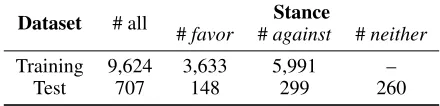
Dataset We evaluate our TARM on SemEval-2016 task 6.B dataset (Mohammad et al. 2016), the benchmark of weakly supervised stance detection task. The target of interest is “Donald Trump”. The official organizers provided 78,156 tweet-ids for constructing domain corpus. Table 1 lists the representative stance-indicative patterns we selected. After automatically annotating the domain corpus, we obtain a noisy labeled training set containing 9,624 tweets. Table 2 gives the full statistics of these datasets. Note that both the auto-labeled training set and the test set are class-imbalanced:
the number of instances withagainstlabels is almost twice
as much as that of instances withfavorlabels.
Baseline Approaches We compare TARM with the related approaches of weakly supervised stance detection task:
• pkudblab(Wei et al. 2016) The winner system of Se-mEval 2016 task 6.B is pkudblab, which adopts a convolu-tional neural network to classify stance in tweets.
• Gen-STS(Ebrahimi, Dou, and Lowd 2016a) It models the interactions among stance, target of stance and overall sentiment by an undirected graphical model.
• SVM-RB-N(Ebrahimi, Dou, and Lowd 2016b) It em-ploys Markov random fields to integrate user relationships, collectively classifying tweet stances and user stances.
Id Topic Words
T1 vote, president, need, america, people
T2 poll, republican, new, campaign, presidential
T3 mexican, mexico, people, drug, elchapo
T4 nbc, univision, fire, miss, comment
T5 illegal, immigration, immigrant, border, american
Table 3: Top-5 words in five topics extracted by BTM.
to encode the target, and then utilizes its cell states as the initial cell states of another biLSTM to encode tweets.
Further, to make full use of target information, we extend BiCond by an attention mechanism used in text entailment:
• A-BiCond (Attentive BiCond) We add word-by-word attention (Rockt¨aschel et al. 2016) into BiCond, modeling the connection between tweet and each target word.
For ablation test, we also compare TARM with its two variants, i.e., TAM and TAM−:
• TAM TAM removes the SRNet in TARM, that is,
di-rectly training TDNet on the auto-labeled data.
• TAM− Compared to TAM, it does not enrich target
content and utilizes target content alone to build model.
Model Configuration For BTM, we set the number of
top-ics toI = 5via Elbow method, and we remove both
high-and low-frequency words in the domain corpus. Table 3 lists top-5 words in five topics extracted by BTM. For TDNet, hyper-parameters are tuned by 5-fold cross-validation. We first pre-train 200 dimensional word embeddings using Skip-Gram (Mikolov et al. 2013) on the domain corpus. GRU
hidden states are also 200 dimensional, andN is set to 2.
The optimizer is Adam with 64 mini-batch size and 5e-4
learning rate. We add an`2penalty term with 1e-5 coefficient
and use dropout with 0.5 ratio after the input layer and the representation layer to relieve overfitting. For SRNet, we set
the max number of tweets in one subset toT = 128. The
update times of PPO in one episode isK = 10(see line 9
in Algorithm 1). The learning rate is 2e-5, and the discount
factor isγ= 0.9.
Evaluation Metrics The average of theF1-score forfavor
class and theF1-score foragainstclass is the official metric
of SemEval-2016 Task 6. We denoted it asFavg.
Experimental Results
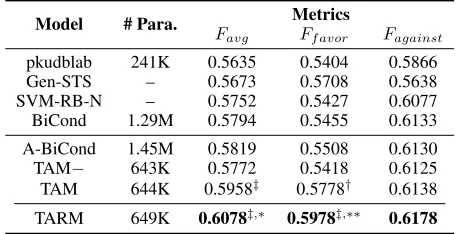
Table 4 gives the performance comparison of different ap-proaches for weakly supervised stance detection. A-BiCond achieves marginal improvement over BiCond, indicating that the semantic information carried by the target itself is limited and may not give enough clues to identify stance accurately because more sophisticated attention model also does not achieve great improvement.
Compared with TAM−and BiCond which consider
tar-get content alone, TAM incorporates topic information for learning topic-aware tweet representation and significantly
Model # Para. Metrics
Favg Ff avor Fagainst
pkudblab 241K 0.5635 0.5404 0.5866 Gen-STS – 0.5673 0.5708 0.5638 SVM-RB-N – 0.5752 0.5427 0.6077 BiCond 1.29M 0.5794 0.5455 0.6133
A-BiCond 1.45M 0.5819 0.5508 0.6130 TAM− 643K 0.5772 0.5418 0.6125 TAM 644K 0.5958‡ 0.5778† 0.6138
TARM 649K 0.6078‡,∗ 0.5978‡,∗∗ 0.6178
Table 4: Performance comparison. The column “# Para.” lists the number of trainable parameters (excluding the word em-bedding matrix) in neural models. “†” (“∗”) and “‡” (“∗∗”) mean that the results outperform BiCond (TAM) by paired t-test at the significance levels of 0.01 and 0.001, respectively.
outperforms them, especially forfavor class (over 3%
im-provement) which is the minority class in the training set. Moreover, the number of trainable parameters in TAM is com-parable with that in TAM−. Such two observations demon-strate that taking target-related topic information into account during learning tweet representation is helpful for stance de-tection and can boost performance without increasing the parameter size of neural network models.
Further, TARM introduces an RL-based revision policy to eliminate noisy instances and achieves the best performance of all three metrics. This result illustrates that TARM is su-perior to the models which are directly built on noisy stance labeled data. Next, we will give more concrete analysis of different components in TARM.
Effectiveness of Incorporating Topic Information
Although the above results show that TAM performs better
than TAM−and BiCond, we need to take a further step
for understanding the effect of topic information. Table 5 shows two tweets whose stances are wrongly predicted by
TAM−and BiCond but accurately predicted by TAM. The
overall sentiment of the first tweet isnegativebut the targeted
stance isfavor. As we can see, although this tweet mentions
the target “Donald Trump”, it stands the viewpoint through
expressing a negative attitude towards “NBC” (topicT4).
Both TAM−and BiCond confuse the targeted stance with
the overall sentiment of the tweet.
Tweet Stance
Kudos to Donald Trump for telling off NBC. The media HATES the GOP’S & will do ANYTHING to destroy them. #NBC #mediaatfault
True:favor
TAM:favor
TAM−:against
BiCond:against
Another Reagan the last thing we need! The #FatherofAmnesty rewarded 3m criminals, displaced 1.9m in workforce! @username
True:against
TAM:against
TAM−:favor
BiCond:favor
Table 5: Two examples: Only TAM predicts the stances
anotherreaganthe last thing we need !
the
<tag> FofArewardcriminaldisplace in
workforce !
(a) TAM−. Attentive vector of the target (“Donald Trump”)
anotherreaganthe last thing we need ! the
<tag> FofArewardcriminaldisplace in
workforce !
(b) TAM. Attentive vector of the topicT1
(“vote,president, ...”).
Figure 3: Visualization results of attentive vectors produced
by TAM−and TAM, respectively.
The second tweet does not explicitly express an attitude
towards the target, but it exists a span “we need”. In Figure 3,
we visualize the attentive vectors produced by TAM−and
TAM to investigate how attention mechanism captures tweet spans with the influences of the target itself and the topic “vote,president,need,america,people” (T1), respectively.
We can clearly observe that the topicT1accurately captures
the span “the last”. However, the target highlights “need !
the #FofA” and fail to identify targeted stance. Therefore, integrating topic information is effective to overcome the target-related implicit expression issue in stance detection.
Effectiveness of RL-based Revision Policy
We discuss the effectiveness of the proposed revision pol-icy for noisy labeled data from two perspectives. First, we compare off-policy optimization with the on-policy one on performance and training time cost. Second, we measure the utility of the revised dataset provided by TARM.
On-Policy vs. Off-Policy Revision Table 6 shows the com-parisons between on-policy and off-policy training strategies. The advantage of policy optimization is evident: (1) off-policy training is eight times faster than on-off-policy training in the pre-training phase, and three times faster than that in the joint training phase; (2) off-policy training also achieves higher stance detection performance. In practice, on-policy TARM needs around 100 episodes for pre-training and 15 episodes for joint training, while off-policy TARM only needs 10 episodes and 5 episodes respectively. Consequently, off-policy revision shortens the training time cost significantly and meets the need of real-world scenarios.
Optimization Method Metric Revision Time
Favg Pre-train Joint
TARM (On-policy) 0.6003 ∼60min ∼12min
TARM (Off-policy) 0.6078 ∼7min ∼4min
Table 6: Performance and training time comparisons between on-policy and off-policy optimization for TARM. Both of them are trained on a single GPU.
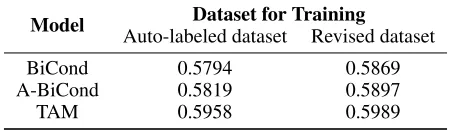
Utility of the Revised Dataset We train TAM, BiCond and A-BiCond on the revised dataset, and compare their performance with the original models trained on the noisy
Model Dataset for Training
Auto-labeled dataset Revised dataset
BiCond 0.5794 0.5869
A-BiCond 0.5819 0.5897
TAM 0.5958 0.5989
Table 7: Performance comparison between training on the
auto-labeled dataset and the revised dataset. Metric:Favg.
Noisy Labeled Tweet
I don’t believe #Donald Trump is really a racist. Probably going to profit off this BorderWall he’s proposing regardless of who wins. (Pattern: racist)
@realDonaldTrump Mr. Donald Trump only you can say, “You are fired,” to illegals. Thank you for standing with
Amer-icans. #Trump2016 (Pattern: fired)
Table 8: Two noisy labeled tweets eliminated by SRNet.
labeled dataset. As shown in Table 7, replacing the noisy labeled data by the revised data to train models can provide a performance boost, thus our RL-based revision policy can improve the quality of auto-labeled data. We also note that the performance of TAM trained on the revised dataset does not outperform TARM, which indicates that first pre-training on large-scale auto-labeled data and then jointly training is more adequate for the weakly supervised setting.
Illustration Table 8 presents two tweets eliminated from the auto-labeled dataset by SRNet during training. Using the first tweet as an example, although this tweet matches the
against-target pattern “racist”, it does not express anagainst
stance towards the target. This shows that TARM can effec-tively eliminate incorrectly labeled instances.
Conclusion
This paper focuses on two challenging issues of weakly su-pervised stance detection: target-related implicit expression issue and noisy stance labeling issue. To address them, we propose a novel topic-aware reinforced model TARM, which overcomes the first issue by integrating topic information into representation learning, and introduces an RL-based revision policy to reduce the negative impact caused by the second issue. Experimental results show that TARM outperforms existing approaches. In further work, we shall explore how to construct high-quality stance-indicative patterns automati-cally, and consider the confidence of different patterns.
Acknowledgments
References
Augenstein, I.; Rockt¨aschel, T.; Vlachos, A.; and Bontcheva, K. 2016. Stance detection with bidirectional conditional encoding. In
Proceedings of EMNLP, 876–885.
Bahdanau, D.; Cho, K.; and Bengio, Y. 2015. Neural machine translation by jointly learning to align and translate. InProceedings
of ICLR.
Benton, A., and Dredze, M. 2018. Using author embeddings to improve tweet stance classification. In Proceedings of
W-NUT@EMNLP, 184–194.
Chen, W.-F., and Ku, L.-W. 2016. UTCNN: A deep learning model of stance classification on social media text. InProceedings of
COLING, 1635–1645.
Cheng, X.; Yan, X.; Lan, Y.; and Guo, J. 2014. BTM: Topic modeling over short texts. IEEE Transactions on Knowledge &
Data Engineering (TKDE)26(12):2928–2941.
Dey, K.; Shrivastava, R.; and Kaushik, S. 2018. Topical stance detection for Twitter: A two-phase LSTM model using attention. In
Proceedings of ECIR, 529–536.
Du, J.; Xu, R.; He, Y.; and Gui, L. 2017. Stance classification with target-specific neural attention networks. InProceedings of IJCAI, 3988–3994.
Ebrahimi, J.; Dou, D.; and Lowd, D. 2016a. A joint sentiment-target-stance model for sentiment-target-stance classification in tweets. InProceedings of
COLING, 2656–2665.
Ebrahimi, J.; Dou, D.; and Lowd, D. 2016b. Weakly supervised tweet stance classification by relational bootstrapping. In
Proceed-ings of EMNLP, 1012–1017.
Feng, J.; Huang, M.; Zhao, L.; Yang, Y.; and Zhu, X. 2018. Rein-forcement learning for relation classification from noisy data. In
Proceedings of AAAI, 5779–5786.
Go, A.; Bhayani, R.; and Huang, L. 2009. Twitter sentiment classification using distant supervision. CS224N Project Report, Stanford.
Hasan, K. S., and Ng, V. 2013. Extra-linguistic constraints on stance recognition in ideological debates. InProceedings of ACL, 816–821.
Lippi, M., and Torroni, P. 2016. Argumentation mining: State of the art and emerging trends.ACM Transactions on Internet Technology
(TOIT)16(2):10.
Liu, B. 2012. Sentiment analysis and opinion mining. Synthesis
Lectures on Human Language Technologies5(1):1–167.
Ma, Y.; Peng, H.; and Cambria, E. 2018. Targeted aspect-based sentiment analysis via embedding commonsense knowledge into an attentive LSTM. InProceedings of AAAI, 5876–5883.
Mikolov, T.; Sutskever, I.; Chen, K.; Corrado, G.; and Dean, J. 2013. Distributed representations of words and phrases and their compositionality. InProceedings of NIPS, 3111–3119.
Mohammad, S.; Kiritchenko, S.; Sobhani, P.; Zhu, X.; and Cherry, C. 2016. Semeval-2016 task 6: Detecting stance in tweets. In
Proceedings of SemEval, 31–41.
Mohtarami, M.; Baly, R.; Glass, J.; Nakov, P.; M`arquez, L.; and Moschitti, A. 2018. Automatic stance detection using end-to-end memory networks. InProceedings of NAACL, 767–776.
Qin, P.; Xu, W.; and Wang, W. Y. 2018. Robust distant supervision relation extraction via deep reinforcement learning. InProceedings
of ACL, 2137–2147.
Rajadesingan, A., and Liu, H. 2014. Identifying users with opposing opinions in Twitter debates. InProceedings of SBP, 153–160.
Rockt¨aschel, T.; Grefenstette, E.; Hermann, K. M.; Koˇcisk`y, T.; and Blunsom, P. 2016. Reasoning about entailment with neural attention. InProceedings of ICLR.
Sasaki, A.; Hanawa, K.; Okazaki, N.; and Inui, K. 2018. Predicting stances from social media posts using factorization machines. In
Proceedings of COLING, 3381–3390.
Schulman, J.; Wolski, F.; Dhariwal, P.; Radford, A.; and Klimov, O. 2017. Proximal policy optimization algorithms.arXiv preprint
arXiv:1707.06347.
Seo, M.; Kembhavi, A.; Farhadi, A.; and Hajishirzi, H. 2017. Bi-directional attention flow for machine comprehension. In
Proceed-ings of ICLR.
Somasundaran, S., and Wiebe, J. 2009. Recognizing stances in online debates. InProceedings of ACL-IJCNLP, 226–234. Sun, Q.; Wang, Z.; Zhu, Q.; and Zhou, G. 2018. Stance detection with hierarchical attention network. InProceedings of COLING, 2399–2409.
Sutton, R. S.; McAllester, D. A.; Singh, S. P.; and Mansour, Y. 2000. Policy gradient methods for reinforcement learning with function approximation. InProceedings of NIPS, 1057–1063.
Takanobu, R.; Huang, M.; Zhao, Z.; Li, F.-L.; Chen, H.; Zhu, X.; and Nie, L. 2018. A weakly supervised method for topic segmentation and labeling in goal-oriented dialogues via reinforcement learning.
InProceedings of IJCAI, 4403–4410.
Thomas, M.; Pang, B.; and Lee, L. 2006. Get out the vote: De-termining support or opposition from congressional floor-debate transcripts. InProceedings of EMNLP, 327–335.
Vaswani, A.; Shazeer, N.; Parmar, N.; Uszkoreit, J.; Jones, L.; Gomez, A. N.; Kaiser, Ł.; and Polosukhin, I. 2017. Attention is all you need. InProceedings of NIPS, 5998–6008.
Wei, W.; Zhang, X.; Liu, X.; Chen, W.; and Wang, T. 2016. pkudblab at SemEval-2016 task 6: A specific convolutional neural network system for effective stance detection. InProceedings of SemEval, 384–388.
Wei, P.; Lin, J.; and Mao, W. 2018. Multi-target stance detection via a dynamic memory-augmented network. InProceedings of SIGIR, 1229–1232.
Wei, P.; Mao, W.; and Zeng, D. 2018. A target-guided neural memory model for stance detection in Twitter. InProceedings of
IJCNN, 2068–2075.
Xia, R.; Jiang, J.; and He, H. 2017. Distantly supervised lifelong learning for large-scale social media sentiment analysis. IEEE
Transactions on Affective Computing (TAC)8(4):480–491.
Xu, C.; Paris, C.; Nepal, S.; and Sparks, R. 2018. Cross-target stance classification with self-attention networks. InProceedings of ACL, 778–783.
Zarrella, G., and Marsh, A. 2016. MITRE at SemEval-2016 task 6: Transfer learning for stance detection. InProceedings of SemEval, 458–463.